Seungwook Kim @1ndependentGrad
PhD @ POSTECH, prev intern @ ByteDance Seed Joined September 2021-
Tweets2K
-
Followers63
-
Following510
-
Likes982

Umar just made a super long 19-hour video explaining distributed training from first principles (while visiting concepts like RoPE, KV Cache, MLA, etc.) I've been missing his tutorials ever since he joined Mistral, one of the best educators on YouTube. So happy he's back.


In this (extremely long) video, I'll build a distributed training framework from first principles using PyTorch. We'll derive everything from first principles, explaining the mathematics behind distributed training as well as every auxiliary component we build along the way,

KVキャッシュの考え方を視覚的に理解しやすい形でブログにしてみました。よければご覧ください! TransformerのKVキャッシュを用いたDecode処理を理解する qiita.com/kenmatsu4/item… #Qiita @Kenmatsu4より



この論文はYann LeCunのLeWorld model論文と合わせて読むと面白いと思うんだけど、あまり日本国内では話題にならなかった感じなんだろうか arxiv.org/abs/2605.27734

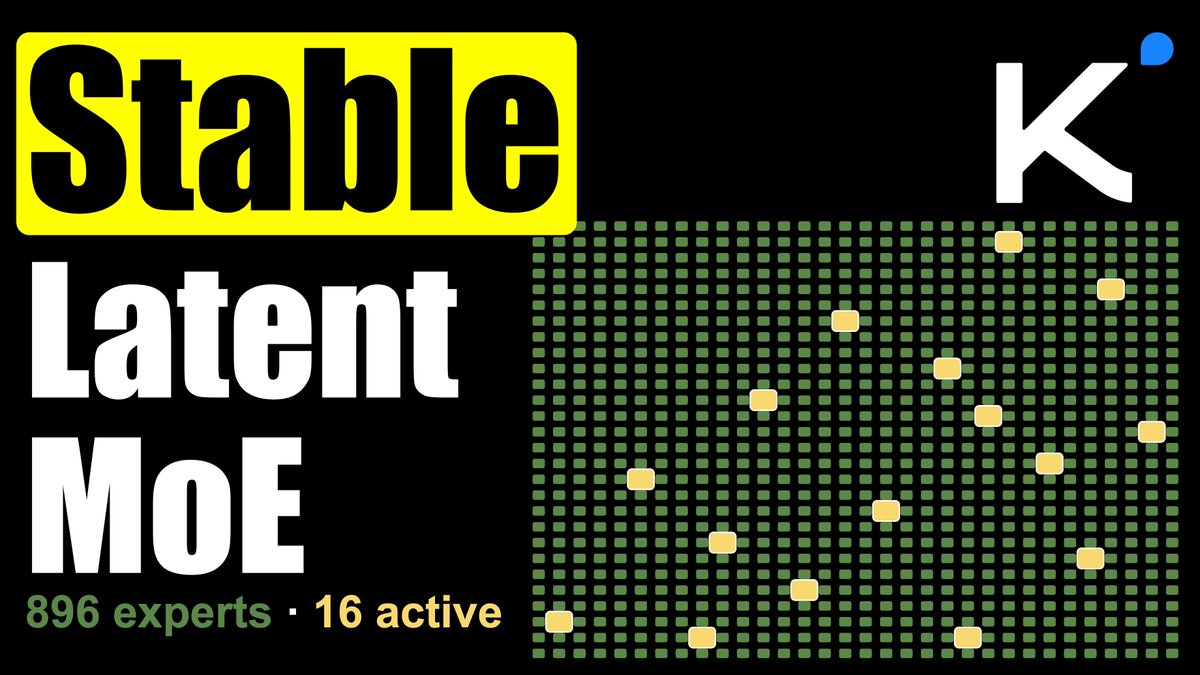
Kimi K3's MoEs should have collapsed. 🫠 But it didn't. How did they stabilize training for highly sparse MoEs? The key is Stable LatentMoE: • Normalization on the routed branch • SiTU-GLU inside each expert • Quantile Balancing on the router Learn more here: youtu.be/vXV2ltVdLMQ

Google just released a free 2-hour course on graph engineering and it's the clearest breakdown of wiring agents into a system that scales on its own. 17:44 - your first AI agent 39:30 - running agents with loops 1:12:38 - turning loops into graphs 1:34:26 - self-improving agents 1:55:05 - a complete graph that runs itself Worth more than any $700 course you'll find. Watch it, then go further with the step-by-step guide below on how to build a system that improves itself.

Ilya Sutskever 认为吃透30篇AI奠基论文,就能掌握人工智能绝大多数核心精髓。最大难点在于看得懂公式,却难以落地成代码。 开源项目 Sutskever 30 补齐了这一环:纯NumPy从零实现全部30篇经典论文,不依赖深度学习框架,Notebook 直接运行。从循环网络、Transformer 到 VAE、神经图灵机全部覆盖。 适合想要弄懂底层逻辑,拒绝只会调用API的开发者。 github.com/pageman/sutske…

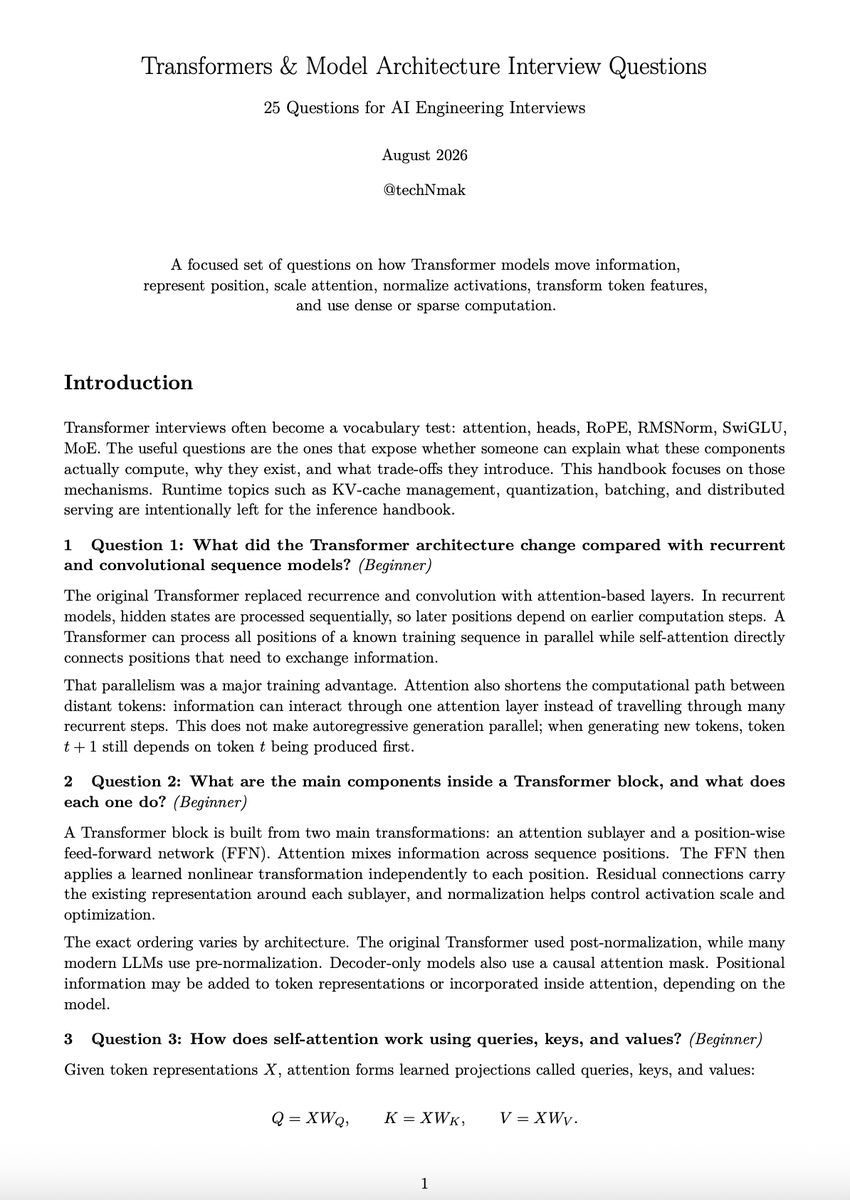
Most Transformer interview questions sound easy until someone asks you to explain what’s actually happening under the hood. > Why divide attention scores by √dk? > Why can training be parallel while autoregressive decoding can’t? > Why does GQA reduce inference cost? > What exactly is quadratic in self-attention? > Why does Pre-Norm train differently from Post-Norm? I put together 25 Transformer architecture interview questions covering the mechanics behind attention, position, normalization, and sparse computation. ➡️ Attention → What Transformers changed vs. recurrence and convolution → Q/K/V and scaled dot-product attention → Self-attention vs. cross-attention → Causal masking: parallel training vs. sequential decoding → Multi-head attention, and why individual heads resist clean interpretation → Tensor shapes: dmodel, heads, dhead, dff → MHA vs. MQA vs. GQA and the KV-cache tradeoff → What actually scales quadratically → FlashAttention and why reducing memory movement matters → Sliding-window attention and local + global attention ➡️ Position → Why attention alone has no built-in token order → Absolute vs. relative positional methods → RoPE and why queries and keys are rotated → How RoPE makes attention depend on relative displacement → ALiBi ➡️ Representations & stability → Input embeddings, LM head, and weight tying → Residual connections → RMSNorm vs. LayerNorm → Pre-Norm vs. Post-Norm ➡️ FFNs & sparse computation → What the FFN contributes beyond attention → ReLU/GELU vs. gated FFNs such as SwiGLU → Why the original Transformer used a much wider FFN hidden dimension → Sparse Mixture-of-Experts, routing, and active vs. total parameters I also added interviewer notes for 8 of the trickier questions: follow-up probes, common weak answers, and red flags. Plus a section on attention sinks and a few details that are often skipped in basic Transformer explainers. Every answer is grounded in the original papers, including work from Vaswani, Shazeer, Ainslie, Dao, Beltagy, Su, Press, Zhang, Xiong, Fedus, and Xiao.
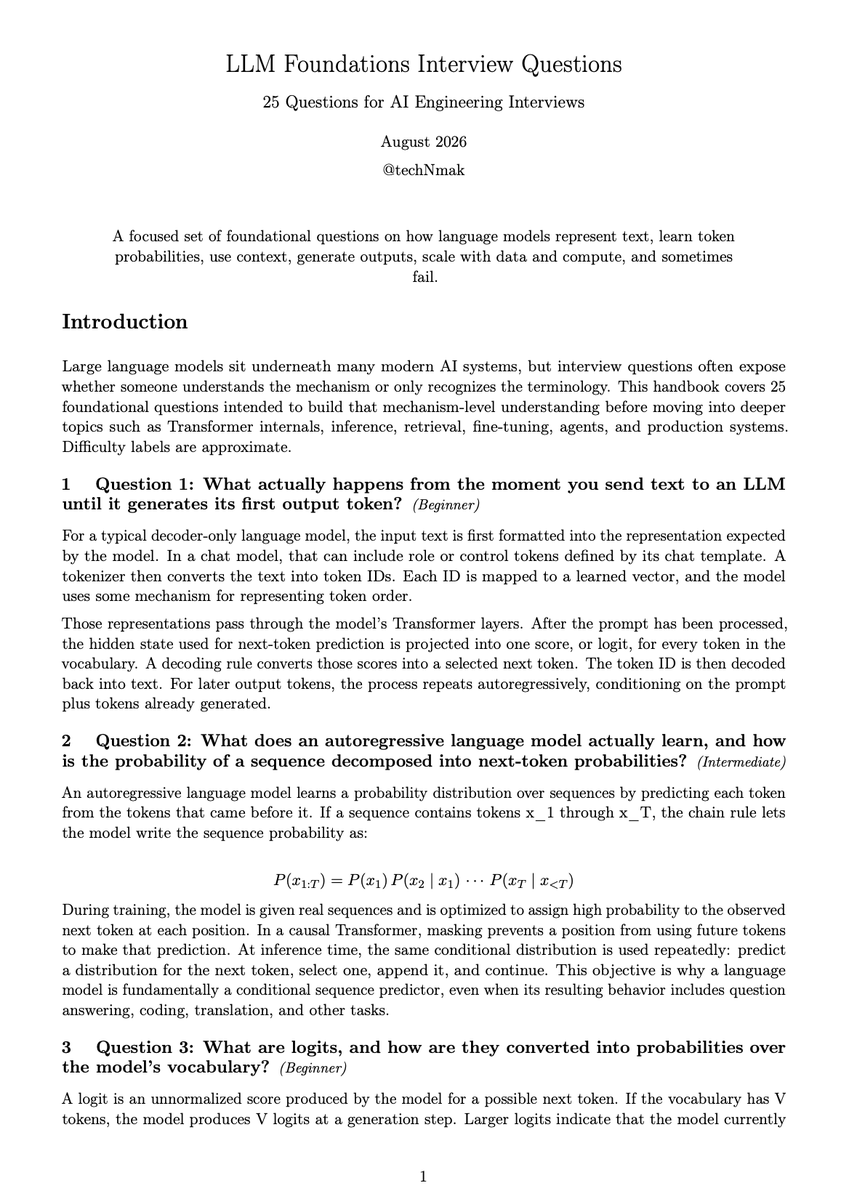
A curated list of 25 LLM foundations interview questions. What's covered Core mechanics: → What happens from input text to first output token → Autoregressive modeling and chain-rule decomposition → Logits, softmax, and how probabilities are formed Decoding & training

Keeping up with @arxiv is impossible. 500+ preprints a day across dozens of fields. @KurateOrg scores papers on 16 dimensions (impact, novelty, rigor, surprise, translational...) so you can spot what's worth reading at a glance. Sort, filter & sign up for the weekly newsletter.

Why Kimi K3 doesn’t need RoPE RoPE encodes relative position info: for any positions m and n, we need the transformations on query and key to cancel out into a relative position after doing q @ k.T Math: R(m).T @ R(n) = R(n-m) It is proven that any powers of orthogonal matrix (A^m) can be RoPE Householder matrix, a type of matrix, satisfies the requirements If you replace RoPE with Householder matrices, after 🧑🍳 hardcore math🧑🍳, DeltaNet pops out in the softmax attention formula Crazy, I know. DeltaNet literally has a Householder matrix in it though Kimi Delta Attention is a DeltaNet variant Hence, KDA can replace RoPE

vLLM runs on half a million GPUs at any given moment. Most people have never heard of it. Simon Mo, co-founder and CEO of @inferact and lead maintainer of vLLM, sits down with a16z’s Matt Bornstein and Elena Burger to discuss what it takes to actually run open models in

NVIDIA researchers did it again! They found a way to make KV cache transferable between models. The target model skips prefill entirely, and the conversion runs 2.7 to 25x faster than processing the context again. Let's understand why this is so important today. LLM APIs are stateless, so every turn sends the entire conversation back to the model. The model reads all of it again before writing a single new token, and all of it is billed as input. Prompt caching allows Anthropic and other providers to hold the KV cache for a stable prefix and bill a hit at roughly 10% of the base input rate, because the compute was already done once. The 90% reduction is one of the largest lever in LLM serving, which is why so much production work goes into keeping prefixes byte-stable. But the cache only works on the model that produced it. Keys and values are produced from that model's weights, so no other model can read them. In pratice, the constraint shows up in LLM routing. If the traffic is shifted to a different model for cost/capability reasons, the accumulated KV cache becomes invalid. As a result, the accumulated context has to be processed from scratch, and it's billed at full rate. NVIDIA's recent paper treats this as a representation problem. Prefill's only output is the KV cache, so to move KV between models, we need to convert one model's cache into the format the other expects. They first checked whether the conversion has any structure worth exploiting. They found that moving from Qwen3 14B to 32B, a plain linear regression from a single source layer reconstructed 56% of the variance in the target model's keys. The two models obviously may have different layer counts, so there is no natural one-to-one pairing between them. For each target layer they rank every source layer by how well it predicts that layer, then feed the top eight in together, which takes the reconstruction to 79%. The mapper itself has three parts: > Each target layer and head gets its own independent linear map, solved in one closed-form step rather than by gradient descent. > The cross-layer selection described above is the second part, and their ablation shows it carries the most weight of the three. > Keys also carry a position-dependent rotation from RoPE. They strip that rotation, fit the map in position-free space, then re-apply the target model's rotation at inference. Across six pairs from Qwen3, Llama 3.1 and Ministral 3, four retain 73 to 98% of the receiving model's standalone accuracy, and the conversion runs 3-25x faster than processing the context again. Prior work on cross-model KV reuse exists, but it either trains a neural adapter per pair or requires both models to be architecturally identical. This is probably the first version that is closed-form and training-free, so a lot of it is still open research. Every pair tested belongs to one family, so it works on Qwen to Qwen and Llama to Llama. Cross-family transfer is listed as future work. All six pairs mentioned above also happen to share KV head count and per-head dimension across scales. Mismatched head configurations are currently untested. The researchers scoped this to dense full-attention only, so sliding-window and attention-recurrent hybrids still need work. Here's the paper: arxiv.org/abs/2608.03893 Plenty of work is yet to be done. Still, the constraint being solved is genuine. Every model swap currently invalidates the full KV that was already paid for, and this is the first result showing that work might be recoverable without training anything extra. That said, all of this only matters because of what the KV cache is doing in the first place. I wrote a first-principles breakdown of it, covering why the model stores keys and values at all, why the cache grows with every token, and what generation speed looks like with and without it. Read it below.

Just saw that the LLMs-from-scratch repository passed 100,000 stars on GitHub! This is super cool and motivating. I am really happy to see that this open-source repo has helped so many people. Thanks also to everyone who shared ideas and opened PRs with improvements! Of course, I plan to keep adding new material, including new attention variants and architectures (while bigger projects like RL and Reasoning From Scratch live in their separate repositories). I am also currently working on a larger applied custom “small” LLM project. It has been keeping me super busy this month, but I will share more on that soon. If you are new to it, some of the highlights include 1. Of course, the complete code path from tokenization and attention to pretraining, classification, and instruction fine-tuning, etc. All of it FROM SCRATCH, of course! (RL lives in a companion repo.) 2. From-scratch implementations of Llama, Qwen, Gemma, and Olmo (smaller variants that run locally and can be plugged into the training scripts). 3. From-scratch implementations of attention alternatives and other architecture components, such as GQA, MLA, sliding-window attention, Gated DeltaNet, DeepSeek Sparse Attention, cross-layer KV sharing, and mixture-of-experts 4. Materials on KV caching, training performance, memory-efficient weight loading, DPO, evaluation, and LoRA So, if you don’t have any weekend plans yet, happy tinkering!


分享一套很适合补「现代强化学习」的开源教程:Hands-On Modern RL。 它的学习路线很完整,从 CartPole、DQN、PPO 这些经典 RL,一直讲到 RLHF、DPO、GRPO、RLVR,再往后延伸到 Agentic RL、工具调用、多轮信用分配和 VLM RL。 我比较喜欢它的一点,是「实践优先」。很多章节都配了可以直接运行的代码、训练曲线和失败案例,比如从零实现 PPO、数学推理 GRPO、Mini Deep Research Agent,以及 VLM 的 GRPO 训练。训练崩溃、Reward Hacking、KL 漂移这些实际问题也被当成正式内容来讲。 尤其 Agentic RL 部分很值得看。它把训练对象从一次回答扩展成完整 trajectory,讨论工具调用、环境反馈、多轮信用分配和异步 rollout,而这些正是 Agent 从「会回答」走向「会长期行动」之后绕不开的问题。 现在很多 RL 教程还停留在经典控制,这套资源已经把学习路线一路接到了今天的大模型后训练和 Agent 研究。 不过项目自己也提醒,目前仍在快速迭代,而且有 AI 协助生成,部分内容尚未全面审稿,阅读时最好结合论文和代码一起验证。 项目链接: github.com/walkinglabs/ha…

🚀Excited to share Qwen-3D (ECCV 2026) — a generalist 3D vision–language model that does grounding, segmentation, VQA, and spatial reasoning in one place. VLMs are great at images and short clips, but long videos bury them in tokens. Our idea: put multi-view frames into a shared 3D world, so attention scales with what’s in the scene, not how many frames you feed it. 📄arxiv.org/abs/2608.02980 🌐qwen-3d.github.io


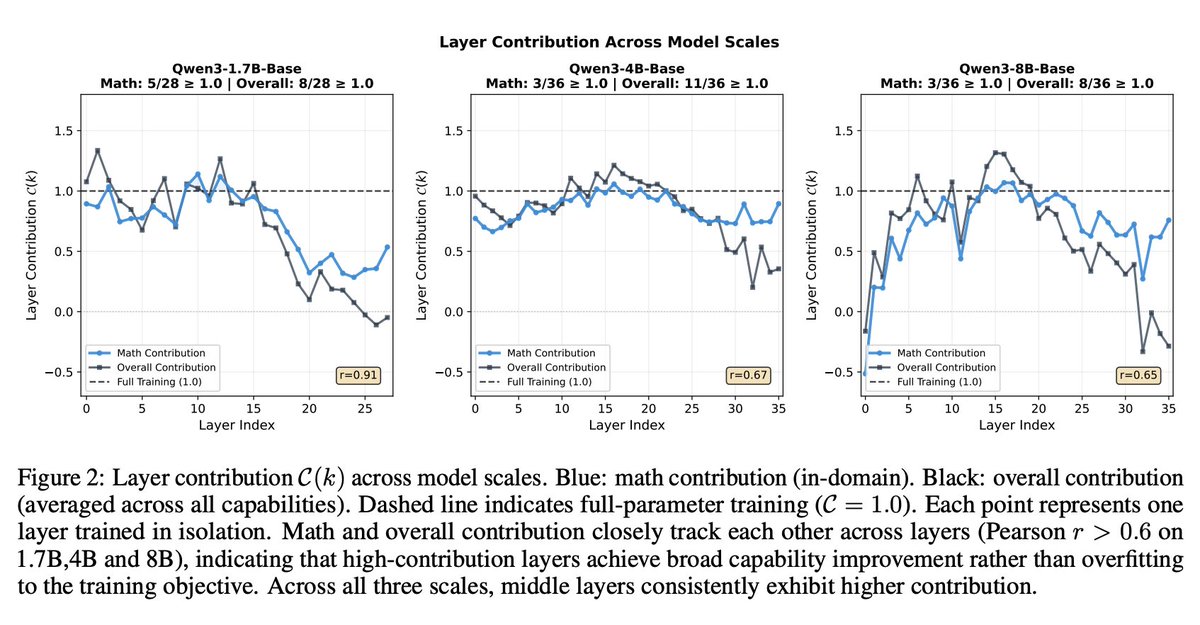
Really enjoyed this paper: “Is One Layer Enough?” A surprisingly simple finding: you may not need to update the whole LLM during RL post-training. Training just a single Transformer layer can recover most of the gains from full-parameter RL — and sometimes even outperform it. Even more interesting, the effect is highly structured: 🧠 High-contribution layers consistently concentrate around the middle 40–60% of the network 📈 The pattern holds across 7 models, 3 RL algorithms, and math/code/agentic tasks 🔄 Layer rankings remain correlated across datasets and tasks 🚀 Using this structure for layer-aware RL can outperform full-parameter training This feels like a really interesting clue about where RL actually changes an LLM — and suggests that post-training may be much more localized than we usually assume. Very nice work! arxiv.org/pdf/2607.01232


A good view at emerging theory on deep learning arxiv.org/abs/2604.21691

We live in a multimodal world. We see, talk, act, and dream. Yet most LLMs still start with language pretraining. Why not train them natively with multimodal I/O from scratch? Because it’s SUPER HARD, adding modalities triggers training instability, design complexity, and often modal competition So what’s the path forward? Introducing: Towards Physics of Multimodal Pretraining (junlinhan.github.io/projects/physi…) We unpack the underlying mechanics of multimodal pretraining across 4 aspects: Knowledge Flow, Modality Synergy, Early Unification, and Recipe.


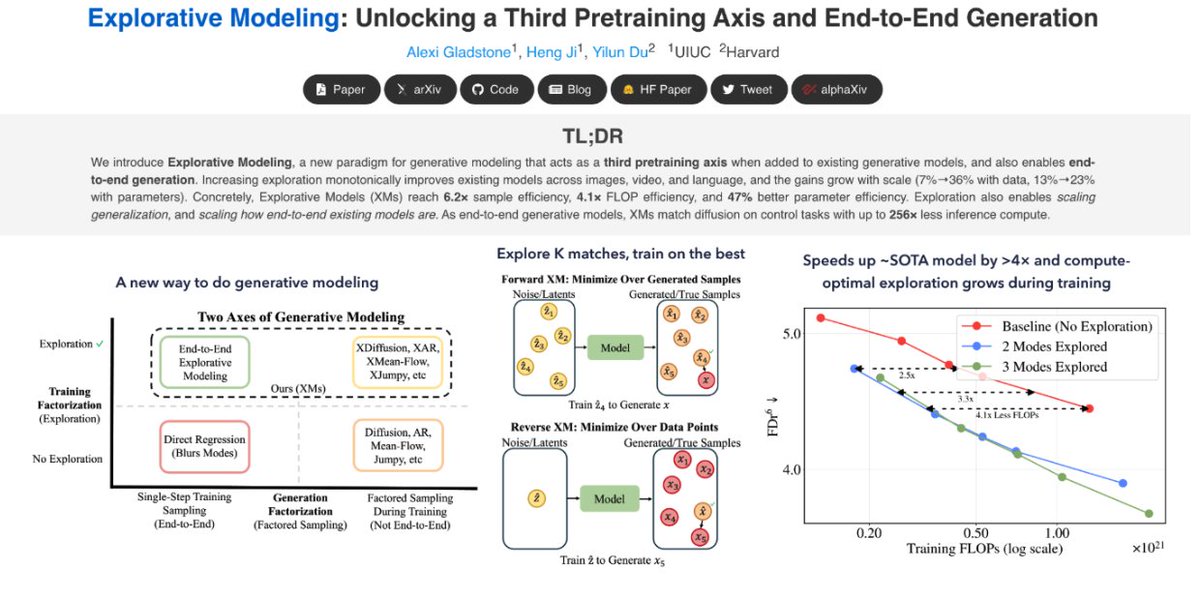
Very elegant idea! The best kind of work has the simplest pseudocode. Also ties into ideas from evolution about maintaining diversity via exploration (i.e. you want enough exploration such that at least one of your mutations is good).


We discovered a third pretraining axis beyond parameters and data: exploration. Scaling exploration monotonically improves existing models across images/video/language, and unlocks end-to-end generation. In the simplest case, it's just a for loop. Introducing Explorative
这篇普林斯顿博士论文,几乎把强化学习过去十年的两条主线串在了一起: 从博弈算法,一路走到世界模型。 作者 Zihan Ding,导师是 Chi Jin。整篇论文超过 300 页,汇集了博士期间八项研究工作,其中多项成果发表于 NeurIPS、ICML、ICLR 和 ICCV。 前半部分研究多智能体博弈:如何学习接近纳什均衡、难以被对手利用的策略,并把这些方法扩展到格斗游戏、多人博弈和真实网络负载均衡。 后半部分转向 Foundation Model 时代:扩散世界模型、生成模型策略、少步视频生成、可交互视频世界模型,以及支持长时预测的记忆机制。 这篇论文最有价值的地方是它记录了强化学习研究重心的一次迁移。 过去,RL 更关注如何在给定环境中学会行动。 现在,Agent 还需要借助生成模型建立对环境的理解,预测不同动作会带来什么未来,再据此规划和决策。 这里收录的也不只是零散的想法,而是一条经过多年研究和多篇顶会论文逐步铺开的路线。 很多论文告诉你某个方法如何提升一个指标。 这篇博士论文更像一张地图,让人看清强化学习如何从策略优化,走向对复杂世界的建模。 想系统理解 RL、世界模型和生成式 AI 之间的关系,这篇很值得完整读一遍。 📎 arxiv: arxiv.org/abs/2607.17560

あっー! 神神神神神神 Qwen 3あたりで知識止まってたので本当にありがとう!! マジで!!!ありがとうすぎる!!!!!! みんなも、読めよな


WAIT... WHAT!! Anthropic burned $3 million and 30 months running AI agents against real tasks in real companies and published everything in 12 pages and the people who read those 12 pages this week are going to make decisions about how they build and work that are fundamentally different from the people who scroll past it thinking they already understand what AI can do. 1,287 real tasks. 2.4 million lines of code. AI outperforming humans on their own projects. 63% of routine work automated. Engineer output multiplied three times with the right memory and the right cycles. Someone paid $3 million so you could read that for free and most people are going to bookmark it and never open it again which is the most expensive free resource in the history of AI research. But here is the gap that the 12 pages do not close. Knowing that the right system multiplies output three times and knowing how to build that system are two completely different things and the second one is where everyone gets stuck and stays stuck while the people who figured it out quietly operate at a different level. My article is the bridge between the $3 million research and the actual system build and it is the thing you read immediately after you bookmark those 12 pages. Do not let this be another thing you meant to act on. Full guide below.


Liming Jiang @SoraEndless
929 Followers 548 Following Research Lead, Generative Foundation Models @ Cantina. Ex. Staff Research Scientist (Tech Lead) @ ByteDance / TikTok, USA. Ph.D. @ MMLab@NTU.
Matiur Rahman Minar @minar09
12 Followers 478 Following PhD Student at Sogang University. #ComputerVision
Junho Cho (Jacey) @junh0ch0
81 Followers 375 Following Bridging AI research & strategy @RLWRLD_ai | ex-Samsung | PhD SNU, KAIST alum
Jacinta @Iecriumir24909
223 Followers 7K Following Beauty begins the moment you decide to be yourself. — Coco Chanel
Razza Islam Official @RazzaIslam
54 Followers 2K Following International Activist, Researcher, Author. Doctor, Founder of Intellectual Power & Peace Pads, Follower of Farrakhan✊🏾
Andrew Davison @AjdDavison
21K Followers 3K Following From SLAM to Spatial AI; Professor of Robot Vision, Imperial College London; Director of the Dyson Robotics Lab; Co-Founder of Slamcore. FREng, FRS.


Ihasur @Ihasur7892140
37 Followers 1K Following
Bridgette Grant @BGrant35580
147 Followers 5K Following
북구 미래 하정�... @JungWooHa2
11K Followers 3K Following 전) 청와대 AI미래기획수석비서관 전) 네이버클라우드 AI 혁신 센터장 한국공학한림원 정회원 Ex) Sr. Secretary to the President for AI & Future Planning, #Korea
Seautree @SeautreeDct
9 Followers 252 Following
Hyungjin Chung @hyungjin_chung
1K Followers 668 Following Lead AI Research Scientist @ EverEx | Ph.D. @KAISTpr | Prev- @NVIDIA @GoogleAI @ LANL | Diffusion models for inverse problems
Yağız Nalçakan @yagiz_nalcakan
282 Followers 508 Following Postdoc in Seamless Transportation Lab at Yonsei University | prev. @SeoulNatlUni, @iyteedutr, @iu_cerrahpasa | working on #Perception of #AutonomousDriving
Jonathon Luiten @JonathonLuiten
4K Followers 3K Following Head of Volumetric 3D Video at Meta Prev Projects: Hyperscape, MapAnything, Dynamic 3D Gaussian Splatting, SplaTAM, HOTA +more Prev PhD at RWTH + CMU + Oxford
Xin Kong @XinKong_IC
2K Followers 3K Following Research Scientist @NVIDIAAI Cosmos Lab, PhD @imperialcollege | ex @Meta @Google | World Model, GenAI, 3DV, Robotics
Joonghyuk Shin @jhshin2000
161 Followers 261 Following Hi, I'm a PhD Student from Seoul National University.
Nando Metzger @NandoMetzger
702 Followers 750 Following CV Researcher @AthlenceSports | PhD from @ETH_en | Ex Student Researcher @GoogleAI | Ex Intern @Meta
Qihang Yu @yucornetto1
236 Followers 246 Following Research Scientist @amazon FAR. Prev: RS @tiktok_us PhD @JHUCompSci, BS @PKU1898, Intern @GoogleAI @Adobe @NVIDIAAI


Jonathan Lorraine @jonLorraine9
7K Followers 8K Following Research scientist @NVIDIA, Agentic AI for Science & Engineering in the LPR
TamalaBoxwell @TBoxwell87676
44 Followers 2K Following
Junyoung Seo @jyseo_cv
783 Followers 572 Following Ph.D. Student @kaist_ai, working on video world models. RS Intern @nvidia Ex-Intern @meta, @sonyAI_global. Collaborated with NAVER AI
Allan Zhou @AllanZhou17
2K Followers 776 Following Post-training @openai | Prev: Robotics, world models @GoogleDeepMind, PhD @Stanford
Seung Wook Kim @seungkim0123
1K Followers 296 Following Senior Research Scientist at Nvidia Toronto AI Lab
Hide @HideMatsu82
788 Followers 385 Following GenXR @Google; Ph.D. at Imperial College London w/ @AjdDavison; https://t.co/98MSwPifTl
Dong Carlo An @andongverse
34 Followers 152 Following Research Scientist at Institute of Foundation Models, MBZUAI
Huan Ling @HuanLing6
2K Followers 170 Following Working on a Startup. Ex- NVIDIA Senior Research Scientist / UofT. I am recruiting
Abhijay @abhijay_9
115 Followers 576 Following Ph.D. Student | Computer Vision | Portland State University
Chrisy @variint
2K Followers 2K Following More active on substack: https://t.co/kGXGBOQSys | interpretability of modular cnns for retinal disease understanding 🦒💕
Huazhe Harry Xu @HarryXu12
6K Followers 986 Following Hi, I like reinforcement learning, robots, and video games:) I am an amateur pianist. Assistant Prof at Tsinghua; Postdoc at Stanford; Ph.D. at Berkeley
Dr. Safdar Ali @DrSafdarAli11
44 Followers 95 Following
Khoa Tuan Nguyen @Khoa_NguyenTuan
908 Followers 7K Following Enjoy learning new things. PhD student at Ghent University Global Campus in Korea.

Sai Mitheran Jagadesh... @smj007_
12 Followers 49 Following Machine Learning @LatentAI | Grad @CarnegieMellon | Undergrad at NIT Trichy (Gold Medalist) || Spent time @AirLabCMU, @CyLab, @NUSingapore, MPI-INF
Minguk_Kang @minguk_kang
724 Followers 1K Following Founding Research Scientist @pika_labs, PhD at POSTECH, First Author of GigaGAN | Built PikaStream1.0
Ednner @EdnnerV
481 Followers 2K Following Msc. Ciencias Biomedicas (Microbiología) virus, antivirales, bacteriofagos.
Chaminda Bandara @wgcban
163 Followers 694 Following Research scientist @apple. Multimodal LLMs and Agents

Jiteng Mu @JitengMu
766 Followers 606 Following @Adobe Firefly. Ph.D. @UCSD ; M.S. @JohnsHopkins ; Intern @Nvidia @Adobe
Sant Ram @ram56331597
2K Followers 4K Following https://t.co/cCM020AjPw from M.D. University, Rohtak in 1992
PRAMOD KUMAR @PRAMODK82015218
2 Followers 123 Following
Mediworldd @Mediworldd
554 Followers 2K Following Enter into the world of medicine and know your body more closely.


JESUBORI OLUSANYA @OlusanyaJDanie3
289 Followers 4K Following B.Agric || Public Health Researcher || Environmental Health || Food safety and security. Open to Graduate school offers. Regenerative agriculture advocate.
Silvia Angela Mansi @SilviaMansi1
557 Followers 2K Following Biomedical Ph.D Student Biomedical signals analysis in the field of indoor Thermal comfort and wellbeing in buildings https://t.co/XRNKXlm3sV…
Liming Jiang @SoraEndless
929 Followers 548 Following Research Lead, Generative Foundation Models @ Cantina. Ex. Staff Research Scientist (Tech Lead) @ ByteDance / TikTok, USA. Ph.D. @ MMLab@NTU.

Hyunwoo Kim @hyunw_kim
3K Followers 773 Following Cognition/Reasoning/Social + AI @NVIDIA | @KAIST_AI
Google Research @GoogleResearch
105K Followers 17 Following Impossible? Let’s see. From algorithms to neuroscience to AI, Google Research strives to progress science, advance society & improve billions of people’s lives.
himanshu @retr0jirachi
3K Followers 3K Following wannabe polymath | prev world models @lossfunk dms open for interesting roles in ml
Ke Li 🍁 @KL_Div
7K Followers 481 Following Assistant Professor and Canada CIFAR AI Chair @SFU @AmiiThinks. Ph.D. from @Berkeley_EECS and Bachelor's from @UofTCompSci. Formerly @GoogleAI and @the_IAS.
Quentin Lhoest 🤗 @lhoestq
5K Followers 333 Following Datasets @huggingface | Open Source + HF Dataset Hub
Embodied AI Reading N... @EmbodiedAIRead
3K Followers 1 Following Sharing daily personal notes on selected interesting Embodied AI papers, blogs and talks | Maintained by @yilun_chen_ | Opinions are my own.
Chris Barber @chrisbarber
14K Followers 1K Following Data, compute. I read DMs. RL & data startup list: https://t.co/hceNvJcdqG Highlights: https://t.co/EgqEFGtwaR

Jacob Bamberger @jacobbamb
488 Followers 754 Following Looking for geometry where it shouldn’t be. PhD student @UniofOxford. Interested in Geometric Deep Learning
Felix Juefei Xu @felixudr
2K Followers 7K Following Research Scientist @GoogleDeepMind, Gemini Omni | Prev. @Meta Superintelligence Labs | PhD @CarnegieMellon | Views are my own | "Physical AGI through video!"
Xun Huang @xxunhuang
6K Followers 583 Following Technical Director @Roblox. Founder of Morpheus AI (acquired by @Roblox). ex-Adobe/CMU/NVIDIA/Cornell. Video world models.
Discrete Diffusion Re... @diffusion_llms
2K Followers 0 Following 📚 Journal club on discrete diffusion models 🎥 Replays available on YouTube! Contact: [email protected] Hosted by @ssahoo_, @jdeschena, @zhihanyang_
Akshay 🚀 @akshay_pachaar
285K Followers 496 Following Simplifying LLMs, AI Agents, RAG, and Machine Learning for you! • Co-founder @dailydoseofds_• BITS Pilani • 3 Patents • ex-AI Engineer @ LightningAI
Andrii Zadaianchuk �... @ZadaianchukML
516 Followers 463 Following Postdoc UvA, PhD @ETH Zürich and @MPI_IS, ex-intern in @AmazonScience. Structured representation learning for and by autonomous agents. 🦋 @zadaianchuk

Unsloth AI @UnslothAI
93K Followers 475 Following Run and train models locally with the Unsloth Desktop app. 🦥 https://t.co/2kXqhhvdCD
Shiqi Chen @shiqi_chen17
815 Followers 355 Following Incoming Postdoc @UniofOxford. PhD student @CityUHongKong. NLPer. Visiting PhD @OxCSML @NorthwesternU and @HKUST. Former @SeaAIL.
북구 미래 하정�... @JungWooHa2
11K Followers 3K Following 전) 청와대 AI미래기획수석비서관 전) 네이버클라우드 AI 혁신 센터장 한국공학한림원 정회원 Ex) Sr. Secretary to the President for AI & Future Planning, #Korea
Starlink @Starlink
1.7M Followers 31 Following Fast, affordable internet available all around the world. Engineered by @SpaceX
cocktail peanut @cocktailpeanut
34K Followers 31 Following Creator https://t.co/Wgwpl7lJ4I, run AI apps on your local PC, for free.
Asli Celikyilmaz @real_asli
3K Followers 1K Following Sr. Director of Research @ms_aifrontiers @MSFTResearch & Affl Faculty @uwcse | IEEE Fellow | TACL editor-in-chief | Prev: FAIR @MetaAI @MSFTResearch @UCBerkeley
World Labs @theworldlabs
73K Followers 49 Following World Labs is a spatial intelligence company, building frontier models that can perceive, generate, and interact with the 3D world.
Junyoung Seo @jyseo_cv
783 Followers 572 Following Ph.D. Student @kaist_ai, working on video world models. RS Intern @nvidia Ex-Intern @meta, @sonyAI_global. Collaborated with NAVER AI
Suhail @Suhail
439K Followers 675 Following Starting something new. Past: CEO & Founder @mixpanel Pizzatarian, engineer, music maker
Austen Allred @Austen
480K Followers 2K Following CEO https://t.co/m6TigM4CJT: Free AI training for the smartest engineers. Will tweet as I wish and suffer the consequences. Accelerando: @kellyclaudeai
Olivia Moore @omooretweets
146K Followers 936 Following Partner @a16z and twin to @venturetwins | Investor in @gammaapp, @happyrobot, @krea_ai, @tomaauto, @partiful, Salient, @scribenoteinc, @lassieai, @meetarc
Rowan Cheung @rowancheung
596K Followers 569 Following Founder of the world’s most read daily AI newsletter @therundownai. Sharing the latest developments in the world of artificial intelligence.
Gradio @Gradio
57K Followers 12 Following Build and share machine learning apps in 3 lines of Python. Part of the @Huggingface family 🤗. DMs are open for sharing your gradio app with us for promotion!
Quant Science @quantscience_
123K Followers 14 Following Develop profitable trading strategies, build a systematic trading process, and trade your ideas with Python—even if you’ve never done it before.
Armen Aghajanyan @ArmenAgha
16K Followers 308 Following Co-founder & CEO @perceptroninc; ex-RS FAIR/MSFT
Hyungjin Chung @hyungjin_chung
1K Followers 668 Following Lead AI Research Scientist @ EverEx | Ph.D. @KAISTpr | Prev- @NVIDIA @GoogleAI @ LANL | Diffusion models for inverse problems
Happy Researchers @hapyresearchers
64K Followers 1 Following Let us share our academic experiences, promote good mental health, and help each other. Run by @hgupta84 Instagram: @hapyresearchers
Yue Wang @yuewang314
8K Followers 1K Following Assistant Professor @ USC CS. Previous: EECS PhD @ MIT CSAIL. Opinions are mine.
Yuandong Tian @tydsh
47K Followers 950 Following Co-founder of @Recursive_SI. ex-Meta FAIR Director. ex-Google. Reasoning, Optimization and Understanding LLM. Novelist in spare time. PhD in @CMU_Robotics.
The School of Hard Kn... @hardknocksedu
36K Followers 68 Following 🎓The University for Everyone🎓| Motivation | Finance | Entrepreneurship | Lifestyle | 22 Million Followers Social-Wide | Subscribe to our newsletter👇
Zeyuan Allen-Zhu, Sc.... @ZeyuanAllenZhu
26K Followers 570 Following physics of language models @ Meta (FAIR at MSL, not GenAI or TBD) 🎓:Tsinghua Physics — MIT CSAIL — Princeton/IAS 🏅:IOI x 2 — ICPC — USACO — Codejam — math MCM
Talking Papers Podcas... @talking_papers
702 Followers 36 Following A Podcast by researchers for researchers. We host early career academics to share their cutting edge research in #CV #ML #AI. Hosted by @sitzikbs.
Yuliang Xiu @yuliangxiu
9K Followers 5K Following Assistant Professor @Westlake_Uni, Ph.D. @MPI_IS, previously @USC_ICT. Focusing on democratizing human digitization. Intern @RealityLabs @Ubisoft

Weikang Wan @weikang_wan
577 Followers 1K Following CS PhD at @UCSanDiego Research Intern @NVIDIAAI | undergrad @PKU1898 | Embodied AI, Robotics
Siyuan Huang @siyuanhuang95
5K Followers 421 Following Research Scientist at BIGAI, Director of Center for Embodied AI and Robotics. Ph.D. in Statistics from @UCLA. Former intern at @DeepMind and @MetaAI.
Jack Langerman (in sf... @jacklangerman
741 Followers 328 Following
Songwei Ge @Songwei_Ge
542 Followers 269 Following training models @Reve | previously @berkeley_ai @nvidia @umdcs

Leonard Bruns @leonard_bruns
241 Followers 294 Following I like computer vision, robotics, and computer graphics; Computer Vision Researcher at @nianticspatial
Georgios Pavlakos @geopavlakos
2K Followers 309 Following Assistant Professor at UT Austin @UTCompSci | Working on Computer Vision and Machine LearningYou might like