2λ @2lambda21
Joined September 2017-
Tweets357
-
Followers7
-
Following241
-
Likes9K

Terence Tao, UCLA mathematics professor and Fields Medallist, on why AI may be succeeding at science while scientists get worse at it: Tao starts by naming the tension directly: "There is this paradox that on the one hand AIs are becoming more powerful and more capable and making fewer mistakes, and they are ostensibly achieving a lot of the goals that we think scientists are trying to do. They're running experiments. They're analyzing data. They're writing papers." Experiments run, data analyzed, papers written — the exact outputs any university or funding body would cite as proof that science is working. Tao's concern is what those outputs stop telling you: "It may be that it comes at the cost of the AI picks up some skill but no human scientist gets any better at doing the science." The skill still accumulates, just in the wrong place. The system gets more capable while the people operating it stand still, because the work that used to build a researcher is now the work being handed off. And the cost shows up in the one thing scientists are supposed to be able to do: "No human can communicate exactly what just happened and why. This scientific discovery is interesting, why this proof is new and what features it has and how it connects." That final clause is the sharp end of it. Tao is describing a result nobody can place — a proof that arrives with no one able to say what makes it new, how it's built, or how it connects to the rest of the field. Understanding is a separate achievement from getting the answer, and it can quietly disappear while the answers keep arriving on schedule. Which is why he thinks the target itself needs re-examining: "We may have to sort of redesign our conception of what science is and what we actually want out of science. What exactly is science for and what are we trying to do? And is there a danger that we are optimizing the wrong thing when we are pointing our AI tools at science?"

Ptm que animal noble es el cuervo, hablan, tienen buena skin, ragebaitearon a Edgal Alan Poe, todo bien

Estos cuervos querían llevar a su humano hasta su árbol favorito y, como él no podía volar, fueron caminando con él. Cada pocos pasos se giraban para comprobar que seguía detrás. 🐦⬛

One second-order equation determines the straightest curves a manifold will admit: d²xᵏ/dt² + Γᵏᵢⱼ(x) (dxⁱ/dt)(dxʲ/dt) = 0. Riemann supplied the metric that generates those symbols in 1854; Christoffel isolated the connection coefficients fifteen years later. The extra terms, built from the Christoffel symbols of the metric, cancel the fictitious accelerations that the coordinates themselves produce, so the left-hand side is the covariant acceleration and vanishes. The resulting curves are the geodesics - great circles on the sphere, meridians, the world-lines of freely falling particles.


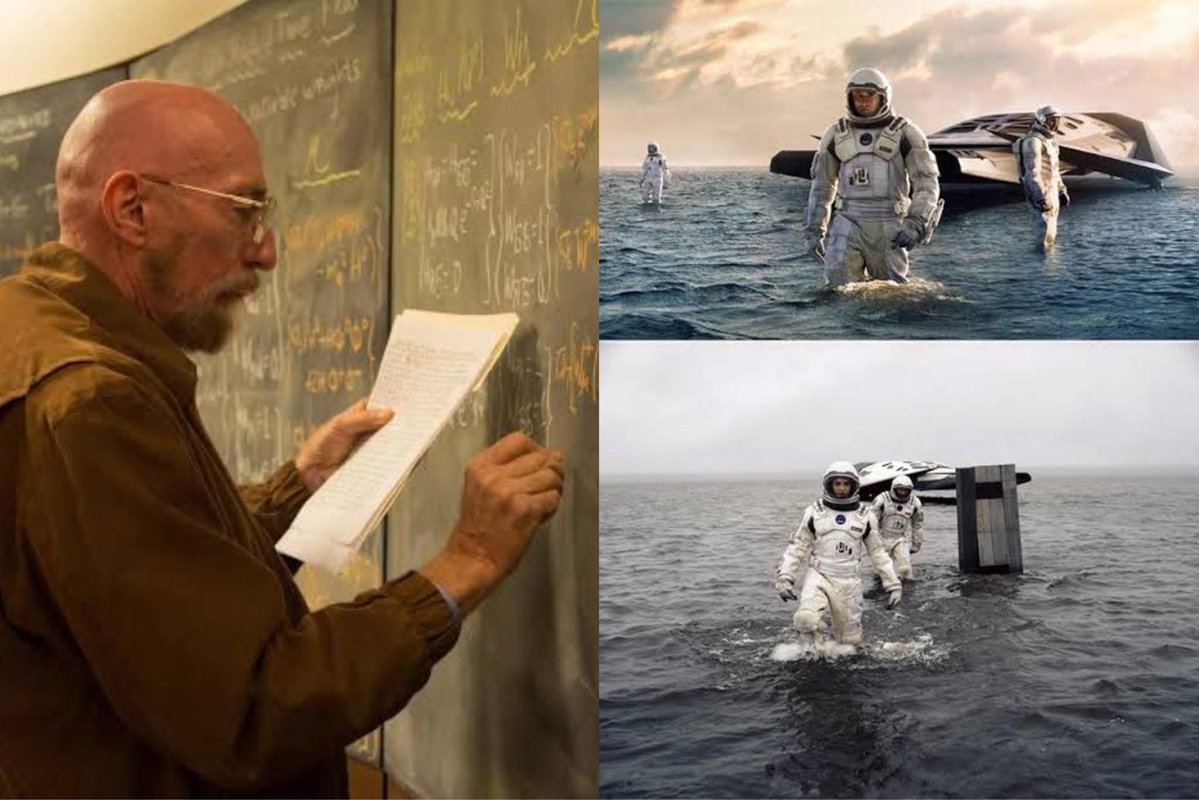
“Cuando Nolan me dijo que quería que una hora en el planeta Miller fuera equivalente a siete años en la nave, mi reacción fue inmediata: eso es imposible, el planeta caería en el agujero negro. Pero él, como buen director con visión, respondió: haz los cálculos de verdad. Y tenía razón. Usé matemáticas, me sumergí en fórmulas complejas… y descubrí que, si el agujero negro gira casi al máximo permitido por la física, la relatividad sí permite una dilatación temporal tan extrema. Increíblemente, ese planeta podía existir. Al borde del colapso, pero posible. El cine pedía una locura… y la física, si se le exigía con rigor, la entregaba.” “Y la famosa escena final no es sólo poesía visual. Cooper no flota mágicamente: está dentro de una estructura construida por una civilización superior, un tesseracto —una nave en forma de cubo de cuatro dimensiones espaciales— que viaja por dimensiones más allá de nuestro universo. Gracias a eso, logra volver a la Tierra sin romper las leyes físicas. Todo eso está detallado en mi libro. De hecho, fue un acuerdo con Nolan: el que quiera entender la película de verdad… va a tener que leerlo. Y esa fue mi manera de asegurarme que el cine, la ciencia y la curiosidad convivieran en una sola historia.” Kip Thorne, astrofísico ganador del Nobel y asesor científico de Interstellar.

Así se grabó Amores Perros.



Place a ball on a saddle it falls, spin the saddle it stays…a ball is trapped in a time-varying quadrupole gravitational potential

i love this fucking movie man

tentando arrumar meu horário de sono, mas o mundo fica tão bom e silencioso entre 00:00 e 5 da manhã

Growing up hearing “Wikipedia isn't a valid source” and then entering a workplace where people say “just ask ChatGPT” is a surprisingly strange timeline

Jude Bellingham consoles 17-year-old Gilberto Mora and they exchange jerseys. ❤️🩹

Johannes Kepler discovered that planets move around the Sun in elliptical orbits, not perfect circles. r = ℓ² / [m²μ(1 + e cos θ)] This relation gives the distance of a planet from the Sun at any point in its orbit and became one of the foundations of celestial mechanics.


Electromagnetic Waves (Circular Polarization)

If this doesn’t give you goosebumps you’re not a physicist




Un abrazo fortalece la salud física y emocional: libera oxitocina, reduce el estrés y contribuye al bienestar integral. Infografía de @UniversumMuseo 👇.

Eclipse total de Luna visto desde Puebla. 📸 Arturo Rentería Lartundo, del Instituto de Astronomía - CU - UNAM.



😢 ¿Una lloradita puede equivaler a correr varios kilómetros? Infografía de @UniversumMuseo. ⬇️
#UnDíaComoHoy se celebra el Día Internacional del Gato 🐱… ¡Prrrr! Para que tu michi siga ronroneando, te compartimos una nota de @unamglobal con recomendaciones sobre sus cuidados. ¿Y tú nos compartirías una foto de tu minino o minina 📸? > bit.ly/46V6gBi


Chocolett @chocolettchoo


Sarah @SofiaGLopez
687 Followers 4K Following ☘️Loves life loves adventures likes to record beautiful moments with a camera📷 and occasionally indulges in books 📚and coffee ☕️
Mundo de Músicas @MusicasMundo
3K Followers 4K Following Reviews · Entrevistas · Streaming · Home Studio · Plugins VST · Aulas · Lojas · Concertos ·

Thomas Kelly @ThomasK67259912
72 Followers 2K Following suri ✦ 23 ✦ they/them ✦ multi-fandom ✦ RT heavy

El De Detras Del Seto @ElDelSeto
3K Followers 3K Following Retarder, manco por nacimiento, e idiota, en resumen.. Streamer!
Armando Araiza @armandoaraiza
410K Followers 342K Following Actor | Fundador & Productor de REARMANDO Historias de marca • Turismo • Lifestyle • Bienestar +1.3M comunidad 🌍
CAMegalópolis @CAMegalopolis
593K Followers 350 Following Cuenta Oficial | Comisión Ambiental de la Megalópolis (#CAMe) integrada por los Gobiernos de #CDMX, #EdoMex, #Hidalgo, #Morelos, #Puebla, #Querétaro y #Tlaxcala
Gerardo L. Munck @GerardoMunck
55K Followers 1K Following Professor, political scientist, Latin Americanist, at USC. Tweets in English and Spanish.
Hades @gmuhvo
11K Followers 49 Following I 🖤 cosplay, games, spiders, and cinnamoroll :3 and I stream on twitch lol.
El Economista @eleconomista
1.0M Followers 107 Following Somos el diario económico, financiero y de negocios de México, fundado en 1988. Hablamos con los profesionales.
IlyaO @FLCm0NESY
378K Followers 745 Following Professional CS2 player for @FalconsEsport https://t.co/NQDx6L44gz https://t.co/resY2JzpfT
Veritasium @veritasium
509K Followers 547 Following An element of truth - videos about science, education, and interesting things. https://t.co/pZUf3POBEr
Dan Madesclaire @Vitality_apEX
361K Followers 797 Following Captain for @TeamVitalityCS 🐝 ⭐ 4-Time Major Champion 👑 Most Decorated CS Player of All Time (42x🏆) @Oakley @ZOWIE_EU Ambassador
Quenelra @Quenelra
14K Followers 357 Following ⚠️ME BURLO DE TODO LO QUE ES POSIBLE⚠️ 💻 Edito "La pensión" así chistoso 😂🤙 hago vfx para películas y hago chistes de todo. ⚽ Amo el fútbol y a THE WEEKND


karrigan @karriganCSGO
596K Followers 535 Following Professional CS2 player for @FalconsEsport - MSc in BA and Auditing. Business enquiries: [email protected]
Kat @Kat_csgo
10K Followers 268 Following 🇸🇰 Professional CS2 player 8x World Champion Faceit adventures at https://t.co/i0dp91pxrB


RHADS @rhads001
25K Followers 487 Following Digital artist and musician: https://t.co/b1uhpLi1lg OPEN TO WORK: [email protected] 🔸https://t.co/4b0ceev6Gs 🔸https://t.co/x04HQu21tl

broky @broky
192K Followers 254 Following Professional CS2 player for @FaZeEsports business inquiries: [email protected]
Coffee Break: Señal ... @pcoffeebreak
27K Followers 264 Following Tu pódcast. La tertulia semanal sobre la actualidad científica. Nos leemos los "papers" para que vd. no tenga que hacerlo. Disponible en todas las plataformas.

michelle L @dearwhittacker
4K Followers 345 Following freelance illustrator • fantasy, plants, birds, sometimes things that sorta look like birds
Reza Afshar @rezaafsharr
166K Followers 1K Following Concept artist and illustrator Prints : https://t.co/O58Jfr3MF8
Biología Desde Cero @BiologiaDesde0
122K Followers 128 Following 🌳| Biología explicada de manera sencilla y entretenida 🦠🕷🦗🐞🪲🕸🐛🪱🦋🐌🐙🌼🌻 Algunos nos conocen como: El canal más serio de Biología
MathMatize Memes @MathMatize
46K Followers 285 Following Started from the axioms now we're here. Original memes
yuurih @yuurih
141K Followers 917 Following Professional CSGO player for @furia 📺 @twitchbr - https://t.co/Cht3lLB8hK
Mehdi Sadaghdar @ElectroBOOMGuy
160K Followers 142 Following Building and fixing and destruction, that's my middle names! https://t.co/TeRNzcmId5
たいやき/Taiyaki @tai2m
85K Followers 442 Following Qe •concept art •creature design ✉️→[email protected](諸事情により返信できません。)
takase@Cosplay @Takase0615
63 Followers 120 Following 恋と深空𓊆レイ先生𓊇Love·͜·ᰔᩚ 晩年金欠レイヤーなのでイベント参加率低め🫥 関西圏で主に活動してます·͜·✌︎ 加工強めなので苦手な方は自衛してね✋

Ramona Azween @RamonaAzween
4K Followers 974 Following Morning! I don't think we've met before, I'm GFi# from 🇲🇾 Singer/Song writer/Professional Gamer.

RIFU☢️ @RIFU_hata
103K Followers 292 Following Digital OCs artist and writer/ SAI2 https://t.co/VvjPrIC3L1 ▄︻̿┻̿═━一*:゚✧ ✧゚・: * lizardfan 🦎no 🅰ℹ️ | Contact - [email protected]

Pol Turrents @polispol
1.6M Followers 4K Following Director de fotografía & Streamer. 🎥 Cine,publi,videoclips y tv ✉️ Work: [email protected] 🎦 https://t.co/2j0ktjKBiX 📸 https://t.co/PODaBuhquE

koto. @koto_chan444
32K Followers 3K Following 心の豊かさを忘れずに居るための絵🏝🇯🇵 / ※本業多忙につきコメント・DMへのお返事がなかなか出来ておりません…、皆様いつもありがとうございます🐈
たけぞえ かな�... @ozg1224
7K Followers 272 Following 心のやわらかいところに触れられるような絵を描いています。透明水彩/展示・装画など。 ▶︎二人展11月名古屋【無断著作物利用禁止・AI学習禁止】BOOTH▶︎https://t.co/OuoKk0dVoB
西游朽 @xiuxiukong
254K Followers 309 Following 📷photographer/ins:xiuxiukong 小红书:西游朽/xiuxiukong [email protected]
King's fool @im_kings_fool
3K Followers 137 Following Hago ilustraciones y cómics! Comisiones abiertas IG: @im_kings_fool
TAO🌷塗り絵本�... @tao15102
111K Followers 7K Following 絵を描いてます|📙主な書籍『ごちゃごちゃした絵の描き方』『TAOの空想ホテル』『ノラ猫しろの町めぐり』|🎨ごちゃ絵協会@gochae_kyokai

🦑SQUIDDY🦑 @big_squid_man
135K Followers 1K Following 23 || UK Green Dog || comms: closed || smashin stuff with @PalPrime1 💚💙 || FURSUIT ACC @squid_noodlez || ⬇️!PRINT SHOP
あきま @AkimatutiX
150K Followers 1K Following 漫画家・イラストレーター。『人喰いマンションと大家のメゾン』作画担当@ジャンプ+Pixiv→ https://t.co/alKmLiAdgv
☽◯ ☾ @eternaIsouIs
158K Followers 0 Following
Dr Laurence Datrier @ASleepyWanderer
3K Followers 796 Following PhD from University of Glasgow | Multi-messenger astronomy | GW cosmology | LIGO calibration | Stereotypical nerd | Occasional artist (she/her)
慧子 @um7mr1
207K Followers 476 Following 慧子(Keiko)イラストレーター お仕事等の連絡先は以下のURLにあります。Reproduction is prohibited. No AI training. インスタ⇨https://t.co/Y9r8CDEcIg
Yukina @Kimura_731
200K Followers 197 Following お仕事のご連絡→[email protected] Instagram:yukina_yk Bluesky : https://t.co/1awN37M0h7 絵の無断使用、転載ご遠慮ください。

You might like