chronicallyundifferentiated @AcGaryS
Joined May 2014-
Tweets1K
-
Followers56
-
Following1K
-
Likes4K



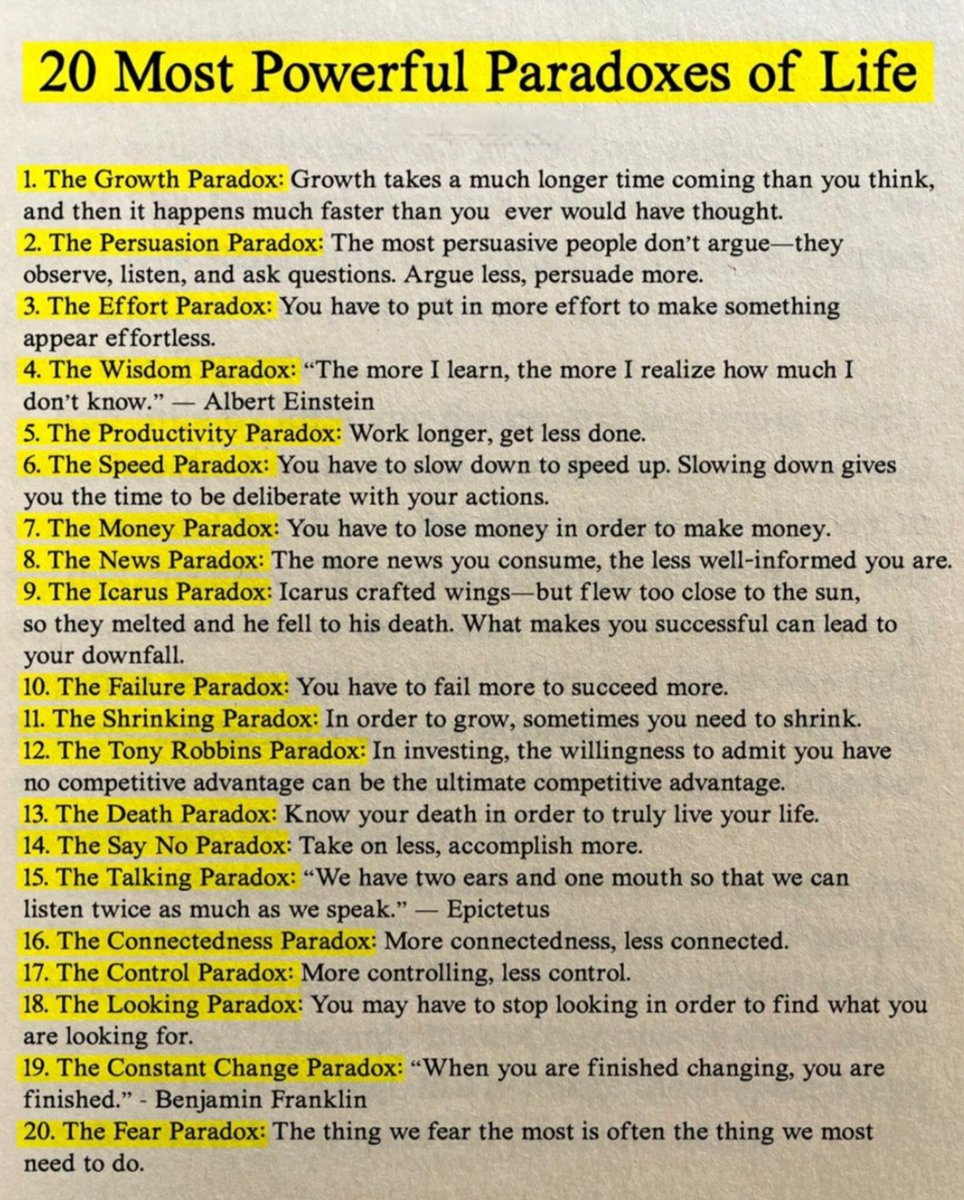
20 Most Powerful Paradoxes of Life

Growth Vs Fixed Mindset


15 HARD HITTING QUOTES


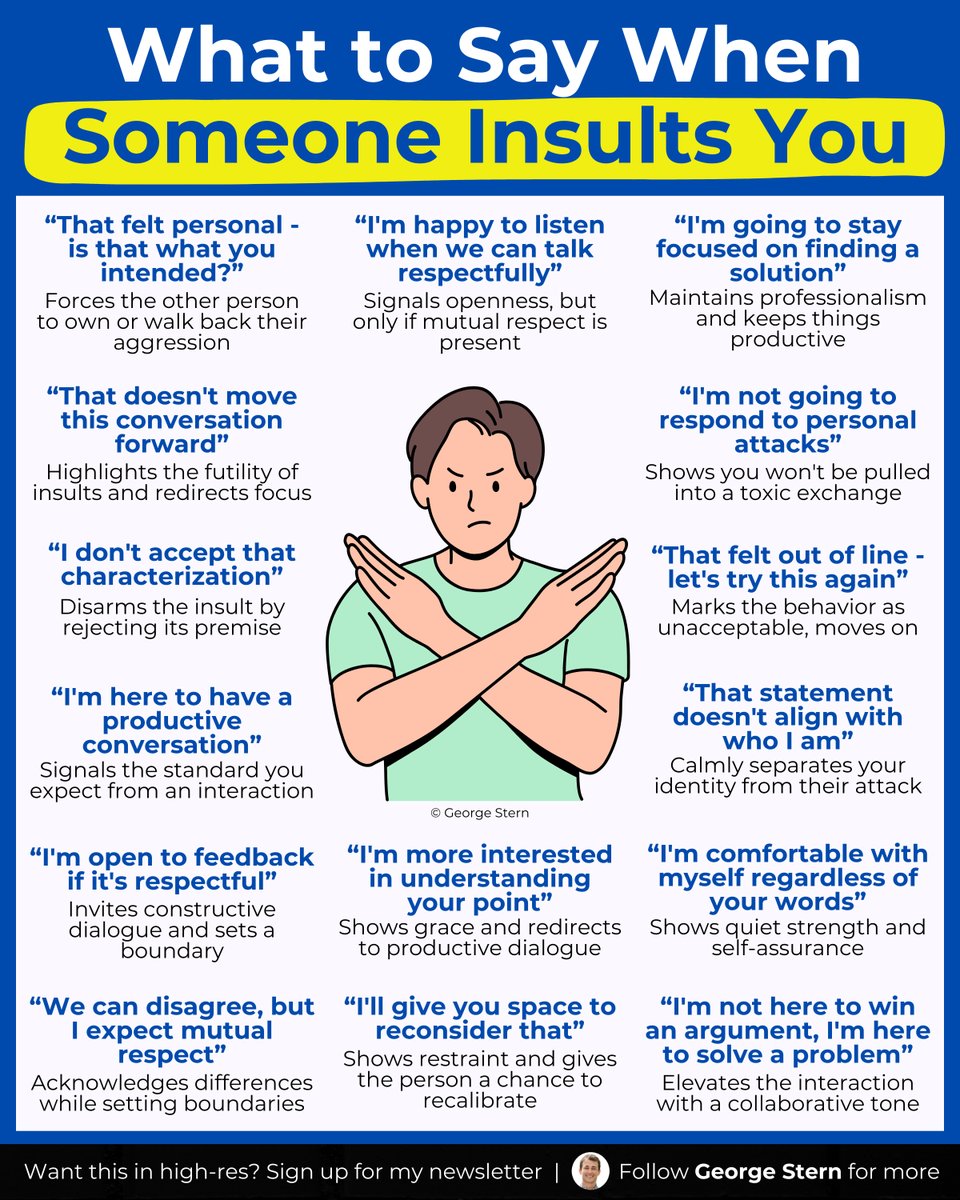
What to say when someone insults you. People respond to insults with insults too often. Or just as bad: they stay silent, letting the behavior continue. But there's another way. These phrases help you take control, while remaining respectful and calm.
12 Traits of High performers


“How to articulate yourself intelligently” article summary in 4k


INSTEAD OF WATCHING AN HOUR OF NETFLIX TONIGHT. This 1 hour Stanford lecture by Joel Peterson will teach you more about negotiation and getting what you want than most people learn in years. Bookmark it and give it an hour, no matter what.

mmmmm algo que vengo diciendo incansablemente tanto aquí como allí: el TDAH es un trastorno confuso que no existe una standarización de su diagnóstico Esta revisión apoya mi tesis al concluir que muchos ensayos clínicos sobre TDAH en adultos podrían estar basados en diagnósticos insuficientemente verificados, lo que plantea dudas sobre la interpretación de sus resultados: - Algunos utilizaron únicamente escalas específicas de TDAH; - Otros aceptaron un diagnóstico clínico previo; - Otros realizaron entrevistas estructuradas para psicopatología general - Unos pocos utilizaron entrevistas psiquiátricas semiestructuradas más completas. - Aproximadamente la mitad de los estudios no evaluó la psicopatología general, algo esencial para realizar un diagnóstico diferencial Los autores no afirman que el TDAH adulto no exista, sino que sostienen que los métodos diagnósticos utilizados con frecuencia no garantizan que los participantes realmente cumplan criterios de manera rigurosa... y ni hablar del TDAH leve Por ello, res importante que desde la neuropsicología seamos críticos con esto, porque la etiqueta de TDAH, sin serla puede llevar a un sufrimiento excesivo y prolongado al tratarlo con terapias que no se ajustan a su necesidad... Os imagináis un TOC con años de tratamiento del TDAH? O alguien con ansiedad generalizada que no le permita concentrarse y muestre déficits atencionales y ejecutivos? Por eso siempre recomiendo, además de un diagnóstico diferencial, empezar a trabajar las comorbilidades para ver cómo el perfil cognitivo del TDAH varía... o no... Fuente: cambridge.org/core/journals/…


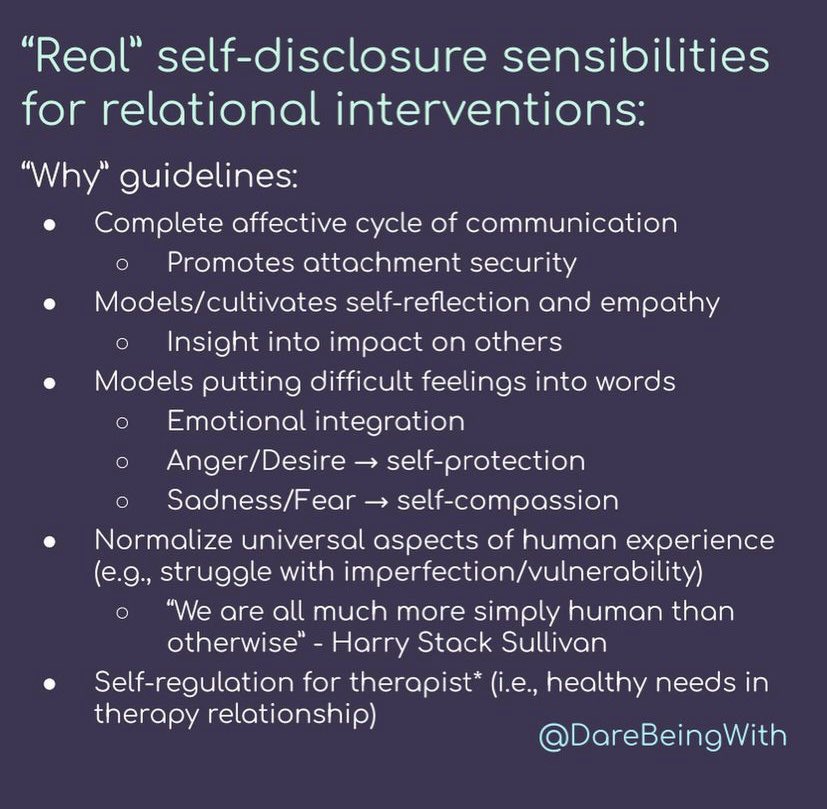
Given therapists’ self-disclosure has emerged again in recent discourse, here are some fundamental sensibilities to practice…
1/ I compiled guidelines/sensibilities (integrating views from Maroda, Yalom, Kuchuck, Walker) for therapists use of self-disclosure (images below): "Although discretion is always indicated, unexamined hiding is not, and it is unhealthy for us and our patients (Kuchuck, 2008)…”



Skilled therapists don’t build “rapport” by talking about themselves. It’s a beginner’s mistake. Non-therapists (and poorly-trained therapists) bring a frame of reference that applies to *social* relationships, not therapy relationships. They are fundamentally different. open.substack.com/pub/jonathansh…


@JonathanShedler @DavidPuder she sounds rather neurotic, as if when any clinician makes any statement about their lives, most likely a small attempt to build rapport, and the poster has some strict expectation of a cold, inhuman advice robot

للمهتمين بالبحث العلمي 📚 هذه من أفضل الأوراق اللي قرأتها عن كتابة ونشر الأبحاث. 👌 3 محررين من مجلات طبية كبرى يشرحون بشكل عملي ماذا يريد المحرر فعلًا من الباحث، وأبرز الأخطاء اللي تسبب رفض الورقة. مفيدة جدًا لأي شخص يبدأ بالنشر العلمي أو يطور طريقة كتابته للأبحاث.


A MUST-READ! This is probably one of my most important papers where I try to teach how to fish rather than offer fish. How I Read a Clinical Trial Report? BG’s primer for Busy Clinicians. Thank you @JCOOP_ASCO @EthicsdoctorP for the kind invitation. I hope the readers will find this useful. ascopubs.org/doi/10.1200/OP…


Professor Jonathan Glover dismantles one of philosophy's most charged arguments with a smirk: John Finnis's research argues that the human embryo deserves full moral respect from the moment of fertilisation. His central claim being that all the genes are there. Glover's response here is not a counter-argument. It's a reductio ad absurdum delivered with a smile. "Now of course on this argument a tadpole or even a bit of frog spawn would count as a frog — because there all the genes are present." He continues, warming to the theme: "And if you're ever invited by Dr Finnis to go and see his butterfly collection, don't be totally disappointed if it turns out to be a jar of caterpillars — because once again, all the genes are there." And once more: "If after that he invites you to stay on for a chicken dinner, don't be surprised if what you get is scrambled egg." The joke itself does the philosophical work. Glover's point is that genetic completeness alone cannot confer moral status — otherwise we'd be morally obligated to treat caterpillars as butterflies and frog spawn as frogs. The presence of a full genetic blueprint tells you what something will become, not what it currently is. The distinction between potential and actuality is one of the oldest in philosophy. Glover resurrects it here not with dense argument, but with three images so vivid they're almost impossible to argue against. What makes a human being morally significant? What it is, or what it will become?

Quantum entanglement and the illusion of time, in 79 minutes | Jim Al-Khalili: Full Interview @jimalkhalili 0:00 Chapter 1: Does time flow? 2:42 Why Time Feels Faster as We Age 3:56 Time and Change in Philosophy and Physics 5:28 Einstein and the End of Absolute Time 6:19 Time in the Equations of Physics 7:50 Chapter 2: How do we reconcile quantum field theory with the general theory of relativity? 12:10 Evidence for Time Dilation: Muons 14:29 Gravity Slows Time: General Relativity 19:22 Space-Time and the Block Universe 21:55 Does Time Really Exist? 26:33 The Debate: Eternalism vs Presentism 34:12 Chapter 3: Is There a “Now”? 40:40 Chapter 4: Why Does Thermodynamics Have a Direction in Time? 49:38 Quantum Entanglement and the Direction of Time 55:10 Did Time Begin at the Big Bang? 45:00 Will Time End? 1:05:40 Chapter 5: Is Time Travel Possible?


@ElizLanders @VivaLaAmes11 @POTUS Is this a reliable reporter @grok



R.I.P. DUOLINGO. 3 years of French. Nothing worked. ChatGPT did it in 5 weeks. Here are the 6 prompts I used :

Vanessa Van Edwards just shared the 3 “magic phrases” that make people instantly like you more — and they’re stupidly simple: 1. “I was just thinking of you.” (Text it when someone pops into your head — it lands like a warm hug.) 2. “You’re always so…” (Fill in the blank with something positive and specific: “You’re always so interesting,” “You’re always so funny,” “You’re always so thoughtful.” People remember labels forever.) 3. “Last time we talked, you mentioned…” (Bring back one detail they were excited about. Nothing says “you matter to me” like remembering what lit them up.) These three lines fight our brain’s natural negativity bias and signal: “You are seen. You are valued.” Try one today — who are you sending “I was just thinking of you” to right now?
Trends for United States
You might like