FemaleShift @Female_Shift
Our initiative supports #women. We believe in a more feminine future and want things to #change. For equality, fairness in the workplace and female #leadership. Joined May 2020-
Tweets2K
-
Followers256
-
Following272
-
Likes2K

#Blog4Managers: Ownership – Why Responsibility Cannot Simply Be Assigned Ownership Starts in the Mind, Not in the Org Chart 🔷 In one department, a recurring quality issue affected several teams. Everyone knew about it, yet nobody felt responsible because the root cause sat outside their formal area of accountability. The problem remained unresolved for months. Only when one engineer stepped forward and said, "It may not be my responsibility, but I will take ownership," did the teams come together, identify the root cause, and solve the issue. The difference was not authority. The difference was ownership. 🔷 Many companies want more ownership. Employees are expected to think entrepreneurially, take responsibility, make decisions, and solve problems before they escalate. At the same time, we often see the exact opposite in many organizations: decisions are delegated upward, alignment meetings increase, initiative declines, and responsibility is often sought where it is formally assigned — not where impact could actually be created. 🔷 The core misconception is often the belief that ownership can simply be mandated. But ownership does not emerge from a new role description or an appeal at a town hall meeting. A new org chart, a culture program, or a motivational leadership message is not enough either. 🔷 Ownership is an internal mindset. It describes the moment when people say, “This is also my issue. I feel responsible for the outcome.” Not because someone assigned it to them, but because they understand the purpose, influence, and significance of their contribution. The difference is subtle, but critical: responsibility can be assigned. Ownership must emerge. 🔷 And that is exactly where the real leadership task begins. Leaders who want ownership have to do more than distribute responsibility. They have to create an environment in which people can and want to truly accept responsibility. What Each Individual Can Do 🔷 Ownership always begins with the personal decision not to be a victim of circumstances. People with a high level of ownership do not first ask, “Who is responsible for this?” They ask, “What can I contribute?” 🔷 This does not mean taking on every task personally or trying to solve every challenge alone. Ownership does not mean constantly taking on more work or replacing other people’s responsibilities. Rather, it is about not automatically treating problems as someone else’s business. Those who live ownership recognize room for action where others mainly see limitations. A first step is to change perspective. Instead of focusing exclusively on obstacles, attention shifts to areas of influence. Even in highly regulated, hierarchical, or process-driven organizations, there are almost always things that can be improved, initiated, or influenced. 🔷 Ownership often shows up in small moments. In the willingness to clearly name a problem. In the decision not to simply leave an open question unresolved. In the impulse to bring forward an improvement suggestion instead of merely complaining about existing processes. And in the mindset of not waiting for someone else to take the first step. Ownership also shows up in reliability. Commitments are kept. Problems are made transparent. Risks are raised early. Mistakes are not hidden, but understood as opportunities to learn. People with ownership take responsibility for outcomes, not just for activities. 🔷 That is an important distinction. Activity means: “I completed my task.” Outcome responsibility means: “I paid attention to whether my contribution actually created impact.” This is where real ownership begins. Especially important is the willingness to think beyond one’s own area of responsibility. Companies do not create value through perfectly optimized silos, but through collaboration along value streams. Ownership therefore also means keeping the bigger picture in mind and understanding the impact of one’s own actions on customers, colleagues, and the entire organization. 🔷 Those who take ownership do not only ask, “What is in my job description?” They also ask, “What does the outcome require?” This mindset noticeably changes collaboration. It reduces friction at interfaces, strengthens initiative, and ensures that responsibility does not end at departmental boundaries. Why Many Organizations Want Ownership, But Unintentionally Prevent It In many organizations, ownership is demanded while the underlying conditions promote the opposite. 🔷 When every decision has to be secured through multiple approvals, risk avoidance emerges. When mistakes are sanctioned, caution emerges. When leaders control every decision, dependency emerges. When initiative is expected but not protected, people learn that restraint is safer than action. 🔷 Many companies want courageous employees, but create systems in which conformity is rewarded and initiative is slowed down. They talk about responsibility, but keep decisions centralized. They demand entrepreneurial thinking, but allow little room for entrepreneurial action. 🔷 People usually behave rationally within a system. They quickly learn which behaviors are rewarded and which are not. Those who experience that decisions are regularly reversed will make fewer decisions in the future. Those who are criticized for mistakes and not recognized for initiative will avoid risks. Those who notice that, in the end, the leader always decides anyway will get used to escalating decisions upward. 🔷 Ownership therefore does not necessarily disappear because of a lack of motivation. It often disappears because of contradictory signals. 🔷 A typical example: A team is expected to act independently, but every relevant decision has to be aligned across several committees. Officially, ownership is expected. In practice, risk mitigation is trained. The outcome is predictable: people take less responsibility because the system shows them that real responsibility is not actually desired. That is why it is not enough to demand ownership through communication. Organizations need to examine which structures, processes, and leadership habits enable ownership — and which prevent it. What Leaders Need to Do 🔷 The most important task of a leader is not to demand ownership. It is to create the conditions that make ownership possible. 🔷 The first lever is clarity. People can only take responsibility when goals, expectations, and decision-making authority are clear. Unclear priorities create uncertainty. When it is not clear what truly matters, responsibility becomes risky. Ownership needs orientation. 🔷 Clarity means more than communicating goals. It means providing concrete answers to key questions: Which outcomes really count? Which decisions can the team make independently? Where is alignment needed? Which guardrails apply? And how will we know whether we are successful? 🔷 The second lever is trust. Anyone who asks for personal responsibility must also grant decision-making space. Nothing destroys ownership faster than micromanagement. Employees need to experience that their decisions are respected — even when not every decision is perfect. 🔷 Trust does not mean giving up leadership. It means not anticipating every decision, not controlling every solution, and not immediately suppressing every risk. Leaders must learn to tolerate responsibility. Because giving responsibility always also means giving up some degree of control. The third lever is psychological safety. People only take responsibility for something new when mistakes do not automatically lead to blame. Innovation, learning, and ownership are inseparably connected. Without the freedom to experiment, genuine personal responsibility cannot emerge. 🔷 Psychological safety does not mean that everything is without consequences. It means that mistakes can be discussed openly without people having to fear personal exposure. The decisive question is: Are we looking for someone to blame, or are we looking for insight? An organization that learns from mistakes strengthens ownership. An organization that punishes mistakes trains self-protection. 🔷 The fourth lever is role modeling. Ownership cannot be credibly demanded if leaders themselves avoid responsibility. Employees observe very closely how their leaders deal with mistakes, uncertainty, and challenges. 🔷 Do leaders take responsibility for decisions? Do they stand by their team? Do they make their own mistakes transparent? Or are problems pushed downward while successes are reported upward? Culture is not created through posters, but through observable behavior. Leaders who model responsibility create a culture in which responsibility becomes natural. Leaders who preach ownership but practice control create cynicism. Ownership Needs Purpose and Room to Shape Outcomes People are especially likely to take responsibility when they understand why their work matters. Ownership emerges more easily where the connection between one’s own contribution and customer value is visible. 🔷 That is why leaders should not only assign tasks, but also convey meaning. Those who understand the purpose behind a task are more likely to develop initiative and engagement. People want to know what they are working for, what difference their contribution makes, and why an outcome matters. A task can be completed correctly in formal terms without real ownership emerging. Only when people understand the impact their work has on customers, colleagues, processes, or the future of the company does a different standard for one’s own actions arise. 🔷 At the same time, ownership needs room to shape outcomes. Responsibility without authority creates frustration. Those who are expected to be accountable for outcomes but are not allowed to make decisions will eventually become demotivated. Real ownership only emerges when people are given both responsibility and the ability to influence outcomes. This also means that leaders must consciously decide where to let go. Not everything needs to be decided centrally. Not every detail requires approval. Not every deviation is a risk. Sometimes the greater damage is not a wrong decision, but the culture that emerges when no one makes decisions anymore. 🔷 Ownership grows where people experience: My contribution matters. My decision carries weight. My initiative is welcome. And when something does not work, we learn from it together. Ownership Is a Joint Effort 🔷 Ownership is neither solely the responsibility of employees nor solely the responsibility of leaders. It emerges through the interaction of both sides. The individual decides to take responsibility, show initiative, and seek solutions. The leader creates an environment in which this mindset can grow — through trust, orientation, decision-making space, and a culture of learning. Where both come together, the organization changes noticeably. People no longer wait for instructions. They shape. They improve. They think ahead. They take responsibility not only for their task, but for the shared outcome. 🔷 That is the decisive difference between organizations that merely administer work and organizations that shape the future. 🔷 Ownership does not emerge through appeals. Ownership emerges through clarity, trust, purpose, room to act, and role modeling. Ownership grows where people experience that their actions make a difference. When ideas disappear into approval processes, initiative fades. When people see their contributions creating visible impact, ownership grows naturally. And it does not emerge when people say, “This is my task.” Ownership emerges when people say, “This is our outcome.” ⭐️ ✨ @Khulood_Almani @timo_vi @TamaraMcCleary @AkwyZ @MaryRich78 @rwang0 @drsharwood @DrHolzwarth @HelenBevan @pierrecappelli @JimHarris @jenstirrup @GlenGilmore @subare @JohnLeh @Ronald_vanLoon @enilev @Scobleizer @AndrewYNg @YuHelenYu @SusanneMadsen ✨ #Leadership #Ownership #People #Trust #Purpose #RoleModel #Culture #PsychologicalSafety #Trasformation #SystemsThinking #FutureOfWork #Blog4Managers by @thomas_dettling | Image created by @thomas_dettling | powered by GPT 5.5

⬛️ Technology Scales Processes. Culture Determines Whether Organizations Learn - Lessons from The Geek Way #Books 📚 Book recommendation by #Block4Managers ✨ @amcafee @Khulood_Almani @timo_vi @TamaraMcCleary @AkwyZ @MaryRich78 @rwang0 @drsharwood @DrHolzwarth @HelenBevan @pierrecappelli @JimHarris @jenstirrup @GlenGilmore @subare @JohnLeh @Ronald_vanLoon @enilev @Scobleizer @AndrewYNg @YuHelenYu @SusanneMadsen #Productivity #HumanCapabilities #People #Technology #OrganizationalDesign #AI #Outcome #DigitalTransformation #LeadershipDevelopment ⭐️ #DigitalTransformation #CultureChange #Data #OrganizationalDevelopment #AI #SystemicThinking #DigitalTransformation #Effectiveness #EndToEnd #LearningOrganization #ValueCreation #Science #Ownership #Speed #Openness #Leadership #TheGeekWay #Blog4Managers by @thomas_dettling and Image created by @thomas_dettling | powered by GPT 5.5

⬛️ #Blog4Managers is for managers who want to understand and actively shape transformation -concise, relevant, and grounded in practice. 🔹This series moves beyond quick insights to focus on what truly matters: real challenges, proven approaches, and learning rooted in everyday management practice. 🔹I share what I explore, experiment with, and refine - so we can collectively move forward in transforming our organizations and economy 🦋 ✨ @Khulood_Almani @AkwyZ @TamaraMcCleary @MaryRich78 @rwang0 @timo_vi @drsharwood @DrHolzwarth @HelenBevan @pierrecappelli @JimHarris @jenstirrup @GlenGilmore @subare @Ronald_vanLoon @enilev @Scobleizer @phinifa @AndrewYNg @jamesvgingerich @YuHelenYu ✨
⬛️ The Cultural Foundations of Psychological Safety Introduction 🔷 An organization cannot mandate psychological safety; it can only enable it - or systematically prevent it. If psychological safety is to emerge seriously as a social property of the system, rather than as a

⬛️ #Blog4Managers is for managers who want to understand and actively shape transformation -concise, relevant, and grounded in practice. 🔹 This series moves beyond quick insights to focus on what truly matters: real challenges, proven approaches, and learning rooted in everyday management practice. 🔹 I share what I explore, experiment with, and refine - so we can collectively move forward in transforming our organizations and economy ✨@TamaraMcCleary @timo_vi @Khulood_Almani @AkwyZ @MaryRich78 @rwang0 @drsharwood @DrHolzwarth @HelenBevan @phinifa @pierrecappelli @JimHarris @jenstirrup @GlenGilmore @subare @Ronald_vanLoon @enilev @Scobleizer @AndrewYNg @YuHelenYu @gleonhard @quepasachico✨
⬛️ Organizational Transformation in the Age of AI 🔷 Artificial intelligence has moved beyond curiosity and early experimentation. Across industries, organizations can point to measurable gains from adoption and are beginning to integrate AI into core enterprise workflows. 🔷

⬛️ #Blog4Managers is for managers who want to understand and actively shape transformation -concise, relevant, and grounded in practice. 🔹 This series moves beyond quick insights to focus on what truly matters: real challenges, proven approaches, and learning rooted in everyday management practice. 🔹I share what I explore, experiment with, and refine - so we can collectively move forward in transforming our organizations and economy. ✨@timo_vi @Khulood_Almani @AkwyZ @MaryRich78 @rwang0 @drsharwood @DrHolzwarth @HelenBevan @phinifa @pierrecappelli @JimHarris @jenstirrup @GlenGilmore @subare @Ronald_vanLoon @enilev @Scobleizer @AndrewYNg @YuHelenYu @quepasachico ✨
⬛️ The agentic opportunity - Where should governments start with agentic AI? What is agentic AI? 🔶 An AI agent is a software system that autonomously executes tasks based on goals, applying decision logic while operating within predefined constraints. Agentic AI refers to

⬛️ #Blog4Managers is for managers who want to understand and actively shape transformation -concise, relevant, and grounded in practice. 🔹 This series moves beyond quick insights to focus on what truly matters: real challenges, proven approaches, and learning rooted in everyday management practice. 🔹 I share what I explore, experiment with, and refine - so we can collectively move forward in transforming our organizations and economy. ✨@timo_vi @Khulood_Almani @AkwyZ @MaryRich78 @rwang0 @drsharwood @DrHolzwarth @HelenBevan @phinifa @pierrecappelli @JimHarris @jenstirrup @GlenGilmore @subare @Ronald_vanLoon @enilev @Scobleizer @AndrewYNg @YuHelenYu @quepasachico ✨
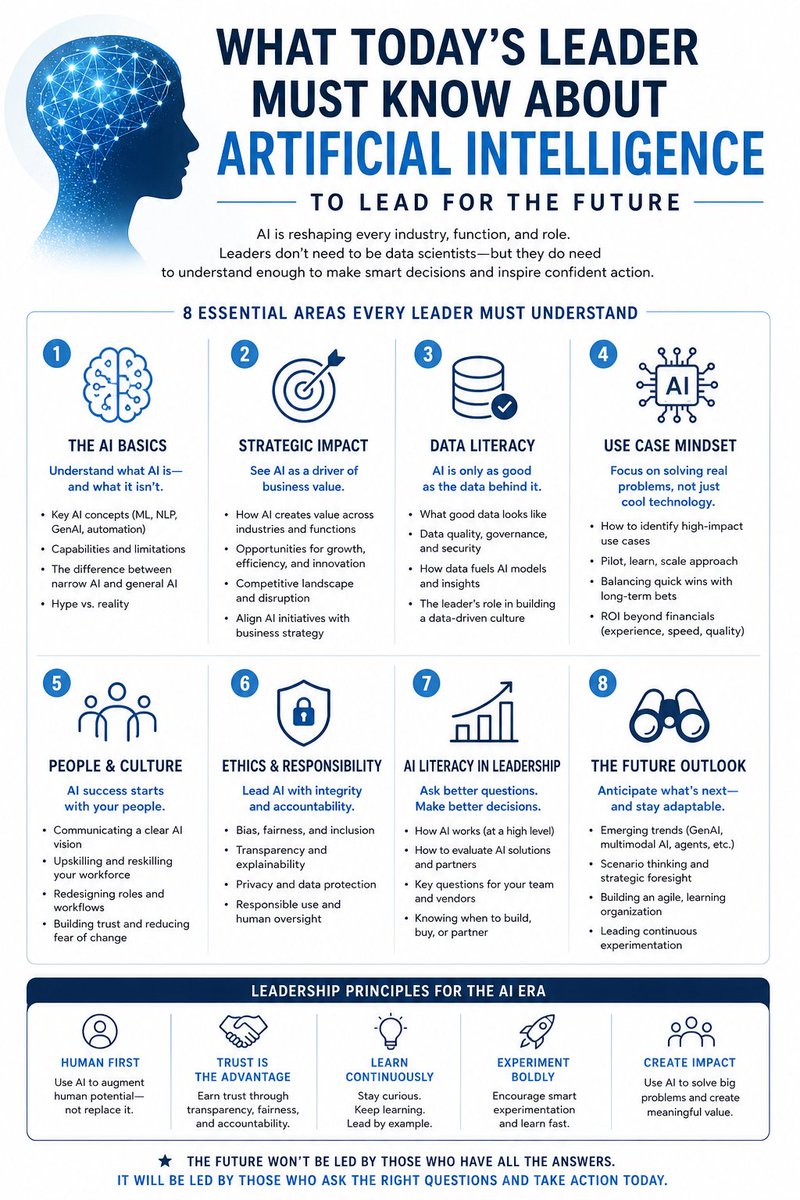
⬛️ #Blog4Managers: What Today’s Manager Must Understand About AI - Beyond the Hype 🔷 Artificial intelligence is no longer a distant vision of the future - it is a concrete management reality. Yet many leadership teams still find themselves navigating between curiosity,
⬛️ #Block4Managers | Digital Transformation – Why 50% of the Journey Already Radically Changes the Way We Work The Misconception of “Complete Transformation” 🔷 One of the biggest misconceptions in digital transformation is the belief that value only emerges once everything is fully implemented. Only when systems are fully integrated, processes completely digitized, and technologies deployed across the entire organization- so the assumption goes - does meaningful progress begin. But this assumption is precisely what slows transformation down in many organizations. 🔷 Because it directs attention toward a destination that is rarely reached: 100%. And while organizations focus on the final state, they often overlook the decisive reality: transformation does not begin once everything is complete. It begins much earlier. It begins when the system starts producing visible impact. And in most cases, that happens long before the organization considers itself “finished.” 📢 The exact percentage is less important than the principle: transformation impact emerges once a critical level of adoption is reached. Why the First 50% Matter More Than Expected 🔷 50% of the journey does not mean transformation is half done. 50% means the system begins to work. As soon as a meaningful share of data is no longer fragmented but accessible and usable, the quality of decisions changes. As soon as the first processes are automated, time is freed up - not theoretically, but in operational reality. As soon as the first AI-supported applications are used productively, expectations regarding speed, effort, transparency, and responsiveness begin to shift. The way people work starts to change. 🔷 At first, this change is rarely dramatic. It emerges quietly, through small but strategically important shifts. A team collaborates more effectively because information flows faster. A project identifies risks earlier because signals become visible sooner. Decisions are prepared more thoroughly because information no longer needs to be manually consolidated from fragmented sources. And something important happens in that moment: Work becomes less reactive. Organizations begin moving from coordination toward orchestration. 📢 That is the true significance of the first 50%. Transformation Does Not Create Momentum Through Perfection 🔷 Most organizations underestimate this phase because they evaluate transformation primarily through completeness. But transformation rarely creates momentum through completeness. It creates momentum through usability. Transformation rarely fails because companies start too late. It fails because they wait too long for perfection. This distinction matters because perfection is static thinking. Usage is dynamic thinking. 📢 Perfection assumes value only exists at the end state. Usage creates value throughout the journey. Practical Example: Project Management in Transition 🔷 A simple example illustrates this clearly: In many organizations, project management is still shaped by fragmented information structures. Status reporting is highly manual, risks often evolve implicitly within operational activities and must be actively uncovered, and leadership decisions depend heavily on experience supported by data that is frequently incomplete, delayed, or inconsistent. This creates a familiar pattern: Teams spend significant amounts of time consolidating information instead of acting on it. Now imagine that only part of the available digital potential is actually implemented - not completely, but deliberately and consistently. A centralized data model captures the most relevant project parameters. Reporting processes are partially automated. Initial analytical models identify deviations and emerging delivery risks at an earlier stage. AI-supported applications help structure project information, summarize dependencies, identify inconsistencies, and prepare decision options. ▪️ None of this represents a fully integrated transformation environment. ▪️ Not every process is digitized. ▪️ Not every system is connected. ▪️ Not every decision is fully data-driven. ▪️ Not every workflow is optimized. 📢 And yet the operational reality changes fundamentally. Project leads gain visibility into emerging issues significantly earlier. Reporting cycles that previously required days can suddenly be prepared within hours. Escalation paths become clearer because underlying information is more transparent. Alignment discussions become more focused because teams spend less time debating data quality and more time discussing consequences and priorities. The organization becomes faster - not because people work harder, but because friction is reduced. The Point Where Behavior Begins to Change 🔷 This is where many organizations misinterpret transformation. They assume that value only scales once everything is integrated. In reality, behavioral change starts much earlier. Once people experience that information is available faster, decisions become clearer, and operational coordination becomes easier, expectations begin to change across the system. Managers start asking different questions. Teams start identifying additional improvement opportunities on their own. Leadership discussions become more forward-looking because less energy is consumed by reconstructing the present. And this is the moment where transformation stops being a program. It becomes an operating reality. This is not the final state. It may represent only half of what is technologically possible. But this half already changes how work gets done. And that is the true power of the first 50%. Why Early Impact Creates Trust 🔷 Because it creates something essential for every sustainable transformation effort: tangible credibility. People do not build trust in transformation through presentations, roadmaps, or strategic ambition alone. They build trust through visible operational improvement. 📢 Once teams experience that even partial transformation creates measurable relief and better outcomes, resistance changes character. The central question is no longer: “Do we really need this?” The question becomes: “What else becomes possible if we continue?” And that question changes everything. Because ambition cannot be mandated structurally. It emerges through experience. Transformation gains momentum when organizations experience progress directly in their daily operations. When Transformation Starts Reinforcing Itself This is why the first 50% matter disproportionately. They establish belief. They create trust in the system. They prove that digital capabilities are not abstract future concepts but operational instruments that improve execution quality in the present. From that point onward, transformation starts reinforcing itself. ▪️ Teams begin identifying inefficiencies proactively. ▪️ Managers rely more consistently on data-informed decision structures. ▪️ Collaboration becomes more transparent and less politically reactive. ▪️ Knowledge becomes easier to access and less dependent on individual gatekeepers. ▪️ Operational discussions become more focused on consequences, priorities, and opportunities instead of information reconstruction. 📢 The system starts learning. And learning systems evolve differently from static organizations. What matters here is that this dynamic is not driven by perfection. It is driven by usage. Transformation Is Not a Destination The remaining 50% of the journey still matters enormously. It represents scaling, integration depth, operational maturity, governance quality, resilience, and long-term optimization. But it is not the prerequisite for impact. It builds on impact that already exists. That is why digital transformation should not primarily be understood as the pursuit of 100%. In reality, 100% is rarely a realistic or even stable condition. Technologies evolve. Organizational structures evolve. Markets evolve. Expectations evolve. Transformation itself continuously changes the definition of what “complete” even means. Transformation is therefore not a destination. It is an adaptive capability. A continuously evolving operational system that learns, adjusts, improves, and expands over time. And in such systems, movement matters more than perfection: ▪️ Usage matters more than theoretical maturity. ▪️ Progress matters more than architectural purity. ▪️ Because organizations do not transform at the moment they finish implementation. ▪️ They transform at the moment behavior begins to change. And that moment often arrives much earlier than expected. The Strategic Significance of the First 50% 🔹50% is enough to fundamentally change the way we work. 🔹50% is enough to create trust in the process. 🔹50% is enough to establish momentum. 🔹50% is enough to change expectations. 🔷 And once expectations change, organizations rarely return to the way they worked before. That is what ultimately makes the difference. Organizations don’t transform when they complete the journey. They transform when they start using what they have. ⭐️ ✨ @Khulood_Almani @timo_vi @TamaraMcCleary @AkwyZ @MaryRich78 @rwang0 @drsharwood @DrHolzwarth @HelenBevan @pierrecappelli @JimHarris @jenstirrup @GlenGilmore @subare @JohnLeh @Ronald_vanLoon @enilev @Scobleizer @AndrewYNg @YuHelenYu @SusanneMadsen ✨ #DigitalTransformation #Behavior #Change #HumanCapabilities #Productivity #People #Technology #AI #Outcome #OrganizationalDesign #Leadership #SystemicThinking #EndToEnd #LearningOrganization #ValueCreation #Blog4Managers by @thomas_dettling and Image created by @thomas_dettling | powered by GPT 5.5

⬛️ Most Leaders Don't Lack Information. They Lack a System to Think - My Reading Guide for Uncertain Times 📚 #Books #Blog4Managers @AkwyZ @Khulood_Almani @Lenovodc @MaryRich78 @subare @DrHolzwarth @timo_vi

⬛️ #Blog4Managers | Why Mindset Is the Decisive Success Factor in Digital Transformation Technology Changes Organizations. Mindsets Change People. 🔷 “Change your mindset.” Few phrases are used as frequently in change programs - and few remain as vague. Many employees sense that it refers to something important, yet when asked, they often struggle to explain what exactly should change. For leaders, this creates a dangerous gap: behavior is expected without a clear understanding of the beliefs and assumptions that drive it. ▪️ In practice, digital transformations rarely fail because of a lack of technology. Organizations invest millions in new platforms, data architectures, and AI solutions, yet the expected outcomes often fail to materialize. The reason is frequently not the technology itself, but the thinking patterns and behavioral habits of the people expected to use it. Transformation is therefore not primarily a technological challenge - it is a human and mental one. What a Mindset Really Is A mindset is far more than an attitude or a temporary motivational state. It is the deeply embedded pattern of beliefs, assumptions, and mental models that shapes how people interpret reality, make decisions, and respond to change. In many ways, mindset functions as the operating system of human behavior. ▪️ Dr. Carol Dweck, Professor of Psychology at Stanford University and one of the world’s leading researchers on the subject, captures its importance succinctly: “The view you adopt for yourself profoundly affects the way you lead your life.” ▪️ The beliefs we hold about ourselves influence how we learn, grow, lead, and respond to challenges. That is why mindset is not a “soft” topic. It is a strategic factor that directly affects leadership effectiveness, organizational performance, and transformation success. Fixed Mindset vs. Growth Mindset In her groundbreaking research, Carol Dweck distinguishes between two fundamental ways of thinking: the Fixed Mindset and the Growth Mindset. ▪️ People with a Fixed Mindset tend to believe that intelligence, talent, and abilities are largely static. Challenges are often avoided because they may expose weaknesses. Mistakes are interpreted as evidence of incompetence, and feedback can feel like a personal judgment rather than an opportunity for improvement. A typical statement reflecting this mindset is: “I can’t do this.” ▪️ People with a Growth Mindset, by contrast, see abilities as developable. They view learning as a continuous process and regard challenges as opportunities for growth. Mistakes are not failures but essential elements of progress and innovation. The difference often comes down to a single word: “I can’t do this yet.” ▪️ This small linguistic shift reflects a profound change in perspective. While a Fixed Mindset seeks to avoid uncertainty, a Growth Mindset actively embraces it as a pathway to learning. As Carol Dweck famously states: “Becoming is better than being.” ▪️ In a world defined by continuous change, the ability to develop becomes more valuable than the desire to appear already accomplished. 🔷 Why a Growth Mindset Is No Longer Enough For leaders navigating digital transformation, a Growth Mindset is essential - but it is no longer sufficient. The speed of technological innovation, the increasing interconnectedness of business ecosystems, and the growing importance of data and artificial intelligence require an additional perspective: a Digital Mindset. ▪️ A Digital Mindset is the ability to view technology not merely as a tool for improving existing processes, but as a catalyst for reimagining value creation, collaboration, customer experiences, and business models. People with a digital mindset think in terms of digital platforms and transparency rather than silos. They make data-informed decisions, understand complex systems, and view change not as a one-time initiative but as an ongoing capability. ▪️ As a result, the key question fundamentally changes. Instead of asking: “How can we digitize our existing process?” they ask: “What problem can we solve differently- or entirely eliminate - through data, automation, or AI?” This shift in thinking often determines whether digitalization simply improves efficiency or creates entirely new opportunities for growth and innovation. 🔷 The Power of Combining Growth and Digital Mindsets True transformation happens when a Growth Mindset and a Digital Mindset work together. An organization may deploy cutting-edge technologies, but if people continue to apply old thinking patterns to new tools, the impact will remain limited. Consider a simple example ▪️A company introduces an AI-powered customer service solution. Employees with a Fixed Mindset may view the technology primarily as a threat to their role. Employees with a Growth Mindset recognize an opportunity to acquire new skills. Employees who combine a Growth Mindset with a Digital Mindset go one step further and ask: “Which tasks can AI handle, and how can we use the time it frees up to create greater value for our customers?” This is where genuine transformation begins - not with technology itself, but with how people think about technology and its possibilities. This is precisely where many transformation initiatives fail. Organizations invest heavily in platforms, tools, and data capabilities while neglecting the mindsets required to make those investments successful. The result is a collection of impressive pilot projects that never scale and gradually fade into irrelevance. 🔷 What Does This Mean for Leaders? The central challenge for leaders is not how to mandate a new mindset. The real challenge is creating an environment where new ways of thinking can emerge and thrive. Mindset Must Be Experienced Mindsets cannot be changed through slogans, presentations, or mandates. People adopt new ways of thinking primarily by observing the behavior of those around them - especially their leaders. Leaders must therefore be willing to learn visibly, experiment openly, and acknowledge mistakes honestly. Leaders who demand innovation while avoiding risk themselves send conflicting messages. Culture follows behavior - not PowerPoint presentations. Leaders use directly influences how teams think. Premature judgments close doors. Curious questions open them. Instead of saying: “That won’t work.” A leader might ask: “What would need to happen for this to work?” The difference appears subtle, but it fundamentally changes the quality of conversations and problem-solving. Structures Shape Mindsets Mindsets are not formed solely in individual minds. They are also shaped by organizational systems. ▪️ If organizations encourage risk-taking but reward only flawless execution, they will inevitably reinforce a Fixed Mindset. Employees quickly learn which behaviors are genuinely valued. For this reason, processes, incentives, performance metrics, and leadership practices must align with the behaviors organizations seek to promote. Consistency Beats Communication Neither a Growth Mindset nor a Digital Mindset emerges through isolated training programs. ▪️ They develop through consistent leadership, continuous feedback, meaningful autonomy, learning-oriented goals, and real opportunities to make decisions. Organizations that measure only outcomes create optimization. Organizations that also recognize learning create the conditions for innovation. 🔷 Mindset Is a Leadership Product Ultimately, the goal is not to ensure that every employee possesses the “right” mindset. ▪️ The goal is to build an organization where new thinking is possible, encouraged, and effective. Lasting behavioral change occurs only when the surrounding environment supports it. Mindset should therefore not be viewed as an individual deficiency that training programs must fix. It is the outcome of leadership, culture, systems, and organizational design. ▪️ Perhaps the most important question for leaders is not: “Do my employees have the right mindset?” But rather: “Are we creating a system that enables the right mindset to emerge?” 🌟 Digital transformation does not begin with technology. It begins with the way people think about possibility, learning, and change. ✨ @Khulood_Almani @timo_vi @TamaraMcCleary @AkwyZ @MaryRich78 @rwang0 @drsharwood @DrHolzwarth @HelenBevan @pierrecappelli @sallyeaves @JimHarris @jenstirrup @GlenGilmore @subare @JohnLeh @Ronald_vanLoon @enilev @Scobleizer @AndrewYNg @YuHelenYu @SDGS4GOOD @SusanneMadsen ✨ #Leadership #DigitalTransformation #Mindset #GrowthMindset #FixedMindset #DigitalMindset #Innovation #AI #DigitalLeadership #LearningCulture #CultureChange #ValueCreation #DataDrivenWork #Blog4Managers by @thomas_dettling. Infographic created by @thomas_dettling, powered by GPT 5.5

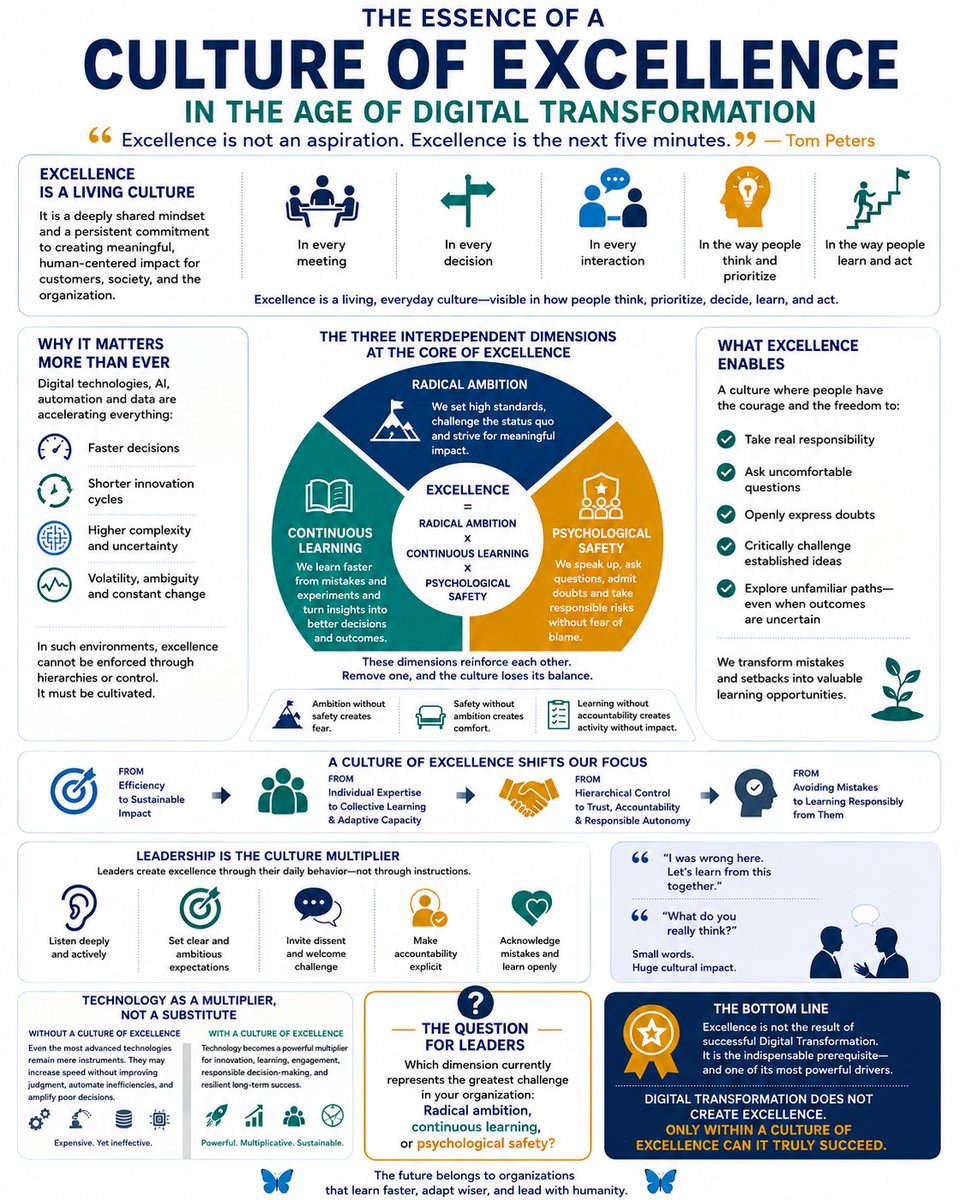
⬛️ #Blog4Managers: The Essence of a Culture of Excellence in the Age of Digital Transformation “Excellence is not an aspiration. Excellence is the next five minutes.” — Tom Peters Excellence Is a Living Culture 🔷 A Culture of Excellence is far more than the pursuit of peak performance, operational efficiency, or the achievement of ambitious OKRs. Its true essence lies in a deeply shared inner mindset: a persistent and passionate commitment to creating meaningful, human-centered impact for customers, society, and the organization itself. Excellence is neither a fixed end state nor a time-bound program that can simply be designed, launched, and implemented. It is a living, evolving culture that becomes visible in everyday behavior - in every meeting, every decision, every interaction, and every moment in which people think, prioritize, question, decide, learn, and act. It is not defined by isolated moments of exceptional performance, but by the consistency with which high standards, responsibility, reflection, and humanity shape the ordinary work of the organization. Three Interdependent Dimensions 🔷 At its core, a Culture of Excellence integrates three deeply interwoven dimensions: Radical Ambition Continuous Learning Psychological Safety These dimensions do not operate independently. They reinforce, balance, and constrain one another. Radical ambition without psychological safety creates pressure, silence, and fear. Psychological safety without ambition risks becoming comfort without progress. Continuous learning without accountability produces activity, but not necessarily meaningful improvement or impact. A true Culture of Excellence invites challenge without provoking fear. It systematically transforms mistakes, setbacks, and failed experiments into valuable learning opportunities instead of hiding, minimizing, or punishing them. At the same time, it does not romanticize failure. It requires disciplined reflection, clear accountability, and the willingness to translate experience into better decisions and more effective action. Courage, Responsibility, and Constructive Dissent 🔷 Such a culture creates an environment in which people have both the courage and the freedom to take genuine responsibility. They can ask uncomfortable questions, openly express doubts, critically challenge established ideas, and explore unfamiliar paths - even when outcomes are uncertain and no proven solution exists. This requires more than permission to speak. It requires confidence that thoughtful dissent will be taken seriously, that disagreement will not be interpreted as disloyalty, and that difficult truths will not be suppressed simply because they disturb established narratives or power structures. Psychological safety, in this sense, is not about avoiding tension. It is about making productive tension possible. It enables teams to confront reality, examine competing perspectives, and make better decisions without reducing debate to personal conflict. In the age of Digital Transformation, a Culture of Excellence is no longer a desirable cultural attribute. It is a strategic necessity. Why Digital Transformation Raises the Stakes 🔷 Artificial intelligence, automation, digital platforms, and data-driven systems are not only increasing technical complexity. They are also accelerating decision-making, compressing development cycles, intensifying competitive pressure, and making uncertainty, volatility, and ambiguity permanent features of organizational life. As technologies become more powerful, organizations must make more consequential decisions at greater speed. They must interpret incomplete information, adapt to changing conditions, and continuously reassess assumptions that may have been valid only months - or even weeks - before. In such highly dynamic environments, excellence can no longer be enforced through rigid hierarchies, detailed master plans, excessive standardization, or traditional control mechanisms. These approaches may create temporary predictability, but they often reduce responsiveness, delay learning, and discourage initiative precisely when organizations need adaptability most. Collective Intelligence Over Centralized Control 🔷 Sustainable excellence increasingly emerges from the intelligent use of collective intelligence: from open, trust-based dialogue across organizational levels and functional boundaries; from deliberate and courageous experimentation; and from the ability to identify, understand, and correct errors faster and more systematically than competitors. No individual leader, function, or expert can fully understand the complexity of a digital and data driven organization. Relevant knowledge is distributed across teams, disciplines, markets, customer interfaces, technologies, and operational systems. This is also why co-creation is essential to integrate distributed knowledge and fragmented perspectives into a shared understanding of complex organizational realities. The strategic challenge is therefore not merely to collect more data or employ more expertise. It is to create the conditions under which distributed knowledge can become shared understanding - and under which shared understanding can lead to timely, responsible action. A Culture of Excellence makes that possible by reducing defensive behavior, strengthening transparency, and enabling people to contribute what they know rather than merely confirm what senior leaders expect to hear. From Efficiency to Sustainable Impact 🔷 A Culture of Excellence fundamentally shifts the organization’s focus. ▪️ It moves the organization from operational efficiency alone toward sustainable and measurable impact for customers, employees, society, and the organization itself. ▪️ It shifts attention from individual expertise toward collective learning and adaptive capacity. ▪️ It replaces excessive hierarchical control with mutual trust, clear accountability, and responsible autonomy. And it moves the organization from the avoidance of mistakes toward the disciplined ability to learn from them. This does not make efficiency, expertise, structure, or performance irrelevant. On the contrary, it places them in a broader and more demanding context. Efficiency becomes valuable when it supports impact. Expertise becomes powerful when it contributes to collective capability. Structure becomes effective when it enables rather than constrains responsible action. Leadership as Cultural Practice 🔷 Leaders play a decisive role in this transformation. They do not create excellence through top-down instructions, detailed specifications, motivational speeches, or carefully designed PowerPoint presentations. They create it primarily through the standards they set, the questions they ask, the behaviors they reward, and the conduct they demonstrate under pressure. This means listening deeply and actively. It means setting clear and ambitious expectations without prescribing every step. It means inviting dissent, making accountability explicit, and responding constructively when people raise risks, doubts, or unpopular perspectives. It also means openly acknowledging their own mistakes. A sincere statement such as: “I was wrong here. Let’s understand what happened and learn from it together.” or a genuine question such as: “What do you really think?” can have a stronger cultural impact than any formal transformation initiative. Such gestures signal that truth matters more than status, learning more than self-protection, and responsibility more than the preservation of authority. People Observe What Leaders Tolerate 🔷 People do not primarily learn culture from corporate values displayed on walls, published in annual reports, or presented at leadership conferences. They learn culture by observing what leaders consistently encourage, tolerate, reward, ignore, and demonstrate - especially in difficult moments. They notice whether bad news is welcomed or suppressed. They notice whether people are rewarded for raising concerns or punished for disrupting consensus. They notice whether leaders protect their own image or take responsibility. And they notice whether high standards are applied consistently or selectively. Culture is therefore not what an organization claims to value. It is what people repeatedly experience. A Culture of Excellence becomes credible only when declared principles and lived behavior are aligned. Technology as a Multiplier, Not a Substitute 🔷 Ultimately, Digital Transformation is far less a purely technological challenge than a profoundly cultural one. Without a strong and living Culture of Excellence, even the most advanced technologies, algorithms, data models, platforms, and tools remain instruments without sustainable impact. They may increase speed without improving judgment, automate inefficient processes, amplify poor decisions, or reinforce existing organizational weaknesses. In such cases, technology can become expensive without becoming transformative. Within a Culture of Excellence, however, technology becomes a powerful multiplier. It strengthens innovation, accelerates learning, improves decision quality, supports responsible experimentation, and enables people to create greater value with greater speed and precision. The difference does not lie in the technology alone. It lies in the culture that determines how intelligently, responsibly, and courageously that technology is used. Excellence as the Prerequisite 🔷 Excellence is therefore not the result of successful Digital Transformation. It is its indispensable prerequisite - and one of its most powerful drivers. Digital Transformation does not create excellence. Only within a Culture of Excellence can Digital Transformation truly succeed. The central question for leaders is therefore not only: Which technologies should we implement? It is also: What kind of culture must we build so that these technologies can generate meaningful and sustainable impact? And within your organization, which dimension currently represents the greatest challenge: Radical ambition, continuous learning, or psychological safety? 🦋 @tom_peters @Khulood_Almani @AkwyZ @TamaraMcCleary @MaryRich78 @rwang0 @timo_vi @drsharwood @DrHolzwarth @HelenBevan @pierrecappelli @JimHarris @jenstirrup @GlenGilmore @subare @Ronald_vanLoon @enilev @Scobleizer @AndrewYNg @YuHelenYu ⭐️#CultureOfExcellence #DigitalTransformation #data #AI #People #Leadership #PsychologicalSafety #Learning #OrganizationalLearning #FutureOfWork #Innovation #Blog4Managers by @thomas_dettling and Infographic created by @thomas_dettling, powered by GPT 5.5
⬛️ #Blog4Managers | Rethinking Productivity: Why Output Alone Is No Longer Enough ▪️ Organizations have never invested more in technology to boost productivity. Powerful digital tools have never been more accessible. Yet global productivity growth has stagnated for years. If technology automatically drove productivity, the problem would already be solved. This is exactly the sobering conclusion of the World Economic Forum’s report on “Productivity in 2030.” Productivity can no longer be viewed as a simple efficiency metric or stable concept. It emerges from the dynamic interplay of technology, human capabilities, and organizational design. ▪️ The starting point is sobering: More than half of the global growth slowdown since 2008 is attributable to weak productivity growth. At the same time, nearly 40 percent of large organizations report declining productivity. The critical question is therefore no longer how productivity can be increased - but why it is not rising despite rapid technological progress. What Is Productivity - Really? ▪️ Traditionally, productivity was defined as output divided by input. This industrial logic worked well for decades. In knowledge work, however, it has become insufficient.Value today rarely emerges from isolated activities. It is created through collaboration, learning, problem-solving, and decision quality. Output is neither linear nor easily attributable to individuals. Productivity is therefore less a metric than a capability: the capability of a system to consistently generate relevant, meaningful output by effectively leveraging collective intelligence. At the same time, modern productivity is not about producing more output - but about creating better outcomes. A new feature is output. Increased customer satisfaction is outcome. A training session is output. Real behavioral change is outcome. ▪️ Frameworks like OKRs deliberately shift the focus from “What did we deliver?” to “What impact did we create?” Highly productive organizations optimize for this conversion from activity to value. The most important question is no longer “How much work was done?” but “What value was actually created?” - “What Counts as Productivity and What Doesn’t?" ▪️ Productivity includes everything that creates genuine, sustainable value: innovation, problem-solving, sound decisions, adaptability, learning capability, and especially the quality of cross-functional collaboration. Value in complex organizations is increasingly created at the interfaces - not inside silos. Learning is a particularly underestimated driver. The WEF report estimates that around 39 percent of core skills will change by 2030. Organizations consistently name capability gaps - not technology - as their biggest transformation barrier. What does not count as productivity: meetings without outcomes, emails without action, reporting without decisions, and busyness without value. Many organizations still measure activity and call it productivity. Productivity Does Not Grow Automatically ▪️ One of the report’s key insights: Productivity is not an automatic byproduct of technological progress. The report outlines four future scenarios - from major productivity leaps to prolonged stagnation. The decisive variables in every scenario are technological advancement and human capital development. Only when both advance in parallel do broad and sustainable productivity gains emerge. Otherwise, benefits remain limited or may even deepen inequalities. Technology alone does not create productivity – it only creates the potential for it. Technology or People? ▪️ The debate “technology versus people” misses the point entirely. AI can measurably improve productivity - studies show annual gains of 1.5 to 3 percent through time savings and efficiency. Yet without the right capabilities, technology simply accelerates existing problems. The reverse is equally true: strong human focus without technological leverage limits scale and efficiency.Productivity only emerges through intelligent combination: Technology without capability remains ineffective. Capability without technology remains inefficient. Only the smart integration of both creates sustainable productivity. Learning and Capability Development ▪️ The report’s most important finding: Technology is not the bottleneck - people are. More precisely, the speed at which new capabilities are built, applied, and turned into value. 63 percent of organizations see skill gaps as the biggest obstacle to transformation, while 85 percent are actively investing in reskilling and upskilling. The competitive advantage of the future will not come primarily from better systems, but from better learning systems. Learning capability is becoming a core economic resource. The Role of Leadership: Productivity Is a Design Challenge ▪️ This shifts the role of leadership fundamentally. Productivity is not an individual performance issue. It is a system design issue. Leaders no longer primarily control output. They design the conditions in which collective intelligence can flourish - through collaboration structures, clear priorities, thoughtful technology integration, learning culture, and psychological safety. Productivity does not come from working harder. It comes from designing better systems. What Should Organizations Do? The report highlights four concrete action areas: ▪️ First: Develop technology and capabilities in parallel. Every AI initiative must be accompanied by corresponding capability building. ▪️ Second: Make learning a core organizational process - with dedicated time, experimentation space, and systematic knowledge sharing. ▪️ Third: Think productivity systemically. The key metric is no longer individual output, but the quality of interfaces and collaboration. ▪️ Fourth: Treat technology consistently as an amplifier of human potential - not as a replacement. Are we still optimizing activity and output - and calling it productivity? Productivity Is a Leadership Decision ▪️ Productivity does not arise from more pressure, more control, or more activity. It arises when people, technology, and organizational systems interact in ways that create real outcomes and sustainable value. Most organizations do not have a technology problem. They have an outdated industrial-age productivity mindset. The productivity challenge is therefore first and foremost a leadership, learning, and design problem. That is why Artificial Intelligence will not automatically solve the productivity crisis. Instead, it will sharply reveal which organizations truly understand modern productivity - and which do not. ▪️ The defining question for leaders today is not: “Which technology should we implement?” But rather: ⭐️ “Are we creating an environment in which people and technology can generate significantly more value together? ” ⭐️ ✨ @Khulood_Almani @timo_vi @TamaraMcCleary @AkwyZ @MaryRich78 @rwang0 @drsharwood @DrHolzwarth @HelenBevan @pierrecappelli @JimHarris @jenstirrup @GlenGilmore @subare @JohnLeh @Ronald_vanLoon @enilev @Scobleizer @AndrewYNg @YuHelenYu @SusanneMadsen #Productivity #HumanCapabilities #People #Technology #OrganizationalDesign #AI #Outcome #DigitalTransformation #Leadership 💡 Download WEF Report: tinyurl.com/5n8tweuj | @wef #Blog4Managers by @thomas_dettling and Infographic created by @thomas_dettling, powered by GPT 5.5

⬛️ #Blog4Managers | From Hype to Accountability: Why AI Agents Are a Leadership Issue 🔷 AI Agents are not a technology initiative - they represent a new organizational principle. The greatest challenge with AI Agents is not their intelligence - it is their authorization. Organizations increasingly understand what agents can do. But they do not yet fully understand what agents should be allowed to do. This is where leadership begins. 🔷 Organizations are becoming increasingly familiar with the capabilities of AI agents, yet many still lack clarity about what those agents should and should not be authorized to do. This is the real leadership challenge. AI Agents act as new organizational actors with delegated authority. As a result, leadership is shifting from technology adoption toward the intentional delegation of decision-making authority under clearly defined conditions. 🔷 For managers and executives, this means AI Agents are not an IT project. They are a governance, organizational design, and leadership challenge. The critical question is no longer, “Which agent should we deploy?” but rather, “Which decisions are we willing to delegate - and which are we not?” Organizations that create clarity around roles, boundaries, and accountability establish the foundation for scale. Those that do not remain trapped in pilot mode. Clarity Before Speed: Creating a Shared Language and Decision Framework 🔷 According to the WEF report - AI Agents in Action, May 2026 - , a recurring pattern in early AI Agent initiatives is that misunderstandings between business functions, IT, and governance teams slow progress. Successful organizations therefore begin with a surprisingly simple but highly effective step: establishing a common language around autonomy, authority, and consequences. 🔷 This has important practical implications. Autonomy describes the degree to which an agent can act independently. Authority defines which actions the agent is permitted to perform - from gathering information to executing transactions. Particularly important are so-called consequential events: actions with legal, financial, regulatory, or reputational implications. 🔷 This highlights one of the report’s most important management insights: risk is determined not by an agent’s intelligence, but by the consequences of its actions. An agent that merely gathers information poses a fundamentally different governance challenge than one that drafts contracts, initiates purchases, approves transactions, or communicates directly with customers. ▪️ The practical takeaway is clear: leaders should define early which decisions can be delegated and where human oversight must remain mandatory. Without this clarity, operational uncertainty emerges - and trust suffers. 🔷 Delegation Requires Accountability: Clear Roles Instead of Technical Enthusiasm The report emphasizes that introducing AI Agents is structurally similar to hiring new employees. Capabilities are evaluated, roles are defined, and responsibilities are assigned. Decision rights, however, always remain with humans. ▪️ In practice, this requires clear accountability. Business functions own outcomes and value creation. IT designs the architecture, data access, and control mechanisms. Risk and Compliance establish the guardrails and oversee adherence. Operational teams supervise critical decisions and monitor agent performance in day-to-day operations. ▪️ Executives should derive a simple principle from this: no delegated authority without assigned accountability. Organizations that consistently apply this principle create transparency and avoid a common trap - distributed responsibility becoming no responsibility at all. This brings a classic management discipline back to the forefront: delegation. AI Agents are forcing organizations to formalize delegation for the first time, explicitly defining who may make which decisions under what conditions. What was often implicit in the past must now become transparent, documented, and governable. Choosing the Right Use Cases: When AI Agents Truly Add Value Not every process is suited for agentic systems. The WEF report offers a simple yet powerful decision filter: AI Agents are most valuable when the objective is clear, but the path to achieving it cannot be fully predefined. ▪️ Typical use cases include dynamic, multi-step processes that require contextual decision-making, such as complex decision support, workflow orchestration, adaptive customer interactions, and coordination across multiple systems and data sources. ▪️ For leaders, this creates a clear prioritization framework. The best starting points are use cases that: 🔹Deliver measurable outcomes 🔹Have limited consequences in case of failure 🔹Can be implemented quickly 🔹Enable rapid organizational learning This approach allows organizations to gain experience, test governance mechanisms, and build trust while minimizing unnecessary risk. Governance as an Enabler: Moving from Intuition to a Structured Model 🔷 One of the report’s most significant contributions is the Agent Capability and Authorization Profile (ACAP). This is far more than a governance document. It is an operational framework that transparently defines what each agent can do, what it is allowed to do, under which conditions it may act, which control mechanisms apply, and when human approval is required. 🔷 The key practical insight is that governance should not be viewed as a control mechanism but as a scaling mechanism. Only when authorization is transparent, auditable, and adaptable can organizations successfully operate multiple agents and coordinate their activities. ▪️ For leaders, this means every AI Agent should be assigned a clearly defined mandate. That mandate should specify not only objectives and responsibilities, but also boundaries, escalation points, and oversight requirements. ▪️ Consider a simple example. A procurement agent may analyze supplier proposals, compare vendors, and place orders up to a predefined spending limit. Once that threshold is exceeded, human approval is automatically required. Rules like these make authorization transparent, manageable, and trustworthy. 🔷 Without this structure, AI remains an isolated experiment. With it, AI becomes a scalable organizational capability. From Pilot to Scale: ▪️ The report introduces a practical operating model consisting of three phases: ▪️ Design & Assessment – Define roles, context, risks, and authorization requirements. ▪️ Prepare & Deploy – Implement technical and organizational controls while integrating agents into existing processes. ▪️ Monitor & Improve – Continuously monitor, evaluate, and enhance performance and governance. 🔷 The final phase is particularly important. Most risks do not emerge during design; they emerge during operation. Business conditions evolve. Data changes. Processes adapt. Consequently, the requirements placed on agents also change. 🔷 Monitoring should therefore not be viewed as an optional add-on. It is an integral component of successful deployment. Organizations should not treat AI Agents as finished implementations but as living systems whose authorization, performance, and risk profiles require continuous review and adjustment. 🔷 Organizations that neglect this reality risk seeing initially safe agents gradually operate outside their intended boundaries. Continuous oversight therefore becomes a leadership and governance responsibility—not merely a technical one. Leadership in the Age of AI Agents: Trust Through Controlled Delegation 🔷 Perhaps the most important insight for the #Blogs4Managers series is this: trust in AI does not come from perfection. It comes from visible, controlled, and accountable delegation. ▪️ Organizations that establish clear boundaries, implement effective control mechanisms, and assign unambiguous accountability can scale faster while reducing risk. They create the conditions necessary for employees, customers, and leaders to trust decisions made by agentic systems. ▪️ As a result, leading AI Agents is becoming a core competency for modern executives. The challenge is no longer primarily about managing technology. It is about designing a system of people, algorithms, authority, and accountability. 🔷 The most important management question of the coming decade is therefore not: “How intelligent is our AI Agent?” It is: “Which decisions are we willing to delegate - and how do we ensure that delegation remains transparent, controllable, and accountable?” That is the true leadership challenge in the age of AI Agents 🎓 ✨ @Khulood_Almani @timo_vi @TamaraMcCleary @AkwyZ @MaryRich78 @rwang0 @drsharwood @DrHolzwarth @HelenBevan @pierrecappelli @JimHarris @jenstirrup @GlenGilmore @subare @JohnLeh @Ronald_vanLoon @enilev @Scobleizer @AndrewYNg @YuHelenYu @amcafee @kaifulee @SusanneMadsen ✨ #AI #AIAgents #Leadership #Governance #Delegation #DecisionMaking #OrganizationalDesign #Data #Ethics #AutonomousValueCreation #SystemThinking #DigitalTransformation #Blog4Managers by @thomas_dettling and Infographic created by @thomas_dettling, powered by GPT 5.5 ▪️ Download Report here: tinyurl.com/5cdeue88 | @wef


⬛️ #Blog4Managers | Co-Creation in Practice: How True Collaboration Creates Better Outcomes Many transformation initiatives fail not because organizations lack ideas, but because the right perspectives never come together. Companies invest heavily in innovation programs, workshops, and new methodologies, yet the results often fall short of expectations. The reason is rarely the tools themselves. 📢 More often, it is the way people work together. This is where co-creation makes the difference. ▪️ Many organizations introduce co-creation through structured methods such as workshops, sprints, innovation labs, or Design Thinking initiatives. This is both rigorously grounded and practically essential. Yet its true impact does not come from methodology - it comes from mindset. Genuine co-creation means not only collecting perspectives but giving them equal space and value. It requires a willingness to trade control for shared insight and to embrace uncertainty as a productive condition rather than a problem to eliminate. ▪️ In this sense, co-creation is less a tool and more a reflection of organizational maturity. Co-creation doesn’t follow a blueprint. It becomes visible through trust, meaningful dialogue, empathy and openness to insights that emerge through collaboration. From Cooperation to Co-Creation: A Qualitative Shift ▪️ In practice, co-creation is often confused with cooperation. While cooperation is based on the division of labor, co-creation takes collaboration one step further. Value is created through shared thinking rather than by combining individual contributions. ▪️ This shift fundamentally changes both dynamics and accountability. The most effective solutions often emerge when no one can clearly identify where the defining idea originally came from. Outcomes become the product of collective learning and shared discovery rather than individual ownership. ▪️ For leaders, this means moving away from being the primary source of answers and focusing instead on the quality of interactions that enable better thinking. The Architecture of Effective Co-Creation ▪️ For co-creation to produce meaningful results, it requires a carefully designed framework. Successful initiatives begin with a shared understanding of the problem. This step is often underestimated, yet it is one of the most critical. Organizations that rush toward solutions too early typically reduce the quality of the outcomes they can achieve. From there, radical transparency becomes essential. Information, assumptions, uncertainties, and constraints must be openly accessible so that all participants work from a common foundation. Structured interaction replaces random discussion. Divergent phases of idea generation are intentionally balanced with convergent phases focused on prioritization and decision-making. Equally important is clarity around decision-making mechanisms. Co-creation does not necessarily require consensus. It requires transparent and trusted processes for making decisions. ▪️ Finally, co-creation delivers its greatest value through iteration. Short learning cycles allow ideas to be tested, challenged, refined, and continuously improved. A Practical Example: How Co-Creation Gets Started ▪️ A common example illustrates how this framework comes to life. The process begins with an intentionally open question such as: “How can we ... redesign the digital experience for our customers?” The question is deliberately framed so that no single function can answer it alone. A small, diverse team is then assembled, bringing together representatives from business functions, engineering, digital transformation, AI, procurement, sales, tender, projects and individuals who provide critical operational perspectives. The process starts with a structured workshop designed not to generate quick ideas, but to build a shared understanding. Roughly one-third of the available time is dedicated to surfacing perspectives, challenging assumptions, and examining the problem from a systems perspective. Only then does true co-creation begin. ▪️ During an open exploration phase, participants generate ideas without evaluation or judgment. In a subsequent phase, ideas are refined, prioritized, and translated into initial solution concepts. A critical success factor is creating something tangible early in the process - sketches, prototypes, mockups, or scenario-based concepts and journeys. These are then tested through short feedback cycles, allowing the team to learn, adapt, and improve. At the same time, decision-making responsibilities are clearly defined, whether through consent-based approaches or final decisions made by an accountable leader. The result is a structured path that transforms open dialogue into actionable and sustainable solutions. This example highlights an important truth: co-creation does not begin with creativity. It begins with clarity - and becomes effective through structure. Leadership as Enablement: A New Role in the System ▪️ Co-creation fundamentally changes the role of leadership. Control gives way to enablement. Leaders create environments where dialogue can flourish and where people have the space to think, challenge assumptions, and contribute meaningfully. One capability becomes particularly important: tolerance for ambiguity. Leaders who embrace co-creation must be comfortable with uncertainty. They need the ability to resist premature decisions and avoid suppressing complexity simply to create the appearance of clarity. Leadership therefore becomes less visible through decisions and more visible through the quality of questions being asked and the culture being cultivated. ▪️ The leader’s role is increasingly to provide direction without prescribing solutions and to create confidence without eliminating uncertainty. Common Tensions - and How to Use Them Productively In reality, co-creation is rarely frictionless. Functional silos, dominant personalities, competing interests, and hidden power structures can all undermine the process. Yet these tensions are also where much of the value lies. Differences in perspective, conflicting priorities, and challenging conversations are not disruptions to the process - they are often prerequisites for better outcomes. The key is not to avoid tension but to channel it productively. Skilled facilitation, transparent rules, and a shared vision help organizations create constructive friction without allowing it to become destructive conflict. Co-Creation as a Response to Complexity ▪️ The value of co-creation becomes particularly evident in environments characterized by uncertainty and rapid change, such as digital transformation. Complex challenges can no longer be solved from a single perspective. They require the integration of diverse expertise, experiences, and viewpoints. Organizations that learn not merely to coordinate diversity but to transform it into genuine shared value creation gain a significant competitive advantage. As business environments become increasingly interconnected and dynamic, this capability grows even more important. Today’s challenges rarely fit neatly within departmental boundaries. They combine data, technological, economic, organizational, and cultural dimensions, demanding solutions that bring multiple perspectives together. In this context, co-creation becomes more than a collaboration method - it becomes a core organizational capability. Three Questions for Your Next Co-Creation Initiative ▪️ Before launching your next workshop, innovation project, or transformation effort, consider these questions: Do all relevant perspectives truly have a seat at the table? Is there a shared understanding of the problem, or are participants addressing different challenges? Are decision-making processes transparent, understood, and trusted? These questions may seem simple, but in practice they often determine whether collaboration remains coordinated - or becomes genuinely co-creative. Conclusion ▪️ The Courage to Build the Future Together Co-creation is demanding. It requires time, clarity, discipline, and a high degree of reflection from everyone involved. Yet it consistently produces solutions that are more sustainable, more broadly supported, and often more innovative. At its core, co-creation represents a shift in perspective - from individual excellence to collective intelligence. Organizations that embrace this shift do more than improve results. They strengthen their capacity to shape the future proactively. The challenges of tomorrow will rarely be solved by individuals working alone. The defining question is no longer who has the best answer, but how organizations can create the conditions for discovering better answers together. Where diverse perspectives are transformed into genuine shared value creation, innovation emerges - and so does long-term organizational resilience. Reflection for Leaders - Where in your current work environment could you intentionally create a space where people do more than contribute ideas - where they develop solutions together? 📢 Because co-creation starts in the mind long before it becomes a process. ✨ @Khulood_Almani @timo_vi @TamaraMcCleary @AkwyZ @MaryRich78 @rwang0 @drsharwood @DrHolzwarth @HelenBevan @pierrecappelli @JimHarris @jenstirrup @GlenGilmore @subare @JohnLeh @Ronald_vanLoon @enilev @Scobleizer @AndrewYNg @YuHelenYu @amcafee @kaifulee @SusanneMadsen @tceb62 ✨ #CoCreation #Leadership #Collaboration #DigitalTransformation #CollectiveIntelligence #OrganizationalMaturity #People #Skills #FutureOfWork #DataDrivenWork #Blog4Managers by @thomas_dettling and Image created by @thomas_dettling | powered by #GPT5

@thomas_dettling I *love* book recommendations! They make my heart sing. These are going on my 'to-read' list. Thank you, Thomas!
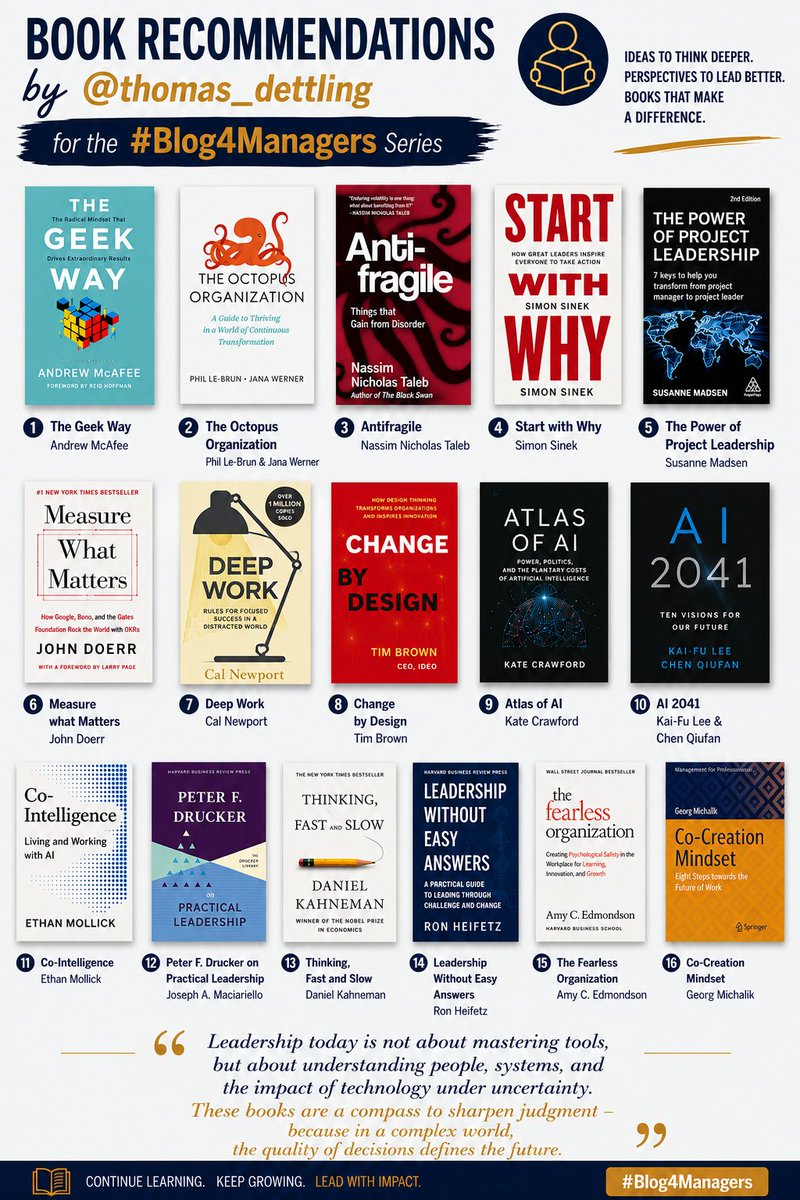
⬛️ Most Leaders Don't Lack Information. They Lack a System to Think - A Reading Guide for Uncertain Times Thinking, Leading, Transforming My #Blog4Managers series represents a deliberate counterpoint to one of the defining challenges of our time: the growing fragmentation of knowledge in a world shaped by accelerating change, increasing complexity, and continuous technological disruption. 📢 Information has never been more abundant. Orientation has never been more difficult. While new trends emerge and disappear at ever shorter intervals, this series follows a different ambition: to curate timeless thinking tools, enduring management principles, and practical perspectives that help leaders navigate uncertainty - not only for today, but for what lies ahead. The books brought together here are far more than a collection of recommendations. Taken together, they form something more valuable: 📢 An intellectual operating system for modern leadership. Works such as Thinking, Fast and Slow and Measure What Matters develop a deeper understanding of judgment, decision-making, prioritization, and organizational impact. Others, such as The Fearless Organization and Leadership Without Easy Answers, broaden the perspective on the cultural, social, and adaptive dynamics that often determine whether transformation succeeds or fails. At the same time, books such as Co-Intelligence, Atlas of AI, and AI 2041 address one of the defining questions of our era: How will artificial intelligence reshape not only processes and productivity, but also responsibility, leadership, value creation, and ultimately our understanding of work itself? What makes this selection particularly powerful is its systemic coherence. 📢 This is not a collection of isolated ideas. It is a collection of connected perspectives. ▪️Strategy without execution remains ineffective. ▪️Culture without clarity becomes ambiguous. ▪️Digital Technology & Data without understanding becomes a risk. ▪️Leadership without reflection becomes management by reaction. Only through the interaction of these dimensions does the capability emerge to build organizations that are resilient, adaptive, innovative, and future-ready. Books such as Antifragile, Change by Design, The Geek Way, and The Octopus Organization provide precisely this perspective. They remind us that uncertainty is not merely a disruption to overcome. Properly understood, it becomes a source of learning, adaptation, and competitive advantage. 📢 The #Blog4Managers series is therefore aimed at people who do not wait for easy answers. ▪️ It is written for managers who are willing to think deeply before acting. ▪️ For professionals who understand that transformation is not a project, but a capability. ▪️ And for organizations that recognize that learning is not an optional activity, but part of the infrastructure of long-term success. This collection can be used in many ways: ▪️ As a personal leadership compass. ▪️ As a foundation for strategic dialogue within teams. ▪️ As a learning architecture for transformation initiatives. ▪️ As a structured entry point into the most important management and technology debates of our time. What matters is not reading everything. What matters is engaging with the right ideas at the right moment- and translating them into meaningful action. ▪️ Because ultimately, this is not about books. ▪️ It is about making better decisions. ▪️ Thinking more clearly. ▪️ Leading more effectively. 📢 And in a world increasingly defined by uncertainty, developing the one capability that matters most: The ability to shape the future with intention rather than merely react to it. ✨ ✨ @Khulood_Almani @timo_vi @TamaraMcCleary @AkwyZ @MaryRich78 @rwang0 @drsharwood @DrHolzwarth @HelenBevan @pierrecappelli @JimHarris @jenstirrup @GlenGilmore @subare @JohnLeh @Ronald_vanLoon @enilev @Scobleizer @AndrewYNg @YuHelenYu @amcafee @kaifulee @SusanneMadsen @tceb62 ✨ #Books #Systemthinking #Leadership #People #DeepWork #AI #Data #CoIntelligence #DigitalTransformation #Measurement #Impact #CoCreation #OrganizationalDesign #CultureChange #Blog4Managers by @thomas_dettling and Image created by @thomas_dettling | powered by #GPT5
⬛️ AI Readiness Is Not Optional - It’s Digital Transformation Intro AI is no longer a future topic. It is already shaping how people learn, think, and work- faster than organizations can adapt. The real challenge is not adopting AI. It is aligning systems, structures, and behaviors around it. What the latest World Economic Forum report - "Shaping the Future of Learning: Education Readiness for the Age of AI | June 2026" - makes clear: The gap is no longer about technology; it is about the system’s ability to adapt. 7 Key Takeaways 1⃣ The real problem is not AI - but system readiness The core challenge is misalignment between governance, organization, and human behavior - not the technology itself. 2⃣ AI readiness is the next stage of digital transformation. AI is not an add-on. It forces a shift toward true end-to-end transformation. 3⃣ Bottom-up adoption vs. top-down systems creates friction. AI spreads faster than institutions adapt - creating structural instability. 4⃣ AI scales efficiency- but can weaken capability Without intentional design, AI leads to less thinking, less depth, and weaker judgment. 5⃣ AI amplifies existing structures- including silos Fragmented organizations don’t improve with AI - they fragment faster. 6⃣ Trust and performance measurement are changing If outputs can be generated instantly, they lose meaning as indicators of performance. 7⃣ Impact requires full-system orchestration Real value emerges only when all layers evolve together: data, governance, organization, leadership, and behavior. Conclusion AI is not just another technology wave. It is a stress test for how well organizations truly understand transformation. It exposes whether systems are: ▪️ integrated or fragmented ▪️ governed or improvised ▪️ learning or merely optimizing 📢 And it makes one thing unmistakably clear: Digital Transformation does not fail because of technology. And AI will not save it. But it will ruthlessly reveal whether we understood it in the first place. ✨ #DigitalTransformation #AI #Leadership #AIReadiness #FutureOfWork #HowWeWork #SystemThinking #EndToEnd #People #Learning #Empowerment #Mindset ✨ @wef @Khulood_Almani @timo_vi @TamaraMcCleary @AkwyZ @MaryRich78 @rwang0 @drsharwood @DrHolzwarth @HelenBevan @phinifa @pierrecappelli @JimHarris @jenstirrup @GlenGilmore @subare @Ronald_vanLoon @enilev @Scobleizer @AndrewYNg @YuHelenYu @quepasachico ✨ 📢 Download Report: tinyurl.com/486m4dd5 | @wef 💡

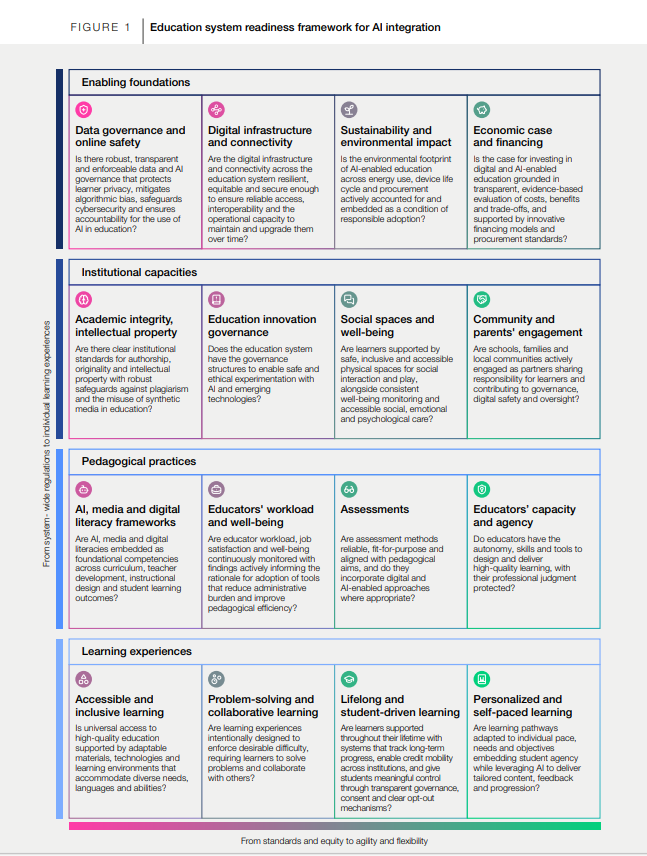
⬛️ Technology Scales Processes. Culture Determines Whether Organizations Learn - Lessons from The Geek Way My #Blog4Managers series combines strategic perspectives with practical organizational development. At its core are topics that are becoming increasingly mission-critical for modern enterprises: digital transformation, organizational effectiveness, holistic thinking and execution, cultural transformation, and contemporary leadership. The objective of the series is not to describe isolated methods or technologies, but to explore how organizations can remain adaptive, resilient, and capable of learning under conditions shaped by complexity, data-centricity, and AI. 📢 Andrew McAfee’s The Geek Way provides a particularly relevant reference framework for this discussion because it consistently shifts digital transformation from the technological to the cultural dimension. The central question is no longer which tools organizations deploy, but according to which normative principles they make decisions, learn, and create value. McAfee describes four norms of what he calls a “New Culture”: ▪️ Science, ▪️ Ownership, ▪️ Speed, and ▪️ Openness. 🔹 Together, they form the cultural operating system of successful digital organizations. What is especially remarkable is not merely the description of specific management practices, but the underlying logic of organizational adaptability. The Geek Way implicitly describes the transition from technology-centered transformation toward evidence-based, human-centered learning systems. That is precisely what makes the book so relevant. 🔹 Many organizations today invest heavily in platforms, data architectures, and AI systems without simultaneously building the cultural conditions necessary for those technologies to generate meaningful organizational impact. Technology scales processes. Culture determines whether organizations learn. Within the context of data-based work, it becomes particularly clear why these norms are so powerful. ▪️ Science replaces opinions with evidence. Decisions are no longer legitimized primarily through hierarchy, experience, or intuition, but through data, experimentation, and testable hypotheses. This creates an organization that functions as a learning system. Co-creation, experimentation, iterative work, and continuous measurement become the foundation of governance and execution. Companies such as Amazon and Netflix have built their operational strength precisely on this principle: decisions are not scaled because experienced managers made them, but because they are empirically validated.For digital transformation, this represents a fundamental break from classical management logic. The perfect business case is no longer the central focus; instead, success depends on the ability to generate valid insights quickly and act on them decisively. The real innovation of digital organizations therefore lies not primarily in technology itself, but in their capability for collective learning adaptation. In an end-to-end system, Science becomes far more than analytical competence - it is the mechanism that overcomes local optimization in favor of systemic evidence. Data is not an end in itself, but part of an organizational knowledge system. ▪️ Ownership embeds accountability across the entire value chain. In many established organizations, accountability remains structurally fragmented: functions optimize isolated domains without considering the performance of the overall system. Sales optimizes revenue, Operations optimizes efficiency, IT optimizes stability - yet no one truly owns the outcome of the end-to-end system. Geek culture breaks with this logic. Ownership here means not only responsibility, but accountability for outcomes across the entire end-to-end process. In highly digital organizations (Maturity Levels 4–5), this becomes especially visible: teams are accountable not for isolated tasks, but for customer value, system performance, and the continuous improvement of an entire value stream.Combined with data-driven transparency, Ownership becomes visible, measurable, and manageable. Teams can immediately see the impact of their actions and adjust accordingly. Particularly in platform models and integrated value streams, this form of Ownership becomes the prerequisite for true scalability. Without it, organizations create highly digitized silos instead of adaptive systems. This is where a fundamental shift in modern organizational development becomes visible: away from functional control and technology dominance toward human-centered, collaborative value creation systems. Co-creation therefore evolves from a complementary method into a structural prerequisite for organizational learning capability. ▪️ For McAfee, Speed should not be understood merely as velocity, but as the structural capability to radically shorten learning cycles. Organizations that experiment quickly, integrate feedback rapidly, and adapt continuously develop a decisive competitive advantage. Speed does not primarily emerge from increased pressure or higher operating tempo, but from reducing friction within the system. In practice, this means small releases instead of large-scale programs, continuous iteration instead of episodic transformation, and rapid feedback loops instead of months-long governance cycles. Data provides the foundation by making progress visible and enabling rapid course corrections. This is why digital leaders are often not more successful because they have superior long-term plans, but because they learn faster than their competitors. Many organizations digitize processes. Only a few digitize learning. In an end-to-end context, Speed therefore becomes an emergent system characteristic: only when information, decisions, and accountability can flow through the organization without structural friction does true adaptability emerge. ▪️ Openness ultimately ensures that the other three norms can function effectively at all. It describes the willingness to question assumptions, make mistakes visible, and accept new evidence - even when it contradicts existing beliefs, power structures, or established experience. For data-driven organizations, this is essential: 📢 Data only creates impact when it is culturally accepted. Many companies fail not because of missing technology, but because of defensive organizational patterns in which evidence is ignored whenever it threatens established narratives. Openness creates the cultural space for critical discourse, interdisciplinary learning, and systemic thinking. In combination with AI, this norm becomes even more important. Algorithmic systems continuously generate new recommendations, patterns, and disruptions. 🔹 Organizations must therefore learn to constantly challenge decision-making logic instead of merely digitizing existing routines. AI thus amplifies not primarily technological capability, but cultural selection capability: organizations must learn which evidence they are willing to accept, which routines they are prepared to abandon, and which mental models they must evolve. Openness therefore becomes a prerequisite for organizational learning capability under conditions of growing complexity. 🔹 Taken together, the four norms address one of the central problems of many transformation initiatives: the gap between technological capability and organizational effectiveness. Many companies today possess data platforms, analytics tools, and modern digital architectures - yet they lack the cultural logic required to use them effectively. Technology scales processes. Culture determines whether organizations learn. 📢 Without Science, data work remains decorative. Without Ownership, accountability dissipates across functional silos. Without Speed, organizations stagnate in lengthy decision and escalation cycles. And without Openness, learning collapses under internal resistance. 🔹 This is precisely where the real challenge of modern organizational development lies. The future viability of digital organizations will not primarily depend on technological competence, but on their ability to place evidence above hierarchy, institutionalize learning systematically, and develop collective adaptability. Digital maturity emerges where technology, culture, and co-creation are no longer treated separately, but function together as an integrated learning and value creation system. For leaders, this creates a clear implication: digital transformation is fundamentally not a technology project, but a design challenge centered on organizational decision and learning systems. 📢 The goal is to build an organization that thinks in evidence-based ways (Science), embeds accountability consistently along value streams (Ownership), learns faster than its environment (Speed), and remains open to correction, disruption, and strategic realignment (Openness). Ultimately, this is the true competitive advantage of digital organizations. ⭐️ The Geek Way therefore provides a precise answer to why so many transformations fail to meet expectations despite massive investments. Technology itself is not the bottleneck. The real bottleneck is the cultural operating system into which technology is embedded. Or more directly: data alone does not create transformation. 📢 Only a culture that functions as a scientific, learning-oriented, end-to-end system can make digital capabilities effective at scale. ✨ @amcafee @Khulood_Almani @timo_vi @TamaraMcCleary @AkwyZ @MaryRich78 @rwang0 @drsharwood @DrHolzwarth @HelenBevan @phinifa @pierrecappelli @JimHarris @jenstirrup @GlenGilmore @subare @Ronald_vanLoon @enilev @Scobleizer @AndrewYNg @YuHelenYu @quepasachico ✨ #DigitalTransformation #OrganizationalDevelopment #Leadership #CultureChange #Data #AI #DigitalTransformation #SystemicThinking #Effectiveness #LearningOrganization #EndToEnd #ValueCreation #Science #Ownership #Speed #Openness #TheGeekWay 💡 #Blog4Managers by @thomas_dettling and Image created by @thomas_dettling | powered by GPT 5.5

⬛️ How People Are Actually Using AI at Work in 2026 | 28% of workplace AI usage is already about decision-making ▪️ According to the Microsoft Work Trend Index 2026 - tinyurl.com/yttzrhyx - decision-making accounts for 28% of workplace AI activity across more than 100,000 Microsoft 365 Copilot chats analyzed globally in February 2026. ▪️ The findings suggest workplace AI is evolving beyond simple productivity tasks. Instead of functioning mainly as an automation tool, AI is increasingly being used to analyze information, evaluate options, and support human judgment. ▪️ The first wave of workplace AI focused heavily on generating content such as emails, meeting summaries, and documents. Now, the technology is increasingly being used for something broader: helping people think through decisions. 📢 If these trends continue, the workplace of the future may rely less on AI to fully automate jobs and more on AI to enhance how people think, analyze, and make decisions every day. ✨ Read more: @Microsoft Work Trend Index 2026 "The opportunity for human potential at work has never been greater. People are using AI and agents to expand what they can do and who gets to do it, and new research shows that’s only accelerating. Call it the new agency equation: as agents take on more of the execution, humans increasingly have more agency - more room to direct the work, make the calls, and own the outcomes. For every firm, the imperative now is to turn that agency into unprecedented value." - tinyurl.com/yttzrhyx ✨ @Khulood_Almani @timo_vi @TamaraMcCleary @AkwyZ @MaryRich78 @rwang0 @drsharwood @DrHolzwarth @HelenBevan @phinifa @pierrecappelli @JimHarris @jenstirrup @GlenGilmore @subare @Ronald_vanLoon @enilev @Scobleizer @AndrewYNg @YuHelenYu @quepasachico ✨ #AI #FutureOfWork #DigitalTransformation #People #HumanCentricAI #Leadership #Copilot #Productivity #DecisionMaking #WorkplaceAI 💡

Absolutely insightful analysis on the evolution toward Industry 5.0, @thomas_dettling! By prioritizing human-centric design, resilience, and sustainable value creation, organizations can move beyond optimization to build truly adaptive and purposeful ecosystems powered by AI and intelligent systems. #Industry50 #DigitalTransformation #HumanCentricAI #AI #Resilience #SustainableInnovation #FutureTech
⬛️ #Blog4Managers | Industry 5.0 – From Efficiency to Meaningful Value Creation Industry 4.0 has fundamentally reshaped industrial value creation. It introduced connectivity, data, and digital infrastructure as the backbone of modern operations. Cyber-physical systems, IoT platforms, cloud architectures, and advanced analytics enabled organizations to automate, integrate, and scale processes at an unprecedented level. Many companies built extensive data lakes, sophisticated digital twins, and end-to-end process transparency. Where these elements were consistently implemented, they created what can truly be described as an operational nervous system: real-time data flows, interconnected assets, and increasingly autonomous decision-making loops. 🔹 And yet, Industry 4.0 revealed a profound structural limitation. It excelled at optimizing what already existed. It made processes faster, leaner, and more scalable - but often without questioning whether these processes were truly meaningful, resilient, or human-centric in the first place. Efficiency became an end in itself, sometimes at the expense of adaptability, purpose, and long-term value. At the same time, many organizations underestimated three critical prerequisites that now determine whether Industry 5.0 can succeed: ▪️ First, the ability to work truly data-driven. Not merely collecting data, but ensuring consistent data quality, shared definitions, and decision relevance across the organization. In many cases, data exists - but it does not create insight, alignment, or action. ▪️ Second, the shift toward end-to-end thinking. Most processes are still optimized locally - within functions, departments, or systems. What is missing is a holistic perspective that connects demand, engineering, supply chain, production, and service into a coherent system of value creation. ▪️ Third, the explicit focus on value creation. Industry 4.0 often optimized efficiency metrics - Overall Equipment Effectiveness [OEE], throughput, cost. Industry 5.0 requires a different question: how does this process contribute to real value - for customers, employees, and the business as a whole? 📢 Without these three capabilities - data maturity, end-to-end thinking, and value orientation - organizations risk digitizing fragmentation instead of transforming performance. 🔹 A realistic example that reflects the reality of many industrial players: A global machinery manufacturer - representative of many industrial players - invested over 250 million € in a comprehensive Industry 4.0 program. Digital twins of production lines delivered impressive OEE improvements of 18%, predictive maintenance reduced unplanned downtime significantly, and supply-chain dashboards provided unprecedented transparency. Yet when a major geopolitical disruption combined with raw material shortages hit, the system faltered dramatically. The highly optimized, just-in-time processes - perfectly tuned for stable conditions - created cascading failures. Data was abundant, but the organization lacked the human judgment frameworks and cross-functional resilience mechanisms to interpret signals early and reconfigure meaningfully. Production lines stood still for weeks, customer commitments were missed, and employee trust in the “smart factory” narrative eroded. 🔸 This case illustrates why Industry 5.0 is not a nice-to-have evolution - it is a necessary correction. Industry 5.0 does not replace 4.0. It builds on its foundation - and fundamentally reframes its purpose. At its core, Industry 5.0 introduces three interdependent dimensions that shift the paradigm from pure optimization to purposeful value creation: 1. Human-centricity The focal point moves from technology to people — employees, customers, and society. The decisive question is no longer “What can we automate?” but “What should we automate - and how do we keep human judgment, creativity, empathy, and ethical responsibility at the center?” AI and cobots become true augmenters: they take over repetitive and dangerous tasks, while humans retain sovereignty over complex decisions, innovation, and relationship-driven value. This requires systems that are intuitive, explainable, and empowering rather than alienating. 2. Resilience Industry 4.0 optimized for efficiency in predictable environments. Industry 5.0 optimizes for adaptability and antifragility under uncertainty. In the machinery example, the company responded by establishing interdisciplinary “Resilience Labs” - teams of operators, data scientists, engineers, and strategists who use 4.0 data not merely for prediction, but for stress-testing scenarios, dynamic reconfiguration, and rapid learning loops. Resilience here means designing systems that become stronger through shocks - far beyond traditional risk management. 3. Sustainability While Industry 4.0 enabled transparency, Industry 5.0 demands accountability and regenerative impact. Value is no longer measured solely in productivity metrics, but in the triple bottom line: environmental, social, and economic outcomes. Digital technologies now enable circular economy models, emissions tracking [eg Scope 3 | GHG protocol], and regenerative supply chains. The critical shift lies in intention: optimizing not just for output, but for sustainable outcomes. 🔹 This evolution exposes a critical dependency: Industry 5.0 can only deliver its promise where Industry 4.0 has been meaningfully implemented. ▪️ Without reliable, high-quality data, there can be no informed decision-making. ▪️ Without robust digital infrastructure, there is no scalability of resilience. ▪️ Without integrated systems, there is no sustainability at scale. In many organizations, however, the Industry 4.0 journey remains fragmented - islands of excellence surrounded by legacy systems. In such environments, Industry 5.0 risks becoming a strategy on paper rather than operational reality. This is where most transformations fail - not because of data or technology, but because of fragmentation. The fundamental insight for leaders today: Industry 5.0 is not primarily a technology program. It is a maturity test for the entire organization. It requires a conscious shift from: ▪️ data collection → deep problem clarity ▪️ automation → meaningful human augmentation ▪️ efficiency → systemic and sustainable value creation This is why Design Thinking, systems thinking, and adaptive leadership move from “nice-to-have” to mission-critical. They provide the cognitive and organizational foundation to decide what should be built before scaling how it is built. Looking ahead, emerging signals around Industry 6.0 point toward autonomous, self-designing systems and deeply integrated human–AI collectives that blur the boundaries between creator and creation. 📢 If Industry 4.0 connected machines and Industry 5.0 re-centered humans, Industry 6.0 may redefine the relationship between both. In such a landscape, competitive advantage will no longer come from technology adoption alone, but from an organization’s ability to continuously redefine what value means, which problems truly matter, and how humans and intelligent systems collaborate. Industry 5.0 is therefore not the next step in industrial evolution. It is the correction of a fundamental mistake: Optimizing systems before understanding what they are for. ✨ @timo_vi @Khulood_Almani @AkwyZ @MaryRich78 @rwang0 @drsharwood @DrHolzwarth @HelenBevan @phinifa @pierrecappelli @JimHarris @jenstirrup @GlenGilmore @subare @Ronald_vanLoon @enilev @quepasachico @Scobleizer @AndrewYNg @YuHelenYu @SDGS4GOOD @EU_Commission ✨ #Industry50 #Industry40 #Industry60 #Innovation #DigitalTransformation #Leadership #AI #Engineering #DesignThinking #SystemsThinking #Resilience #Sustainability 🌱 #HumanCentric #People #HDC #ValueCreation #DataDriven #EndToEnd #Competitiveness Infographic by @thomas_dettling | GPT 5.5


Magdalena Rogl @LenaRogl
20K Followers 2K Following ➡️ Inactive Account, please find me on LinkedIn. ⬅️ Diversity & Inclusion Lead @microsoftDE | Autorin #MitGefühl | Speakerin |
Kristina Faßler 🌊 @KristinaFassler
8K Followers 3K Following Communication | Strategy | Feminism | Diversity & Inclusion | Wertebotschafterin @germandream_de | she/her | 🗽📚⛵️🏃🏼♀️🐶
Constanze Holzwarth @DrHolzwarth
4K Followers 3K Following Führen im #Topmanagement #Leadership Consulting & Coaching #Führung #Transformation #Change #Innovation #Führungskultur #Innovationskultur #Digitalisierung
Stefan B. Lummer @derLummer
2K Followers 2K Following SMART RESILIENCE | Health. Digital Deep Dive | Kommunikation | Kant | privat
Nicole Diekmann @nicolediekmann
114K Followers 941 Following Journalistin. Schwerpunkte: AfD, Weihnachten und mein Sohn Kai.
Karine Gromada @karine_grows
209 Followers 1K Following HAII & CogSci Professional | Researcher | Head of Product & AI @DASHDOCK | Speaker


Vero Lombardo @velombardo
43 Followers 259 Following Experta en Comunicación Interna & Employer Branding. Inspirada por los desafíos del #FutureOfWork. Authentic communication works, shocking, I know. BRIDGE
pang @pangauma
1 Followers 135 Following
amara @amaramhfi
8 Followers 252 Following
L-K 🌸🥀_ @AnmphButle81047
1 Followers 127 Following
EllaLamb @0OXmdzGxw16r4
76 Followers 2K Following
Casimir Jacobs @CasimirJac65150
14 Followers 459 Following
Charlotte @NashortMgXyL
183 Followers 4K Following
Dr Stephen Harwood #T... @drsharwood
45K Followers 46K Following Researching, writing & innovating #TrustInTech #TechForGood #equality #sustainability #emergingtech #SDGs #futures #AI #digital #cybernetics @TechnoForeSight
Elitsa Krumova @Eli_Krumova
63K Followers 47K Following |Digital🦄| 🏆🔝 Global Thought Leader & B2B #Tech #Influencer | #WomenInTech @Onalytica @WomenTechmakers |#AI #IoT #IIoT #ML #Robotics|#Marketing #SocialMedia|

Women'n'STEM @Women_N_STEM
2K Followers 2K Following Digital Social Channel aiming to empower Successful Women in STEM. #WomeninTech #Diversity #Inclusion #WomenPower #WomeninSTEM
Stasaw @StasawVuFhVFs
14 Followers 225 Following
Silke Hahn ✨ @_SilkeHahn
2K Followers 1K Following Tech & IT editor currently at GEF Ingenieur AG • ex https://t.co/WshQoHefR0 · Let's be curious together ✨ Alumna @univienna · honour past—welcome future
Ariane Bibel 🍵 @ArianeKonzepte
823 Followers 898 Following Kommunikations- & Medienwissenschaftlerin 👋 | Angeh. Konzepterin | Strategien für: deutsche Technik, Ingenieur, Forschung & KMU | Kurator @medienfeed
Jessica Ritter @DrJessicaRitter
12K Followers 5K Following Staatsbürgerin in Uniform | Ärztin | Gleichstellung | Vielfalt | Augenhöhe | Chancengerechtigkeit | Zukunft | Privater Account #WirSindMarine #Ostsee ⚓️
Jennifer Stirrup #MBA... @jenstirrup
22K Followers 16K Following Thoughtleader. Top 50 Global #WomenInTech, Top 100 Global #data #Visionary. Top 10 #datascience #leadership. Top 7 #B2B #influencer. #AI #Keynote she/her

Parents for Future Ha... @P4F_Hamburg
3K Followers 4K Following Menschen aus Hamburg und Umgebung mit viel Energie zusammen mit #FFF - FÜR 1,5 Grad und unseren unglaublichen Planeten
Metavorhaben_Innovati... @meta_IFiF
252 Followers 311 Following Gemeinsam für mehr #Sichtbarkeit von Frauen in Forschung, Wissenschaft, Innovation. @meta_IFiF, gefördert vom @BMBF_Bund, ist ein Projekt von @kompetenzz_ev.
Prof/Dr Lisa M Given,... @lisagiven
2K Followers 3K Following Director, Social Change @RMIT, Editor-in-Chief @arist_org. Info science, qualitative, metal, cats (Threads/IG: @lisamgiven; @lisagiven.bsky.social)
KaterinaChrysostomou @KaterinaChrysos
3K Followers 2K Following

Nicole Schrön @n_bezreg
14 Followers 216 Following
Anne_H @annestbg
107 Followers 462 Following Ab sofort unter https://t.co/e0lEYi65IB Gerechtigkeitsfanatikerin. Neutral Good. Full-time working mom. RT no endorsements, views my own. she/her
Jana Catharina Rehder @Jana05204602
13 Followers 316 Following

Parents For Future #E... @parents4future
50K Followers 36K Following Aktivist*innen - Eltern, Freunde und engagierte Menschen 🦣 @[email protected] 🟦 @parentsforfuture.de #EndFossilFuels #ClimateCrisis
Paula Andrea Urrea @Paulandreaurrea
179 Followers 665 Following Estudiante de derecho Universidad Nacional de Colombia
Wolfgang Kerner @WKerner
2K Followers 5K Following Talks about #Consultancy, #Recruitment, #Talentadvisory, #EmployerBranding, #Media, #career, #jobs, #humans, #carinthia, #switzerland @WKerner
Julia Müller @MuellerJuliaUni
857 Followers 3K Following Professor of Management at @UniOsnabrueck / Research in Human Resource Management, Leadership, Future of Work, Teams, Behavioral Economics / Views are my own.
Robert Baker @robertbkr
1K Followers 2K Following CEO Potentia Talent Consulting Limited, supporting #diverse #talent #genderbalance and #inclusion
keaedition Verlag @keaedition
12 Followers 172 Following keaedition Verlag für schöne Gestaltung. Fachbuchverlag für übergreifende Themen mit nachhaltiger Druckqualität und herausragender Gestaltung.
claudia @schardelus
1 Followers 45 Following
Mamo @MamoHurra
131 Followers 3K Following
Andreas Kühner @andes_kuehner
254 Followers 3K Following
Tizia @aizitizia
7 Followers 124 Following
CATRIN VON CISEWSKI @Catrin_von_C
707 Followers 3K Following #SmartCity Enthusiast & Speaker ♥️ Talk to me about #SmartCities #Mobility #Innovation #Sustainability #Future ♥️ https://t.co/RAwi2elzLK…
Jellylight @Jellylight1
14 Followers 571 Following
Martin Gaedt 4 TAGE W... @MartinGaedt
8K Followers 8K Following 4 TAGE WOCHE - mein Buch präsentiert 151 Unternehmen im DACH-Raum, die die 3-Tage-Freizeit leben. Mehr Erholung, Gesundheit, Produktivität, Umsatz & Bewerbungen
Elle Bushfield ⭕️ @SDGS4GOOD
8K Followers 4K Following Behavioral Scientist: Motivation & Decision Insight | UN Messenger of Humanity, SDG Voice | Advocate for Global Cooperation in International Affairs | Kindness
Brigitte Häring @bri_haering
264 Followers 606 Following Feministin, Medienfrau (2014-2020 Gleichstellungsbeauftragte WDR, davor seit 2006 stv. GleiB) #Diversity #Chancengleichheit * hier auch privat


Chris G. @SupportUKMfg
7K Followers 7K Following Helping #SupportUKMfg. Raising the profile of good news stories and the best accounts.
Vanessa Oberst @Vanessa_Oberst
4 Followers 29 Following
Lawendy 🔻🟪 @wendibcn
2K Followers 5K Following heavy &metal, birras a copón. AL FASCISMO NO SE DISCUTE, NO T MOLESTES, BLOCK
世博体育 DQD体�... @SilkeWSH
3K Followers 1K Following 【开云:https://t.co/JShEKI6YhO】【 鸭脖:https://t.co/oqJUm1QTDX 】 【国际线路:https://t.co/w7642b21EH】【星空:https://t.co/psTYy0VkBe】 【江南:https://t.co/bwVtbBxUaQ】【棋牌:https://t.co/s29efZDkrH】 【彩票:https://t.co/vpT8Iu3oVR】【百家乐:https://t.co/y5pOcG5Np5】 【电子:https://t.co/tEZxKqvtiA】【电竞:https://t.co/nXCXD614kO】 【赌球:https://t.co/W2eXOr45Ws】
teresa bücker @teresabuecker
97K Followers 2K Following Journalistin | Autorin | Kolumne »Freie Radikale« im @szmagazin | Neues Sachbuch über #Zeitpolitik: »ALLE_ZEIT. Eine Frage von Macht und Freiheit« | sie/ihr
Düzen Tekkal @DuezenTekkal
80K Followers 7K Following German-Yazidi journalist, filmmaker, war reporter, human rights activist, Founder of @HawarHelp, @GermanDream_de
Magdalena Rogl @LenaRogl
20K Followers 2K Following ➡️ Inactive Account, please find me on LinkedIn. ⬅️ Diversity & Inclusion Lead @microsoftDE | Autorin #MitGefühl | Speakerin |
Natalie Amiri @NatalieAmiri
151K Followers 1K Following Int. Correspondent - 2015-20 Iran/Tehran ARD @DasErste German Television bureau chief - Anchorwoman @Weltspiegel_ARD, Autorin: "Zwischen den Welten"
Ricarda Lang @Ricarda_Lang
190K Followers 5K Following Bundestagsabgeordnete. Wahlkreis Backnang Schwäbisch Gmünd. Hier als Humorbeauftragte der Grünen.
Kristina Faßler 🌊 @KristinaFassler
8K Followers 3K Following Communication | Strategy | Feminism | Diversity & Inclusion | Wertebotschafterin @germandream_de | she/her | 🗽📚⛵️🏃🏼♀️🐶
Carlo "Realism, Gedan... @CarloMasala1
181K Followers 1K Following IR Scholar, Director @metis_institut, Director @cissmunich, Co-Host @sicherheitspod (Goldener Blogger (2023); Karl Carstens Preis (2023)).Private account
JAGODA MARINIĆ 🪝 @jagodamarinic
52K Followers 2K Following „Ms. Marinić is an essayist & novelist who writes extensively about German politics and society. @nytimes“ | Maverick
Friederike Busch @rike_tweet
10K Followers 5K Following Projects, Communication, Strategy and Concepts for #literature #science #politics. Antiracist feminism. She/Her
Constanze Holzwarth @DrHolzwarth
4K Followers 3K Following Führen im #Topmanagement #Leadership Consulting & Coaching #Führung #Transformation #Change #Innovation #Führungskultur #Innovationskultur #Digitalisierung
Mareile 🤌🏻 @Hoellenaufsicht
84K Followers 1K Following Laut BILD “Ex-FDP-Influencerin” // Meinungen sind von mir und so gemeint // sozialliberal // Grün // Referentin im Landtag // hier super privat
Stefan B. Lummer @derLummer
2K Followers 2K Following SMART RESILIENCE | Health. Digital Deep Dive | Kommunikation | Kant | privat
Prof. Dr. Katharina Z... @nettwerkerin
11K Followers 2K Following Professor at RPTU, leading the algorithmic accountability lab. Co-Founder Trusted AI GmbH. Impressum: https://t.co/YNri0j63Po
Prof. Stefan Rahmstor... @rahmstorf
170K Followers 278 Following Professor of Physics of the Oceans & Head of Earth System Analysis at the Potsdam Institute. Public speaker. Dad. I don’t read comments here, I do at Bluesky.
Nicole Diekmann @nicolediekmann
114K Followers 941 Following Journalistin. Schwerpunkte: AfD, Weihnachten und mein Sohn Kai.
Jutta Allmendinger @JA_Allmendinger
21K Followers 378 Following Professorin an der @HumboldtUni und @FU_Berlin, ehemalige Präsidentin des @WZB_Berlin.
Karine Gromada @karine_grows
209 Followers 1K Following HAII & CogSci Professional | Researcher | Head of Product & AI @DASHDOCK | Speaker
Philine Widmer @phinifa
913 Followers 671 Following Researching topics around the media, AI, and politics.
The Global Watch Club @GlobalWatchClub
243K Followers 6 Following A dog is a man's best friend. His watch is the second. Subscribe to my newsletter below 📩
Margriet de Schutter @MargrietdeS
1K Followers 1K Following Former shorttrack speedskater | Presenter | Speaker | Awardwinning docu | Author @StoppenDoorgaan @SecretBalanceOC | https://t.co/uoVpoBOAuv | Insta: margrietdeschutter
Laura, just a regular... @LauraSavino747
33K Followers 19K Following Pilot on the B777, B767, B757, B747, B737, A319, A320 for United Airlines. (ret) Author of JET BOSS: A Female Pilot on Taking Risks and Flying High.
Clara Chappaz @ClaraChappaz
17K Followers 765 Following Ambassadrice pour le numérique et l’intelligence artificielle | Ex-Ministre
Digital Growth Collec... @DG_Collective
380 Followers 38 Following The Digital Growth Collective is an ecosystem of business, technology, and investment leaders. We realize corporate value from digital growth initiatives.
Mélanie Joly @melaniejoly
210K Followers 3K Following Ministre de l’Industrie et Ministre responsable de DEC pour les régions du Québec | Députée de Ahuntsic-Cartierville | Minister of Industry and EDC for QC.

kasch @ambrosianuss
23K Followers 3K Following Genervter Genosse, Volljurist und „Syndikats“-Anwalt, fußballverrückter Bierfreund mit misanthropem Einschlag. Vorlautes Frauenzimmer.
Elitsa Krumova @Eli_Krumova
63K Followers 47K Following |Digital🦄| 🏆🔝 Global Thought Leader & B2B #Tech #Influencer | #WomenInTech @Onalytica @WomenTechmakers |#AI #IoT #IIoT #ML #Robotics|#Marketing #SocialMedia|
Jules @ed_ju1es
7K Followers 576 Following Hätte ich Zeit, würd ich noch mehr mit Acryl + Aquarell malen | Mom von K1 (20) & K2 (7) | Disneyfan | Ally in training 🏳⚧🏳🌈| #fckafd | #notjustsad

Maggie McGrath @mcgrathmag
9K Followers 313 Following I say wooder, not waah-ter. @ForbesWomen editor often found on-camera @forbes, @knowyourvalue and via @mcgrathmag wherever you get your socials.
Women'n'STEM @Women_N_STEM
2K Followers 2K Following Digital Social Channel aiming to empower Successful Women in STEM. #WomeninTech #Diversity #Inclusion #WomenPower #WomeninSTEM
Thomas Bischoff @boysdontcrei
2K Followers 4K Following Vice Chairman "AI in Industrial Automation" @ZVEIorg | Founder @aicommunityowl | CAIM @ Phoenix Contact
Peter M. Wald @PeterMWald
3K Followers 901 Following HR-Generalist, Modern HRM, Leadership & Social Media
Physics In History @PhysInHistory
1.1M Followers 0 Following Photos from the history of physics | © with mentioned Archives. Shared for educational purposes. Einstein portrait © Ullsteinbild. Subscribe for curated papers.
Dr. Khulood Almani | ... @Khulood_Almani
122K Followers 5K Following Founder/CEO @HKB_Tech ■ @UN Ambassador■ 🏆Global #AI Leadership Award ■ @TEDx Speaker ■ Senator G20-WBAF ■ In Strategic Partnership with @Google @NVIDIA @Amazon
People Matters @PeopleMatters2
26K Followers 1K Following Asia’s largest and leading community platform of 300K talent professionals, leading the conversations on People & Work.
Tim Walz @Tim_Walz
1.1M Followers 2K Following Dad, husband, teacher, coach, veteran. 41st Governor of Minnesota. Official account: @GovTimWalz
Governor Tim Walz @GovTimWalz
608K Followers 946 Following Dad, husband, teacher, coach, veteran. Governor of Minnesota. Working to move our state forward as #OneMinnesota.
Antonio Vieira Santos @AkwyZ
73K Followers 31K Following @Atos Innovation Evangelist. Future Of Work Expert. Helping Customers grow. @axschat @DTLabUCC. Accessibility 🔍 Sustainability, Sociologist🎙
TheoryU NL @theoryu
96 Followers 3 Following The Dutch platform for TheoryU by Otto Scharmer. Join our mailinglist on http://t.co/HRdngxZbcW for more news.
Terry Reintke @TerryReintke
76K Followers 1K Following Join me on Bluesky: @terryreintke.bsky.social ➡️ Feminism. Social justice. Fundamental Rights. Co-President of @GreensEFA in the EP (she/her). 🌈🇪🇺✨
Anna Cavazzini @anna_cavazzini
16K Followers 1K Following X is broken. You find me on https://t.co/4QAjgOECJi
Management @SP__Management
790 Followers 1K Following #SpringerProfessional: Aktuelle Fachartikel aus #Management + #Führung. Impressum: https://t.co/UlqyUlRasf
𝙎𝘼𝙆𝙄 🗯 @saki_statements
12K Followers 889 Following Fahrrad & E-Auto fahrender, Anime schauender und Metal hörender Veganer. Hier meist Satire.
Silke Hahn ✨ @_SilkeHahn
2K Followers 1K Following Tech & IT editor currently at GEF Ingenieur AG • ex https://t.co/WshQoHefR0 · Let's be curious together ✨ Alumna @univienna · honour past—welcome future
Dr. Doro Baumann-Paul... @DoroBauPau
5K Followers 3K Following Professor for Business and Human Rights at business schools: @nyuSternBHR & @UNIGE_en Geneva Center for Business and Human Rights
Jessica Ritter @DrJessicaRitter
12K Followers 5K Following Staatsbürgerin in Uniform | Ärztin | Gleichstellung | Vielfalt | Augenhöhe | Chancengerechtigkeit | Zukunft | Privater Account #WirSindMarine #Ostsee ⚓️
Helen Yu @YuHelenYu
59K Followers 18K Following #DigitalTransformation obsessed #CXO and #GrowthHacker. Find me at the intersection of #Tech and #Humanity. #AI #DataAnalytics #FinTech #CX #IoT #CyberSecurity
Jennifer Stirrup #MBA... @jenstirrup
22K Followers 16K Following Thoughtleader. Top 50 Global #WomenInTech, Top 100 Global #data #Visionary. Top 10 #datascience #leadership. Top 7 #B2B #influencer. #AI #Keynote she/her
Ariane Bibel 🍵 @ArianeKonzepte
823 Followers 898 Following Kommunikations- & Medienwissenschaftlerin 👋 | Angeh. Konzepterin | Strategien für: deutsche Technik, Ingenieur, Forschung & KMU | Kurator @medienfeed
Waldlaeuferin.bsky.so... @ichbinschoener
6K Followers 6K Following Ich kann hier nicht mehr dazu beitragen einen Demokratie Feind zu finanzieren.
Nurder Koch @NurderK
74K Followers 498 Following „Skills can be taught. Character you either have or you don't have.“
cansinkoektuerk @cansinkoek
22K Followers 540 Following Sozialarbeiterin & Mitglied des Deutschen Bundestages Sozialpolitische Sprecherin @dielinkebt | Aus'm Ruhrpott mit Gerechtigkeit im Herzen

Marie von den Benken @Regendelfin
252K Followers 279 Following Chefreporterin GNTM • https://t.co/MBOcuFdGFh • n-tv Kolumnistin: https://t.co/LlCdU8URcU • Buch: https://t.co/phvoBOYlYk
Metavorhaben_Innovati... @meta_IFiF
252 Followers 311 Following Gemeinsam für mehr #Sichtbarkeit von Frauen in Forschung, Wissenschaft, Innovation. @meta_IFiF, gefördert vom @BMBF_Bund, ist ein Projekt von @kompetenzz_ev.
Elizabeth McCormick, ... @pilotspeaker
87K Followers 95K Following TOP Leadership Expert Motivational Keynote Speaker: Former US ARMY Black Hawk Helicopter Pilot, Certified Virtual Presenter for Sales, Safety or Leader Meetings
Paola Dazzan @paola_DZN
3K Followers 2K Following Psychiatrist @KingsIoPPN. Interested in #psychosis #perinatal psychiatry, #diversityandinclusion, President @SIRSGlobal. Runner, traveller and sea lover.
Prof/Dr Lisa M Given,... @lisagiven
2K Followers 3K Following Director, Social Change @RMIT, Editor-in-Chief @arist_org. Info science, qualitative, metal, cats (Threads/IG: @lisamgiven; @lisagiven.bsky.social)
Sarah Bosetti @sarahbosetti
88K Followers 190 Following Feministin wider Willen. BOSETTI WILL REDEN beim @ZDF, BOSETTI LATE NIGHT bei @3sat, Podcast "Bosettis Woche" bei @extra3, Autorin bei @rowohlt.
Vera Püttmann 🇪�... @VeraPuettmann
564 Followers 506 Following ꝏ Learning never stops ꝏ L&D Professional
Land der Ideen @Land_der_Ideen
4K Followers 838 Following Hier twittert die Initiative Deutschland - Land der Ideen über Innovation, Erfindergeist, Einfallsreichtum und Engagement. Impressum: http://t.co/RgnbCwVQD6
Julia Rafal-Baer @juliarafalbaer
3K Followers 2K Following CEO @WeAreILO, founder @WomenLeadingEd; partner @WeAreTheForum; Ph.D. @Cambridge_Uni; fmr NY Assistant Commissioner+teacher; boy mom x2; Board Member @GovBoardYou might like