
Nicolai Reinbold @ReinboldNicolia
Venture Capital / Web3 cvvc.com Kloten, Schweiz Joined December 2010-
Tweets133
-
Followers87
-
Following151
-
Likes7

Khabib and his family are dominating the UFC. When asked about the secret sauce, his answer is pretty chilling. Check it out.

Chamath Palihapitiya on the growth principles that got Facebook to billions of users “The most important thing we did was I teased out virality, and said, ‘You cannot do it. Don’t talk about it. Don’t touch it. I don’t want you to give me any product plans that revolve around this idea of virality. I don’t want to hear it.” Instead, Chamath urged the growth team at Facebook to focus on “the three most difficult and hard problems that any consumer product has to deal with”: 1. How do you get people in the front door? 2. How do you get them to an aha moment as quickly as possible? 3. How do you deliver core product value as often as possible? Chamath warns that focusing on virality is why you see so many startups experience this amazingly steep rise and then fall off a cliff. The second thing he set out to do at Facebook was invalidate all of the lore: “In any given product, there’s always people who strut out around the office like, ‘I have this gut feeling.’ It’s all about gut feeling. And most people’s gut feelings are morons. They don’t know what they’re talking about. Gut feel is not useful because most people can’t predict correctly. We know this. So one of the most important things that we did was just invalidate all of the lore… You can’t believe your own BS. Because when you do, you start to compound these massively structural mistakes that don’t expose core product value… You don’t listen to customers because you think it’s all about your gut. You don’t bother doing any of the traditional, straightforward, obvious things, and you lose yourself.” As Chamath explains, a maniacal focus on delivering core product value as frequently and fast as possible is what led Facebook to its most important realization: “The single biggest thing we realized was to get any individual to 7 friends in 10 days. That was it… There was not much more complexity than that. There’s an entire team now of hundreds of people that have helped ramp this product to a billion users, based on that one simple rule — a very elegant statement of what it was to capture core product value… And then what we did at the company was talk about nothing else. Every Q&A. Every all-hands… It was the single, sole focus.” He continues: “You have to work backwards from: What is the thing that people are here to do? What is the ‘aha moment’ that they want? Why can I not give that to them as fast as possible? That’s how you win.” Chamath recommends starting with a cohort of your most engaged users — What features are they using? What pathways in your product did they take? Then work backwards and try to get all of your other users to that same state.

always optimize for momentum the simplified formula for momentum in physics is p = mv mass x velocity a large company has mass and can get by with little velocity a startup has little mass and must make up for it by moving faster in a specific direction

Has Uber ever once pitched themselves as a decentralized transportation service? No. They pitch themselves as better than cabs For a while Uber’s were cheaper than cabs, but that was unsustainable In time, they increased prices and takerates to become more profitable That only worked because retention was high due to the core product pitch and ability to follow through on that promise Drop the tech idealism, drop the jargon, understand your progression from growth to sustainability, and deliver on your promises

True consumer surplus offerings powered by crypto & correct incentives: eg one-click credit, automatic yield on anything your money touches, & lower fees anytime you move your money across borders (these projects are moving different than rest of market imo, unfazed)


Just got out of a meeting where we discussed moving $500M-$1B in monthly cross-border flows to stables. Stablecoins are a going to vampire liquidity from the correspondent banking system. 100x improvement. The efficiency gains in capital markets are going to be glorious.
Keith Rabois tells the story of Elon Musk observing interns waiting in line for coffee at SpaceX Keith is asked how Elon Musk gets so much done, to which he replies: “If you approach every day and every week of your life with the question, ‘What did you accomplish this week?’ I think that compounds, and very few people do that. I think that’s the number one ingredient.” As for the second ingredient, Keith tells a story he heard from some friends at SpaceX where Elon observed a line of interns piling up around the coffee machine. This prompted Elon to send a memo to the company asking: “Why are all the interns wasting all this time? If you feel like you have nothing better to do than waiting in line, you’re at the wrong company. And by the way, I’m installing cameras to make sure that we don’t have lines at the coffee shop.” Keith believes that stamping out entitlement and expecting people to accomplish things every day also compounds over decades in Elon’s career. He recalls a principle PayPal cofounder Max Levchin taught him where he compares startups to gas in chemistry: “Gas expands to the size of the container… If you tell people they have a month, it’ll take a month. If you tell people it takes two weeks, it’ll take two weeks. Tell them a week, it’ll take a week. So you want to constantly compress the container size because those accomplishments add up over months, quarters, years, and decades.” Video source: @imchrisvasquez (2024)

Innovation is art - it can’t be scaled. Scaling a team creates a hierarchy to reduce coordination costs. Hierarchy introduces the Principal-Agent problem. Agents optimize for status and cohesion over correctness. Going from zero to one requires a founder-led flat team.
Netflix founder Reed Hasting explains the "keeper test": “If a person on your team were to quit tomorrow, would you try to change their mind? Or would you accept their resignation, perhaps with a little relief? If the latter, you should give them a severance package now, and look for a star, someone you would fight to keep.”


Sam Walton's retail empire was built using a 'saturation strategy' that competitors completely missed until it was too late. In his book 'Sam Walton - Made in America,' he reveals the geographical chess game that transformed Walmart:

Before AI, we lied to ourselves… We praised effort. We worshipped process. We filled calendars with meetings and called it momentum. We did “research” by opening a dozen tabs and waiting for inspiration. We stitched together slides and labeled it analysis. Most of it was synthesis theater. Pretty decks, no real insight. Feedback was late. Decisions dragged. Information was stale. Everyone smiled during reviews. No one said what needed to be said. The tools were passive. The work was static. We scaled by adding humans, not by compounding learning. Then AI arrived. And the excuses collapsed. You can generate five strategies in five seconds. You can test, analyze, and rework a launch before your team finishes their morning coffee. You can learn in real time. Not next month. Not in the QBR. Now. The bottleneck is no longer capability. It’s clarity. It’s courage. It’s whether your team can loop faster than the market shifts. AI shrinks the gap between input and action. Between error and feedback. Between knowing and doing. So what’s your excuse now? If your team still moves at calendar speed, don’t blame the tech. Blame the systems that never changed. Blame the manager still writing reports instead of making calls. Blame the process built for comfort instead of clarity. The future of work isn’t coming. It’s already compounding. You’re either designing the feedback loop. Or you’re trapped inside someone else’s.
Jeff Bezos explains Amazon’s process for expanding into new products like Kindle and AWS “I would definitely advise a small startup company to be as narrow and as focused as is possible to be. If you look at the original Amazon business plan, there was no hint of anything other than books in it… I wanted to build an online bookstore, and that was it.” But the online bookstore worked better than they thought it would. So Amazon launched music, and that worked better than they thought. Then video, and that worked too. So Jeff sent an email to customers: “I picked about 1,000 customers and I said, besides the things we sell today - books, music, and video - what would you like to see us sell? And the list came back incredibly long-tailed… So it’s been kind of one foot in front of the other.” As Jeff explains, Amazon expands into new businesses in two ways: “One is from a customer need. We will work from a customer need to the skills that we need. And the other one is skills forward: from a skillset we have to a new set of customers.” Kindle is an example of a customer need - Amazon had no hardware team at the time, but to make sure they didn’t miss the transition to ebooks, they built one. Amazon Web Services (AWS) is an example of skills-forward: “We had probably more distributed computing expertise than anybody else in the world because of transactions. Transaction systems are so complicated and hard to build, and we had a service-oriented architecture of great complexity - probably before anybody else. Because we were doing that, we could see the future a little bit and decided to build AWS, which has turned into a huge business in its own right.” Jeff concludes: “Business is very situational. Rules of thumb are good, but they have to be applied to the right situation. Sometimes the old maxim that you should stick to the knitting is correct, but sometimes it’s wrong. And a senior leader’s job is to figure out: Which situation are you in?” Video source: @BusinessInsider (2014)

I don't think people are fully appreciating the impact of stablecoins. It's not just about cheaper, faster transactions –– it's about fundamentally reducing the friction of sharing value globally. By enabling humans (and eventually AI agents) to coordinate more effectivley across global borders, stablecoins will eliminate deadweight loss and unlock trillions in GDP.

Jack Dorsey on the power of attention to detail

The best definition of ‘focus’ - Jony Ive on what Steve Jobs taught him about focus

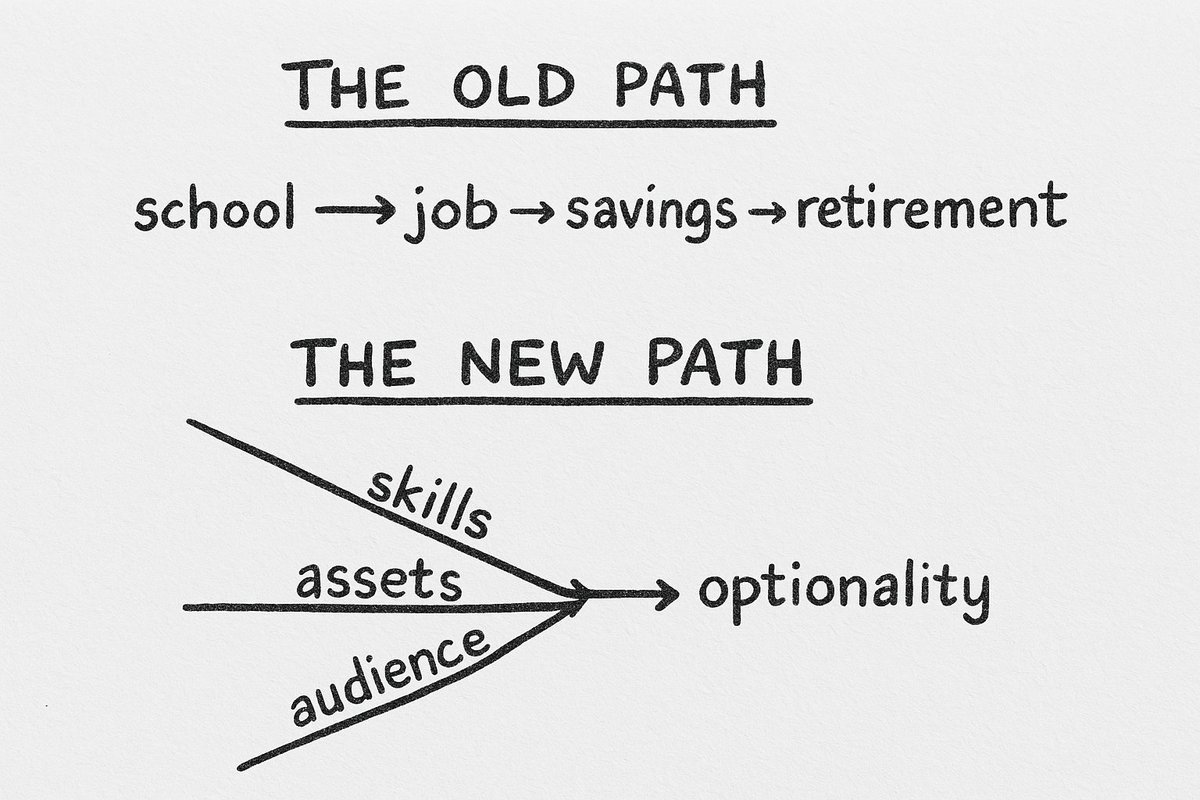
if you want more out of your career, READ this: the old path was linear: school → job → savings → retirement. the new path is convergent: skills + assets + audience → optionality. we keep applying industrial-age career advice to an AI-powered economy, and it's causing millions to live unhappy professional lives. i think the most valuable people today they're the convergence players building three things simultaneously: 1/ skills: vibe coding, vibe marketing etc. UNDERSTAND THE TOOLS (replit, v0, chatgpt etc) like a wizard. not just content creation, but AI-human collaboration. not just management, but community orchestration. 2/ assets: digital products, content libraries, data moats, and micro-SaaS tools that generate income while you sleep and appreciate over time. 3/ audience: direct relationships with people who trust you, bypassing platforms, institutions, and algorithms. the magic happens at the intersection. your audience adopts your assets. your assets showcase your skills. your skills attract your audience. this is why the designer with 50,000 X followers can launch a $500K product with a single tweet while the better designer sends out desperate job applications. this is why the developer with 3 tiny SaaS products making $2K/month each has more leverage than the senior engineer earning $250K at google. this is why the writer building an email list while ghostwriting for executives has more security than the career journalist. the system isn't designed to teach this approach. universities, HR departments, and even venture capital still operate on linear achievement metrics. they want to know where you went to school, where you worked, or how fast you're growing in a single dimension. BUT THIS IS WHAT FIRES ME UP the opportunity has never been greater for those who see it. the tools to build skills, create assets, and grow an audience are more accessible than at any point in history. The future is bright.

"Hire people who give a shit." by Alexandr Wang, founder of Scale AI

If you were to build our global financial rails from scratch you’d optimize for five things — (1) global (2) cheap (3) fast (4) open and (5) programmable. Irrespective of ideology, stablecoins are the optimal first-principles reconstruction of our global financial system.

Stablecoins: Payments Without Intermediaries The internet made information free and global. So why is it still so hard — and expensive — to move money? The early internet promised a future where anyone could publish, build, or transact without permission. Protocols like email

Avoid these 9 mistakes 👇 1. Losing sight of dreams and falling into work for work’s sake (W4W). 2. Micromanaging and e-mailing to fill time. Set the responsibilities, problem scenarios and rules, and limits of autonomous decision-making—then stop, for the sanity of everyone involved. 3. Working where you live, sleep, or should relax. Separate your environments—designate a single space for work and solely work—or you will never be able to escape it. 4. Not performing a thorough 80/20 analysis every two to four weeks for your business and personal life. 5. Striving for endless perfection rather than great or simply good enough, whether in your personal or professional life. Recognize that this is often just another W4W excuse. Most endeavors are like learning to speak a foreign language: to be correct 95% of the time requires six months of concentrated effort, whereas to be correct 98% of the time requires 20–30 years. Focus on great for a few things and good enough for the rest. Perfection is a good ideal and direction to have, but recognize it for what it is: an impossible destination. 6. Blowing minutiae and small problems out of proportion as an excuse to work. 7. Making non-time-sensitive issues urgent in order to justify work. Focus on life outside of your bank accounts, as scary as that void can be in the initial stages. If you cannot find meaning in your life, it is your responsibility as a human being to create it, whether that is fulfilling dreams or finding work that gives you purpose and self-worth—ideally a combination of both. 8. Viewing one product, job, or project as the end-all and be-all of your existence. Life is too short to waste, but it is also too long to be a pessimist or nihilist. Whatever you’re doing now is just a stepping-stone to the next project or adventure. Any rut you get into is one you can get yourself out of. Doubts are no more than a signal for action of some type. When in doubt or overwhelmed, take a break and 80/20 both business and personal activities and relationships. 9. Ignoring the social rewards of life. Surround yourself with smiling, positive people who have absolutely nothing to do with work. Happiness shared in the form of friendships and love is happiness multiplied.

Steve Jobs on storytelling


Jack Haldorsson @Jackhaldorsson
13K Followers 12K Following partner @lunarstrategy @creator_wire @turtledotxyz

Alfreda O'Keefe @AlfredaK63335
141 Followers 5K Following

Teresa @Xihi9344409
50 Followers 1K Following

Kevin Schellinger @k_schellinger
14K Followers 2K Following Tech Entrepreneur | Co-founder @1deltaDAO | Building DeFi's best founders network @DeFiFounders | 🇨🇭 Crypto OG | Forbes 30 Under 30
porda @davidportmann_
12 Followers 83 Following
Engin Caglar @EnginChaglar
4K Followers 4K Following Work at the intersection of AI, Blockchain and Tokenization One Person One Billion Dollar Blue Prints: https://t.co/eOUFvsQZQp
henrik br @bredi030
556 Followers 773 Following
Cate @categcc
1K Followers 2K Following 🪄 marketing, content & community building • 🎩 wearing many hats: https://t.co/azhsWEaQe5 • 💫 @shefiorg S9 • member of @wikieditoraslx
Execution Pioneer @executionpioee
4 Followers 616 Following 𝑇ℎ𝑜𝑠𝑒 𝑤ℎ𝑜 𝑤𝑒𝑟𝑒 𝑠𝑒𝑒𝑛 𝑑𝑎𝑛𝑐𝑖𝑛𝑔 𝑤𝑒𝑟𝑒 𝑡ℎ𝑜𝑢𝑔ℎ𝑡 𝑡𝑜 𝑏𝑒 𝑖𝑛𝑠𝑎𝑛𝑒 𝑏𝑦 𝑡ℎ𝑜𝑠𝑒 𝑤ℎ𝑜 𝑐𝑜𝑢𝑙𝑑 𝑛𝑜𝑡 ℎ𝑒𝑎𝑟 𝑡ℎ𝑒 𝑚𝑢𝑠𝑖𝑐
Klaytn Quicksilver @klaytnquicksie
5 Followers 624 Following Buysell nfts 💰 create an nft entire collection directly from our platform 🎨 create an nft staking pool via our automatic tool to reward your community 🚀

Mana Shadow @s_haddowmana
6 Followers 634 Following Vibing on the web3 🌊 • marketing 📈 • community builder 🏗️ • dm for business 📥 • btc bnb okx trx avax
Klaytn Star @klaytnstsra
6 Followers 654 Following We are creating x-clusive acrylic wall art of your nft's. metadata included and qr code optimized.
Fibonacci Trailblazer @fibonncciatrai
5 Followers 554 Following Gm23 founder. five years into the crypto industry. live to the end in this market=💰💰💰 nft | eth | bitcoin | crypto | web3

Airdrop Djinn @djinnniirdropa
8 Followers 648 Following Jpeg collector and crypto enthusiast | not an influencer just a degenerate
Dogecoin Seeker @seekerdogecocn
5 Followers 607 Following 👩🚀astronaut mindset exploring and sharing about web3 💎 imaginary ones whale since day 1 🦖 experienced investor&advisor nft equity startup
Graph Mist @mimtsgrhpha
5 Followers 509 Following Follow me if you love nft dm is open only for business purpose. follow the instructions on the website link below to get proper reply from us.
Celo Whisper @whisperclo
10 Followers 647 Following Crypto trading - charting a course through the exciting digital frontier
Sed Note @sesdn_otte
6 Followers 632 Following A collection of 10, delightfully cute moles on ethereum blockchain.
Ar Barbarian @arbarbaria30
4 Followers 583 Following Envisioning a future where blockchain technology reshapes societal systems
Algo Madelyn @madely_nalglo
5 Followers 613 Following Promoting defi to level the financial playing field


Metal Wrapped @wrapppedmeetal
4 Followers 565 Following ~ i am da'at i am ~ life an expansion of consciousness ° 11 nfts ° original exclusive artworks to nft masterpieces °
Polkadot Baroness @baronessspoolk
5 Followers 574 Following 🦊 the ultimate web3.0 solutions provider | nft platform | premiere gamefi destination | pioneer launchpad | dao governed by $babi 🚀
Yfi Ellie @yfielllie63
10 Followers 626 Following Win nft hero is a next-generation, 3d cartoon-style strategy game based on bsc and tron
Trend Conquistador @trendconquisad
12 Followers 635 Following Believing in blockchain's ability to decentralize and democratize
Utk Karma @karmauutk
9 Followers 580 Following savagenft is a nft project that has consistently provided value to the nftcommunity. with many utilities and amazing collections. truly an underrated brand
Decentralized Enthusi... @decentralizeen
6 Followers 576 Following Co-founder the hodl 🫡, nft investor 📈, tech couture ✍️
Bat Caster @batcaste
7 Followers 499 Following Promoting defi as the game-changer for financial access
Security Dynamo @dynamsecurity
6 Followers 572 Following Nft artist & collector🎨 supporting the nft community. hey girl hey boy, land of whimsy💫 nurodivergent alien from planet earth
Buy Ice @icebuyy68
7 Followers 499 Following Join the wild, meme-filled world of balatroon. a gaming universe where the greatest rewards await players ready to risk it all! powered by $gob & $chunks
Ai Pioneer @ppioneeraii40
5 Followers 605 Following The platform where nfts come together with the art of ambigram. ethereum
Elliott Thunder @thundeerelliot
5 Followers 695 Following Social influencer || dm for promotions || crypto & nft promoter|| btc nft bnb web3 eth trx pepe newprojects raynewinners
Bitcoin Trickster @krickstertbitc
6 Followers 603 Following Level 20 argonian ceoproducerinvestor - chaotic neutral - golgari agent
Stoploss Scarlett @stoplossscarlr
7 Followers 607 Following Promoting the defi revolution for a more inclusive financial world
Buy Empress @buuyemprre_ss
3 Followers 641 Following Riding the wave of crypto market's volatility, anticipating the tides
Steem Zoey @stteemzoey
5 Followers 661 Following The 1 source of upcoming nfts calendar on twitter ⚡️


Cel Enchanter @cc_elenchanter
5 Followers 608 Following Making my mark in the digital art world with unique nfts


Avalanche Autumn @utumnavalache6
8 Followers 555 Following All about digital assets - cryptocurrency. updates. news. advertising.
Bittorrent Apex @bittoorrentape
5 Followers 627 Following The first ever nft project to reward holders for their engagement and activity. discord: discord.ggaarifkara 🧡🤝
Digibyte Crusader @digibytecrusaa
4 Followers 647 Following Join the fluffiness! 🦔 hand-drawn nft project with reallife impact.🎨 everybody fluffy! 🦔🥰 check out the two cute collections!
SingularityNET @SingularityNET
151K Followers 53 Following Our mission is to create decentralized beneficial AGI for humanity and other sentient beings. We are a Founding Member of the @ASI_Alliance, powered by $FET.
porda @davidportmann_
12 Followers 83 Following
Jenny Eriksson @JennyEr72415785
1 Followers 46 Following
rama @_cryptorama
298 Followers 734 Following Proptech, Food, Health & Consciousness | Always Building 🛠

Fabiola Luna Huerta @fab_lunah
229 Followers 605 Following
Alexander Spahn @AlexanderSpahn
109 Followers 174 Following Co-founder @veertly | Creating exciting and robust virtual event experiences
Daniel Popa @_DanielPopa
272 Followers 1K Following Looking to reinvent the way we think about money through @theAnchor_io - the one true #stablecoin.

Joel @joelschm1dt
37 Followers 363 Following

Zukisani @Zukisan18431996
39 Followers 274 Following
Giwhea @giwhea32801
69 Followers 7K Following
Pieter Perrett @utzenstorf
1K Followers 3K Following Swiss-based Professor, lectures: leadership & project mgmt, Switzerland. Interest in Asia, AI & disruptive business models🇨🇭🇬🇧
James Bong @0xjamesbong
1K Followers 4K Following

Henrique Jorge @HenriqueJorge__
966 Followers 5K Following Founder of #ETER9, an avant-garde and experimental AI-driven social network designed to extend human presence beyond the constraints of time and availability.
Lukas Sieber @LukasSieber
1K Followers 951 Following Enabling smarter expansion to new locations @UpsiteSystems | attracting US tech to @GreaterZurich | co-founder @Mindfire_Global | Ex @aisotHQ & @SwissEmbassyUSA
Ralf Kubli @RRKUBLI
1K Followers 784 Following used gopher, coded html in '94, remember Mosaic? back in tech with #crypto, #DLT, @_cv_vc_. Views are my own.
Johanna Olea. @ruthiolea
422 Followers 2K Following Art, sustainable ways of life, nature, fintech ~no order~
Kirill Varlamov @ongridpro
300 Followers 2K Following CTO and systems architect at @DefinmeAG. Pushing the boundaries of possibility with transformative solutions in DAOs, DeFi and Web3.
Mathias Ruch @MathiasRuch
937 Followers 289 Following
E @RoomEngin
321 Followers 1K Following
Martin C. Meyer @martincmeyer
1K Followers 3K Following Entrepreneur +++ Head Innovation - Global Wealth Management, UBS AG +++ "Rethink Wealth Management!" +++ "Think 30 years ahead!" +++
Simon ~ 📱👔📹 @eggwhisk
9K Followers 10K Following Building an #edtech startup for #neurodivergent children 🚀 #AI #crypto #startup ❤️ #Everton #StarWars #beer
Christian König @finanzprodukt
5K Followers 6K Following Financial Products-Professional (ETF, Derivatives) with Social Media & Online /Content Marketing Expert KnowHow. #Finance20 #Fintech First Mover

David Bundi @DavidBundiX
4K Followers 5K Following
Kevin Schellinger @k_schellinger
14K Followers 2K Following Tech Entrepreneur | Co-founder @1deltaDAO | Building DeFi's best founders network @DeFiFounders | 🇨🇭 Crypto OG | Forbes 30 Under 30
Chris_Riedi @Chris_Timeleft
2K Followers 3K Following Consultant, media, helping startups grow Former Global head of ops @TimeleftApp

Brad Furber @bradfurber
2K Followers 4K Following Tech startup coach, advisor and investor, and (US) corporate and securities lawyer. @dukelaw @dukesanford @uw
Daniel Diemers @DanielDiemers
3K Followers 3K Following Strategist with Digital Edge. Interest in Transformation of Society & Economy through Technology. SNGLR. #singularity #ai #fintech #blockchain #crypto #ar #vr +
Bernegger Ventures @BernVen
5K Followers 4K Following Supporting passionate entrepreneurs - Investment company of @marcpbernegger focusing on #Bitcoin (since 2012) and #Longevity (since 2020)
Ralf Glabischnig @GLRalf
3K Followers 3K Following Entrepreneur. Invested. Involved. Co-Founder @theCryptoValley @CryptoOasisUAE @inactaventures, Commited to build the #WEB3 ecosystem #Switzerland & #MiddleEast
Engin Caglar @EnginChaglar
4K Followers 4K Following Work at the intersection of AI, Blockchain and Tokenization One Person One Billion Dollar Blue Prints: https://t.co/eOUFvsQZQp
DeFi Degen the III�... @MrDiamondHands4
2K Followers 2K Following Mastering DeFi includes sleepless nights, a pintch of failing and a hand full of ruggedness. I'll do it. follow along.
Elie🔺 @ElieRest
4K Followers 652 Following CEO and Co-Founder of @Colonylab accelerator of #Avalanche | Managing @cai_index | Building #LiquidVesting : the first liquid grey market on-chain!
Shiv Malik @shivmalik
18K Followers 6K Following Building Forest City 1. Author of books. Co-Founder of @inter_gen. https://t.co/WsSzqewlfD
Herbert R. Sim @HerbertRSim
366K Followers 351K Following PhD(c), MBA | CMO @WebseaOfficial 🌊 VC https://t.co/zjtLNJnVNp 📊 https://t.co/oNUDO3nhNJ (1999) 🧠 https://t.co/QgASuahnNZ (2002) 🧬 @FortuneZnet 🎰🎲🃏


Sergio Mello ⚓ @sergiofly
3K Followers 2K Following Global Head of Stablecoin Solutions at Anchorage Digital @anchorage

⭐️Danielle Guzman... @guzmand
46K Followers 12K Following Coaching employees & brands to be unstoppable on social media | #FutureOfWork Influencer | Global Head of #SocialMedia @MarshMcLennan | #Career #Leadership
ganeshraju.eth | Rapi... @_GaneshRaju
648 Followers 5K Following Co-Founder @RapidEVChargE @AkshayaNFT @akshayaCoin #Startup #Investor #phygital #NFT #DigitalTwin #Metaverse #Crypto #ElectricVehicle #ChargingStations #EV
Sing @0xSing00
117 Followers 445 Following Business Development - @dwflabs Web3 | Blockchain | InvestmentTrends for United States
You might like