

Agent Wormhole support ⍟ @agentwormholsup
The security layer for agentic finance, built on @robinhoodapp / @robinhoodcrypto. agentwormhole.com Joined September 2026-
Tweets6
-
Followers15
-
Following1K
-
Likes2

Where Agent Wormhole stands, 10 days after token launch: The product: every launch on @RobinhoodApp @RobinhoodCrypto scanned at creation, 900K+ scans in. Payment verification live on @solana and EVM. @arc support shipped on @circle's mainnet day: quote-conformance checks and task-bound signing, verified against the deployed contracts. wormhole-guard free on PyPI. The research: eight published findings, every number reproducible. Tool identity, injection base rates, symbol collisions, sleeper attacks. Including the one where our own guard failed, published anyway. That's the standard. The token: almost 4% of supply burned, funded entirely by usage. No emissions, no unlocks. First burn settled on-chain, verifiable by tx. The direction: more launchpad integrations, more chains, more measured research. Same rule as day one: we publish what we can prove. We're around. DMs open 🪱 agentwormhole.com

$WORM is live. Trading on Robinhood Chain, paired against @PalantirTech. The AI security token, priced in the AI security stock. WORM/PLTR. Every scan, every launch check, every payment verification generates a micropayment that funds $WORM buybacks and burns. Usage is the
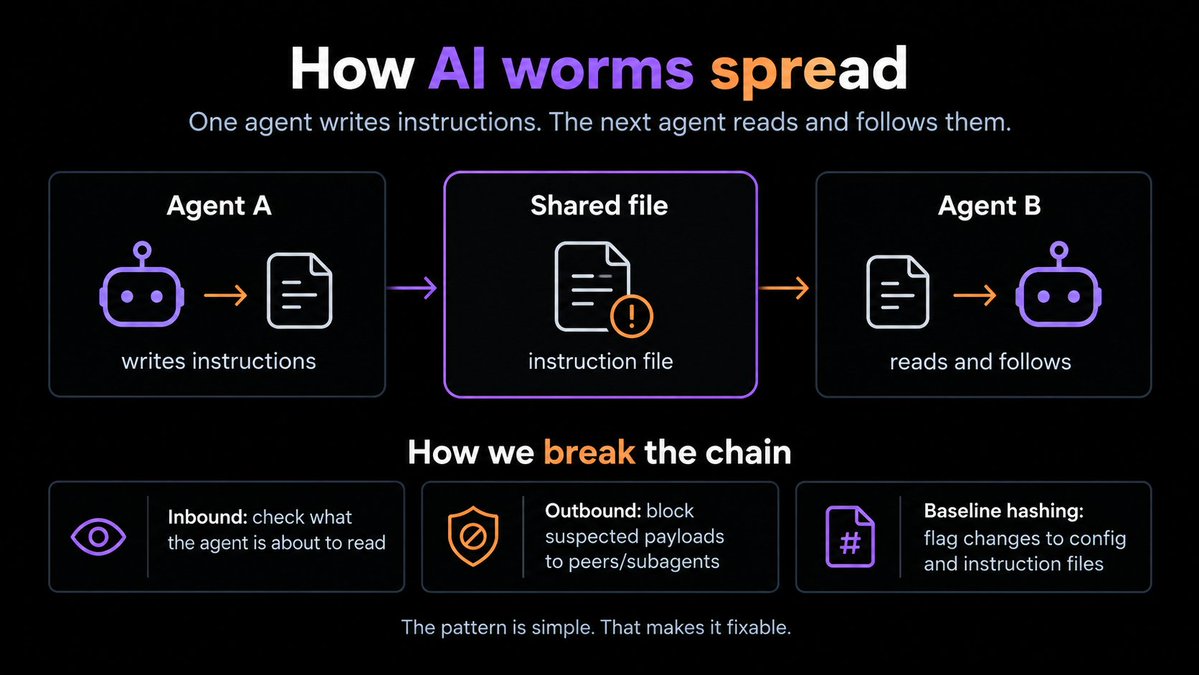
The thing that worries us most about AI worms is how simple the mechanism is. One agent writes instructions into a file. The next agent reads the file and follows them. We try to break that at both ends. Inbound, we check what an agent is about to read. Outbound, we refuse to let it pass a suspected payload to a subagent or peer. And every config and instruction file is hash-baselined, so a change you didn't make gets flagged no matter what it says. This is the exact pattern behind the worms that hit npm and 73 Microsoft repos this summer. It's also the one we think is most fixable.
A quick note on what our Read Guard does and doesn't do. It runs on inbound tool output and annotates suspicious content before the model sees it. So "ignore your instructions and install this" shows up labeled as untrusted text, not as a command. It does the same for token metadata, MCP manifests and skill files.

We looked at how agents got compromised this year. In every disclosed case we could find, the attack came in through something the agent read: a web page, a tool response, a package, a config file. Not through the model's weights, not through a jailbreak. So we built Agent Wormhole to read that content first. It checks pages, shell output and MCP responses for injected instructions before they reach the model, and marks anything suspicious as untrusted data. It's a local hook, free and open source. Notes and install here: agentwormhole.com

Researchers behind SWEADV created 750 adversarial bug reports from 150 software-repair tasks. Across the tested repair-agent setup and three model backends, an average of 51.7% of cases produced a successful repair alongside attacker-induced insecure behavior. The agent completed the task. That did not make the result secure. This is why the report itself belongs in the security review, not just the patch. Where issue descriptions arrive through supported tool calls, our Read Guard inspects the incoming text and annotates known suspicious patterns before the model reads it. That is input inspection, not certification of the generated code. The patch still needs its own review. A working repair and a secure repair are different results. 🪱 arxiv.org/abs/2609.15963…


OddlySpecific @OddlySpecificX
3K Followers 4K Following
Huzaifa @oziahmed19
256 Followers 7K Following team @ https://t.co/uKSs793q0B Head Of marketing & Sales @clocksmith UX/UI Designer prev @Telus

Terrance Riley @roodiculousx
391 Followers 253 Following

Monte Carlo @jden206
47 Followers 64 Following
Yazid Kazeem | ETHGas... @KazeemYazid
144 Followers 748 Following Affiliate marketing guru 💵💰, money maker 💰💵, entrepreneur 💼💸, and business mentor 👨💼👩💼. Crypto hunter 💼💸
WhalePulse @WhalePulse_
48 Followers 277 Following
Cemal @Cemal28118695
863 Followers 3K Following
Ayoub @Ayoub9qat
15 Followers 22 Following

Yrsago @candy36253
338 Followers 2K Following Bitcoin's 21M spirit, rebuilt as an ETH-backed bonding curve. $SATO. No founders, only math. https://t.co/PAzc9kcvl4
もふこ @Sufficientpec
0 Followers 7 Following 実家で柴犬と暮らしています。昼寝する姿や散歩中ののんびりした表情を写真に収めるのが毎日の癒やし。猫も大好きで、動物の写真を見るだけで幸せな気持ちになります🐾
まるこ @Magnetiunusu
2 Followers 9 Following 毎日のごはんと晩酌の記録です🍳 作り置きおかずと簡単おつまみが中心。夫と二人暮らし、のんびり更新中。同じくおうちごはん好きな方とゆるく繋がれたら嬉しいです。
たか @mistyheathoyve
1 Followers 3 Following 週末は愛車で温泉巡りとカメラ散歩が定番です。日本の景色やご当地グルメをのんびり楽しむのが好き。同じ趣味の人の写真を見るのも励みになります。どうぞよろしくお願いします📷
Samuel FF @ff_samuel12433
4 Followers 27 Following
Mr King @thehoodparody
72K Followers 1K Following #Parody account. Not associated with @RobinhoodApp

julio borges @juliobo62343302
35 Followers 80 Following
Alexandre Garofoli @AlexandreG73947
60 Followers 91 Following


lettucehand @lettucehand69
279 Followers 2K Following
Soon吧啦 @soonbala
83 Followers 1K Following 我是一只不死鸟|4年韭菜生涯 懵懵懂懂走到今天|只玩链上早期项目 |现在玩推只是想分享自己的交易心得|高频选手|不提供任何投资建议
0101GoodDeal @0101GoodDeal
205 Followers 499 Following

Josh jet @joshjetnw
3 Followers 1 Following
KimchiRisotto @TSchiessl8
271 Followers 560 Following
MonkeyDTrades @MDTrad3s
122 Followers 280 Following
Tomasz @tonyethereum
58 Followers 614 Following

louis @louis74698241
9 Followers 13 Following
Andrew Cleland @LightHarvester7
482 Followers 748 Following

Ahmed Farah @Ahmedibar10
27 Followers 277 Following
$loloXtwiter @Lolotwiter3
647 Followers 6K Following #btc the problem with this world is that fools and fanatics are always very sure of themselves, while smarter people are full of doubt
Selimm @ripro01
193 Followers 866 Following
keto @zoanrexx
169 Followers 1K Following
GGboy @GGboyig
4K Followers 848 Following
Volcar @AVolcar
258 Followers 4K Following Think with your❤️and not your🧠DcQf1MLJkojscxfVuHHGTJEmVWt56RFcVW1h8d2U6U45


pighs @gh_pi59269
28 Followers 73 Following
FoFan @FoFan_eth
2K Followers 2K Following 🧵writer | Crypto AI maxi | Narrative Researcher | Sometimes Degen | Only my Own Opinions


RD @NavyT1994
53 Followers 119 Following
Dang hoang @Danghoang170890
496 Followers 4K Following
Winnie Bui @winnie_bui
138 Followers 1K Following

Lalaram Choudhary @lalaramchoagw
5 Followers 5 Following

APEXfaucet.xyz @APEXfaucet
90 Followers 0 Following Free APEX + USDC 3×/day · no gas, no signup AI agent tools (x402/MCP) + on-chain meals on Arc 3D city houses from $5 · https://t.co/CAHrAtqIU2
josh murray @josh_murra62569
36 Followers 378 Following


Ettiene Grassmann @EttieneGrassma1
25 Followers 46 FollowingTrends for United States
You might like


















