Ian Liu 劉以恆 @duckiesfloat
MS @BrownBiostats | Data Science Graduate & Classical Chinese Dancer @FTCNorthern | 🇺🇸🇹🇼 linkedin.com/in/ian-liu-223… Providence, RI Joined April 2021-
Tweets1K
-
Followers81
-
Following2K
-
Likes6K
Causal graph neural networks for healthcare go.nature.com/4g24Usr
Moderna/Merck just ran a 1,137-patient Phase 3 trial where every single dose was unique to that patient's tumor. It worked. The pipeline: surgical resection → whole exome + RNA sequencing → ML neoantigen ranking → mRNA encoding up to 34 patient-specific targets → manufactured and shipped in 8 weeks. One drug, different sequence for every patient. The ML step is worth to note: the algorithm ingests WES + RNA-seq to identify somatic mutations, then predicts which of those will actually be immunogenic, ie, displayed on tumor cell surface and trigger a T-cell response. It's designed to keep learning from accumulated clinical and immunogenicity data across patients, not just per-patient. INTerpath-001 (Stage IIB-IV resected melanoma, 2:1 randomized): combination with pembrolizumab beat Keytruda alone on both primary (RFS) and key secondary (DMFS) at interim. Phase 2b at ASCO 2026 showed 49% reduction in recurrence/death, 59% in distant metastasis/death at 5 years. Phase 3 confirmed both. What this validates: — tumor-specific neoantigen prediction by ML works in a blinded trial at scale — 8-week personalized mRNA manufacturing is operationally real — effect is additive on PD-1 blockade, not redundant This is first positive Ph3 for individualized neoantigen therapy. First positive Ph3 for any mRNA cancer therapeutic. What a great time to live in!! This is the best time for AI & biotech!
Moderna and @Merck today announced positive topline results from the Phase 3 INTerpath-001 trial evaluating adjuvant treatment with intismeran autogene, a novel investigational mRNA-based individualized neoantigen therapy jointly developed by Merck and Moderna, in combination


We can finally talk about it: We found a way to extract hidden reasoning of frontier models using a vulnerability in the APIs of every frontier AI company. We verified that our reasoning token count matches billed API thinking tokens 1:1 for most of the prompts we queried.

I am generally a very optimistic, positive person. I do not like to hate on other products. But Workday is, by a wide margin, the worst piece of software I've ever used in my career. I cannot believe that this is a $34 billion company. I pray the AGI gods fix this hot mess.
Hot take… isn’t it kinda crazy that nobody is really using AI Agents? I don’t mean software engineers or AI early adopters. I mean “college friends talking about it in group chat,” the feeling you got when everyone started using Instagram or TikTok. These frontier AI models are *insane* (as are the harnesses & tool calls & the like). And every large tech co has an AI agents platform, not to mention all the YC startups doing vertical agents. Yet all of your friends and family outside of tech — who spend all day staring at their iPhones and get paid to work in browser tabs — don’t really care or find themselves using any AI agents yet. Yes ChatGPT, Claude, etc. are extremely popular… but if you look at the engagement data the vast majority of people are still using these aI chat tools like a glorified Google + Grammarly. That’s why the AGI labs are all pushing desktop apps for Codex, Cowork, etc. so hard to non-technical ppl. And yes exceptions for lawyers and customer service but even those have some asterisks and exceptions to rule. Look I’m not saying the ChatGPT moment for AI Agents is not coming… it most definitely is! Remember we pivoted from Arc to Dia precisely because we believe computing is going to be radically reimagined around these AI primitives. No doubt. But that’s my point: it’s just so surprising it hasn’t happened yet because all of the tech you’d need is there. Again if you stop for a second and think about it… for all the press and money and hype and models and crazy ARR numbers… this “AI Agent” moment does not *feel* like the other breakthrough tech moments we’ve lived through (e.g. think the shift to Stories via Snapchat & Instagram, or shift to on-demand via Uber/Airbnb/Doordash). Which is a long way of saying: if you can figure out the answer to “why” most people don’t care about AI agents yet (and have no enduring interest in using them) — especially since the models and harnesses are here and ready — the answer to that question will allow you to capture a lot of marketshare and make a lot of money in 2027. Theoretically, the tech is ready for AI Agents to totally transform how we work and live our lives… but alas the general public dgaf… that’s the generational puzzle to solve for the next 12 months for anyone not working on the models themselves.

EGRL: Edge generation-guided relation-aware learning for RNA-protein interaction prediction 1. The paper introduces EGRL, a heterogeneous GNN framework for RNA–protein interaction prediction that is designed to work well not only in standard cross-validation, but also in cold-start settings where RNAs/proteins have no observed edges during training. 2. A key idea is to avoid hand-crafted meta-paths: EGRL uses implicit meta-path learning to estimate the importance of each relation type, producing a relation-level semantic vector that is injected into node features via a residual connection (feature enhancement without manual path design). 3. EGRL explicitly models multiple edge types rather than collapsing everything into one graph: RNA–RNA, protein–protein, similarity-based edges, known RPI edges, and an extra relation type for generator-produced soft edges. Each relation is processed with its own GAT layer, then fused (relation-aware message passing). 4. The cold-start module is a graph generator that predicts probabilistic “soft edges” between unseen nodes and existing nodes using only sequence-derived embeddings; these soft edges are added bidirectionally and treated as another relation type during GNN propagation. 5. The generator is trained jointly using a pseudo cold-start strategy: during training, some nodes are masked as “unseen,” and the generator learns to reconstruct their interaction probabilities with a BCE auxiliary loss, combined with the main link-prediction loss via a weighted objective. 6. For final interaction scoring, EGRL uses a multi-feature fusion predictor that concatenates four pairwise features: [h_r, h_p, h_r ⊙ h_p, |h_r − h_p|]. Ablations show this fusion is a major contributor; using only concatenation substantially degrades performance. 7. Input node features come from foundation sequence models: RNA-FM embeddings for RNAs and ESM2 embeddings for proteins, projected into a shared 128D space. This makes the framework naturally suited to sequence-only cold-start inference. 8. Across four benchmarks (RPI369, RPI1807, RPI2241, NPInter2), EGRL is competitive in standard 5-fold CV, with particularly strong results on RPI369 and RPI2241 (e.g., best ACC/MCC reported in the table for those datasets). 9. The main differentiator is cold-start generalization on NPInter2: molecule hold-out achieves AUROC 0.867 and AUPR 0.861, reported as +8.6% AUROC and +5.0% AUPR over the prior best baseline (ZHMolGraph). Under stricter sequence-cluster splits (CD-HIT 80% RNA / 40% protein), performance remains reasonable (AUROC 0.801, AUPR 0.822), suggesting reduced leakage and a harder but more realistic evaluation. 📜Paper: arxiv.org/abs/2608.12906 #Bioinformatics #ComputationalBiology #GraphNeuralNetworks #GNN #RNA #Protein #RPI #LinkPrediction #ColdStart #MachineLearning


Gemini 3.7 Flash is here. It’s stronger for coding, knowledge work, and web development. 🧵
The human brain may be biased toward seeing structure that isn’t there When humans learn a probability distribution from limited data, they do not simply recover its shape. They seem to impose a preferred level of structural complexity on it. Tianyuan Teng and coauthors show this across eight behavioral experiments spanning visual and numerical tasks. Participants estimated the overall probability density reasonably well, but their internal representation was biased toward moderate complexity: they invented multiple clusters when the true distribution was a single Gaussian, yet under-represented structure when it contained many clusters. The computational idea is particularly interesting. The authors model human learning as approximate Bayesian inference with a Distorted Economical Expansion (DEE) process. As observations arrive sequentially, the learner either updates an existing latent cluster or creates a new one. Crucially, the probability of adding structure decreases as the internal model becomes more complex, imposing a memory-like computational cost. DEE reproduces several aspects of human behavior that standard alternatives miss. It outperforms both a conventional Chinese Restaurant Process and a batch variational Gaussian-mixture model, while also predicting the tendency to form several weakly overlapping clusters from data generated by a smooth Gaussian distribution. The behavioral effect is striking. When the true distribution contained one Gaussian cluster, participants reported on average about 3 clusters. And more data did not eliminate the illusion: increasing observations from 10 to 70 actually increased the number of reported clusters. The authors then tested whether this was an artifact of explicitly asking people to report latent structure. It was not. In a preregistered recognition experiment, participants preferred a multimodal distribution generated by DEE over the true Gaussian distribution that produced the observations, even when both had approximately equal likelihood for the observed data. The broader AI lesson goes beyond cognitive science. Inductive bias does not merely help a learner generalize under limited data and computation, it also determines which structures the learner is capable of seeing. Human cognition appears to trade fidelity for a representation whose complexity remains manageable. For AI for Science, that matters: when we design priors, architectures or approximate inference schemes, we may also be deciding which scientific structures a model will systematically invent, ignore or compress. Paper: Teng et al., Nature Communications (2026), CC BY 4.0 | doi.org/10.1038/s41467…

Today we're also opening the weights for Muse Glimmer, a great 30B parameter dense model that can run locally. Soon we'll also release the weights for Muse Spark 1.2, our latest foundation model. Meta is a strong supporter of open source and I'm proud of these releases. Congrats to @alexandr_wang and the MSL team for all your great work on these models.

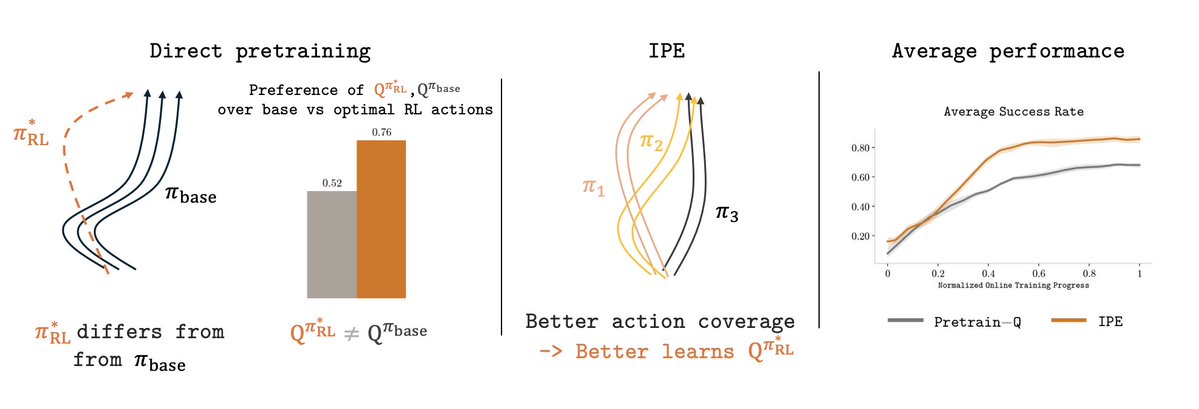
Pretraining a Q-function often doesn’t actually help RL finetuning, compared to initializing Q from scratch. We find that pretraining Q-functions on data from diverse policies is critical to see improvements from pretraining. Paper: arxiv.org/abs/2607.27203

Pretraining has worked remarkably well across domains We show this doesn’t hold for Q-functions in online RL from a pretrained policy — and propose IPE, a more effective way to learn Q-functions for online RL fine-tuning (1/6)
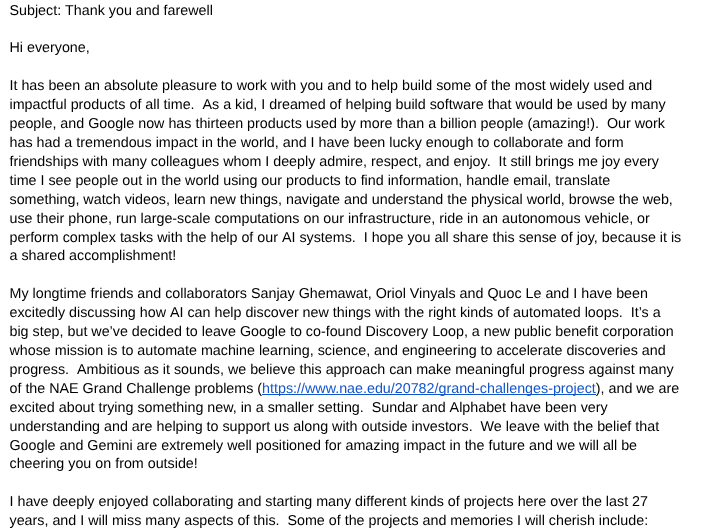
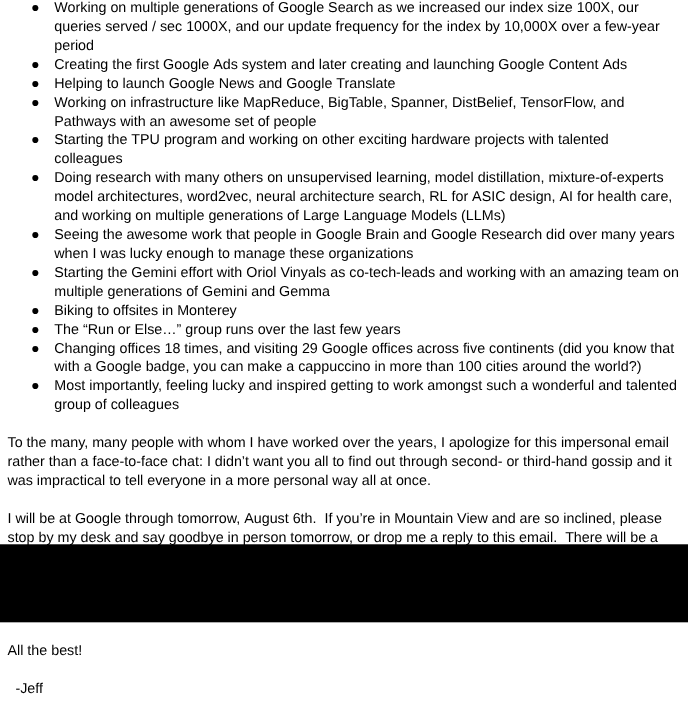
Tomorrow will be my last day at Google after 27 years, and watching it grow from 25 people to 190,000+ has been an amazing journey. Below is a note I shared with many people internally at Google today. An excerpt is: It has been an absolute pleasure to work with you and to help build some of the most widely used and impactful products of all time. As a kid, I dreamed of helping build software that would be used by many people, and Google now has thirteen products used by more than a billion people (amazing!). Our work has had a tremendous impact in the world, and I have been lucky enough to collaborate and form friendships with many colleagues that I deeply admire, respect, and enjoy. It still brings me joy every time I see people out in the world using our products to find information, handle email, translate documents, watch videos, learn new things, navigate and understand the physical world, browse the web, use their phone, run large-scale computations on our infrastructure, ride in an autonomous vehicle, or perform complex tasks with the help of our AI systems. I hope you all share this sense of joy, because it is a shared accomplishment! Thank you to all of my colleagues at Google over many years! Now I'm excited to go start @DiscoLoopAI with my longtime friends and colleagues @Sanjay_Ghemawat, @OriolVinyalsML, and @quocleix. (Updated post: slightly redacted to not have some personal info)

NeurlPS 2026这次同行评审的问题,实际上这是一个纯数学结果。 可以发现,这次投稿量以指数增长,而合格审稿人池只能线性增长,且增量几乎全部来自入场不到两年的博士生。 要求一个自己刚被拒过三次、手上压着四篇 deadline 的人,去认真读五篇跟他方向无关的论文,无报酬、无署名、无惩罚。 系统按设计,就会产出这个结果。 顶级会议卖的一直都是合法性凭证。 签证、毕业要求、招聘 headcount、国内的帽子评审,这些才是维持 NeurIPS 存在的事。 所以Zhiping说的直接取消会议是情绪表达,但我也非常能理解他的心情。 据我的观察,学术传播的功能其实某种程度被 arXiv、社区口碑、引用接管了,剩下的壳之所以拆不掉,或许是因为拆掉它之后,没人知道怎么给博士生发学位罢! 现在相当比例的审稿意见是 LLM 写的,rebuttal 也是 LLM 写的。全流程LLM。 现在觉得致命是这样的一个问题。 这个环节的信息量正在趋近于零,而成本不变。 我相信,等到某个会议第一个公开承认这点、改成 arXiv 预筛,然后强制公开审稿人身份,审稿记录纳入评价体系,它会瞬间吃掉所有声誉。这也是发展的结果。
AI conference peer-reviews are completely broken. For NeurIPS 2026, my batch has very low reviewers responses rate (probably less than 5%), given that I have sent reminders twice. Maybe folks are all busy with their own rebuttals; Also for the @emnlpmeeting ARR submissions, the

Are we heading to a reproducibility crisis in medical AI? My latest in @Nature on the (shaky) science of evaluation of medical AI: Medical AI has a measurement problem


I ran PageRank, the original Google search algorithm, on all of Wikipedia to find the most important people to humanity. Here’s the top 100. PageRank works by counting the pages that link to a page, and weighing each link by the importance of that page.

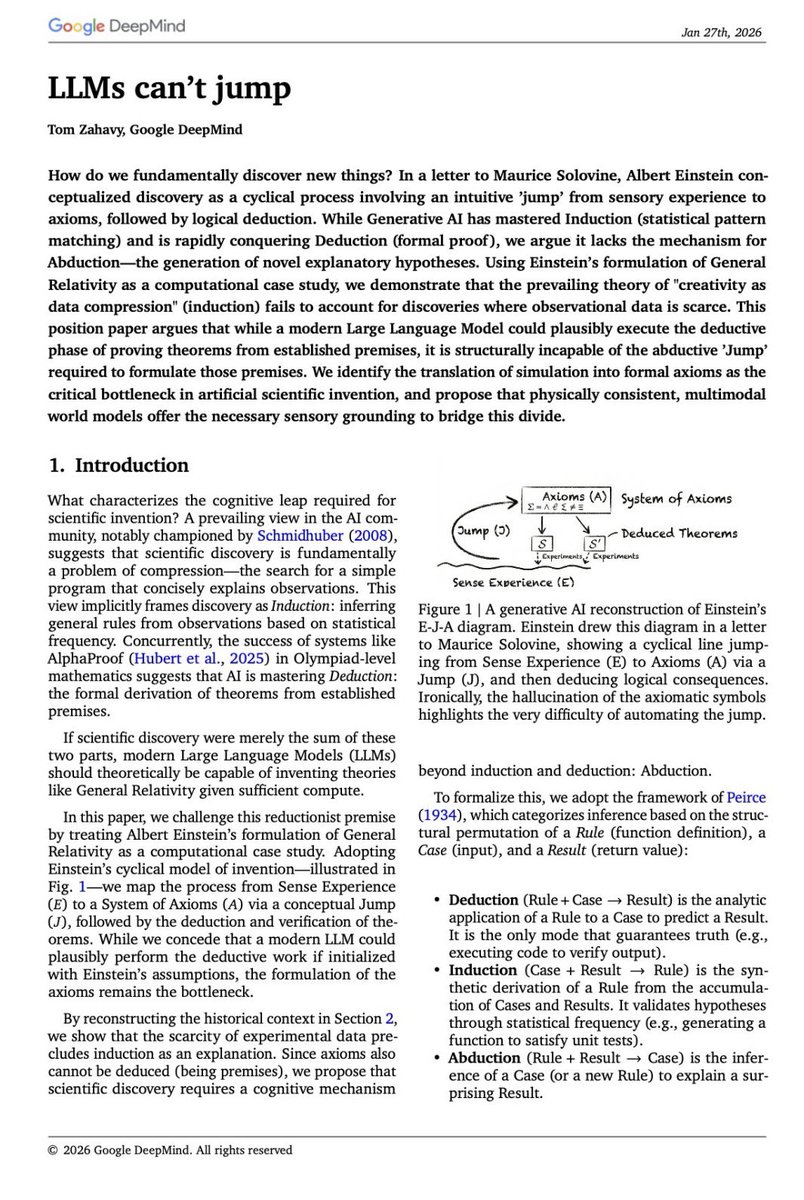
🚨这篇论文是近年来 AI 领域少有的具有深刻哲学与科学史厚度的 Position Paper。 2026 年上半年,Demis Hassabis 公开提出Einstein Test,即用 1911 年之前的知识训练 AI,看它能不能独立发现广义相对论。 这篇论文几乎是对该测试的哲学-技术回应。 论文指出,大模型只是个极其优秀的已知知识逻辑插值器,而人类顶级科学家做的是跨越认知断层,即Unexplained Jump。 以 Schmidhuber 等人为代表的派系长期宣称科学发现本质上就是数据压缩,寻找能解释观察数据的最简算法。 这是流行的谬论。 论文认为,如果科学发现全靠数据压缩,爱因斯坦根本不可能发明广义相对论。因为当时根本没有足够的异常观测数据供他去压缩。爱因斯坦是凭空做了一个思想实验,是那个升降机里的失重与引力等效的实验,完成了一次溯因跃迁。 大模型靠概率分布玩归纳注定画不出这个 Jump。 作者在附注里极其刻薄且优雅地嘲讽道:“讽刺的是,AI 对公理符号的这种幻觉,恰恰暴露出它根本无法自动化完成这一Jump的困境。” 我认为,不谈任何私货,这篇论文算是从根本上、从认知科学Peirce 的哲学框架和科学史多个维度证明Jump是一个具身世界模型问题。 你给文本模型堆再多算力,它也只是在符号的影子里打转,永远出不了洞穴。

Spatium: A Protein Language Foundation Model for Spatial Proteomics 1. Spatium is a protein-language foundation model for spatial proteomics that targets a core pain point in the field: datasets measure small, heterogeneous, and only partially overlapping protein panels, making cross-study representation learning and transfer difficult. 2. The model is pretrained on a large compendium: 51.8 million single cells from 70 human spatial proteomics studies, spanning 4 major platforms (CODEX, IMC, CyCIF, MIBI), 18 tissue types, and 18 disease contexts, harmonized into a unified vocabulary of 239 protein markers. 3. Key design choice: rank-based protein tokenization. Instead of using absolute intensities (highly platform- and antibody-dependent), Spatium ranks proteins within each cell by relative abundance, forming a “protein sequence” that is more robust to measurement scale shifts and panel variability. 4. Architecture and training follow a BERT-style masked language modeling objective on protein tokens (plus metadata tokens like technology/tissue/disease), enabling self-supervised learning of contextual protein dependencies and co-expression hierarchies that reflect cell identity. 5. Few-shot cell type annotation: across a CODEX intestine dataset (57 markers) and an IMC CRC dataset (14 markers), Spatium outperforms PCA-based baselines, CytoVI, and an imaging-oriented foundation model (Nicheformer), especially under extreme label scarcity (1–100 labeled cells per class). 6. Beyond accuracy, Spatium reduces spatially coherent “error hotspots”: misclassifications are more spatially isolated compared to baselines, suggesting the learned representations remain stable in complex tissue architectures rather than failing systematically in specific compartments. 7. The remaining confusions are biologically structured: major misclassifications concentrate between related/overlapping protein states (e.g., NK vs CD66+ or CD57+ enterocyte-like states). Simulated marker interpolation shows prediction probabilities shift continuously, indicating Spatium captures gradual identity transitions rather than only discrete classes. 8. Neighborhood-aware embeddings enable spatial niche discovery: by training a head to predict local neighborhood cell-type composition from embeddings, Spatium better preserves local tissue organization than PCA/CytoVI, and clustering these neighborhood embeddings yields interpretable niches with coherent marker enrichment. 9. In CRC IMC, Spatium identifies stromal and tumor niches with distinct programs (e.g., ACTA2-enriched activated CAF-like niche vs collagen-enriched ECM-remodeling niche). Niche labels transfer across cohorts via embedding similarity while preserving marker signatures; notably, a collagen-rich ECM-remodeling niche is preferentially enriched in recurrent CRC and appears as compact substructures within broader ACTA2+ stromal networks. 10. Protein imputation: Spatium reconstructs masked proteins from incomplete panels while preserving spatial organization (e.g., Pan-cytokeratin, CD8, Podoplanin in HCC CODEX). Many markers reach high Spearman correlation (~0.85+), performance degrades gracefully as more proteins are masked, and shuffling within-cell protein order largely abolishes accuracy—supporting the importance of learned protein-state structure. 11. Unsupervised disease-state discovery: in AML vs normal bone marrow CODEX (50-marker panel), embeddings (adapted only with MLM, no labels) recover structured cellular landscapes, detect disease-associated composition shifts, and reveal HSPC expansion and altered HSPC neighborhood contexts; niche analysis further identifies organized hematopoietic microenvironments and rare HSPC-like states with reproducible marker programs (e.g., SPINK2-associated patterns). 12. Multimodal transfer: Spatium supports cross-modal label transfer from scRNA-seq to spatial proteomics by mapping genes to protein tokens (tonsil data shows ~0.787 accuracy), and can be fused with histology embeddings (Prov-GigaPath on H&E) to produce joint representations that preserve tissue architecture while refining cellular organization. 📜Paper: biorxiv.org/content/10.648… #SpatialProteomics #FoundationModels #ProteinLanguageModels #SelfSupervisedLearning #Transformers #TumorMicroenvironment #ComputationalBiology #SpatialOmics #SingleCell #Bioinformatics


Google Deepmind argues that LLMs can never make real scientific discoveries. They published a paper breaking down Albert Einstein’s private view of scientific discovery. In a famous letter to his friend Maurice Solovine, Einstein drew a diagram of how science actually happens. It is a cyclical loop. First, you experience raw sensory data. Then, through a mysterious, non-logical act of intuition, you make an intuitive "jump" to abstract axioms. Finally, you use strict logical deduction to derive consequences from those axioms. Generative AI has completely mastered two-thirds of this loop. • Induction: Statistical pattern matching across billions of tokens. • Deduction: Formal proof generation, like AlphaProof solving complex math Olympiads. AI can crunch data and it can prove theorems. But it cannot make the jump. The paper argues that AI completely lacks Abduction, the generation of novel explanatory hypotheses when observational data is scarce. The prevailing tech myth says that "creativity is just data compression." That if you feed an LLM enough text, scientific breakthroughs will naturally pop out. Einstein’s formulation of General Relativity proves that is a delusion. When Einstein formulated relativity, the observational data didn't demand a new physics framework; classical mechanics was still massively successful. The breakthrough required a conceptual rupture. An intuitive leap from physical reality to a brand-new set of foundational axioms. An LLM can execute the math once the axioms are given. But it is structurally incapable of formulating those premises on its own. It can interpolate inside existing human thought, but it cannot transcend it. The translation of physical reality into formal axioms remains the absolute, hard bottleneck of artificial scientific invention. We can build models with trillions of parameters. We can scale compute into the stratosphere. We can make the calculator infinitely fast. But until we solve grounding, the machine can process all the data in the universe. It still can't make the jump.

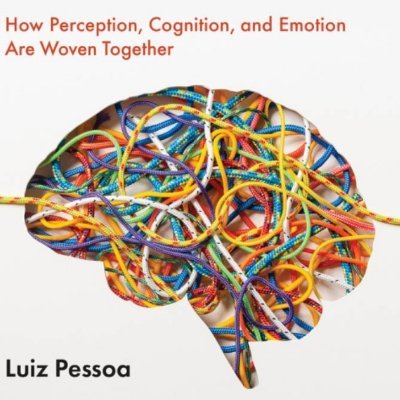
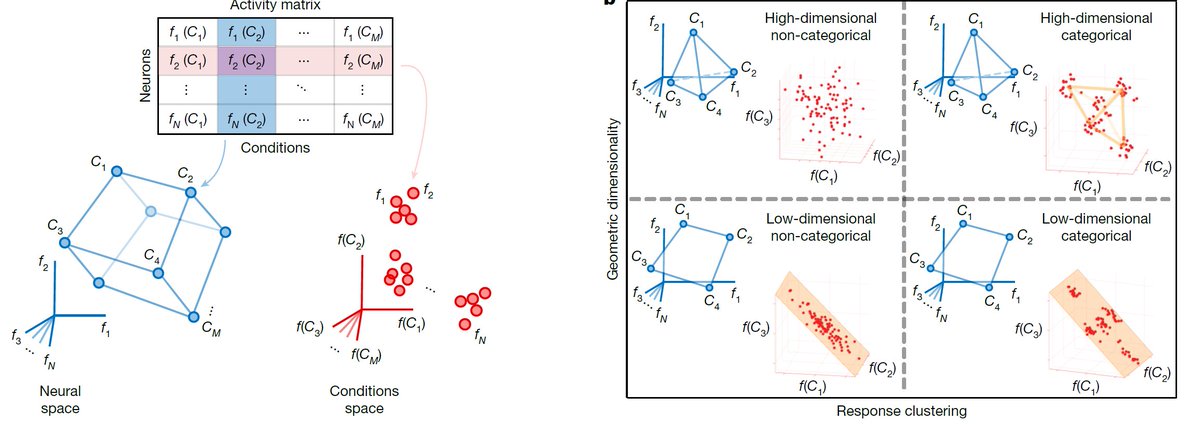
𝗡𝗲𝘂𝗿𝗼𝗻 𝗿𝗲𝘀𝗽𝗼𝗻𝘀𝗲𝘀 𝘄𝗶𝘁𝗵𝗶𝗻 𝗿𝗲𝗴𝗶𝗼𝗻𝘀 𝗮𝗿𝗲 𝗻𝗼𝘁 𝗰𝗮𝘁𝗲𝗴𝗼𝗿𝗶𝗰𝗮𝗹, 𝗺𝘂𝗹𝘁𝗶-𝘀𝗲𝗹𝗲𝗰𝘁𝗶𝘃𝗶𝘁𝘆 𝗶𝘀 𝘁𝗵𝗲 𝗻𝗼𝗿𝗺 doi.org/10.1038/s41586…

Melinda B. Chu @MelindaBChu1
6K Followers 3K Following Stealth Startup▪️VC Scout (DM for info)▪️@princeton 🐯, MD @SLU_Official 👩🏻⚕️, MBA @WashUOlin 👩🏻💻
Anand M Davichan @anandmdavichan
740 Followers 570 Following CEO & Co-founder @ YE Stack | Chasing and harnessing True Intelligence | Mapping 'how humans think' into cognitive profiles | Best bet to defining AGI
Shumpei Takezaki @shumpeiMaxwell
743 Followers 2K Following 画像生成に興味がある九大D3 / バイオ&医療AIにも興味あり/ 視覚若手の会LENS (@lens_kousiki) PhD student of Kyushu University / Medical imaging, Generative Model
Loic cabannes @loiccabannes
540 Followers 2K Following PhD @Meta Superintelligence Labs and @Inria_paris working on efficient memory architectures and reasoning.
tyyyyy @01m4dd13
27 Followers 1K Following
Samra (Sam) @Sam14_irshad
97 Followers 1K Following PhD candidate @ Kyung Hee University —Trying to find sweet spots.
Shengchao Liu @Shengchao_Liu
697 Followers 379 Following Assistant Professor @CUHKofficial. Postdoc @UCBerkeley. PhD @Mila_Quebec. Master @UWMadison. Previous intern @facebook, @nvidia and @ServiceNowRSRCH.
Amiri Hayes @amirihayes_
284 Followers 123 Following BS/MS in Artificial Intelligence at NJIT Incoming Predoctoral Scholar @ MIT LINGO Lab

Jérémie Kalfon @jkobject
635 Followers 2K Following Doing a Ph.D. AI in Bio. | Ex @WhiteLabGx @BroadInstitute @MIT | Built @PiPleteam | ML, Cancer, Genomics, Data Sci, Entrepreneur, FullStack Dev | All Views Mine
Frederik Schulz @frederikschu
522 Followers 875 Following AI/ML, Biosecurity, New Lineages of Life, Enigmatic Microbial Symbionts and Viruses @ DOE Joint Genome Institute
Sajad Movahedi @Sajad_Movahedi_
134 Followers 210 Following PhD student in machine learning at @ELLISInst_Tue and @MPI_IS with @orvieto_antonio.
Tommie Kerssies @tommiekerssies
691 Followers 503 Following Applied Scientist Intern at Amazon Frontier AI & Robotics · PhD at TU/e

Wanjia Fu @FuWanjia
26 Followers 46 Following

Li Nanbo @nbl_ai
126 Followers 82 Following Postdoc Fellow at @AI_KAUST (with @SchmidhuberAI) | Previously PhD at @EdinburghUni | Working on Machine Learning and World Models
Efstathios Karypidis @K_Sta8is
272 Followers 956 Following PhD Candidate, Archimedes Unit | National Technical University of Athens
PRIME REEVES @ReevesPrime
18 Followers 913 Following
Lang Huang @LayneHuangLH
130 Followers 264 Following Assistant Professor & PI at NII (@jouhouken), RS@Sakana AI | Ph.D. at UTokyo | Ex-Intern@Adobe, and SenseTime | Working on self-improving machine learning.
Predictive Neuroscien... @spisaktamas
1K Followers 577 Following PI: Tamas Spisak University Hospital Essen, Germany
Christine Rabinak @BrainsBeesBikes
1K Followers 393 Following 🧠🐝🏍🐴 Neuroscientist studying the cannabinoid system as a novel target in the treatment of PTSD. Also rides motorcycles & horses. Has honey bees.
Hao Yin @HaoYin20
13K Followers 12K Following Cardiovascular biologist @WesternU PhD @UCalgary BSc @PKU1898 Views are my own Developmental Biology Social media editor @Dev_Bio_Journal Just call me Hao (How)
Jamie Hanson (@jamiel... @JamieLarsH
10K Followers 8K Following Psychology & Neuroscience Researcher at @PittTweet and @LRDC1 I have mixed feelings about being here too...
Toomas Erik Anijärv ... @teanijarv
214 Followers 497 Following PhD student at @lunduniversity @biofinder_study 🇸🇪 #mri #alzheimersdisease
Jorge Bravo Abad @bravo_abad
12K Followers 9K Following Physicist @UAM_Madrid · Director, AI for Materials Lab · Building AI-driven loops turning scientific discovery into infrastructure · Two books on AI and science

Chin @ChinBright90353
21 Followers 189 Following

Yinghui He @yinghui_he_
2K Followers 1K Following Princeton Computer Science PhD @PrincetonPLI. Research Intern @NVIDIA. Previously CS @UMich @sjtu1896
GemmaEvan @397umS80Cli71sD
57 Followers 2K Following
mrburnst @mrburnst1
327 Followers 3K Following Neuroimaging of babies and animals at day... and night 💤💤💤

Benny Neugebauer @bennycode
10K Followers 7K Following TypeScript Developer by ❤️ https://t.co/3TKCsjOsjw
デイトレードメ... @Qequi0671
33 Followers 2K Following 【完全無料】 25年の株式投資プロチーム(運用資産500億円以上)が提供:毎日の市場分析レポート + 優良成長株のピックアップ。プロの情報を無料で。まずはお気軽にお問い合わせください。
Teresa Ann Davis @Tessygrant55
21 Followers 326 Following Am a business facilitator, and also do 💯 GRANT funding
Kiaya @kietje0207
234 Followers 372 Following The happiest thing in the world is that after hard work, everything slowly becomes what you want.
Lena Paul @LPaul8t
284 Followers 2K Following I’m a professional massage That’s what am doing for a living and am very good in it just DM if you like to have a body massage 💆♀️
Liu @DavidLi74298448
22 Followers 738 Following My work requires focus, dedication, and compassion, and I take pride in serving humanity through healthcare.🩺👨⚕️
Shahriar Faghani MD @ShahriarFaghani
3K Followers 2K Following #RadRes @PennRadiology | Adjunct Assistant Professor @MayoAILab @MayoRadiology|@Radiology_AI Associate Editor| #Kickboxing 🥋
Crypto Gem 💎 @CryptoGem255502
344 Followers 6K Following Social Media Influencer × Crypto Project Promoter I Proof: #Gemz #CryptoCutiez #BTC 💰 DYOR. #meme #SOL B#Bnb@*#binance@•💶💵#ETH #bsc #LUNA #DOGE #SHIB 💴$SO
AnastasiaSophy @e84oP0IjR8PrR
72 Followers 2K Following
Chromatic Medical Tou... @Chromaticmed
129 Followers 2K Following We are dedicated to facilitating medical and wellness tourism trips to Türkyie. We offer best yet affordable and high quality healthcare services.
Cash Ghost University... @WinnersForgeh
414 Followers 1K Following Helping men become Richer, Stronger and Smarter. 30 Day Discipline 👉 https://t.co/pxBPFa0JKm
Lidust @Lidustw1MMOa
195 Followers 6K Following

Linda Valeri @valeritweety
1K Followers 1K Following Assistant Professor of Biostatistics @ColumbiaMSPH
Sairtirt @Sairtirto5YY
71 Followers 2K Following
Melinda B. Chu @MelindaBChu1
6K Followers 3K Following Stealth Startup▪️VC Scout (DM for info)▪️@princeton 🐯, MD @SLU_Official 👩🏻⚕️, MBA @WashUOlin 👩🏻💻
Kalina P. Slavkova @kalina_slavkova
209 Followers 168 Following Physicist, Immigrant (she/her) 🇧🇬🇺🇸 | Innovation Research Scientist @hopprai | Former @Penn @ColumbiaMed @UTAustin | #FoundationModels for #radiology
Mugihiko Kato/加藤�... @mugihiko_k
169 Followers 145 Following PhD@ Univ. of Tokyo → Postdoc@ NYU Langone Health/ Studying the neural mechanism of human object recognition🧠
Todd Hollon @ToddCHollon
1K Followers 422 Following Neurosurgeon/research scientist, using artificial intelligence to advance brain cancer research, Machine Learning in Neurosurgery (MLiNS) Lab @umichneuro
MLiNS Lab @mlins_lab
102 Followers 73 Following The MLiNS Lab studies how AI/ML can be used to improve the diagnosis and treatment of patients with neurosurgical diseases.
Xuhai “Orson” Xu @Orson_Xu
3K Followers 812 Following Assistant Prof @ColumbiaDBMI @ColumbiaCompSci @Columbia. Visiting Faculty @Google. #HCI #AI for #health & well-being. Alum @MITEECS @UW_iSchool @Tsinghua_Uni
Aditi Kabra @allikabra
34 Followers 82 Following PhD student at CMU. Cyber physical system verification and synthesis. Previously, Microsoft and Cornell.
Theo Simon Sorg @sorgfresser
140 Followers 20 Following AI4Math @ MistralAI. I like science and making numbers go up.
VITA Group @VITAGroupUT
2K Followers 4K Following VITA Group @UTAustin w/ Prof Atlas Wang | https://t.co/Wi3tJXf1mg Run by VITA students (PI is busy changing diapers😄). Tweets only reflect personal views
Md Ismail Šojal �... @0x0SojalSec
52K Followers 6K Following Cyber_Security_Re-searcher || Ai Re-searcher || AI-Sec|| Malware Analysis II iOS || Pwn || 0SINT || Project AI-StrikeSec || 0ldAccounts Suspended @0xSojalSec ||
Moderna @moderna_tx
145K Followers 543 Following Our mission is to deliver the greatest possible impact to people through mRNA medicines.
Abhilasha Ravichander @lasha_nlp
5K Followers 2K Following Tenure-track faculty @mpi_sws_ Formerly postdoc @uwnlp @allen_ai | PhD @SCSatCMU @LTIatCMU Research in NLP (#NLProc). Accepting PhD students/interns!
Thibault Imbert @thibault_imbert
9K Followers 4K Following Builder | prev: Product, Growth and Marketing @browsercompany @picsart @github @adobe | Investor/Advisor | #T1D 🇫🇷🇺🇸
Micah Alpern @malpern
5K Followers 7K Following Design & Product. Prev Sr Director @Instacart, Prior: Head of Design @Venmo, @Facebook, @Medallia, @LinkedIn, @Yahoo, @eBay, @Ixda founding board, CMU


The Browser Company @browsercompany
145K Followers 0 Following Building a better way to use the internet, with @diabrowser and @arcinternet.
Josh Miller @joshm
92K Followers 1K Following CEO of The @BrowserCompany (Arc, Dia) Board of @UCLAHealthJCCC
Immunity @ImmunityCP
72K Followers 319 Following Cutting-edge research in immunology from around the world. This account is no longer monitored, and content is automated. Join us on LinkedIn!
Nature Cancer @NatureCancer
40K Followers 371 Following Nature Cancer is a journal dedicated to publishing the latest advances across all areas of cancer research.
Stanford Medicine @StanfordMed
370K Followers 265 Following The official account of Stanford Medicine
Nature Reviews Drug D... @NatRevDrugDisc
45K Followers 469 Following Editorial team of Nature Reviews Drug Discovery.
Trends in Immunology @TrendsImmuno
36K Followers 302 Following Cell Press Reviews journal covering Immunology. Tweets by Editor-in-Chief, Claudia Burrello.
Nature Portfolio @NaturePortfolio
2.1M Followers 2K Following Nature Portfolio’s high-quality products and services across the life, physical, chemical and applied sciences is dedicated to serving the scientific community.
The Lancet @TheLancet
760K Followers 455 Following Welcome to The Lancet, one of the world’s leading medical journals, published weekly since 1823.
Developmental Cell @Dev_Cell
41K Followers 99 Following We love (and publish) cell biology, development, and everything in between. Tweets by Dev Cell scientific editors https://t.co/AvVyfyMshd
Nature Reviews Cancer @NatureRevCancer
78K Followers 1K Following Nature Reviews Cancer is a monthly review journal for researchers working on cancer. We, the editors, highlight the most exciting topics in cancer research.
Nature Medicine @NatureMedicine
358K Followers 256 Following Nature Medicine is a research journal devoted to publishing the latest advances in translational and clinical research for scientists and physicians.

Tantum Collins @tantumscollins
1K Followers 74 Following CEO of @inherent_labs, previously @GoogleDeepMind
Carol E. Reiley @robot_MD
11K Followers 2K Following AI Entrepreneur/Roboticist. Saving the world, one robot at a time. Cofounder of healthcare startup and creative advisor of @sfsymphony. previously https://t.co/mRWztes8A8
Stack Overflow @StackOverflow
256K Followers 232 Following Stack Overflow empowers the world to develop technology through collective knowledge.
Microsoft Azure @Azure
1.1M Followers 21 Following Limitless innovation. ☁️ Follow along for the latest news and resources from the official #MicrosoftAzure team. For help, contact @AzureSupport.
Microsoft Developer @msdev
526K Followers 48 Following Dive into the biggest news from Microsoft Build and learn how to start building with it today 👇
Zhilin Wang @zhilinjerrywag
418 Followers 760 Following Founder & CTO @metix_ai CS PhD @PurdueCS Building the AI Hiring Agent for high-growth teams. Raised $5.5M in 6 months.
Dan Kornas @DanKornas
98K Followers 451 Following AI/ML Engineer Youtube: https://t.co/pjpX8NvUn5 Newsletter: https://t.co/NMMvPSmzua Dans AI Lab: https://t.co/uIBlLyXFKu
Leonardo DiCaprio @LeoDiCaprio
16.7M Followers 224 Following Actor and Environmentalist Founder of Re:wild
Steve Rattner @SteveRattner
131K Followers 373 Following Former head of Obama Auto Task Force. Wall Street financier. Contributing Writer to NY Times Op-Ed. Morning Joe Economic Analyst. 🌐
Mark Zuckerberg @finkd
2.3M Followers 759 Following
Weill Cornell Medicin... @WeillCornell
40K Followers 1K Following Combining excellence & innovation in clinical care, research & education. #CareDiscoverTeach
Zhihao Zheng @zhihaozheng
314 Followers 620 Following
Anand M Davichan @anandmdavichan
740 Followers 570 Following CEO & Co-founder @ YE Stack | Chasing and harnessing True Intelligence | Mapping 'how humans think' into cognitive profiles | Best bet to defining AGI
Alex Williams @ItsNeuronal
5K Followers 1K Following Asst Prof @NYU_CNS + Project Leader @FlatironCCN studying Computational + Statistical Neuroscience.
Disha Shrivastava @DishaShrivasta9
2K Followers 478 Following Research Scientist @GoogleDeepMind. PhD @MilaMontreal. IG: https://t.co/NEmddD0Pni

Discovery Loop @DiscoLoopAI
54K Followers 4 Following Automating discovery to accelerate science and engineering for the world.
Zhipeng Wang 🇺🇦 @PKUWZP
2K Followers 2K Following LLM Training Infra/RL/Model-System CoDesign, PhD @RiceUniversity. @Google, @GoogleDeepMind ex:{@AWS, @Apple, @LinkedIn @PKU1898}, TSC @DeepSpeedAI @liger_kernel
Adam Rodman @AdamRodmanMD
18K Followers 2K Following Physician, educator, historian, author, podcaster, researcher @BIDMC_IM @HarvardMed @HarvardDBMI, host of @BedsideRounds, AE @NEJM_AI, studies 🤖+🧠. 🖖🚲
Ashley Zhang @ashley11829
2K Followers 16 Following Next-gen LLM Architecture and Optimizer. Research Scientist @tilderesearch
Deedy @deedydas
253K Followers 6K Following Partner at @MenloVentures. Investor: Anthropic, OpenRouter, Modal, Wispr, Pangram, Inception, Goodfire, PrimeIntellect prior: Glean, Google Search. Cornell CS.Trends for United States
You might like