20th Century Boxing: Icons, Memories & More @20thCentBoxIMM
Brief glimpses into fights, and fighters, of the 20th century; the great, the near great, the very good, the journeymen, the opponents and much more. facebook.com/groups/1805925… Joined April 2025-
Tweets10K
-
Followers451
-
Following291
-
Likes6K
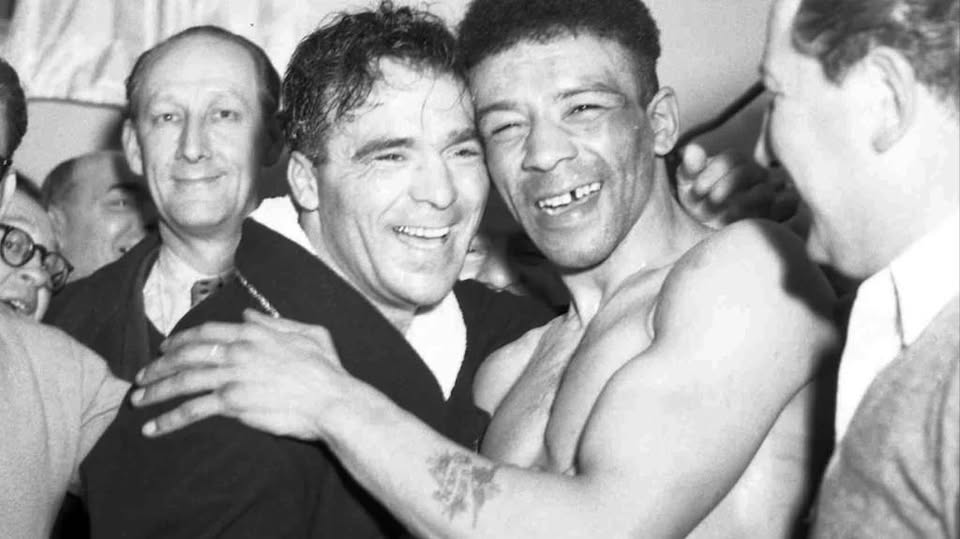
Dick Turpin (right) makes British history on June 28, 1948, at Villa Park in Brimingham, when he becomes the first black man (some seem to think that this nonsense started and ended with only America for some reason) to ever contest for, and win, a British Championship. With his 15-round points win over Vince Hawkins, Lionel Cecil Whitehouse 'Dick' Turpin (older brother of Randy) earns the British and Commonwealth Middleweight Titles. During late 1948 and early 1949, Turpin fought European boxers, drawing and then losing on points against Tiberio Mitri, of Italy, then being knocked out in seven rounds in a non-title fight against the then world middleweight champion, Marcel Cerdan, of France. He then won by a disqualification against another Frenchman, Robert Charron. In June of 1949, he defended his British and Commonwealth titles against Albert Finch, winning on points after fifteen rounds and in September of 1949, he defended his Commonwealth title against Australian, Dave Sands. The fight was at Harringay Arena, and Turpin was knocked out in the first round, and so only retained his British title. Turpin then won his next four fights, losing the fifth, on points to the American, Baby Day, before defending his British title against Albert Finch, whom he had beaten in his previous defence. The fight was held in April 1950, in Nottingham and Finch won on points after fifteen rounds. Having lost both his titles, Turpin had only two more fights, against the Belgian, Cyrille Delannoit, in Brussels, losing on a technical knockout in the sixth, and finally against his old rival Albert Finch, losing on a technical knockout in the eighth. This last fight was in July 1950. Dick Turpin, who also trained his brother (future Middleweight Champion) Randy, would end his own ring career at 83-21-5 (35 KO's).
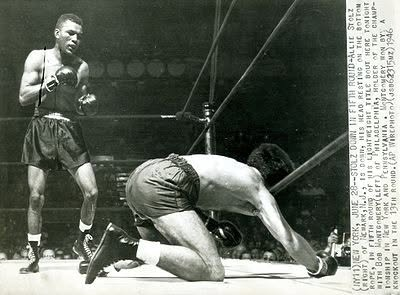
Lightweight Champion Bob Montgomery KO's Allie Stolz, on June 28, 1946, in the 13th round at Madison Square Garden. Stolz was knocked down once in the 2nd, again in the 5th, and for the count in the 13th round. Montgomery would only defend his title once more sucessfully, avenging a non-title KO loss from August of 1946 with a November 2nd round KO of Wes Mouzon. The "Bobcat" would lose his title in August of 1947, via 6th round TKO, to the great Ike Williams. Montgomery had KO'd Williams in 12 rounds in January of 1944 in their first meeting. Montgomery had traded the title back and forth with Beau Jack in 1943 - Montgomery won it in May and lost it back in November, and would regain it from Jack in March of 1944 - and then held it until 1947. In the September 2001 issue of The Ring Magazine, Montgomery would be named the 9th greatest lightweight of all-time.
In a splendid brawl on June 28, 1943, Al Tribuani (Center, right) wins a 10-round split decision over Al "Bummy" Davis at The Philadelphia Arena. Alfred Armand Tribuiani had a 4-1 record with fighters on the 2003 Ring Magazine's list of the 100 Greatest Punchers of All-Time. The only loss of those five bouts was a 10-rounder to Henry Armstrong described by the AP as "Ten rounds of non-stop slugging that left many of the spectators almost as limp as the combatants at the finish." Armstrong, a 5 to 1 favorite, admitted afterwards that it was a "tough fight." adding "I was fighting a superman because he's ambitious and a win over me would have put him right up there. It was tough." From Boxrec on Al Tribuani, who went 34--5-4 (11 KO's) as a pro: As a perennial high school football player Al Tribuani posted 48 AAU victories by the end of his junior year, thirty by knockout, of whom five were district Golden Gloves champions. At times Al performed in football games during the day and fought at night, notably in the finals of the 1939 Philadelphia Daily News Golden Gloves Tournament. In 1940 as a senior in high school, Tribuani won the Diamond Belt in Philadelphia and the New York Golden Gloves Tournament of Champions at Madison Square Garden in the welterweight division. Within the same year he split four fights with Savey Canadeo, winning the second and fourth, reportedly only having marginal differences in the first three bouts. Upon completion of high school, Al was offered scholarships to both Duke and Villanova Universities while his National Guard unit was being activated as a prelim to World War II. He has conflicting birth dates. It appears he joined the Delaware National Guard at sixteen, two years under the required age. In 1941 being selected by team coaches Spike Webb and Sugar Ray Robinson and obtaining a leave from the military, Tribuani won the Intercity Golden Gloves in the middleweight division by knocking out Bob Satterfield in two minutes and forty-nine seconds of the first round at Chicago Stadium. "I'm happy to say I got him before he got me" (1953). Al fought out of the T & C Athletic Association of Wilmington, Delaware. Some felt Tribuani was weakened in making the weight for the Armstrong bout, others felt the bout contributed to Armstrong's loss to Beau Jack. Regardless, it was a great fight, with the crowd being so loud the combatants could not hear the bell at the end of the rounds. His bouts with Bummy Davis were classics. The second bout left Tribuani with a cheekbone fractured in three places, "Even now all I have to do to recall my toughest fight is rub my hand across the left side of my face. The pain and memory of that June night and a great fight against a real game guy flashes quickly to mind" (1953). In reference to Armstrong and Davis being dirty fighters his response was "No, they were just rough, tough fighters and they fought that way" (1976). Al and other members of his National Guard unit were sworn into the United States Army on 26 September 1940 at Jamaica, New York. Tribuani was subsequently sworn into the United States Army for a second enlistment on 19 August 1943 at Camden, New Jersey. Several months later Al transferred to Fort Ord, California where he trained for deployment overseas and served as a boxing instructor. Babe Griffin managed his affairs while he was stationed in California. Tribuani always expressed respect and fondness for Griffin. Al experienced difficulty at times to obtain leave from the military to train; however, his colonel was a boxing enthusiast and permitted him to continue his prizefighting career whenever possible. Tribuani managed to post seven victories and one disputed draw prior to deployment overseas. Al’s deployment conflicted with his pending opportunities to fight Jose Basora and Charley Burley. Tribuani and his representatives attempted to secure a fight with Bruce Woodcock. “Heck, I would have taken a shot at him, going overseas anyway” (1976) Al was deployed to Europe as a infantryman in General Patton’s Third Army, 90th Infantry Division (Tough Ombres), serving in the 358th Regiment (Peragimus), recipients of the Presidential (Distinguished) Unit Citation. In addition to participating in the liberation of the Flossenburg Concentration Camp, he fought in five major campaigns, being decorated for valor. On 28 April 1945, Tech 5 Alfred Tribuani on patrol en route to Rybnik, Czechoslovakia was severely wounded in combat by the Waffen-SS (Nazis). Said combat wounds would result in his retirement from the boxing ring. (We have gone over Al "Bummy" Davis several times here and his story is just as interesting, and also very tragic, so if you'd like to read more about him just type his name in the FB group search box and those posts should come up.)

In a wild Heavyweight Championship bout held on June 28, 1939, at Yankee Stadium, in the 7th defense of his reign atop of the division, Joe Louis will be staggered in round one, and then drop "Two Ton" Tony Galento in the second round before Louis was knocked down in third round. Louis finally rights the ship in the 4th round and TKO's his colorful challenger. From Gene Talbot of the AP: The roof finally fell in on Tony Galento last night and nearly killed him, but before it happened the bold New Jersey barkeep gave a fight crowd in Yankee stadium a succession of thrills it will not soon forget. Yes, Champion Joe Louis butchered the poor galoot, sent him falling to his knees bleeding and helpless so that Referee Arthur Donovan had to stop it in 2:29 of the fourth round. That was almost the pre-ordained result. But Tony gave an account of himself that will enshrine him in the minds of those who saw. Tony, the round-man, never took a backward step. In the third round, when his face already was cut to ribbons and the heart would long since have been beaten out of a less brave fighter, he swung a left to Louis' jaw that sent the champion bouncing on the canvas. In the opening minutes, when the fight was young, he rocked the big, bronze champion to his heels with another terrific left and for a fleeting instant held the championship in the chubby fists that have drawn ten thousand beers. He did everything he said he would do—except knock out "dat bum." Tony, the man they've all been laughing at, climaxed his career with his greatest performance. Louis, who had knocked out his three previous challengers in less than a round each, said it was the toughest fight he ever had. In that terrible last round, when Galento was defenseless, Joe said he had to hit him a dozen times as hard as he ever hit a man before Tony finally fell into the referee's arms, groping for the ropes in a desperate effort to keep his feet. Such a great stand did Galento make that he probably will be matched against Lou Nova, recent conqueror of Max Baer, in September. Through battered, puffed lips Tony begged for another chance at Louis, but he won't get that. Nova, at the ringside after the battle, said nothing would suit him better than a few shots at Tony, except a chance at the champion. "If I ever staggered Louis the way Tony did he never would get away from me," declared the confident young Californian. "If I'd had him on the floor like Tony did, I would have kept him there. The fellow can't take a punch." At that, those who had posted money at 8 to 1 on Louis must have come near swallowing their gullets both times Galento landed on Joe's whiskers. Each time all that saved the champion from serious difficulties was Tony's inability to follow up fast. Tony simply could not shove his 233 pounds forward and strike again before Louis recovered. Louis treated his stubby rival with a world of respect after he got clipped the first time. He claimed afterward that it wasn't caution so much as it was his inability to solve Tony's crouching style. But for a time he stepped very lightly and didn't really open up until a series of terrific left hooks had placed Galento at his mercy. Galento returned to his corner with a cut upper lip at the end of the first round, the first of many cuts he was to receive. They had only been at it a few seconds when Louis whipped over a left to Tony's jaw that spun him to the floor for a two-count. For the remainder of the chapter Joe handed his dazed opponent a bad beating, but could not put him down again. Thus was Tony's knockdown of his tormentor in the third such an electrifying thrill for the crowd of nearly 35,000. Louis had been whipping them into the Orange man's gory face again, staggering him with brutal rights, when Tony from in close brought up a quick right and then a left squarely to the champion's jaw. Joe went down on his pants like he had been clubbed, but quickly braced himself with his hand on the floor and was up again as the timekeeper tolled two. Tony had him going the rest of the round. Louis started the fourth dancing around and keeping out of Tony's reach, watching for the big chance. Suddenly it came. Two left hooks crackled on Galento's jaw like summer lightning, and he swayed like a tilted barrel but didn't go down. In a breath Louis was on him, pounding sledge-hammer blows into Tony's face. Within 10 seconds he made Galento a horrible sight. It was all over. Mrs. Galento cried bitterly when she saw Tony's face as they led him reeling into the Yank's dressing room. Today Louis was heading for Atlantic City for a vacation before returning to Detroit. He didn't know when they would want him to turn his fists loose on another man. Before the fight, Galento was famously quoted as saying in a mangled New Jersey accent, "I'll moider da bum." 68-26-6 (56 KO wins), "Two Ton" Tony Galento remains one of the most colorful characters in boxing history, despite his known propensity for fouls, lack of training, and using every other trick in the book to try and get a win. Short for a heavyweight, standing only 5'9", and weighing 230-plus pounds, Galento enjoyed claiming that he trained on beer, hamburgers and spaghetti. He was a rough-and-tough brawler, but he was not without some skill. He fought out of a very low crouch and would feint his way into a position to launch his left hook, which many consider to be one of the hardest of all time. According to accounts of the time, Galento could also use a decent double jab when he wanted to. Galento's famous nickname, "Two-Ton", came not from his sizable girth, but from his job delivering ice. As the story goes, Galento arrived late for one of his fights, and his manager, Harry Kinney, yelled, "Where the hell have you been? Don't you know you're supposed to fight tonight?" to which Galento replied, "Take it easy. I had two tons of ice to deliver on my way here." Dominick Anthony Galento would open his career with a 3rd round KO of Floyd Shiballa at Laurel Garden in Newark, New Jersey. One of the more comical "stories" about him was that , despite the fights not being on his official record, on May 1st of 1931, Galento reportedly fought three times and won all three fights. He was reportedly drinking beers between rounds of all three bouts. Even though he'd lose four fights in 1931, his antics in and out of the ring must have been entertaining at the least, as he'd knock out Arthur De Kuh in four rounds on April 11th of1932, just hours after he had won a $10 bet by eating 52 hot dogs. 55-19-3 by the end of 1935, Galento would finally start putting wins together more consistently starting in 1936. Soon billed as "New Jersey's Heavyweight Hope," Galento was featured on the cover of the August, 1938, issue of The Ring magazine. He would be featured again, along with Joe Louis, on the cover of the June 1939 issue, which previewed their upcoming title bout. "I don't see anything wrong in sticking your thumb into a guy's eye. Just a little." - Tony Galento, date unknown. Galento knocked out Lou Nova in 14 rounds in September of 1939, following his loss to Louis, and it would benamed the 3rd dirtiest fight of all-time in the December 1997 issue of The Ring. "One of the most disgraceful fights staged since the days of the barroom brawls. Referee George Blake . . . would have retained his reputation as a great referee had he disqualified Galento." was part of The Ring magazine's account of this fight in its December 1939 issue. The Washington Evening Star would write of Galento-Nova: "Tony used everything but a blunt instrument on his dazed and bloody opponent. He heeled, thumbed, elbowed and back-handed the bewildered Nova as he lumbered to victory." Following the Nova bout one could imagine that Galento's lack of training discipline had caught up to him as he was stopped in back-to-back bouts in 1940-41 by the Baer brothers (Max and Buddy). Two years after the losses to the Baer's, in 1943, Galento would come back and win his final three boxing matches, one of them a KO of future pro wrestling legend "Classy" Freddie Blassie. After he retired as a boxer, Galento would also become a professional wrestler and then a wrestling referee. In a publicity stunt, Galento would wrestle an octopus named Oscar in 1946. The match was a publicity stunt staged by Ivar Haglund, who established Seattle's first aquarium in 1938 and had opened "Ivar's Acres of Clams" restaurant in 1946. The press ate it up, especially when it was reported that Oscar died shortly after the bout. However, the octopus actually died of natural causes before the fight. Galento wrestled Oscar's corpse, surreptitiously animated by Haglund. Galento would then own and operate a bar named "The Nut Club" in Orange, New Jersey. And, if you recall the film, Galento would later act in the (Marlon Brando) film On The Waterfront, which won the Best Picture Oscar for 1954. Suffering from diabetes, Galento underwent surgery in June of 1977 to remove his left leg at mid-calf, and his right leg would be amputated in July of 1979. Galento died from a heart attack at St. Barnabas Hospital in Livingston, New Jersey, on July 22, 1979 at the age of 69. Galento's lack of training disipline, and at times and training whatsoever, was a constant source of frsutration to those around him. From boxrec and the late, great Ray Arcel: When Jack Dempsey became Galento's manager in 1933, the former champion asked Arcel to train the young heavyweight. "I told Jack it was a waste of time and money," Arcel recalled years later, "but he was convinced that Galento could be a world beater and so, since we were friends, I agreed." One day, Dempsey quietly strolled into Stillman's Gym and walked up to the balcony while Galento went through the motions of working out. Arcel recalled that Galento "was fatter than ever, hopelessly out of condition, and quite obviously doing nothing about it. . . . He didn't see Dempsey and continued waddling around the ring, clowning and wisecracking as he fooled with his sparring partners. After watching for a couple of rounds, Dempsey came down to ringside. He was wearing a beautifully cut light gray suit, tan and white shoes, and white silk shirt. When Tony caught sight of him, he gave him a big hello. 'You look like a million bucks dis afternoon,' he says to him. 'Never mind how I look, you big bum,' Dempsey answers. 'Let's see you do some work.' " When Galento continued to loaf, Dempsey asked Arcel for some boxing gloves. "He took off his coat and stripped right down to his white silk monogrammed underpants and vaulted into the ring," Arcel said. "Now, Tony," Dempsey told Galento, "I’ll show you how we used to do it." "What he did to Galento in those three minutes was nobody's business," Arcel remembered. "He ripped punches into the pudgy torso from all angles, split his lips with a terrific left, and sent the blood squirting from his nose with a right." Even when Galento threw his arms up for Dempsey to stop, Arcel said, the former heavyweight champion kept going. "He chased after him, throwing punches until I called time. Still breathing easily, Dempsey ducked under the ropes and began to dress while Galento stood shaking his head in a semi-daze and trying to wipe the blood from his face with the back of his boxing gloves. When dressed, Dempsey gave him one contemptuous look. 'That's how we used to fight, Galento,' he said. 'Now I'm through with you. You can find yourself another manager.' Then he turned to me and said, 'You were right, Ray. It's a waste of time trying to make a champ out of this chump.' " Arcel, who briefly trained Galento, would say years later: "He was as strong as an ox, and his powers of endurance and his ability to soak up punishment and absorb pain bordered on the freakish. . . . But outside the ring he was nothing but a comic, noisy man whose circus tent antics and crazy eccentricities certainly brought no credit to the game. Trying to get Galento fit was a farce. The New Jersey Fat Boy dragged his training down to a comic strip level."


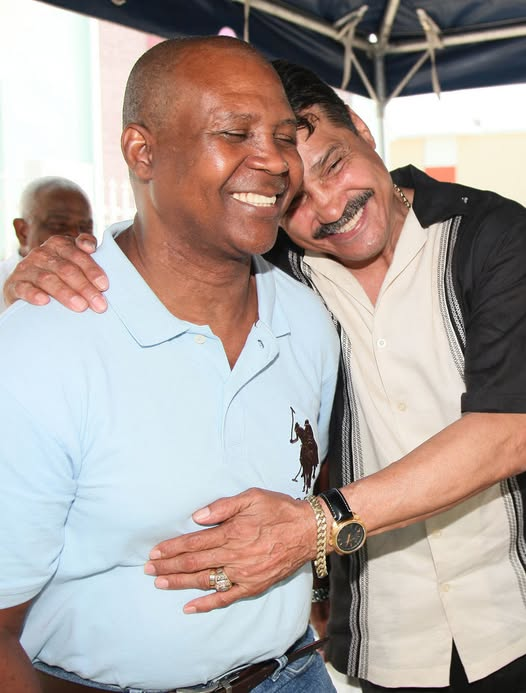
Former foes, Alfredo Escalera (left) and Alexis Arguello, hug on June 27, 2009, during an inauguration of a public boxing gymnasium named after Arguello, in Carolina, Puerto Rico. Arguello, who was also the current mayor of the Nicaraguan capital city of Managua, was found dead in his home on Wednesday, July 1st, just four days later. Argüello died on July 1, 2009, after being accused of shooting himself with two bullets through the heart in Managua. The national police, under Sandinista control, confirmed the death shortly afterwards, and it was declared a suicide following an autopsy. Those close to Argüello, including his daughter Dora Arguello and his sons, asserted that he was killed by the Ortega regime because he had become increasingly disenchanted with the Orteguistas and the Sandinista government, and was planning an imminent departure from the Sandinista political party.
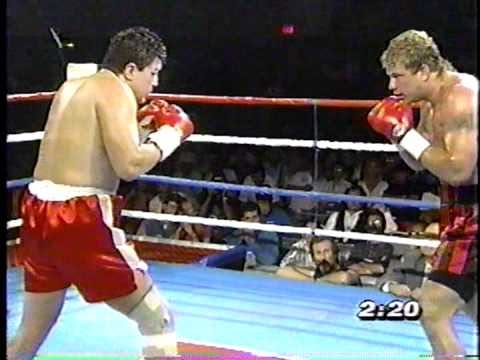
Tommy Morrison (right) scores a 9th round TKO of southpaw Joe Hipp, on June 27, 1992, in Reno, Nevada. Televised live on ABC, Morrison suffered a broken jaw and hand during this bout, and Hipp (an 11 to 1 underdog) had his cheekbone shattered. Hipp was knocked down in the 5th and 9th rounds.
Frank Bruno, with Sir Roger Moore, aka 007, on June 27th of 1989 at the Variety Club Awards Gala.

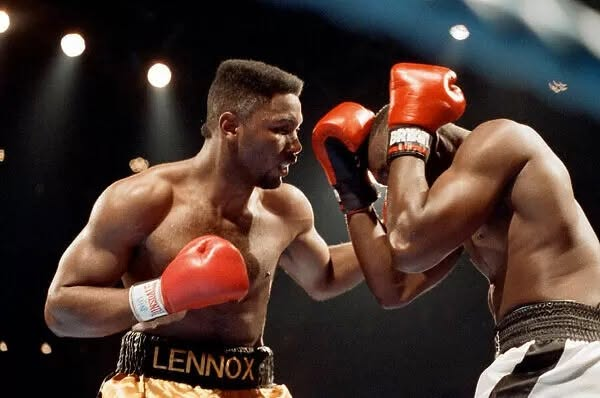
In the professional debut for the 1988 Super Heavyweight Olympic Gold Medalist, Lennox Lewis Ko's Al Malcolm 19 seconds into the 2nd round at The Royal Albert Hall, on June 27, 1989. The bout began with both fighters swinging wildly with wide power punches. A right hand to the body and a left hook to the jaw from Lewis sent Malcolm down in the opening minute of the bout. He was able to get to his feet at the count of eight, and the fight continued. Malcolm remained defensive, despite an occasional connection, for much of the remainder of the round as Lewis threw power shots looking for the knockout. As the opening bell of Round 2 rang, Malcolm came forward and threw a looping right hand but took a left jab to the right eye. He fell forward and went down to all fours, covering his face with his gloves. He remained on his knees with his eyes closed as referee Roy Francis reached the count of ten.
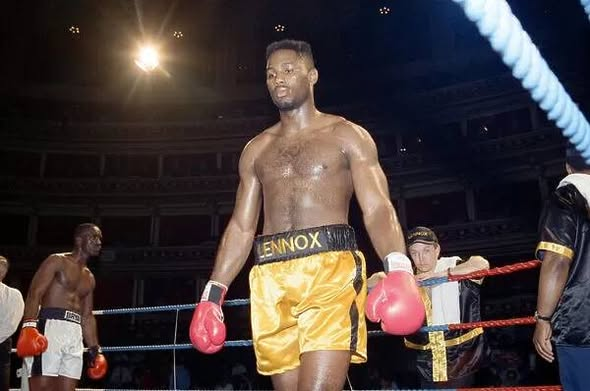
Lennox Lewis walks away after flooring Al Malcom in the 2nd round in his pro debut, on June 27, 1989, in London.
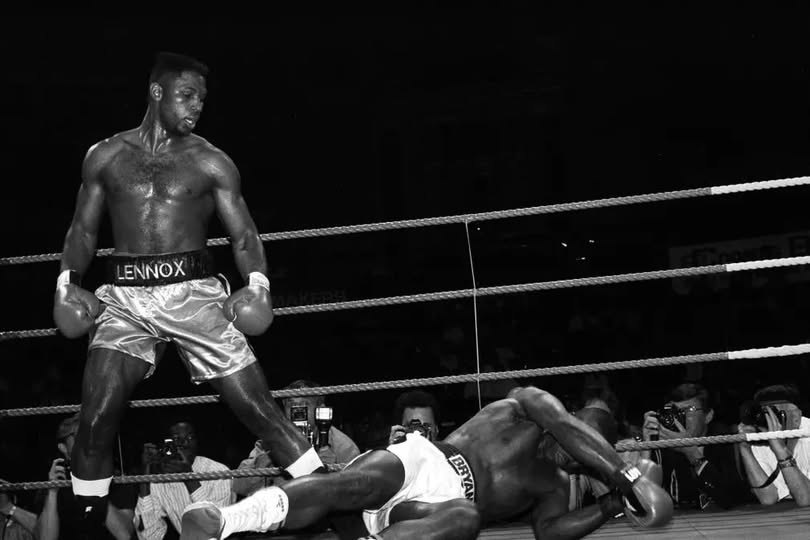
Lennox Lewis makes his pro debut on June 27, 1989 against Al Malcom, winning on a 2nd round KO.
Mike Tyson KO's Michael Spinks in the 1st round, on June 27, 1988,in Atlantic City, to lay claim to the undisputed Heavyweight Championship. The fight was billed as "Once And For All."and was a fight between two undefeated fighters, each with a legitimate claim to the heavyweight championship of the world. The winner would have sole possession of the title. Spinks became the first reigning light heavyweight champion to win a heavyweight championship when he defeated Larry Holmes for the IBF heavyweight title in 1985. He was stripped of that title in 1987 for refusing to fight #1 contender Tony Tucker. Spinks chose to fight Gerry Cooney instead for a guaranteed purse of $4 million. Spinks knocked out Cooney in five rounds. Tyson entered the fight as the holder of all three major sanctioning body titles: He was the WBC, WBA and IBF heavyweight champion. Spinks entered the fight without an alphabet title, but he was regarded by many as the lineal World Heavyweight Champion, as he had beaten Larry Holmes for the title and did not lose it in the ring. Tyson, who had a record of 34-0 (30 KOs), was 7-0 (5 KOs) in world title fights while Spinks, who had a record of 31-0 (21 KOs), was 14-0 (9 KOs) in world title fights. Spinks, 16 days short of his 32nd birthday, had also not fought in 12 months, which was the longest layoff of his career. From Sports Illustrated: Butch Lewis picked a lousy time to make heavyweight champion Mike Tyson angry. Just as Tyson prepared to leave his dressing room and make his way to the ring for Monday night's title defense against Michael Spinks at Atlantic City's Convention Center, Lewis, Spinks's promoter and manager, spotted what he thought was a lump on the wrist of Tyson's left glove. "Hold it," said the tuxedoed but bare-chested Lewis. "Get rid of that, or we don't fight." Tyson's handlers explained that the bulge was simply the knotted laces, but Lewis demanded that it be examined by Larry Hazzard, the chairman of the New Jersey State Athletic Commission. Tyson, sweat dripping from his broad body, began pacing the dressing room in anger. Hazzard examined the glove and found it faultless, but Lewis continued to protest. The impasse wasn't broken until Eddie Futch, Spinks's 77-year-old trainer, said he, too, found the lump harmless. As Lewis left the locker room, Tyson turned to his trainer, Kevin Rooney. "You know," he said softly of Spinks, "I'm gonna hurt this guy." As the challenger, the 31-year-old Spinks entered the ring first after the long delay. When he removed his robe, his 6'2½" body looked trim carrying 212¼ pounds, his heaviest weight ever, but it was dry. Spinks is a notoriously slow starter; it did not bode well that he hadn't warmed up properly. By contrast, the 21-year-old Tyson was glistening as he prowled the ring during the introductions, and at the opening bell he pounced and threw a left hook that caught Spinks high on his head. "I noticed the fear come into his eyes then," Tyson said later. Spinks seemed to sag after the punch, a telling bit of body language common to Tyson's opponents the first time they absorb a solid blow from him. At that moment of violent impact, survival suddenly becomes much more important than victory. Before the fight Futch had warned Spinks not to clinch. "We're not matching strength for strength," Futch had said. "That's his game." But Spinks seemed more interested in trying to wrap Tyson in his arms than in escaping harm with practiced retreat. In their first clinch, referee Frank Capuccino moved in when he spotted the laces of one of Tyson's gloves resting heavily against Spinks's throat. "All right, stop punching," ordered Capuccino, at which point Tyson's elbow snapped up and his forearm cracked against Spinks's head. "Hey, Mike, knock it off," Capuccino yelled. "Knock it off." A moment later, as Spinks tried to back away, Tyson snapped his head back with a left uppercut. Spinks was still reacting from that when a short, twisting right hook caught him just below the heart. He dropped to one knee, the first knockdown of his professional career. Spinks was up at four as Capuccino counted to the mandatory eight. "You O.K.?" Capuccino asked, staring into Spinks's eyes. Spinks peered down at Capuccino. "I'm all right," he said. When Tyson renewed his attack, Spinks tried to fend him off with a right, but it was too soft and moved too slowly. Tyson fired a left hook, shoulder high, over the uncertain right hand. The momentum of Spinks's own punch carried his head forward and down, and Tyson met it with a sweeping right hand. The punch traveled on a waist-high arc and caught Spinks at its most powerful point flush against his jaw. No man could have withstood it. Spinks's eyes rolled up; his legs quivered. Then he fell straight back, arms outstretched. When Capuccino began to count, Spinks tried to force himself to his feet, but as he began to rise he crashed over on his right side. His head was resting against the bottom rope when Capuccino reached 10. Tyson, three days short of his 22nd birthday, produced what is regarded by many as the best performance of his career.

Matthew Hilton wins the IBF Super Welterweight Championship, on June 27, 1987, with a 15-round unanimous decision over Buster Drayton, at The Montreal Forum. From Max Boxing, in 2020, on Davey and Matthew Hilton: Dave Hilton Sr. had over 80 fights from the late 1950’s through to the mid-1970’s. Boxing was in the family and there was no question what his sons were going to do for a living if Pops had anything to say about it. Dave, who could be as rough out of the ring as he was in it, along with his wife Jeannie, raised 5 sons - all of them would fight. By the age of 5, they were all in the gym and learning the trade that had seen their father become a national champion. Time would tell as to what degree of success each son would have as an amateur or a professional. But, make no mistake, for the Hilton’s, boxing was the family business. After long amateur careers, the direction of the sons would play out. Sadly, and tragically, son Stewart was killed in an auto accident at age 17. Brother Jimmy never turned pro. Alex, rough and rugged, worked his way to a Canadian title. However, brothers Matthew and Dave Jr. managed to wrap world title belts around their waist; they were the best of the bunch in terms of success in the ring. All the Hilton brothers had been in boxing their whole life and it was evident in the ring as both amateurs and professionals. They all had a little something – be it speed, power, guts, and if nothing else, lineage. However, it was brothers Dave and Matthew that were indeed the best of the bunch. For a period of time, they were as big a star as any athlete in Montreal and they played to packed houses. Success as world champions seemed a certainty for the brothers who had simply been born and bred to box – but life doesn’t always play out like you plan. Matthew would turn pro in 1983 and by 1987, at 26-0, with 23 KO’s, would challenge and beat Philadelphia tough guy Buster Drayton to capture the IBF world junior middleweight title in front of a packed Montreal Forum where the fighting Hilton’s had become huge stars in the province of Quebec. After one successful title defence, Hilton would lose the title to American Robert Hines in 1988. He would challenge WBO middleweight champion Doug DeWitt 3 fights later but would get stopped late in the fight. After the DeWitt loss, amid poor training habits and out of the ring troubles, Hilton would go 2-1-1 over the next couple of years to close out his career. While Matthew was powerful and explosive in the ring, the best of the boys was oldest brother David Jr. He didn’t have a little something, he had a whole lot of everything. He really had it all - exceptional speed, good foot work, good head movement, he had power in both hands and, not unlike his father, was iron-tough. He was, or could have been, a great fighter on a world class level. Dave Jr. turned pro in 1981 and would go 17-0 over the first couple of years before drawing with fellow Quebec fighter Mario Cusson in 1983. He would avenge that resume asterisk with a KO 1 against Cusson in his next fight and then would rattle off 10 more wins before losing a split decision to fellow Quebec fighter Alain Bonnamie. After 6 straight wins, Hilton would face Bonnamie 2 more times scoring a draw and a win over a 4-month span in 1996. Fights with fellow-Quebec fighters like his trilogy with Bonnamie, and later Stephane Oulette, and his pair with Mario Cusson, drew huge attention in the province, led to sold out houses with thousands and thousands of fans, and made Hilton a local star. After the 3rd Bonname fight, Hilton would put 2 more wins together before stopping massively popular Quebec fighter Stephane Oulette in the 12th round of their Canadian middleweight title bout in 1998. They would have the rematch 5 months later and Hilton would stop him in 3 rounds on this occasion. After a win to kick off 2000, the two would meet later that year with a distracted and unfocused Hilton losing a decision. However, 3-months later, the handlers for Dingaan Thobela, now the WBC world super middleweight champion, were looking for a name fighter for their champion to make his 1st title defence against. Hilton was a massively popular Canadian star and would draw a huge crowd in a world title fight. Dave, now 37 years of age, had been leading an undisciplined lifestyle and, they assumed, would be easy pickings at this stage of his career. So, Hilton was the choice they made for their champion – that was a mistake. In December of 2000, in front of a very pro-Hilton crowd at the Molson Centre in Montreal, Canada, Davey would bang out a 12-round, split decision to capture the WBC world super middleweight title; the Hilton family had another world champion. Unfortunately, by this stage of his life, Hilton was making poor choices away from boxing and was in trouble with the law. Before long he found himself in prison, and the title, and his boxing future, was gone. While he did come back after being released from prison several years later to pick up one more win, his career, for all intents and purposes, was over. The Hilton boys Hilton grew up in a rough and tumble environment - all the boys knew was boxing and it was all they were ever trained for. While it would make them into massively popular fighters in their native Quebec, one-man franchises for a time in the province, they struggled with life outside of the ring. In short, legal troubles and substance abuse would be the downfall of Dave, Matthew and Alex’s career. But, make no mistake, during their brief, but exciting, run in professional boxing in the province of Quebec, the Hilton boys were huge stars. Matthew, with his child-like innocence out of the ring and his aggressive and exciting style in it, made for box office magic in Montreal. Dave, friendly and easy-going out of the ring, and so clearly so talented in it, had superstar written all over him. When focused and disciplined, and on point in his career, Dave Hilton Jr. was as good a fighter in his weight class as anyone in the world. He could have competed with the very best fighters of most, if not all, eras of boxing – he was that good. Dave was fast, had excellent head movement, could put together fast and effective combinations to the head and body and had an excellent chin; he really was the whole package. If Dave’s lifestyle outside of the ring matched his talent in the ring, the fighter that Hall of Fame trainer Angelo Dundee once called, “the best welterweight in boxing”, could have indeed been a long reigning world champion. Legendary Quebec cornerman Russ Anber has worked with some of the very best boxers in the world, on both an amateur and professional level. He was around the Hilton’s throughout their whole career and in a recent chat was quick to weigh in on Dave and Matthew. He clearly remembered a time in his home province when the Hilton boys were huge stars in Canadian boxing and the world was beckoning. “Of course, being from Montreal, I know the Hilton’s very well Bill”, he said. “In his prime, Matthew, as both an amateur and a pro, was without a doubt the most devastating puncher and fighter I had ever seen. He was not only crushing guys; he was hurting them with highlight reel KO’s. He was Tyson before Tyson! Matthew is really the only one who can answer this, but something changed as soon as he won the title”, said a reflective Anber. “From the outside it appeared that once he achieved his goal of becoming world champion, he seemed to say, ’I did it.’ He was never the same. But, despite that, he was always a wonderful, likeable kid who seemed to have the world in the palm of his hands”. Asked about Dave Jr. Anber clearly saw the former Quebec star as a special fighter. “Dave was a great fighter, but he never quite reached the pinnacle of what he should have. He had it all! A great smile, fan-friendly, a happy guy; a very, very tough guy in the ring. Fans loved him, had all the talent in the world. He could have been a huge international star, an excellent all-around fighter”, he said. “This country has produced some great fighters and I am quite confident in saying that he was the best Canadian fighter, pound for pound, in history”. From wikipedia on Matthew Hilton's career: It was tough growing up for Hilton, but he transferred that toughness to the ring, at least as his career started. Though Matthew had decent boxing skills for a brawler, he preferred to press forward, back up his opponents, and detonate his punishing left hooks, and powerful overhand rights. Two of the big names he faced in his rise to stardom were former 3-time world champion Wilfred Benítez and former world middleweight champion Vito Antuofermo, who both fell victim to his devastating KO power. He won the IBF junior middleweight title, and brought Canada its first world boxing title since the 1940s, with a 15-round unanimous decision over defender Buster Drayton on ABC in Montreal, June 27, 1987, which was also named KO Magazines TV Fight of the Year for 1987. He made one defense on the Tyson-Biggs undercard on HBO in October of that year, busting and bruising up a totally outclassed Jack Callahan before the referee called things off after two rounds. His next fight was an exciting non-title bout on ESPN in the middleweight division against Paul Whitaker of New Orleans, who was knocked down and brutally battered by Hilton before being KO'd in the fourth round. Matthew then apparently had the upper hand in the early going in his next defense - a November 1988 matchup with Robert Hines on Showtime. After knocking a bloodied Hines down twice, he let Hines back in the fight, and Hines steadily hammered a very tired and not very well prepared Hilton in winning a come-from-behind 12-round unanimous decision, after which Hilton would be champ no more. Hilton admitted after the fight that he had sustained rib injury during training for that fight (Between rounds, Hilton could be heard telling his father that he couldn't throw his left hand). Matthew later rebounded with a lackluster (though controversial) draw against Fermin Chirino, a bout in which many felt that Matthew had won by a 10-round unanimous decision, followed by two more exciting bouts against journeyman Tim T. Williams (on ESPN), who was KO'd in round 10, and Tennessee toughman Knox Brown, who had only previously been down at the hands of John Mugabi, and was again floored by Hilton in a 10-round decision victory on the USA Network. His last crack at a title was on the Foreman–Cooney undercard in January 1990, when his eyes were again swollen shut by the punches of defending WBO middleweight titlist Doug DeWitt. This time, though he fought gamely, Hilton was the loser not by decision but rather by 11th-round TKO when his father had seen enough and did not let him fight the last round. Hilton's eyes were both swollen completely closed. His cutman only had ice to decrease the swelling, which was ineffective. Because of that fight, he suffered a retina injury which followed him for his next few fights before forcing him into retirement. Hilton received many unsuccessful surgeries for his eyes. His career began to sputter during the 1990s, and, partly due to the various troubles plaguing the Hilton family, Hilton never was really able to regain his championship-level caliber. He said he's never been as much motivated for training after he won the IBF's belt against Buster Drayton.

The redemption of Roberto Duran is the subject of the June 27, 1983 issue of Sports Illustrated.

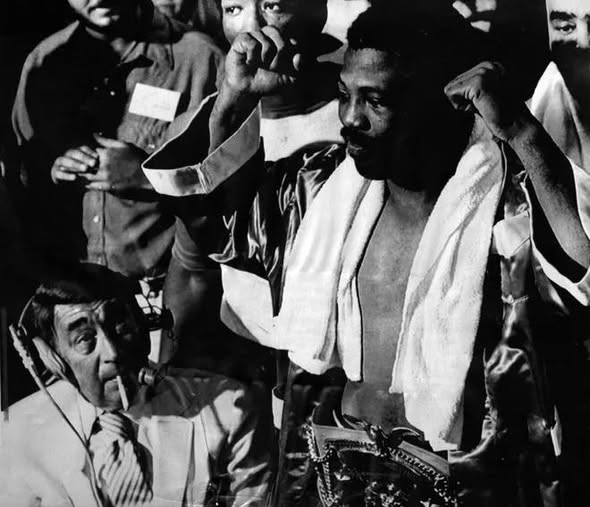
Cigarette in his mouth, a bemused Howard Cosell watches WBA Junior Welterweight Champion Aaron Pryor raise his two fists in triumph, on June 27, 1981, after his 2nd round KO of Lennox Blackmoore at The Hacienda Hotel in Las Vegas. Pryor dropped Blackmoore twice in the 1st, and once in the 2nd, before referee Mills Lane stopped the fight. This was The Hawk's 3rd title defense.
'Irish' Tony Doyle loses, on a 9th round TKO, to a journeyman (7-6) heavyweight named Mike Weaver on June 27, 1975 at the San Diego Coliseum. Doyle had a win over Joe Frazier as an amateur and fought a draw with Jerry Quarry as a pro. He lost on points, to Leotis Martin, for the 1961 National AAU title at 165 lbs. "I remember one day sparring with Ken Norton. He told me if you take the game seriously and run and train like you’re supposed to, you can make noise in the heavyweight division." -Mike Weaver Ken Norton gave Weaver the nickname "Hercules" when Weaver was working as a sparring partner for Norton who, Weaver has said, discouraged him from retiring on three different occassions including before this fight. Weaver is one of the few world champions to have lost his first two fights. He lost 3 of his first 4 fights and was just 6-6 after 12 fights.

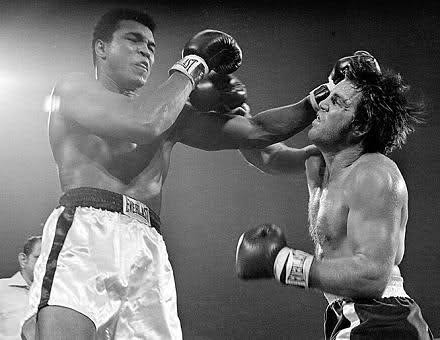
Former Heavyweight Champion, and #1-ranked contender for the world title, Muhammad Ali makes his 3rd defense of the NABF Heavyweight Championship, on June 27, 1972, scoring a 7th round TKO of Jerry Quarry in Las Vegas. World Light Heavyweight Champion Bob Foster would defend his title on the undercard against Mike Quarry, Jerry Quarry's younger brother, on a card that was publicized as "The Soul Brothers vs. The Quarry Brothers." "I definitely could have gone on" said the 2nd-ranked Quarry in the post-fight and he added "But it wouldn't have done any good, My brother's fight took it all out of me." Mike had suffered a brutal, and frightening, 4th round KO in his challenge of Foster.
Danny MacAlinden KO's Jack Bodell in the 2nd round, on June 27, 1972, at Villa Park in Birmingham, UK, for the British and Commonwealth heavyweight Championships. This would be the final bout of the southpaw Bodell's career, which ended with three straight stoppage losses following his points decision win over Joe Bugner in September of 1971, which ended with him holding a 58-13-0 (31 KO's) record. MacAlinden would lose his titles to Bunny Johnson, in 1975, in his first defense after several non-title fights.

Muhammad Ali and George Foreman (36-0 at this point and two fights from meeting Joe Frazier) share an icy stare during pre-fight introductions, on June 27, 1972, before Ali's fight with Jerry Quarry in Las Vegas.

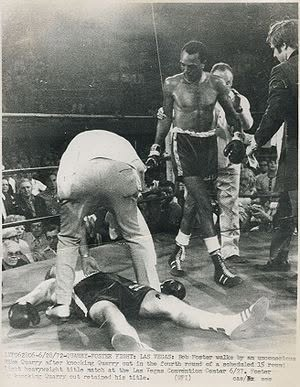
Light heavyweight Champion Bob Foster scores a devastating 4th round KO of Mike Quarry, on June 27, 1972, in Las Vegas. Foster had chased the undefeated (35-0) counter puncher Quarry for three rounds, the challenger trying to counter-jab and move left and right and tie Foster up wherever possible. By the fourth round, though, the fast pace had Quarry with his mouth open and visibly tired. This left him up for Foster's left, which began to land more frequently. Foster then landed a right cross followed by a devastating left hook which dropped Quarry just before the bell sounded ending the fourth round at 3:00. Quarry was down on his back and out, and would be counted out. It was certainly a tense moment for Foster, and anyone else who had great concern for his unconscious opponent after this bout ended.
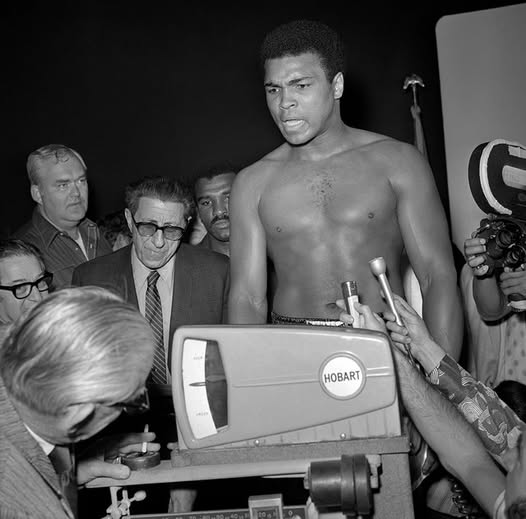
Muhammad Ali weighs in at 216 lbs on June 27, 1972, for his fight with Jerry Quarry, in Las Vegas.


Yatingtwo @BenDove27405605
422 Followers 49 Following I want to be one of those obscure drinks in the freezer—mint-flavored. Sales might not be huge, but there are people who love that specific taste.


Tomomi Shibasaki @ykylm9796
42 Followers 143 Following single and tired of dating apps 😮💨 find me here 👇 it's easier
Muhamed marwan @muhamed29403
2 Followers 247 Following

Christina Flores @tinaflores0
156 Followers 5K Following God First | Proud Patriot 🇺🇸 | currently living in USA 🇺🇸 | Artist ✍️ | Philippians 4:13

たかはしひろの... @Hiro4560852
51 Followers 306 Following ☕ stay at home mom making more than my old 9-5 $487 last week alone 💸 👇
Catriona McLean @CatrionaMcLean4
2K Followers 4K Following

Husker4Life @NE_good_life
17K Followers 16K Following I'm kind of a big deal IRL but also humble, so I can't believe I just typed that. No DMs unless you are super hot and just wondering about my day. JK--no DMs!
John smith @Xthebeauties091
3 Followers 93 Following

divebar @divebar_info
278 Followers 853 Following I'm Sophie, Berlin → NJ → LA. Bass player. Dive bar obsessive. Come find your next favorite bar @ https://t.co/C4N7hp9bMn 🍺
. @tpotbg
0 Followers 494 Following
Jay Allen Square @TheSquareAllenJ
118 Followers 2K Following My previous and first ever Xwitter account got hacked so I made a temporary 2nd one until I am able to recover that account
javierlaflare @javierburr
113 Followers 1K Following Professional Boxer🥊 https://t.co/Ik3Q65ODMv Omaha, Ne📍

Pamela @Pamela943312
18 Followers 1K Following
Cynthia @CynthiaPhala
324 Followers 3K Following CARTOONS: The only place you can wear the same thing everyday & nobody cares.
Coach James Gogue @CoachJamesGogue
333 Followers 56 Following Victory loves preparation. EVERY PRACTICE COUNTS. Attitude Toughness Effort.
porjosh sports @porjoshsports
0 Followers 5 Following PORJOSH Sports® 🏆 | Premium Martial Arts & Athletic Wear | Built on Discipline. Defined by Quality.

✌🏼 @MiguelAlonsoF
57K Followers 3K Following
Hugo Riquelme @riquelme83104
85 Followers 533 Following



Carol @carolcole9096
5K Followers 4K Following 🌟 'Life is short, make it count' - My motto, one adventure at a time! Let's create memories!
Lucy @LuciofBarethaa
198 Followers 2K Following there’s a special place in hell reserved just for me it’s called the throne
Luciano Millanao @MillanaoLuciano
29 Followers 187 Following soft girl, big heart, open dms 💕 don't make me wait 👇
Sophia @Sophia1831254
223 Followers 2K Following
Jefferson Steelflex @SteelflexJ2
111 Followers 599 Following
Mark George @MarkGeorgevwu
14 Followers 192 Following
Serhan Dayi 🏈🥊�... @SerhanOnX
5K Followers 5K Following Host of All Era Sports with Serhan. Analyst for all sports. DM for Inquiries (case-by-case) #PorVida #whodey #ATOBTTR #FCCincy
OneMikerophone 🎤 @OneMike14
140 Followers 469 Following I've been here before buddy, this aint my first life. You can hear me through your 🔊🔊 talking about your favorite sports! 🏀🏈🥊

mividaloca @Mividaloca1965
296 Followers 384 Following よく遊び、よく遊べ。単なる純粋な愛国者。 思考割合はボクシング7割、昭和プロレス3割。 いくら綺麗ごとを言っても麻雀は決して競技ではなく博打。とびきりの。 長嶋監督より村西監督。「裏本時代」「AV時代」は必読の書。
Wendy @WendyClauws
147 Followers 2K Following Living a life of purpose, passion, and impact. Leaving a legacy that inspires future generations to dream big.


Kathy @Band_23fgjTq
109 Followers 2K Following Resident DJ on AfterhoursFM, Discover Trance Radio & Experience Music.
Brady Penfield🇻�... @brady_penfield
17K Followers 3K Following Catholic🇻🇦 | Chairman: @stcroixvalleyyr| Fmr. WI State Assembly Candidate | Badger Field Rep. @TPACTION | AKA “Ginger Mr.Beast” | UWRF Alum | Views are my own
Catriona McLean @CatrionaMcLean4
2K Followers 4K Following
Carol @carolcole9096
5K Followers 4K Following 🌟 'Life is short, make it count' - My motto, one adventure at a time! Let's create memories!
Lucy @LuciofBarethaa
198 Followers 2K Following there’s a special place in hell reserved just for me it’s called the throne
Luciano Millanao @MillanaoLuciano
29 Followers 187 Following soft girl, big heart, open dms 💕 don't make me wait 👇
Allan Ley🏴... @allanley29
2K Followers 5K Following Ex pro boxer,former Welsh flyweight champion,Liverpool fan,married with 6 children,3 grandchildren,Bus Driver with Newport Bus,Covid survivor.🏴YNWA
Serhan Dayi 🏈🥊�... @SerhanOnX
5K Followers 5K Following Host of All Era Sports with Serhan. Analyst for all sports. DM for Inquiries (case-by-case) #PorVida #whodey #ATOBTTR #FCCincy
Joe Maxims Ghost @bedouinpicks
201 Followers 461 Following

Ian mcilroy @IanTwacker
724 Followers 209 Following
Stacy @davisstacy952
2K Followers 4K Following studying fashion design & spending money i dont have | 22
Harry Harish sports a... @HarryHaris48861
6K Followers 7K Following Sharing the things I enjoy in life
OneMikerophone 🎤 @OneMike14
140 Followers 469 Following I've been here before buddy, this aint my first life. You can hear me through your 🔊🔊 talking about your favorite sports! 🏀🏈🥊
Shane Turner @mccovey
1K Followers 847 Following Dallas Star Hockey Scout, Business Owner, Mgmt Consultant, Proud father of 3 wonderfully talented & smart kids plus the absolute best grandchildren everrr
Aggman @aggmanski
150 Followers 906 Following


Mikayla Barnett @BarnettMikayla
22 Followers 81 Following lonely nights, open dms 💌 you found me, now what? ↓
The Excelsior Sportin... @ExcelsiorSc1
354 Followers 578 Following Exclusive Professional Boxing Black Tie Dinner Shows & Professional Boxing Arena Shows in the Midlands Licensed by the British Boxing Board of Control

Lee Groves @LeeGrovesBoxing
4K Followers 6K Following CompuBox researcher/punch counter, "In This Corner: The Podcast" Executive Producer, IBHOF voter, historian, author, 2022 BWAA Good Guy Award winner
Maggie Alderson @AldersonMa24398
319 Followers 189 Following
María Vázquez @MaraVzquez24135
41 Followers 258 Following
Sofia López @SofiaLpez49
43 Followers 266 Following
Sofia Sánchez @sanchez_so22458
59 Followers 151 Following
massimo p. @mpalarchi
188 Followers 145 Following
Roy Bennett @TrigramSage
306 Followers 531 Following
Jacqueline @prestonjacqueli
2K Followers 4K Following you can find me making memories, not waiting around
Jackie Redmond @Jackie_Redmond
172K Followers 2K Following Find me on @NHLNetwork @NHL_on_TNT @WWE & @NHL YouTube! I ❤️ potato chips. Laugh as much as possible. I tweet and delete. 😌 IG: jackieredmond

John Walker @speic58104
245 Followers 73 Following "...but lately, I’m getting the feeling that I came in at the end. The best is over.”
Felix Chavez @Fchavezeptimes
31K Followers 2K Following I cover prep sports, horse racing, boxing and the El Paso Chihuahuas for the El Paso Times. I also provide sound advice on picking winners at the racetrack.
TheBoxingExchange @MONTE17
177 Followers 476 Following

Jonny Danger @JonnyDanger14
2K Followers 521 Following
Ronnie @ronnieoc01
164 Followers 810 Following
Carl Banks @CarlBanksGIII
85K Followers 4K Following Official twitter of former Giants player Carl Banks. MSU HOF Chairman/Founder G-III Sports by Carl Banks and G-III 4Her by Carl Banks @Starter #Flint
Derek @fansincemac
470 Followers 126 Following 🙏❤️⚾️ 🇺🇸Focus on what’s important. Stay in your own lane. Use some common sense. Play Ball.

Gina Carano 🕯 @ginacarano
1.4M Followers 650 FollowingYou might like