QNET BLOCKCHAIN @AIQnetLab
https://t.co/Yo6S9fF27S https://t.co/FmGnpGNIYA 4R3DPW4BY97kJRfv8J5wgTtbDpoXpRv92W957tXMpump aiqnet.io https://t.me/AiQnetLab Joined March 2025-
Tweets190
-
Followers922
-
Following0
-
Likes136
“Reworking consensus” doesn’t mean rewriting it. The core and consensus are built right - the design stands. The freeze was one rare edge case at an epoch boundary, not a flaw in the foundation. What’s left is closing that gap at the protocol level and catching the remaining edge cases so nothing else can stall the network. No rebuild, no starting over - just finishing the last loose ends before launch.
New wallet addresses in the new launch I moved the wallet to post-quantum cryptography - ML-DSA-65 (FIPS-204) signatures. Because of that, your address changes. A QNet address = hash of the public key, and the key is derived from your seed phrase through the signature algorithm. I changed the algorithm → the same seed phrase now yields a different key → a different address. I also fixed a mismatch, so the app and the node now produce the same address. So in the new launch: • update the wallet once I post the new version; • request test tokens again from the faucet - to the new address; • re-do node activation. Your seed phrase doesn't change - same mnemonic.
QNet - testnet status The previous testnet run stayed up for a few days and then stalled: in a rare scenario at an epoch boundary, finality stopped advancing and the network couldn't recover on its own. So instead of slapping on a patch, I'm reworking consensus so this class of freezes is gone at the protocol level rather than papered over. That's the main reason for the delay. Since I'm starting from a clean genesis anyway, I also folded in the things that can't be added after launch: • full post-quantum security - ML-DSA-65 (FIPS-204) signatures and post-quantum transport; • on-chain tokens and smart contracts - a token standard, mint/burn, a deterministic WASM VM. Where I am now: I'm putting the consensus changes through their paces. The automated tests and audits pass, but the real test is live - new issues can still surface, and I'll fix them as they do. What's left is to bring up a fresh network and run it through many epoch boundaries - exactly the conditions where it used to freeze. On timing: Once the network runs stably for several days with no freezes, I'll launch and open onboarding for light nodes and super nodes. Thanks for waiting. I'm choosing the right launch over a fast one.

QNet Wallet - early access on Android (APK) I've decided to open early access for light nodes - just through the APK. That gives you a few days to test it out while I finish a round of fixes: audit items, plus removing all the non-quantum signature paths that blockchains normally use, so QNet stays fully post-quantum. On the official launch: I've set up an LLC and I'm waiting on the documents to finish Apple's D-U-N-S verification. Once that paperwork clears, QNet goes live officially on both Google Play and the App Store. Download (Telegram): t.me/AiQnetLab/155 Test tokens: aiqnet.io/testnet Made a wallet during earlier testing? Create a fresh one - the wallet format changed, so old wallets may not import correctly and can come up invalid.
Super Node rewards are LIVE. Claim and receive your QNC rewards straight from the mobile wallet - one tap, on-chain verified, post-quantum secured.
Testing the full integration of a super-node with the mobile app - including reward claiming - and debugging all the processes.

QNet - what's been done over the last 3 months It's been quiet - because the work went into rebuilding the foundation, not cosmetics. The facts: 1. Consensus core rewritten → Checkpoint-BFT v2 The old macroblock consensus was three-phase (commit → reveal → finalize) with fixed ~12+12+6 sec windows and heavy post-quantum signatures collected at every phase - both slow (~30 sec per macroblock) and fragile (desync at phase boundaries → occasional forks and stalls). Replaced with a single-round Checkpoint-BFT v2: instead of three phases, one 2f+1 quorum certificate (QC), with no fixed windows and no dependence on clocks; producer selection is deterministic, and forks are impossible by construction. Post-quantum BFT on Dilithium / ML-DSA. 2. Scale - to millions of nodes Emission and the node registry were rewritten to O(1) operations (previously the cost grew with the number of participants). The architecture is designed to hold millions of light nodes and super-nodes without degradation. 3. Security Several audit rounds (120+ fixes), node identity-binding, and fail-closed key handling from the mnemonic. 4. Node onboarding Solved the problem of a new node joining a live, running network without disruption. The first real super-node is connected. By the numbers: 150 commits 168 files changed (21 new, 1 removed, 145 reworked) +53,611 / −38,944 lines Huge thanks to everyone for your patience. What's left: test reward claiming by a super-node, finish the node-update mechanism, and run my own final audits before the testnet launch.
Super-node onboarding is finally complete - along with a lot of other work I'll share more about soon. Now it's time to observe and test how the network runs after onboarding. I'm genuinely happy to finally have visible progress to show, and to share it with you.

@OnlyHades_ How I finish what I wrote in this post
Hey everyone - it’s been a few quiet weeks on the feed, but development has been moving steadily behind the scenes. What’s been done: - Server node registration is live and working - Synchronization logic with the network is nearly complete - Reactivation logic implemented - nodes now handle reconnects correctly after migrations or long offline periods (same nuances as mobile nodes, just different complexity) - Security audit done: a vulnerability in the network was identified and patched What’s left: Finishing server node integration + polishing the node update mechanism. We’re close - genuinely the last stretch before testnet. Thanks for your patience. It means a lot. Testnet is coming. Soon.
Here's how light node proof-of-participation works in QNet. Every 4 hours the network checks whether your device is online. This isn't a simple ping - it's a cryptographic challenge-response. How it works: Each 4-hour window is split into 240 one-minute slots. Every node gets a unique randomized slot per window, derived from a hash of the node_id and window number. You can't predict in advance when the request will arrive. When your slot hits, a genesis node sends a challenge - a random 32-byte string - to your device via push notification. The device signs it and sends back the response. Three attempts, not one. If the primary genesis node doesn't get a response, two backup nodes retry with a delay, giving the primary time to complete first. Miss all three - the round is skipped. After 5 consecutive missed rounds, the node is marked inactive. There's a reactivate button in the app to bring it back. The ping key is separate from the wallet. At registration, the device generates a dedicated Dilithium3 key specifically for signing ping responses and issues it a delegation certificate signed by the main wallet key. This lets the app respond to challenges in the background even when the screen is off or the app is closed - the main wallet key is never touched. The response is signed with this delegated Dilithium3 key. The attestation is then propagated to all genesis nodes via gossip protocol. Rewards aren't instant. Participation data is collected into a MacroBlock at the end of the epoch, and payouts happen one epoch later - 4 hours after the window closes. This is an intentional delay to allow finalization through BFT consensus.
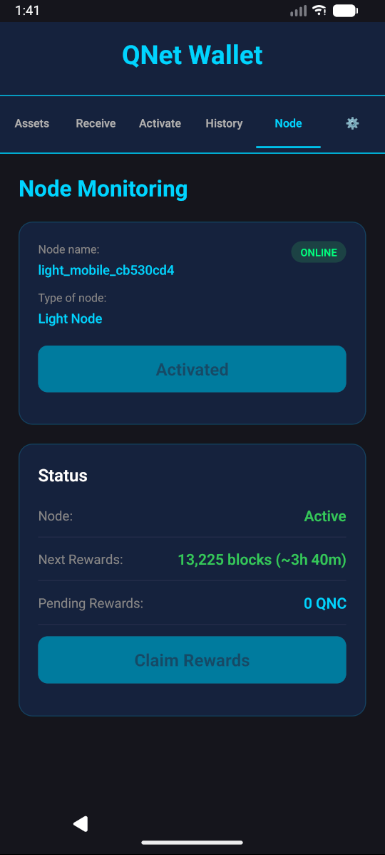
Huge block of tasks done. Completed the full light node cycle for QNet. Everything works now - from wallet creation to receiving rewards for participating in the network. How it works: Burn 1DEV - get a spot in the network App registers the device on-chain Every 4 hours the device sends a ping - proof of participation At the end of an epoch - rewards are accrued One-tap claim - tokens in the wallet, send anywhere The video shows the real thing: claiming light node rewards and transferring QNC to another wallet.
🎂 Exactly one year ago, I wrote the first lines of QNet Blockchain code. Over this time, I went through many AI models - each one better than the last, helping me solve problems faster and more efficiently. I want to repeat the core idea once more, because it truly matters. I wanted to build a system that rewards every user - constantly and automatically. When I started, I had no references, no other project attempting anything like this. And today, I still haven't seen a single one moving in this direction. QNet is: - No premine. Every participant gets an equal share after activation. - No technical knowledge needed. A couple of taps on your phone screen - that's it. - Rewards accumulate automatically. Hit claim whenever you want - no daily grind, no tapping required. Think of the legendary early Bitcoin faucet - but permanent, effortless, and accessible to absolutely everyone. This is the blockchain approach I always dreamed of. And we're on the final stretch. A few finishing touches remain in the consensus mechanism - and the user reward system will be fully complete. Very soon. And once again - a huge thank you to each and every one of you. Without your support and engagement, reaching this point would have been incomparably harder. More to come 👀
Still working on the app. Latest focus - backend fixes and background pings: your node stays active even when the app is closed or the screen is locked. Open the app once - the network handles the rest. No commits ≠ no progress. Not everything goes to the repo right away.
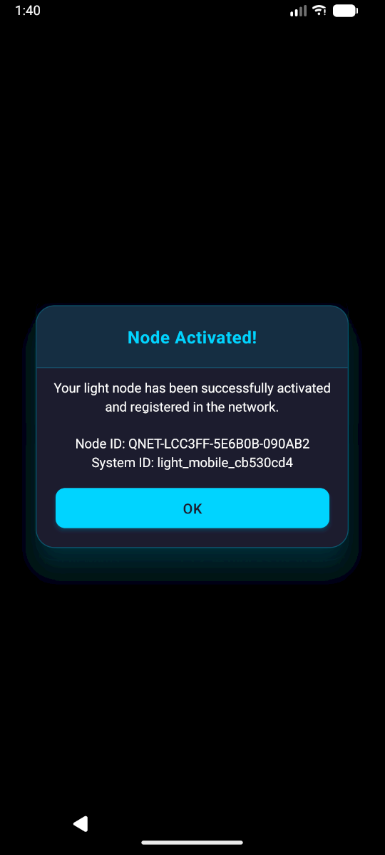
Here is what code recovery and Light Node activation look like on a real device
QNet Testnet - what's on the roadmap? Want to share a quick update on what I`m planning to ship: - Token creation tools for users within the QNet ecosystem - NFT collection launches - fully on-chain - In-wallet mini-activities - compete with other users, earn $QNC. A little on-chain gambling energy never hurt anyone 🎲 No hard dates yet - these features land after Light & Super Node activations are complete. But they're next in line. Building doesn't stop
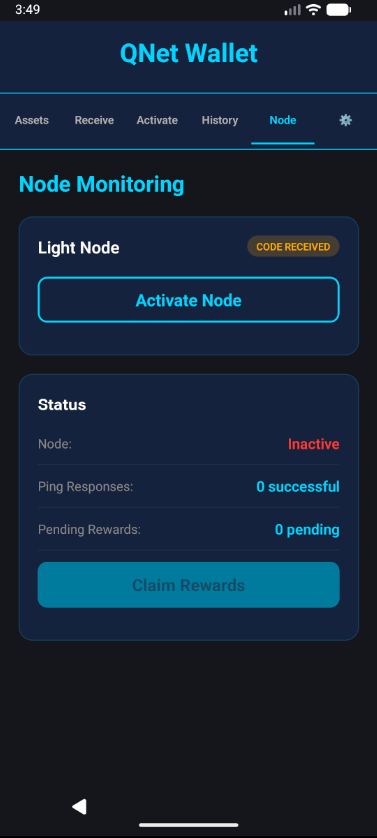
Finished developing activation code recovery and the full node activation flow for light nodes — everything works smoothly. Next up: testing light node pings and reward distribution. After that, server node activation, then testnet launch. explorer.aiqnet.io/explorer/tx/de…
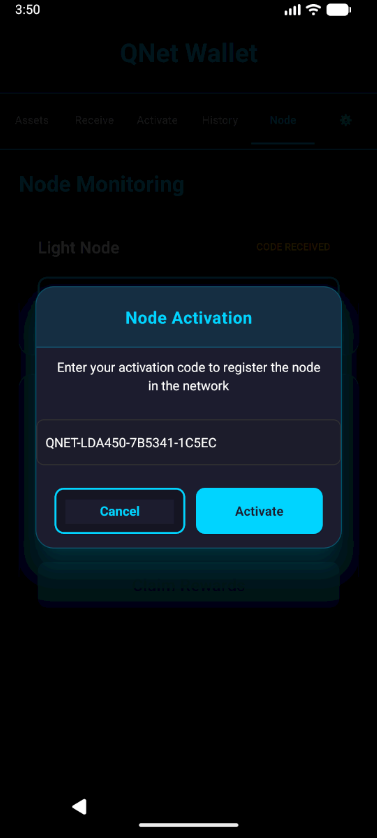
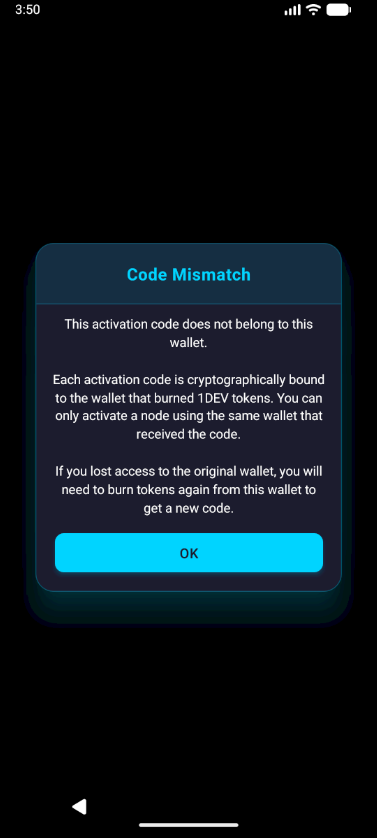
QNet activation code - public by nature, secure by design. Code = XOR(wallet, SHA3(tx_hash:type:amount)) - yes, anyone can technically reconstruct it from public Solana data. But it's useless without: - Dilithium3 (post-quantum) signature with your private key - Code embeds your wallet prefix - someone else's code won't match your wallet - 1 wallet = 1 node enforced in persistent storage forever The secret isn't the code. The secret is your private key.
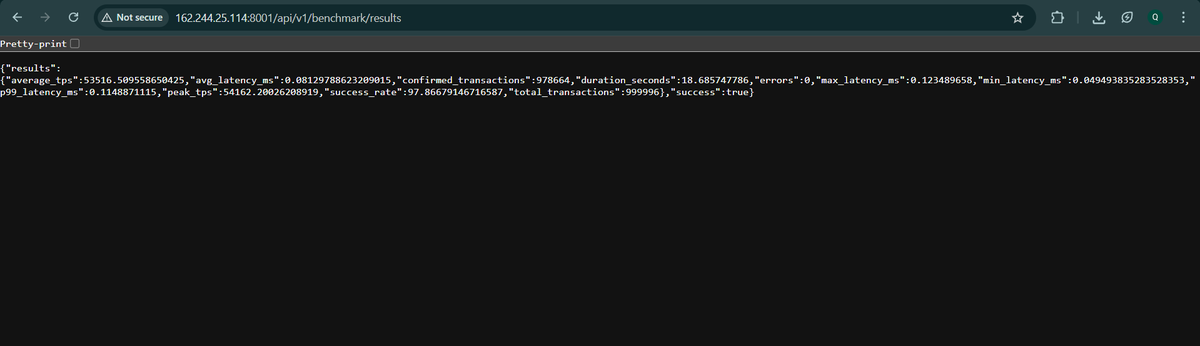
Not long ago I ran stress tests on the network that showed around 100K TPS - but the problem was that the network broke down afterwards, likely due to issues with the cryptographic signatures at the time. Since then I reworked the signature system and ran new tests. Results: - Peak TPS: 54,162 - Average TPS: 53,516 - Transactions: 978,664 out of 999,996 (97.9% success) - Duration: 18.7 sec - Errors: 0 - Latency avg: 0.081 ms - Latency p99: 0.115 ms The network runs flawlessly after the tests - all 5 nodes are synchronized, 0 forks, 0 errors. It's possible to push TPS even higher, but that would require expanding the mempool and increasing block sizes, which could cause issues with block propagation and exchange between nodes due to their size. So I prefer to focus on finishing the node registration work for now. Either way I'm happy with the current 54K TPS - that's an insane result for an L1 blockchain with post-quantum Dilithium3 signatures. http://162.244.25.114:8001/api/v1/benchmark/results

WEB3 MATRIX @WEB3_MATRIX
693 Followers 5K Following Building the bridge between Web3 projects and thriving communities. 🌐 AMAs • Community Growth • Partnerships • Web3 Marketing
Jr @grass_sup
1K Followers 6K Following

OUANCOIN @ABOMOTASSIM
24 Followers 546 Following
Mylos @Mylos2611
39 Followers 57 Following
Robinhood Chain Pulse @ChainHunter_2
47K Followers 11K Following Exploring the future of Robinhood Chain, one gem at a time. Alpha • Smart Insights • High-Potential Gems DMs open for collaborations
Martin Bruno @gfyselfb
76K Followers 18K Following Tier-1 Crypto Influencer.NFA - DYOR. DM for Business Inquiries!
Robert Boss™ @BossRobertX
91K Followers 18K Following 🚀 Marketing Expert || Growth Strategist 📈 Brand Growth || Community Building 📩 DM for Partnerships
Mr Whale Official @mrcryptooreal
56K Followers 22K Following Top-Tier Crypto Influencer . Spotting gems. Creating hype. DM for promotions.
CZ Robinhood 🪙 @PoriAkter5
41K Followers 22K Following Top Crypto Trader 📊 || Covering Robinhood chain's news,insights and gems || Partner @Robinhoodapp || DM for business
Mr Alan Official @CryptoAlanReal
74K Followers 13K Following Crypto Ethusiast • NFA • DYOR • Dm for discussions! Partner @MilliClubCoin
Enjit-Enjit @EnjitEnjit1234
162 Followers 259 Following


Milo Dinosaur (Unc) �... @miloDinosaur787
36 Followers 324 Following
Krypth3o @Krypth3o
47 Followers 229 Following Web3 & Crypto Enthusiast • Blockchain Explorer • exploring DeFi

Asahi |🚢 @zx23884486
296 Followers 6K Following "Empty your mind. Be formless, shapeless like water. Pour into cup, it becomes cup; bottle, bottle; teapot, teapot. Water can flow or crash. Be water, my friend
Mr|Coin 🍩 @JCMH_ETH
3K Followers 963 Following engineer | trader/investor | i like crypto, skiing and gargantua | bought MATIC at $0.006| NFA & DYOR 📊
റോമൻ @SuperbroWLGTN
123 Followers 700 Following Electrical Engineer | Project Leader | Blockchain lover | Art lover | Dad & Husband
THIRUMAL KARANAM @trkaranam
63 Followers 766 Following
PePreRich @PePrerich
236 Followers 73 Following They want us to believe we’re stuck in the matrix of lies, but we’re not stuck, we’re Pre-Rich, aligned and ready to awaken.


AnimalPynchon @AnimalPynchon
112 Followers 230 Following Get the moonshot and there will be a screaming across the sky. Decentralise or get rekt. Soon to be best NFTs on RH @hoojafun
RAM @RAM1045072
11 Followers 194 Following
DankyDyl @Chippyhodler
471 Followers 3K Following Building Generational wealth one brick at a time 🧱


Viking hub @Vikinghubco
0 Followers 17 Following Here and ready to take you through Viking hub , a crypto trading platform that manages your capital for daily income.
#RaviVisvesvarayaShar... @rvp
5K Followers 2K Following Master of Science @cmu_ece @CarnegieMellon 1986 | Master of Engg @cmu_mse @CMUEngineering 1985 | MS Physics @IITKanpur 1982 | Research Fellow @cmu_robotics 1985
crowley @kng_crowley
544 Followers 937 Following
Xj @jinx55424
158 Followers 2K Following
hhhhh @portfoolio_
29 Followers 89 Following

viet thang nguyen @vietthangnguye7
186 Followers 5K Following
BOUMELKI ABDERRAOUF @abderaoufkaiz
51 Followers 876 Following

astroskull (✨,💀) @ASTR0skull
567 Followers 3K Following Biohacker ~ Speaker of Truth satori has morphed to astroskull, a perfect convergence of the archetypal king, warrior, magician and lover.
I'm Kevin Coo of cryp... @kevinCofounder
459 Followers 1K Following I'm Coo of crypto moon shoot // Our Community Services AMAs partnership pin post etc connect : https://t.co/3Us6KODzn9
X 🩸 @NexvoidX
163 Followers 550 Following
btkcts @btkcts45713
14 Followers 98 Following
thomas @thomaz687
2K Followers 609 Following just a dog wif a hat liking all kinda coins 🐳 Fomo Fee Discount: https://t.co/8FbeE8HEHM
Archibald Moretti @Archibald1_OVO
1K Followers 3K Following I don't see any obstacles as long as I have a goal. Venture Capital scouter for 3 years. Love managment reading📚 Love good food Working at @Bip32Ventures
Katherine Moore @KMooreaa
0 Followers 2 Following Infrastructure as Code Continuous deployment believer
You might like