Ash Dayanim @AshDayanim
Taking book recs 🤖 prev: Cerebras, zypl AI 📚 Stanford MIP ‘28, TAU-Columbia BA ‘24 whatsapp.com/channel/0029Va… Bay Area, California Joined May 2024-
Tweets65
-
Followers81
-
Following274
-
Likes35


The strongman of Pakistan ft.trib.al/aRh4x2N
@MilksandMatcha @tyler_fong_ Congrats Sarah and Tyler! 🍾
Is GenAI causing the relative decline in early-career hiring? Our latest research finds that these effects may be conflated with another important driver: the rise of WFH arrangements (1/N)


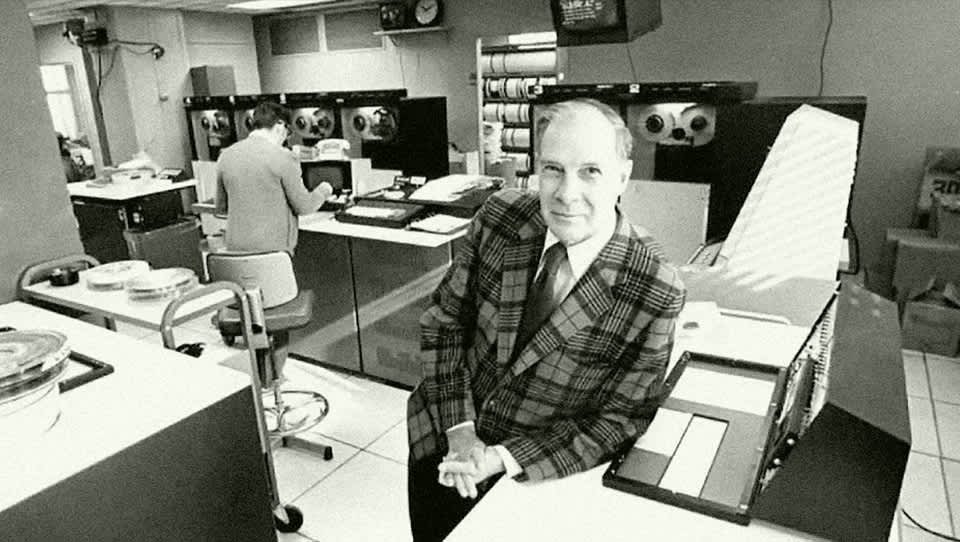
A mathematician who shared an office with Claude Shannon at Bell Labs gave one lecture in 1986 that explains why some people win Nobel Prizes and other equally smart people spend their whole lives doing forgettable work. His name was Richard Hamming. He won the Turing Award. He invented error-correcting codes that made modern computing possible. And he spent 30 years at Bell Labs sitting in a cafeteria at lunch watching which scientists became legendary and which ones faded into nothing. In March 1986, he walked into a Bellcore auditorium in front of 200 researchers and told them exactly what he had seen. Here's the framework that has been quoted by every serious scientist for the last 40 years. His opening line landed like a punch. He said most scientists he worked with at Bell Labs were just as smart as the Nobel Prize winners. Just as hardworking. Just as credentialed. And yet at the end of a 40-year career, one group had changed entire fields and the other group was forgotten by the time they retired. He wanted to know what the difference actually was. And he said it wasn't luck. It wasn't IQ. It was a specific set of habits that almost nobody is willing to follow. The first habit was the one that hurts the most to hear. He said most scientists deliberately avoid the most important problem in their field because the odds of failure are too high. They pick a safe adjacent problem, solve it cleanly, publish it, and move on. And because they never swing at the hard problem, they never hit it. He said if you do not work on an important problem, it is unlikely you will do important work. That is not a motivational line. That is a logical one. The second habit was about doors. Literal doors. He noticed that the scientists at Bell Labs who kept their office doors closed got more done in the short term because they had no interruptions. But the scientists who kept their doors open got more done over a career. The open-door scientists were interrupted constantly. They also absorbed every new idea passing through the hallway. Ten years in, they were working on problems the closed-door scientists did not even know existed. The third habit was inversion. When Bell Labs refused to give him the team of programmers he wanted, Hamming sat with the rejection for weeks. Then he flipped the question. Instead of asking for programmers to write the programs, he asked why machines could not write the programs themselves. That single inversion pushed him into the frontier of computer science. He said the pattern repeats everywhere. What looks like a defect, if you flip it correctly, becomes the exact thing that pushes you ahead of everyone else. The fourth habit was the one that hit me the hardest. He said knowledge and productivity compound like interest. Someone who works 10 percent harder than you does not produce 10 percent more over a career. They produce twice as much. The gap doesn't add. It multiplies. And it compounds silently for years before anyone notices. He finished the lecture with a line I have never been able to shake. He said Pasteur's famous quote is right. Luck favors the prepared mind. But he meant it literally. You don't hope for luck. You engineer the conditions where luck can land on you. Open doors. Important problems. Inverted questions. Compounded hours. Those are not traits. Those are choices you make every single day. The transcript has been sitting on the University of Virginia's computer science website for almost 30 years. The video is free on YouTube. Stripe Press reprinted the full lectures as a book in 2020 and Bret Victor wrote the foreword. Hamming died in 1998. He gave his final lecture a few weeks before. He was 82. The lecture that explains why some careers become legendary and others disappear is still free. Most people who could benefit from it will never open it.
Main takeaways: 1. Jensen does not seem AGI-pilled, instead views it as another technological leap 2. Nvidia is best because it is broadest, but not because of inference or training performance 3. The nationalist framing falls through since "US" and "Nvidia" are always indistinguishable

The Jensen Huang episode. 0:00:00 – Is Nvidia’s biggest moat its grip on scarce supply chains? 0:16:25 – Will TPUs break Nvidia’s hold on AI compute? 0:41:06 – Why doesn’t Nvidia become a hyperscaler? 0:57:36 – Should we be selling AI chips to China? 1:35:06 – Why doesn’t Nvidia

New paper with @NoamGidron reviewing (and trying to organize) recent research on the economic and political impact of national identification. From trade wars to fertility, from violent conflict to redistribution, national identity is a powerful force. But there's a puzzle...🧵

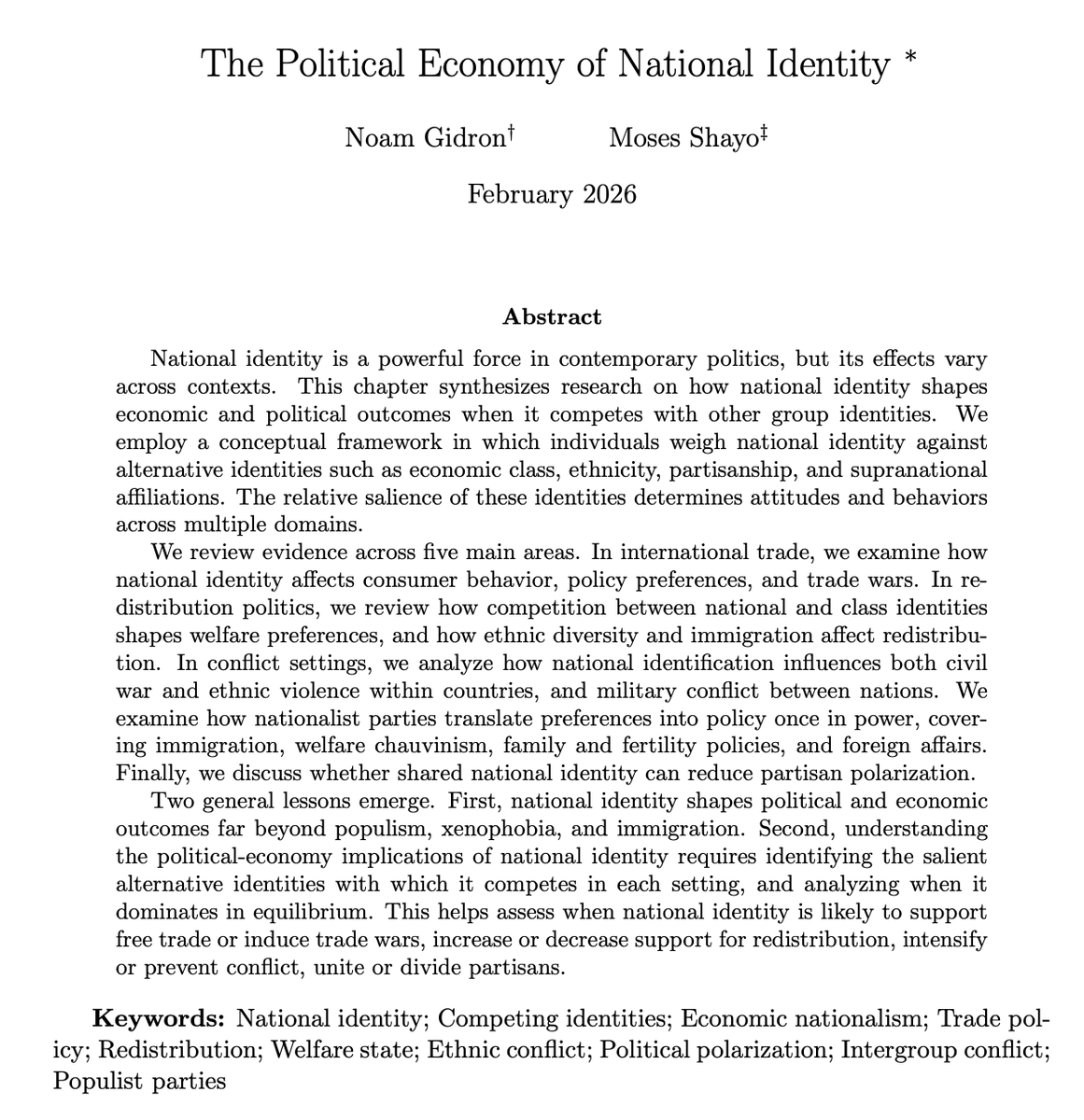
The Political Economy of National Identity: a chapter with @moseshayo for the Handbook of the Economics of Identity. We review econ & pol‑sci research on how national identities shape trade, welfare policy, conflict, and polarization. papers.ssrn.com/sol3/papers.cf…
Take of the day: this conflict is centered around US disengagement in the Middle East and advantages Israel and other US allies in the post-US era.
Best way to gather info on the Iran conflict in real-time. Fully agentic, tasteful interactive map of events sourced by OSINT. Great job @KestrelAI !
The Political Economy of National Identity: a chapter with @moseshayo for the Handbook of the Economics of Identity. We review econ & pol‑sci research on how national identities shape trade, welfare policy, conflict, and polarization. papers.ssrn.com/sol3/papers.cf…
Initial Iran strikes appear to be targeting airport, the leadership compound at Pasteur/Jomhouri street, and the transportation hub of Seyyed Khandan. Perhaps initial strike is aimed at senior government leadership to prevent fleeing
They should make AI cliff vesting schedules milestone-based instead of just 1 year. Time is way too linear for a technology that compresses time to value.
I feel quantized when I don’t get enough sleep. 6 hrs of sleep is like FP4, 7hrs is FP8, 8 hrs is FP16, 9 hours is FP32

Everyone following AI should take a moment to understand this graph to grasp the importance of hardware. The important and less talked about part of this graph is that for the SAME DURATION cerebras provides HIGHER ACCURACY with a SMALLER MODEL. This is the Hardware Lottery by @sarahookr and Bitter Lesson by Richard Sutton playing out in real life. Over time cerebras hardware will prove that SPEED is a QUALITATIVE ADVANTAGE and not just QUANTITATIVE. Congrats to @OpenAIDevs and @cerebras for this milestone.


Very fast Codex coming!


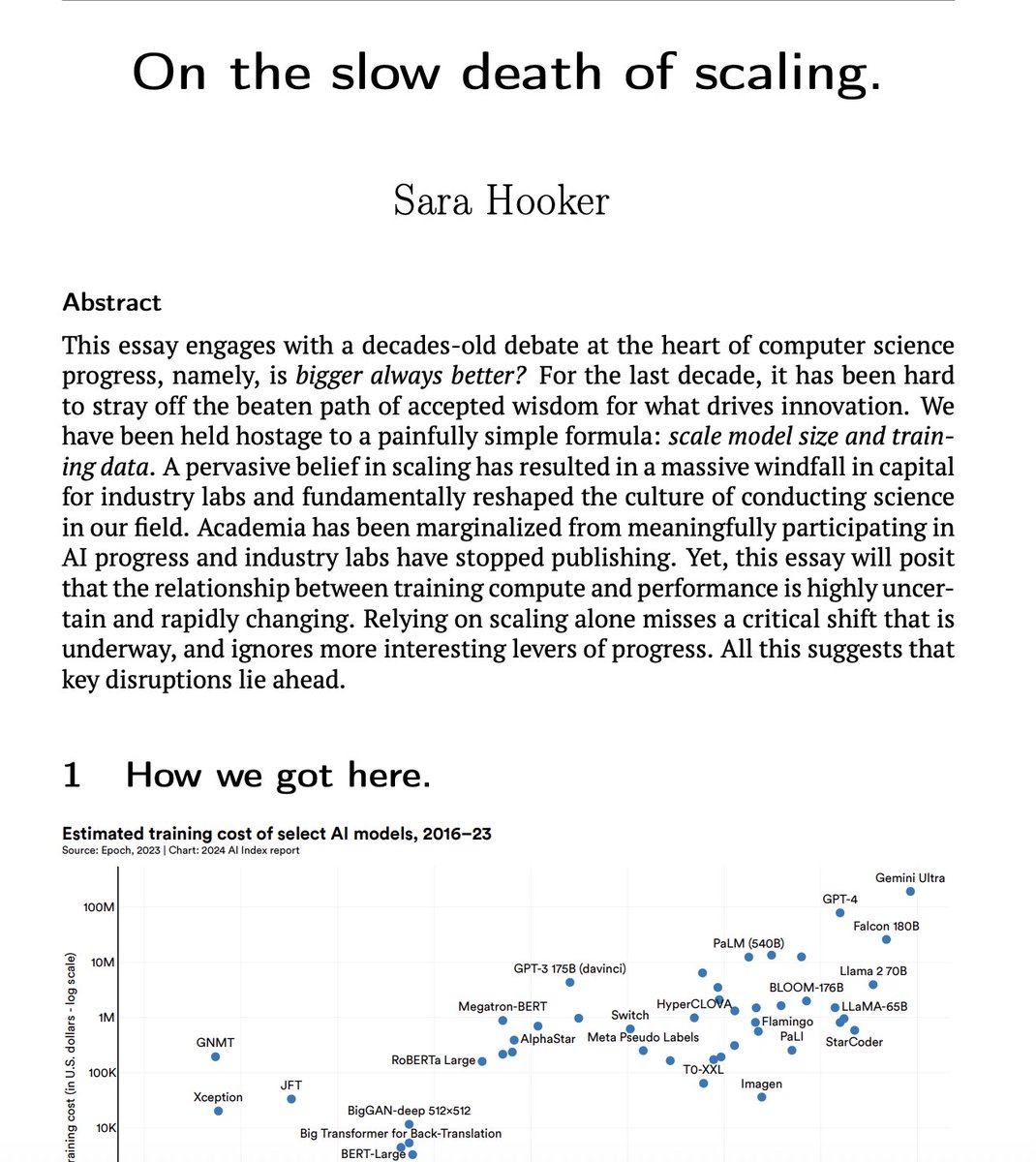
For the last decade, it has been hard to stray off the beaten path of accepted wisdom that scaling training parameters drives innovation. However, the relationship between training compute + performance is uncertain + rapidly changing.
So many bad takes on Groq as if its LPU is some magical new architecture or a TPU for hire. Groq's micro architecture does not matter. The *only* reason Groq has any traction is because it bet on SRAM. Without SRAM, there's no speed advantage, no PMF, no demand, and no acquisition. No one cares about deterministic latency, fancy compilers, or VLIW cores. Ultimately Nvidia bought Groq because if Groq is allowed to scale its roadmap - especially as part of a well funded hyperscaler - it would become a huge drag on Nvidia's narrative/valuation. $20B today saves $200B later. The tech almost doesn't matter.

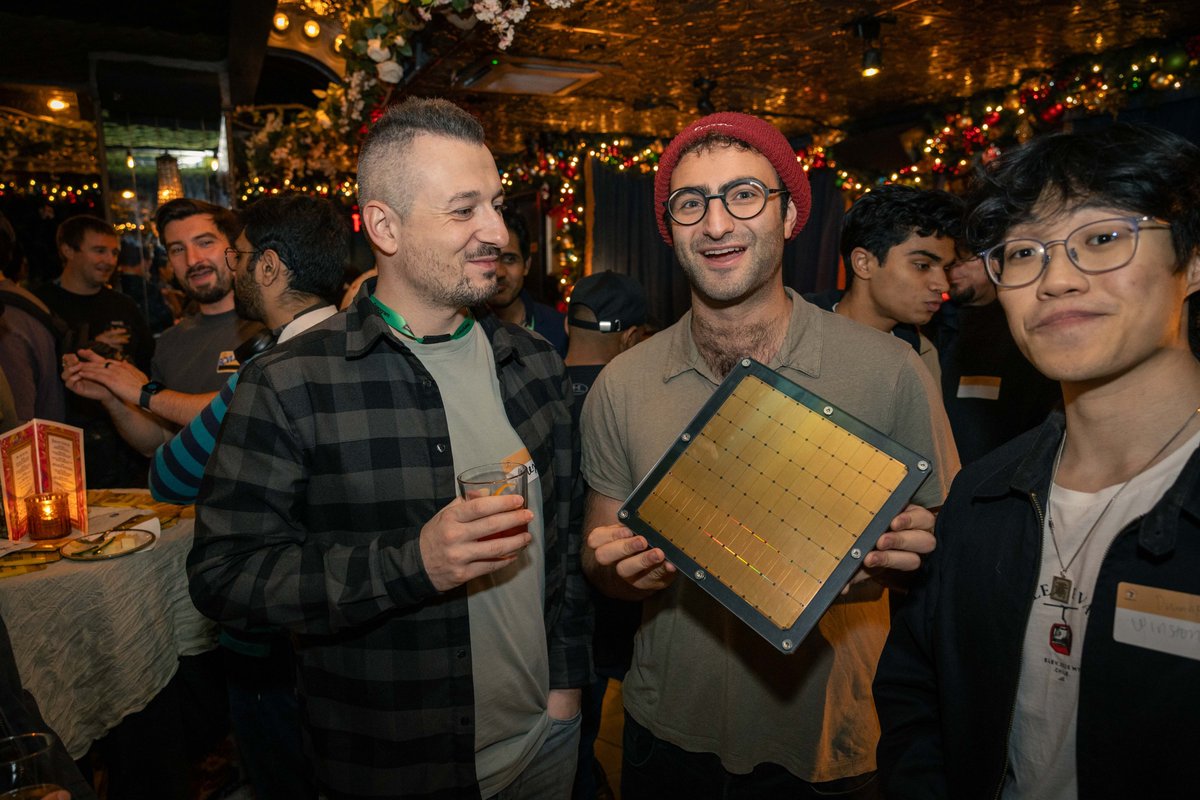
Last @cerebras Cafe Compute of the year was a cereal success!! 🎄 We had more than 100 AI builders, entrepreneurs, and investors come through the door to enjoy our barista bar, talk shop, and hold THE BIG CHIP. Thanks for joining us for the launch of the Big Chip Club, and stay tuned for BIGGER & BETTER in 2026 🥂 Huge thanks to my awesome DevX team - @SarahChieng @zhennydez @alyciazcary, plus plus our amazing Cerebras colleagues who showed up and supported (special shoutout to @AshDayanim the red nosed reindeer... had a really big big chip 🎶)


My eyes are up here 👀 But true, this chip is the biggest and fastest AI semiconductor in the world! Stay tuned for more chip pics


Emily @BlueMMedia
443 Followers 3K Following Independent and sober, gentle but firm, writing her own story💕

Ben Marder @Bredram02
5 Followers 140 Following
Tristan Comte @tristan_cte
1K Followers 2K Following building https://t.co/DJTBpCWxlm | prev @doctolib @ankorstore | made in HK, designed in FR, shipping in SF
Zhan Yang Lim @bersloj1
1 Followers 1K Following
Ashley Benit @AshleyBenitb2j
3 Followers 250 Following

Joan DeGennaro @TheRioDeGennaro
2K Followers 2K Following events & community @speedrun | formerly yc | mostly retweeting because I'm too verbose for Twitter 📍SF
Jacob Neplokh @jacobneplokh
165 Followers 424 Following Sade Coast Borgesian | “studying hard-to-explain things @uchicago”
Irie Banks @Irena2328783837
121 Followers 171 Following Geologist in the energy sector. Finding the resources that power a nation, past and future.
Kevin Kenneally @kenneally15
129 Followers 1K Following
Ben Lerner @benjamin_lerner
283 Followers 578 Following ML @ Meta AI | ex @DoorDash @recursecenter @twosigma @snap

William Chen @solidwillity
1K Followers 6K Following trying to manufacture inference hw + sw @fdotinc @scale_at_gmi
MAD09X14 @mad09x14
71 Followers 932 Following
James Wang @draecomino
88K Followers 2K Following Something new Prev: Cerebras, Nvidia, ARK Invest, 21Shares
Danso Alfusainey @danso_alf
940 Followers 3K Following Give love if you want love back from people and respect ✊
Zhenwei Gao @zhennydez
472 Followers 154 Following @cerebras / prev. international security @stanford
Sophia @Jane70098998591
51 Followers 336 Following


Kestrel Intelligence @KestrelAI
82 Followers 28 Following The AI engine for the world's most chaotic information. Providing live Iran coverage.

Richard Burton @Ricburton
8K Followers 4K Following British man from Norfolk in California 🌄 Working on robots for the people 🤖 Supporter of @RestoreBritain 🇬🇧
Sara Hooker @sarahookr
63K Followers 11K Following Building intelligence that evolves @adaption_ai. Built @Cohere_Labs, @GoogleBrain, @GoogleDeepmind. ML Efficiency, Multimodal\lingual.

Simone Saidmehr @saidmehr_s499
4 Followers 27 Following

GDP @bookwormengr
17K Followers 12K Following AI model & hardware co-design, Inference economics Safe super intelligence for all All views strictly personal
Raja Patnaik @RajaPatnaik
2K Followers 2K Following Head of AI (Research) @ Asset Manager. Quant PhD. Financial economist. Engineer. Tech and science enthusiast. Angel investor. All opinions are my own.
Margarita G @Marg_Groisman
2K Followers 765 Following 🚀 Building software for data centers @Aravolta_X25
Iskandar Haykel @i_haykel
107 Followers 603 Following AI Policy Researcher @americans4ri Retweets, endorsements, and opinions are my own.
Ryan Cunningham @rydcunningham
1K Followers 861 Following doing things • energy + compute @ Edgerunner Ventures • Machine Yearning on Substack • ex Uber
Sparsh Agarwal @sparshselim
4K Followers 5K Following Reviving Darjeeling | @dorjeteas | Creating Abundance | @altcarbonindia | Making Progress | @altermagindia


Lauren @4754dcd14U6O7
68 Followers 1K Following No one can make you feel inferior without your consent.
ちひろ @Wilhelmine32027
131 Followers 4K Following
Marjan Keypour (Green... @MarjanKg
4K Followers 2K Following Passionate Iranian. Proud American. Peacemonger. #humanrights #minorities @Harvard @ucla @HOMANITYmusic @NUFDIran @FemicideIran @ARAMalliance
Álvaro Delgado-Vega ... @lvaro_d
839 Followers 1K Following Assistant Professor at the University of Chicago. Economics Ph.D. from UC3M. Political Economist. My soul was always for History. RT&like≠endorsement
Pearl Hulbert @PearlHulbert
132 Followers 416 Following Growth @ Cerebras Prev: Founder of EasySpeak AAC https://t.co/Qp4CY9sNPK
Isaac Tai 🧇 @hi_im_isaac_
977 Followers 7K Following

Bubacarr Sowe @BubacarrSo53803
49 Followers 2K Following Consistency is what transform average into excellent 👌
Zihan "Zenus" Wang @wzenus
23K Followers 687 Following Reasoning agent / RL / efficiency research @NorthwesternU & @nvidia. Ex @Microsoft @yutori_ai @deepseek_ai @uiuc_nlp @RUC1937.
Sophia. @Aura_Gleam
268 Followers 3K Following Embrace each challenge as an opportunity to grow, for it is through adversity that we discover our true strength.
GDC @GeneralDataCorp
9 Followers 0 Following The General Data Corporation gives your agents access to the physical world through one API. 🤗 https://t.co/AINDpFmfag


Julia Steinberg @juliasteinberg
8K Followers 892 Following "Raise less corn and more hell"; General Manager of Books @arenamagdotcom
Farza 🇵🇰🇺�... @FarzaTV
127K Followers 2K Following hi. i make things. hacking on @heyclicky. prev founder @_buildspace.

Patrick McKenzie @patio11
197K Followers 809 Following I work for the Internet and am an advisor to @stripe. These are my personal opinions unless otherwise noted.
Michael Granoff @mikejgr
8K Followers 4K Following Founder of VC @manivmobility, backing startups that help companies make, move, power, and compute. Sondheim lover, runner, harness horses, politics (US/Israel)
Charlie Bullock @CharlieBull0ck
3K Followers 624 Following Senior Research Fellow @Law_AI_ working on questions about U.S. law + AI governance
justin curl @curl_justin
2K Followers 1K Following Member of technical staff @AnthropicAI Researching law, institutions, and AI Prev: @cognition, @harvard_law, @princetoncs
Wakana Asano @Wakana_Asano
85 Followers 147 Following Research Associate @IISS_org -Asia | geoeconomics | science & tech | multilateralism | views my own. rt ≠ endorsement. @georgetownmsfs @FulbrightPrgrm
rishi @ ICML @RishiBommasani
8K Followers 3K Following Economic impacts of AI; AI policy & governance @StanfordHAI Previous: Stanford CS PhD w/ @percyliang @jurafsky, Cornell CS
Ben Marder @Bredram02
5 Followers 140 Following
Jacquelyn Schneider @JackieGSchneid
10K Followers 815 Following Hoover Fellow @HooverInst, Director Hoover Wargaming &Crisis Simulation Initiative, affiliate @StanfordCISAC; emerging tech, wargames, & natsec. Views my own.
Zvi Mowshowitz @TheZvi
40K Followers 314 Following Blogger primarily on AI and AI x-risk but also other things at Don't Worry About the Vase (SS/WP/LW), founding Balsa Research to fix policy.
Daniel Kokotajlo @DKokotajlo
38K Followers 279 Following
Yoshua Bengio @Yoshua_Bengio
44K Followers 276 Following Turing Award recipient and world's most cited scientist. Working towards the safe development of AI for the benefit of all @UMontreal, @LawZero_ & @Mila_Quebec
Jack Clark @jackclarkSF
138K Followers 5K Following @AnthropicAI, ONEAI OECD, co-chair @indexingai, writer @ https://t.co/3vmtHYkIJ2 Past: @openai, @business @theregister. Neural nets, distributed systems, weird futures
Helen Toner @hlntnr
37K Followers 1K Following AI, national security, China. Part of the founding team at @CSETGeorgetown (opinions my own). Author of Rising Tide on substack: https://t.co/LKAoyL00iB
Jeffrey Ding @jjding99
10K Followers 446 Following Assistant Professor at George Washington University @GWtweets | technology and int'l politics | newsletter on China's AI landscape: https://t.co/ciqWZF1jiV
Matt Sheehan @mattsheehan88
17K Followers 6K Following US/China AI & tech. Fellow @CarnegieEndow. Author "The Transpacific Experiment: How China & California Collaborate & Compete For Our Future." Nuggets.
Gregory C. Allen @Gregory_C_Allen
8K Followers 370 Following Founder & CEO of Decision Tree Research Host of the AI Power Podcast https://t.co/G6FSgPOJ0V
Tim Fist @fiiiiiist
4K Followers 889 Following Director of Emerging Technology @IFP. Adjunct Senior Fellow @CNASdc. AI & compute policy, science, innovation.
Lennart Heim @ohlennart
16K Followers 760 Following managing the flop | prev @RANDcorporation @GovAIOrg @EpochAIResearch

Director Michael Krat... @mkratsios47
47K Followers 51 Following Assistant to the President & 13th Director of @WHOSTP47 | Previously 4th CTO of the United States and Under Secretary of War | South Carolinian 🇺🇸
David Sacks @DavidSacks
1.7M Followers 4K Following Tech founder & investor @Craft_Ventures @theallinpod. Co-Chair, President’s Council of Advisors on Science & Technology.
𝔊𝔴𝔢𝔯𝔫 @gwern
78K Followers 110 Following Internet besserwisser; pedantic, mean reply guy. 𝘞𝘢𝘵𝘢𝘴𝘩𝘪 𝘬𝘪𝘯𝘪𝘯𝘢𝘳𝘪𝘮𝘢𝘴𝘶! (Follow requests ignored due to terrible UI.)
Michael Bennon @mbennon
201 Followers 237 Following Infrastructure policy research @StanfordCDDRL. Project Finance. Current topics: BRI, Vert. Industrial Policy, US Public-Private Partnerships, Infra. Permitting
Lauren Gilbert @notanastronomer
5K Followers 3K Following Anyone can be wrong on the internet but only some of us can pull off getting paid for it. currently: @indevmag. formerly: @renphilanthropy, @open_phil, etc.
amos hochstein @amoshochstein
22K Followers 273 Following Managing Partner @ TWG Global, former WH senior advisor to POTUS. Carnegie Distinguished Fellow @SIPA Columbia U; Husband, father of 4; Tweets are my own

Senator Scott Wiener @Scott_Wiener
113K Followers 1K Following 6’7” CA State Senator 🏳️🌈 ✡️ Policy nerd & chronic legislative overachiever 🤓 Running for Congress to protect our democracy 💙 Vote Nov. 3, 2026 🗳️
Condoleezza Rice @CondoleezzaRice
302K Followers 114 Following Director of the @HooverInst. 66th Secretary of State, author, professor, pianist, golfer, and football fan. Working to build a better world.
LarryDiamond @LarryDiamond
20K Followers 377 Following Senior Fellow at the Hoover Institution, & Mosbacher Senior Fellow at the Freeman Spogli Institute at Stanford University. Views expressed are purely my own.
Kathryn Stoner @kath_stoner
3K Followers 1K Following Political Scientist, Mosbacher Director, CDDRL, Stanford University. Author of Russia Resurrected: Its Power and Purpose in a New Global Order (2021)
Abbas Milani @milaniabbas
188K Followers 48 Following Director, Hamid & Christina Moghadam Program in Iranian Studies, Stanford University. Research Fellow at Hoover. Opinions are my own. Telegram: https://t.co/vWsiNIFuN1
H.R. McMaster @LTGHRMcMaster
39K Followers 31 Following Veteran, 25th NSA, Senior Fellow @HooverInst, Fellow @FSIStanford, Lecturer @StanfordGSB, Chairman @FDD_CMPP, Japan Chair @Hudsoninstitute
Brett McGurk @brett_mcgurk
238K Followers 4K Following Former WH Coordinator / Presidential Envoy. Served four presidents. Now @Kennedy_School @lux_capital @CNN @N7_initiative @Cisco
Jerry Kaplan @Jerry_Kaplan
2K Followers 16 Following Jerry Kaplan is widely known in the computer industry as a serial entrepreneur, technical innovator, bestselling author, Stanford adjunct lecturer & futurist.
Herb Lin @HerbLinCyber
4K Followers 21 Following Stanford University. Work on cyber and influence operations; emerging technologies and national security; science, technology and public policy. Views are mine.
steve blank @sgblank
218K Followers 506 Following Customer Development & Secret History, Teaching at Stanford
Alex Stamos @alexstamos
91K Followers 2K Following Doing AI security stuff at https://t.co/dAzjWy3P9q and teaching at Stanford (https://t.co/qi1lzlkg3K).
Karen Kornbluh @KarenKornbluh
4K Followers 2K Following Former Ambassador to OECD. Tech, etc. NYT says I'm "fighting for economic equality." Still trying to learn French.
Colin Kahl @ColinKahl
80K Followers 965 Following Director @FSIStanford. Husband. Dad. Music fan. Game lover. Wonk and all-around nerd. Former national security guy.
Alain Schläpfer @AlainSchlaepfer
59 Followers 102 Following Lecturer in Political Science and Economics at Stanford
Michael McFaul @McFaul
887K Followers 2K Following Professor of Political Science, Senior Fellow, Freeman Spogli Institute & Hoover Institution, all at Stanford University. U.S. Ambassador to Russia, 2012-2014.
Francis Fukuyama @FukuyamaFrancis
277K Followers 809 Following Senior Fellow at Stanford's Freeman Spogli Institute, Director, Ford Dorsey Masters in Intl Policy @StanfordCDDRL Instagram: francis.fukuyamaYou might like