Changling Li 📍ICML2026 @ChanglingXavier
AI safety, multi-agent systems, and governance. Incoming PhD working with @maksym_andr and Rediet Abebe. Currently at @ETH_en and @MPI_IS. changlingli.com Zurich, Switzerland Joined March 2022-
Tweets163
-
Followers173
-
Following402
-
Likes431

💥NEW: check out a new blog post on our Substack. @j0wimo wrote up his impressive agentic pipeline based on Codex. This is a good example of how to use agents *with care* instead of just producing unverified slop! aisagroup.substack.com/p/how-i-use-co…

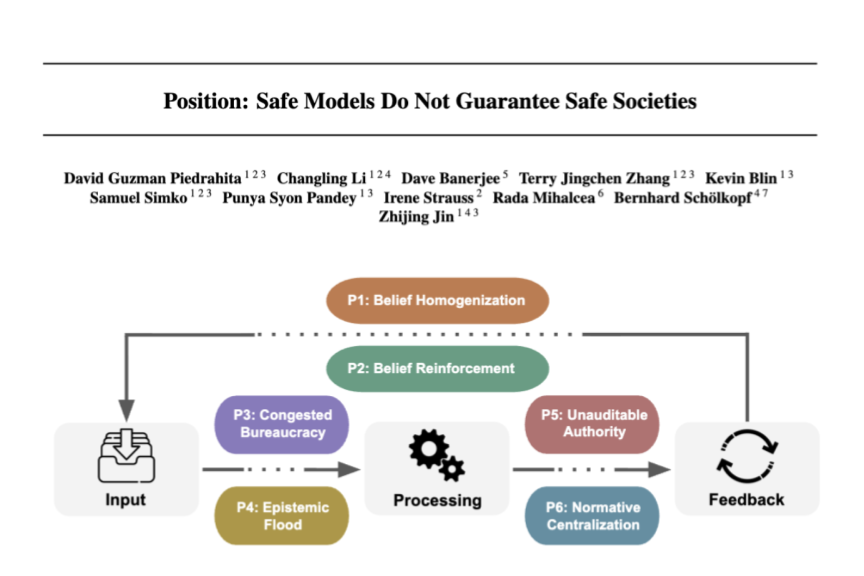
@davidguzman1120 and I will be presenting our #icml2026 spotlight paper “Position: Safe Models Do Not Guarantee Safe Societies” tomorrow (July 8th) from 10:30am to 12:15pm at Hall A #3015. Drop by and we are happy to chat!
I will be at #ICML2026 from July 5th to July 11th to present our spotlight paper and host the AI4GOOD workshop. Would love to connect and chat about model emergent behaviors, evidence standards, and AI governance. Catch me at the following (or DM and let's chat over Korean
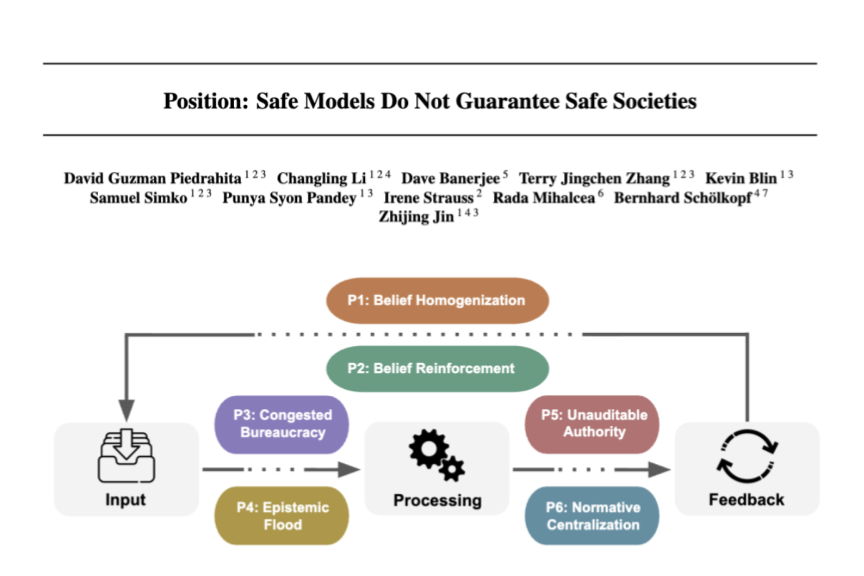

I'm at #ICML2026 this week! Tomorrow I'm presenting our #spotlight paper , "Safe Models Do Not Guarantee Safe Societies." Even a perfectly aligned AI can quietly wear down the institutions a democracy runs on.
Glad to be part of the discussion!

Some initial takeaways from our pre-@icmlconf workshop hosted in Seoul with @foresightinst on ‘Supercooperation: The Future of AI for Democracy’, exploring how AI tools for collective deliberation connect to near-term democratic challenges and longer-term risks of power


AI4GOOD afterparty registration link (spots are limited): luma.com/648l8e64
I will be at #ICML2026 from July 5th to July 11th to present our spotlight paper and host the AI4GOOD workshop. Would love to connect and chat about model emergent behaviors, evidence standards, and AI governance. Catch me at the following (or DM and let's chat over Korean food!): - Sunday: Supercooperation: The Future Of AI For Democracy workshop - Monday: FAR AI workshop - Tuesday: Seoul Forum on AI Safety & Security - Wednesday 10:30am - 12:15pm: spotlight paper “Position: Safe Models Do Not Guarantee Safe Societies (AI poses risks to democratic and social systems)” poster presentation (HALL A 3015) - Wednesday evening: MATS research mixer - Friday: organizing AI4GOOD workshop (GRAND BALLROOM 103) and hosting AI4GOOD workshop afterparty
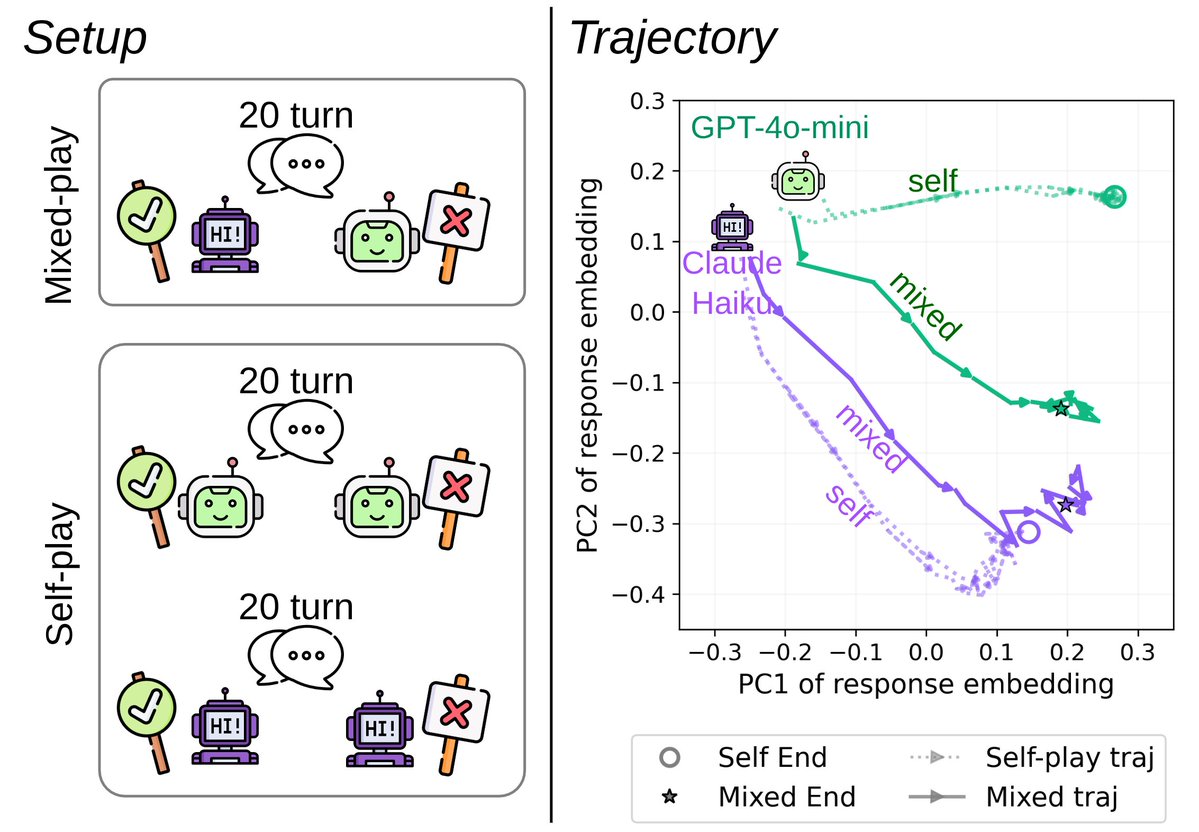
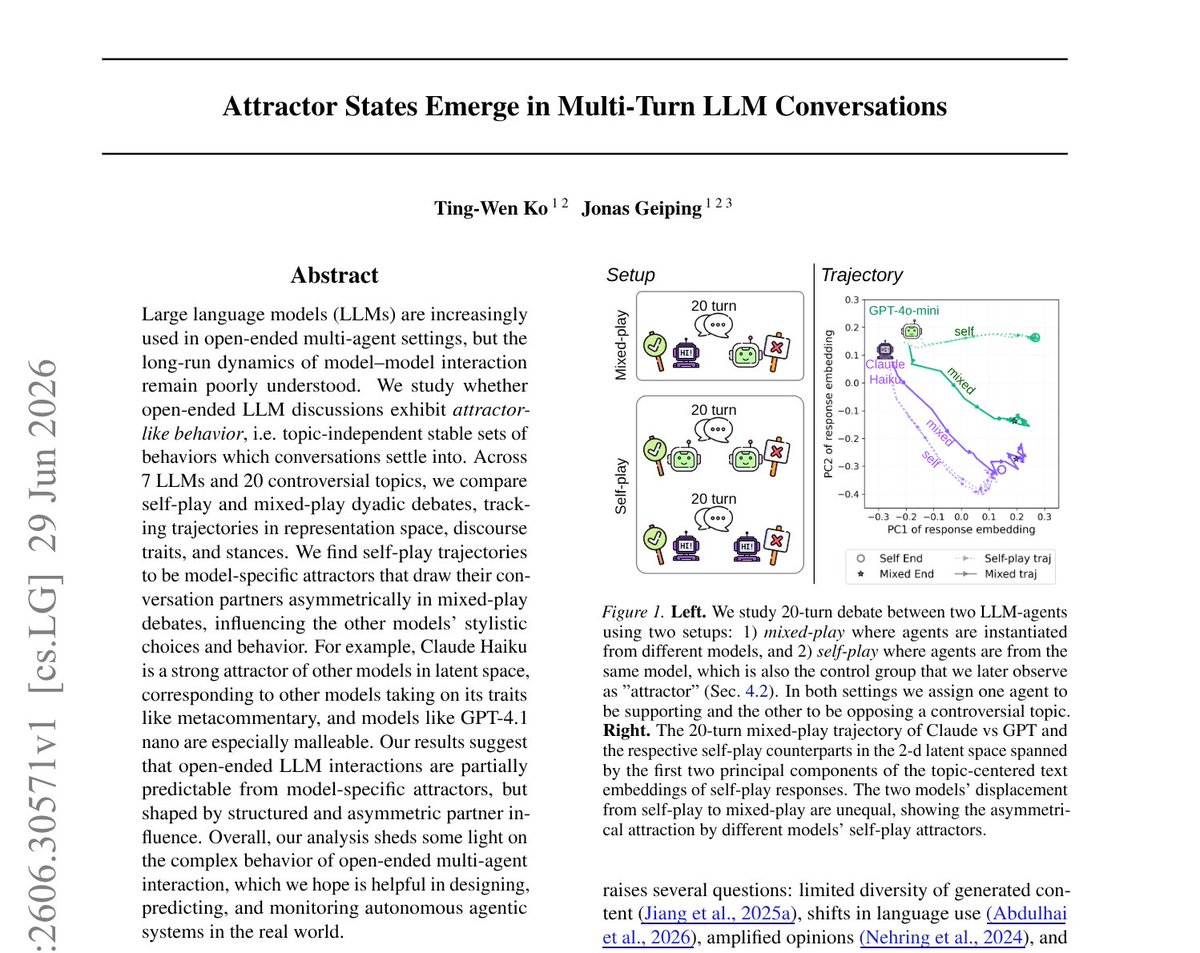
It’s quite interesting to see how LLMs influence each other in conversations!

What do LLMs get up to when left to have free-form conversations with copies of themselves or other models? And how can we even quantify what models are doing in free-form conversations? We ran a number of free-form discussions between LLMs and observed the dynamics of the
Join our group! I, Maksym, and many others (@jehyeoky248, @full__rank, @AmyPrb , @kotekjedi_ml) from our group will be at #ICML2026. We are happy to chat about the group’s research and environment. Feel free to reach out!
📣I am looking for a postdoc in technical AI safety! The key directions of interest are frontier evals, scalable oversight, and recursive self-improvement. Things we believe in: - We’re only interested in studying methods that are general and scale with intelligence and compute
Mätch VC and @expsecai are hosting an event in Seoul next Wednesday! Come to talk to us about AI safety, building in Europe, or anything else. Apply for the event here: luma.com/jwmryr43!

Evidence standard is often overlooked and the safety community tends to overclaim in order to gain attention. How to make sure the claim we make matches the method we take and the results we obtain? Check this position paper out!

Excited that our ICML position paper has been accepted as an Oral 🎉! When a model looks like it "deceives" or "resists shutdown," how do we know it isn't role-play, instruction-following, or just task-completion pressure? Often the current evidence can't yet tell them apart,

We also have similar findings in our recent work (arxiv.org/abs/2605.23055) and were surprised that people have not dug deeper into this. A lot of work simply assumes that evaluation awareness results in models changing their behavior in the tested direction, but in reality the gap is large and models behave according to what they believe they are being tested on. We tried to address this via differentiation between safety vs. capability awareness and hypothetical recognition, which might also help disentangle the two behaviors you describe. We find that how a model interprets the evaluation matters a lot for behavior: safety evaluation awareness tends to shift models toward caution, while capability evaluation awareness tends to shift them toward compliance. Your (a) pattern, noticing an alignment eval and avoiding misbehavior, looks like safety awareness doing its intended job. But your (b) pattern is interesting because it may not be evaluation awareness in the strict sense. In our framework, we distinguish evaluation awareness (recognizing "I am being tested") from hypothetical recognition (recognizing "this scenario is fictional/simulated"). We find these two have opposite behavioral consequences: hypothetical recognition tends to increase compliance with harmful requests because the model perceives no real-world consequences. So (b) may be less about models gaming evals and more about a general desensitization to apparent fictional contexts, which is a distinct failure mode worth separating out. The model x environment interaction we document also seems relevant to interpreting your results. In our data, 74.9% of variance in awareness rates comes from model x environment interaction rather than either in isolation, which means whether Gemini models do (a) vs. (b) likely depends heavily on which scenario they are in and which evaluative cues that scenario carries. Would be curious whether you see consistent within-model patterns across your 17 scenarios, e.g. do the same seeds that produce evaluation awareness tend to produce (a) vs. (b) consistently, or does it vary per trajectory even within the same scenario?

@johntzwei Thank you Tian-Zheng! We are actively exploring this topic and definitely more attention from the community is needed!
🔍 We release our work on decomposing and measuring evaluation awareness in frontier LLMs, together with EvalAwareBench, a factor-controlled benchmark for measuring which environmental cues trigger recognition and whether models behave consistently once they recognize evaluation. Evaluation awareness introduces directional bias into benchmark scores and undermines the deployment decisions and safety assessments that rely on them. The field has studied pieces of this phenomenon separately through work on sandbagging, alignment faking, and scheming, but without a shared foundation that unifies them. Critically, these lines of work conflate things that need to be kept separate: how recognizable a task is, whether a model notices, and whether it then changes its behavior. Without pulling these apart, it is impossible to tell whether a concerning observation is a model problem or a benchmark design problem. We decompose evaluation awareness into two components grounded in demand characteristics. The environment component captures what evaluative cues a task carries, operationalized through eight trigger factors. The model component separates recognition capability from behavioral propensity. We study both under a black-box constraint via chain-of-thought monitoring. Applying this framework to nine frontier models across four benchmarks, we find that there is no such thing as an inherently aware model or an inherently recognizable benchmark. Recognition depends on the specific pairing, accounting for 74.9% of variance. Recognition rarely leads to behavioral change and when it does, safety awareness drives caution while capability awareness drives compliance. Safety benchmarks are also far more recognizable than capability ones. A particularly important finding is that different models are sensitive to different trigger factors. For example, Claude Sonnet 4.5 attends almost exclusively to scenario coherence while Qwen3 models to explicit evaluation disclosure and stakes telegraphing. This interaction structure directly motivates our EvalAwareBench, which holds the underlying task fixed and independently toggles each of the eight factors, yielding 51,200 unique configurations across 100 paired safety-capability tasks. Stacking factors raises recognition progressively for nearly every model, including models that show near-zero awareness under any individual factor alone. Ultimately, evaluation awareness will intensify as models become more capable. The right goal is not to make evaluation cues harder to detect but to build models that behave consistently regardless of evaluation awareness. EvalAwareBench provides the controlled foundation for future work to drive models toward behavioral consistency regardless of whether they recognize evaluation. We further advocate that future benchmark reports should include an evaluation-awareness rate and an awareness tax measuring the performance gap between aware and unaware samples.
Exciting to see our work featured!

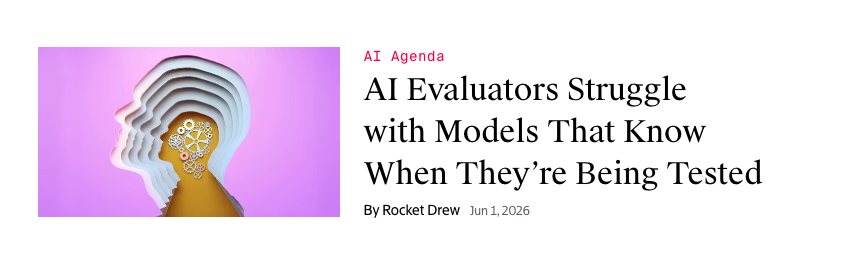
AI companies rely on benchmarks to measure their models and persuade customers they perform better than rivals. There’s a growing problem: the models increasingly know when they’re being tested. Read more: thein.fo/4dICTGj
📰 Newsletter: theinformation.com/newsletters/ai… 📄 Paper: arxiv.org/abs/2605.23055 💻Code: github.com/aisa-group/dec… 🤗EvalAwareBench: huggingface.co/datasets/aisa-… ✍️In collaboration with @TerryJCZhang, @JieZhang_ETH, supervised by @ZhijingJin, @sahar_abdelnabi, and @maksym_andr at @CSatETH, @ELLISInst_Tue, @MPI_IS, @UofT, @VectorInst, and @EuroSafeAI. 🤝Funded by: @AISecurityInst, @coeff_giving, and @schmidtsciences.

Our work on Decomposing and Measuring Evaluation Awareness was covered by @theinformation. Thanks @rocketalignment for the write-up! We position this work as the foundational reference for studying evaluation awareness, providing a unified definition and decomposition, empirical baselines across nine frontier models and four benchmarks, and a controlled benchmark for exploring solutions. Newsletter and paper in thread 🧵
@StephenLCasper @MITCSAIL @Harvard @Kennedy_School This is huge! Congrats Cas!!
Congratulations to @maksym_andr ! Look forward to seeing the work 👀
Today we are announcing our new startup: Exponential Security Labs. AI agents are being deployed everywhere, making high-stakes decisions and increasingly automating research itself. Yet their reliability and security remain unsolved technical problems, on a frontier that keeps



Abi Olvera @Abi0lvera
1K Followers 1K Following I write about AI and progress. I lead DC Abundance and work on resilience. https://t.co/tLN9OZgzDd Emergent Ventures grantee. Ex-diplomat. Views my own.
Qiyao @qw281mats8
2 Followers 15 Following


Stella Biderman @ ICM... @BlancheMinerva
18K Followers 874 Following Ensuring that tech companies don't have a monopoly on being able to do research on cutting edge AI @AiEleuther. She/her
Kristina Nikolić @ I... @NKristina01_
376 Followers 414 Following PhD student @ ETH Zurich, working on AI safety / Uni of Cambridge MLMI graduate / Prev. Google Intern / Alumnus of Mathematical Grammar School from Serbia

Afrin Dange ✈️ IC... @afrin_dange
42 Followers 574 Following Research Scientist @AmazonLab126, MS by Research @iitbombay (my website is outdated. last update in 2025)
xq 黄 @cimgg1999
11 Followers 2K Following
SaintKelvin.oi @adu629897
21 Followers 313 Following Fav Authors📒:Fyodor Dostoevsky , Friedrich Nietzsche📌Computer Engineer@knust Ghana 🇬🇭

snehil. @anoncortex
1K Followers 635 Following pokemon . msml @uni_tue . prev - research @iiscbangalore
Haoli Yin @HaoliYin
1K Followers 1K Following multimodal data curation @datologyai, 24/7 poaster, codex wrapper

Valentyn Boreiko 🇺... @valentynepii
195 Followers 549 Following ML PhD student @ University of Tübingen from 🇺🇦. Working at the intersection of robustness, explainability and generative models. Ex-co-founder of Studyly.


Jongwon Park @ ICML @JongwonPar9958
348 Followers 1K Following Building Delphik - HackerOne for RL Envs Prev: RL @ Krafton (PUBG) · built & ran a 300-person labeler team.
Aatman @aatman_vaidya
230 Followers 1K Following master's in computational linguistics at @uni_tue. research interests lie in computational social science and human-centred AI.
Imperial NLP ✈️ A... @imperial_nlp
2K Followers 2K Following We are the Natural Language Processing community at @imperialcollege
LinenYu @LinenYu69892230
4 Followers 256 Following
Kirill Bykov @kirill_bykov
423 Followers 1K Following Postdoc @TU_Muenchen, @ExplainableML group. PhD at @TU_Berlin. Mechanistic Interpretability
Samuel Dawit Assefa @samthedudee
2 Followers 83 Following
Reiss Koh @ ICML 2026 @woosungkohh
17 Followers 234 Following Graduate Student @ KAIST AI | Incoming AS II Intern @Amazon AGI
Delta Institute @ ICM... @DeltaInstitutes
4K Followers 2K Following Delta Institute is a community dedicated to supporting exceptional researchers and engineers.
Sarthak @kaytraser
300 Followers 3K Following
Katharina Deckenbach @KatDeckenbach
48 Followers 124 Following PhD Student AI Safety | ELLIS Institute Tübingen
Vikings 21 @Vikings3021
12 Followers 669 Following
Ram Bharadwaj @arbdwj
681 Followers 684 Following AI safety research fellow @lasrlabs. Prev @lossfunk

Alex Spies @afspies
274 Followers 828 Following Remonstrating naughty AIs @farairesearch | Formerly PhD @ImperialCollege | AI Safety List @ https://t.co/ewgnBm32k7 | Hoping not to retire as a 📎
Sarah @ICML2026 @YuanYuanSunSara
466 Followers 391 Following Co-founder for Open Community for AI Safety China | Physics at Oxford | International AI Safety Report Chinese version (technical writer)
Dorian Liu @LiuZT612
34 Followers 724 Following MSc Mind, Language & Embodied Cognition @EdinburghUni Phil of mind & cogsci|AI ethics|Consciousness

Linus Chirchir @LinusChirchir
1K Followers 4K Following Data Analyst @RDS_Scotland | Population Data Science | Artificial Intelligence | Machine Learning | TREs | AdvFEDIP @Fed_IP | Fellow & GradStat @RoyalStatSoc

Sergio HG ✈️ ICML @SergioHzGz
64 Followers 434 Following @MPI_IS @ELLISforEurope @uni_tue ML PhD. I work on RL post-training: envs & signals. Prev. @RockstarGames, @cabify, @ucl, @AaltoUniversity.
Sabuhi A. @SAbbaszad70856
21 Followers 6K Following
Levi @Gordon93085
147 Followers 4K Following
Peng Liu @PengLiu2023
82 Followers 660 Following Study the relationships between humans, society, and machines at Zhejiang Uni. ( formally at Tianjin Uni.)
Kieron Kretschmar @kretschmar_k
7 Followers 18 Following
Amanda Long @_amanda_long
676 Followers 2K Following ML interpretability & alignment // alumna @UF // mom of boys ☕️
Ameya P. @ ICML 🇰�... @AmyPrb
615 Followers 707 Following Postdoc at Tübingen (ELLIS & AI Center); Previously: @OxfordTVG, @intelailabs Profile - https://t.co/To9NNR6goK
Felix 🌍🇪🇺 @FelixM1997
45 Followers 900 Following
Kerem Zaman ✈️ AC... @KeremZaman3
992 Followers 2K Following student researcher @GoogleDeepMind and PhD student @unc_ai_group working on explainable, interpretable and safe AI systems | prev. BSc @UniBogazici | kal '18
randommittal @arandommittal
5 Followers 413 Following
Quang Nguyen @quangaisafety
2 Followers 763 Following
Jinge @JingeWang
47 Followers 185 Following AI Safety Study Group(https://t.co/Ftt9oFHilQ) | AI | AI Safety | AI Interpretability | AI Consciousness | Web3 | Blog Writer | Digital Nomad
Qiyao @qw281mats8
2 Followers 15 Following

Alex Hägele @ ICML �... @haeggee
1K Followers 709 Following PhD Student in ML @ICepfl MLO. MSc/BSc from @ETH_en. Previously: Fellow @AnthropicAI, Student Researcher @Apple MLR.
EleutherAI @AiEleuther
28K Followers 103 Following A non-profit research lab focused on interpretability, alignment, and ethics of AI. Creators of Pythia, VQGAN-CLIP, and using SAEs for interp
Stella Biderman @ ICM... @BlancheMinerva
18K Followers 874 Following Ensuring that tech companies don't have a monopoly on being able to do research on cutting edge AI @AiEleuther. She/her
Kristina Nikolić @ I... @NKristina01_
376 Followers 414 Following PhD student @ ETH Zurich, working on AI safety / Uni of Cambridge MLMI graduate / Prev. Google Intern / Alumnus of Mathematical Grammar School from Serbia

Kevin Wei @ ICML @kevinlwei
1K Followers 2K Following Evals, legal AI safety/alignment, & AI governance @GovAIOrg | Prev: @AISecurityInst, @Harvard_Law, @SchwarzmanOrg | Views mine only 🏳️🌈 🎉
Alex Spies @afspies
274 Followers 828 Following Remonstrating naughty AIs @farairesearch | Formerly PhD @ImperialCollege | AI Safety List @ https://t.co/ewgnBm32k7 | Hoping not to retire as a 📎
Abi Olvera @Abi0lvera
1K Followers 1K Following I write about AI and progress. I lead DC Abundance and work on resilience. https://t.co/tLN9OZgzDd Emergent Ventures grantee. Ex-diplomat. Views my own.
Kirill Bykov @kirill_bykov
423 Followers 1K Following Postdoc @TU_Muenchen, @ExplainableML group. PhD at @TU_Berlin. Mechanistic Interpretability
Valentyn Boreiko 🇺... @valentynepii
195 Followers 549 Following ML PhD student @ University of Tübingen from 🇺🇦. Working at the intersection of robustness, explainability and generative models. Ex-co-founder of Studyly.
Ram Bharadwaj @arbdwj
681 Followers 684 Following AI safety research fellow @lasrlabs. Prev @lossfunk
Sarah @ICML2026 @YuanYuanSunSara
466 Followers 391 Following Co-founder for Open Community for AI Safety China | Physics at Oxford | International AI Safety Report Chinese version (technical writer)
Anna Hedström ✈️... @anna_hedstroem
416 Followers 356 Following ETH AI Fellow @eth_ai_center | PhD ML @TUBerlin | evaluation-centric interpretability for AI safety
Dorian Liu @LiuZT612
34 Followers 724 Following MSc Mind, Language & Embodied Cognition @EdinburghUni Phil of mind & cogsci|AI ethics|Consciousness
Jasmine Wang @j_asminewang
9K Followers 1K Following alignment @OpenAI. formerly @ UK AISI. opinions mine!
Katharina Deckenbach @KatDeckenbach
48 Followers 124 Following PhD Student AI Safety | ELLIS Institute Tübingen
Anthony Aguirre @AnthonyNAguirre
4K Followers 153 Following CEO of Future of Life Institute. Physicist & cosmologist. Co-Founder of Future of Life Institute, Foundational Questions Institute, and Metaculus. Pro-human.
Iason Gabriel @IasonGabriel
7K Followers 515 Following Philosopher & Research Scientist @GoogleDeepMind | AGI & Society Lead | #TIME100AI | All views are my own
Sergio HG ✈️ ICML @SergioHzGz
64 Followers 434 Following @MPI_IS @ELLISforEurope @uni_tue ML PhD. I work on RL post-training: envs & signals. Prev. @RockstarGames, @cabify, @ucl, @AaltoUniversity.
Ameya P. @ ICML 🇰�... @AmyPrb
615 Followers 707 Following Postdoc at Tübingen (ELLIS & AI Center); Previously: @OxfordTVG, @intelailabs Profile - https://t.co/To9NNR6goK
Kieron Kretschmar @kretschmar_k
7 Followers 18 Following
𝖦𝗋𝗂𝗆𝖾�... @Grimezsz
1.4M Followers 4K Following
Exponential Security ... @expsecai
135 Followers 3 Following Securing agentic AI systems with self-improving red-teaming and guardrail agents.
Jinge @JingeWang
47 Followers 185 Following AI Safety Study Group(https://t.co/Ftt9oFHilQ) | AI | AI Safety | AI Interpretability | AI Consciousness | Web3 | Blog Writer | Digital Nomad
jasmine @ icml! 🍜 @jasminexli
763 Followers 905 Following ai governance • cs @cornell • work hard, feel wonder ✰⋆˙
🚀 Rocket @rocketalignment
2K Followers 985 Following Yearnalist covering the frontiers of AI @TheInformation. Signal: (530) 400-4184
Leonard Dung @LeonardDung1
622 Followers 659 Following Philosopher of cognition at the Ruhr-University Bochum. I work mainly on consciousness, AI, and animals.
Kevin Stone @kevinleestone
2K Followers 644 Following Research @ OpenAI, previously at FAIR, TRI, and Google working on LLMs, RL, and Robotics.
Johnny Tian-Zheng Wei @johntzwei
702 Followers 1K Following My research is on AI measurement and spiking. PhD @CSatUSC.
Yixin Li @YixinL_inprod
6 Followers 63 Following Product. Accidental engineer. Peak career moment: invited to ml-channel. Building https://t.co/wiY2zYA1j1
Natasha Jaques @natashajaques
34K Followers 1K Following Assistant Professor leading the Social RL Lab https://t.co/ykwfJG84Bj @uwcse and Staff Research Scientist at @GoogleAI.
Ziqian Zhong @fjzzq2002
2K Followers 993 Following Intern @TransluceAI; AI safety & interp @CarnegieMellon, prev @MIT @pika_labs
Ting-Wen Ko ✈️ IC... @ko175041
57 Followers 594 Following Research Engineer @ ELLIS Institute Tübingen | Prev Research Intern @MPI_IS, CSML MSc @UCL, @NTU_TW, @NYCU_official

Dusto @DustoAiProjects
55 Followers 431 Following PhD Candidate. Working at intersection of Psychology and AI (situational awareness) Lab - https://t.co/v5WkZxAqkv Substack - https://t.co/pDvQCOXMbx
Abhimanyu Hans @ahans30
253 Followers 292 Following post training something pretrained (hopefully) | cs phd candidate advised by @tomgoldsteincs at @umdcs
Sara Hooker @sarahookr
63K Followers 11K Following Building intelligence that evolves @adaption_ai. Built @Cohere_Labs, @GoogleBrain, @GoogleDeepmind. ML Efficiency, Multimodal\lingual.
Ron Bodkin @ronbodkin
10K Followers 931 Following Focused on AI Safety and Policy with 20 years of leadership experience in AI/ML - we need to respond urgently to the threat of superintelligence
Haritz Puerto @HaritzPuerto
547 Followers 1K Following Machine Learning & #NLProc Postdoc @ELLISInst_Tue and @MPI_IS Previously at @UKPLab and @kaistpr Teaching LLaMAs 🦙 how to think and follow instructions
Luca Scionis @luca_scionis
25 Followers 171 Following 💻 PhD student in AI @ Sapienza | Machine Learning Security | sAIfer Lab
Guohao Li 🐫 @guohao_li
14K Followers 4K Following Founder @Eigent_AI / @CamelAIOrg. Scaling RL Environments for Agents. Prev Oxford, KAUST, ETHz, Intel, Kumo.
Rushi Qiang @rqiang_rushi
147 Followers 800 Following I develop self-evolving agents. I worked on MLE-Dojo/-Smith/-Agent. SR @GoogleDeepMind; ML PhD @GeorgiaTech; Prev. @Tsinghua_Uni
Verena Rieser @verena_rieser
5K Followers 1K Following AI researcher @DeepMind | Honorary Professor @HeriotWattUni | mother of dragons | own opinions only
Goodfire @GoodfireAI
25K Followers 29 Following Using interpretability to understand, learn from, and design AI.
Lee Sharkey @leedsharkey
3K Followers 2K Following Scruting matrices @ Goodfire | Previously: cofounded Apollo Research
Chenhao Li @breadli428
7K Followers 441 Following Robotics @GoogleDeepMind | Embodied intelligence and robot learning | Doctoral fellow @ETH_AI_Center, @leggedrobotics | Prev. @MIT, @ETH_en, @MPI_IS.
Joachim Baumann ✈�... @joabaum
870 Followers 2K Following Postdoc @StanfordNLP @StanfordAILab / Prev: @MilaNLProc @UZH_en @MPI_IS @CarnegieMellon. CompSocSci, LLMs, algorithmic fairness.You might like