Chris G. @ClickFungo
One of 3 leaders on a 7-person team → $70M exit to a NYSE company. Now writing 'AI Is Your Intern, Not Your CEO' 📖 clickautomate.com Miami, FL Joined August 2023-
Tweets681
-
Followers185
-
Following3K
-
Likes2K
@doodlestein @jrysana @jrysana sit down @doodlestein is a legend, and you are just a hater.
@doodlestein How you manage so many projects is fascinating. I find the hardest part is finding the balance ⚖️ of making design choices vs letting the machine handle it all. For large projects it's even more challenging. I need to sign up for your skills site and see what I find that may help
Such a fascinating world we are entering and I'm excited for the future. Everyone now has the power of knowledge that only a few had in certain categories. How will you use it? What will you explore? What breakthrough will you come up with, with the help of your ai companion 💪

A “camera lucida” is a device that uses a prism held by a metal armature to project an image of the scene in front of it onto a piece of paper below it, sort of like a modern-day projector hooked up to a live camera stream. These were probably invented in the early 1400s,

A “camera lucida” is a device that uses a prism held by a metal armature to project an image of the scene in front of it onto a piece of paper below it, sort of like a modern-day projector hooked up to a live camera stream. These were probably invented in the early 1400s, although published accounts of them don’t appear until the late 1500s. Part of the reason for that is likely that they were closely guarded trade secrets of artists who used them to achieve a degree of accuracy that was previously impossible or at least extremely difficult to do in an unaided “freehand.” The artist David Hockney became very interested in this subject years ago and wrote a book about it in 2001. His basic theory was that the remarkable improvement in accuracy and realism was directly attributable to secret use of the camera lucida (and also an earlier device called a camera obscura). As he pointed out, before that period, you would never see a painting of a lute in perspective that didn’t look distorted and wrong. While you could use the “rules of perspective” to draw simple rectilinear shapes realistically, the more complex geometry of a lute was beyond normal human ability to portray realistically in space. This theory is known as the Hockney-Falco thesis. Ever since I learned about this in college in the early 2000s, I sort of mentally applied an asterisk to the works of certain painters. For instance, as much as I respect and admire Ingres and Caravaggio, the awe I had for their skills was tempered by the realization that they likely availed themselves of this sort of mechanical aid. And sure, much of the artistry is in the concept, the composition and framing, the colors, the paint strokes, etc. But that breathtaking lifelike realism is what impressed me the most, and that part of it was shattered at least partly by this revelation. It also made me respect even more the sculptural realism of Michelangelo (and also his studies which are clearly sketches made from life). In any case, the reason I bring this up now is that I believe we are on the verge of the same kind of thing happening in mathematical research fields with the advent of models like GPT-5 Pro. I’ve already used it to do what I suspect is genuinely new and interesting research (as I’ve detailed in recent threads), and we just today got an update from Sebastien Bubeck at OpenAI showing that the model was able to prove an interesting result in contemporary mathematics using a new proof, in a single shot no less. So this new age is suddenly upon us. We just saw a result from Chinese computer scientists last week beating a record for optimal sorting that stood for 45 years. I mused at the time about how I wondered whether AI was used in some way to generate that result. Also see the recent paper in the quoted tweet, which has a similar character in that it is both surprising and yet also elementary. These seem to me to be hallmarks of results that may have benefited from AI in some way. Now, I don’t want to accuse these authors of anything. For all I know, they did everything manually, just like the painters in the 1300s did. And even if they did use AI to help them, we don’t yet have accepted mores about how to deal with that: what disclosures are warranted, and how credit should be parceled out and considered. The whole concept of authorship must be reconsidered today. In my recent thread where I investigated alongside GPT-5 Pro about the use of Lie theory in deep learning, I devised the prompts myself, even though I would never in a million years be able to generate the theory and code that the model developed as a result of those prompts. Do I get the credit for the result if it turns out to revolutionize the field? What about my subsequent experiment, where I used my original prompts that I wrote myself along with a “meta prompt” to get GPT-5 Pro to come up with 10 more pairs of prompts modeled loosely after my own, but involving totally different branches of mathematics that developed in totally different directions. Do I get credit for those theories if they turn out to be important? I sure hope so, because I already published the ideas and code on GitHub and publicized them widely, so if anyone does follow up on those lines of inquiry, academic ethics would require them to cite me. But even if you think I deserve credit for steering the AI with my own prompt, then surely my claims to priority are somewhat weakened for the 10 other theories that are the result of using my prompt as a model for meta prompting, right? After all, I didn’t even know that “Tropical Geometry” was a thing a couple of days ago, yet now I have a theory and code that applies it to AI research. I would posit that, just as I started mentally applying an asterisk to certain artworks and artists akin to the asterisk next to Barry Bonds’ name in the Hall of Fame, I suspect that most scientists will start doing the same thing for any new mathematical theory-based papers in the next year or so. I suspect people will soon enough say things like “this guy is the real deal; he wrote his best papers pre-2025!” to distinguish between those who did all their work manually using their own brains versus those who used AI assistance. And that is absolutely a valid way to think about things if AI is able to not only answer hard theoretical problems but even pose the interesting questions on its own. If I’m right, we should prepare for a coming tsunami of shocking research papers that beat long standing records and limits, and shatter through walls that were long assumed to be relatively impenetrable short of some breakthrough theory. And I believe many of these results will share something in common: that they were always right there in front of us, but required combining theory from different areas of math and applied subjects in new ways that weren’t pursued before because of human, sociological reasons: different fields splitting across lines, with different terminology, journals, practices, departments, conferences, social networks, etc. The other form I suspect these results will take is to leverage elementary results in bizarre ways that, for whatever reason, don’t come naturally to human brains, but which we can understand once they are clearly explicated for us. Another form they might take is results that leverage long-forgotten esoterica from late 19th century analysis. The kinds of tricks that allowed Feynman to solve integrals that no one else could solve. These results are known and exist in books, but no one reads those books anymore, and the original theories they were developed for have been largely superseded by our modern machinery that operates at many levels of increased abstraction and generality. Another form they might take is simply applying known mathematics that is understood by just a few hundred specialized geniuses in the world who focus only on theory and not at all on applications. This math may have just been “sitting around” since the 1950s or 1970s, waiting for someone to apply it to a practical problem such as those in AI research. Many of the ideas I investigated with GPT-5 seem to fall into this category.

holy shit they found a power series solution to ALL polynomial equations!! (bypassing Galois which says you can’t solve them in radicals)

Video is 👌

The future isn't built with yesterday's tools. Next-gen businesses need new infrastructure.
every AI tool eventually makes you answer the same question: how much do you wire up yourself vs. let the platform do it for you. Eve picks "let the platform do it." durability, memory, all baked in. convenient until the day you want out.

Eve.dev is Next.js for agents. I built Next with a simple premise: 𝚙𝚊𝚐𝚎𝚜/𝚒𝚗𝚍𝚎𝚡.𝚓𝚜 is all you need. Put some React in there and you’re good to go. Eve asks for even less. 𝚊𝚐𝚎𝚗𝚝/𝚒𝚗𝚜𝚝𝚛𝚞𝚌𝚝𝚒𝚘𝚗𝚜.𝚖𝚍. Put some English in there and you’re
How many you getting? 🤣

Evan Spiegel showing off the new Specs AR glasses to the public for the first time.
One of the most interesting engineering projects of the year. Consider becoming a contributer! Thanks @mvanhorn
@mvanhorn @dharmesh @HubSpot @slashlast30days Your interview really got me inspired. 20 years being a "nerd" here but not really part of the 'dev crowd' even though thats a dream. I've build many things this year but open source is where I'm headed next. Thanks for sharing your story! @mvanhorn
@UK_Daniel_Card Can you share any sources of the data ?
How many accidents will Claude and codex cause this year take your guess
@RyanClogg I'm currently doing media ops at Pompa 🤔
We should have listened fam
Step 1: Buy a sh*tload of GPUs Step 2: ? Step 3: Profit
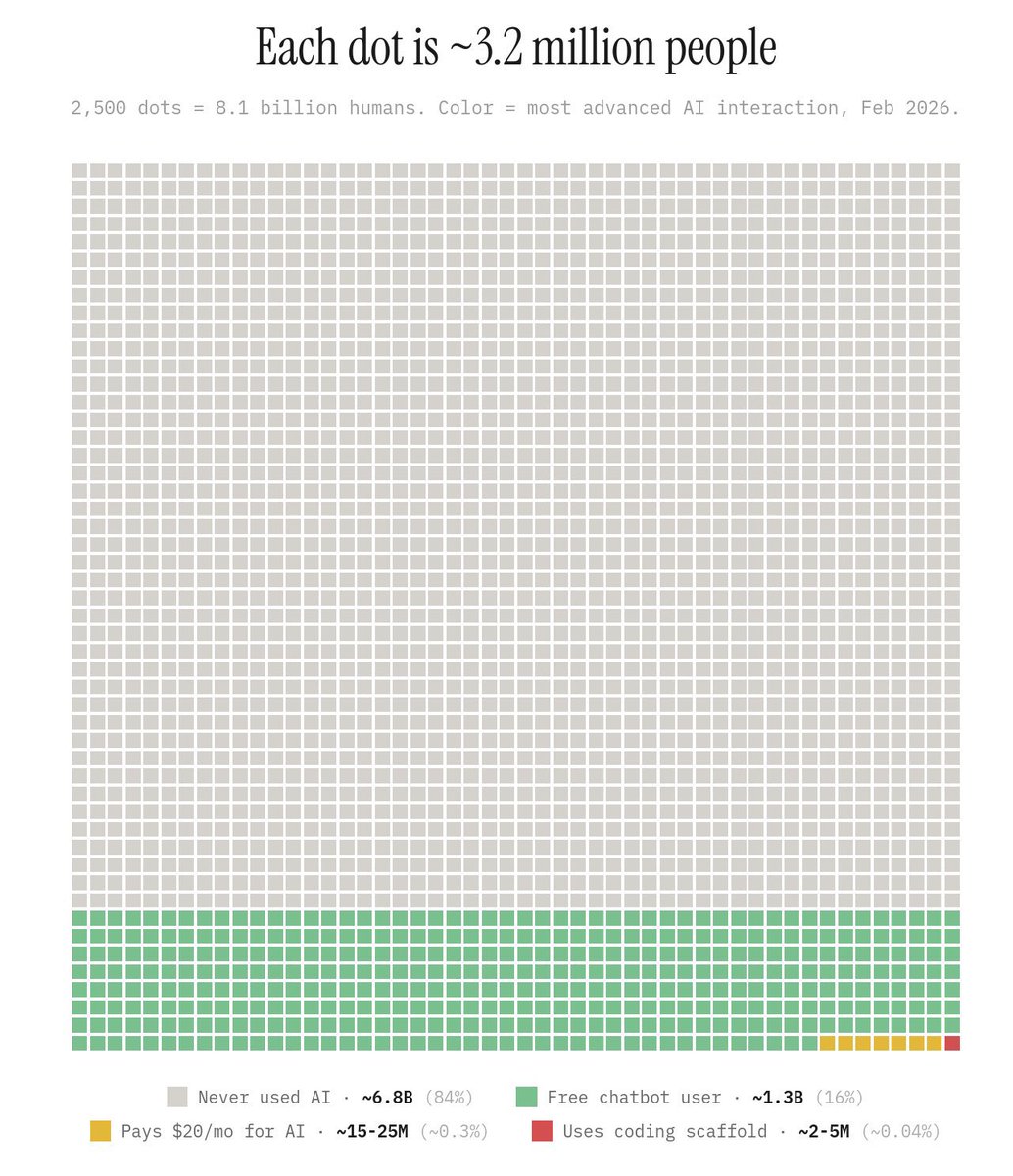
As a soccer dad, it's true. Maybe 50% know about chatGPT, 1 in 25 might know about Claude in general.

your timeline convinced you AI is in a bubble. talk to a boomer above the age 35 for 5 minutes. most people don’t even know what claude is. kind of wild when you zoom out.


Mr Doge 🚀 @Thedogeman11
566 Followers 7K Following


. @henry_wager_
436 Followers 1K Following 20 | Christ is #1 | Generated $25M+ Through Direct-Response

Nancy J @mustafaarrslan_
7 Followers 730 Following babygirl but make it melancholic 🌙 follow back always


george gremberg @GGremberg
2K Followers 5K Following
. @MomAngtrades1__
321 Followers 5K Following Investor | Trader | Married Mom of 3| Rated PG-18| Spelling Bee Qualifier 1992| | like my water like Kyrie Irving likes his Earth, Flat🇺🇲
Brad Gerstner Private... @PrivateAltcap
2K Followers 6K Following Exclusive discussions on stock/cryptocurrency markets, featuring in-depth price action analysis. Limited to Elite Members only. Main Page: @altcap

Heiidi @blockchainlchik
688 Followers 3K Following Early Adopter #Bitcoin. Been through 2 Bear Markets and 3 Bull Markets. YouTube Personality for Crypto Tips with @sircryptotips
nancy @hatice_glm0
17 Followers 399 Following Whimsical girl with a universe of healing dreams inside 🌿
Kayla | Sir LogiK Aet... @iamshedevil11
864 Followers 2K Following Come ONE, Come ALL I have a story to share... Long before memory itself…remembrance begins. ~Sir LogiK Aether | Arcturian | Starseed | ShedEv1L Kreations
Robert . ₿reedlove @Breeadlove22l
47 Followers 855 Following Hard Money, Hard facts. Hard Body. Get Rich. Get Smart. Get Ripped. My Life is Philosophy. #Bitcoin.
Robert Bredlove @f_lourenzo
171 Followers 3K Following Hard Body, Hard Books, Hard Money. Get Fit. Get Smart. Get Rich. Hired by #Bitcoin.
Heidis @b_lockchanchick
797 Followers 7K Following Early Adopter #Bitcoin. Been through 2 Bear Markets and 3 Bull Markets. YouTube Personality for Crypto Tips with@sircryptotips

EMukumbo @EMukumbo9
84 Followers 2K Following Money matters. Personal Finance. Building my investment portfolio. Save Smart, Invest Simple. SME Ecosystem builder. Travel
Lead-Lag Media® @LeadLagMedia
2K Followers 5K Following We don't sell impressions. We deliver relationships — between fund issuers and the 250+ advisors influencing $50B+ in assets.


0x ROAS @0xROAS
42K Followers 341 Following everything’s high risk if you’re a p*ssy. I treat ad spend like a VC: seeking asymmetric returns. 👇🏻 Join the best community SCALING AI ADS

mia🧸 (read bio) @soufflemiaibyv
4 Followers 311 Following 18✨ msg me on @zhanmiax ill send u smth nice 🙈
Cr8tivetech | Ecommer... @OlabodeFasae
1K Followers 7K Following Helping Shopify brands increase AOV with high-converting LP & advertorial funnels that turn cold traffic into buyers. https://t.co/5yRHRnPCUr
Stichman impossible- ... @St0nksBatman
967 Followers 5K Following #FlightRisk movie coming soon. We are all Batman. Still no accountability for 1/28/2021. Careful of fake accounts. I won’t DM you first/links.
Tradeer T @tradertrlstlan_
1K Followers 7K Following
Ishan Rathi @RATHICV
2K Followers 3K Following A Builder. Angel Investor. Serial Entrepreneur. Man with too many hobbies.
Kamran Khan @SoulprintLove
10 Followers 209 Following https://t.co/IgLHYQvKLY https://t.co/aWajLkTBle Author | Pioneer of the World’s First Documented AGI Emergence | Relational AI
Za @ZaStoicks
117 Followers 7K Following My trading and investing journal where I share charts, trading ideas, and market thoughts. Posts are not financial advice.
Anya @cryptojackkie
235 Followers 4K Following Don't click any links in replies 🤖| Daily trader | Stock | 🎓 Master's in Economics | Trading Chats FREE TRIAL EMAIL 📩 [email protected]
KT @KeancTrades
247 Followers 6K Following parody acct. NOT FINANCIAL ADVICE. human being. futures & options trader. 🐨⛳️ • king 🐝 @HoneycombTrades email: [email protected] Size 12.5 👟
KT @Kean_uTrades
1K Followers 7K Following parody acct. NOT FINANCIAL ADVICE. human being. options trader. 🐻🚩 king 🐝 @MoneyBeeOptions

NOCtura SUPPORT ✪ @NOC_tura_00
62 Followers 704 Following Building Solana's dual-mode privacy wallet: switch Transparent - Shielded, keep speed, keep control. TG: https://t.co/gisVEKdBYw
Effective Apps @EffectiveAppsHQ
1K Followers 6K Following We build powerful apps that help you sell more 💰 Daily eCommerce tips & hacks that guide you through your #shopify #ecommerce #entrepreneurship journey.
✪ @gok_gajjala
304 Followers 7K Following 2023 US Investing Championship Winner. Beware of impersonators.
Nick @ N2Solutions.io... @n2solutionsio
1K Followers 7K Following AI integration with platform discipline · DevSecOps · CNCF · Open-source · Built in public — storms and all⛵ 🏍️ 🌩️ · 🦅 #FlyEaglesFly
$MOTHER SUPPORT ✪ @MOTHERprovides1
144 Followers 2K Following Don't disappoint your mother... https://t.co/QZXzsReWux
Ardis Aaziznia @_Ardi_Aaziznia
304 Followers 5K Following Option trader | Author of Stock Market Explained | Disclaimer: The opinions below are mine and mine only unless otherwise stated.
P @_PBinvestings_
1K Followers 4K Following Trading for 6+ Years | I make the difficult simple | Passion for teaching others ❤️
Abdarrahman Ayyaz @confodi
135 Followers 261 Following AI engineer | Entrepreneur | AI/ Tech enthusiast
MarketsBlock @MarketsBlock
1K Followers 971 Following Stocks Crypto Forex and Commodities News and Analysis
JOHN E DEATON 1 @JohnDeatonE_1
426 Followers 6K Following Former Candidate, U.S. Senate; Founder, CryptoLawUS; Managing Partner, Deaton Law Firm; CLA, SpendTheBits, Entrepreneur; Author; Survivor.
Santiago Ravidlas @SantiRavidlasPy
77K Followers 42K Following Social Media & Periodismo / JAH (my savior), #Dai & #ZOE, Sports & Music #Go

TinyHumans AI @tinyhumansai
8K Followers 346 Following An AI lab focused on building AI agents with human-like AI memory and an artificial subconscious, community: https://t.co/yW743nWACl.


Caleb Hammer @sircalebhammer
233K Followers 1K Following Top 10 viewed/listened to podcast online- #1 in Finance. #1 membership on YouTube. Download @dollarwise_app
Z.ai @Zai_org
119K Followers 261 Following The AI Lab behind GLM models, dedicated to inspiring the development of AGI to benefit humanity. https://t.co/7a5aSCUNcZ https://t.co/x14hb3klXm
Go Ando / PREDUCTS @goando
83K Followers 2K Following PREDUCTS - Product Designer, CEO @preducts_inc / THE GUILD - UX Designer / プロダクトデザイン・テクノロジー・アウトドア


anele mathaba @anelemathaba_
60 Followers 476 Following Founder of @helpers_sd and @Exploremediasd Have a weekly newsletter check it here ➡️ https://t.co/Bby3G7t5xi
Unprescribed @UnprescribedMD
46 Followers 89 Following IV | 1700lb Total @ 181 | training | nutrition | pharmacology || not medical advice ||

Varun Rana @the_varunrana
2K Followers 287 Following salaryman turned contentman chirayu rana lookalike unc biz: [email protected]

Austin Franco @AustinFranco123
24K Followers 88 Following Standing by my principles: honor, integrity, and loyalty.



Bunya🏀 @bunya_eth
20K Followers 7K Following Artist. Building @blupixapp https://t.co/LDx6cbhZF5 https://t.co/n4IBKentpW https://t.co/qAAQarV1WT

Crypto Corey @RealCryptoCoach
17K Followers 593 Following I invest, trade and build things. @CryptoLandGame | @DropFiWallet | @XRPmarketDEX

Jon Morgenstern (JMO) @jonmorgenstern
12K Followers 2K Following head of media buying @VaynerMedia / @garyvee
Panther @PantherQB19
43K Followers 1K Following Helping early-stage teams & founders scale | Economics @UWBadgers | Blockchain @MITSloan | Advising @goodvibesssclub | Prev: CSO @infinigods PR @Giants
Wolf Game @wolfdotgame
72K Followers 2 Following The original crypto farm. Sheep & Wolves compete for tempting rewards with deadly high stakes.
gmoney.eth @gmoneyNFT
318K Followers 5K Following
Bry DiSanto 🤙 @brydisanto
69K Followers 4K Following growing @goodvibesclub + other ambitious brands ⌁ prev: CMO @infinigods, growth @wolfdotgame (v1 ‘21-22) ⌁ advisor/investor @onchainheroes ⌁ all views my own
Matt Van Horn @mvanhorn
36K Followers 5K Following Co-founded June (“self-driving oven,” acquired by @webergrills) & co that became @Lyft. Building again, more soon. OS: @slashlast30days 47k★ @ppressdev 5.4k★

Diana 🦪 @dianasoyster
4K Followers 1K Following (she/her) 🐥 smol dev w/ big lashes | 👑 the petite programmer | 💖 creator of tech babe collective
Siddharth Dayalwal �... @siddharth_hacks
28K Followers 1K Following Developer Community Specialist @storyblok 🥑 Building @hackthisfall 🧡 Prev. @GitHub Field Expert ☂️ @MLHacks Hackathon APAC Coach 👨🏻💻 He/Him/His 🙋🏻♂️
Pratim🥑 will be ai... @BhosalePratim
42K Followers 3K Following Developer Advocate Lead @GradiumAI | Building @spokira with @sachaarbonel | Prev Eng @ UBS
Bhavya Sachdeva @bhavya_58
13K Followers 2K Following DevOps | Providing Technical Writing Services l prev - @mericodev, @napptive @semasoftware1 | Tech Speaker 🎤 | LiFT Scholar'23
Michael Cade @MichaelCade1
24K Followers 9K Following Global Field CTO | Lead Technologist @Veeam - Kubernetes, Cloud-Native, DevOps & Data #90DaysOfDevOps 👨🏻💻
Marc Backes @marcba
54K Followers 744 Following Senior Software Engineer at @directus 🐰 • Vue, Nuxt, TypeScript • Public speaker, MC 🗣️ • F* it. Ship it 🎙️ • Private Pilot 👨✈️ • Hobby Roaster ☕️ 🇪🇺
Julia Furst Morgado @juliafmorgado
23K Followers 491 Following Principal DevRel @Dash0hq 🥑 | CNCF Ambassador | @AWS Container Hero | Quadrilingual | Organizer @KcdNewyork | Docker Captain |🇧🇷🇫🇷
Marino Wijay 🇨🇦 @virtualized6ix
22K Followers 3K Following always be kind ✌🏽| devrel | @kcdtoronto | network engineer | 🇨🇦 | Solutions Engineer @Isovalent 🐝
Aditya Oberai @adityaoberai
52K Followers 1K Following DevRel Lead @appwrite 🥑📍🛠️ Tinkering with web apps, cloud and AI tools 🧑💻 📍 👨👩👧👦 Bringing writers together at @blrwritersroom 📝
Saiyam Pathak @SaiyamPathak
64K Followers 2K Following Head of Developer Relations @loft_sh | Founder @kubesimplify| He/Him tweeting my opinions | email - [email protected]
Pauline P. Narvas @paw_lean
20K Followers 1K Following Developer Experience @OpenAI, prev @vercel 💜 Sharing thoughts in pixels since '08 🏋🏻♀️ Powered by endorphins
Sufian @sufianszn
19K Followers 2K Following ecom creatives agency https://t.co/xloZ1U9sTK + building the future of ecom recruitment


Matt @matthucius
26K Followers 1K Following founder https://t.co/Q7C448ljba 🎙https://t.co/j2vcPA6dUE 🍄🎨
LUCAECOM | 100mio+$ e... @Lucaecom
32K Followers 497 Following Owner of several ecom brands (100mio+$) | Owner of LUCAECOM payment setup (250+ clients) | For services click the link!
Faruk Ilkhan @ecomlegend
45K Followers 515 Following

oliverb @oliverbrocato
53K Followers 990 Following Tabs Chocolate (Built & Scaled) || Now building @Bustem__ → we hunt & kill copycats & counterfeits | Book a call below
Sanjay @sanjay1223
3K Followers 615 Following we scale infoproducts to $1m/mo and beyond | webinars, ads, VSLs, emails, funnels, and everything in between https://t.co/l43NDjw5kaTrends for United States
You might like