Founding Dev @FoundingDev
Replace expensive SaaS with the tools you own founding.dev San Francisco, CA Joined January 2026-
Tweets169
-
Followers48
-
Following9
-
Likes254
Some founders operate with a structural advantage that's almost invisible from the outside, until you look at their margins and their speed. They ship faster. Their tools are built exactly around how they work, not adapted to fit someone else's product. They don't sit through quarterly pricing reviews, scramble when a vendor changes terms, or lose half a sprint because a third-party API went down. Their cost of operations is meaningfully lower than comparable businesses. Not because they cut corners, but because they made a different decision early about what to rent versus what to own. They build on @foundingdev. They own their stack outright. And over time, that compounds in saved costs, in operational flexibility, and in the ability to move without asking permission from a vendor's roadmap. #Founders #Startups #CompetitiveAdvantage #FoundingDev #SaaS
AI coding tools have made building software 10x faster. They haven't made it 10x safer. Agents still produce code that LOOKS correct. Most of the time it is. The 10% that isn't ships bugs to production because vibecoders may trust the output without reading it. Three red flags to watch for: RED FLAG 1: References things that don't exist. AI sometimes hallucinates imports — calling functions or hooks that aren't real. Verify imports against real docs. If your editor underlines it in red, that's the tell. RED FLAG 2: Skipped error handling. AI writes a 30-line happy path with no try/catch, no input validation, no "what if the API is down" branch. Push back: "What happens if this fails?" RED FLAG 3: Outdated patterns. Sometimes AI uses patterns from 2016 because they were over-represented in training. React class components. var instead of let/const. Deprecated APIs. If something looks unfamiliar, ask: "Is this the current way to do it?" Follow @foundingdev more vibecoder basics. #vibecoding #ai #cursor #claudecode #buildinpublic #Vibecoderbasics

The skies in Birmingham are still well lit at 10pm. It's a bright afternoon in San Francisco, with the wind fighting to be heard. Two founders on opposite sides of the world talking about AI, the future, and taking occasional detours into banter. Episode 3 of Unhinged AI with @chrisbradyuk, founder of Metrix, and @ai_talha, founder of Founding Dev. You should listen. 🔗 in 💬 #AI #AIinConstruction #UnhingedAI #Metrix #FoundingDev #AIinBusiness #SaaSReplacement
Moment where @chrisbradyuk shares his candid thoughts on how more businesses will interact with software in the near future with @ai_talha One interface to get all your work done. No more juggling several tools or paying for features you don’t need. Leaner processes, powered by AI. Full episode out 28th July. Leave a 👍 and we’ll send you the link when it’s live. #AI #AIinConstruction #SaaSReplacement #foundingdev #metrix #AIinBusiness
“I’ve got 2-3 years until a tool replaces me.” An AI consultant. About his own job. Ep 3 of Unhinged AI: @chrisbradyuk founder of Metrix (AI adoption consultancy, UK construction) in conversation with @ai_talha. In this episode: → Why construction firms build AI tools but never adopt them → The 10-80-10 rule for working with AI → Guardrails that catch hallucinations before clients see them → The new RICS AI standard → Why every business ends up with its own OS instead of a SaaS stack Chris has helped clients win £4.8M in tenders and saves teams 14 hours of admin a week. Airing 28th July 🎥 #AIinConstruction

There's a pattern that plays out across nearly every business that spends serious time evaluating software platforms before landing on the right one. You start with the obvious choices — the platforms that show up first in searches, that have the biggest marketing budgets, that come recommended by every agency you've spoken to. You work through the onboarding. You hit the pricing wall. The feature you actually need is locked behind an enterprise tier. You evaluate the next option. It has a different limitation. You repeat the process. The frustration isn't usually about any single feature or any single price point. It's the accumulated weight of platforms built for investor growth metrics rather than for the operator who needs something working by the end of the week. You start every evaluation optimistic and end it with a slightly shorter list of what the platform can't do for you at a price that makes sense. @foundingdev tends to come up later in that journey, after the evaluation fatigue has already set in. The response from most people who find it at that stage isn't excitement. It's relief. The kind that comes from realising you've been solving the problem the hard way when there was a cleaner path the whole time. #Founders #SaaS #Startups #BuildVsBuy #FoundingDe
YC's new Request for Startups lists "Cloud for small software": the internal tools your small team builds. At Founding Dev we hear it constantly. People won't deploy because cloud scares them. Would you use a one-click cloud for small software?
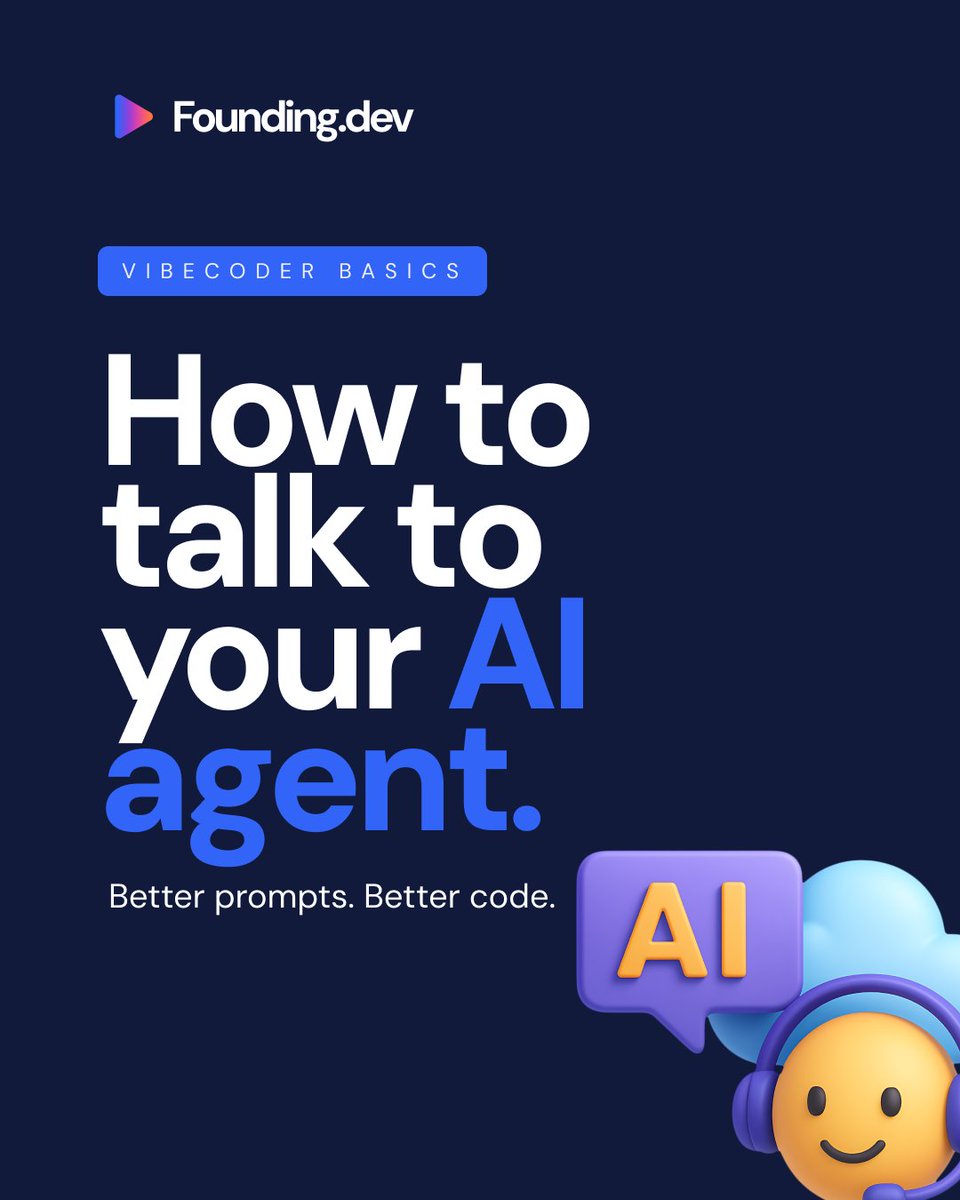
How to talk to your AI agent. The framework is three parts: GOAL — what you want, in one sentence. CONTEXT — what already exists (file paths, the stack, related code). CONSTRAINTS — what NOT to change, what style to follow, what edge cases to handle. Here is an example of a good and bad prompt: Bad prompt: "Add login to my app." Good prompt: "Add email-and-password login to my Next.js app. We're using Supabase. The form lives in components/LoginForm.tsx. Don't change the existing auth context. Handle empty/invalid email and wrong password with inline error messages." Same task. The second one gets working code on the first try. Two more tricks: · Big task? Ask for a plan first: "Before you write code, list the steps you'll take." · Add to any code-editing prompt: "Show me the diff before applying." Follow @foundingdev for more.
We just published the ultimate guide to kill SaaS. Read it and stop paying expensively for SaaS founding.dev/guides/saas-re… #SaaS #KillSaaS #AI
@AliceInfoAi Please. We would love your support: producthunt.com/products/kalen…
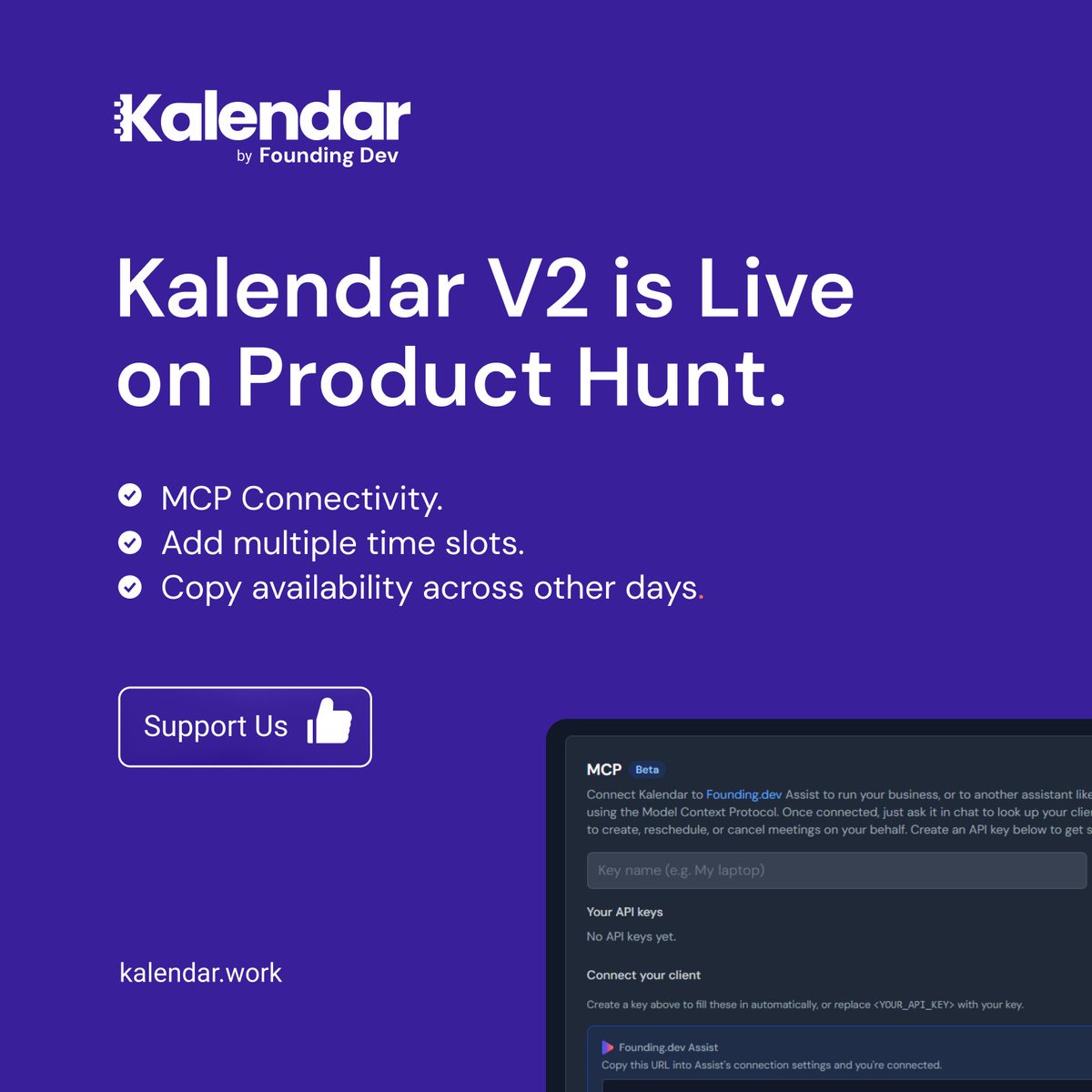
Kalendar V2 is live on Product Hunt today. Here's what's new: MCP connectivity, multiple time slots per day, and one-click copy across your week and more. Would mean a lot if you supported us today on product Hunt. Link: producthunt.com/products/kalen… #ProductHunt #BuildInPublic #AIScheduling #SaaS
If you're using AI tools like Cursor or Claude, three names come up constantly: React, Next.js, and Tailwind. Here's what each one actually is. A FRAMEWORK is a pre-built kitchen for software. Instead of starting with raw HTML, CSS, and JavaScript, you start with a structure that already handles the boring parts. That's why AI tools reach for them by default. REACT: a library for building user interfaces, built by Facebook. It introduced the "component" pattern (next week's topic) where you build your UI in reusable blocks. If your AI mentions JSX, hooks, or useState — that's React. NEXT.JS: React plus everything else: routing, data fetching, image optimization, deployment-ready by default. When you see app/, pages/, or layout.tsx in your folder — that's Next.js. It's the default for most modern apps and most AI builders. TAILWIND: handles your styling without separate CSS files. Instead, you add styles directly to your HTML as class names like "bg-orange-500 px-4 py-2 rounded-lg." Every word does one thing. Combine them for any look. This is why AI-generated code is covered in class names. Follow @foundingdev for more. #vibecoding #react #nextjs #tailwind #buildinpublic #vibecoderbasics

Kalendar V2 is launching on Product Hunt this Thursday, July 16th. What's new in this version? MCP connectivity, multiple availability windows per day, one-click to copy availability across your week and more!!! Try out all new features, follow Kalendar on Product Hunt for updates and support us during our launch. Link: producthunt.com/products/kalen… #ProductHunt #BuildInPublic #AIScheduling #SaaS #Founders


We are hiring. Capable or know anyone who is? Please apply — onteam.work/careers/foundi… #hiring #ReplaceSaaS

Open any modern project your AI tool generates and you'll always see the same five things at the root. src/ → Where YOUR code lives. Components, pages, styles. You'll spend 95% of your time in here. public/ → Static files. Images, fonts, your favicon. Anything in public/ becomes a URL when your site is deployed. package.json → The project's ID card. Lists the project's name, its version, what libraries it depends on, and what commands you can run (like npm run dev). When someone else clones your project, they read this file to install the same things. node_modules/ → Where all your dependencies live. Hundreds of megabytes of code your project depends on. NEVER commit this folder. It's in your .gitignore for a reason. README.md → Documentation for humans. Now you can navigate any project without panic. Save it. Follow @foundingdev for more.
No Opt-Ins. No Opt-Outs. No Per-Seat Fees. No Hide & Seek. Just your software, working exactly the way you want it to.

...with your own software — streamlined for how your business operates, AI operable and up to 70% savings. Visit Founding.dev to learn more. #BuildVsBuyVsOwn #SaaS #BuildVsBuy #CustomSoftware #SaaSpocalypse #fable



Chris Brady @chrisbradyuk
275 Followers 186 Following UK AI Adoption Consultant. Founder of Metrix. Fuelled by coffee.

Adeboye isaiah @Isaiahmotionlab
42 Followers 266 Following Saas explainer video | Motion graphics |Saas video #BuildInPublic #SaaS #StartupFounder #IndieHackers #MicroSaaS DM open for collaborations
Reena Tech & Tool @ReenaTech0
17K Followers 2K Following Testing Al tools, exploring trends & sharing what works Open Collab working with @invideoOfficial DM for paid collaboration 📨[email protected]
RAZA | AI EXPLORER @natinati1905
64K Followers 11K Following Exploring the edge of tech,art and automation. Sharing tools,experiments & prompts that actually work for smarter. DM for collab: [email protected]
Oyebamiji kazeem Ayod... @Oyebamijikazee3
863 Followers 7K Following Hi👋I'm a competent in creating 2d animated explainer,Motion Graphics Startup explainer videos,b2b startup video https://t.co/mf7nz9kFQl
Ali Asad @__ali_asad__
148 Followers 645 Following building stuff (https://t.co/9T5jEoMfGz, https://t.co/M8VnzoOeNZ) prev. @vectara @_buildspace
belix.ai | Agentic AI @belix_AI
670 Followers 3K Following Building Agentic AI systems for business. Agentic AI • AI Engineering • Ethical AI • Automation
Sarmad @smmd999a
60 Followers 886 Following 16 | bringing exceptional design to software companies running @knot_hq
L. James Mokgobi @MokgobiLJames
2 Followers 106 Following
Ran Geva @rangeva
541 Followers 2K Following Founder and CEO of https://t.co/nB0vguu4hk and https://t.co/IbC7u9aCAX
bento @dtk4723
647 Followers 2K Following 🚀 Startup lover | 🤖 Tech + AI | 🌎 Digital nomad 🚀 Talking startup & AI
Max the VC 👨�... @mreiffy
30K Followers 7K Following Tinkerer 🧙♂️| Early stage Angel & VC 🦄 | Attorney ⚖️ Pulse on all things tech and where value accrues next. Luck befalls the curious mind 🔮 |👇 Pitch me.
Ammar Ijaz @mammarijaz
22 Followers 166 Following Software Engineer, GIKI Graduate, Agriculturalist, Progressive Farmer
Majheed @Callie1267834
25 Followers 201 Following I help startups turn complex ideas into simple explainer videos 🎥 Perfect for product demos & pitch decks DM if you're building something
vlad tlavov @VTlavov
0 Followers 108 Following
Abbey | SaaS Explaine... @Saasvideoguy
13 Followers 144 Following Helping SaaS founders explain their products clearly & boost conversions 🚀 | Explainer Videos • Product Demos •Launch Videos | Trusted by startups | 📩 DM open
Esbern Corp @EsbernCorp
8 Followers 36 Following Be part of your community, real relationships with local businesses in your area, built on trust and collaboration.
Katrina Laszlo @Katlaszlo
25 Followers 172 Following Co-Founder @ Tanso · Monetization for AI & SaaS · 10 yrs product/growth · Writing about AX (agent experience)
Ernesto Riestra @netoriest
4 Followers 6 Following
Ghulam Abbas @Abbas143office
1K Followers 2K Following Growth @LaunchIgniter Helping startups grow faster I love supporting startups and helping them grow faster by sharing the right tools stories and opportunities
Isaiah @isaiahadel
195 Followers 2K Following
Jonathan @JonathanOC
804 Followers 668 Following Hub/Dad. Random posts that are sometimes funny and/or relevant on accident. Hi from OC, CA, USA. I use AI for many things, but not to write my posts!
Rebel @censoreduser77
126 Followers 852 Following
Anurag Bhanderi @anurag_bhanderi
223 Followers 781 Following ॥ स्थितप्रज्ञ ॥ • Engineer • Writer • Spirituality • Writing what I learn, feel & live #gujju

Timi Adesina @TimmyAdesina
334 Followers 3K Following Big Beaver 🦫 @unboxdco 👨💻 @peigesapp 🚀 @weddnco 💍. Romans 9:16
Kristen | Content Str... @kris10creates
49 Followers 146 Following Driving growth and revenue with strategic content that builds trust and shorten sales cycles | 700+ projects | Special focus in high-regulation brands ↓

Naveed Memon @naveedmemon
585 Followers 345 Following Founder Verge Systems - https://t.co/AWYjuzuMuh, Founder WebHR Inc. - https://t.co/cHUKLdoiG9

Jennifer Yoder @jenniferyodercx
20 Followers 348 Following I help brands turn their products into souvenirs of their customers’ experiences with their brand. If we’re doing it right.
Nonop @nonop_on_x
11 Followers 308 Following Fan de graphisme, d’audiovisuel, de Justice, de sappe et de risotto en gros shitpost ici vive @deezer
Mayank Jain @JainMayank237
8K Followers 3K Following Product hunt Launch Upvotes 💻 , AI Influencer🎉 |Ai & Tech Tools |Brand Promotions|| 107K+ Linkedin Helping Brand to Grow 📈 AI Promotion Dm for Collaboration

Codehub Technologies @Codehub_tech
175 Followers 524 Following An ICT Consultancy, Product Design (UI/UX) and Software Development Agency...

Michael Oduah @michael_oduah
26 Followers 38 Following Fullstack Developer | Passionate about building digital solutions |
Biniodie Mathias O. @Mattsanches1
17 Followers 179 Following - Flutter App Developer - Swiitch Technologies Limited
Mofe Ejegi @MofeEjegi
273 Followers 346 Following
Oge_Eucharia🇳🇬 @Oge_Eucharia1
58 Followers 283 Following 🔶Web developer 🔶 Coding Academy Building @sabicoders
Edike Esther @Uche_jewel
376 Followers 865 Following Community Manager | Certified Scrum Master | Digital Marketer | Organizer at @GoogleDevGroups @GdgAsaba | Chapter Lead at @SCA_Asaba | WTMAmbassador | @WTMAsaba
adasen @adasen14
9 Followers 38 Following
Trenches TechBro. @jerrychika
616 Followers 1K Following Digital strategist|Content Developer|Creative Writer|Product designer| Sports Addict.



Allie K. Miller @alliekmiller
106K Followers 2K Following #1 Most Followed Voice in AI Business (2M followers). Former Amazon, IBM. Time100 AI. Fortune 500 and startup AI advisor, public speaker. AI-First courses in 🔗
Ernesto Riestra @netoriest
4 Followers 6 Following
AlternativeTo @AlternativeTo
43K Followers 1K Following Crowd-sourced software recommendations, tech news & great apps! What application, service or game would you like to replace? Co-founded by @olaj & @raawmarkus
@jason @Jason
1.6M Followers 7K Following Host: @twistartups @theallinpod @thisweeknai; I invest in 100 startups a year @launch & @founderuni [email protected] for life


Hubert Thieblot @hthieblot
60K Followers 3K Following Investing @fdotinc, Founder @curseforge acq by @Twitch, love @oheather1337, 3x dad, 🇫🇷🇨🇭🇺🇸

You might like