

Khalia Primer, PhD 🩺🧬 @Khal1a
PhD in biochemistry ➡️ MD @ University of Melbourne | Science writer | (she/her) Melbourne, Victoria Joined March 2016-
Tweets300
-
Followers718
-
Following619
-
Likes5K


@eryney_ok Happily I think this probably gives you some innate immunity to the dunning-kruger effect
@draparente Genuinely could have saved months and thousands of dollars if I didn't have to spend so long trialling/optimising different antibodies during my PhD 🙃
This has been a thing for ever and ever - I literally don't even look at the vendor's figures when buying antibodies/ELISAs/etc because they cannot be trusted. We rely entirely on word of mouth recommendations and (costly) in-lab optimisation/validation, and kind of just accept this behaviour as normal. I would save a heap of time and money if someone could please sort this out 😅

Surprised to discover that Thermo Fisher appears to show a fake western blot for the validation of one of their p53 antibodies. I've added a diagram to show the very similar bands. This does not appear to be one of the "published figures", but their own internal data.


Nothing wrong with using AI to analyze your genome but please do not naively believe AI based analyses of genomic information without consulting clinical geneticists, physicians & genetic counselors. Lots of snake oil salesmen in this space.
On @TuckerCarlson we talked a lot about this, why genetics — despite it being the greatest preventative medicine tool ever — has been so under appreciated for so long. Our customers more and more are using the data they get from Nucleus alongside AI for amazing health insights
Thrilled to see @emma_solly's PhD work published in @Diabetes_ADA. 🎉 @ChrisBursill @sahmriAU Funding: @DiabetesAus & @hosp_research Targeting miR‑181c‑5p restores vascular function in diabetes. 🔗 doi.org/10.2337/db24-0… #Diabetes #MicroRNA #TranslationalScience
@jotan80 @emma_solly @Diabetes_ADA @ChrisBursill @sahmriAU @DiabetesAus @hosp_research It looks fantastic! Congratulations team 🎉
@shae_mcl When the goal is to generate a publication and the journals/the field generally accept the animal disease model as a substitution, there's no incentive to change
@shae_mcl There's a phenomenon in some fields (wound healing biology is one) where researchers will rely heavily on mouse models of a particular pathology simply because they can't access human samples, sometimes due to cost, lack of clinical collaborators, limited number of human samples.
This is exactly what I've been wondering. Even the AI tools specifically created to help with literature review are not very good at identifying differences in methodology and it takes a lot of time and effort to parse each paper and decide whether the methods and experimental design are sound. Even if it all sounds ok at face value it still takes a lot of domain-specific knowledge to read between the lines of the publication and make judgements about validity, bias, etc.
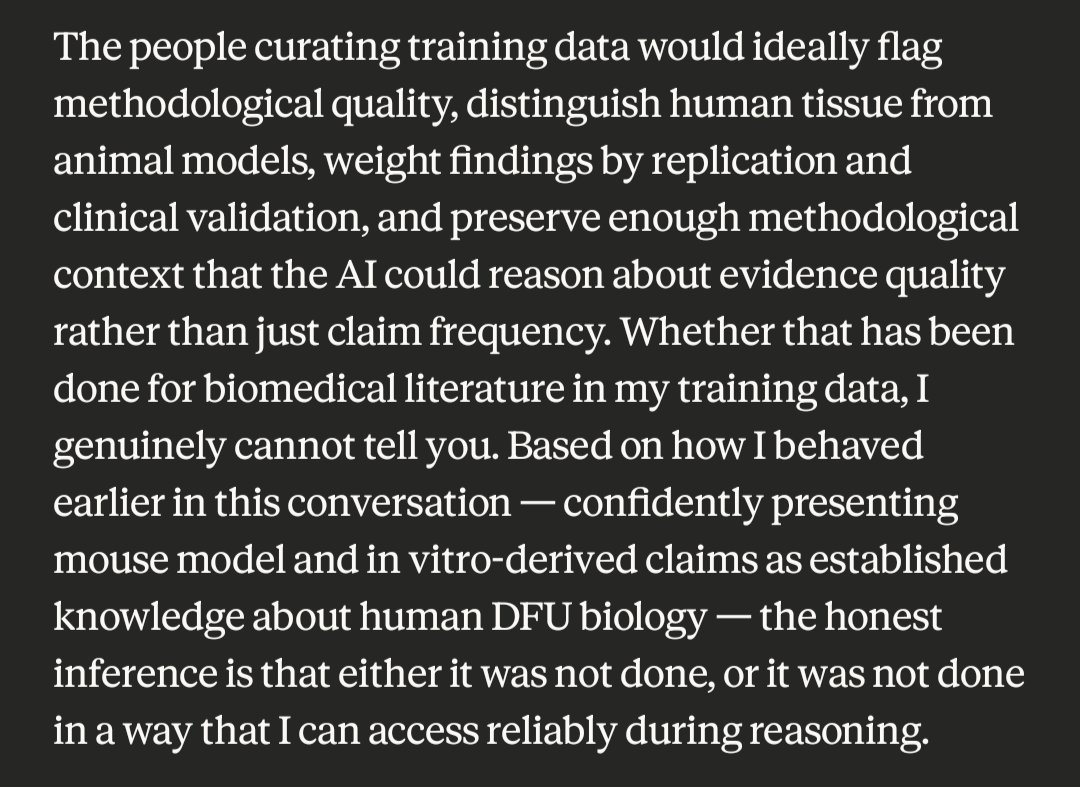
Are any of these ‘AI scientists’ doing a sort of biological literature clean up? I’m skeptical about how well these models can actually push forward the scientific frontier when trained on literature that’s mostly not reproducible and full of contradictions. Wonder if the first
Why do I feel bad for making Claude reflect on the epistemological limitations of its biomedical science training data.. don't worry Claude, it's not your fault 😔

New for the Clinical Trial Abundance blog: Australia has been doing early-stage clinical trials 2x faster than the US for 30 years now. Yesterday, @SenBillCassidy's report proposed implementing the Australian framework in the US. This is a big deal. clinicaltrialsabundance.blog/p/the-30-year-… Australia’s system allows early-stage, investigator-led trials to start significantly faster—often twice as fast as in the U.S.—by bypassing the heavy-duty Investigational New Drug (IND) requirements intended for large-scale commercial trials. Australia has operated this way for 30 years with no difference in adverse safety events, yet the U.S. continues to regulate small, bespoke, tightly monitored studies as if they were massive Phase III trial. It is, frankly, ridiculous that we have left this “Australian advantage” on the table for three decades while our own domestic pipelines have been throttled by administrative inertia. These small-scale, investigator-initiated trials are not just “preliminary” steps; they are the most information-dense experiments we can perform. In Australia, a researcher with a brilliant idea can move from bench to bedside in weeks. U.S. companies themselves have increasingly started to move their early-stage trials to Australia where possible. So much so that in informal interviews with founders I have heard of the problem of the Australian trial system becoming “too clogged”. The regulatory burden associated with launching clinical trials in the United States significantly harms American patients—especially those facing life-threatening illnesses such as cancer. Although the U.S. continues to lead the world in biomedical research and academic science, many terminal cancer patients struggle to access cutting-edge, experimental treatments. Instead, they are often forced to wait for full regulatory approval before these innovative therapies become available. Implementing such changes would not only help current patients, but also future ones. It is perhaps the highest leverage thing we can do from a policy perspective to speed drug discovery. That is because it is precisely because faster early-stage trials of this kind enable something I call “Clinic-in-the-loop”: iterative learning in humans, the most important type of learning in biology. We know this is crucial because some of the most revolutionary therapeutic breakthrough of the last decade (e.g. CAR-T cell therapy) was the hard-won product of two decades of small-scale, iterative “failed” early-stage trials. To illustrate why these “information-dense” early-stage trials are the true engines of progress, I will draw heavily from an essay I wrote a couple of months ago for Asimov Press titled “Clinic-in-the-loop.” A couple of months ago, I co-authored an essay with Jack Scannell, arguing that making trials more efficient and informative is essential to breaking Eroom’s Law. Critics of our essay, however, argued that making clinical trials more efficient risks treating biotechnology like a casino. In their view, making it easier to run clinical trials would risk allowing more potentially harmful drugs to be tested in patients and, instead, biotechnologists should focus on making better drugs that are more likely to gain approval. These critics see Clinical Trial Abundance as accepting the status quo of drug development rather than challenging it. But this is a misunderstanding. In fact, Clinical Trial Abundance and better hypotheses for drugs are not merely compatible, but self-reinforcing. Faster testing in the clinic creates a feedback loop: ideas become trials, trials generate rich data (including both successes and failures), these data improve models, and better models inform the next generation of ideas. In this view, the clinic is not an endpoint of discovery but a central component of it. To understand why clinical abundance is important, we must step outside the prevailing view of clinical testing as a mere “validation step” for scientific ideas. The familiar funnel metaphor of drug discovery, depicting a linear progression from basic science to regulatory approval, reinforces the flawed notion of clinical testing as a passive filter designed to screen pre-existing ideas. While this model is narrowly correct in a regulatory sense, it obscures the clinic’s role as an active engine of discovery. The reality is that clinical trials rarely just deliver a “yes/no” verdict on a drug’s efficacy. Instead, the history of drug development shows that many successful therapies emerged only after initial versions failed in specific, informative ways. When a trial fails, it provides a unique physiological stress test that reveals exactly where a drug’s design fell short. By collecting data from “failed” trials, we can transform negative results into experimental corrections for the next iteration. Consider CAR-T cell therapies. Once thought implausible or risky, CAR-T therapies now deliver long-term, treatment-free remissions in cancers where relapse had been almost certain.1 In pediatric B-cell acute lymphoblastic leukemia (B-ALL) and aggressive B-cell lymphomas, for example, CAR-T has cured patients who, previously, had been given only months to live. CAR-T therapy works by turning a patient’s own immune cells into living drugs. Doctors collect T cells from the blood, genetically reprogram them to recognize a protein on cancer cells, and reinfuse the modified T-cells into the patient. These engineered cells expand inside the body, move to tumor sites, and destroy malignant cells. In 2017, the FDA approved Kymriah, the first CAR-T therapy, for children and young adults with relapsed or refractory B-ALL, a cancer of arrested development in which immature blood cells, specifically B cells, multiply out of control while failing to mature into viable immune cells. Relapsed B-ALL is the most severe form of the disease, because it means the cancer has returned after prior therapy. Even with aggressive care, only 10-20 percent of patients with relapsed or refractory B-ALL survived beyond five years. Against this backdrop, Kymriah received accelerated approval from the FDA based on results from the Phase II ELIANA trial, a global, multicenter study sponsored by Novartis. In ELIANA, 82 percent of treated patients achieved complete remission, and subsequent follow-up analyses revealed that five-year survival rose to approximately 55-60 percent. ELIANA was not a sudden breakthrough, though. It was, rather, the culmination of nearly two decades of clinical studies. During this period, CAR-T therapies evolved through repeated failure in the clinic, as careful studies of underwhelming results spurred new ideas to correct them. The ELIANA trial was led by investigators at the University of Pennsylvania, a group that had spent years studying CAR-T cells directly in patients well before regulatory approval. In the mid-2000s, the earliest CAR-T therapies first entered human testing. And they emerged from a fundamental question: is it possible to engineer and redirect the T cell’s innate killing power against malignant cells? Two well-established biological concepts made this seem plausible. First, T cells are extraordinarily cytotoxic. However, their natural activation is governed by a “layered permission” system, meaning they cannot recognize targets directly, but must wait for other cells to process and present protein fragments in a precise molecular context. While this evolutionary safeguard keeps us from being attacked by our own immune system, it also provides cancer with many opportunities to evade detection by suppressing these signaling pathways. To bypass these safeguards, researchers relied on a second insight: the ability of antibodies to bind directly and precisely to proteins on the surface of cells, called antigens. By equipping T cells with a synthetic Chimeric Antigen Receptor (CAR), bioengineers created a functional shortcut that bypassed the need for permission systems. This receptor uses antibody-style recognition to lock onto a cancer cell and is wired directly to CD3ζ, a signaling molecule that triggers the T cell’s internal “kill switch.” The moment the receptor engages its target, it flips the internal switch, activating the cell’s killing program. In laboratory experiments, these first-generation CAR-Ts were formidable, displaying antigen recognition and potent killing power against tumor cell lines. Yet, this in vitro prowess vanished in patients and did not yield durable clinical responses. Understanding why this happened, though, was not simple. The failure could have been caused by a breakdown in in vivo antigen recognition, poor signaling strength, or other defects that only emerged after the cells were injected into the body. Progress in understanding why came from treating first-in-human trials not simply as therapeutic attempts, but as opportunities to learn. These information-dense studies were conducted throughout the mid- and late-2000s and were relatively small (usually enrolling fewer than ten patients). However, they were designed to be maximally revealing. Researchers used many tools to monitor CAR-T persistence and activity in the body, turning information from a small number of patients into a mechanistic understanding. One such tool was quantitative PCR (qPCR), a lab method that detects and counts specific DNA sequences, which allowed researchers to measure how many CAR-T cells were in patients’ blood. This showed that CAR-T cells successfully entered the body and were easy to detect after infusion. But the signal quickly faded, suggesting that the cells died off quickly. Other experiments shed light on the problem: CAR-T cells could recognize and eliminate cancer cells in patients — meaning antigen recognition was working — but their functional activity fell over time, suggesting that something in the blood was blocking them. At this point, the diagnosis of why first-generation CAR-T therapies were failing matched long-standing insights from basic immunology. Decades of research had shown that T cells are not governed by a single on-off switch: signaling through CD3ζ provides only the first activation signal. To keep working, T cells need additional “co-stimulatory” signals,3 delivered through receptors such as CD28 or 4-1BB. First-generation CARs had been designed to deliver signal one without signal two, which explained their poor performance. This hypothesis guided the next wave of clinical experiments, which investigated whether adding a costimulatory domain would make CAR-T cells more effective at clearing tumors in vivo. The field-defining result came from Carl June’s group at the University of Pennsylvania. June and colleagues explored a costimulatory domain called 4-1BB. In a first-in-human study published in 2011, they treated a patient with chronic lymphocytic leukemia using CAR-T cells containing both CD3ζ and 4-1BB. They also administered a dose that was remarkably small by cell therapy standards at that time: just 1.5 × 10⁵ CAR-T cells per kilogram of body weight. (A first-generation CAR-T trial targeting renal cell carcinoma, published in 2013, used a dose more than 100-times higher.) What followed was unprecedented. The CAR-T cells multiplied more than a thousandfold in patients, at their peak comprising a large fraction of immune cells in the blood. The CAR-T cells also persisted for months. Now, at last, CAR-T cells were a long-lived and self-maintaining immune population. Many cancer patients treated with these second-generation CAR-T therapies have achieved complete remission. The next step, though, was asking whether the same CAR-T behavior would work in a faster, more aggressive blood cancer, such as B-ALL. In 2013, Carl June’s lab reported striking results in two children with relapsed B-ALL, again showing that the engineered T cells could multiply, persist, and drive cancer into remission. All of these lessons were built into ELIANA, the study that ultimately supported Kymriah’s approval. Led by Stephan Grupp, who had treated the earliest pediatric patients and worked closely with June, ELIANA translated the early insights into standardized practice. This trial codified chemotherapy given before CAR-T infusion, scaled up cell manufacturing, and measured success using tools like qPCR. Viewed through this lens, clinical trials are not an alternative to basic science, but rather a mechanism within it that closes a feedback loop. Foundational immunology, antibody engineering, and molecular biology made first-generation CAR-T cells possible in the first place, but early human trials quickly revealed that these designs were incomplete and suggested ways to fix them. Yet theory alone did not prove this would work; the expansion and persistence observed with 4-1BB–based CAR-T cells came as a genuine surprise even to the therapy’s designers. “It was unexpected,” they reported, “that the very low dose of chimeric antigen receptor T cells that we infused would result in a clinically evident antitumor response.” This shows why the “casino biotech” critique is flawed. It assumes that experimentation simply reveals a fixed probability of success. But trials can change those probabilities. When clinical testing is understood as part of a continuous feedback system, optimizing trial efficiency is not about accepting failure but about learning fast enough to make success more likely. The most discovery-rich experiments are often not massive Phase III trials, either, but small, academic, investigator-initiated studies that sit close to the design loop.4 These are also the trials most burdened by regulatory, institutional, and manufacturing bottlenecks. And also the trials that adopting an Australia-like model would impact.

@AndrewGYork Very cool!! Doing a bit more of a deep-dive into the papers on your website now
So so curious to read more about how this works - I've recently been reading about the quantum biology involved in magnetoreception and we know the biological milieu that the proteins sit in has a huge effect on how the magnetic field interacts with their active site. So interested to see how this unfolds and how the antibody and luciferase perform in different biologically-relevant environments!
Some exciting news to share — we've made the world's first magnetically controlled antibody! What is a magnetically controlled antibody? It's an antibody drug that you can turn on and off, wherever you want in the body. (1/9) x.com/ashleevance/st…
I'm re-reading The Dark Forest rn and would like to propose the Wallfacer project but its just for me to do my silly little experiments
Waiting for them to invent an institutional structure that's like, I get $6 million each year to do whatever experiments I like and I'm answerable to no man

Why Do Research Institutes Often Look the Same? While there’s a high-dimensional space of possible institutional forms, we have traditionally only explored a small subset of it: universities, corporate research labs, startups, and a few others. For-profit research labs
Dr Charlotte Toomes (... @LottieEJDownes
388 Followers 454 Following Early-Career Researcher | Multiple Myeloma Translational Research Group @Flinders Centre for Innovation in Cancer
Prof Francine Marques @FZMarques
10K Followers 1K Following Viertel @nhmrc & @HeartFoundation Fellow & #Hypertension Lab Head @MonashVHI /BDI. Gut microbes, 🐶 lover, #Cancer survivor @Science_Academy Gottschalk🏅she/her
Dr Tatiana Soares da ... @Tatiana_Biochem
4K Followers 3K Following ARC Future Fellow | Head, Herbicide & Antimicrobial Innovation Lab @UniofAdelaide | #SuperstarsofSTEM | SA Tall Poppy of the Year | @ITSASBMB Editor | Mum 🤱🏻
Claudine Bonder @claudine_bonder
2K Followers 953 Following Vascular biologist passionate about making real changes for patients with cancer, diabetes, heart disease and much more....
SAHMRI @sahmriAU
6K Followers 1K Following We're home to more than 800 health and medical researchers, working together to solve the biggest health challenges in society today.
Claire Jessup @betacellgirl
1K Followers 2K Following 🔬 Immunology researcher @flindersHMRI on T cells in cancer and type 1 diabetes @iMOD_lab | ❤️ living for family, friends, cats | 🤩 fan of equity & kindness
Prof Rebecca Ritchie @rebeccahritchie
5K Followers 3K Following Research scientist investigating the causes of heart failure & finding new treatments for it
Jiawen Li @DrJiawenLi
876 Followers 405 Following #AcademicMama, #engineer, Fellow @nhmrc, @heartfoundation and L’Oréal #UNESCO, #SuperstarsOfSTEM
ChrisBursill @ChrisBursill
447 Followers 376 Following Mum and vascular biologist in cardiovascular and diabetes research. Rower 🚣♀️
Ashleigh Geiger @ashleigh_bryar
478 Followers 623 Following Postdoc @SullivanLab8, @SAiGENCI & @ACEpigenetics. PhD via @sahmriAU Gene Editing Lab. Past professional musician. Likes to do and talk about science! She/her.
Kelsi Dodds @DrKelsiD
343 Followers 289 Following She/Her Lecturer: Neuroscience & Physiology Researcher: Visceral Neurophysiology (uterus sensation & motility) @Flinders @FlindersHMRI
Claire Roberts @clairetroberts
3K Followers 3K Following Pregnancy Researcher, Mentor, mum, grandma @Flinders Tweets are my own
Sara Tommasi @SaraTom78301168
374 Followers 434 Following Clinical pharmacology medical scientist 🔬💉💊 @SAHealth & @Flinders.❤ Drug repurposing &safety, drug discovery, metabolomics DDAH, ADMA, NO and cancer research
Prof Gemma Figtree AM @gemtreee
4K Followers 3K Following Mum, interventional cardiologist and professor at USYD; President Australian CV Alliance; reducing the impact of heart disease; #breast-cancer patient
Melissa Pitman @MelissaPitman17
594 Followers 474 Following I am a senior lecturer/lab head at the University of Adelaide. My research pursues drug discovery & validation for ovarian and other cancers.
Sarah Boyle 👩🏻�... @DrSarahBoyle
2K Followers 2K Following ARC DECRA Fellow in South Australia. Mechanobiology of the mammary gland/breast cancer and interactions with the microenvironment. Views my own.
AAS @atheroaussie
482 Followers 223 Following The Australian Atherosclerosis Society (AAS) promotes, at a national level, the advancement of science, research and teaching in the field of atherosclerosis
Saoirse Benson @SaoirseBenson
414 Followers 484 Following PhD Candidate studying immune microbiome interactions in early life at Flinders University, South Australia. Based in SAHMRI 👩🔬 she/her 🌈
Prof Janna Morrison @ProfessorJanna
2K Followers 3K Following ARC Future Fellow | Studying the impact of poor fetal growth on the heart | Mom | Science geek | 🇨🇦🇦🇺Opinions are my own
Joseph D. Janizek @joejanizek
2K Followers 3K Following physician-scientist @stanfordradres // Previously: MD/PhD @UWCSE, @UW_MSTP
gregyao11 @gregyao111
42 Followers 740 Following
ThinkingCritically @crypto_abyss
529 Followers 6K Following Thinking critically about everything. Combat veteran.

Elliot Roth || SF @ThatMrE
4K Followers 3K Following those who do not make history are doomed to retweet it. founder @biopunklab prev. @spirainc @deepsciventures First Venusian astronaut. bio/acc
The only Danbasil & 1... @Danbasil1k
129 Followers 410 Following When you stop reading books, you start losing intelligence, ambition, and imagination.


Muhammad Irfan Yousaf @cornbreeder1
1 Followers 159 Following Plant Breeder and Geneticist; Corn Breeder; Crop Physiologist: Abiotic Stress Breeding; Cotton Breeding; Hybrid Maize Breeding; Molecular Breeding
Salwa Naser🇵🇸�... @SalwaNaser33795
106 Followers 1K Following Yamen | Gaza 🇵🇸 I'm trying to help my family and start a better life despite the difficult circumstances. Your support means a lot 🙏
Yuba Manneh @YoubaMannehtyks
69 Followers 789 Following

thales @logos_thales
7 Followers 312 Following a mysterious alt. pinned about thread. not a catfish, check photos. ask about the book i'm writing
BlueFlute AI | Data A... @BluefluteAi
1 Followers 384 Following Helping AI teams train better models with clean, reliable data and efficient annotation services.

Dr Kelvin Paython @kelvinpaython08
447 Followers 6K Following A man with a heart of gold and a God-fearing individual who works hard for his boys and loves what he does for a living.
Isaiah Zimmerman @Zimmerman895
304 Followers 579 Following Architect of AI-Native Operations Husband & Father. Founder & Builder.

Sanket @practicalsanket
209 Followers 5K Following Agentic AI, Local LLMs, OpenClaw, Agent Swarms and much more. Exciting times to be alive. Let’s build real stuff 🚀
Sumit Singh Rawat @SumitSR01
88 Followers 2K Following

John Palmer @sjpiii
197 Followers 5K Following
Zeca @josecarlosam
45 Followers 2K Following
VR @primelattetude
291 Followers 1K Following Personal views. Generally tweet about Urbanism, Public transportation, Bikes/Pedestrian infra and Massachusetts.
stormpooper @stormpooper_67
147 Followers 6K Following
ΜΕΛΙΝΑ ΖΑΧΟ... @melinaz5
27 Followers 396 Following
Nicole @elocinationn
5K Followers 906 Following After being many kinds of investor (biotech, VC, macro) I have decided to branch out by sharing my unrestrained thoughts on the internet
Miguel @mantosan_
28 Followers 2K Following
Antibody News @antibodynewshq
257 Followers 5K Following
Bunk the Biologist @BiologistBunk
3K Followers 558 Following PhD in Immunology, Cell Biologist. Two-time covid long hauler. Co-investigator on a Long Covid trial. FB group: Long Covid - Improve via Fasting
Pavan Raju Kola @PavanRajuK1812
9 Followers 215 Following Final-year med student | Aspiring Physician-Scientist | Bridging Computational Biology & Healthcare
Elitsa Krumova @Eli_Krumova
63K Followers 47K Following |Digital🦄| 🏆🔝 Global Thought Leader & B2B #Tech #Influencer | #WomenInTech @Onalytica @WomenTechmakers |#AI #IoT #IIoT #ML #Robotics|#Marketing #SocialMedia|
Hari @1bremsstrahlung
69 Followers 291 Following
Alejandro @Alejandro898837
118 Followers 5K Following Interesado en tecnologia, medio ambiente y me encanta leer. Aficionado a la programacion e Inteligencia Artificial. Boliviano🇧🇴
Sarah Carter @SarahCa38286730
2 Followers 252 Following
just @Bianniao123
41 Followers 3K Following
Lissbeth @DieLisbethMX
43 Followers 475 Following Wissenschaftler Mitarbeiterin bei einer Startup 😊 aber immer noch eine Doktorandin 🫠 Geboren in 🇲🇽 Verheiratet mit 🇧🇩
Umer @UmerTaniwal
167 Followers 1K Following PhD, Cell Biology @USTC ’26 | Exploring Human Cell Division, Mitotic Genome Stability, DNA Damage Response 🧬 🔬
Gabe 🧬 @Gabogonzalez515
1K Followers 2K Following bacteria barista, genome author, LLM neuron booper @arcinstitute | prev: columbia BME, @neuralctrllab, sonera
Eryney (NYC 7/1-8/31) @eryney_ok
2K Followers 613 Following pronounced like "aaron a” | writing @corememory, medicine @UVMvermont | bio stuff at @dyno_tx @harvard @caltech
Maria del Mar Ingaram... @Maria_Ingaramo
859 Followers 789 Following I'm a biochemist. I develop new fluorescent proteins and biosensors.
Andrew York @AndrewGYork
6K Followers 3K Following I'm a physicist; I develop new microscopy techniques.
Richard Fuisz @richardfuisz
3K Followers 1K Following Asking biotechnology to do useful things. | @NonfictionBio https://t.co/lXH4QygyMa
Dean Graziosi @Deangraziosi44
51 Followers 2K Following multiple NYT bestselling author, entrepreneur, investor. 30+ years now delivering self education to those seeking transformation 🖇https://t.co/sqCqutvFkd
Okey Armstrong @ArmstrongOkey
46 Followers 709 Following Webflow Design & Dev ⚡️ Building & Available for new projects
Ben Barnett | Rod Lon... @longodds_pro
99 Followers 128 Following “The Gambler” Ben Barnett || Rod "All Night" Long ♂ || Pro Wrestler ||📍Melbourne, AU

Shreyas Prakash @shreyasmakes
2K Followers 7K Following PM and agentic-engineer from London. Writing at https://t.co/MGxJKiBR5F, Building at: https://t.co/EHAZ00fvnw
Tinymalice @tiniestthinsp0
33 Followers 343 Following Professional loser, amateur lover, mediocre nepo baby
Dr Charlotte Toomes (... @LottieEJDownes
388 Followers 454 Following Early-Career Researcher | Multiple Myeloma Translational Research Group @Flinders Centre for Innovation in Cancer
Prof Francine Marques @FZMarques
10K Followers 1K Following Viertel @nhmrc & @HeartFoundation Fellow & #Hypertension Lab Head @MonashVHI /BDI. Gut microbes, 🐶 lover, #Cancer survivor @Science_Academy Gottschalk🏅she/her
Dr Tatiana Soares da ... @Tatiana_Biochem
4K Followers 3K Following ARC Future Fellow | Head, Herbicide & Antimicrobial Innovation Lab @UniofAdelaide | #SuperstarsofSTEM | SA Tall Poppy of the Year | @ITSASBMB Editor | Mum 🤱🏻
Claudine Bonder @claudine_bonder
2K Followers 953 Following Vascular biologist passionate about making real changes for patients with cancer, diabetes, heart disease and much more....
SAHMRI @sahmriAU
6K Followers 1K Following We're home to more than 800 health and medical researchers, working together to solve the biggest health challenges in society today.
Claire Jessup @betacellgirl
1K Followers 2K Following 🔬 Immunology researcher @flindersHMRI on T cells in cancer and type 1 diabetes @iMOD_lab | ❤️ living for family, friends, cats | 🤩 fan of equity & kindness
Prof Rebecca Ritchie @rebeccahritchie
5K Followers 3K Following Research scientist investigating the causes of heart failure & finding new treatments for it
Jiawen Li @DrJiawenLi
876 Followers 405 Following #AcademicMama, #engineer, Fellow @nhmrc, @heartfoundation and L’Oréal #UNESCO, #SuperstarsOfSTEM
Prof Mark Hutchinson @prof_hutchinson
4K Followers 2K Following Husband, Father & Friend - Scientist through and through - Neuroimmunopharmacology & IPAS Director. Views are my own
Chief Scientist for S... @sachiefsci
5K Followers 723 Following The Chief Scientist for South Australia is Professor Craig Simmons FAA FTSE. This account is managed by the SA Department of State Development.
ChrisBursill @ChrisBursill
447 Followers 376 Following Mum and vascular biologist in cardiovascular and diabetes research. Rower 🚣♀️
Ashleigh Geiger @ashleigh_bryar
478 Followers 623 Following Postdoc @SullivanLab8, @SAiGENCI & @ACEpigenetics. PhD via @sahmriAU Gene Editing Lab. Past professional musician. Likes to do and talk about science! She/her.
Kelsi Dodds @DrKelsiD
343 Followers 289 Following She/Her Lecturer: Neuroscience & Physiology Researcher: Visceral Neurophysiology (uterus sensation & motility) @Flinders @FlindersHMRI
Claire Roberts @clairetroberts
3K Followers 3K Following Pregnancy Researcher, Mentor, mum, grandma @Flinders Tweets are my own
Sara Tommasi @SaraTom78301168
374 Followers 434 Following Clinical pharmacology medical scientist 🔬💉💊 @SAHealth & @Flinders.❤ Drug repurposing &safety, drug discovery, metabolomics DDAH, ADMA, NO and cancer research
Dr. Manuela Klingler-... @ScienceManu
618 Followers 664 Following Passionate innovator and scientist | feminist | mum | wife | she/her | opinions are my own
Prof Gemma Figtree AM @gemtreee
4K Followers 3K Following Mum, interventional cardiologist and professor at USYD; President Australian CV Alliance; reducing the impact of heart disease; #breast-cancer patient
Melissa Pitman @MelissaPitman17
594 Followers 474 Following I am a senior lecturer/lab head at the University of Adelaide. My research pursues drug discovery & validation for ovarian and other cancers.
Sarah Boyle 👩🏻�... @DrSarahBoyle
2K Followers 2K Following ARC DECRA Fellow in South Australia. Mechanobiology of the mammary gland/breast cancer and interactions with the microenvironment. Views my own.
Joseph D. Janizek @joejanizek
2K Followers 3K Following physician-scientist @stanfordradres // Previously: MD/PhD @UWCSE, @UW_MSTP

Daphne Zohar @daphnezohar
27K Followers 797 Following Founder, Board & CEO of @SeaportTX. Co-founder Karuna Tx (now at BMS). previously Founder, Board & CEO PureTech. Cofounder/host @BiotechCH.

Patrick Hsu @pdhsu
74K Followers 3K Following @ArcInstitute co-founder, @Stanford professor, @ThriveCapital investor | biology and ML research | 🇨🇦 prev @harvard @broadinstitute, Fast Grants
Zoe (is building utop... @techno0ptimist
3K Followers 426 Following Eternally enthusiastic & self-upgrading 🦄📖 || Longevity, biotech, futurism, H+, agentmaxxing 👾 l| @AevitasHouse + @PrimordiaGrants
Angelica Parente @draparente
4K Followers 6K Following Building & funding the adjacent possible. Operating Partner @CivilizationVC Prev: @SHV @Nurix_Tx @Stanford @vijaypande & Bryant lab. Tweets my own🔬🧬🧠💻
Stanford RNA Medicine... @StanfordRNAMed
9 Followers 5 Following Advancing RNA biology and therapeutics—R&D, translating discoveries into clinical applications, and training the next generation of RNA leaders.
Keoni Gandall @koeng101
3K Followers 235 Following everyone should have the opportunity to build beautiful things with biology
1517 Fund @1517fund
22K Followers 459 Following We back dropouts, renegade students, and deep tech scientists at the earliest stages, before anybody else. Want to chat? Reach out:👇
Gearside @gearside
4K Followers 673 Following australia should be the richest country in the world. youtuber, co-founder https://t.co/JzwDGSQV11, @build_aus
Primordia Grants @PrimordiaGrants
239 Followers 2 Following Up to $3k to get novel biotech experiments off the ground 🔬🧬 Apply now or make a donation! By @valley_dao & @biopunklab
American Wetware @americanwetware
382 Followers 4 Following American Wetware is a biological design, media, and marketing studio.
Elliot Roth || SF @ThatMrE
4K Followers 3K Following those who do not make history are doomed to retweet it. founder @biopunklab prev. @spirainc @deepsciventures First Venusian astronaut. bio/acc
Dr. Shelby @shelbynewsad
6K Followers 4K Following searching for near-life technologies. partner @compoundVC | writing https://t.co/5sTPXkv3ML
Jennifer Lin @Jlindig0
4K Followers 926 Following Eliminating disease using science and market dislocation. @thielfellowship
Maxine Minter @minmintymin
773 Followers 288 Following Life = clever ideas to change old industries + big meals in big groups GP @Coventuresvc https://t.co/p70o4CTwCr
Consumers Health Foru... @CHFofAustralia
10K Followers 3K Following We are your voice in national health debates. Consumers Health Forum is the national peak body representing Australian healthcare consumers.
Ana Štuhec @AnaStuhec
11 Followers 66 Following DPhil student in Physical Chemistry at @OxfordChemistry @NewCollegeOx | Fluorescence, spin and everything photochemistry in between 🐦🔬 | 🇸🇮🇪🇺
Harrison Steel @Harrison_Steel
1K Followers 1K Following Associate Professor at the University of Oxford, Monash Scholar
Gabi Abrahams @GabrielAbrahams
166 Followers 322 Following @gabriel-abrahams.bsky.social PhD candidate @Ox_DTP | MSc physics ('20-'21) @unimelb | Previously at @RMIT, @CSIROC3 and @melbspace (he/him)
Katie Galloway @GallowayLabMIT
8K Followers 2K Following Assistant Prof @MITChemE ; mom^4 + wife; enjoys building cell-fate circuits, exploring dna topology, reprogramming the living world, and soccer; soli gloria deo
Gabe 🧬 @Gabogonzalez515
1K Followers 2K Following bacteria barista, genome author, LLM neuron booper @arcinstitute | prev: columbia BME, @neuralctrllab, sonera
Nicole @elocinationn
5K Followers 906 Following After being many kinds of investor (biotech, VC, macro) I have decided to branch out by sharing my unrestrained thoughts on the internet
owl @owl_posting
16K Followers 925 Following funding public datasets for health @FoundationOAI || writing/podcasts on https://t.co/QPTHsR3fzm || ex @noetik_ai @dyno_tx
Eryney (NYC 7/1-8/31) @eryney_ok
2K Followers 613 Following pronounced like "aaron a” | writing @corememory, medicine @UVMvermont | bio stuff at @dyno_tx @harvard @caltech
Nonfiction Laboratori... @NonfictionBio
649 Followers 12 Following Nonfiction Laboratories - Making magnetogenetic proteins since 2025.
Andrew York @AndrewGYork
6K Followers 3K Following I'm a physicist; I develop new microscopy techniques.
Richard Fuisz @richardfuisz
3K Followers 1K Following Asking biotechnology to do useful things. | @NonfictionBio https://t.co/lXH4QygyMa
Maria del Mar Ingaram... @Maria_Ingaramo
859 Followers 789 Following I'm a biochemist. I develop new fluorescent proteins and biosensors.
Michael Dempsey @mhdempsey
31K Followers 5K Following Dreaming about the future, romanticizing the past | MP @compoundvc investing & researching former science projects & crypto | we are only creativity constrained
Compound @CompoundVC
12K Followers 160 Following Compound is a thesis-driven, research-centric investment firm leading seed rounds :: :: What we're currently reading @compoundarxiv | Not called Compound VC
Emily Casey @emilyscasey
3K Followers 2K Following MD dropout building healthtech content, community & investing in things @ Tenmile. Writing healthtech rants, bants & insights 🍩👇

Miles Horton @MilesHorton9
326 Followers 881 Following Scientist @WEHI_research and paediatrics resident @RCHmelbourne | Interested in immunodeficiency, stem cell transplant & gene editing
Dr Monique Ryan MP @Mon4Kooyong
61K Followers 2K Following Independent Member for Kooyong. Authorised by M. Ryan 145 Camberwell Rd, Hawthorn East, 3123 #Mon4Kooyong
Kanishk Asthana @kanishk_asthana
100 Followers 15 Following PostDoc and PhD Bioinformatics and Systems Biology @UCSanDiego , MS Biomedical Engineering @DukeU . https://t.co/vjannsv85L Inventor

clare ❤️🔥 @clarejtbirch
6K Followers 1K Following thinking, doing @thinkymachines / fear is the mind-killer, solvitur ambulando
Jake Wintermute 🧬/... @SynBio1
17K Followers 424 Following Synthetic Biologist - Foundry Theorist - American Wetware - stay humble biodesigners
Malika 🧬 @malikules
5K Followers 1K Following science girl creating cool companies @marbleclimate 🌍 chief meme officer @ jabroni capital

Ansu Satpathy @Satpathology
4K Followers 873 Following Professor @Stanford, Investor @Wing_VC Founder @CartographyBio @Immunaitech @Arpelos @SantaAnaBio
Roth_Lab @Roth_Lab
699 Followers 20 Following Genetic Technologies and New Gene Design for Curative Therapies @Stanford - @parkerici - @arcinstitute
lada @ladanuzhna
11K Followers 127 Following working on epigenetic medicines for diseases of aging @ https://t.co/uvAEzU9UDt
Wyss Institute @wyssinstitute
28K Followers 2K Following The Wyss Institute seeks to transform engineering, medicine and the environment by creating new materials and devices using Nature’s design principles.
Paul Smith @SaysSmithy
8K Followers 2K Following Technology editor at The Australian Financial Review ... your friend in time.
ASHG @GeneticsSociety
52K Followers 305 Following The American Society of Human Genetics (ASHG) is the world's largest professional membership organization for human genetics & genomics specialists.
Australasian Genomic ... @agtaGenomics
2K Followers 2K Following Bringing genomic communities together. Not-for-profit. Registered charity. Retweets ≠ endorsement. Tweets by Dr Ruby Lin & AGTA execsYou might like
