Michael Li @Michaelli2021
Christian. Investment Analyst at a Global L/S Equity Hedge Fund covering tech stocks. Was a former CFO at a Sydney tutoring centre. Views are my own. michaelli.io Hong Kong Joined September 2019-
Tweets90
-
Followers162
-
Following1K
-
Likes18K

Really fun to interview my old friend Bret Johnsen in Mission Control. Three parts of the @SpaceX story that I wish were more widely discussed: SpaceX has created thousands of good blue-collar jobs: welders, machinists, electricians. Everyone talks about the need to bring high-paying, blue-collar jobs back to America. SpaceX and Tesla are making that happen. To the best of my knowledge, they have created more manufacturing jobs in the US than just about any other American company over the last ten years. It’s hard to imagine our nascent industrial renaissance succeeding without these companies. SpaceX was started with the goal of putting humans on Mars. And along the way, they have massively improved life for many humans on Earth. Mars may be a starter planet, but Earth is our planet, and the technologies developed at SpaceX are already in use today connecting and safeguarding the people of Earth. Starlink is a really efficient way to bring internet to low-income countries. In Kenya’s remote Murang’a County, Starlink has made it possible for patients in rural villages to consult with medical specialists via telemedicine. In the rainforests of Brazil, Starlink has connected schools to reliable high-speed internet that will provide more educational opportunities to students. Here in America, Starlink has proven vital to emergency teams responding to natural disasters. During Hurricane Helene, the Starlink hubs dropped into North Carolina and East Tennessee were often the only contact point between cut-off towns and the outside world. Literally life-saving. This IPO will be a big milestone for the company. It’s important to celebrate this, while also remembering that making humanity multi-planetary is the ultimate goal. Going to Mars is really hard. There have been many setbacks thus far, ranging from fiery explosions to failed landings. There will be many more. Ad Astra Per Aspera. But SpaceX is at its best *after* a setback imo. Their first 3 launches were “failures”. Had the 4th not succeeded, there might not be a SpaceX today. The company’s success in the face of such daunting odds is a testament to the resilience of the culture and absolute commitment to the mission shared by every employee I’ve ever spoken with. Some of the world’s most talented engineers have chosen to live in Airstreams at Starbase away from their families for weeks on end in service of this goal. I will never forget the welders who told me they signed every weld because they wanted to be accountable if they were responsible for a failure. True missionaries, all of them. I am grateful to every single person at SpaceX for helping to make the future as inspirational as possible. And I will be even more grateful if I get to see a blue sunset on Mars! More info on spacexipo.com
@AdtechGod @trishlaostwal @MarkStenberg3 @TheTradeDesk @OpenAI Recent high-profile departures from TTD include CMO Ian Colley, communications VP Melinda Zurich, and SVP Matthew Henick in April 2026, plus a CFO who lasted only six months and several board resignations...

My guest today is Paul Tudor Jones (@ptj_official), one of the greatest macro traders of all time. He correctly predicted the 1987 stock market crash and shorted the Japanese bubble in 1990. For over 40 years, his flagship fund has had a negative correlation to the S&P 500. 100% of his returns are alpha. He says today's market has so many similarities to 2000, "the easiest bear market I've ever seen in my whole life." He makes the case for going long dollar-yen, why Bitcoin beats gold as an inflation hedge, and why he was wrong about Warren Buffett. But what I'll remember most from this conversation is Paul's zest for life. He's 71 and still wakes at 2:30 every morning to trade the London open. He works out for two hours a day. He walks with his wife every evening. He travels the country chasing peak spring and peak fall. He's so excited about the songs picked for his funeral that he wishes he could be there to hear them. Paul has lived five lifetimes in one. He's one of the most entertaining and interesting people I've met, and the conversation will leave you searching to be as passionate about what you do as he is about what he does. Enjoy! Timestamps: 0:00 Intro 1:00 The Kindest Thing 13:19 Trading vs. Investing 17:33 Lessons from Warren Buffet 22:24 The Existential Risks of AI 29:54 The Nature of Trading 31:46 Bitcoin 35:55 Bubbles 42:08 A Day in the Life of PTJ 46:00 Information Overload 47:07 Passion for Markets 50:49 The Robin Hood Foundation 54:18 The Workless World 56:03 Journalism 1:00:00 Principal Components of a Great Life 1:05:06 Kill Them With Kindness
@thetripathi58 @threadreaderapp unroll this

"Hey Gemini, what’s playing at The Sphere tonight?"
@unusual_whales @grok why is Trump buying a lot of state gaming tax bonds?

Google $GOOGL loses the anti-trust case and the earnings multiple continues to drop. It's currently sitting at 17x while growing earnings in the mid-low teens. This stock just keeps getting beat up. At 17x earnings and Google returning capital to shareholders now via buybacks & dividends how is this a bad investment here??

$META's iPhone moment

A few words of advice to $TSLA fans: Don't compare $TSLA to $AAPL 1) $AAPL had 3-4 major rivals at iPhone launch 2) $TSLA has 100 alone in China 3) That's why $TSLA *has to* spend 10% capex/sales 4) $AAPL capex/sales = 4% 5) $TSLA 5yr R&D/sales = 5.3%; $AAPL = 6.7% Game Over
@HedgeyeGLL Wrote my words in email, but again want to say my thoughts and prayers are with Todd's family and colleagues. Hope you're well too mate. 🙏
@_universally Not fun is an understatement 🥲
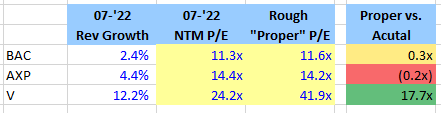
THE PRIMACY OF REVENUE GROWTH Having grown up as a Tiger-style investor, one of the lessons that sticks with me the most is the value of revenue growth. As an impressionable 24 year old analyst, I will never forget Steve Mandel from Lone Pine telling our analyst group a simple but powerful truth - sustained structural growth is (almost always) chronically underpriced in the market, and sustained secular decline is (almost always) chronically overpriced in the market. In a market ecosystem keyed on P/E ratios, investors will get the proper P/E range directionally correct but will miss on magnitude. Don't take my word for it. A simple 30-year DCF architecture structured to sensitize revenue growth will display this truth. To simplify a complex reality, here I take revenue of $1m at T0 and hold 10% operating margins, 6.5% FCF margins, 35% debt/EV (5.5% interest rate), 10x terminal multiple at year 30, and an 8% WACC in all cases (which is generous to the decliners as usually revenue has beta to margins both ways). What stands out to me on this chart is how much more a 10% grower is worth than a 5% grower - roughly double in P/E ratio terms. This math shows that companies that can grow 10%+ on a sustained basis *should* have a floor P/E of roughly 30x, and companies that cannot growth revenue should trade with a 10x P/E ceiling. In my observation, this simple math explains one of the biggest philosophical differences between the Tiger-style long books and classical value investors where the value trigger tends to be low multiples on current year earnings. Let's pick on Buffett for a minute. Two of his largest holdings have been BAC and AXP. These stocks have been "cheaper" than the market historically trading ~11x and ~14x, respectively. V, in comparison, has seemed "more expensive". However, with perfect foresight, we can see that V's meaningfully superior revenue growth rate is "worth" a P/E over 40x. Price is what you pay, value is what you get. V has been demonstrably the cheaper stock over the last 15 years (and as such, a vast outperformer vs. BAC & AXP), despite never looking optically cheap on a near term P/E basis. Certainly the pushback to this mindset is "well, hindsight is 20/20". In aggregate and over long periods of time, it pays to bet against the durability of double digit revenue growth. Almost always, the "next AMZN" is not the next AMZN, and investors can fall into survivorship bias here. As the base grows, sustaining 10%+ gets mathematically more difficult. And the market tends to extrapolate these levels of growth, such that top line decelerations are usually painful events with a twin smackdown of revenue misses and de-rating lower (this is a key short alpha hunting ground). I don't dispute that. What I would suggest is that one of the most powerful insights that a fundamental investor can reach is conviction in the next durable growth story. Applying your idea generation & due diligence process to uncovering the next business that can sustain 8-12% revenue growth for 10+ years is, in my opinion, one of the more broadly fruitful approaches and an enduring lesson that the Tiger investment community has taught us. And even in a hyper competitive institutionally driven market of quants & pods, my observation is that the market still hasn't gotten this message on its chronic mispricing error. Hope that is helpful! Brett

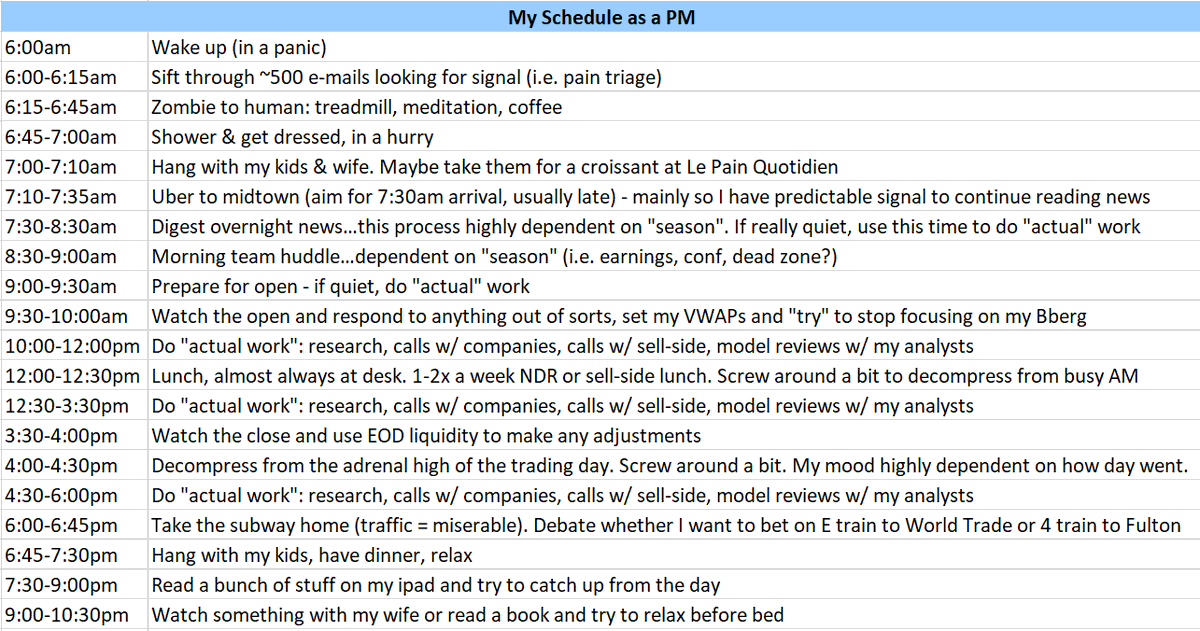
MY DAILY SCHEDULE AS A PORTFOLIO MANAGER Last week in class at ASU I had a PM at a NYC hedge fund come in as a guest speaker. A student asked him the typical "day in the life" question and we got a good laugh thinking about a "Hedge Fund Morning Routine" post...his first step was "wake up in a panic" and oh man it brought me back... Rather than attempt to be purely comedic, I thought it might actually be helpful to some analysts to see the day from the PM perspective and a few takeaways from my ~5 years of the daily balancing act of being a PM. The reality is that the PM seat (this is from my pod era) is an incredibly demanding life, which I'll discuss a bit here. I do occasionally hear the perspective from analysts of "what does my PM do all day" - it may feel to the analyst like YOU are doing all the work - building the models, generating the thesis, etc., and that the PM is just overseeing that process. I would push-back on that view, in most cases, and hope to give you a perspective from the other side of the table. BREAKING DOWN THE DAY First, a caveat: I can give you a much more accurate "quarter in the life" than a "day in the life". The quarters are predictable...earnings, conferences, dead zone, repeat. The below script makes the day look much more predictable than it really is. Is it earnings season? Am I at a conference? Did my biggest long blow up and I'm in all-hands-on-deck triage mode? With that caveat, my *general* day was a 16.5 hour day with 7.5 hours of sleep (I did and still need my sleep). About an hour of time for personal needs, 1 hour with my kids (part of the reason I retired...I wanted more), 1-2 hours with my wife, and 1 hour commuting. That left roughly 12 hours for work focus. That seems like a lot, right? It gets chopped up quicker than you think. In this scenario, I'm spending 2-3 hours on my phone / iPad reading news, sell-side research, spec sales notes simply digesting the news flow of the day. Some of this while I'm on the treadmill in the morning, in an Uber, the rest at home in the evening. With a portfolio of 60-80 stocks and a broad coverage of 250 stocks there is a LOT going on each day. In this scenario, I'm spending 1-2 hours on the tactical considerations of the day. The morning huddle, speaking to my trader, making nips & tucks on positioning, watching the open, watching the close. This part has a gravitational pull as the blinking lights on Bloomberg can really pull me down a rabbit hole... This leaves 5-6 hours for actual research work. The outbound, intentional, rigorous work that is required to generate differentiated investible insights needed to generate consistent alpha. Speaking with companies. Calls w/ sell-side & other investors. Reading source documents. Joining expert calls w/ my analyst. Evaluating data sources w/ data science team & analysts. Doing analyst model reviews. This is on an ideal day, which happens about as often as an ideal NYC weather day (i.e. 20 times a year). More often, this gets compressed to 2-3 hours per day as my calendar gets filled with compliance training, internal interviews, broad sector meetings, etc. Doesn't seem like enough? Doesn't seem like enough to me, either. This was a genuine struggle I had. How do I carve out enough time to generate alpha insights when my day is crowded by these other considerations? My only real answer was to lean on my team, build the trust in other team members to do good research. But that can be a chicken & egg problem...if I don't have enough time to train my juniors & engage with them deeply on a due diligence process and lead by example, how will they ever learn? Thinking through this reality, as an analyst, and this is mostly pod-specific but has applicability to other firms as well, there are four things I would propose at takeaways from the typical PM schedule. 1) A 24-HOUR PARANOIA ON NEWSFLOW. Even if your PM "seems" like he or she is not working 14 hour days, your PM is almost certainly tied to e-mail / Bloomberg / Street Accounts / company IR alerts with an intense paranoia about news. Steve Schwarzman said there are no old brave people in finance. Senior PMs live with an intense paranoia around news, pretty much around the clock. This doesn't make for a peaceful life, but you as an analyst should align with that...i.e. wake up early and distill news for your PM, constantly monitor news around the clock and contextualize key news / sell-side actions with your specific expertise. If your company blows up on news at 7am, you should be digesting that immediately and responding to your PM as close to real-time as you can. These are the moments when your expertise of being closer to the situation matter. 2) VERY LITTLE ACTUAL RESEARCH CAPACITY. BY FAR the hardest transition for me from Tiger style analyst to pod PM and from single man to married man with 3 kids was the compression of my research capacity. As a 25 year old Tiger-style analyst so many days I could work 7:30am-10:30pm and get 12 hours of true research done in a day. I was a psycho and intentionally lived at 56th & Lexington by the Harley Davidson store so I had a 5 minute walking commute. I was all in. Per the schedule below, as a 32 year old father of 3 living in Battery Park City that was no longer possible. On a BEST case day I had 6 hours to lock in and dig through companies. On a more typical day, that is 1-3 hours. How can I hope to do differentiated stock research in that situation? I can't, unless I have good team members around me. It's also the reason after I left Citadel that I considered a concentrated boutique small cap long only strategy where I could go back to 8-10 hours of true research in a day, but that's a story for another day. Know that in this context as an analyst, your job is the be the lead on the due diligence process. 3) ANALYST TRAINING. INTENTIONS VS. REALITY. I've beat this dead horse a million times here. But my opinion is a junior analyst needs 100-150 hours of training & mentoring to get up to speed in the first 6 months on the buyside. Our Academy is 60 hours over 6 weeks. With this schedule I led a team of 9. 100 hours of training for 4-5 junior analysts was just not time in my schedule that I could spare, despite my good intentions. If your PM is neglecting you as a mentor, my hunch is that it's the same story. It's (likely) not personal, it's just the simple reality of the crushing responsibility of the PM seat. This creates an environment where being a self-starter and a self-learner differentiate success vs. failure (insert obligatory plug for the Fundamental Edge Analyst Academy...) 4) A GENUINE STRUGGLE WITH BALANCE. The sad part about revisiting this schedule is the minimal time I had to spend with my kids. Many days it was only 10 minutes in the morning, 10 minutes in the evening. I get a pit in my stomach thinking about it now. This job can absolutely dominate your consciousness and I have insane respect for the PMs who can balance everything. I still mark my second son's birth to the day Valeant blew up and my third son's birth to the day our biggest short MRK missed and cracked. It's sad to me that my focus on my portfolio crowded into those special moments in my life. Not to mention, on this schedule below I didn't have much time to be helpful around the house / a super participatory parent outside of the weekends. There are numerous reasons that my PM career was relatively short (4-5 years), not least of which is that I was not a top 5-10% ace, but ultimately the biggest reason was the nearly unending and crushing responsibility that comes with being a fiduciary of capital and being in a seat where the difference between down 3% and up 3% is the difference between being fired & ostracized and being paid 7-8 figures...the intensity of the incentive can create a real addiction. For me, it was a simple story of burn-out and shifting desires in life. If you are in that situation...I've been there, and unfortunately I never found the perfect answer to manage it. Well per usual I intended to write a short tweet and I wrote a long one. I must get back to work!!

Does your business have a Financial Policy?
If not, you need one.
The Financial Policy is the rulebook that governs how you fund your business. And treat your shareholders.
It’s especially valuable in businesses where there are multiple complex stakeholders.
It provides the framework for making capital structure and balance sheet decisions. Ensuring everyone is working to the same plan.
If you are a Board, you need to have one.
If you are a Shareholder you should demand your Company has one.
If you are a CFO or CEO having one will make your job easier.
By setting clear guardrails you can take the emotion out of corporate finance decision making.
A Financial Policy has 5 Sections:
1. Overall Objective
2. Debt
3. Liquidity
4. Distributions
5. Capital Allocation
1. Overall Objective
Start with what the overall financial objective for the business is.
This will depend on the stage of business, and should speak to the financial risk and return appetite of the business.
Some examples for (illustrative purposes only):
- Dividend Stock: Deliver total shareholder return of at least a 6% premium to the base rate, with a minimum of 50% of after tax profits distributed to shareholders.
- Turnaround: Reduce debt levels to below $700m and Net Debt Leverage to below 3x EBITDA. Then recommence dividends.
- Startup: Maintain a minimum 12 months runway, and grow valuation by 2x each funding round
- PE Backed: Minimum Net Debt: EBITDA of 4x upon entry, maximizing equity value accretion over 5 years
- Prudent Balance Sheet: We never have more than 1.5x EBITDA of debt, and ensure we always have $100m of cash on balance sheet as a minimum.
2. Debt
This should set the rules around how and when you use debt, and sets some limits on how much.
Example Policies:
- Long Term Leverage Target is 3x.

The IPO process takes more time and is more intensive than any management team ever thinks. For many Australian technology founders with a potential IPO on the horizon, listing on @Nasdaq and @NYSE has become an increasingly viable option, given Atlassian's success in doing so. The IPO location conversation is one we’re very familiar with. As board members and investor partners, it’s our job to arm our portfolio companies with the facts and figures to understand the trade-offs between listing in the US and listing in Australia on @ASX. This post reviews a few of the key discussion points sitting in most executive teams' blind spots. Capital Market Differences – USA vs Australia The US capital markets are the deepest in the world, and with that comes more analyst coverage – however, given this, it can mean it’s harder to garner attention for smaller growth businesses in the US. · There are 15x more listed software companies of scale (>$200 million in revenue) in the US than in Australia · The median market cap of software businesses on the S&P500 is 9x higher than the ASX200. However; · There is a higher concentration of analysts in Australia for businesses with an EV sub $3 billion. A common misconception is that US-listed technology businesses receive higher valuations. Generally, we see zero impact between the two locations on valuation multiples. Both markets are highly correlated for valuation in terms of both absolute growth and efficiency. If there is any valuation premium, we actually see top-quality ASX tech businesses attract a valuation premium given there are fewer of them (see image 1 & 2). Free float of US companies turns over about 3x faster than ASX-listed companies. A more stable register of longer-term investors gives businesses greater ability to execute longer-term strategic initiatives. Australia has the 5th largest pool of pension assets & global investors make up a significant portion of ASX-listed companies’ share registers. It is far easier for smaller businesses to qualify for major indices in Australia. Inclusion in the indices can create meaningful demand. For example, the market cap threshold of an ASX200 is ~$510 million vs S&P500 ~$7.6 billion. Operational Preparation and Governance Differences The two markets have vastly different operational and governance requirements. Here are some we find most commonly discussed: 1/ Cost to list: Listing in the US costs more upfront and ongoing. On average is it 2x more costly to list in the US – a difference of $10 million. The biggest variance in quantum is in underwriting fees – while the legal fees are almost 5x more expensive to list in the US, Directors and Officers insurance can be up to 10x more expensive in the US (see image 3). 2/ Timelines: Pre-prospectus lodging: US 18-24 months, AUS 9-12 months. The work streams are wide and varied, but most of these fall upon the finance function. Of course, there are other work streams relating to corporate and capital structure, compensation and post-IPO stock-based incentive programs, governance and board composition and committees. Official IPO timeline: US 4-7 months, AUS 3-4 months. Notably, the SEC review process in the US can take up to 16 weeks vs the typical ASIC review of one week (see image 4 for complete timeline). 3/ Secondary transactions (pre- and post-listing): In Australia, it is easier to sell shares at IPO and raise money in follow-up offerings. The US, however, is better structured to facilitate founder and management selling post-IPO via 10b5-1 plans. 4/ Ongoing obligations: The most obvious variation is that the US requires financial reporting quarterly vs Australia’s requirement for semi-annual. Beyond this, it is generally far more onerous to be a listed business in the US – audit and internal control requirements are cases in point. 5/ Directors and Board Governance: There is a wide variety of nuances to consider in the two markets that you need to be aware of. By way of example, in Australia, all Directors are (re) elected at each AGM, while in the US Directors have set terms. Remuneration norms are also very different – for instance in the US often board members are issued RSUs, while in Australia there is no allowance for performance-based equity programs for directors. 6/ Foreign Issuer and Emerging Growth Company (EGC) concessions: There are a variety of benefits of being both an EGC in the US – defined as being <$1.235 billion in gross revenue – during the IPO process as well as ongoing. For instance, only two years of audited financial statements are required vs three for non-EGCs and there is a more streamlined executive compensation disclosure on an ongoing basis. As a foreign private issuer (FPI) there are reduced disclosure requirements but of course, this comes with the risk of reduced investor appetite and associated trading discount. Attached Example 3 is a more complete list of FPI Benefits. TDM Additional Views We have long preached the importance of acting and behaving like a public company well in advance of even contemplating listing. Aside from the scaling of systems and processes, ensuring a high-impact board and having key executives in place and highly incentivised for the next 4-5 years more broadly, we encourage; · Establishing and practising your financial reporting framework. Management must develop and foster the skill of providing formal investor presentations and financial forecasts on a semi-annual basis. · Practising the rhythm of not only preparing regular forecasts but also making a good habit of meeting or exceeding them. · Establishing investor relations and education. It is important to start now to raise awareness and understanding of your business among public market investors, using these opportunities to learn how to deal with a public market investor ‘Q and A’. This post is a combination of public data and our views from regularly working through this process with our portfolio companies. If you would like more IPO preparation resources, our quarterly newsletter will be including more detailed slides on this analysis and other IPO-related content : bit.ly/tdmquarterly If you want more IPO content now, linked is a chapter we wrote in the @ASX Entrepreneur’s Guide on IPO Readiness : asx.com.au/documents/reso…


@craig_pan Enjoy the vivid light show mate 👌
@HedgeyeComm Sad to hear but totally understand! Was wondering where you were finding all that time to make these balancing tweets with work/personal life. You'll still hear from me via emails sometimes 🙏

Novice investors focus on the income statement. After a few years they move to the statement of cashflows. As a sage they will move to the balance sheet. A few enlightened souls then realise all of that is garbage and that the proxy statement was where it was at all along.


Brett Caughran @FundamentEdge
58K Followers 4K Following Completed my hedge fund tour of duty (Maverick, D.E. Shaw, Citadel, Schonfeld). Adjunct at ASU. Now building an exceptional analyst training firm. DMs open!
Bottleneck Capital @Klaudnin3
2K Followers 7K Following L/S TMT Investor, tweets are not investment advice
Anicca Cap @ttril22
539 Followers 834 Following LO equities. Looking for narrative inflections & strong management
Ryan tendall @ryantendall
259 Followers 4K Following
Callisto Research @callistores
1K Followers 841 Following Activist investigative research in the public interest. Not investment advice. [email protected]
Robin Dods @toy59496
2K Followers 557 Following Polymath Event Arbitrage Astrophysicist, Anaesthetist, Aerospace Engineer, Finance. The other guy is the Canadian Astronaut.
Wilson Thai @wilsonthai0
18 Followers 205 Following All opinions are my own and not representative of my employer.
Ethan Choi @EthanChoi7
8K Followers 5K Following prev @Khoslaventures, @Accel /views r my own. wrk w/ @OpenAI, @ClickHouseDB, @glean, @vercel, @tryRamp, @AbridgeHQ, @R1RCM, @Anrok, @dualentry, outsmart
Ell @CeoEll
269 Followers 440 Following
Vincent in Vietnam @vincentmcli_
0 Followers 6 Following building wins in vietnam🇻🇳 | lawyer, founder, consultant |📍ho chi minh city & hong kong
PennyParasite @pennyparasite
3 Followers 67 Following 29 👶🏻| Living with my parents 🏠| Compound Interest Expert⌛| Index Funds 📈| Bitcoin | Building the Snowball 🏂🏻 | Daily Finance tips 📊
MidCurveCapital @midwit_capital
3K Followers 2K Following Forward Deployed Shitposter / Just midcurving / I own 0.1% of Personalis
dash @datadashboards
4K Followers 798 Following I popularised prediction market data cofounder @ https://t.co/Xy0fcnG2Qw dashboarding @ https://t.co/Ycy0U8dWIX prev @ billion dollar protocols you used

Toj @_toj27
76 Followers 329 Following Built https://t.co/MZgpndPIs4 | Learn about stocks through daily games built on real stock market data | Value investor + demand premium


FlorenceBurne-Jones @075D687V8JILV8
38 Followers 987 Following
KarenCatharine @ofioYyv1m5Oovdb
2 Followers 265 Following
TinaBethune @75G2yUEEd96xY
22 Followers 1K Following
MaureenRaphael @T8S723Q1HLa4KW
6 Followers 261 Following
VisionaryScarlettTayl... @u4r5Tm0d5e8ddS3
16 Followers 1K Following Building my brand, living my best life.

Elsie Heaney @ElsieHeane45728
60 Followers 2K Following
SP500_Insider🇺🇸 @Trawlar437957
40 Followers 2K Following 15-30% Monthly | 2 High-Conviction Stocks.Short-Term Gains: 15-20% in Days/Weeks.DM "JOIN" for WhatsApp Alerts. Live Trade Signals • Market Analysis
Brett jenner @Eeheovar937
10 Followers 344 Following The individual investor should act consistently as an investor and not as a speculator. - Ben Graham https://t.co/jnnCfBlpsb
RateCutTrader🇺🇸 @Awdwirnood605
53 Followers 2K Following 15-30% Monthly | 2 High-Conviction Stocks.Short-Term Gains: 15-20% in Days/Weeks.DM "JOIN" for WhatsApp Alerts. Live Trade Signals • Market Analysis
少額投資スター... @Beafea235032
46 Followers 2K Following 【完全無料】 25年の株式投資プロチーム(運用資産500億円以上)が提供:毎日の市場分析レポート + 優良成長株のピックアップ。プロの情報を無料で。まずはお気軽にお問い合わせください。
Sinuo @SorsnarfF1fO_r
16 Followers 32 Following Girls who love to laugh will never have bad luck. I also hope to meet my prince charming.
Westley Thompson @westley12045
17 Followers 2K Following

Psyop Capital @psyopcapital2
167 Followers 5K Following
ElmaWollaston @8Hu6zT3ogiaua
166 Followers 6K Following Adulting level: Forgot to buy toilet paper 🧻🚫
notacinnamon @J16753227902
86 Followers 1K Following
Sooknar @SooknarPiVb
38 Followers 826 Following

WinifredHughes @24aP80rl49Rsq
58 Followers 7K Following

Thairez @ThairezTlpgaL
52 Followers 4K Following
Soothoez @Soothoez7cNFRU
50 Followers 5K Following
Wonderful @8jW8MHpsK1PkC
70 Followers 7K Following
新澳门六合彩 47... @osanomiwak77799
1K Followers 7K Following "问:什么东西安得更宁?——安宁 全网最晚封盘时间21:28封盘 这里 @satsukatom75887 图片带网址进去要买金币充值钱才能看资料,提前修改资料马后炮中奖说查看战绩,只要关于要钱的都是骗子!"
Turdea @TurdeaW4Eb
47 Followers 4K Following

Dnoneys @DnoneyspBAKGZp
39 Followers 4K Following
ParraPower @parrapower2022
7K Followers 412 Following Eels For Life | Part-time Investor | Full-time Buffoon | Risk Taker| Politics| Sarcasm | No financial/legal advice|

BatmanCapital 🦋 @capitalatrisk23
3K Followers 749 Following -Ex teenager -Built a few companies -Entropy connoisseur
Parrot Analytics @ParrotAnalytics
6K Followers 997 Following Helping the media industry understand global audiences and the value of content 🌎 📈 #StreamingEconomics
Antenna @AntennaData
5K Followers 87 Following Antenna is building the market standard for subscription analytics
Mark Stenberg @MarkStenberg3
6K Followers 3K Following media reporter at @adweek | [email protected] | subscribe to my weekly media newsletter, On Background, below
Matthew Prince 🌥 @eastdakota
242K Followers 302 Following A little bit geek, wonk, and nerd. Repeat entrepreneur, recovering lawyer, and former ski instructor. Co-founder & CEO of Cloudflare (NYSE: NET).
TV Grim Reaper @TVGrimReaper
16K Followers 1 Following "It’s a great business model when a whole bunch of people pay for something they don’t really care if they have or not” - Rob Manfred, on the cable bundle
Randian Capital @RandianCapital
4K Followers 7K Following Contrarian investor in the public markets. Not investment advice or a solitication to buy/sell securities. May hold/trade securities mentioned without notice.


The Wall Street Journ... @WSJ
21.7M Followers 1K Following Sign up for our newsletters and alerts: https://t.co/QevH0DLQi8 | Got a tip? https://t.co/iXIigdPjEZ | For WSJ customer support: https://t.co/DZgH9n53qg
Trishla Ostwal @trishlaostwal
3K Followers 2K Following covering AI for @adweek • DM me off-the-record • Signal: @ trishla.07 (no pitches) • @ColumbiaJourn alum
Kamil @KamilSzybalski
1K Followers 621 Following Agents and AI @gitlab | Prev AI @slackhq @Microsoft
Jared Sleeper @JaredSleeper
18K Followers 2K Following Partner at Avenir, where I invest in startups. Here to bring some analytical irreverence, while trying to add a little information to the world. Views my own.
SoftwareIQ @software__iq
560 Followers 497 Following A modern research platform purposefully built for the software industry. Sign-up today!
Apoorv Agrawal @apoorv03
18K Followers 882 Following Investing at Altimeter. Before: eng @palantirtech, alum @stanford. Views personal no investment advice
Serenity @aleabitoreddit
898K Followers 173 Following I only use X, beware of imposters. AI/Semi Supply Chain Analyst Not investment advice, DYODD. Sharing personal thought process on supply chain bottlenecks.

tae kim @firstadopter
96K Followers 10K Following "Key Context" Substack covering Nvidia/AI. Reached #1 new bestseller in first 24 hrs Subscribe https://t.co/3N2fHOXQfL "Be so good they can't ignore you"
Wilson Thai @wilsonthai0
18 Followers 205 Following All opinions are my own and not representative of my employer.

Callisto Research @callistores
1K Followers 841 Following Activist investigative research in the public interest. Not investment advice. [email protected]
Perplexity @perplexity_ai
495K Followers 76 Following Curiosity changes everything. Download our free app on iOS, Mac, Windows, and Android.
Paul Enright @pmje73
28K Followers 255 Following
Trung Phan @TrungTPhan
729K Followers 4K Following Write on business with @workweekinc. Building @bearlyai.
Amit Goel @amitgoel78
482 Followers 520 Following CPO - MovingWalls | Led global products at TheTradeDesk, Amagi, Synamedia. Media&AdTech. Product Leader, Entrepreneur, Engineer Building https://t.co/ntoWa357xL
Negligible Capital @negligible_cap
13K Followers 609 Following Stocks mostly. Long and short Not advice
Nyan Nyan @CatNyanpital
1K Followers 574 Following I buy socks and talks shit nothing is real on this account imagine taking sock advice from a cat

David George @DavidGeorge83
20K Followers 1K Following GP, Head Growth Fund @a16z | 👨👩👧👦 | See disclosures: https://t.co/AgIphFgvmR
John Wilson @WilsonCompanies
39K Followers 308 Following Building a $100m Home Service Co. Host of Top 150 Business Pod @ownedxoperated
Indie Game Joe @IndieGameJoe
60K Followers 1K Following I’m Joe, a former painter & decorator turned award-winning video game marketing consultant. Love sharing indie games! Discord: https://t.co/SlcRjcxzlT
Manus @ManusAI
249K Followers 30 Following Manus from @Meta is the general AI agent that bridges minds and actions: it doesn't just think, it delivers results. Telegram: https://t.co/kdHdNxZ6xF
Oracle @Oracle
828K Followers 790 Following With industry-leading cloud and AI, we help people see data in new ways, discover insights, unlock endless possibilities.
Andy Stone @andymstone
52K Followers 2K Following Communications, @Meta. Alum: @HouseMajPAC, @SenatorBoxer, @DCCC, @RepMcNerney. Open to your hot takes.
Dom Davies @_DomDav
566 Followers 200 Following ad tech, finance, mobile gaming, food, wellness, arts, sports, dogs, etc.
Robin Dods @toy59496
2K Followers 557 Following Polymath Event Arbitrage Astrophysicist, Anaesthetist, Aerospace Engineer, Finance. The other guy is the Canadian Astronaut.
Jamie Halse (Senjin C... @JamieHalse
6K Followers 934 Following Japan-focused shareholder activist. Buying stakes in Japanese small caps for ~30c on the $ and engaging with them to realise the embedded value . DMs open
Clark Tang @_clarktang
12K Followers 453 Following investing @ altimeter // be humble, never stop learning // no investment advice all views personal
Lin @pyhrroll
845 Followers 393 Following Ran a 300m dau social platform / Now @ frontier AI lab in the Bay Area / Dad of 2.
David Baszucki @DavidBaszucki
435K Followers 505 Following Founder and CEO of Roblox. Greater good via Baszucki Group. Inventor. Engineer.
Ethan Mollick @emollick
364K Followers 585 Following Professor @Wharton studying AI, innovation & startups. Democratizing education using tech Book: https://t.co/CSmipbJ2jV Substack: https://t.co/UIBhxu4bgq
Andrew Ng @AndrewYNg
1.7M Followers 1K Following Co-Founder of Coursera; Stanford CS adjunct faculty. Former head of Baidu AI Group/Google Brain. #ai #machinelearning, #deeplearning #MOOCs
footnoted @footnoted
28K Followers 2K Following Reading SEC filings obsessively for the past 20 years. Home of the Friday Night Dump. Stay tuned for more products. Find out more here: https://t.co/P8Dz61B1pT
Hudson Labs @HudsonLabs
4K Followers 1K Following Find what matters in public markets Guidance, catalysts, risk, and high-precision financial drivers — institutional-grade AI.
dara khosrowshahi @dkhos
2.5M Followers 756 Following Uber CEO; travel and sci-fi geek; gamer who doesn't have enough time to play much.
Trends for United States
You might like