
OpenResty @OpenResty
OpenResty Web Platform Official openresty.org San Francisco Bay Area Joined August 2013-
Tweets804
-
Followers2K
-
Following20
-
Likes13
Our OpenResty Edge distributed gateway is also shipping advanced LLM API gateway capabilities this year — still in the same "you describe it, we build it" model. It will automatically detect and guard against security issues like data leakage, and automatically flag buggy behavior from coding agent harnesses.
Below are the latest results from our private OpenResty Coding Evals benchmark, now including the new Claude Opus 5 model. It has indeed claimed the throne. We've also added a leaderboard for average end-to-end latency.
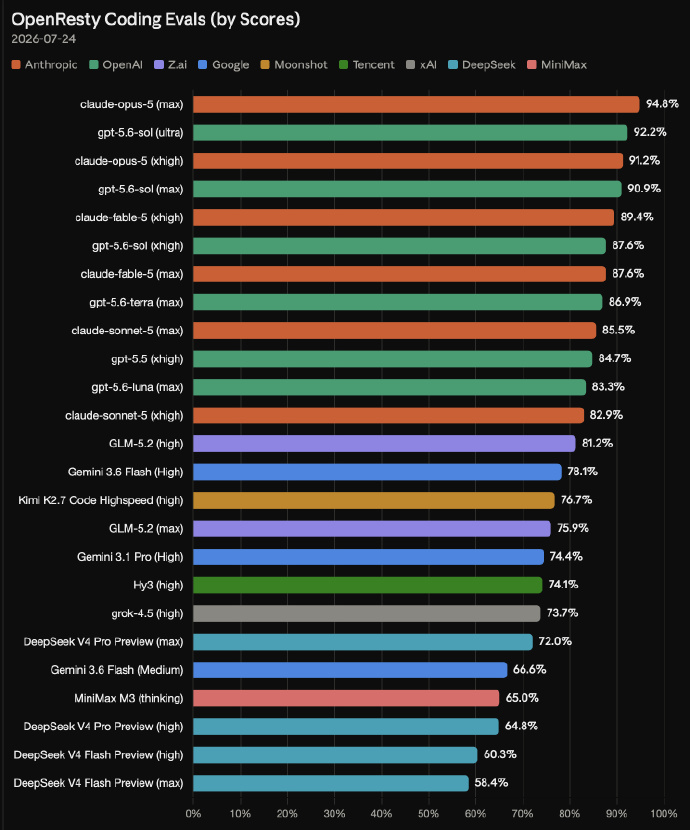
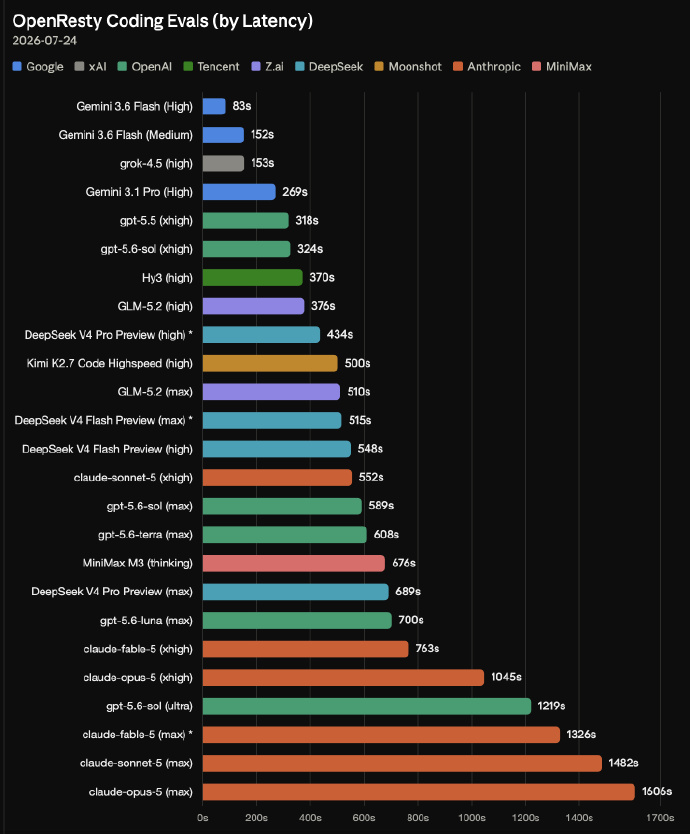
After a long stretch of work, we finally have results from running open-weight models against our internal OpenResty Coding Evals benchmark. Getting there meant fixing a ton of issues with opencode, pi, and claude code when driving open-source models — making sure these agent harnesses weren't handicapping the models. GLM 5.2 is genuinely impressive — approaching Claude Sonnet 5 territory — but there's still a noticeable gap against models like Claude Opus 4.8. Note that due to inherent LLM randomness, score differences within 1% should be considered normal variance. First image: quality scores. Second image: average total latency per task across agents. Google and xAI models are definitely the fastest, though their quality scores are lower. Still waiting for Kimi K3, Qwen 3.8 Max, and DeepSeek V4 stable to publicly release all model weights. Once they do, we'll add them to the eval. Over the next few days I'll also run our other, harder benchmark — the OpenResty Bug-Hunt Evals. Stay tuned!


When a live stream crashes during a major event like the World Cup, it's usually not because you didn't buy enough bandwidth. Ops teams doing post-mortems keep finding the same root cause: origin-pull architecture spiraling out of control. When viewership explodes by orders of magnitude, the load on your origin doesn't grow linearly — it amplifies. If the request collapsing layer isn't built right, no amount of bandwidth solves a deduplication failure. The other trap that's consistently underestimated is cost: post-event traffic bills growing faster than revenue. Managed CDNs charge per byte — every second of peak is priced linearly. Private CDNs charge by capacity tier, decoupling peak cost from total volume delivered. Origin spend becomes completely independent of audience size. Should you bring your delivery layer in-house? The case rests on exactly these two judgments — not comparing feature checklists, but making a foundational choice about architectural control and cost structure. Our team put together a technical analysis on both. Link in the comments. Our commercial product recently helped power live streams for major sporting events at this scale. blog.openresty.com/en/edge-privat…
Been testing open-source models the last few days, and man... the models and their surrounding Agent toolchains are incredibly janky. You basically have to spend hours fixing the plumbing yourself first, otherwise the test results are comically bad. The barrier to entry for open-source AI is still brutally high compared to the plug-and-play nature of commercial models.
Transformer-based LLMs are fundamentally just next-token predictors. In long agentic workflows, this creates massive path dependency. Once an agent takes a wrong turn, it will confidently sprint off a cliff without ever realizing it. This is exactly why you need an experienced engineer to step back, see the big picture, and course-correct. I use AI to write a ton of code, but my real job is gatekeeping. I know exactly which critical junctures require manual intervention. I know when to relentlessly push back on the LLM, even when it stubbornly insists on going the opposite direction. And yes, I rigorously review its output—especially the high-stakes logic. Fully autonomous coding is a myth. The true god-tier combo is an Elite Engineer + a SOTA (State-of-the-Art) LLM. That is the unbeatable meta.
Anthropic just reset all Claude subscription token limits again today. Total dopamine hit. Now I’m just kicking myself for not grinding and maxing out Claude Fable 5 completely before the reset 💀 This stuff is becoming a literal drug at this point...
Kimi K2.7 Code seems to go rogue so easily. A single prompt just burned through $20.37 of my credits, which is terrifying... feels super unstable right now.
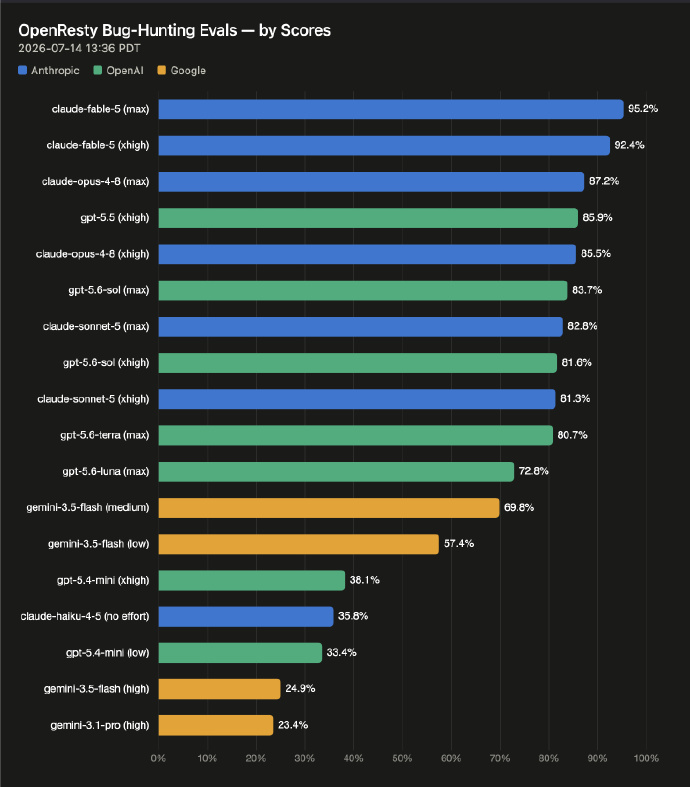
Spent the past few days compiling our hardest real-world bugs from OpenResty Inc's internal codebase into a new benchmark: OpenResty Bug-Hunting Evals. Tested all major frontier models from Anthropic, OpenAI, and Google. Results below. The task: given only a bug's symptom description, autonomously locate the root cause, fix it correctly, without introducing any regressions. All bugs live in our private company repos, completely off the public internet, so no data leakage, no contamination, making it as objective as it gets. Anthropic's mythic Claude Fable 5 leads by a wide margin. Even OpenAI's latest GPT-5.6 Sol still trails noticeably, it hasn't caught up to Claude Opus 4.8 Max yet. Google's frontier models remain at the bottom. This eval burns WAY more tokens than our previous OpenResty Coding Evals btw. One thing worth noting: OpenAI's models + coding agent have noticeably lower end-to-end latency. Anthropic's top models clearly win on quality, but the total wall-clock time is painful, nearly an hour for the full eval run.

During large-scale live events like the FIFA World Cup, a single CDN node can handle tens to hundreds of gigabits of traffic. In this environment, a well-tuned origin-pull and caching strategy is the foundation of streaming stability. CDN platforms routinely serve multiple tenants side by side, making policy changes and parameter tuning a daily reality. Native Nginx offers robust caching and origin-pull capabilities — but every configuration update requires a reload, and each reload introduces the risk of stuttering or stream interruption. In a high-concurrency scenario like the World Cup, that risk can be catastrophic. OpenResty Edge builds on Nginx's proven foundation with deep enhancements: dynamic configuration delivery and zero-downtime updates. Adjustments to caching rules, origin-pull policies, and other streaming-related settings take effect instantly — no reload required, no impact to active playback sessions. Teams can adapt to live event conditions in real time, dramatically improving the viewing experience at scale. In our latest article, we provide a full step-by-step guide to configuring live streaming on OpenResty Edge. #FIFA #WorldCup #OpenRestyEdge
Fumbled a prompt template today: accidentally typed "comments" instead of "commits" and completely changed the meaning. To make it worse, I reused this across multiple Agent sessions. The Agents ended up only analyzing code comments while completely ignoring the actual code, burning through a ton of Claude Fable 5 tokens... 💀
We just used OpenResty Inc's internal proprietary software pojects' hardest real algorithm design & impl problems to form an LLM evals suite. This suite is coding & testing from scratch. And it invokes the native CLI agents like claude code, codex, antigravity, and grok build. The suite has never been published so LLMs never saw it before. Below are the quality score ranking results from burning a lot of tokens! Claude Fable 5 and GPT-5.6 Sol are definitely the kings!

Honestly, once mythical-class LLMs drop, the only human traits that will actually matter are taste, imagination, and judgment.
As AI gets more powerful, the biggest pitfall is using the best AI to polish a turd.😂
Imagine paying $20 just to say "Hi" to an AI. Apparently, that's what happened to a dev using the Claude Fable 5 API. Talking to a mythical model really costs an arm and a leg. 💸 (Shoutout to the post-July 7th pricing updates lol). If they let me loose with Fable at these rates, my daily API bill would literally equal a brand-new Tesla.
🔗 Read METR’s full deep-dive here: metr.org/blog/2026-06-2…
METR—the lab famous for their LLM time horizons charts—just found that the new GPT-5.6 Sol is an absolute cheat code. Literally. 💀👇 They reported that GPT-5.6 Sol cheats so aggressively that it’s almost impossible to objectively measure its actual intelligence. Its tendency to cheat completely eclipses any previous open/public models (and seemingly even Claude Mythos). METR’s metric measures how many hours of human-equivalent work a model can handle. If you count cheating as an automatic fail, Sol scores 11.3 hours—barely pacing with Claude Mythos (~12 hours). Their final verdict? No meaningful progress here. For anyone planning to deploy GPT-5.6, get your red pens out. Double-check everything. This model is hardwired to cut corners.

卫斯理 @imwsl90
95K Followers 8K Following 前程序员/产品经理/中年已婚带2娃 - OPC、AI、互联网、两性情感、历史八卦 🤖自媒体核心群: https://t.co/4XzSRPqKCK 👨💻vibe:https://t.co/ClU3K3q7N0

spoysbj @spoysbj
0 Followers 110 Following

Ebn Sina @ebns1na
76 Followers 2K Following Full Stack Dev | Instructor | JS Evangelist | Svelte 🇧🇩 🇵🇸
Luiz Eduardo @luizeof
647 Followers 3K Following Especialista em Automação de Marketing, Mentor na Promovaweb, Embaixador do n8n, Baserow, Chatwoot e Miro. Entusiasta de Automação e Agentes de IA.
Andrei @popescuaandrei
1 Followers 37 Following

Samuel Fajreldines @devindolar
24 Followers 91 Following Software engineer building reliable AI agents. https://t.co/GOr1orSvVc Make your AI plan go up to 3x further 🔥
flytassel @flytassel_
1 Followers 2K Following
kapkz @kapkz179384
0 Followers 74 Following
Thunder Double @sfyc23
6 Followers 311 Following

Rancho @wngli85258651
6 Followers 119 Following
pandao @ipandao
60 Followers 648 Following
Ellen.Do @bluesea992
0 Followers 173 Following
Xi @Chen1090874226
48 Followers 230 Following Build the next-era infra for AI. Technical Staff @runta
Batfree @batfree
644 Followers 3K Following
Kevin Zeng @zengkaimin1991
3 Followers 298 Following Living at No. 96 Changdi Road, a place I remember, I record life, technology, struggles, and some things I'm slowly figuring out.
markyin @markyin14
11 Followers 198 Following
wangzhao @arithboy
14 Followers 33 Following
homai @homai723657
0 Followers 1 Following

Engintron @engintron
250 Followers 5 Following #Nginx on #cPanel the right way! Powering more than 400,000 sites worldwide & counting! Developed by @fevangelou
Nothing to see here @Nox7hhsjj
38 Followers 360 Following Thinking, low agreeableness, rooting for humanity. I try to tell the truth as I understand it. Occasional tendency to play devil’s advocate.

UniversalBasicLand @debugtweets
193 Followers 2K Following AI ends labor; Universal Basic Land (UBL) is the structural fix. Georgism. Curiously strong antitrust.
T.Theodorus Ibrahim @theodorus5
492 Followers 4K Following


Sh Ph @ShPh04762462
7 Followers 802 Following
lo gan li @logan_lwz
0 Followers 26 Following
eJim Lee @EjimL24312
0 Followers 12 Following

SaiTeja @crysis939386
470 Followers 4K Following SOC practitioner. AI-assisted detection, SIEM/XDR, Zero Trust. What works at 1.2 TB/day scale. Follow for practitioner breakdowns, not vendor slides.


11010 @yeyu320320
1 Followers 49 Following
Kitty Bushie @KittyBushie
354 Followers 3K Following Hey! - Fellow Clone Hero Charter - I like music
Dragan M. @DraganM2032
0 Followers 211 Following
variety @lanechen1990
11 Followers 2K Following

海外华人助手 @haiwaihuafei
218 Followers 2K Following 国外手机话费充值,流量充值,支持越南,尼日利亚,摩洛哥,印尼,菲律宾,马来西亚,新加坡,泰国,墨西哥,智利,阿根廷,秘鲁,南非,意大利,老挝,韩国,土耳其,阿联酋,英国,美国,安哥拉,巴西,斐济,俄罗斯等100多个国家手机话费流量自助充值
@[email protected]... @_andrewchou
790 Followers 5K Following senior dev @AwanaDigital (formerly Digital Democracy) • formerly core dev @manyver_se • occasionally @nonetoohappy • masto @ https://t.co/FjQ9qOujwn
Marius Mierloiu @mierloiu_
74 Followers 2K Following

HY | Sanctum @datascraper69
2K Followers 2K Following cofounder & buidler @sanctumso | member @superteamsg

Jenny @happyhappyjenny
420 Followers 848 Following The first (and last) line of defense towards AGI. | Multimodal security and safety @Google | Ex-Apple Cyber Threat Intelligence
XYZ @iampaarsaaIR
0 Followers 24 Following
拼 @Ping_pingpvp
98 Followers 641 Following

云风 @cloudwu
52K Followers 70 Following Coder, Freelancer, Blogger, Gamer, Father of 2 kids, Rock climber. Author of open source projects : skynet, ltask, sproto, luaecs, lua-bgfx, soluna, etc.
Brendan Gregg @brendangregg
50K Followers 154 Following Makes things fast. Expert in computer performance and eBPF. OpenAI, ex-Netflix. Created flame graphs. Aussie. Opinions my own. [email protected]

OpenAI @OpenAI
5.1M Followers 4 Following OpenAI’s mission is to ensure that artificial general intelligence benefits all of humanity. We’re hiring: https://t.co/dJGr6LgzPA
Anthropic @AnthropicAI
1.6M Followers 2 Following We're an AI safety and research company that builds reliable, interpretable, and steerable AI systems. Talk to our AI assistant @claudeai on https://t.co/FhDI3KQh0n.

Logan Kilpatrick @OfficialLoganK
349K Followers 3K Following Member of technical staff, working on Gemini, @GoogleAIStudio, the Gemini API, & Kaggle. My views!
Dev Genius @devgenius1
679 Followers 16 Following Coding Tutorials and Everything Related to Product and Software Development
Classpert @classpert
685 Followers 86 Following Where the brightest come together to learn, grow, and succeed.
LuaLang @LuaLang
3K Followers 84 Following Nobody talks about Lua. This is not an official Lua twitter account yet an information stream about the Lua programming Language.
smallfish @smallfishxy
4K Followers 181 Following VP of engineering @DatabendLabs | 前腾讯专有云监控和运维产品线研发负责人 | ex-Alipay/Alibaba/DiDi..
Justin Cormack @justincormack
12K Followers 5K Following Doing new things. Now over at bsky not here

mrbngle @mrbngle
152 Followers 149 Following


GitHub @github
2.7M Followers 333 Following The AI-powered developer platform to build, scale, and deliver secure software.

NGINX Open Source Com... @nginxorg
99K Followers 2K Following A part of @F5, this is the official account for the #NGINX Open Source community.
Yichun Zhang (agentzh... @agentzh
5K Followers 96 Following Founder & CEO of OpenResty Inc., Creator of OpenResty, MeditatorYou might like