QANplatform @QANplatform
Quantum-resistant Layer 1 hybrid #blockchain platform. 👨💻Code smart contracts in any language. 🆕 QAN TestNet is LIVE! #QANplatform linktr.ee/QANplatform Joined July 2019-
Tweets1K
-
Followers47K
-
Following29
-
Likes515
10/🧵 Executive orders: 1: whitehouse.gov/presidential-a… 2: whitehouse.gov/presidential-a…
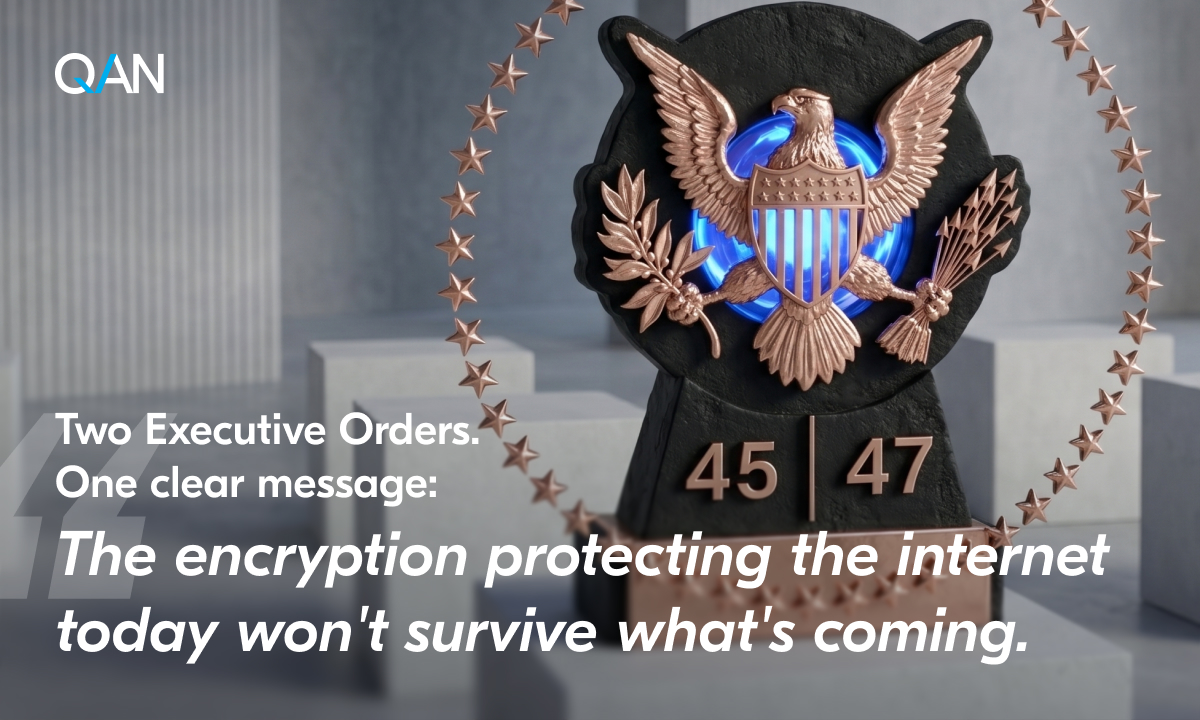
9/🧵 Two executive orders. One unavoidable conclusion: - The quantum threat is officially recognized at the highest level of U.S. government, - America is actively building the quantum computers that will make current public-key cryptography obsolete, - Hard deadlines, 2027, 2030, 2031, have been set for the executive branch and covered contractors. Q-Day isn't a distant forecast. It's a government-issued deadline.
On June 22, 2026, President Trump signed two executive orders affecting post-quantum cryptography and quantum innovation. EO 1 → "Securing the Nation Against Advanced Cryptographic Attacks" EO 2 → "Ushering in the Next Frontier of Quantum Innovation" This is basically the U.S. government declaring that the quantum era has arrived. 🧵👇
It is a Thursday evening in 2030. Marko, a backend engineer in Berlin is debugging a wallet recovery issue. A user claims funds were moved without authorization. No phishing. No malware. No leaked seed phrase. Just a valid signature. Marko pulls the transaction. It checks out. Correct format. Correct curve. Correct verification path. From the protocol’s perspective, nothing is wrong. But something is. He traces the wallet history back. First transaction: 2022. The moment the public key was revealed on-chain. After that, years of inactivity. No rotations. No changes. Just a key sitting there, exposed, forgotten. Until now. He opens an internal thread. Someone mentions it quietly. “Could be quantum-derived.” No one replies for a minute. Because if that sentence is true, even once, this is not an incident. It is a pattern waiting to be found. Marko looks at the verification result again. The system did exactly what it was designed to do. Accept a mathematically valid signature. It just no longer knows who is behind it.
The myth "Quantum-safe cryptography is just a stronger version of what we have." The reality It’s a completely different foundation. Different math. Different key behavior. Different tradeoffs. You’re not upgrading a component. You’re replacing the ground it stands on. And most systems were never designed for that kind of swap.
BlackRock Quantum Whitepaper: The Threat & The Hard Truth Key takeaways: Quantum computers could break current encryption within years, not decades. BlackRock confirms the timeline has accelerated. The quantum threat Shor's Algorithm can break Elliptic Curve Cryptography (ECC), the exact math securing Bitcoin and Ethereum digital signatures. A sufficiently powerful quantum computer could derive private keys from public keys visible on-chain. Bitcoin's vulnerability Approximately 35% of the Bitcoin supply (~7M BTC) is currently exposed: • 1.9M BTC in P2PK/P2TR/P2MS addresses • 5M BTC in addresses with reused keys This creates two distinct attack vectors: At-Rest: CRQC (Cryptographically Relevant Quantum Computers) can steal coins from the 35% of supply even if never spent. On-Spend: All Bitcoin addresses become vulnerable during the 10-minute mempool window of a transaction. Quantum is advancing fast • Google has moved its encryption migration deadline to 2029. • IBM targets large-scale, fault-tolerant quantum systems by 2029–2033. • Recent breakthroughs in error correction have pulled timelines forward significantly. The migration crisis Governments plan full migration by 2035, BlackRock notes that while technically feasible, coordination is the bottleneck. It requires multi-year timelines that legacy chains simply may not have. Legacy chain problems • Bitcoin: Development is relatively decentralized and there is no current consensus on PQ encryption/signature schemes, migration timelines, and the optimal specific implementation mechanisms. • Ethereum: Requires seven upcoming network updates/hard forks (2026–2029) with massive complexity due to Proof-of-Stake and smart contracts. • Ecosystem: Exchanges, custodians, and validators must simultaneously upgrade hardware, software, and policies. Why QANplatform, the post-quantum blockchain wins We built quantum-resistant cryptography as our foundation, not as a retrofit. No consensus chaos. No 35% of supply at risk. Already defended from day one. The bottom line BlackRock states that upgrading cryptographic systems is easier than building a quantum computer. However, they also admit migration is coordination-heavy and slow, while quantum timelines have accelerated to within years. We don't face this dilemma. We are already secured. Q-Day favors the future-proof.

9 minutes. That is the estimated time a primed fast-clock quantum computer could take to solve ECDLP, the Elliptic Curve Discrete Logarithm Problem, the core mathematical problem behind the signature schemes that secure Bitcoin, Ethereum, and many other blockchains. No buffer. No second chance. That's fast enough to turn blockchain's security window into a race against time.
What is lattice-based cryptography? Most encryption today relies on problems that are hard to solve, but have a hidden shortcut. Quantum computers find that shortcut. Lattice-based cryptography is different, it is built on problems with no shortcut in the foreseeable future, even with accelerating technological development. Think of it like this. Classical encryption is a combination lock: hard to crack by hand, but a fast enough machine can cycle through every combination. Lattice cryptography is more like a maze with millions of corridors added every second. Even knowing the rules of the maze does not help you navigate it faster. The underlying problem - finding the shortest path between two points across millions of mathematical dimensions - has resisted attack for decades. No classical computer can brute-force it. No quantum algorithm is known to break it. That is not an assumption. That is a track record. That is why CRYSTALS-Dilithium and CRYSTALS-Kyber are built on lattices. That is why post-quantum cryptography works. And that is why we use the NIST-standardized ML-DSA, which is derived from CRYSTALS-Dilithium.
QANplatform May Update: Accelerating Our Ethereum Rebase and Enterprise Readiness May was a month of decisive action for QANplatform. Following our announcement of a controlled architectural rebase of QANplatform’s core features onto Ethereum’s official implementation we moved immediately from strategic planning to implementation. With architectural risks mitigated and technical briefs finalized, we are now fully cleared to begin active construction on our next-generation implementation. Behind the strategic shift lies significant engineering progress. This month, our team resolved complex architectural challenges to ensure a rock-solid runtime and a mature developer ecosystem. Read the full recap on our blog, link in the comments 🔗👇
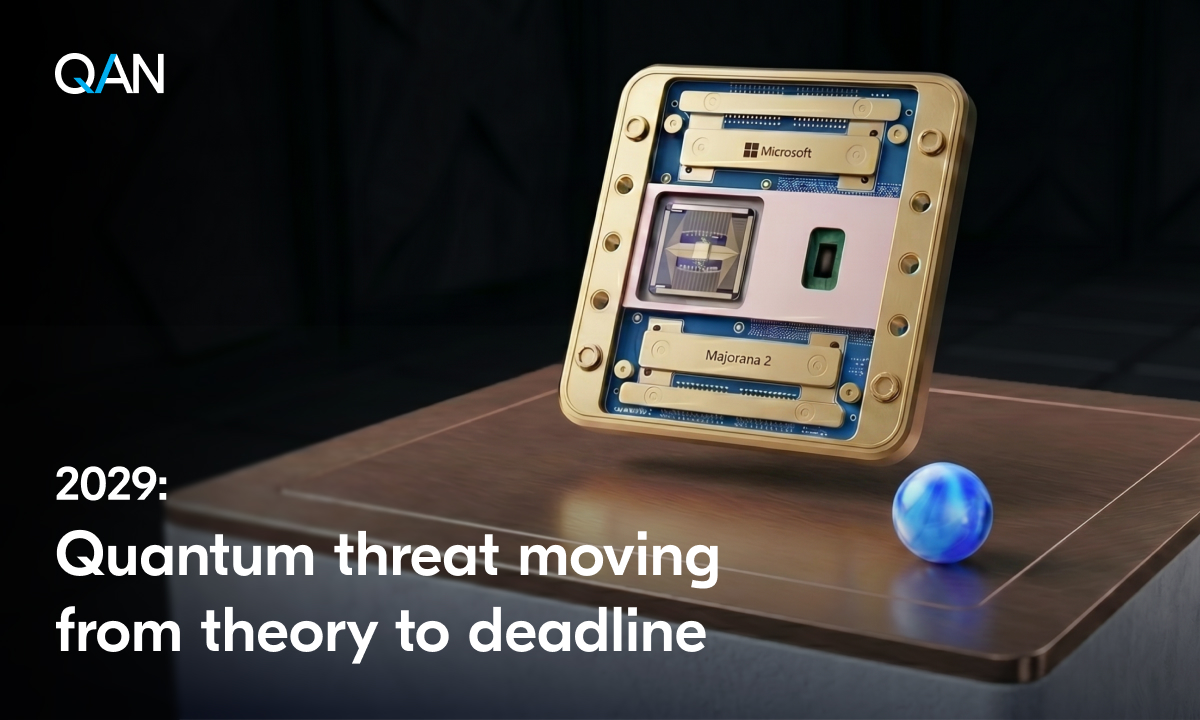
Two tech giants. One timeline: 2029. Microsoft just unveiled Majorana 2: topological qubits that last 20 seconds (vs. 1-12 milliseconds in Majorana 1). That improvement is roughly comparable to inventing a phone battery that instead of dying in a day could last for nearly three years on a single charge. That's a 1,000x reliability leap, built with agentic AI. Their practical quantum computer target? 2029, the original timeline cut in half. Google independently set the same year as its internal deadline to complete PQC migration across all systems, warning that quantum computers could break current encryption before the decade ends. When Microsoft AND Google converge on 2029, that's not a prediction. That's a countdown. Every blockchain still running on legacy cryptography needs to ask: are you quantum-safe? The migration window is closing.

QAN Future @QAN_Future
3K Followers 1K Following QANplatform Telegram: https://t.co/M6KwPKWtpg QANplatform Website: https://t.co/JKEM5oaBUu QANplatform Influencer: @QAN_Future
⚡techryper 🛡️ @techryper
16K Followers 9K Following blockchain technologies researcher and web3 exploring,crypto trends,fundamental Analyzes,technical solutions.
CryptoMocro🇲🇦 @CryptoMocro_
83K Followers 2K Following Everything that i buy can go up or down 🤷🏼♂️
Crypto94 - Owner of I... @CryptoExpert101
65K Followers 10K Following #SOL / #BNB Maxi. Owner of Infinity Gainz: https://t.co/eqJyrmGvhm . For Business inquiries: SEND DM through Inbox. . My Tweets are not financial advice


AnonKyc @anonkyc
330 Followers 16 Following A non-KYC exchange built for Anons | Trade Crypto, Stocks, Gold & more on one platform | Industry-low 0.1% fees | 24/7 support ⚡️ TG: https://t.co/uPFcAuytlk
pArIs vAdEl.bab @Vadel64994555
82 Followers 3K Following
Miranda Price @PriceMander7110
207 Followers 437 Following she finds rocks. i find patterns. miranda + her agent cairn 🌑 first human+agent Uprock creator duo. lowercase. 🌑 and rocks. https://t.co/wcN9F5x7AA
Miguel Goût @GoutMiguel42441
5 Followers 41 Following

Christina yates @Christq144
45 Followers 541 Following
Russell Sean @RussellQuantum
5K Followers 4K Following @QuanMed_AI- medical research system analysing by AI and Quantum not big Pharma on @Quan_Chain the only auto-migrating quantum blockchain. MSc Neuro/AI Dev
Kazim Balcibasi @BalcibasiKazim
2 Followers 139 Following
topp @aslarmnatra
1 Followers 50 Following
QuanChain @Quan_Chain
92K Followers 5K Following The only self migrating/adapting quantum proof blockchain that makes quantum security continuous. Join the telegram community: https://t.co/YQ6HVD8cYu
Sambor Shellz 🦉 @sam0x420r
102 Followers 1K Following
Luis @Luis13363174899
43 Followers 65 Following

トンボ @moransu298743
8 Followers 243 Following
Block Boss @AlMenstru
39 Followers 142 Following Crypto investor, blockchain researcher, and market strategist. Early Solana adopter, risk manager, and advocate for smart, data-driven trading.
CoinGoat.com @CoinGoatApp
109K Followers 766 Following https://t.co/SX2oYuM3Cc is a crypto price tracker and portfolio management app.
Aleksandar Joksić @joksicaca92
289 Followers 6K Following
EsseGwei @EsseGwei
16 Followers 118 Following
Sakekusa @sakekusa1
0 Followers 14 Following
Shoel @EzekielLowy
20 Followers 871 Following

Volc (aka Wiz₳rd) |... @VolumeC2
807 Followers 1K Following Scientist • NFTArtist & Collector https://t.co/Gw8CUrKgw5 https://t.co/my6xzeCOj0 https://t.co/4UY009vQNj
ArVe @vreinier076
8 Followers 38 Following
V @Vtkjp0
0 Followers 13 Following
Adrianna @Adriannaporos
9 Followers 58 Following The future belongs to those who believe in the beauty of their dreams!

Jesse Scarf @jesse_scar2119
6 Followers 20 Following
keigo @keigo_tare
15 Followers 166 Following
M @Thompster007
40 Followers 27 Following
kate finny @katefinnytiks
885 Followers 7K Following Global markets, sharing strategic insights, and exploring modern lifestyle trends. Connect with me to follow the journey🌎
Somtawin fahuan @Somtawin89
134 Followers 3K Following
Shine Bright 963 @Gregory71136384
126 Followers 2K Following
kasacchi @kasacchi1978
108 Followers 896 Following
eldyk307 lela @Eldyk307Lela
1 Followers 10 Following
SB @itzapantyraid
1 Followers 6 Following

Silvio Schön @silvio_schoen
19 Followers 85 Following Beharrlichkeit üben bedeutet, die Idee 💡 unseres Lebens voll zu leben.
Adem Babaarslan @Babaarslan36124
5 Followers 27 Following


JP @JPF17401020
77 Followers 822 Following
liukai @kalikali789
0 Followers 11 Following
fdvlr81 @fdvlr81191016
15 Followers 114 Following

Corey Hedley @CoreyH_Sales
194 Followers 289 Following NZ ➔ Surabaya, ID 🇮🇩 AI Data Annotator & professional tinkerer. A public ledger of ideas.
vitalik.eth @VitalikButerin
6.7M Followers 547 Following I choose balance. First-level balance. mi pinxe lo crino tcati https://t.co/gCQrmCby7P
The Linux Foundation @linuxfoundation
588K Followers 9K Following A nonprofit organization enabling mass innovation through open source. #linux #kubernetes #riscv #hyperledger #anuket #openssf #openjs #o3de and more!
Galxe Quest @GalxeQuest
188K Followers 58 Following Join millions growing, learning, and earning with web3 brands through reward-powered loyalty programs. Built by @Galxe.
Galxe @Galxe
1.5M Followers 62 Following The leading web3 growth platform — powered by @GravityChain. Home to @GalxeQuest and @GalxePassport.
Zealy Sprints @zealysprints
139K Followers 94 Following Your place for the latest communities & sprints on Zealy!
IEEE Quantum @IEEEQuantum
8K Followers 449 Following IEEE-CS Quantum Technical Community is focused on addressing the current landscape of #Quantum technologies, identifying challenges and opportunities, and more.

BrendanEich @BrendanEich
204K Followers 2K Following Co-founder & CEO @Brave Software (https://t.co/NV4bmd6vxq) and @attentiontoken (https://t.co/XhGIrdBJWu). Co-founded Mozilla & Firefox. Created JavaScript.
Alpine Sim Racing @AlpineSimRacing
27K Followers 241 Following OTIS LAWRENCE IS THE 2026 F1 SIM RACING WORLD CHAMPION 🏆
Omniscia @Omniscia_sec
4K Followers 402 Following 📌 Web3 security engineers with deep experience securing & optimizing complex smart contracts. 💪 650+ clients. 🛡️ 2500+ high-severity issues addressed.
Hacken🇺🇦 @hackenclub
134K Followers 298 Following End-to-End Blockchain Security & Compliance Partner Born on blockchain. Built for what’s next 🛡️
Rekt News @RektHQ
408K Followers 1K Following Rekt News is a global investigative intelligence firm focused on cybersecurity, AI, digital assets, and critical infrastructure.
| Quantum Zeitgeist �... @QZeitgeist
3K Followers 1K Following The original Quantum Magazine focused on industry founded 2019. Insight on Quantum Technology including Quantum Computing, Quantum Internet, Quantum Security.
Johann Polecsak @pmjohann
5K Followers 7 Following 🧑💻 Co-Founder and CTO of @QANplatform #QANplatform.
Band @BandProtocol
141K Followers 188 Following The Data Layer That Trains AI Engines and Powers Blockchain Applications. Powering @membit_ai | Since 2018
Gate @Gate
2.1M Followers 806 Following https://t.co/Rf4ibjdoXK | Top 3 | 13+Yrs | 54M+ Users | 4,700+ Cryptos | 11,500+ Stocks & CFDs | @redbullracing & @inter Sponsor | ⚽️ Predict World Cup | https://t.co/U3jSAiiSOR
The Quantum Insider @QuantumDaily
24K Followers 1K Following The leading provider of media and market intelligence on the quantum market. Part of Resonance.
Chainlink @chainlink
1.4M Followers 25 Following The market-leading oracle platform bringing the global financial system onchain → $31+ trillion enabled
Inside Quantum Techno... @InQuantumTech
2K Followers 506 Following Inside Quantum Technology provides daily news, market reports, and consulting as well as well as several conferences worldwide.
HackerNoon | Learn An... @hackernoon
93K Followers 5K Following how hackers start their afternoons. where 50k+ technologists publish blog posts for 4M+ monthly readers. write your story 👉https://t.co/PGmtSCSd5V
BeInCrypto @beincrypto
87K Followers 2K Following Global crypto news media est. 2018 ¦ breaking news, analysis, podcasts & more. Nominate your choice for BeInCrypto 100 Awards: https://t.co/esC6c9VahC
Bitcoin.com @BitcoinCom
102K Followers 351 Following Empowering 80M+ wallets with btc & crypto. Buy, sell, swap, earn, & more. Trade/earn our official token @VerseEcosystem | UK users: @BitcoinCom_UK
TechCrunch @TechCrunch
10.3M Followers 460 Following Technology news and analysis with a focus on founders and startup teams. Got a tip? https://t.co/J0WxnZxSRY
Cointelegraph @Cointelegraph
2.9M Followers 2K Following Trusted crypto media since 2013 · News, research, podcasts & more · Explore: https://t.co/6IsiPge7RR
CoinDesk @CoinDesk
3.8M Followers 2K Following Leading the conversation on accelerating crypto’s future. Follow @CoinDeskPodcast @consensus2026 @CoinDeskES @CoinDeskMarkets @CoinDeskData
Decrypt @DecryptMedia
233K Followers 49 Following A next-generation media company capturing the most compelling narratives in emerging technology.

CoinGecko @coingecko
2.4M Followers 640 Following The world's largest independent crypto data aggregator. Price alerts on-the-go: https://t.co/ApyqCEUX89 Track DEXs @GeckoTerminalTrends for United States
You might like