Random Variable @Random190398
Sample Space Joined September 2025-
Tweets41
-
Followers5
-
Following119
-
Likes13
I took a Jacobi Theta divisor, Θ(z,t) = ∏ⱼ θ₁(z - cⱼ(t) | τ(t)), and let it breathe across a torus, with the small spheres marking its moving zeros... the precise points where Θ(z,t) vanishes.
一般化した方が応用先が広がるけど、過度に一般化すると言語を理解しずらいものになるので、程度を見極めるのが大事なんじゃないかと思った
A Neural Sheet Discovers the Shape of Data A self-organizing map (SOM) starts as a flat sheet of neurons with no knowledge of the data around it. For every input sample, it finds the best-matching neuron, c = argminᵢ ‖x - wᵢ‖, and updates that neuron together with its neighbours, wᵢ ← wᵢ + η(t)hᶜᵢ(t)(x - wᵢ). As the neighbourhood radius shrinks during training, the sheet gradually bends and folds onto the hidden geometry of the dataset while preserving its neighbourhood structure. Developed by Finnish computer scientist Teuvo Kohonen, the Self-Organizing Map remains one of the most elegant examples of competitive learning, where order emerges from thousands of simple local updates. #MachineLearning #ArtificialIntelligence #SelfOrganizingMap #NeuralNetworks #DataVisualization #Mathematics #ComputerScience #Finland #TeuvoKohonen
A gas in a box contains an enormous amount of microscopic information. If q represents the positions of all particles and p their momenta, the complete state is one point (q, p) is in a 6N-dimensional phase space! The genius of Statistical Mechanics is that it sidesteps this impossible description by working with the probability density ρ(q, p, t) instead.

Statistics as a field has not historically oriented itself around formalized open problems. Part of the reason is that the hardest problems in the field are ones of formalizing what the problem even is. Once you formalize a problem, much of the work may be done. Of course, there are counter examples, but, if I were to cast statistics as an AI problem, I think the bulk of (impactful) statistics is closer to auto-formalization than to theorem proving.

The martingale central limit theorem (CLT) extends the classical CLT to sequences of dependent random variables that form a martingale difference array. It shows that, under suitable conditional variance and moment conditions, normalized sums of such dependent terms still converge to a normal distribution. In probability, the martingale CLT is a cornerstone for studying stochastic processes, random algorithms, and limit behavior in dependent settings. In machine learning, it justifies asymptotic normality of stochastic gradient descent, online learning, and adaptive algorithms where data dependence is unavoidable. In real life, the martingale CLT supports inference in finance, queueing systems, network traffic, and control systems, allowing reliable uncertainty quantification even when observations evolve over time and influence future outcomes.


AIの進化により、将来的には「役に立つから学ぶ」という時代は終わるかもしれません。 それでも、人類が学びや思考を捨ててしまったらおしまいです。 だからこそ、学び、考え、試し、活かすことそのものを楽しむ、知的スポーツのような場が、これまで以上に重要になると思っています。
The Chinese Physicist Who Turned Force Into Geometry In 1954, Chinese physicist Chen-Ning Yang, together with Robert Mills, introduced a new idea that changed modern physics: Maybe a force is not just something that pushes or pulls. Maybe a force can come from geometry. In Yang-Mills Theory, every point in space carries a hidden internal direction. As you move through space, that direction can twist. If you go around a closed loop and the direction does not return exactly the same, the field has curvature. That curvature is what we see as force. In this animation, the glowing surface shows where the gauge field is strongest. The changing colours show how the hidden internal direction varies across space. The moving rectangular loops are Wilson loops. They travel through the field and measure how much the internal direction changes after completing a closed path. The key equation behind the scene is Fₓᵧ = ∂ₓAᵧ - ∂ᵧAₓ + Aₓ × Aᵧ. The final term, Aₓ × Aᵧ, is the special part. It means the field can interact with itself. That self-interaction is one reason Yang-Mills theory became one of the foundations of particle physics. #China #ChinesePhysics #YangMills #GaugeTheory #QuantumFieldTheory #NonAbelianGeometry #WilsonLoops #ModernPhysics #STEM
Offline Reinforcement Learning is a rapidly growing area of AI that studies how agents can learn optimal decision-making policies from previously collected data without further interaction with the environment. Unlike classical reinforcement learning, where an agent continuously explores and gathers new experiences, offline RL relies entirely on a static dataset of state-action-reward transitions. This setting is particularly important when exploration is expensive, risky, or impossible. Examples include healthcare, autonomous driving, robotics, finance, and recommendation systems, where poor exploratory actions may have serious consequences. In machine learning, offline RL combines ideas from supervised learning, sequential decision-making, and distributional estimation. In deep learning, large neural networks are used to learn value functions and policies from massive datasets. Modern algorithms such as Conservative Q-Learning (CQL) and Implicit Q-Learning (IQL) address the challenge of distributional shift, where the learned policy may choose actions rarely observed in the training data. Offline RL is also becoming a foundation for data-driven AI systems trained from large historical datasets. The deeper insight is that intelligence can often be learned from experience that has already been collected. By transforming static data into sequential decision-making strategies, offline reinforcement learning bridges the gap between prediction and autonomous decision-making. Image: share.google/cihGY5rV502UcF…

Information Bottleneck Theory is a powerful framework introduced by Naftali Tishby for understanding learning and representation in intelligent systems. The central idea is that a good representation should compress the input while preserving information relevant to the prediction task. Formally, the objective balances two quantities: maximizing information about the target Y while minimizing unnecessary information about the input X. A typical objective is: I(T;Y) − βI(T;X) where T is the learned representation and I(·;·) denotes mutual information. In statistics and machine learning, the information bottleneck provides a principled approach to feature extraction, dimensionality reduction, and prediction. In deep learning, it offers a theoretical perspective on why hidden layers learn compressed representations that retain task-relevant information while discarding noise. It has influenced research on generalization, representation learning, self-supervised learning, and neural network interpretability. In reinforcement learning, information bottleneck methods are used to learn compact state representations, improve exploration, and reduce sample complexity. The broader insight is that intelligence is not merely about storing information—it is about retaining the right information. By balancing compression and prediction, the information bottleneck provides a unifying principle connecting information theory, learning, and decision-making. Image: share.google/icpdTVCg7DegzS…

Geometric Deep Learning is an emerging paradigm in machine learning that extends deep learning methods to non-Euclidean domains such as graphs, manifolds, and meshes. Unlike traditional Euclidean-based models, GDL exploits symmetry, invariance, and equivariance principles to design architectures that respect the underlying structure of data. At its core, it generalizes convolution and representation learning beyond regular grids to irregular and structured domains. In machine learning applications, GDL is widely used through graph neural networks for problems like social network analysis, recommendation systems, and molecular property prediction in chemistry and drug discovery. In deep learning, it enables advances in 3D vision, point cloud processing, and graph-based transformers, while also unifying convolutional neural networks as a special case of geometric operators on lattices. This leads to better inductive biases, improved sample efficiency, and stronger generalization on structured data. In reinforcement learning, Reinforcement Learning, geometric methods help model multi-agent systems, traffic networks, and relational environments where states and interactions are naturally graph-structured. This supports better coordination, planning, and transfer across agents and environments. Overall, geometric deep learning provides a unifying framework linking ML, DL, and RL by embedding geometry and symmetry into learning systems, enabling more structured, efficient, and generalizable intelligence. Image: share.google/CPaCdmSG0vBrZQ…

Wasserstein Learning Theory is a rapidly growing area of machine learning that uses ideas from optimal transport to analyze probability distributions, generalization, and learning dynamics. At its core is the Wasserstein distance, which measures the minimum cost of transporting one probability distribution into another. Unlike divergences such as KL divergence, Wasserstein distances incorporate the geometry of the underlying space, making them particularly suitable for comparing complex distributions. In probability and statistics, Wasserstein metrics are used to study convergence of distributions, concentration inequalities, empirical processes, and distributional robustness. In machine learning, they provide powerful tools for domain adaptation, distribution shift analysis, generative modeling, and robust optimization. The success of Wasserstein GANs demonstrated how transport-based objectives can stabilize training and improve sample quality. In deep learning, Wasserstein methods help analyze representation learning, neural network dynamics, and generalization under distributional changes. In reinforcement learning, Wasserstein distances are widely used in distributional RL, where agents learn entire return distributions rather than only expected rewards. They also appear in robust RL and exploration under uncertainty. The deeper insight is that learning often involves comparing distributions rather than individual observations. By incorporating geometry into probability, Wasserstein learning theory provides a principled framework for understanding robustness, generalization, and adaptation in modern AI systems. share.google/5G5OG3I8eHS0aV…

Kernel Mean Embeddings are a powerful framework that represents probability distributions as elements of a reproducing kernel Hilbert space (RKHS). Instead of working directly with probability densities, a distribution P is mapped to a feature representation μₚ = E[k(X, ·)] where k is a kernel function. This allows complex distributions to be analyzed using geometric and functional-analytic tools. In probability and statistics, kernel mean embeddings provide nonparametric methods for comparing distributions, hypothesis testing, density estimation, and causal inference. They form the basis of powerful techniques such as Maximum Mean Discrepancy (MMD), which is widely used for two-sample testing. In machine learning, kernel mean embeddings enable learning directly on distributions rather than individual data points. They are used in domain adaptation, generative modeling, distribution regression, and uncertainty quantification. In deep learning, MMD and related kernel methods appear in generative adversarial learning, representation learning, and self-supervised learning. In reinforcement learning, kernel embeddings help model transition dynamics, value functions, and belief states in partially observed environments. The deeper insight is that many learning problems involve distributions rather than individual observations. Kernel mean embeddings provide a mathematically elegant way to transform probability distributions into geometric objects that can be manipulated, compared, and learned efficiently. Image: share.google/pfstLtTYOGn7da…

weak derivative もdivergence もadjoint みたいなものとして解釈すると親近感が湧いた
The Plancherel transform extends the Fourier transform into a powerful isometry between function spaces, stating that the L² norm of a function is exactly preserved under transformation to the frequency domain. While Parseval’s identity gives this result for simple Fourier series, the Plancherel theorem formalizes it for general square-integrable functions and underlies harmonic analysis. In probability, it allows characteristic functions and spectral densities to be analyzed without loss of energy, making it central to limit theorems and the study of stationary processes. In statistics, it supports spectral estimation, deconvolution, and efficient computation of likelihoods in the frequency domain. In machine learning, the Plancherel transform justifies learning in transformed feature spaces, where distances and inner products remain unchanged, which is crucial for kernel methods and signal-based models. In deep learning, it helps analyze convolutional architectures and frequency bias, revealing how neural networks distribute information across scales.

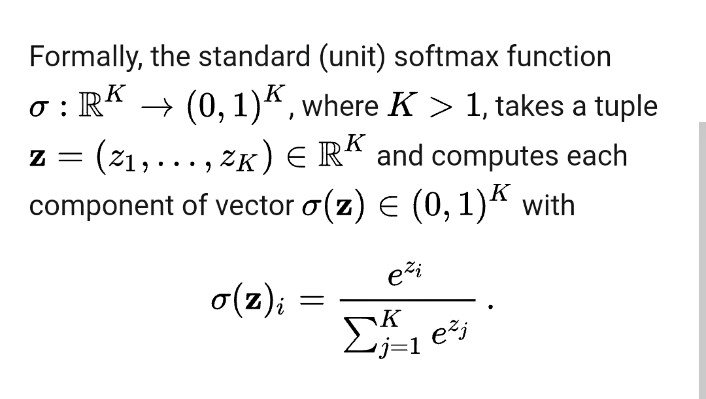
The softmax activation function transforms a vector of real numbers into a probability distribution by exponentiating and normalizing its components so they sum to one. In probability theory, it corresponds to the multinomial logistic model, turning arbitrary scores into valid probabilities for categorical outcomes. In statistics, softmax underlies logistic and multinomial regression, where it models the likelihood of each class given predictors. In machine learning, softmax is the standard output layer for classification networks, enabling models to express uncertainty and be trained via cross-entropy loss, which has a clear probabilistic interpretation as maximum likelihood estimation. In deep learning, softmax is crucial for tasks such as image recognition, language modeling, and attention mechanisms, where it converts raw network outputs into interpretable probabilities over words, labels, or features. In real-world systems, from recommendation engines to speech recognition, softmax allows models to make calibrated, probabilistic decisions. By linking linear scores to probabilities, softmax forms a bridge between geometry, statistics, and learning.
Fourier inversion is a fundamental principle stating that a function or signal can be exactly reconstructed from its Fourier transform, meaning that no information is lost when moving between the time or space domain and the frequency domain. In probability theory, this underlies the use of characteristic functions: a probability distribution can be recovered from its characteristic function via Fourier inversion, enabling proofs of limit theorems and distributional identities. In statistics, it powers density estimation, deconvolution, and spectral methods for analyzing time series and noisy data. In machine learning, Fourier inversion supports kernel methods, random feature models, and signal representations, where learning is often easier in frequency space than in raw coordinates. In deep learning, it helps explain convolutional networks, spectral regularization, and the behavior of neural networks on high-frequency versus low-frequency patterns. Across science and engineering, Fourier inversion allows hidden structure to be revealed and reconstructed, making it a cornerstone of modern data analysis and learning.

Stochastic gradient descent (SGD) is a fast, noisy version of gradient descent that updates model parameters using small random subsets of data instead of the full dataset. This randomness makes each step cheaper and allows learning to scale to massive problems. In probability theory, SGD can be viewed as a stochastic process that approximates solutions to optimization problems, and its behavior is analyzed using martingales and diffusion limits. In machine learning, SGD is the workhorse behind training deep neural networks, recommendation systems, and large language models, enabling them to learn from billions of examples. In real life, SGD reflects how people and organizations learn: making decisions based on limited, noisy feedback and gradually improving over time, showing how randomness and iteration can drive efficient adaptation.

Deep neural networks are computational models made of many layers of interconnected units that learn complex patterns from data. Each layer transforms its input into more abstract representations, allowing the network to model highly nonlinear relationships. In probability, deep nets are used to approximate probability distributions, likelihoods, and conditional dependencies, forming the backbone of modern generative models such as variational autoencoders and diffusion models. In machine learning, they power vision, speech recognition, language models, and recommendation systems by learning directly from massive datasets. In real life, deep nets drive technologies behind self-driving cars, medical imaging, fraud detection, and personal assistants, enabling machines to perceive, reason, and make decisions in ways that increasingly resemble human intelligence. Image: share.google/4AqLUmF617BjoG…

The Riesz representation theorem is a foundational result in functional analysis that shows how every continuous linear functional on a suitable space of functions can be represented as an integral against a measure or inner product. In probability theory, this links random variables, expectations, and measures in a rigorous way, explaining why expectations can always be written as integrals with respect to probability distributions. In machine learning, the theorem underlies kernel methods and reproducing kernel Hilbert spaces, where evaluation and learning are represented through inner products, enabling algorithms like support vector machines and Gaussian processes. In real life, Riesz representation supports signal processing, physics, and data analysis by providing a universal way to turn abstract linear measurements into concrete, interpretable quantities.

Mathelirium @mathelirium
39K Followers 18K Following applied maths & stats, comp physics, & scientific visualizations. Want great visuals for your ML, Math, Physics paper or presentation? DM me for more details.
今泉研究室(東... @imalab_org
2K Followers 2K Following 東京大学 先進科学研究機構 今泉研究室 / 理化学研究所 AIPセンター 今泉チームのアカウントです。 数理統計・機械学習・深層学習の理論研究を進めています。 東大・今泉研究室: https://t.co/fzSsXdgNmd 理研・今泉チーム: https://t.co/AKdBLfBBys
Ydauijea @Ydauijea593
28 Followers 336 Following
リリカのような... @like_lyrica
120 Followers 363 Following
Paavo ✈️ ICML @PaavoParmas
205 Followers 475 Following RL, LLM post-training, MBRL. Assistant Professor at @UTokyo_News. エストニア人. Prev: @Cambridge_Uni, @OISTedu, @GoogleDeepMind intern, @RIKEN_AIP intern

今井翔太 / Shota ... @ImAI_Eruel
112K Followers 972 Following 人工知能の研究者 / JAIST客員教授 / 東京大学松尾研で博士(工学)/ GenesisAI代表取締役社長CEO / 国家戦略特区アドバイザー / 東京大学150人委員会 委員/著書:ベストセラー『生成AIで世界はこう変わる』など
Yuandong Tian @tydsh
46K Followers 950 Following Co-founder of @Recursive_SI. ex-Meta FAIR Director. ex-Google. Reasoning, Optimization and Understanding LLM. Novelist in spare time. PhD in @CMU_Robotics.
Yuzo Maruyama @umaruyama
4K Followers 761 Following 神戸大学 経営学部→千葉大学 理学部 数学・情報数理学科 統計学者 丸山祐造 Editor-in-Chief, Japanese Journal of Statistics and Data Science
KoichiroKOKUBUN國分... @lethal_notion
72K Followers 560 Following Philosophy prof, Tokyo Univ., Komaba Campus, Japan/Philosophic Picture Essay/Spinoza, Deleuze 東京大学駒場哲学教員/映像による哲学の試み/スピノザ、ドゥルーズ、著書『中動態の世界』『暇と退屈の倫理学』
Adam Tauman Kalai @adamfungi
3K Followers 88 Following
Geoffrey Irving @geoffreyirving
13K Followers 355 Following Cofounder and Chief Scientist at Resolution. Alignment will be solved, but not necessarily in time. Previously AISI, DeepMind, OpenAI, Google Brain, etc.
square1001 🍎 @square10011
3K Followers 160 Following 競技プログラミングを中心に活動している square1001 です。東京大学の修士 2 年です。 2025/9/4: ICPC 2025 世界大会 準優勝 🥈 (東京大学 Screenwalkers)
E869120 @e869120
17K Followers 495 Following 国際情報オリンピック金メダル/大学対抗プログラミングコンテスト (ICPC) '25 世界 2 位/東京大学修士 2 年/著書『アルゴリズム×数学』等累計 10 万部突破
Anupam Gupta @anupamg
2K Followers 191 Following Professor, Computer Science, New York University. Also at: @[email protected] @anupamg.bsky.social
Victor Reis @vetohaze
661 Followers 138 Following Senior researcher @MSFTResearch. Previously postdoc @the_IAS, PhD @uwcse
Neel Nanda @NeelNanda5
43K Followers 122 Following Mechanistic Interpretability lead DeepMind. Formerly @AnthropicAI, independent. In this to reduce AI X-risk. Neural networks can be understood, let's go do it!
Jeremy Bernstein @jxbz
8K Followers 704 Following 🧪 @thinkymachines ✍️ anon feedback @ https://t.co/RIhBhjMRdD
Keller Jordan @kellerjordan0
18K Followers 449 Following CIFAR-10 fanatic Pretraining @OpenAI OpCo LLC.
Jiwei Liu @JiweiLiu
685 Followers 225 Following Agent Research Engineer @nvidia 3x Kaggle Grandmaster https://t.co/h6rv4mGxbF
Jun Otsuka @junotk_jp
6K Followers 101 Following 自然哲学者。進化論の哲学、統計学/機械学習の哲学。著書:『統計学を哲学する』(名古屋大学出版会)など。The author of Thinking About Statistics (Routledge), The Role of Mathematics in Evolutionary Theory (CUP).
Hiroki Naganuma @_Hiroki11x
1K Followers 956 Following PhD @Mila_Quebec / @UMontreal → @NVIDIA · large-scale optimization, efficient training, generalization · prev @AIatMeta @GoogleDeepMind @MSFTResearch
Akari Asai @AkariAsai
23K Followers 943 Following Incoming Assistant Professor @SCSatCMU (Hiring Ph.D. students for Fall 2026) & research scientist @allen_ai OLMo. akariasai @ 🦋
Sham Kakade @ShamKakade6
19K Followers 586 Following Harvard Professor. Full stack ML and AI. Co-director of the Kempner Institute for the Study of Artificial and Natural Intelligence.
Math Cafe @Riazi_Cafe_en
54K Followers 113 Following The goal of this account is to encourage mathematical thinking.
John Jumper @JohnJumperSci
32K Followers 0 Following
Samira Khan @samiramanabi
6K Followers 674 Following Gemini @GoogleDeepMind, ex-professor @CS_UVA, ex-@CarnegieMellon. Vanity is not my fav sin, self-deprecation is.
Sanjeev Arora @prfsanjeevarora
28K Followers 127 Following Director, @PrincetonPLI and Professor @PrincetonCS. Seeks math/conceptual understanding of deep learning and large AI models. Also on the "other" social network
Timothy Gowers @wtgow... @wtgowers
58K Followers 189 Following Mathematician. Professeur titulaire de la chaire Combinatoire au Collège de France. Also fellow of Trinity College Cambridge.
Lilian Weng @lilianweng
281K Followers 190 Following Co-founder of Thinking Machines Lab @thinkymachines; Ex-VP, AI Safety & robotics, applied research @OpenAI; Author of Lil'Log
Financial Times @FT
7.0M Followers 1K Following Big stories and breaking news as they are published on https://t.co/EYmAcRLBHv. Register here to access free articles: https://t.co/NRg2hritkA
Learning Theory Allia... @let4all
2K Followers 36 Following Together we will build the future of the machine learning theory research community!
Lance Fortnow @fortnow
6K Followers 383 Following Professor. Complexity Theorist @iitcomputing @[email protected] @lance.fortnow.com
Gautam Kamath @thegautamkamath
66K Followers 628 Following Assistant Prof of CS @UWaterloo, Faculty @VectorInst, Canada @CIFAR_News AI Chair. Joining @NYU_Courant Fall 2026. Co-EiC @TmlrOrg. I lead @TheSalonML.
DeepLearning.AI @DeepLearningAI
343K Followers 114 Following We are an education technology company with the mission to grow and connect the global AI community.
Behnam Neyshabur @bneyshabur
44K Followers 1K Following Co-Founder & CEO @mirendil 💼 Past: co-led Discovery team @AnthropicAI & Blueshift team @GoogleDeepMind 🎒Traveling & Backpacking
Anthropic @AnthropicAI
1.6M Followers 2 Following We're an AI safety and research company that builds reliable, interpretable, and steerable AI systems. Talk to our AI assistant @claudeai on https://t.co/FhDI3KQh0n.
Andrew Ng @AndrewYNg
1.8M Followers 1K Following Co-Founder of Coursera; Stanford CS adjunct faculty. Former head of Baidu AI Group/Google Brain. #ai #machinelearning, #deeplearning #MOOCs
Weijie Su @weijie444
14K Followers 503 Following Researcher @OpenAI, Professor @Wharton, CS, Math @Penn, coDir PRiML, PhD @Stanford
春茶 STAFF @harutyaofficial
7K Followers 5 Following 春茶(@HARUTYA1226)インフォをお届けします ◼ 06.03 Major 1st Single Release ◼ 09.12 FCライブ-ROOM-開催 お仕事のご依頼・お問い合わせ▼ [email protected]
優子鈴(ゆこり... @_yukoring
197K Followers 407 Following 銀座三越個展4/29-5/11◆画家 イラストレーター*フランスARCHES® アンバサダー&丸善美術アンバサダー●透明水彩●商業画集、技法書発売中⚫︎NHKカルチャーオンライン講座/絵師100人展13~16⚫︎お仕事:[email protected]

Yann LeCun @ylecun
1.3M Followers 788 Following Professor at NYU & Executive Chairman at AMI Labs. Ex-Chief AI Scientist at Meta. Researcher in AI, Machine Learning, Robotics, etc. ACM Turing Award Laureate.

数学セミナー @sugaku_seminar
5K Followers 236 Following 雑誌『数学セミナー』(日本評論社)にまつわる告知と、ほんの少しの日常をゆるふわにお届けするアカウントです。 (アイコンは前川淳さんによる「折紙評論社」のマークです(『折る幾何学』より)) (雑誌等で関わりのある方を中心にフォローしていきます)
Ariel @ArielKwiat
6K Followers 292 Following p/hd | Big RL energy | RS @ fruit company (not speaking for the company though) | Prev. {Meta FAIR; Gym(nasium)} | Glory to Mankind
No Context Brits @NoContextBrits
1.8M Followers 0 Following A “mordant celebration of British mediocrity” according to the Washington Post. Contains sarcasm, irony and context. Blocked by John Cleese.
松尾 豊 @ymatsuo
111K Followers 1K Following 東京大学で人工知能の研究をしています。東京大学大学院 工学系研究科 技術経営戦略学専攻 教授。内閣府AI戦略専門調査会座長、日本成長戦略会議構成員、国連AI科学パネル委員、日本ディープラーニング協会理事長、ソフトバンクグループ社外取締役、パナソニックHD社外取締役、東京都AI戦略会議座長。専門は人工知能/深層学習
Kempner Institute at ... @KempnerInst
4K Followers 360 Following The Kempner Institute for the Study of Natural and Artificial Intelligence at @Harvard University. RTs ≠ Endorsements
Zhuoran Yang @zhuoran_yang
3K Followers 1K Following Assistant Professor of Statistics and Data Science @Yale | Blogs from my research group: https://t.co/NxQU752ff2
You might like