𝕽𝖊𝖋𝖔𝖗𝖒𝖊𝖉 𝕽𝖊𝖙𝖗𝖎𝖊𝖛𝖆𝖑 🕊️ @RefRetrieval
Recovering the Reformed Tradition. youtube.com/@reformedretri… Joined November 2023-
Tweets19K
-
Followers3K
-
Following285
-
Likes12K
@Duke456521 @_DHDS Because I can provide proof of how the reformed understood it.
If the ordination of all events is such an ordination that doesn’t make God the author of sin, then it must be a permissive decree regarding sin. All of the non-modern reformed authors I’ve read understand this. What Calvinists on X think is irrelevant unless they provide proof against it. I have scores of quotes of Reformed authors understanding a permissive decree regarding sin because that’s the way it has always been intended and understood. WCF 3.1 literally tells you this by the qualification “yet so, as thereby…” That qualification then naturally means God ordained to permit sin, not to effect it. Quotes are helpful because it shows what the Reformed actually said and they were much deeper thinkers and more reliable sources than the average TulipBro on X and the quotes usually address specific points in much better depth than a comment on X.

A problem these anti-calvinists have is that they often impose their own definitions onto our terms. The intro to the Minutes of Westminster quotes Crawford as being representative of the Westminster Assembly regarding the term “decree” and how it’s understood in WCF 3.1.

God’s Eternal Decree Made Simple!
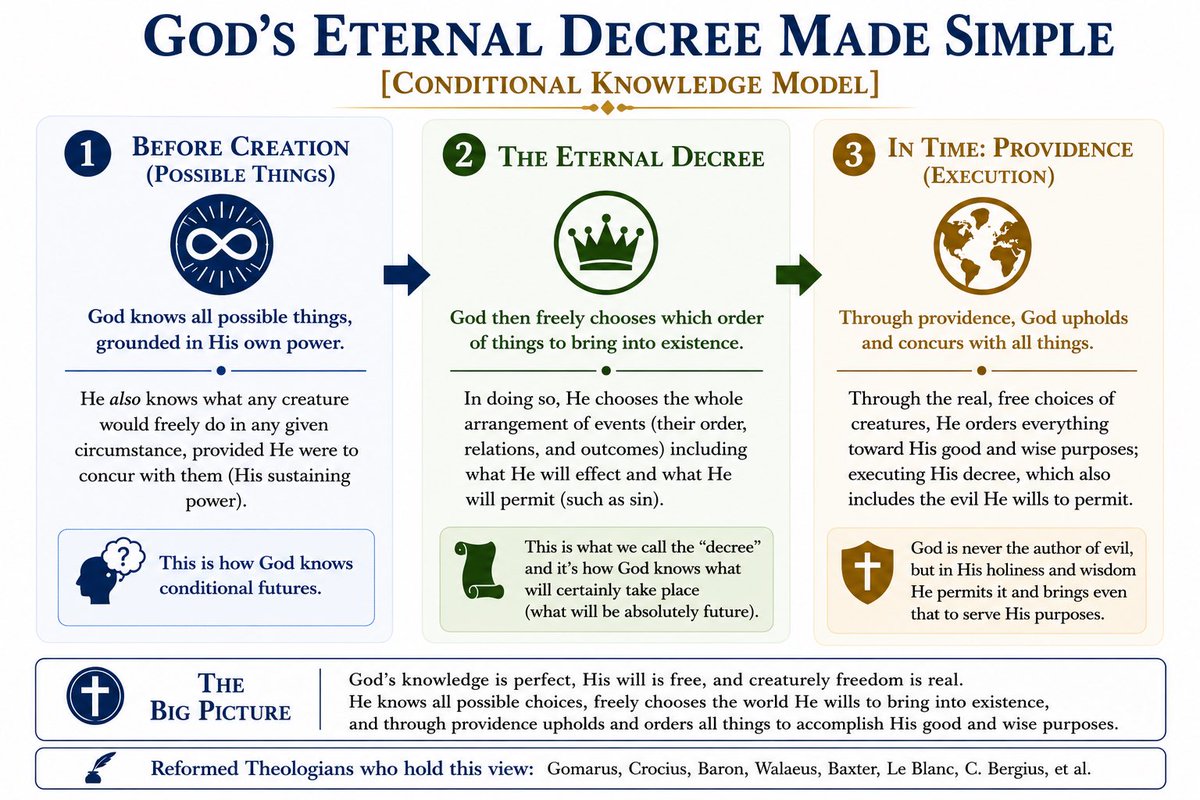
I gave a fairly straightforward explanation. It’s as simple as simple as can be. The quotes are much more helpful. This one in particular (OP) actually already answered your question. I assume the problem is that you’re not familiar with the debate about premotion/predetermination.
Suárez responding to the objection that conditioned future free acts are foreknown apart from God’s decree, arguing that they presuppose God’s permissive or concurring decree, but not an efficacious predetermining decree of the created will. “Second, one must consider that God’s free decree, taken generally, is often confused with his efficaciously predefining or predetermining decree. And because we say that God foreknows futures before a predetermining decree, or that they can be future without such a decree, it is immediately inferred — or attributed to us — that we assert that conditioned futures are foreknown independently of the decree of God’s will. But this is not a good inference, because it argues negatively from a particular to a universal. The defect can easily be detected. For sin is foreknown as future not only before a predetermining decree, or before a decree absolutely predefining — or, what is the same, predestining — even the act of the sin itself. It is also foreknown as future without such a decree. Nevertheless, it will not be future without some decree of God’s will, according to Augustine’s statement in the Enchiridion, chapter 95: “Nothing happens unless the Omnipotent wills it to happen, either by permitting it to happen or by himself doing it” (St. Augustine, Enchiridion 95). Therefore, to know conditioned futures, it is necessary that some decree of God be placed in the condition itself. Yet it need not be so absolute that it predetermines the created will. For the necessity of such a decree would be repugnant to the freedom of the created will with respect to the free use of other acts, or with respect to free omission — or, what amounts to the same thing, with respect to freedom and specification. And, with respect to the same future act by force of such a decree, it would be repugnant to freedom with respect to exercise; nor would it be foreknown as contingent, but as necessarily consequent upon an antecedent supposition. Besides this, there follows the absurdity concerning sins: that in a similar decree they would be foreknown as future, at least with respect to the very acts from which malice is inseparable. How great this absurdity is has often been emphasized by us, and it will be repeated a thousand times and treated very broadly in the course of this work, because the matter is of the highest importance and brings great light to this subject.” —Francisco Suárez, On Grace, or On God the Savior, Justifier, and Helper of Free Will Through His Grace.


Idk what that razor thing is. A decree to predetermine is a decree to determine the created will to elicit that particular act. “If I decree to determine this will to choose X, it will choose X.” A hypothetical decree is the supposition that God wills to concur with the act, not determine the will. “If I decree to concur with this person under these conditions, he will choose X.” Both sides agree that some divine decree is presupposed in the hypothesis of conditional futures. The disagreement is what kind of decree is included. The Dominican says the hypothesis includes a decree of predetermining premotion while Suárez says it includes only a decree of concurrence and not one determining the will.
@_DHDS It still presupposes a hypothetical decree to concur and there is no futurity apart from a decree.
@_DHDS “Without such a decree” is referring to a decree of predetermination of a particular act.
“We concede the equivalence which is made there between things future absolutely and things future under a condition, as far as this point goes: just as nothing is absolutely future unless God either wills it to be done or wills to permit it to be done, so in conditionals nothing is future from the hypothesis unless God either would will it to be done or would will to permit it to be done.” —Francisco Suárez, On Grace, or On God the Savior, Justifier, and Helper of Free Will Through His Grace.


Suárez responding to the objection that God’s foreknowledge of conditional future free acts requires a prior predetermining decree, arguing instead that God’s knowledge of simple intelligence presupposes only His simultaneous concurrence, not a predetermining motion of the will. “First, then, one must observe that many arguments of this sort proceed from this: that they do not distinguish between God’s decree as preceding, according to the order of reason, in God himself, and God’s decree as objectively included in the hypothesis of the conditioned future event. Yet these things are different, both as was touched upon above and as is manifest in itself. For God, through the knowledge of simple intelligence, which precedes every free decree, knows that if fire is applied to wood, it will heat it. Yet in that hypothesis God’s decree willing to concur is necessarily included, because without it such an effect could not follow, even with the condition posited. Therefore, this is included in the hypothesis: “If fire is applied, and God does not suspend his concurrence…” This is not expressed because it is presupposed as included from a kind of natural debt. And in free works, even works of grace, God foreknows by the same knowledge that if such a man has such an inspiration, with such or such a motion, at such a time, he will consent. For knowledge precedes every free decree in God himself. Nevertheless, it does not exclude a free decree according to the mode of the possible, and as included in the object. On this point, under these words, even the adversaries must agree, since such foreknowledge is necessary so that God can will and choose the efficacious means of predestination. But the difference lies in the mode of the decree or motion. The adversaries wish that, in that hypothesis, there must be included a motion predetermining the created will, or this conditional: “If I efficaciously will this will to consent, and from this will call it,” and so on. But we say that such a decree, included in that condition in this way, is not necessary. Rather, a decree of concurring simultaneously after such a vocation is sufficient, so that the sense of the conditional is this: “If I give this person such an inspiration or vocation, and will to offer him my concurrence, or concomitant aid, such an act will follow.” From this it follows that such an act is never known as future under a condition without some free decree of God, even if, according to our mode of knowing and speaking, such foreknowledge is prior in God to the quasi-eliciting of such a free decree of God.” —Francisco Suárez, On Grace, or On God the Savior, Justifier, and Helper of Free Will Through His Grace.


@rootcausesleuth x.com/refretrieval/s…
“…after the fall there remained in the intellect of man not only the light of natural wisdom for understanding the things of this life, but also certain little sparks, as it were, of the knowledge and notice of God the Creator, which the holy Apostle, in Romans 1:19, 20, says

@rootcausesleuth x.com/refretrieval/s…
Reformed professor Paul Testard teaches that the “blindness” of fallen man does not mean the destruction of the natural faculties of intellect, reason, or conscience, nor an utter absence of all knowledge of God and the good. Fallen man still retains the natural power of

@AngAesthetics @logos_asarkos Have you read Le Blanc’s view on foreknowledge? There’s guys like him and others (Gomarus, Crocius et al.) who posited knowledge of hypothetical conditionals as part of God’s natural knowledge. youtu.be/kqSYYJCtzCc?is… youtu.be/kqSYYJCtzCc?is…
@GeoChonker x.com/ozmarquezz/sta…
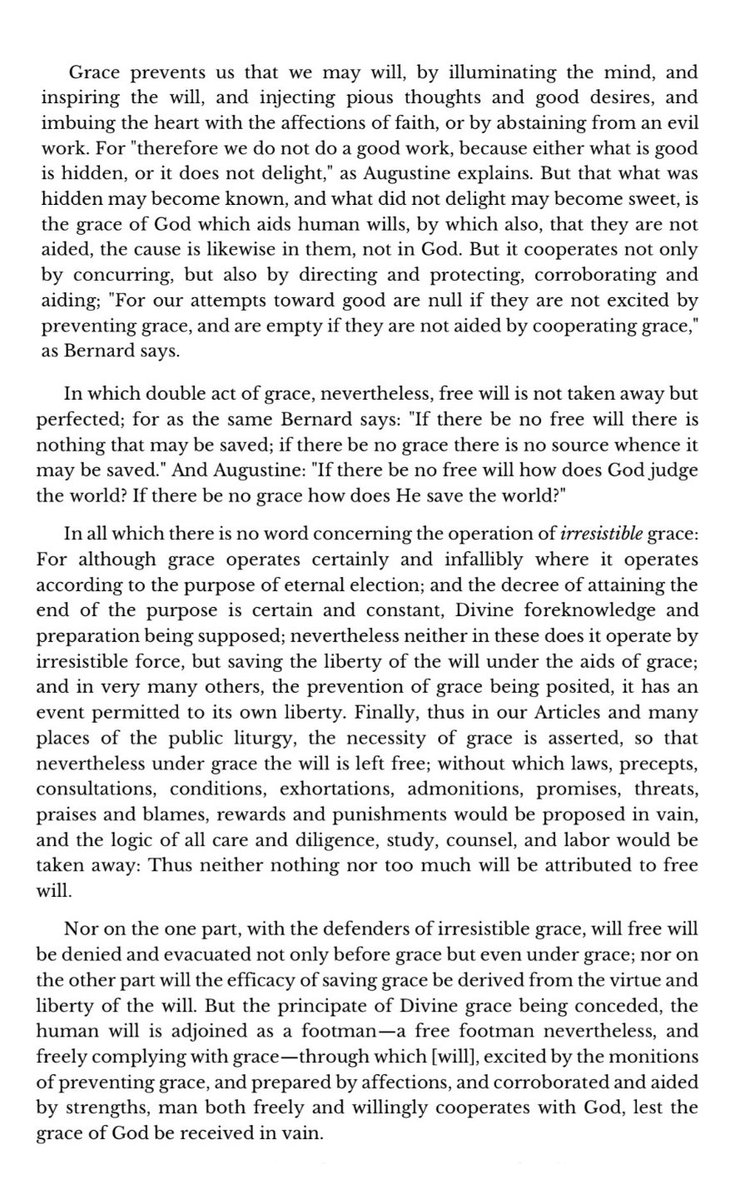
John Davenant on efficacious grace, graciously exciting, directing, and strengthening the will unto faith, causing it to act freely rather than by irresistible force.
"For although in the point or doctrine of justification, the Gospel is content with faith alone; yet in the subject and doctrine of sanctification, it demands the fruits of faith, and a life worthy of the Gospel. But it behoves us, if we are desirous of living agreeably to the Gospel, to listen to the Gospel, not only when it proclaims gratuitous justification through faith; but also when it requires due holiness of life from the justified. Moreover, justification by faith alone does not yield any consolation to such as voluntarily persevere in wicked works; for though such persons may imagine that they are justified, they cannot in reality believe it." ~John Davenant, Treatise on Justification
Suárez explaining that every saving act of the human will is wholly from God’s grace even is physical premotion is not present. “Objection 2: If God's physical premotion is not present, it follows that man in the business of salvation has something proper which he has not received from grace, namely the operation of his will. I respond: I deny the conclusion. Because whatever is in man operating well, conferring to salvation, all of this is had from God: namely antecedent helps of grace, infused habits, their acts proceeding from God immediately concurring, and the effects of the acts.”


“God wills that you should neither receive his word nor his grace in vain: say not therefore when he calls upon you to repent, and incites you thereunto, that his meaning is you should not repent. … The goodness of the action which God commands, the word commanding, and the Spirit exciting thereunto, are good proofs unto you that God means (that is, likes, desires, wills) that you should do those good things which he requires:” —John Davenant, Animadversions


Sic Semper Tyrannis @FEC0702
327 Followers 27 Following French and Indian War Vet. Revolutionary War Vet. Commander-in-chief of the Continental Army. First President of the United States of America. Founding Father.
Betty @betty_thomas56
14 Followers 524 Following
rafa, o teófilo. @rafa_o_teofilo
20 Followers 624 Following
Cory Boyer @dortenjoyer
1 Followers 59 Following Presbyterian layman studying the faith. Student of law.

Scholasticus Reformat... @ScholasticusRef
1 Followers 36 Following PCA presbyterian learning scholasticism Highschool Theo nerd 📚

mendy Gomez @Simonba01598151
144 Followers 2K Following God ‘ll always bless what you have done for his kingdom and what you have given for the things of the lord and to help others 🙏🏿🙏🏿 ✝️💜

Brother Tom @thomas_luay
79 Followers 86 Following Sheep of Jesus Christ, the Good Shepherd ❦ Lutheran Church–Canada Layman ❦ Hamannian ❦ Conservative Christian Ordoliberal ❦ Namesake of St. Thomas the Apostle

MitChrist🌷 @cristao49736
200 Followers 465 Following Católico reformado, burkeano. Rejeito a utopia secular, a fé triunfalista e todo moralismo tribal. @normabragaven 👑
Miguel DeJesus @TheMiguelDJ
287 Followers 779 Following Coffee connoisseur, Musician, Superhero aficionado and Bible addict. I’ve called Atlanta home for 40+ years. Also known as the Bass player for Smalltown Poets.
Orthodox Ensign ☦�... @TheOrthoEnsign
2K Followers 2K Following EO Christian ✝️ All sinned; God's Son was punished in our place; the Bible is God's clear Word. ✝️ Tetelestai ✝️ https://t.co/k5gPoWNlk3
Chrisann M Dawson �... @ChrisannDawson
26K Followers 20K Following #AmWriting I love Jesus, the Word, my family, and the Congo! Read my book Congo Crisis. @ChrisannDawson #HealthyFaithChat

FaithTensor @faithtensor
54 Followers 619 Following FaithTensor™ - Faith in an afterlife. Vocals and instrumentation by MusicGPT https://t.co/cQUSzFK52f Without God, Lord, Father, Creator; AI Means Nothing.
1S4 @1S4_DG
2 Followers 32 Following
Felipe dos Santos @FelipeSaints507
6 Followers 703 Following


Josue Roman- Velazque... @Jsaved7
15 Followers 68 Following Christ Follower. Arm Chair Theologian. Baptist .Husband.Father.
Jacob Dunlap @JacobtheDunlap
136 Followers 384 Following Husband to @hdunlap1210 | Member at @RedeemerOB | Teacher | Praise God, I'm just a sinner saved by grace.
Delta @lastdelta2k
0 Followers 591 Following
Kris Kord @kris_kord
19 Followers 70 Following Reformed Christian serving as a ruling elder in the OPC.
Jack Reid @jnreid825
2 Followers 60 Following
Philotheos, the Wayfa... @heavenwardheart
6 Followers 68 Following A yearning saint of God seeking Him and the Light with his heart, mind, and soul.
Patrick Trent @PTrent2005
46 Followers 211 Following @OrthodoxPC | The credit belongs to the man who is actually in the arena, whose face is marred by dust, sweat and blood - T.R.
Son Of Numenor @Numenorian83
125 Followers 557 Following "Tell me, slave, what is Numenor?" "The True West," said Ransom.
Classical Protestant @ClassicalPromax
7 Followers 186 Following Ethiopian 🇪🇹 Anglican Promax, Ex Pentecostal
Augustine 📖🩸 @restlessaugust
197 Followers 244 Following Reformed Anglican, Old High Churchman, Deacon in The North American Anglican Diocese E&R. "Our hearts are restless, until they rest in God" -St. Augustine
Andy @TheNoematicCut
15 Followers 263 Following
White Horses @white_horses_
56 Followers 95 Following We shall never escape them—we who live in this house.
☺︎ @meloglor
106 Followers 104 Following
Dave Alford @dave_alford
17 Followers 291 Following
Ossos vivos @homemcaveiraviv
3 Followers 12 Following
Jey @tnediserPyaJ
19 Followers 2K Following
سيباستيان | ... @djcbav
20 Followers 364 Following الذِّهن قابل للإثارة وغير ثابت، ومِن الصَّعب السَّيطرةُ عليه وضبطُه وصَونه. وذو الحكمة يُدرِّب ذهنه على غِرار صُنَّاع السِّهام، إذ يُسَوُّون الأسهم.
Fine Da Kine @finedakineglass
255 Followers 3K Following
Philosophus @doctrinares
13 Followers 1K Following

Azurnite @KingDragonaut
93 Followers 1K Following

Sonny Cannatella ✞ ... @CannatellaSonny
357 Followers 2K Following “Lord (Jesus), to whom shall we go? You have the words of eternal life, and we have believed, and have come to know, that you are the Holy One of God.”
Ийр @LessthanBrand
890 Followers 344 Following Casual lingerer, occasional poaster -- ever faded. This is a Kriemhild stan account.

Filósofo amoroso da ... @jonhconsta8877
39 Followers 2K Following Estudos filosóficos praticante de loa lei da suposição estudos ocultos e esoterismo
The Books of James �... @thebooksofjames
48 Followers 365 Following Welcome to The Books of James, #Reformed #Christian book blog. #ReformedTheology “Jesus said to him, I am the way, and the truth, and the life – John 14:6“

Stiven Peter @StvenWithAnI
635 Followers 2K Following
Ethan Montgomery @ep_montgomery
78 Followers 145 Following Christian Reformed 🐟 (CRCNA) | RBC | WSCal | Ephesians 5:16 | Tigers fan | Avid reader of synodical minutes | Strict observance Husserlian | Opinions my own
Josue Roman- Velazque... @Jsaved7
15 Followers 68 Following Christ Follower. Arm Chair Theologian. Baptist .Husband.Father.
David S. Sytsma @SytsmaDavid
3K Followers 594 Following Prof @TCU_jp. Director @PostRefDL. 📚on R. Baxter (OUP 2017); Beyond Dordt & De Auxiliis (Brill 2019). 16/17thC historian and lover of wisdom ✍️ now on ethics.

Seth Powers @SethPow97546441
49 Followers 355 Following
Eduardus Ekofius @EddyEkofo
5K Followers 2K Following Gloria in excelsis Deo • Husband • Father • Software Engineer • #1689 • Biblicist • #ChelseaFC • 🇨🇩 + 🇮🇪 + 🇫🇷
Moh ♱ ☧ 🛡 🍇 @Mohsule_
6K Followers 1K Following Born-again ✞ | Philomath 📖 | Orange juice enjoyer | Historic Evangelicalism | Dutch Reformed | @arminianthought |🇳🇬
Matt Marino @RefClassicalist
898 Followers 518 Following Pastor of Grace ARP | Professor at New Aberdeen College | Theology ☩ Philosophy ☩ Ethics ☩ Old Books | “Let your reasonableness be known to everyone” (Phi. 4:5)
Gallant 🍇 @bongybingy89601
161 Followers 171 Following
J. Dahl @jdahlxn
1K Followers 2K Following U.S. Army Chaplain | Instructional Technologist | PCA | MDiv, MAR @GordonConwell | MEd @WinthropU | DMin student @ErskineSeminary
Colton Yarbro 🥝 @ColtonYarbro
2K Followers 531 Following Christ Alone. Husband of @ericagailyarbro, and we have 4 arrows. Baptistic proponent of the Congregational Way. 2LCF. Pastor at FBC Dawson.

Dr Alan C. Clifford @dralancclifford
126 Followers 9 Following Pastor of the proposed English Reformed Church; author of several books and articles on the Reformed Faith. First book: Atonement & Justification (OUP, 1990).
Dylan Morscheck @dylanmorscheck
382 Followers 4K Following Reformed Catholic (PCA) | MDiv student @BirmingTheoSem
Joe Gibbons @JoeGibbons84
976 Followers 650 Following Christ is King ✠ Deacon in the PCA ✠ Armchair historian ✠ MA Theology

Hannah Oliver @EruditeTogether
4K Followers 1K Following Confessionally Reformed, interest in cults and spiritually abusive relationships, education and awareness, mental health advocate, and a fan of kindness. 🍉
Rev. Don Baker @DonaldBaker89
54 Followers 13 Following
Connor Perry @connor_perr
55 Followers 49 Following Social Sciences Researcher. Texas Tech alum. Christian (PCA). Follows & Retweets =/= endorsement.

Anglo @Catholike__
70 Followers 119 Following Wisconsinite. Reformed. Christian Nationalist. Westminster Enjoyer.
Trent Still 🇸🇴�... @RevDTStill
364 Followers 578 Following
P&R Publishing @prpbooks
12K Followers 727 Following P&R Publishing is a Christian book publishing company. Founded in 1930, we have over 750 titles in print, releasing an average of 40 new titles per year.
SpongeAnon @spongeanon102
600 Followers 1K Following An Anonymous Sponge | Heritage American | Christian Nationalist
Post-Liberal Presby @builtbygospel1
220 Followers 901 Following “the loudest, the most intolerant of all sects, the most tyrannical, and ambitious.” - Thomas Jefferson on Presbyterians
Robbie Crouse @robbie_crouse
100 Followers 820 Following
Jacob @quicunque_vult_
22 Followers 324 Following Quicunque vult salvus esse, ante omnia opus est, ut teneat catholicam fidem.
Miles Brown @MilesBrown1646
279 Followers 598 Following Student at Reformation Bible College. Romans 6:23. Presbyterian (PCA). Yooper! Opera lover. Opinions my own.

Christian Conservativ... @Christ_Conserv
1K Followers 1K Following Disgruntled Conservative. Reformed Christian. Ephesians 2:8-10

Free Grace Scholastic... @saint_trae35891
239 Followers 224 Following 🇷🇴Romānian · Gratia Gratvita · Thomiſmvs · Mos Maiorv̄m̃
Joshua @iosuah_
59 Followers 256 Following ‘Yet you do not know what tomorrow will bring. What is your life? For you are a mist that appears for a little time and then vanishes.’ Particular Baptist
Jesus fan 🍇 @4Dupont
1K Followers 4K Following vile sinner saved by the grace of God given to us through Jesus Christ. Reformed and postmill. Hypothetical universalist. From Quebec not Canada


Code name E9 @CodeNameE9
92 Followers 145 Following Idk why I’m on this app | Reformed Catholike | OPC | Classical Presbyterian
Reformed Reader @Reformed_Reader
562 Followers 865 Following Reformed Catholic • Crux probat Omnia • Covenanter

DanielBurdine @DanielBurdine
415 Followers 1K Following Husband, Theologian, Simul Justus et Peccator, Presbyterian, under care of the OH Presbytery of the PCA
James Baird @james_d_baird
11K Followers 1K Following PCA pastor | formerly @westminsterts @ligonier | book: "King of Kings" | #LiveLikeCharlie
Josue 🍇 @caJosue0060
315 Followers 1K Following No puedes volver atrás y cambiar el principio, pero puedes empezar donde estás y cambiar el final.
Wes White @wes_net
556 Followers 406 Following Pastor for 20 years, still learning, writing, speaking, traveling. Have an A+wife, 7 kids + spouses, trying to do bigger things. Pastor at Grace Pres in Peoria

John Barach @John_Barach
1K Followers 656 Following Writer / copy editor / proofreader / indexer / West Coast Swing / Charlotte Mason / JSOT JSNT @_Theopolis @BakerAcademic @ZonderAcademic @KregelAcademic
𝐌𝐢𝐜𝐡𝐚�... @MichaelCarlino
2K Followers 419 Following Husband of @kyliecarlino. Father of 3. Deacon @kenwoodbc. Operations Director @CBMWorg. Assistant Director @sbtsrevitalize. Adjunct Theology Prof @Boycecollege
Darin Lippard @darinlippard
78 Followers 416 Following
Onku @OnkuOh
342 Followers 212 Following Deficient Moral Cause Affirmer | Reformed Catholike | Romans 7:24-25 May He, who is the Way and the Truth, lead us into all Truth.You might like