The Situation Report @TheSitRepPH
The Situation Report delivers breaking news, special reports and in-depth stories of critical national issues in the Philippines | [email protected] situationreport.net Republic of the Philippines Joined April 2025-
Tweets12K
-
Followers901
-
Following90
-
Likes1
VIETNAM MAUUNA PANG MAGTAYO NG HIGH-SPEED RAIL KAYSA PILIPINAS? SITREP/Transport: Siemens Mobility, the rail division of German industrial and technology conglomerate Siemens, signed a turnkey contract worth up to 1 billion euros with Vietnam's VinSpeed to build two high-speed rail lines, the companies announced at InnoTrans 2026 in Berlin. The deal covers the 121-kilometer Hanoi-Quang Ninh line and the 54-kilometer Ben Thanh-Can Gio line, with VinSpeed handling project development, track, and civil works, while Siemens supplies trains, signaling, electrification, and communications systems. The contract includes 10 Velaro Novo trainsets, seven-car units measuring 200 meters each, capable of running up to 350 km/h and carrying 760 seats per train, with 30 percent less energy use and over 10 percent more passenger capacity than previous models. Siemens Mobility CEO Michael Peter said the project reflects the company's commitment to "helping countries modernise their transport infrastructure while supporting economic growth and environmental protection." Likewise, VinSpeed CEO Pham Thieu Hoa said the partnership lays the groundwork for an integrated high-speed transport system in Vietnam. The contract builds on a strategic cooperation and technology transfer agreement the two companies signed in December 2025, and will mark the first deployment of Automatic Train Operation over European Train Control System (ETCS) Level 2 signaling on a national high-speed rail network. ETCS Level 2 is a digital signaling system that sends speed and movement instructions directly to a train's onboard computer in real time, instead of relying on trackside signals. This allows trains to run closer together more safely and efficiently; paired with Automatic Train Operation, the system lets the train largely drive itself under human oversight. #TheSituationReport

Maaaring mamatay nang maaga ang mga taong kulang sa tulog, ayon sa pag-aaral. Buong ulat sa thread. #TheSituationReport

NIA: INVEST IN DAMS WATCH: Malaking bagay ang mga dam sa isang bansa lalo na ngayong may nararanasang strong El Niño. Ayon kay Administrator Eduardo Guillen ng National Irrigation Administration, parte ng climate change resiliency and adaptation ang mga dam. "Dahil kapag umulan, naiimbak ang tubig dyan, nababawasan 'yung baha. Kapag tag-araw, nagagamit mo siya ngayon sa irigasyon at inumin," sabi ni Guillen. Panoorin ang video na ito. #TheSituationReport
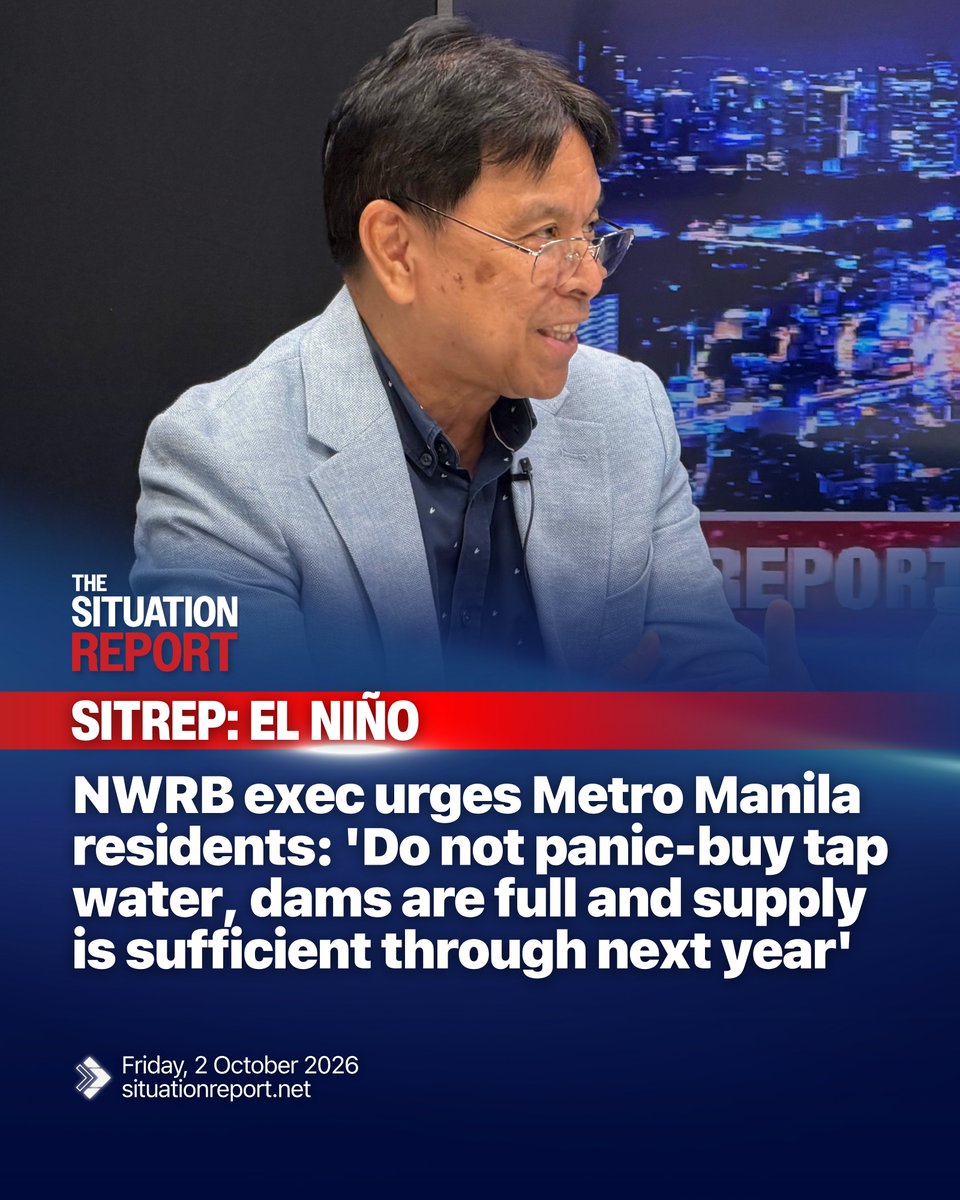
NWRB URGES METRO MANILA RESIDENTS TO AVOID PANIC-BUYING, HOARDING SITREP/El Niño: Metro Manila residents who have begun stockpiling water from their faucets in anticipation of El Niño shortages are being urged to avoid hoarding. The dams are full, supply is sufficient through next year, and hoarding tap water only increases pressure on the distribution system unnecessarily, National Water Resources Board (NWRB) Executive Director Sevillo David Jr. said Thursday. David addressed the panic in an interview on @DZRHNews program "The Situation Report" on Thursday, October 1, saying reports of residents storing tap water in large containers had reached the NWRB and that the behavior, while understandable, is counterproductive. He said if residents want to prepare for the El Niño period, the right approach is rainwater harvesting: collecting rainwater in containers during the remaining wet weather and using it for household purposes like cleaning, laundry, and garden watering, which reduces demand on the treated water coming from the dams. "Ang pwede pong gawin ng kababayan po natin kung mag-iimbak ba ng tubig, ay 'yung rainwater harvesting. Kasi 'pagka ginawa po nila 'yan, magiging alternative source po 'yan sa iba pa nating pangangailangan sa bahay para naman po ma-preserve natin 'yung mga tubig na nasa mga dams po natin," David said. He said the NWRB is working closely with MWSS to monitor supply levels and ensure that distribution to Metro Manila through Manila Water and Maynilad remains reliable through the first quarter of 2027 when El Niño's impact is expected to peak. #TheSituationReport
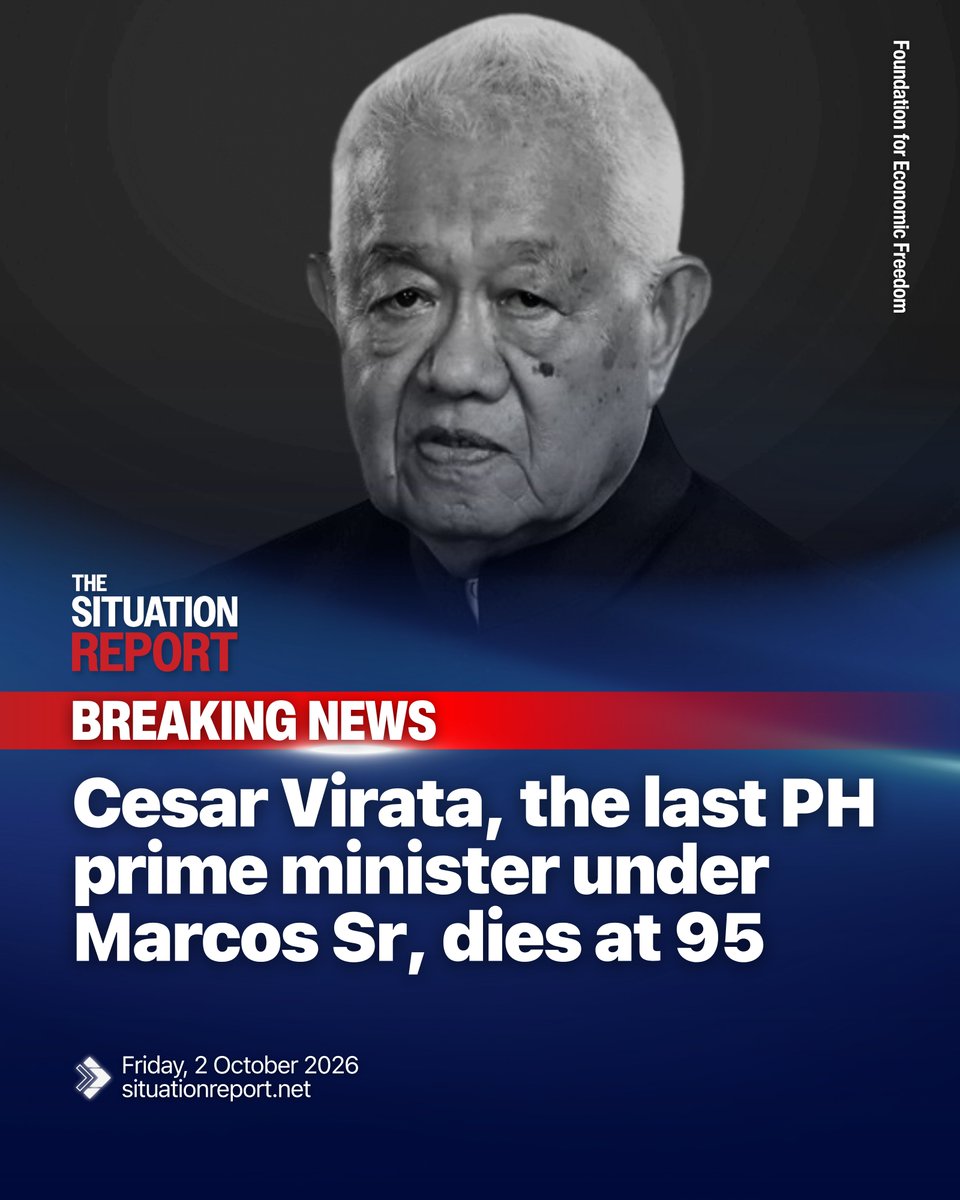
CESAR VIRATA, THE LAST MARCOS SR.-ERA PRIME MINISTER, DIES AT 95 BREAKING: Cesar E.A. Virata, the Philippines' last Prime Minister under the Marcos Sr. administration, died on Friday, October 2. "It is with deep sorrow that the Bank announces the passing of Mr. Cesar E.A. Virata, our Corporate Vice Chairperson/Director, today, October 2, 2026," the Rizal Commercial Banking Corporation (RCBC) said in its disclosure filed with the Philippine Stock Exchange (PSE). "Mr. Virata was a valuable part of the organization being a Director of the Bank since 1995 and has been the Board’s Corporate Vice Chairperson for 26 years," it added. Virata served as the fourth and last Prime Minister of the Philippines from 1981 to 1986, and as Finance Minister from the 1970s to 1986 under the late President Ferdinand Marcos Sr. He also headed the National Economic and Development Authority (NEDA) and served as the Philippines' governor to the World Bank, the Asian Development Bank, and the International Fund for Agricultural Development. Virata was the grand-nephew of Emilio Aguinaldo, the first President of the Philippine Republic. #TheSituationReport
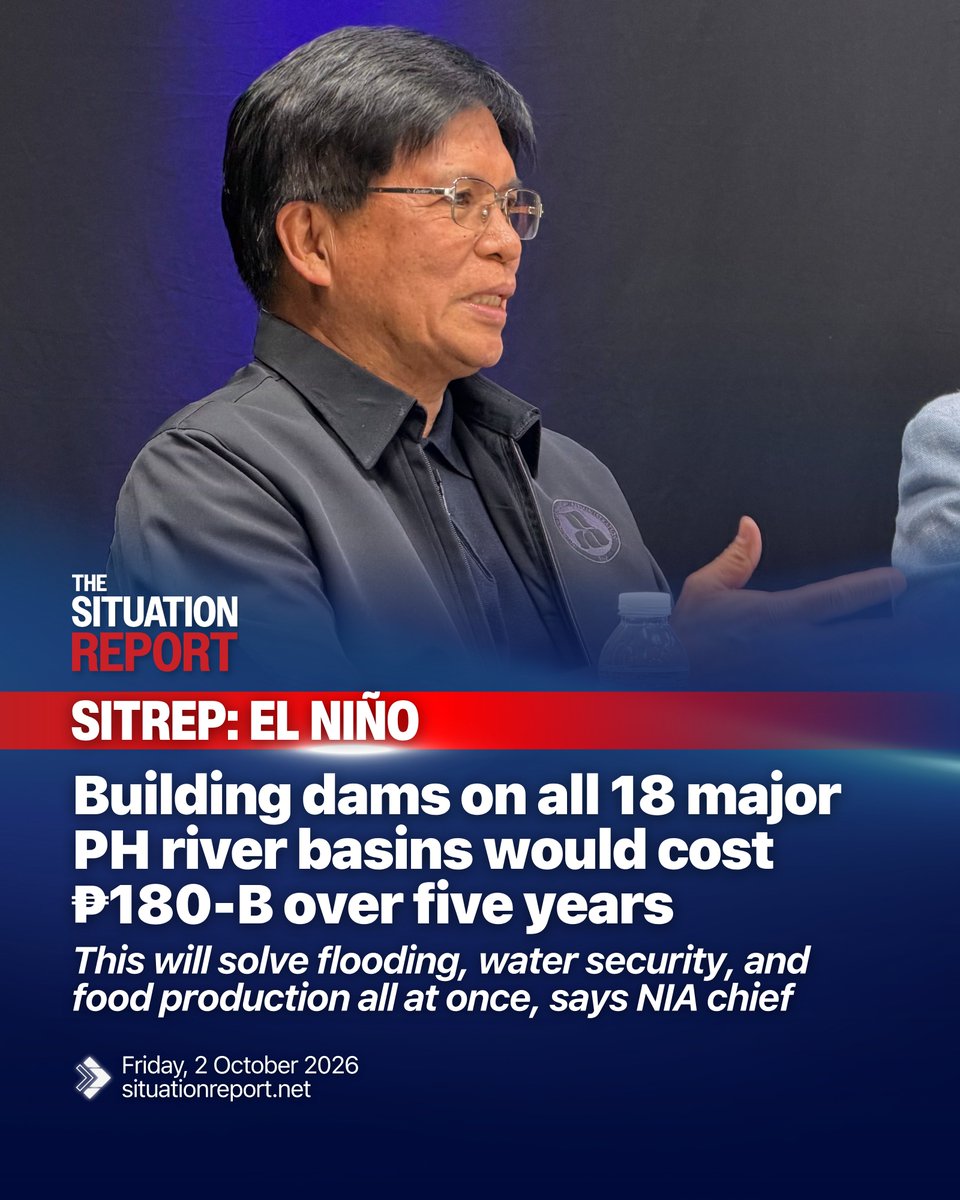
BUILDING DAMS ON ALL 18 MAJOR PH RIVER BASINS WOULD COST ₱180 BILLION OVER FIVE YEARS This will solve flooding, water security, and food production all at once, says NIA chief SITREP: The Philippines has only 18 major river basins, and building a dam on each one, at approximately ₱10 billion per dam based on the cost of the Jalaur Dam, would require ₱180 billion spread over five years, or roughly ₱36 billion per year. National Irrigation Administrator Eddie Guillen is confident that this investment would simultaneously solve Philippine flooding, water security, and food production at a fraction of what most people assume it would cost. Guillen laid out the arithmetic in an interview on @DZRHNews program "The Situation Report" on Thursday, October 1, making the case that dams are among the most cost-effective infrastructure investments available to the Philippine government because each one serves multiple purposes. He said a single dam on a river basin provides flood control by absorbing rainfall before it reaches downstream communities, irrigation water for crops during dry season, and hydropower generation. "Ang maganda po kasi sa NIA, ang kailangan kasi natin is climate change resiliency, adaptation, and mitigation projects po 'yan. 'Yung mga dams, adaptation po itong mga ito," Guillen said. "Dahil 'pagka umuulan, naiimbak ang tubig diyan, nababawasan 'yung baha. And then 'pagka tag-araw, nagagamit mo siya ngayon sa irigasyon at inumin. Hindi lang po 'yan, hydropower production po 'yan," he said. The NIA chief said his agency was moved from the Department of Agriculture (DA) to the Office of the President under the Marcos administration precisely to accelerate this agenda. This gave NIA direct presidential attention and faster access to budget and approvals, Guillen said. "Ang Pangulo, dinala niya ang NIA sa Office of the President para mas matulungan niya tayo sa funding," Guillen said, adding that the Senate budget hearing had already been receptive to the NIA's dam-building case. #TheSituationReport
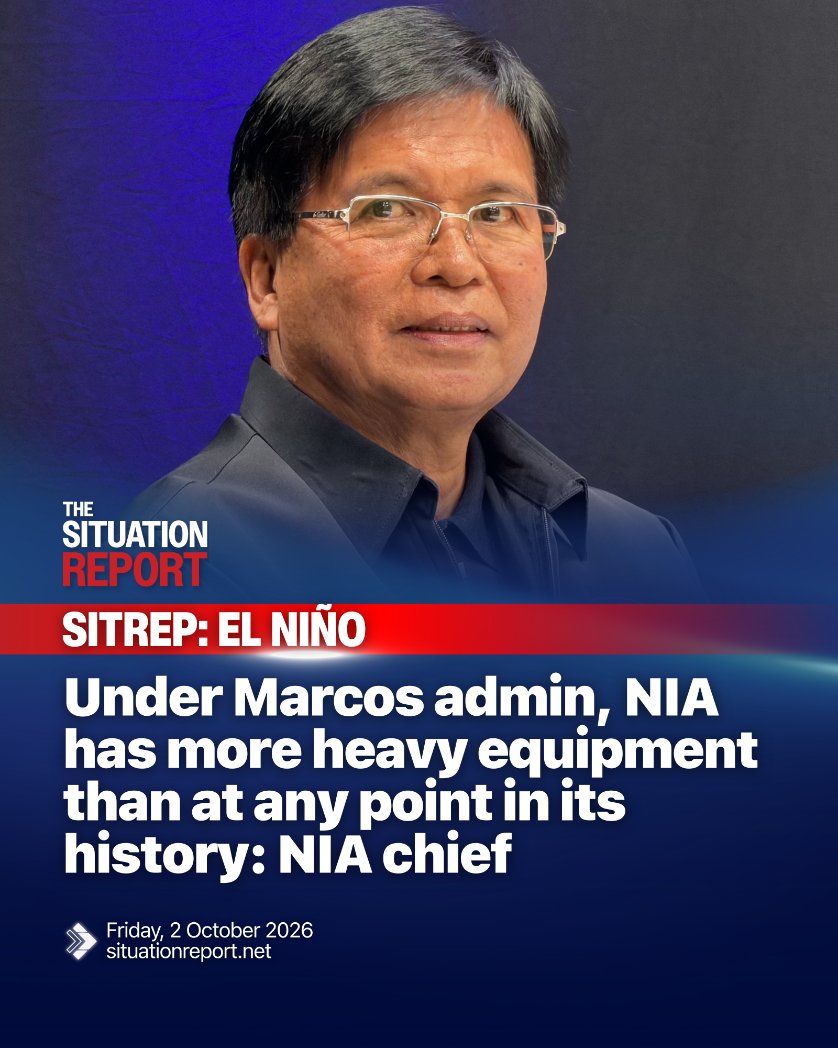
UNDER MARCOS ADMIN, NIA HAS MORE HEAVY EQUIPMENT THAN AT ANY POINT IN ITS HISTORY: NIA CHIEF The National Irrigation Administration now has more heavy equipment than at any point in its history, all provided under the administration of President Ferdinand Marcos Jr. NIA Administrator Eddie Guillen said the agency is now using that equipment to desilt irrigation systems, build temporary brush dams during dry periods, and accelerate solar pump irrigation projects across all regions. Guillen made the statement in an interview on @DZRHNews program "The Situation Report" on Thursday, October 1, saying the scale of the equipment provision by the Marcos administration represents a historically unprecedented level of support for NIA's operations. "Tinitingnan ko ang history ng NIA, ngayon po talagang napakarami," Guillen said. He said the distribution is nationwide, not just concentrated in Luzon's major agricultural centers but spread across all regions and all provinces. The NIA chief said this was a deliberate choice by the President to ensure that the agency's response capacity is available wherever it is needed. "Massive po. Marami pong ibinigay na heavy equipment ang ating Pangulo," Guillen said. "Kasi ang projects naman po natin ay kalat po sa lahat ng regions, ano po, at tsaka sa mga probinsya. Pati 'yung mga heavy equipments natin na ibinigay ng ating Pangulo na siyang ginagamit po namin kapag may El Niño. Ito po 'yung mga panggawa namin ng mga brush dams eh. 'Pag may La Niña naman, pinagde-desilt natin sa mga irrigation facilities po natin." He said the equipment serves two distinct purposes depending on the season: during El Niño, it goes into riverbeds to build temporary brush dams that divert available water toward irrigation facilities; during La Niña, the same machines desilt canals and restore carrying capacity to waterways that have been silted by floodwaters. Guillen described in detail how a brush dam works: when river levels drop during dry season, NIA's heavy machinery moves in and piles sand and gravel into temporary structures that redirect whatever water remains toward the irrigation channels that serve farmland. "Ayun po 'yung mga temporary dams na kailangan po natin, kagaya po halimbawa 'pagka ganitong kokonti ang tubig sa ilog. 'Yung mga heavy equipments natin ang pupunta doon, gagawa ng mga dams. 'Yung mga buhangin po, tatambak nila diyan, or iti-train nila 'yung tubig papunta sa ating mga irrigation facilities. Oo, ganun po 'yung gamit namin," Guillen said. The NIA chief said the President did not just provide the equipment but ensured it could be mobilized when needed. "Lahat po ng regions binigyan ng ating Presidente eh. Lahat ng probinsya. At hindi lang 'yun, pati 'yung pag-mobilize namin ng heavy equipments, talaga pong sinigurado ng ating Pangulo na meron kaming gagamitin," Guillen said. He also said NIA also uses the Alternate Wetting and Drying System to stretch water supply during El Niño, a method that reduces water consumption by 20 to 30 percent without significantly affecting yield. Guillen said this complements the brush dams and solar pump projects as part of a short-term, medium-term, and long-term response framework for climate resilience. #TheSituationReport
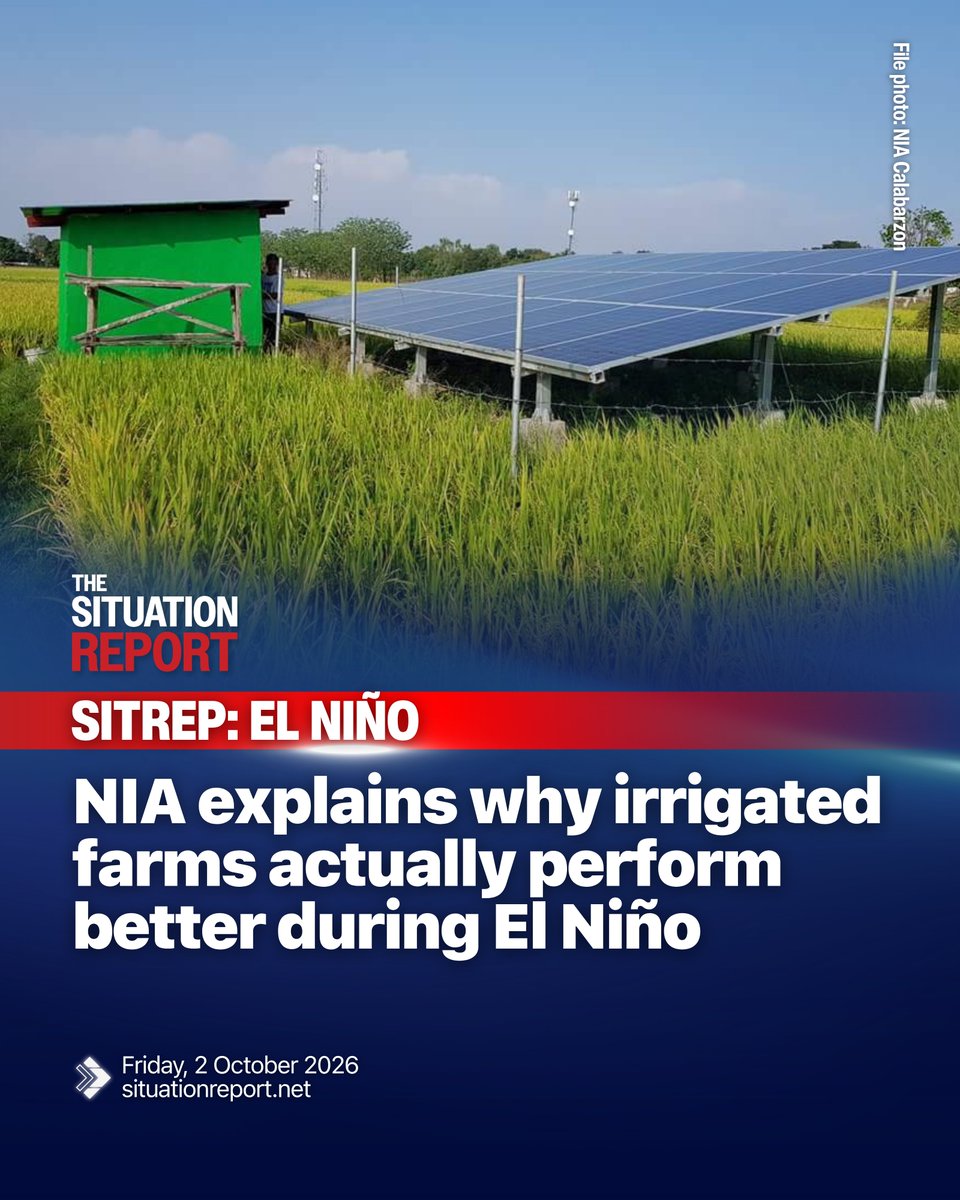
WHY IRRIGATED FARMS ACTUALLY PERFORM BETTER DURING EL NIÑO: NIA SITREP/El Niño: The National Irrigation Administration (NIA), the agency tasked with keeping Philippine farms watered through drought and deluge alike, is more worried about La Niña than El Niño. NIA Administrator Eddie Guillen said it plainly in an interview on @DZRHNews program "The Situation Report" on Thursday, October 1: "Mas takot po ang NIA sa La Niña kaysa po sa El Niño." The reason, he said, is not counterintuitive once you understand how irrigated farming works. The key is sunlight. When the sun shines during dry season, plants photosynthesize more efficiently. They convert more sunlight into food, which means more grain per hectare. The limiting factor in a wet season is not water but light. Overcast skies and heavy rainfall limit the solar energy available to crops, suppressing yields even when the fields are well-watered. In a dry season, with an irrigation system supplying the water that rain would otherwise provide, the sun does all the rest. "Alam naman po natin, 'pagka maaraw at may El Niño, pabor po rin sa amin 'yan, kung sa mga farmers, basta may tubig. Dahil 'pag maaraw, mas maganda ang photosynthesis. Mas makakagawa ng pagkain ang halaman, kaya mas mataas ang yield o produksyon natin," Guillen said. The numbers are dramatic. Wet season rice yield in irrigated areas averages around four metric tons per hectare. In dry season, the same land under the same irrigation produces eight, and hybrid varieties can reach ten to twelve. "Talagang nadodoble po ang yield natin 'pagka dry season. 'Pagka wet, nasa 4 tons lamang kami, pero 'pagka dry season, 8 tons. May umaabot pa ho ng mahigit 10 tons, 12 tons. Ganun po kahalaga. Per hectare po ito nakaka-12 metric tons na tayo sa mga high-yielding po, itong mga hybrid," Guillen said. This is why Guillen says NIA actually looks at El Niño with cautious optimism for the irrigated sector. "Actually po, kasi 'pagka El Niño, mataas talaga 'yung production po ng pagkain natin doon sa mga part na kaya naming i-irrigate. So ang pagkain po ay nasi-secure natin 'yan. Kaya mataas po ang confidence namin na 'yung sa pagkain, mase-secure po natin," Guillen said. La Niña, by contrast, is a different story. Excessive rainfall floods standing crops, damages irrigation canals and pump stations, and creates waterlogged soil conditions where farming becomes impossible rather than merely difficult. The infrastructure NIA has built, which include the canals, the pump stations, the solar irrigation systems, is far more vulnerable to floodwater than to drought. The caveat, Guillen acknowledged, is the 40% of Philippine rice production that comes from non-irrigated farms. These rainfed areas will feel El Niño's impact directly, because they have no stored water to draw from when the rains stop. But even for those farmers, Guillen said, the situation is not hopeless. "Hindi ho kasi ibig sabihin na kapag kulang na ho 'yung tubig ay hindi na makakapagtanim. Dahil meron naman po tayong pwedeng ipatanim sa kanila na mga high-value crops na nasa 2 months, pwede na ho silang mag-harvest," Guillen said. NIA is also changing the cropping calendar itself: teaching farmers to plant during the sunniest months and harvest before the rains arrive, rather than timing crops around the wet season and leaving them exposed to typhoons at their most vulnerable stage. "Binabago namin talaga 'yung cropping calendar natin. Nilalagay namin 'yung double dry cropping. Sinasabi namin na dapat magtanim tayo kung kailan tag-araw," Guillen said. This shift, combined with full dams, expanding solar pump irrigation, and a growing fleet of heavy equipment, is why Guillen believes NIA can hold the line on food production through the El Niño period. The sun, he says, is not the enemy. It is the asset. The task is making sure there is enough water to let it work. #TheSituationReport
BREAKING: 7 patay sa gas leak sa isang minahan sa Itogon, Benguet | via Romy Gonzales, DZRH News Abangan ang detalye sa ulat na ito. #TheSituationReport
LOYZAGA: 'SA GREENING NG OF THE ECONOMY THROUGH RENEWABLE ENERGY, TAO PO ANG NANGUNGUNA' WATCH: May isang pag-aaral na ginawa ang think tank na Bain kung saan lumabas na nangunguna ang Pilipinas sa mga ekonomiya sa Southeast Asia na mabilis na mag-shift sa renewable energy, sabi ni Antonia Yulo-Loyzaga, Special Envoy for Disaster Risk Reduction and Management. Kaugnay nito, sinabi ni Administrator Eduardo Guillen ng National Irrigation Administration na mas magandang mas marami ang solar pump irrigation dahil mas mura pa ito. Panoorin ang video na ito. #TheSituationReport
WATCH: Hindi lang ang sektor ng pagsasaka ang apektado ng El Niño kundi pati na ang sektor ng pangisda. Paliwanag ni Antonia Yulo-Loyzaga, Special Envoy for Disaster Risk Reduction and Management, ito'y dahil umiinit o tumataas ang temperatura sa karagatan na siya namang makakaapekto sa mga isda, seaweed farming at iba pa. Panoorin ang video na ito. #TheSituationReport
'WE NEED TO MANAGE OUR CONSUMPTION' WATCH: Sapat naman ang suplay ng tubig sa Metro Manila hanggang Pasko, pero nagpaalala ang mga eksperto na dapat mas paghandaan ang unang kwarter ng 2027 kung saan lalatay ang matinding El Niño. Paliwanag ni Sevillo David, executive director ng National Water Resources Board, na-recharge ang mga dam nitong mga nagdaang buwan at aabot naman ito hanggang sa susunod na taon. Gayunpaman, sinabi ni Antonia Yulo-Loyzaga, Special Envoy for Disaster Risk Reduction and Management, mahalaga pa ring maging wais sa paggamit ng tubig. #TheSituationReport
INVESTMENT SA EDUKASYON, KALUSUGAN, NUTRISYON WATCH: Maglalaro sa pagitan ng P1.2 trillion hanggang P1.4 trillion ang kailangang ilaan ng Pilipinas para sa climate change adaptation. Paliwanag ni Antonia-Yulo Loyzaga, Special Envoy for Disaster Risk Reduction Management, tumutukoy ito sa mga dapat tugunan tulad ng food security, pagtiyak ng sapat na tubig, imprastruktura at iba pa. Panoorin ang video na ito. #TheSituationReport
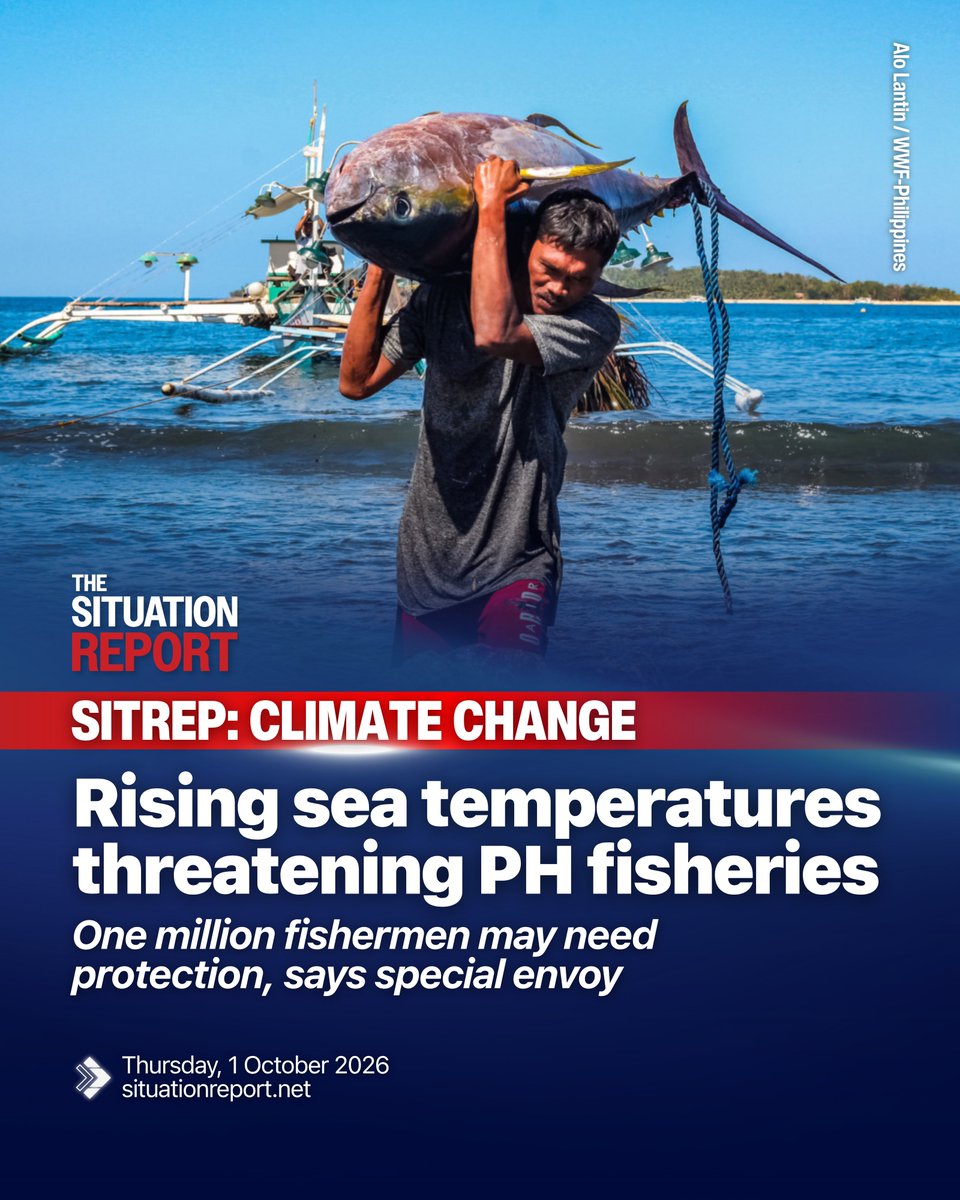
RISING SEA TEMPERATURES ARE THREATENING PHILIPPINE FISHERIES One million fishermen may need protection, says special envoy SITREP: Rising ocean temperatures from El Niño and accelerating climate change are threatening Philippine fisheries and seaweed farming. This puts ivelihoods of approximately one million fishermen at risk and requiring targeted social protection and insurance products from the government, Special Envoy for Disaster Risk Reduction and Management Toni Yulo-Loyzaga said Thursday, October 1. Yulo-Loyzaga raised the fishery sector in an interview on @DZRHNews program "The Situation Report," saying it is one of the most overlooked but most vulnerable sectors in the El Niño and climate change response. This is because the fish that Filipinos depend on for protein are already being affected by warming oceans, she said. Yulo-Loyzaga, who previously served as the President's environment secretary, specifically cited seaweed farming communities in Tawi-Tawi as a group that requires immediate attention. The special envoy noted that seaweed farming is a primary source of income in coastal communities and is directly threatened by rising sea temperatures. "Sa fishery sector natin, important ito kasi po sa pag-iinit po ng dagat, our fish will also be affected, and our seaweed farming will be affected. So areas, for example po, sa Tawi-Tawi and areas wherein seaweed farming is in fact a source of income po ng ating mga population in the coast, these areas have to be given special support," Yulo-Loyzaga said. She said the government needs to ensure that social protection programs and insurance products are made available to the fishing sector, not as charity but as a recognition that these communities are bearing the front-line cost of a climate crisis they did not cause. Yulo-Loyzaga also noted that fisheries represent the Philippines' chief source of protein, making the protection of the fishing sector not just an economic issue but a food security and public health concern that the NDRRMC and sectoral agencies must treat with equal urgency as agriculture. #TheSituationReport
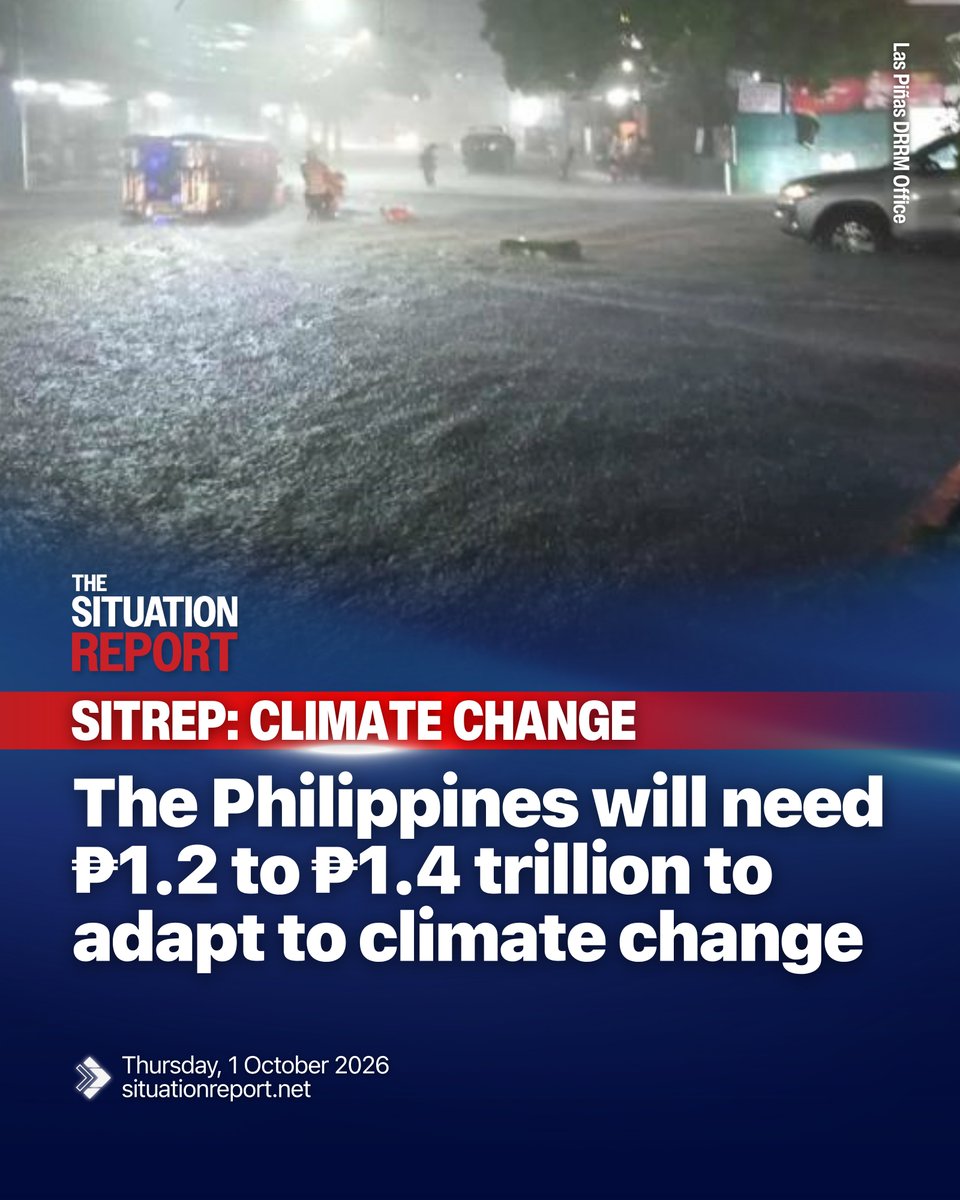
SURVIVING CLIMATE CHANGE WILL COST THE PHILIPPINES ₱1.2-₱1.4 TRILLION BY 2030 SITREP: The total investment the Philippines needs for climate change adaptation between 2024 and 2030 is estimated at ₱1.2 to ₱1.4 trillion. But that figure covers only the cost of coping with projected climate impacts, not the additional investments needed for development or progress, Special Envoy for Disaster Risk Reduction and Managment Toni Yulo-Loyzaga said Thursday, October 1. Yulo-Loyzaga disclosed the figure in an interview on @DZRHNews program "The Situation Report," explaining that the investment requirement cuts across water security, agriculture, infrastructure, utilities, nutrition, education, and health, reflecting the breadth of what climate change will affect in the Philippines. "Ang total investment po na kailangan ng bansa for climate change adaptation between 2024 and 2030, ang estimate po niyan, just to adapt, hindi lang to progress, ha, just to adapt, is between 1.2 and 1.4 trillion pesos," Yulo-Loyzaga said. The special envoy said President Marcos has a National Adaptation Plan that is currently being implemented and localized, with every LGU in the country required to have its own localized climate change adaptation plan tied to its Annual Investment Plan. "Ang adaptation, ang ibig po sabihin niyan ay kaya nating harapin 'yung challenge ng climate change in the future if we make those investments today. 'Yun talaga ang kailangan nating i-take to heart. Dapat isapuso po natin na kailangan po ng investments today because we're already feeling ang impact ng climate change sa vulnerable sectors," Yulo-Loyzaga said. Yulo-Loyzaga, who previously served as Marcos' environment secretary, said the investment requirement is to be submitted to the United Nations as part of the Philippines' international climate commitments, underscoring that the figure is not a rough estimate but a formal planning number. The special envoy said the most important sectors for adaptation investment are food security, water supply, resilient infrastructure that can withstand typhoons, and social protection for the most vulnerable, particularly the one million fishermen whose livelihoods depend on the health of Philippine fisheries and ocean temperatures. #TheSituationReport
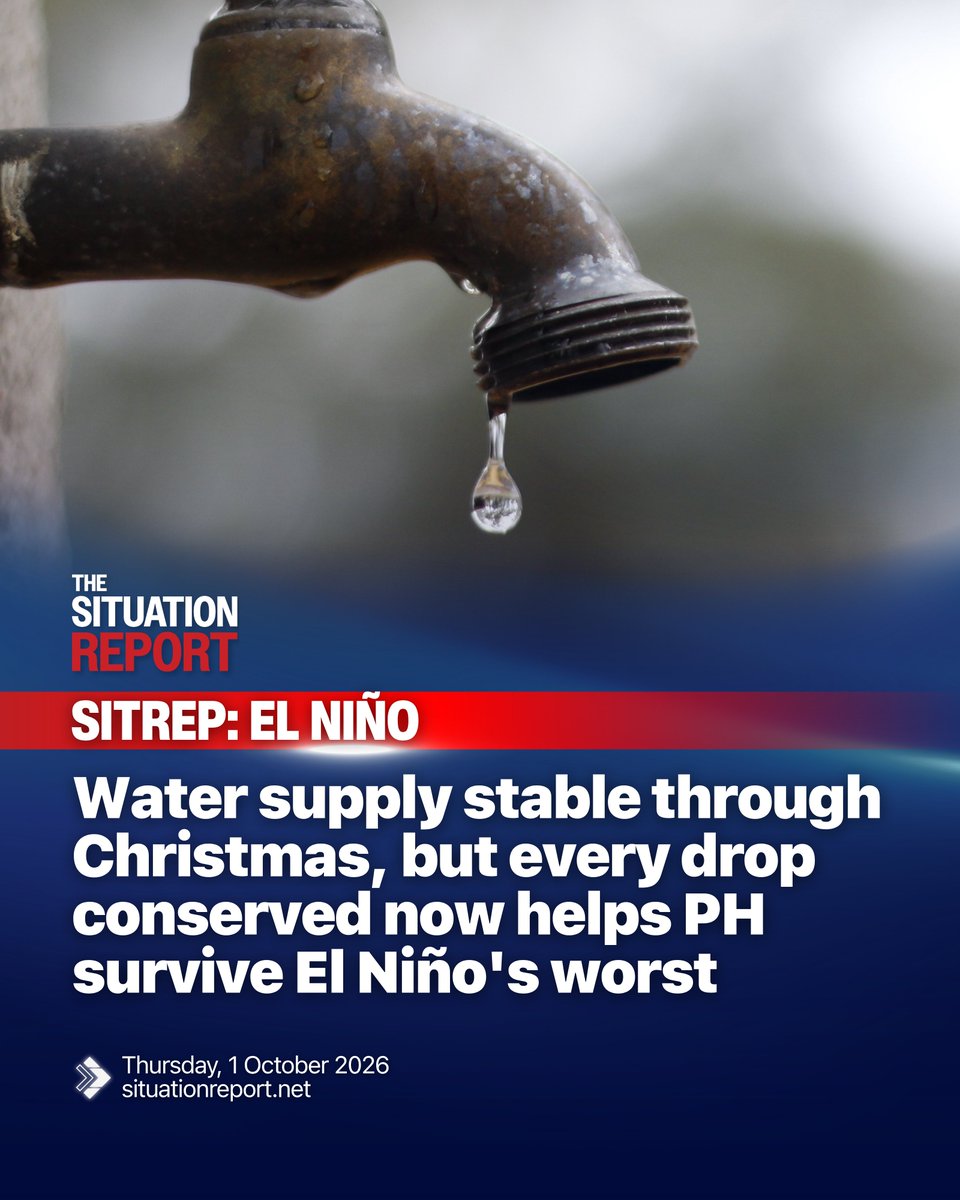
WATER SUPPLY STABLE THROUGH CHRISTMAS, BUT EVERY DROP CONSERVED NOW HELPS PH SURVIVE EL NIÑO'S WORST SITREP: Metro Manila's water supply is stable and sufficient through Christmas and beyond, but residents should begin conserving water and harvesting rainwater now. This is not because of an immediate shortage, but this is because the worst months of El Niño are expected in the first quarter of 2027, and every drop preserved today extends the buffer that will be needed then, NWRB Executive Director Sevillo David Jr. and Special Envoy for Disaster Risk Reduction and Management Toni Yulo-Loyzaga said Thursday. Both officials gave the same assurance in an interview on @DZRHNews program "The Situation Report" on Thursday, October 1, responding to a question about whether Metro Manila residents should be worried. David said the habagat season has recharged the major dams that had dipped dangerously low during the previous summer, and that current storage levels are projected to last through next year even under a do-nothing scenario. "Sa ngayon po, kung walang ulan sa dalawang buwan o tatlong buwan na walang ulan, sa tingin po natin 'yung kasalukuyang pag-recover po ng mga dams po natin ay aabot 'yan hanggang sa susunod na taon," David said. He said residents who want to store water should collect rainwater rather than hoarding tap water from their faucets, because rainwater harvesting creates an alternative source that reduces demand on the dams without depleting the supply already stored in them. Yulo-Loyzaga added that conservation of both water and energy must begin now, emphasizing that the country has the capacity to cope if it manages its natural resources responsibly, and that the message applies equally to households, companies, and local governments. "'Yung message is talaga pong water conservation, energy conservation, energy efficiency. Sana po maayos-ayos 'yung sa kabahayan po natin," the special envoy said. "We need to trust in each other and trust in the science, kasi po we have the capacity to cope and we have the capacity to respond," she said. #TheSituationReport
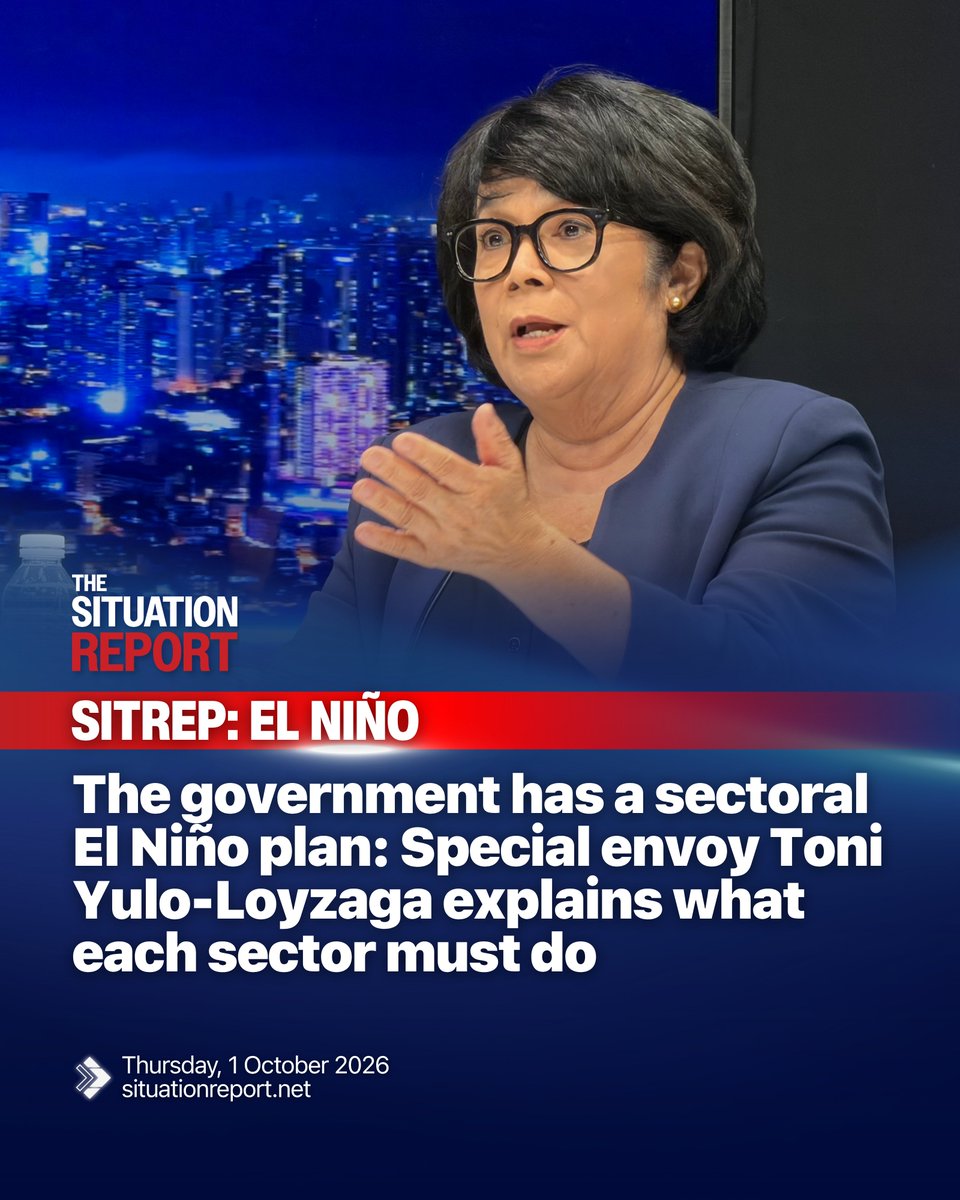
SPECIAL ENVOY EXPLAINS THE NATIONAL ACTION PLAN FOR EL NIÑO SITREP: When El Niño arrives, and it is already arriving, it does not hit everything equally. It hits the farmer differently from the power plant operator. It hits the coastal fisherman differently from the city dweller waiting for tap water. It hits the elderly and the very young differently from healthy adults. A single government response cannot address all of these at once, and former Environment Secretary Toni Yulo-Loyzaga, who is currently the President Marcos' Special Envoy for Disaster Risk Reduction and Management, says the government knows that. That is why the National Disaster Risk Reduction and Management Council (NDRRMC) has a Strategic National Action Plan for El Niño that is organized not by agency but by sector, each one with its own vulnerabilities, its own interventions, and its own chain of command. Yulo-Loyzaga laid out the plan in an interview on @DZRHNews program "The Situation Report," walking through what the government is doing in each priority area. TOP PRIORITY: FOOD, WATER The first and highest priority, she said, is food and water. Not because the others do not matter, but because this is where the President's own instruction begins. "Of course, the first one is food and water. Kasi 'yun po 'yung talagang priority ni Presidente na sigurado po na meron talagang food and water," Yulo-Loyzaga said. On the food sector, the Bureau of Soils and Water Management (BSWM) already has substitute seeds ready for farmers who will not be able to plant rice during the dry months: crops with shorter growing cycles that can be harvested before the worst of El Niño sets in. On water, both the National Irrigation Administration (NIA) and the National Water Resources Board (NWRB) are managing dam levels and irrigation allocations to stretch current supply through the first quarter of 2027, when PAGASA expects the impact to peak. ENERGY Energy comes next. The reason is structural: the Philippines relies partly on hydropower, and when water levels drop, generation capacity drops with it. At the same time, rising temperatures increase electricity demand: people run fans and air conditioners longer, industrial cooling systems work harder. The result is a system being squeezed from both ends. "Kasi po we do have hydro, but we do have also needs for cooling in terms of the energy generation that we have," Yulo-Loyzaga said. The government's response on energy covers both supply and demand: ensuring that generating plants in marginal condition are brought up to working standard before they are needed, while also pushing consumers and businesses toward conservation and efficiency. The shift to solar, which she noted the Philippines is leading in Asia according to a Bain study, is both a long-term strategy and an immediate contributor during El Niño conditions. HEALTH Health is the third sector, and in some ways the most diffuse. The impacts of El Niño on public health are multiple and compounding: extreme heat causes heat stroke and cardiovascular stress in the elderly and the very young; reduced water availability creates sanitation problems that lead to waterborne disease; and communities with less access to cooling or clean water carry a disproportionate share of the burden. EDUCATION Yulo-Loyzaga said she is also tracking what El Niño means for education, noting that Education Secretary Sonny Angara is already using an AI-assisted system to predict how many school days will be affected by the climate, allowing the department to plan in advance for schedule adjustments rather than reacting to crises as they arrive. The special envoy said the coordination across sectors is happening inside the NDRRMC, where every national government agency has a seat and where the plans are being cascaded from national to local. She stressed that the front line of any El Niño response is not in Manila but in the barangay, the farm, and the household. "It has to be both po. Kasi at the end of the day, the frontline is the local government. The national government po can give the support in terms of the infrastructure and the policy framework. But in the implementation, especially for specific vulnerability po, 'yung talagang may kahinaan nga na sector, sa local po 'yan ang kailangan i-strengthen," Yulo-Loyzaga said. WHOLE-OF-NATION APPROACH The plan exists. The sectors are identified. The interventions are in motion. What remains, and what Yulo-Loyzaga was careful to say out loud, is that no government plan survives without the cooperation of the people it is meant to protect. Water conservation, energy efficiency, awareness of heat-related health risks, community-level preparedness: these are not things the government can do alone, or do for anyone. "We can manage if we are driven by knowledge," she said. #TheSituationReport
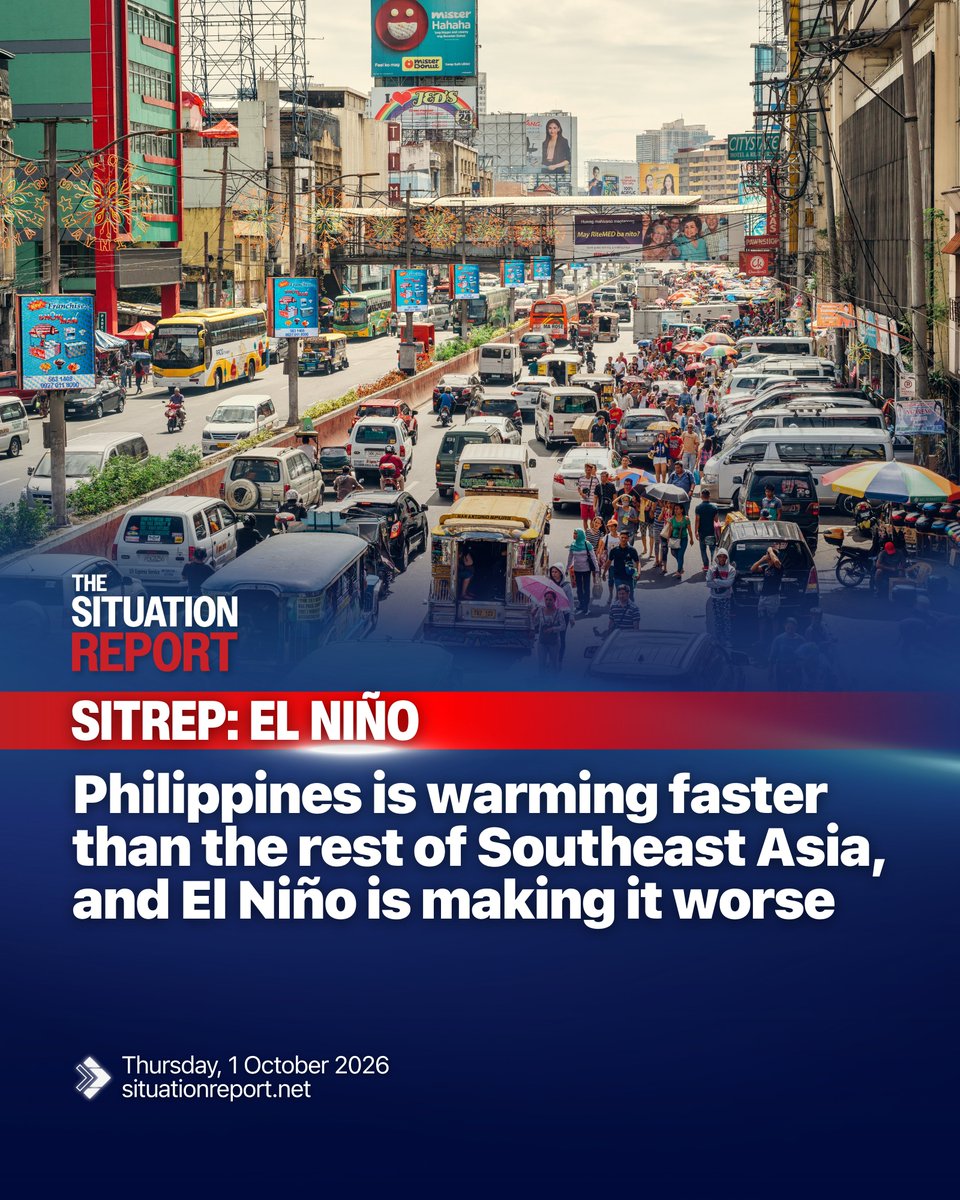
PHILIPPINES IS WARMING FASTER THAN THE REST OF SOUTHEAST ASIA, AND EL NIÑO IS MAKING IT WORSE SITREP/El Niño: The Philippines is already warming faster than the rest of Southeast Asia, and the current El Niño phenomenon is amplifying the effects of global warming. This produces both prolonged dry spells and more intense rainfall and tropical cyclones that the country must prepare for well in advance, Special Envoy for Disaster Risk Reduction and Management Toni Yulo-Loyzaga said Thursday, October 1. Yulo-Loyzaga made the assessment in an interview on @DZRHNews program "The Situation Report," explaining that while the Pacific Ocean's temperatures are near normal in Southeast Asia, the Philippines already has a distinct warming signal. She said the consequence of this warming pattern will not be simple: higher temperatures cause more ocean evaporation, which forms more rainfall, meaning the Philippines can expect both extreme heat and extreme rainfall events, not one or the other. "Ang combination po niyan ay already extreme heat or extreme rainfall ngayon. In this particular season, and because of El Niño, na-e-enhance pa rin po ang effects ng global warming," Yulo-Loyzaga said. Yulo-Loyzaga, who previously served as the Philippines' environment secretary, said the warming country is already seeing impacts on its coral reefs, fisheries, and the formation of extreme weather events. Observations from U.S.-based National Oceanic and Atmospheric Administration (NOAA), she stressed, have confirmed that the Philippines is warming faster than the rest of Southeast Asia. PAGASA has already forecast a period of prolonged rainless days beginning in the last quarter of 2026 and extending into the first quarter of 2027, with below-normal rainfall beginning in Northern Luzon in November, spreading to Visayas and Mindanao in December, and covering the entire country by February to March 2027. #TheSituationReport


Hamza Tillah @hamza_till91794
47 Followers 2K Following
Sarah 5% @SarahLewis7o
868 Followers 4K Following whatever the least favourable interpretation is #healthylongevity #a2zbyjan
DarrenZedren @Drink_and_Vibe
242 Followers 464 Following Aussie Veteran. Vibe Coder. Former electrician. Now I code all day and build my imagination. Check out my website for all my builds!
Sky Knight @SkyKnight1570
328 Followers 924 Following Traditional Catholic, Death to the enlightenment! Yes to the Social Kingship of Christ !!!
Kabesang Tales @KabesangTales19
38 Followers 2K Following


Betha Servito @bethaaaser
1 Followers 78 Following


Lyn Cristobal @CristobalLyn3
0 Followers 257 Following
cheri @yumicherii20
16 Followers 39 Following
tess @tessky6d
30 Followers 739 Following
Daimyo Holdings @daimyo_holdings
44 Followers 2K Following
Martin Julius @martjulps
485 Followers 791 Following 📰 Archivist. 📚Librarian. 🎓New Professional. 📝Educator. 🇵🇭 Public Servant. 💭INFP-T.
Hoàng Ngô @Diggory3010
1 Followers 23 Following
Marius Reginald Alari... @mariuspriolo
488 Followers 2K Following Media Practitioner. 📺🎤🎬 | (B.A. Communication) Licensed Real Estate Broker. 🤝💼🏘️ | (B.S. Real Estate Management). @mariuspriolotwo Digital Savvy.


EjaeA @iamEjaeA
1K Followers 2K Following Plan the trade, trade the plan. Otherwise, don't engage. | Thank God for MJH and SMC. | Retail Speculator — NFA.
decoy @22three7eleven
4K Followers 5K Following Filipino🇵🇭. reflections on PH politics, mostly in Tagalog + English. dumping random thoughts on Pokémon, anime & manga. sometimes food. September ♎️

Joy de Guzman @cjoytalk
27 Followers 852 Following
Tómas 💀 @tevszn
28 Followers 2K Following
Marcy Gibson @MarcyGibsoayo
39 Followers 1K Following

A T Garcia- Chang 张... @HeyItsTyroneC
792 Followers 975 Following Online seller, BGYO, Win Metawin, Byeon Wooseok, River Joseph, BL and Asian Drama fan, Dishwasher, Encoder, Food monster, Singer, 🌈since March 2020.
Bayani Gonzales @Bayani77
59 Followers 264 Following Passionate about Filipino culture, food, and family. Exploring the beauty of the Philippines one adventure at a time. Join me on this amazing journey! 🌴🌄
Dioscoro Alvarado @DioscoroAlvarad
5 Followers 63 Following
Judy @Judyxoalee
189 Followers 3K Following Finding beauty in diversity, appreciating the richness of cultures, and celebrating our differences.
ligaya-dc @ligayadc80
4 Followers 36 Following
decoy @decoy2wit
32 Followers 1K Following
Yam @yam888star
0 Followers 52 Following
Christomatic @Christo39685220
12 Followers 207 Following



Bon Marcelo @Bonfrancism
37 Followers 236 Following I am a loving father to my son and wife...a son to a parents who worked hard to raise me to the person I am today...with a heart for the needy
Edwin Tejada @EdwinTejad2326
1 Followers 25 Following
Lito Nunag @LitoNunag4686
10 Followers 476 Following
Reg @in_rage
135 Followers 365 Following Don’t get it twisted.. get it Right.. did it different.. did it better.. did it Nice.. did the impossible.. then I did it Twice..
Brog @Brog84652577
58 Followers 3K Following

Ser Cha @chanitzgor
20 Followers 120 Following i8 am juzt ur ordinary gay friend...looking for a relationship with a person who does like gays also...im an educator who tries to educate my self bout lovelife
Edgardo Faustino @EdgardoFaustin1
5 Followers 55 Following
Renee Solid @LumbangRodolfo
10 Followers 302 Following

BBC News (World) @BBCWorld
42.3M Followers 17 Following News, features and analysis from the World's newsroom. Breaking news, follow @BBCBreaking. UK news, @BBCNews. Latest sports news @BBCSport
World Economic Forum @wef
4.3M Followers 975 Following The international organization for public private cooperation. #wef26
University of Oxford @UniofOxford
1.1M Followers 1K Following Welcome to our official account 👋 Follow for the latest news, research and updates about life at Oxford.
PHIVOLCS-DOST @phivolcs_dost
851K Followers 61 Following PHIVOLCS is the service institute of the DOST for monitoring and mitigation of volcanic eruptions, earthquakes and tsunami.
Light Rail Manila Cor... @officialLRT1
56K Followers 154 Following Private operator of #LRT1 🇵🇭 | https://t.co/CwLELpdsvb
PING LACSON @iampinglacson
94K Followers 636 Following What is right must be kept right; what is wrong must be set right. (ANG TAMA AY IPAGLABAN; ANG MALI AY LABANAN)
Politiko @Politiko_Ph
78K Followers 197 Following Your ultimate insider pass to the lives of the country’s newsmakers. We've got the drama and stories you won't find anywhere else. Founded 2014.
Abante News Online @AbanteNews
68K Followers 205 Following Abante ang pinakamatinding tabloid sa Pilipinas ngayon! Mag-like, mag-follow at maging updated sa mga balitang sumasagitsit at pumupulandit - mainit-init pa!
Fox News @FoxNews
29.4M Followers 290 Following Stay Ahead. Get Breaking News Here First. Download the App.

Reuters @Reuters
26.4M Followers 1K Following Top and breaking news, pictures and videos from Reuters. For breaking business news, follow @ReutersBiz. Our daily podcast is here: https://t.co/KO0QFy0d3a
Pope Leo XIV @Pontifex
17.9M Followers 47 Following Welcome to the official account of His Holiness, Pope Leo XIV.
alvin elchico @alvinelchico
123K Followers 214 Following
AFP News Agency @AFP
2.4M Followers 641 Following Top news and features from AFP's reporters around the world. Official account.
CBCPNews @cbcpnews
34K Followers 2 Following The news service of the Media Office of the Catholic Bishops' Conference of the Philippines E-add: [email protected]
Vatican News @VaticanNews
732K Followers 3 Following Vatican News is a service provided by the Holy See's Dicastery for Communication. Follow us for news about Pope Leo XIV, the Vatican, and the Church.
Al Jazeera English @AJEnglish
10.1M Followers 259 Following Your story. Your platform. For breaking news alerts, follow @AJENews. Join us on Telegram for real-time updates: https://t.co/xl7ggSArvE
DOE Philippines @DOEgovph
47K Followers 190 Following The Official Twitter account of the Department of Energy of the Republic of the Philippines
BBC Breaking News @BBCBreaking
50.2M Followers 3 Following Breaking news alerts and updates from the BBC. For news, features, analysis follow @BBCWorld (international) or @BBCNews (UK). Latest sport news @BBCSport.
Philippine Airlines @flyPAL
2.5M Followers 1 Following 🩵 Fly PAL and experience #CareThatComesFromTheHeart 🇵🇭 The Philippines’ flag carrier and Asia’s longest-serving airline
Philippine Informatio... @PIADesk
54K Followers 500 Following The Official X account of the Philippine Information Agency.
DepEd @DepEd_PH
3.0M Followers 225 Following The executive agency for basic education of the Republic of the Philippines. For comments, queries, or complaints, email us at [email protected]

Bangko Sentral @BangkoSentral
75K Followers 444 Following The official Twitter account of the central bank of the Philippines #BSP #BangkoSentral | https://t.co/KbwBsd7p0h
DOTrPH 🇵🇭 @DOTrPH
272K Followers 72 Following Official Twitter Account of #DOTrPH | Working to provide a comfortable, accessible, safe, sustainable, and affordable transportation services for the Filipinos.
KapusoMoJessicaSoho @KM_Jessica_Soho
1.1M Followers 62 Following The official Twitter account of #KMJS. This account is managed by @GMA_PA Social Media Team and does not necessarily reflect the views of our host.
TIME @TIME
18.5M Followers 472 Following News and current events from around the globe. Since 1923. Subscribe: https://t.co/yT0dueLEm0
The Manila Times @TheManilaTimes
191K Followers 481 Following The Manila Times is one of the leading national daily broadsheets in the Philippines. It is one of the longest running having been founded in 1898.
State of the Nation -... @stateofdnation
111K Followers 260 Following State of the Nation is GTV's flagship newscast anchored by Atom Araullo.
Philippine Navy @Philippine_Navy
51K Followers 184 Following Official Twitter Account of the Philippine Navy | Protecting the Seas, Securing Our Future
Manila Standard @mnlstandardph
114K Followers 224 Following Manila Standard 🌏🇵🇭 Your trusted news source https://t.co/rmQCnNSgGa🌐 [email protected]
Philippine Air Force @PhilAirForce
33K Followers 129 Following The Philippine Air Force is a Branch of Service of the Armed Forces of the Philippines which has the primary responsibility to protect the Philippine Air Space
Philippine News Agenc... @pnagovph
88K Followers 267 Following The official Twitter account of Philippine News Agency, the newswire service of the Philippine government.

risa hontiveros @risahontiveros
513K Followers 920 Following Senator - Para sa kalusugang pangkalahatan! Akbayan Chairperson - para sa magandang laban!
MERALCO @meralco
1.8M Followers 21K Following The OFFICIAL Twitter Account of the Manila Electric Company. SMS Messaging: 09209716211 (SMART) / 0917-5516211 (GLOBE)
Philippine Red Cross @philredcross
542K Followers 566 Following Always first, always ready, and always there #PHRedCrossCares #PRCLifelineOfThePeople #HopeBeginsWithTheRedCross
DILG Philippines @DILGPhilippines
113K Followers 94 Following The Official Twitter Account of the Department of the Interior and Local Government, Republic of the Philippines. #DILGNatin https://t.co/k8LWbFqsQo
BusinessWorld @bworldph
72K Followers 702 Following The official page of BusinessWorld. The Philippines' leading and most trusted source of business news.
Official MMDA @MMDA
4.0M Followers 125 Following Official X Account of the Metropolitan Manila Development Authority | Hotline 136 | [email protected] | VIBER 0956-6632-221
DPWHph @DPWHph
78K Followers 111 Following Official account of the Department of Public Works and Highways (DPWH) - the engineering and construction arm of the government of the Philippines.
TV Patrol @TVPatrol
2.3M Followers 267 Following Patrol ng Pilipino, naglilingkod saan man sa mundo.
Philippine National P... @pnppio
225K Followers 1K Following The Official Twitter Account of the Philippine National Police TO SERVE AND PROTECT
Philippine Statistics... @PSAgovph
66K Followers 54 Following This is the official page of the Philippine Statistics Authority.
COMELEC @COMELEC
184K Followers 326 Following The official X account of the Commission on Elections managed by the Education and Information Department..
Department of Finance @dofgovph
46K Followers 206 Following The Department of Finance is the Philippine government's steward of sound fiscal policy. Receive on-the-go economic updates: https://t.co/3h9ms58FJV.
DZBB Super Radyo @dzbb
262K Followers 1K Following The official X account of Super Radyo DZBB 594 kHz, the flagship AM radio station of GMA Network, Inc.
Philstar Business @philstarbiznews
18K Followers 63 Following Data-driven news and analysis on Philippine economy, business and public policy.
Philippine Coast Guar... @coastguardph
89K Followers 42 Following
Department of Health ... @DOHgovph
663K Followers 65 Following The official twitter account of the Department of Health Philippines.Trends for United States
You might like