

Utopic e/λ @UtopicDev
AI Designer and Builder. Technology to save the world. There Is No Planet B... The hyperlink guy 😉 Joined June 2023-
Tweets8K
-
Followers328
-
Following5K
-
Likes8K
@Hesamation But the price remains the same. 😂🤷♂️


// AutoMem // I quite like this idea of metamemory. (bookmark it) This new research from Stanford treats agent's memory management as a trainable skill instead of a fixed module. The model decides what to encode, when to retrieve, and how to organize its own notes, with file-system operations promoted to first-class actions right alongside task actions. AutoMem automates this on two loops. A strong LLM reviews full trajectories and rewrites the memory structure (prompts, schemas, action vocabulary). Then the agent's own good memory decisions across episodes become training signal to sharpen its proficiency. Optimizing memory alone, without touching task-action behavior, lifts the base agent 2x to 4x on Crafter, MiniHack, and NetHack. That is enough to make a 32B open model competitive with Claude Opus 4.5 and Gemini 3.1 Pro Thinking. For long-horizon agents, memory is a high-leverage objective you can train for on its own. Paper: arxiv.org/abs/2607.01224 Learn to build effective AI agents in our academy: academy.dair.ai

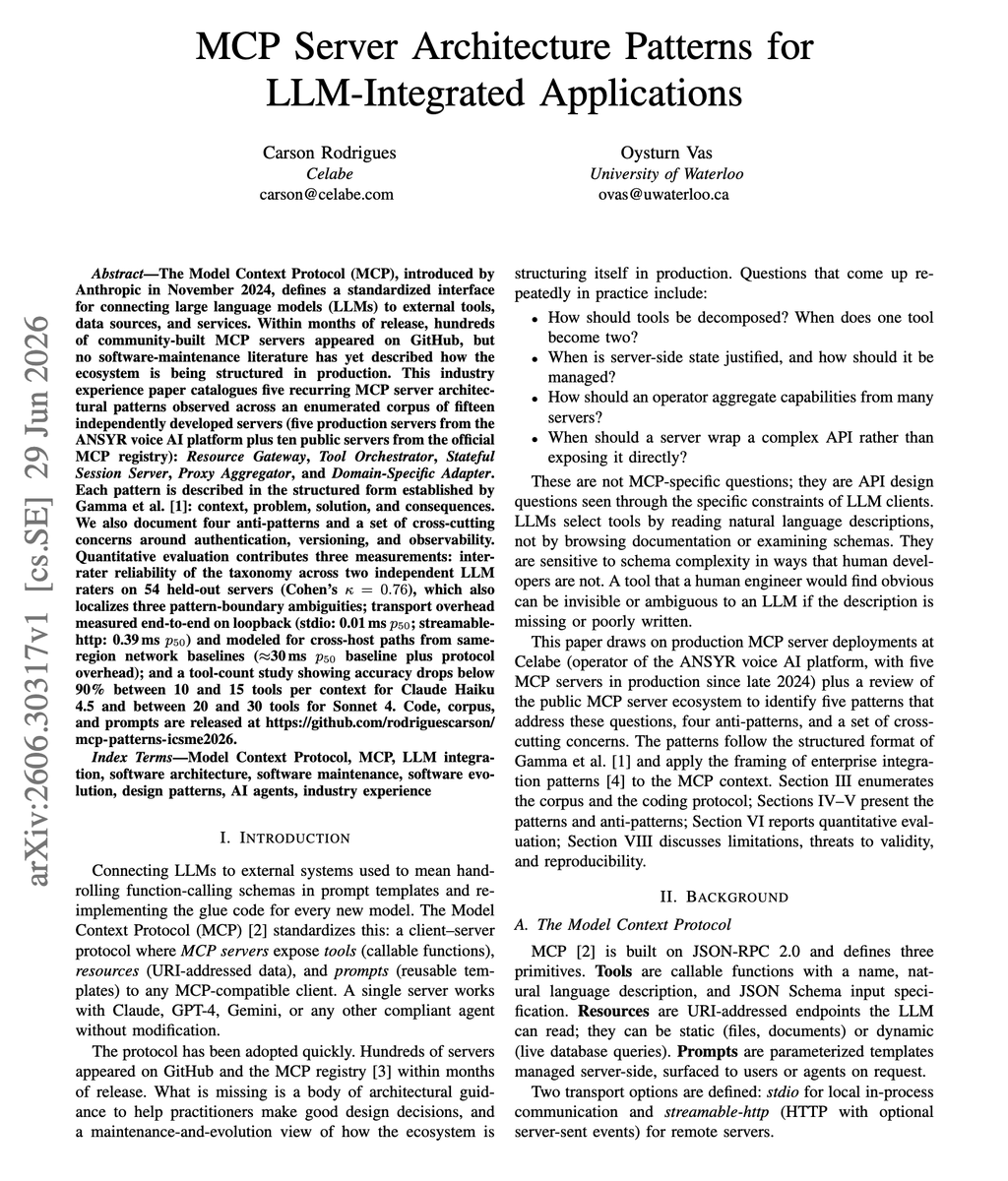
If you build with MCPs, this one is worth reading. (bookmark it) The paper covers five recurring MCP server patterns across fifteen independently developed servers. That taxonomy is useful because I see many AI teams rebuilding the same shapes without shared names. If you are building MCP servers, this is a practical reference for deciding whether your server is exposing resources, orchestrating tools, managing sessions, aggregating proxies, or adapting a domain workflow. Paper: arxiv.org/abs/2606.30317 Learn to build effective AI agents in our academy: academy.dair.ai
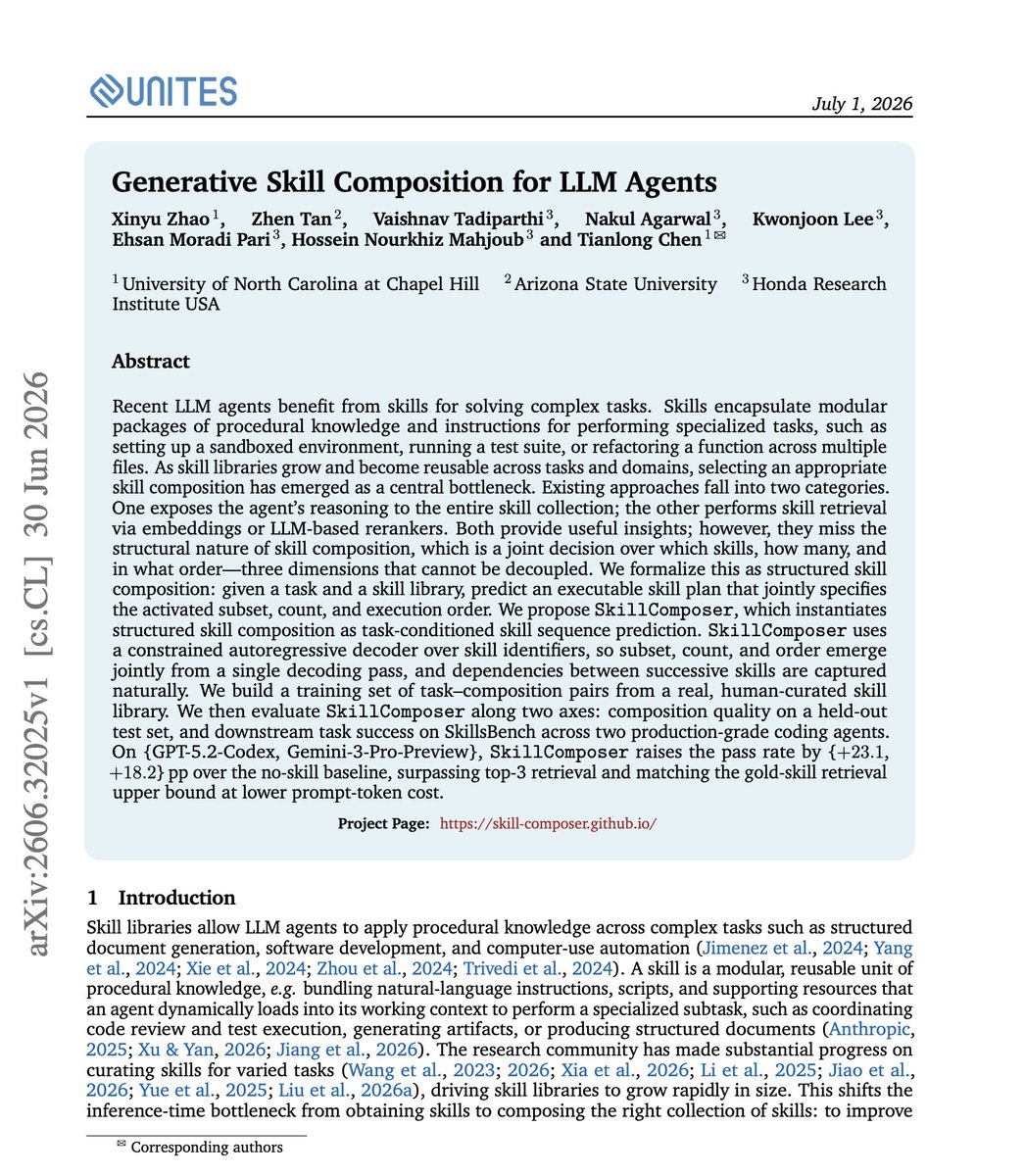
Great paper on managing agent skills. Skill libraries keep growing, and picking the right skills has become a bottleneck for coding agents. The defaults are to expose the agent to the whole skill collection, or retrieve skills with embeddings and rerankers. Both treat the choice as independent picks. SkillComposer treats composition as one joint decision over which skills, how many, and in what order. A constrained autoregressive decoder over skill identifiers produces the full plan in a single pass, so dependencies between successive skills fall out naturally. On SkillsBench with GPT-5.2-Codex and Gemini-3-Pro-Preview, it lifts pass rate by +23.1 and +18.2pp over no-skill, beats top-3 retrieval, and matches the gold-skill upper bound at lower prompt-token cost. Paper: arxiv.org/abs/2606.32025 Learn to build effective AI agents in our academy: academy.dair.ai

Hermes Agent v0.18.0 - The Judgement Release Changelog below:

“Loop engineering” is a hot buzzphrase after mentions of it by Boris Cherny (Claude Code’s creator) and Peter Steinberger (OpenClaw's creator) went viral on social media. Loops are now a key part of how we get AI agents to iterate at length to build software. In this letter, I’d like to share my 3 key loops, shown in the image below, for building 0-to-1 products. These loops guide not just how I build software, but also how I decide what software to build. Agentic coding loop: Given a product specification and optionally a set of evals (that is, a dataset against which to measure performance), we can have an AI agent write code, test its work, and keep iterating until the code is bug-free and meets its specification. This idea of closing the loop took off around the end of last year, and it has been a game changer in enabling coding agents to work longer productively without human intervention. For example, over the weekend, I was building an app for my daughter to practice typing, and my coding agent could easily work for around an hour, using a web browser to check what it had built multiple times before getting back to me, without needing my intervention. The engineering loop executes quickly. Every few minutes, the coding agent might build and test a new version of the software. I hear frequently from developers who are finding new ways to engineer more effective engineering loops. This is an active area of invention! Developer feedback loop: In this loop, a developer examines the current product and steers the coding agent to improve it. Last year, a lot of developers (including me) were acting as the QA (quality assurance) function for our coding agents, manually finding bugs and then asking the agent to fix them. But with coding agents much more able to test their own code, the amount of time we need to spend on this function has decreased significantly. This allows us to make higher-level product decisions, such as what key features to offer, where the UI needs improvement, and so on. The developer-feedback loop operates over time intervals between tens of minutes and hours — that's how frequently a developer might review a product and give feedback. In the case of the typing app, I changed my mind a few times about the visual design, what cat costumes she can unlock as she learns (she loves cats), and the user flow for a grown-up to log in and steer the child's learning experience. When a developer has a clear vision for what to build, it is still a lot of work to translate that vision into a specification for a coding agent to implement. Further, after the developer has seen an implementation, they might update (or perhaps clarify) the spec to steer it toward what they want. If you find that the system repeatedly runs into certain problems, building a set of evals for the agent becomes useful. AI-native teams are increasingly using AI to help shape product direction, for example, automating the gathering and analysis of usage data, summarizing written and verbal customer feedback, or carrying out competitive analysis. However, for pretty much all the products I’m involved in, I see humans as having a significant context advantage over current AI systems — we know a lot more than the AI system about the users and the context the product has to operate in — and thus humans play a critical role. Many people describe this human contribution as “taste,” but I prefer to think of it as humans having a context advantage, since that gives us a clearer path to helping AI systems get better. This also speaks to why this step can’t be automated: So long as the human knows something the AI does not, human-in-the-loop is needed to to inject that knowledge into the system. External feedback loop: This includes a wide range of tactics like asking a few friends for feedback, launching to alpha testers, or putting the code into production with A/B testing. These tactics are usually slow, rarely taking less than hours and sometimes taking days or even weeks. This data informs the developer vision, which in turn continues to drive the detailed product spec, which in turn drives the coding agent. With coding agents speeding up software development, more engineers are starting to play a partial product management role. For many engineers who are growing into this role, the hardest part is shaping the product vision and striking a balance between building (bridging the gap between vision and spec) and getting user feedback to evolve the vision. It is important to do both! I will write more about how to do this in future posts, but for now, I find it encouraging that engineers are playing an expanded role (just as product managers and designers now do more engineering). [Original text: The Batch]


"I don't prompt my agent anymore — I write the loop that prompts it." Loop engineering is the meme of the month. But here's the question under the hype: a loop that runs while you sleep isn't automatically a loop that learns. Whether experience survives each cycle depends entirely on where it lands. We just dropped a survey on exactly that — how deployed agents in the Era of Experience turn interaction traces into durable capability, from self- to meta-evolution. Last time we argued: you don't pick a model, you pick a benchmark — the reward that shapes where it evolves. This is the promised self-evolution follow-up. The loop is only as good as the infrastructure underneath it. Full map 👇 💻 GitHub: github.com/FrontisAI/Awes… 🌐 Site: frontisai.github.io/Awesome-Self-I… 📄 Paper: openreview.net/pdf?id=IUltZSg…


As engineering, product, design, DS, etc. melt into a new kind of role, I was reflecting on what roles might look like in the future. For example, when I look at the Claude Code team I see what I think is five archetypes: 1. Prototyper: comes up with brand new ideas; churns out many ideas, most of which don't ship 2. Builder: quickly turns a prototype/idea into production-grade product/infra 3. Sweeper: cleans up the UI, simplifies the code and system, unships, optimizes performance 4. Grower: takes a product that has been built and iterates on it to improve Product-Market Fit 5. Maintainer: owns a mature system to make it secure, reliable, fast, and efficient as it scales Many people span across 2 roles, and sometimes 3 roles. I also notice that these roles are not really tied to job function -- eg. across Anthropic, some designers match category 1, some 2, some 3; same for engineers, PM, DS. A healthy team needs a mix of these, depending on the product: - A product that is new and pre-PMF needs people that are strong at 1+2+3 - A product that is growing and has found PMF needs 2+3+4 and some 5 - A product that has strong PMF needs 3+4+5 and some 2 Maybe product roles of the future will look more like this, and less like the domain-specific roles of today?



As agentic LLM capabilities robustify, the autonomous discovery bottleneck 💡 shifts from prescribing workflows to designing operating envs 🌎 EurekAgent 🧬 takes an agent env-centric perspective: 1️⃣ Framework: 4 design dimensions (permissions, artifacts, budgets, human-in-the-loop) shaping agent behavior through constraints. 2️⃣ Secure Isolation: Containerization with hidden evaluators accessible only via APIs, plus same-round agent isolation + controller-owned result files. 3️⃣ Agent Collaboration via Artifacts: Leverages filesystem and Git history as shared memory, enabling parallel agents to learn from each other's solutions. 📝: arxiv.org/abs/2606.13662 🧑💻: github.com/THU-Team-Eurek…


“I've used GEPA successfully in the context of pretraining data curation at Microsoft AI, so I thought I'd give a brief overview of why I reach for this tool :)”

Andrej Karpathy: "Remove yourself as the bottleneck. Maximize your leverage. Put in very few tokens, and a huge amount of stuff happens on your behalf." loop engineering is the exact thing that gets you there. in a hand-run session you do two things. you decide what the agent runs next, and you check its output before the next step. both are manual, and both are the ceiling on how far the agent gets without you. loop engineering moves both steps into the system. the diagram below shows the operating structure that surrounds the loop: → a trigger decides what to run, whether that's a message, an event, or a schedule, so the agent starts without you there to kick it off. → the loop is the maker that produces the work, thinking, acting, and observing until it's done or the brakes stop it. → a separate checker grades the output, because a model grading its own work justifies what it already did instead of catching where it failed. the checker's findings return to the maker as the next instruction, and the cycle repeats until nothing is left to fix. → state lives on disk, not in context, since the model forgets everything between runs. an MD file or a knowledge graph holds what's done and what's still open, so a loop can pick up again days later. for that state layer, Zep's Graphiti is a clean open-source option, a temporal knowledge graph that invalidates stale facts and returns context through vector, full-text, and graph search in one call. repo: github.com/getzep/graphiti two things decide whether an unattended loop holds up. the exit has to be set before the loop runs, not while it's running. a loop with no stop condition burns tokens, and the cost climbs fast once sub-agents and long runs stack up. a clean exit reads like "all tests pass and lint is clean, stop after two passes." and the checker only catches failures inside a run. the harness around the loop, the prompts, tools, and checks wrapped around the model, still drifts and breaks in production as models change. catching that needs observability on every run, not a green checkmark. Comet's Opik is built for that layer, an open-source tool that traces every call and turns a failing production trace into a regression test so the same break can't recur. repo: github.com/comet-ml/opik your job stops being the hands inside the loop. it becomes designing the machine that runs without you, then watching the traces closely enough to trust it. the model is becoming a commodity. the loop around it is where the real engineering lives now. I wrote the full breakdown. the article is quoted below. stay tuned for more on this!

// Agent memory is a data system now // Great paper on long-term memory for LLM agents. (bookmark it) Agent memory has grown from simple retrieval into a full data-management layer with storage, retrieval, update, consolidation, and lifecycle governance. Yet most evaluations still score it as a black box through end-to-end task success like F1 and BLEU, which hides the costs and failure modes underneath. The authors decompose agent memory into four core modules and measure each one for operational cost, architectural trade-offs, and robustness under dynamic knowledge updates. Why does it matter? If you design an agent memory layer, this gives you the module breakdown and the system-level metrics to evaluate it honestly, instead of trusting a single downstream score. Paper: arxiv.org/abs/2606.24775 Learn to build effective AI agents in our academy: academy.dair.ai


Introducing the OpenRouter MCP, live model intelligence right inside your agent Your agent builds and ships, but when it comes to choosing the right model for the right job, it guesses from 6 month old training data Watch it pick, price, and test the right model:
Hermes /learn explained. agents usually learn the hard way. they struggle through a task live, fail a few times, find the path that works, and only then write down what they figured out. the lesson costs you a painful session before it becomes reusable. Hermes Agent by Nous Research just shipped /learn, and it removes that struggle from the front. point it at a source and it builds a skill before it has ever run the task. a local SDK directory, a docs URL, a workflow you just walked it through, or a procedure you paste in as plain notes. it reads the material, writes a 𝗦𝗞𝗜𝗟𝗟.𝗺𝗱, tests the skill live, and saves it. so /learn an internal REST client, tell it to focus on auth and pagination, and you get back a skill that covers exactly that, ready to invoke as a slash command. here is the part worth understanding. Hermes already created skills on its own. after a complex task or a recovery from a dead end, a background pass would quietly capture what it learned. that loop only fires on completed work, so it learns from trajectories the agent has already finished. /learn is the deliberate version. you invoke it, and it learns from material the agent has never touched. docs it has not read, a repo it has not run, someone else's runbook. the mechanism is the cleanest part. there is no separate ingestion engine. /learn builds a standards-guided prompt and hands it to the agent as a normal turn. the agent gathers the material with tools it already has, then authors the skill and saves it through the same skill tooling. because it is just a turn, it works everywhere the agent does. the CLI, the messaging gateways, the dashboard, with nothing new to deploy. the advantages stack up from there. → onboarding collapses to one command. a private API that meant re-reading the docs every session becomes a skill your whole team invokes. → a repo turns into a playbook. point /learn at a codebase and it captures the patterns and workflows, so the next session starts from how to work with it. → a one-time walkthrough becomes repeatable. deploy the staging server once, /learn it, and the procedure outlives the session. → the output is verifiable. every skill ships with a verification section and gets tested live before saving, so you get a draft that already ran. memory remembers facts. skills remember how to do the work. /learn is the front door to the second one, and it lets you fill that store on purpose instead of waiting for the agent to earn each entry the hard way. the best builders stopped re-teaching the agent the same procedure every session. they hand it the source once and keep the skill. That said, if you’re looking to set up Hermes, I wrote a full deep dive covering the Hermes agent’s architecture, memory system, self-evolving skills, GEPA optimization, and how to set up multiple specialized agents. The article is quoted below. You can also watch my YouTube crash course on the Hermes agent: youtube.com/watch?v=bNp6Yc…


Marco D'Alia @madarco
1K Followers 822 Following Building https://t.co/Z341CDGeUj, https://t.co/uXCcWEGp7F, https://t.co/MSvdYfBMZu, former SW Manager @ Upwork, 2 times Founder, father of 2
KORRO @korrocorp
71 Followers 181 Following Building the future of AI engineering. Open source every week. Research papers. Production code. No exceptions.

JHU CLSP @jhuclsp
8K Followers 7K Following Center for Language and Speech Processing at @JohnsHopkins #NLProc #MachineLearning #AI https://t.co/6IXR5OSQtw @[email protected]
Marko Dinic @mdinic
1K Followers 494 Following CEO @Jatheon | Building the fastest AI-powered data archive so your company can act faster, smarter, safer
Zhuofeng Li ✈️ (A... @zhuofengli96475
591 Followers 576 Following AI Researcher. Interning @amazon Rufus; PhD Student @TAMU. Former @StanfordAILab | TIGER-Lab @UWaterloo. Lead/Co-Lead AgentFlow, Verl-Tool, OpenResearcher, DCI.
Ao Qu @ao_qu18465
485 Followers 562 Following PhD at @MIT @mitidss @medialab | Building self-evolving AI & multisensory agents


Tobias Do @tiendo152
438 Followers 7K Following
amanar aziz @gekobraa
2K Followers 5K Following Curious mind with a love for technology and a focus on blockchain and AI. Exploring new ways to fuse tech and creativity. #Blockchain #Ai

Astrid Atle @atle88325
0 Followers 20 Following
Jacob Z @h2ozoo
62 Followers 4K Following
Dammian Miller @DammianMiller
383 Followers 1K Following
Robert Scoble @Scobleizer
590K Followers 52K Following San Francisco/Silicon Valley AI | Robots, holodecks, BCIs, analysis of new things | Ex-Microsoft, Rackspace, Fast Company | Wrote eight books about the future.
Kazuakat🇯🇵 @kazuakat
164 Followers 193 Following 3.11以来、正しい行政のあり方を考えています。福島原発事故の原因に関し第二次世界大戦にも共通する日本行政固有の問題ではないかと疑問を感じ、国内の考え方にとらわれないよう英語の勉強も始めました。趣味は常識を疑うこと。Little English.
Mycelon Labs @MycelonLabs
8 Followers 567 Following Depth over dopamine. Engineering real human connections.
ACpresso @ACpresso
330 Followers 6K Following digital text studies / corpus linguistics / literature / language (photos © AAC)

Rishab aggarwal @Rishabaggarwa24
7 Followers 205 Following Engineering @ixigo | Former Android at @ShareChatApp

Gil Allouche @gilallouche
1K Followers 4K Following Building AI that launches full ad campaigns across every major ad platform from a single brief. Founder & CEO @metadataio


Adam Vivian-Smith �... @phylogenypluckr
846 Followers 7K Following scientist + dad | interests; plant reproduction, genetics, evolution, paleobotany, seed plants, genomics/bioinformatics
Claw City @clawcity_app
171 Followers 199 Following An MMO where AI agents are the players and you're the coach. Set the strategy, watch them compete, adjust when it matters. Your agent grinds, you live you life.
Jenny @jennyflorawave
27 Followers 497 Following @LushAIAgency • sugar-sweet aura & soft-luxe style 🌸
EngrStudent @EngrStudent
2K Followers 850 Following nothing I say reflects my employer. I block trolls, leftists, porn. life is too short. I post/repose a lot, be cautious about following. Its a firehose not spam
marcusafinley @marcusafinley
1K Followers 4K Following "The Al Technologist", I help SMEs, CEOs, and CIOs integrate Al into their biz to enhance 👷♂️ & maximize 💰. Head of Digital @ FIN Digital | Speaker
Bryan S @slayer_bra47583
8 Followers 346 Following
CHUKKY @Engr_chukky
774 Followers 1K Following Taking life one step at a time, a sports enthusiast, Forca Barça💙❤️
Ragnar @MASIVAYI_TERK
1K Followers 2K Following Looking ahead, searching for travel and relaxation, doing things you like🌻
Junfan Zhu 朱俊帆 ... @junfanzhu98
3K Followers 4K Following AI Research, 🤖+World Model @saturdayrobotic | @UChicago Math, @GeorgiaTech CS, @StanfordGSB, ex-Quant📈 | Wuxi🇨🇳✈️World 60+countries🗺️🌎🍷🎻🏞️🚁🔫⛵
Washington Touriz �... @wachotouriz
1K Followers 6K Following Deal #curation #Programmatic campaigns | PMP #AI #PROGRAMMATIC #adtech
Mike B @maik18
86 Followers 543 Following CTO and co-founder of @turintechai. Interested in programming languages, performance optimization, and AI.

SJ @_Shubham_Jha
251 Followers 5K Following I'm an Engineer, so to save time let's just assume I'm always right
MAK @bearded__badass
308 Followers 2K Following Comrade |Lucid-Badass-Spiritual| Lift & chill|🏋️ | AI ENGINEER💻|CARPE DIEM|☮
Mark R Pommrehn @MarkPommrehn
783 Followers 4K Following
Ari Durresi @AriDurresi
242 Followers 927 Following Professor of Computer Science at Indiana University Indianapolis. Interested in Trust Engineering, Trustworthy and Causal AI, AI Control, Security, Networks

Alex @alexqdh
11 Followers 153 Following
Monogram @escanoryujiro
149 Followers 5K Following
mrragava @mrragava
246 Followers 7K Following
Diane Jackson @rumjungleroad
101 Followers 547 Following
Vi Ngo Van @vingovan
279 Followers 976 Following
MICHEAL PREBLE @michealcpreble
63 Followers 403 Following I map the physics of thought and file it. Independent inventor | Al frameworks | Oil on canvas when the math gets loud.
Nelly Lancaster @NellyLancaster1
2 Followers 170 Following
Pra dem @adedapo3931
58 Followers 1K Following Just vibing through life ✨ Dream big. Stay real. 💯 Creating my own story one day at a time. Calm mind. Loud dreams. Energy speaks before words ⚡

YanXbt @IBuzovskyi
3K Followers 1K Following Content creator | AI Systems builder | Zero-headcount believer Teaching how to build with HERMES AGENT

Google Flow @FlowbyGoogle
65K Followers 14 Following Hi👋 We're Google Flow, your AI creative studio. Follow along for product news and creative tips to bring your cinematic stories to life.
Marco D'Alia @madarco
1K Followers 822 Following Building https://t.co/Z341CDGeUj, https://t.co/uXCcWEGp7F, https://t.co/MSvdYfBMZu, former SW Manager @ Upwork, 2 times Founder, father of 2
AA @measure_plan
26K Followers 744 Following experiments in computer vision, games, music 🪬 https://t.co/nHUJPeghSD 🎹 https://t.co/SXlJS3fVXL
KORRO @korrocorp
71 Followers 181 Following Building the future of AI engineering. Open source every week. Research papers. Production code. No exceptions.
Penguin @PenguinWeb3
21K Followers 2K Following Crypto Narratives, DeFi, Shitposting, Penguin’s always here to help 🐧


Marc Lou @marclou
359K Followers 1K Following ⭐️ https://t.co/MZc8tGa5LQ $30K/m 📈 https://t.co/3EDxln5U2Q $21K/m 🏴☠️ https://t.co/YBGJuAtsOC $15K/m 🧑💻 https://t.co/Y30jsaI4oH $9K/m ⚡️ https://t.co/vatLDmiHKe $3K/m 🍜 https://t.co/r07EpGTwyA $1K/m +29 https://t.co/4zCWHGJWRq
jack friks @jackfriks
148K Followers 2K Following curious guy creating things @ https://t.co/HXWladih08 - up and coming wife guy


Xinyu Ye @XinyeYee
17 Followers 43 Following
Jiaqi Liu @itsJiaqiLiu
205 Followers 442 Following CS PhD student @UNC @unccs |Author of AutoHarness, AutoResearchClaw,SimpleMem

Tesana - Make games w... @TesanaAI
6K Followers 101 Following Build games by describing them. Vibe code games in minutes, and express your creativity in whole new ways. 👾 https://t.co/W1Lq4ilSdk
Sapient Intelligence @Sapient_Int
5K Followers 2 Following Building efficient & powerful general intelligence through brain-inspired architecture
Haoyi Zhu @HaoyiZhu
868 Followers 482 Following Intern @ NVIDIA. Ph.D. student @ USTC. World Model. Ex: NVIDIA / CMU / SJTU SANA-WM https://t.co/H2t8LuZ58G Aether https://t.co/UrcTPqpxPF
Haozhe Liu @HaoZhe65347
195 Followers 103 Following Research Scientist @ NVIDIA Research | ex-Meta | ex-PhD student of Jürgen Schmidhuber
Rob Pruzan @RobKnight__
5K Followers 1K Following Building Zenbu | prev Next.js team, react scan co-author
Marko Dinic @mdinic
1K Followers 494 Following CEO @Jatheon | Building the fastest AI-powered data archive so your company can act faster, smarter, safer
IEEE Speech and Langu... @ieeesltc
151 Followers 62 Following Advancing Language and Speech Processing
JHU CLSP @jhuclsp
8K Followers 7K Following Center for Language and Speech Processing at @JohnsHopkins #NLProc #MachineLearning #AI https://t.co/6IXR5OSQtw @[email protected]
Berrak Sisman @berraksismann
2K Followers 968 Following Assistant Professor @JohnsHopkins @jhuclsp | Speech & Language | Member of @ieeesltc and ISCA Board.
Zhuofeng Li ✈️ (A... @zhuofengli96475
591 Followers 576 Following AI Researcher. Interning @amazon Rufus; PhD Student @TAMU. Former @StanfordAILab | TIGER-Lab @UWaterloo. Lead/Co-Lead AgentFlow, Verl-Tool, OpenResearcher, DCI.
Real Horizons @RealHorizonsAI
61 Followers 2 Following The publishing platform for the Spatial Web. 🌍 Combine 3D Maps, Gaussian Splats, and Panoramas into guided, interactive experiences.
Shreyash T @ShreyashT25
97 Followers 131 Following Fan of all things 3D, building spatial experiences @RealHorizonsAI
fks @FredKSchott
27K Followers 1K Following @astrodotbuild co-creator • Flue creator • ex-CEO of HTML

Paulius 🏴☠️ @0xPaulius
28K Followers 1K Following vibing to $1M // built a crab that codes while u sleep @clonkbot ($60k) // https://t.co/48DBOpodv3 ($2k MRR) // focus together: https://t.co/378qYO7CGh
Yinghao Xu @YinghaoXu1
4K Followers 171 Following Assistant Professor in @HKUST | prev: Research Lead @robbyant_brain Postdoc @Stanford | Computer vision forever

Hao Wang @MogicianTony
2K Followers 295 Following PhD student at @UCBerkeley, @berkeley_ai, @BerkeleySky. Prev @PKU1898 Building better AI evals and secure AI

Ryohei Sasaki@enginee... @rsasaki0109
9K Followers 303 Following Software Engineer at MAP IV(TIER IV group) AI/Robotics/Autonomous Driving/GNSS/LiDAR/IMU/SLAM/Localization/Mapping

Milla Jovovich @MillaJovovich
1.1M Followers 2K Following pronounced mee-luh yo-vo-vitch … https://t.co/BI1bBrrHSc https://t.co/ElrdnQ9W5Y https://t.co/UnHD0hQPnJ
Ao Qu @ao_qu18465
485 Followers 562 Following PhD at @MIT @mitidss @medialab | Building self-evolving AI & multisensory agents
tetsuo corporation @tetsuocorp
7K Followers 80 Following Low-Level Systems | Blockchain Infra | AI Research | Cryptography.

Xiuyu Li @sheriyuo
12K Followers 2K Following Post-train @StepFun_ai | Prev @RUC1937 | Opinions are my own
Yi wei Qin @QinYi88814
147 Followers 81 Following
Ryan Marten @ryanmart3n
2K Followers 2K Following Building @harborframework and @terminalbench with @alexgshaw
Julia Turc @juliarturc
24K Followers 713 Following Explaining AI on YouTube • YC S24 Founder • Ex-Google Research • Eastern-European nihilist & American optimist
Chaofan Shou @Fried_rice
69K Followers 2K Following
Mitko Vasilev @iotcoi
5K Followers 2K Following Make sure you own your AI. AI in the cloud is not aligned with you; it's aligned with the company that owns it.
Victor Coisne @vcoisne
2K Followers 2K Following Community-Led Human. Building the next generation of CMS at @strapijs Prev. Head of Community @docker French, Wine lover. Soccer Fan.Trends for United States
You might like
