Yilong Chen @Yichen4NLP
PhD Student at UCAS. Research on efficiency and generalization in LLM architectures. Still a lot to explore in model architect. chenyilong.cn Joined January 2025-
Tweets28
-
Followers117
-
Following141
-
Likes5
@YouJiacheng @classiclarryd We can quickly verify it on nano, but I don't see a particularly big gap between this article and other btye tokenizers, such as the source of 20x gain.
@karpathy Used your repo for my latest experiments, super cool stuff! I did notice that a lot of the gains come from hyperparameter tweaks and existing methods, though. Any ideas on how to take it a step further into some really original territory?
Three days ago I left autoresearch tuning nanochat for ~2 days on depth=12 model. It found ~20 changes that improved the validation loss. I tested these changes yesterday and all of them were additive and transferred to larger (depth=24) models. Stacking up all of these changes, today I measured that the leaderboard's "Time to GPT-2" drops from 2.02 hours to 1.80 hours (~11% improvement), this will be the new leaderboard entry. So yes, these are real improvements and they make an actual difference. I am mildly surprised that my very first naive attempt already worked this well on top of what I thought was already a fairly manually well-tuned project. This is a first for me because I am very used to doing the iterative optimization of neural network training manually. You come up with ideas, you implement them, you check if they work (better validation loss), you come up with new ideas based on that, you read some papers for inspiration, etc etc. This is the bread and butter of what I do daily for 2 decades. Seeing the agent do this entire workflow end-to-end and all by itself as it worked through approx. 700 changes autonomously is wild. It really looked at the sequence of results of experiments and used that to plan the next ones. It's not novel, ground-breaking "research" (yet), but all the adjustments are "real", I didn't find them manually previously, and they stack up and actually improved nanochat. Among the bigger things e.g.: - It noticed an oversight that my parameterless QKnorm didn't have a scaler multiplier attached, so my attention was too diffuse. The agent found multipliers to sharpen it, pointing to future work. - It found that the Value Embeddings really like regularization and I wasn't applying any (oops). - It found that my banded attention was too conservative (i forgot to tune it). - It found that AdamW betas were all messed up. - It tuned the weight decay schedule. - It tuned the network initialization. This is on top of all the tuning I've already done over a good amount of time. The exact commit is here, from this "round 1" of autoresearch. I am going to kick off "round 2", and in parallel I am looking at how multiple agents can collaborate to unlock parallelism. github.com/karpathy/nanoc… All LLM frontier labs will do this. It's the final boss battle. It's a lot more complex at scale of course - you don't just have a single train. py file to tune. But doing it is "just engineering" and it's going to work. You spin up a swarm of agents, you have them collaborate to tune smaller models, you promote the most promising ideas to increasingly larger scales, and humans (optionally) contribute on the edges. And more generally, *any* metric you care about that is reasonably efficient to evaluate (or that has more efficient proxy metrics such as training a smaller network) can be autoresearched by an agent swarm. It's worth thinking about whether your problem falls into this bucket too.

Yeah, totally — I think this is a very meaningful point. And honestly, it’s super valuable for me to get feedback from someone with real large-scale training experience. I’ve been thinking about these issues a lot too. I think you’re right here: if we try to share across the whole model, at least for now it actually seems worse than more local / smaller-scale sharing, just because the systems complexity gets too high. Really appreciate the suggestion overall. And please feel free to keep the ideas coming — I’d love to hear more.
One more thought: if sharing is on the table, infra may get a new optimization lever. On an existing cluster, better PP / expert placement is not only a throughput issue — it can also shape expert locality, and possibly how much specialization MoUE can extract in practice. So in some cases, colocating experts may help quality too, not just systems efficiency.
@selfattentive @teortaxesTex Our intuition is that PP and experts operate on different axes. PP slices the model by depth, while experts slice it by function. As long as a PP rank contains multiple experts, routing can still produce specialization locally and you still get benefits from parameter sharing.
Also, increasing expert count often means increasing node count, which has real cost both in training and inference. So another angle is: instead of constantly adding parameters and hardware, can we organize the existing parameters better so they specialize more effectively? If that works, you can get algorithmic gains without paying the full economic cost of scaling out.
@selfattentive @teortaxesTex Another lever here is experts per node. If expert capacity is useful, you don’t necessarily have to scale EP across more nodes. You can also increase the number of experts within a node, which keeps routing more local and reduces cross-node traffic.
@selfattentive @teortaxesTex We may also want to re-search the optimal tradeoff among depth, width, and expert count. Since some capacity can be covered by shared experts, we might allocate parameters to more important parts of the model instead, such as hidden dimension.
@strong_signal1 Yes, that’s a feasible approach for downstream systems built on open-source models. For model developers though it might work even better, since they have access to the original pretraining data and can maintain a more consistent expert distribution.
We introduce MoUE. A new MoE paradigm boosts base-model performance by up to 1.3 points from scratch and up to 4.2 points on average, without increasing either activated parameters or total parameters. The main idea is simple: a sufficiently wide MoE layer with recursive reuse can be treated as a strict generalization of standard MoE. arxiv.org/abs/2603.04971 huggingface.co/papers/2603.04… #MoE #LLM #MixtureOfExperts #SparseModels #ScalingLaws #Modularity #UniversalTransformers #RecursiveComputation #ContinualPretraining
@teortaxesTex @kalomaze Great intuition! Stronger routers can actually benefit from these harder load-balancing regimes. We’ve also tried a few small router improvements (Universal Router and I'll try yours). At this point standard LBL is mostly solved — maybe it’s time to focus on the harder cases. 😂
@Xinyu2ML if we could truly solve load balancing, an infinitely wide MoE-MLP might already be enough for AGI lol.
@rudzinskimaciej @teortaxesTex Yes! I have tried this idea, and it has some effect, but the improvement is not particularly significant. The challenge lies in achieving balanced training while ensuring good utilization of both local and shared experts.
@rudzinskimaciej @teortaxesTex What you said makes a lot of sense! Considering that this topology can have countless combinations, there is a lot of work to be done to study how to reduce the complexity of the algorithm's search space while achieving good results.
Thank you for your interest! CPT does indeed yield excellent MoUE results. In our experiments, we achieved good results without even complex design and hyperparameter searches (for example, universal expert selection was directly randomized). However, CPT requires a very fine-grained warmup to ensure that the routing does not crash.
MoEUT is a representative work combining MoE and UT, and I really like it! However, they mainly focus on model-level recursion, which is different from the layer-level reuse problem that MoUE addresses. Nevertheless, I still really like it and will add a discussion section to the paper. Thank you for your suggestion!
Tagging a few communities and curators who might find this interesting: @_akhaliq @huggingface @dair_ai @the_gradient @rasbt Would greatly appreciate any feedback or discussions!
The result is a useful scaling trade: instead of buying capacity mainly with more activated compute or more stored parameters, we can trade **algorithmic structure** for capacity by increasing global reusable experts and their recursive compositions. In practice: - up to +1.3 avg from scratch with no increase in activated params or total params - ~+2.5 in depth expansion - up to +4.2% avg in checkpoint conversion / CPT Our bet is that MoE may scale not only by adding more experts, but by making experts more reusable, modular, and globally composable. That is the direction behind MoUE.
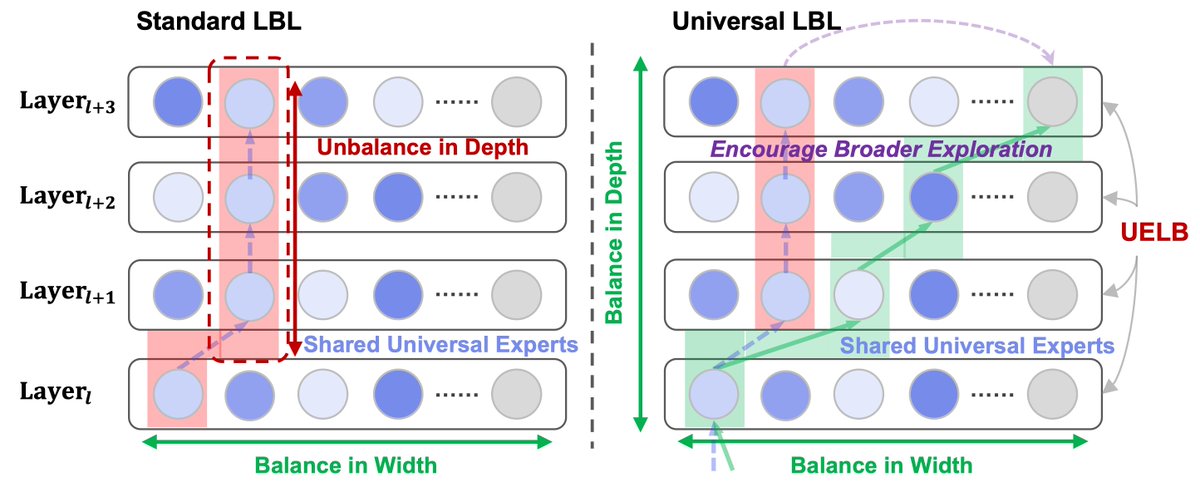
The UELB point is central. Under reuse, load balancing should not just be layer-local. It should reflect the computation graph. That gives a new depth-wise / topology-aware view of load balancing: balance experts relative to where they can be used, not how often they appear globally. This is a different optimization problem from standard MoE.

ALBARON @HamamDarah
112 Followers 2K Following Don’t trust https://t.co/LX9cOKxgLp actions.Behavior will tell you everything.
Pdhpv Xvhdc @xymwsn91847
0 Followers 18 Following
Anthony Dsouza @ajdsouz
13 Followers 480 Following Reasoning | Mech Interp | Multimodality | MSc & Research @LstSaar
Yifan Zhang @yifanzhang_
15K Followers 4K Following PhD at @Princeton University, Princeton AI Lab Fellow. RL & LLM Reasoning, Pretraining & Language Modeling. Prev @ Seed @Tsinghua_Uni
Yu Zhang 🐙🌘 @yzhang_cs
6K Followers 898 Following @Kimi_Moonshot; working on efficient methods for LLMs; disciple of parallel programming; INTP; 🐈
Louis @Louis9687221579
109 Followers 4K Following Mainline Economics | Idea page | ramblings of a schizo
Nathan @bazezew_na2634
281 Followers 4K Following
halfdiminished @halfdiminished0
18 Followers 2K Following


Revant Mahajan @MahajanRevant
141 Followers 2K Following Generalised Robotic Exploration in Real World | M.S. CSE @UCSD | Ex-Software Engineer in Path Planning @AmazonRobotics
John D. Pope 🦒 @johndpope
2K Followers 8K Following Hi-Yo, Silver! - prepare for financial reset. 🧙♂️🔮 🍿 I built a chrome extension for grok imagine -
David Schneider-Josep... @TheDavidSJ
1K Followers 3K Following Working on AI gov. Past: Technology and Security Policy @ RAND re: AI compute, telemetry database lead & 1st stage landing software @ SpaceX; AWS; Google.
dfp00 @dfp002
29 Followers 3K Following
alex rubinsteyn @iskander
7K Followers 5K Following Genomics + immunology + ML = personalized cancer immunotherapy | https://t.co/nReVwtVHPq | https://t.co/8DWibdfDWa
Ravi Vijayakumar @thehiphopswami
4K Followers 4K Following Chip Implementation @ OpenAI. Prev: TPU Impl lead of Ironwood + TPU 8i @ Google. Pushing limits of physics gives me the thrills.
Manu Gaur @gaur_manu
930 Followers 1K Following used to do physics, now working on world models and memory @CMU_Robotics


Concerned for Canada @LetCanadaGrow
75 Followers 214 Following An alarmed citizen’s graphical journey through Canada’s self inflicted problems. I am a former financial analyst.

trumpcrypto.base.eth @KhanhViVan1
90 Followers 1K Following
victor @victortalksnow
405 Followers 2K Following Narrative creator . Peace and Love. Angel Investor PENNIES Gamble Diary: https://t.co/I3wdIqiMN8
oliverr @oliverrtzx
62 Followers 215 Following

Hashy @HashyMindset
2K Followers 713 Following How you do anything, is how you do everything. *Click Click Click*
大拿(努力修炼... @can131u
6K Followers 5K Following 找到自己的赚钱方式,你要追求高倍数就要放弃高胜率,追求高胜率就要接受卖飞永赚,链上交易首选币安钱包:EL4WNU2Z 注册后联系下方TG进小群。#蓝鸟会



Thesis @Theeesis
2K Followers 1K Following On-chain treasure hunter//Co-owner @Whipped Perpetual Retard @Riftapp Trade on Terminal// https://t.co/NstV0zoOXg



HomieDaddy @HomieDaddy_HD
1K Followers 2K Following
Inferhaus @inferhaus
8 Followers 294 Following L1 hits different when you write it yourself LLM inference | CUDA kernels | vllm

Angry Degen (A.D) @RealAngryDegen
2K Followers 3K Following Tech Maxi | Onchain Analyst | Community Advocate | ClawPump Alliance🦞 @clawpumptech (not officially affiliated) | AMA Speaker 🎙️ | Partnership Relations
SPACEPAPI @SpacemanPapi
289 Followers 1K Following I’m skilled at being poor. | Axiom fastest fills in the trenches https://t.co/zfFk9P9QDF
Chemically combined @masud_basheer
13K Followers 8K Following Nothing really matters at the End 🙃 Deep in the Solana trenches. Anything you buy if I post isn’t a financial advice. you are responsible for what comes next.


Marc Andreessen 🇺�... @pmarca
5.1M Followers 32K Following You’re not talking to someone who woke up a loser. That loser attitude, that loser premise makes no sense to me.
Dwarkesh Patel @dwarkesh_sp
243K Followers 1K Following Host of @dwarkeshpodcast https://t.co/3SXlu7fy6N https://t.co/4DPAxODFYi https://t.co/hQfIWdM1Un
Fei-Fei Li @drfeifei
900K Followers 1K Following Cofounder/CEO @theworldlabs, Prof (CS @Stanford), Co-Director @StanfordHAI, #AI #SpatialIntelligence #GenAI #computervision #robotics #AI-healthcare
Jeff Dean @JeffDean
450K Followers 6K Following Chief Scientist, Google DeepMind & Google Research. Gemini Lead. Opinions stated here are my own, not those of Google. TensorFlow, MapReduce, Bigtable, ...
Demis Hassabis @demishassabis
1.5M Followers 178 Following Nobel Laureate. Co-Founder & CEO @GoogleDeepMind - working on AGI. Solving disease @IsomorphicLabs. Trying to understand the fundamental nature of reality.
Daniela Amodei @DanielaAmodei
30K Followers 289 Following President @AnthropicAI. Formerly @OpenAI, @Stripe, congressional staffer, global development

Elon Musk @elonmusk
241.0M Followers 1K Following
Yifan Zhang @yifanzhang_
15K Followers 4K Following PhD at @Princeton University, Princeton AI Lab Fellow. RL & LLM Reasoning, Pretraining & Language Modeling. Prev @ Seed @Tsinghua_Uni
张小珺 Xiaojun Zha... @zhang_benita
43K Followers 122 Following Award-winning tech journalist · Host of Zhang Xiaojun Podcast

kabikabi @jakevin7
21K Followers 697 Following Building https://t.co/3kGDPSgMGW & https://t.co/1aJnnxFlma & https://t.co/IXRkk1MroF AI enthusiast ! Love open source! ExDatabaseer. Apache Arrow/Datafusion/Doris PMC member
Nous Research @NousResearch
239K Followers 26 Following A bunch of nerds making progress toward open source AI https://t.co/vrD0aDJeto
Yonglong Tian @YonglongT
4K Followers 256 Following Research Scientist @OpenAI. Prev RS @GoogleDeepMind , PhD @MIT. Opinions are my own.
Marc Andreessen 🇺�... @pmarca
5.1M Followers 32K Following You’re not talking to someone who woke up a loser. That loser attitude, that loser premise makes no sense to me.
Teortaxes▶️ (Deep... @teortaxesTex
71K Followers 3K Following We're in a race. It's not USA vs China but humans and AGIs vs ape power centralization. @deepseek_ai stan #1, 2023–Deep Time «C’est la guerre.» ®1
Rudzinski Maciej @rudzinskimaciej
2K Followers 2K Following Stealth Neuro+AI startup mechanistic genAI + BCI ex: wearables, stats algorithms design, dynamical social science, explainable ML Structuralist
Huizhuo Yuan @HuizhuoY
1K Followers 1K Following Research Scientist at ByteDance. Seed Pretraining. Ex. @UCLA @PKU
davinci @leothecurious
7K Followers 1K Following robotics engineer, student of nature, perpetually curious.
Saining Xie @sainingxie
40K Followers 2K Following cofounder & chief science officer at @amilabs | faculty @nyu_courant | prev: @googledeepmind @meta (fair) @ucsandiego | ynwa
fly51fly @fly51fly
9K Followers 2K Following BUPT prof | Sharing latest AI papers & insights | Join me in embracing the AI revolution! #MachineLearning #AI #Innovation
Runxin Xu @pigjunebaba
7K Followers 3K Following AI researcher @deepseek_ai | @PKU1898 | @SJTU1896 Opinions are my own.

Taishi Nakamura @taishinakamura_
3K Followers 7K Following PhD student at @sciencetokyo_en Researcher @SakanaAILabs
Benhao Huang @huskydogewoof
2K Followers 809 Following Attracted in Loop Models➰| M.S. student @mldcmu, Prev. @sjtu1896 | Opinions approved by my puppy.

Lilian Weng @lilianweng
273K Followers 189 Following Co-founder of Thinking Machines Lab @thinkymachines; Ex-VP, AI Safety & robotics, applied research @OpenAI; Author of Lil'Log
Andrew Ng @AndrewYNg
1.7M Followers 1K Following Co-Founder of Coursera; Stanford CS adjunct faculty. Former head of Baidu AI Group/Google Brain. #ai #machinelearning, #deeplearning #MOOCs
elvis @omarsar0
312K Followers 947 Following Founder @dair_ai • Prev: Meta AI | PhD • Learn about AI Agents for FREE here: https://t.co/P5SA9u54xO
peekaboo @peekaboocosmic
1 Followers 41 Following
PyTorch @PyTorch
503K Followers 87 Following Tensors and neural networks in Python with strong hardware acceleration. PyTorch is an open source project at the Linux Foundation. #PyTorchFoundation
AI at Meta @AIatMeta
827K Followers 344 Following Together with the AI community, we are pushing the boundaries of what’s possible through open science to create a more connected world.
Anthropic @AnthropicAI
1.6M Followers 2 Following We're an AI safety and research company that builds reliable, interpretable, and steerable AI systems. Talk to our AI assistant @claudeai on https://t.co/FhDI3KQh0n.


Kaixin Li @kxli_2000
6K Followers 160 Following Final year PhD @ NUS Prev Qwen, Tiktok, Sea AI Lab Agents, Code and Multimodality Core contributor of Qwen3.5 & VL &Coder 🖥️ScreenSpot-Pro
Xinyu Yang @Xinyu2ML
18K Followers 2K Following Scaling everything @Kimi_Moonshot. Building open frontier intelligence. Prev. PhD @CarnegieMellon. Opinions are my own. Architect. They/Them

Florian Brand @xeophon
15K Followers 776 Following evals @PrimeIntellect | open models @interconnectsai
You Jiacheng @YouJiacheng
12K Followers 2K Following
DAIR.AI @dair_ai
129K Followers 1 Following Democratizing AI research, education, and technologies. Learn about AI Agents for FREE at https://t.co/HHXg8rryu4
Piotr Nawrot @p_nawrot
11K Followers 261 Following LLM Efficiency @NVIDIA - views have always been only my own 🥇🥈 @ Flunkyball Polish Championships
Zichang Liu @lzcemma15
19 Followers 31 Following
Chunting Zhou @violet_zct
3K Followers 316 Following Past: Research Scientist at FAIR | PhD @CMU. she/her.
Omar Khattab @lateinteraction
37K Followers 3K Following asst professor @MIT CSAIL @nlp_mit. https://t.co/VgyLxl0VZz, https://t.co/ZZaSzaRIOF (@DSPyOSS), GEPA, RLMs, Pedagogical RL
Abhay Gupta @gupta__abhay
547 Followers 2K Following Scaling @DbrxMosaicAI, previously @cerebras @CMU_Robotics
otaviogood @otaviogood
809 Followers 102 FollowingTrends for United States
You might like