Ritabrata @__ritptr
đã kết hôn Joined June 2024-
Tweets211
-
Followers12
-
Following142
-
Likes1K

Sens. Susan Collins, Lisa Murkowski, Thom Tillis, and Mitch McConnell voted against Sen. John Kennedy's amendment to add SAVE America Act provisions—requiring proof of U.S. citizenship for federal voter registration and photo ID for ballots—to a budget reconciliation package. The measure failed 48-50, stalling the House-passed bill amid filibuster hurdles and concerns over Senate rules like the Byrd rule. Trump allies expressed outrage, accusing leadership of betrayal, while moderates worried about unlimited Democratic amendments; Democrats called it unnecessary voter suppression. It's funny they want to blame Republicans and point out the 4 when in all this here, what I am posting is what your DEMORATS are about. Yes, nearly every Democrat in Congress has consistently voted against the SAVE America Act (and the similar SAVE Act) in its various forms.

❤️ this post if you wanna be startin’ somethin' with us and get updates on Scary Movie, only in theatres June 5.

Pulwama में 300 किलो RDX का सच, J&K की टेरर फ़डिंग, गोधरा कांड पर खुलासे और शीना बोरा-हरेन पांड्या को क्यों मारा गया? 'क्राइम ब्रांच' के लेटेस्ट एपिसोड में सुनिए NIA के पूर्व चीफ़ Y.C. Modi से. @arvindojha Full Ep: youtu.be/rm4ScVawutA #PulwamaAttack #NIA #CrimeBranch #YCModi #KashmirTerrorism #GodhraCase #HarenPandya #SheenaBora #GujaratRiots #Article370 #IPSOfficer #IndiaNews #JaishEMohammed #CRPF #TerrorFunding #NarendraModi #IndianPolice #NationalSecurity #PakistanISI #InvestigationPodcast #TrueCrime #India #CrimePodcast

I published a premium subscription write-up.✍ It includes a 27-minute voiceover I recorded.🎙️ Bottom Formation Signals Flashing - Technical Indicators and On-Chain Historical Signals, Coins that Have Institutional & Value Demand. blockchainbacker.substack.com/p/bottom-forma…
Improving Outlook for XRP Price Chart, Bitcoin and Altcoin Market as Drawdown Transpired Perfectly youtu.be/zkqp5vyjU0w

🚨 WOW! President Trump reads 2 Chronicles 7:11–22 as part of the America Reads the Bible event Incredible 🙏🏻 "And as for you, if you will walk before me as David your father walked, and do according to all that I have commanded you, and shall observe my statutes and my judgments, then will I establish the throne of my kingdom according to as I have covenanted with David your father, saying there shall not fail you as a man to be ruler in Israel." "But if you turn away and forsake my statutes and my commandments which I have set before you and shall go and serve other gods and worship them, then will I pluck them up from the roots out of my land which I have given them, and this house which I have sanctified for my name will I cast out of my sight and will make it to be a proverb and a byword among nations." "And this house which is high shall be an astonishment to every one that passes by it, so that he shall say, why has the Lord done thus to this land and to this house?" "And it shall be answered, because they forsook the Lord God of their fathers which brought them forth out of the land of Egypt and laid hold on other gods and worshiped them and served them, therefore has he brought all this evil upon them."

I find it interesting how certain people feel attacked by things that weren’t directed at them ..
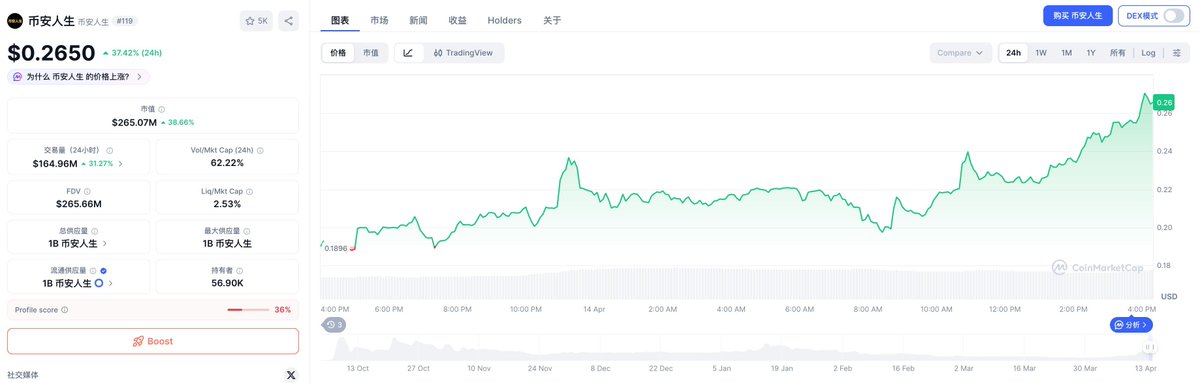
还在拉盘📈 🚨疑似 #币安人生 控盘地址持仓增至1.47亿枚,占总量14.67% 据加密分析师 余烬@EmberCN 监测,约 8785 万枚币安人生(价值约 1493 万美元)此前由疑似相关地址通过 9 个钱包自币安转出后,币安人生价格上涨约 59%。 当前疑似相关地址集在链上共持有约 1.467 亿枚币安人生,占总供应量约 14.67%,对应价值约 3980 万美元。


decentralization is the whole point of blockchains

As with all the scaremongering in defense of financial surveillance, the root of this problem goes deeper. Why make this about KYC and privacy instead of addressing broader systemic problems with campaign finance?

The UK is planning to ban crypto donations to politicians, due to no sender KYC. They understand that payments are political, and they want to limit the markets ability to make decisions. Encrypted private payments are a must for the free world. assets.publishing.service.gov.uk/media/69c29f84…
😉👍🏽

Curious about the connection between Japan and Australia? Follow us for stories, updates and moments that bring our countries together.


Now, the quantum resistance roadmap. Today, four things in Ethereum are quantum-vulnerable: * consensus-layer BLS signatures * data availability (KZG commitments+proofs) * EOA signatures (ECDSA) * Application-layer ZK proofs (KZG or groth16) We can tackle these step by step: ## Consensus-layer signatures Lean consensus includes fully replacing BLS signatures with hash-based signatures (some variant of Winternitz), and using STARKs to do aggregation. Before lean finality, we stand a good chance of getting the Lean available chain. This also involves hash-based signatures, but there are much fewer signatures (eg. 256-1024 per slot), so we do not need STARKs for aggregation. One important thing upstream of this is choosing the hash function. This may be "Ethereum's last hash function", so it's important to choose wisely. Conventional hashes are too slow, and the most aggressive forms of Poseidon have taken hits on their security analysis recently. Likely options are: * Poseidon2 plus extra rounds, potentially non-arithmetic layers (eg. Monolith) mixed in * Poseidon1 (the older version of Poseidon, not vulnerable to any of the recent attacks on Poseidon2, but 2x slower) * BLAKE3 or similar (take the most efficient conventional hash we know) ## Data availability Today, we rely pretty heavily on KZG for erasure coding. We could move to STARKs, but this has two problems: 1. If we want to do 2D DAS, then our current setup for this relies on the "linearity" property of KZG commitments; with STARKs we don't have that. However, our current thinking is that it should be sufficient given our scale targets to just max out 1D DAS (ie. PeerDAS). Ethereum is taking a more conservative posture, it's not trying to be a high-scale data layer for the world. 2. We need proofs that erasure coded blobs are correctly constructed. KZG does this "for free". STARKs can substitute, but a STARK is ... bigger than a blob. So you need recursive starks (though there's also alternative techniques, that have their own tradeoffs). This is okay, but the logistics of this get harder if you want to support distributed blob selection. Summary: it's manageable, but there's a lot of engineering work to do. ## EOA signatures Here, the answer is clear: we add native AA (see eips.ethereum.org/EIPS/eip-8141 ), so that we get first-class accounts that can use any signature algorithm. However, to make this work, we also need quantum-resistant signature algorithms to actually be viable. ECDSA signature verification costs 3000 gas. Quantum-resistant signatures are ... much much larger and heavier to verify. We know of quantum-resistant hash-based signatures that are in the ~200k gas range to verify. We also know of lattice-based quantum-resistant signatures. Today, these are extremely inefficient to verify. However, there is work on vectorized math precompiles, that let you perform operations (+, *, %, dot product, also NTT / butterfly permutations) that are at the core of lattice math, and also STARKs. This could greatly reduce the gas cost of lattice-based signatures to a similar range, and potentially go even lower. The long-term fix is protocol-layer recursive signature and proof aggregation, which could reduce these gas overheads to near-zero. ## Proofs Today, a ZK-SNARK costs ~300-500k gas. A quantum-resistant STARK is more like 10m gas. The latter is unacceptable for privacy protocols, L2s, and other users of proofs. The solution again is protocol-layer recursive signature and proof aggregation. So let's talk about what this is. In EIP-8141, transactions have the ability to include a "validation frame", during which signature verifications and similar operations are supposed to happen. Validation frames cannot access the outside world, they can only look at their calldata and return a value, and nothing else can look at their calldata. This is designed so that it's possible to replace any validation frame (and its calldata) with a STARK that verifies it (potentially a single STARK for all the validation frames in a block). This way, a block could "contain" a thousand validation frames, each of which contains either a 3 kB signature or even a 256 kB proof, but that 3-256 MB (and the computation needed to verify it) would never come onchain. Instead, it would all get replaced by a proof verifying that the computation is correct. Potentially, this proving does not even need to be done by the block builder. Instead, I envision that it happens at mempool layer: every 500ms, each node could pass along the new valid transactions that it has seen, along with a proof verifying that they are all valid (including having validation frames that match their stated effects). The overhead is static: only one proof per 500ms. Here's a post where I talk about this: ethresear.ch/t/recursive-st… firefly.social/post/farcaster…
🚨 @SecRollins is launching the National Proving Grounds Network for AgTech — a bold new initiative that puts American farmers and ranchers FIRST! Together with Chairman @SenJohnHoeven, @USDAScience Under Secretary Scott Hutchins, and our partners at @TheGrandFarm in North Dakota, we’re rigorously testing precision ag tools under real farming conditions. This means cutting input costs, reducing risk, boosting productivity, and giving producers trusted data they can actually use. Innovation + American farmers = the future of agriculture. Farmers come first! 🔗 usda.gov/agtech

Meta Muse: “Make a flappy bird clone” One shot in only a couple minutes in canvas not bad at all!

Golden Retriever wearing a hat went viral devouring a full hot dog at the ballpark. Dude was in heaven

An insider is claiming that GTA 6's user-generated content will "produce millionaires" "When it does come, especially on PC, if you thought GTA 5 was crazy, especially with the RP servers, you haven’t seen nothing yet"


💥 NEW: @tether CEO @paoloardoino says the company is developing a decentralized search engine.



Essie @Clover1267687
122 Followers 144 Following Grow in adversity, perish in good times: the power of struggle!

CryptoLoots Official ... @crypto__loots
71 Followers 821 Following Open virtual loot boxes to win #cryptocurrencies and #NFTs

Steven Lindell @steven_lin30713
93 Followers 2K Following

Silenz @Slilenz_
9 Followers 39 Following Exploring the world of crypto, one blockchain at a time. Passionate about decentralization, innovation, and the future of finance. #defi #crypto #web3
haonaonao @_haonaonao
3 Followers 40 Following Call me Base-T cuz I prefer to stay #based @base $Toshi $Mochi $TYBG $Wolf $Bento

WIZZ 🥷🏾 ( bewar... @shahul69
15 Followers 190 Following FET WOO INJ MLT VANRY https://t.co/gyqsBb8SGW... Watch out for scammers !! discord is closed since 2021.
Tarun Chitra @tarunchitra
82K Followers 7K Following ヽ(⌐■_■)ノ♪♬ @gauntlet_xyz/@robotventures/@aerafinance/@thelatestindefi/@_choppingblock/@zeroknowledgefm // main: @guilleangeris
TRON DAO @trondao
1.8M Followers 414 Following TRON is dedicated to building the infrastructure for a decentralized internet. 🌐

Tiffany Fong @TiffanyFong
767K Followers 3K Following sometimes, i interview criminals 👉 https://t.co/8sZhrHgUp3 & more: @tiffanyxfong & @tiffanyfongetc
Pesandapur @pesandapur
978 Followers 784 Following Red 💊 Orange; Bad for education good for health #Bitcoin #BNB #tron VS fiat ... Let it sink https://t.co/cOJ1xnwYz9
Dept. of Agriculture @USDA
1.1M Followers 2K Following Leadership on #food, #agriculture, natural resources, #rural development, #nutrition, & related issues based on public policy, science, & effective management.
Ispolink @ispolink
103K Followers 906 Following Ispolink Ecosystem 1. AI-based Web3 dev platform | $ISP 2. @GiantAI_agent sentient Agent on Roblox, Web2, Web3 | $GIANTAI 📬TG https://t.co/RQZVeKbqQ6

攻殻パラレル @xNFT_killa
810 Followers 2K Following
Seong donghun 🅁�... @TONewYork0724
453 Followers 486 Following
Anson Zeall @0xa8l
10K Followers 2K Following Building @azentiqnexus | Created https://t.co/9IDCyhKUa6
Matt Walsh @MattWalshBlog
4.1M Followers 601 Following Theocratic fascist, bestselling children’s author, world renowned DEI consultant
Pete Buttigieg @PeteButtigieg
3.8M Followers 3K Following Husband, dad, veteran, writer, and proud Midwesterner. 19th US Secretary of Transportation and former Mayor of South Bend.
Tokamak Network @Tokamak_Network
12K Followers 167 Following On-Demand Ethereum Layer 2 Platform, The easiest and trustless way to build blockchain applications.
Dr Jordan B Peterson @jordanbpeterson
6.2M Followers 2K Following Best-Selling Author | Clinical Psychologist | #1 Education Podcast | Co-founder of @petersonacademy | Order my new book "We Who Wrestle With God" here:
Blake Hall @Blake_Hall
24K Followers 929 Following Founder & CEO of https://t.co/rlteLqhtTe Army Veteran. American. Live free or die.
Tucker Carlson @TuckerCarlson
17.8M Followers 3 Following
Polaris @PolarisProgram
153K Followers 18 Following A first-of-its-kind effort to rapidly advance human spaceflight capabilities while continuing to raise funds & awareness for important causes on Earth

John Dough @RealJohnDough
95K Followers 3K Following Prop Trader • IRATA L3 • https://t.co/5cxUWMOHr8 @TheLockedTrader Markets • Trading • Mindset | Prev https://t.co/hbeBkhicpQ
Tokenlon DEX | Best E... @tokenlon
17K Followers 638 Following Large-scale ETH/USDT swaps, on-chain. 💵 Up to 1,000 ETH per tx · 💯 99.8% success rate 🥪 MEV protected · 🏦 Fees from 0.1% · 👛 Self-custodial
Serhat @serhatisblr
12K Followers 601 Following Kendi fikirlerimi paylaşıyorum. Yatırım tavsiyesi vermiyorum. | #Bitcoin | #PriceAction | #RangeTrade
M!Dξ.⚛️🈺 @mideenigmA
5K Followers 508 Following Buying and Scaling SMBs • Investing in Emerging Technologies: Blockchain • Energy • Art Collector. Prev @amazon|@google. Tweets not financial advice. #CFC 💙
Robin Hanson @robinhanson
124K Followers 772 Following Let’s skip witty banter & talk deep Qs. Books: https://t.co/hpZgEm5DBI https://t.co/iFs9C3J2Ek Advisor @_futarchy @MetaDAOProject @butterygg
OpenAI @OpenAI
5.0M Followers 4 Following OpenAI’s mission is to ensure that artificial general intelligence benefits all of humanity. We’re hiring: https://t.co/dJGr6LgzPA
Byron Donalds @ByronDonalds
1.2M Followers 558 Following Trump-Endorsed Republican for Governor of Florida, Congressman, Husband, Father, and Follower of Christ Proudly Serving SWFL. Official Account: @RepDonaldsPress
Snit Skeptic @SnitSkeptic
2K Followers 2K Following I hate Myths and Superstitions. Hedonistic Nihilist #F1 #SimRacing #MUFC #Atheism #Bitcoin #RedditAvatars
Joe Carlsmith @jkcarlsmith
12K Followers 690 Following Philosophy, futurism, AI. Working on Claude's values @AnthropicAI. Formerly @coeff_giving. Opinions my own.
意気地なしソー... @saamon2500
35K Followers 4K Following 極HYPE活動家 スピったら儲かったハゲ 世の中にはHYPEを握れる人間と握れない人間の2種類がいます。
SpaceX @SpaceX
41.9M Followers 123 Following SpaceX designs, manufactures and launches the world’s most advanced rockets and spacecraft

Yan Zhang @krzhang
2K Followers 806 Following Youth corruptor. Mathematician. Father. The Fool. Player of Games.
PROXIMUS @pdexd
391 Followers 2K Following
OdailyNews @OdailyChina
73K Followers 783 Following 亚太地区领先的加密媒体平台 APP下载:https://t.co/N5EHg9ypjL TG订阅:https://t.co/xF7bTaWyGL 预测市场资讯订阅:https://t.co/QrI2aBcMA7 联系合作:[email protected]
Dwarkesh Patel @dwarkesh_sp
242K Followers 1K Following Host of @dwarkeshpodcast https://t.co/3SXlu7fy6N https://t.co/4DPAxODFYi https://t.co/hQfIWdM1Un
一颗小青菜.|KF... @wang_eth
17K Followers 2K Following 入群小助理:PD123456V |入群需自我介绍|不必盲从|时间有限|心境|频道|https://t.co/YVhjhvswdO
George Conway ⚖️�... @gtconway3d
2.3M Followers 3K Following Relapsing lawyer | Owned by a Pembroke Welsh Corgi
Madelon Vos @MadelonVos__
84K Followers 2K Following Financial Analyst | Macroeconomics, Investing, Bitcoin, Gold | 125K YouTube subs | Ambassador Financially Fit Kids Foundation | Ex-host @BNR | @Goud999
Andrew McCarthy @AJamesMcCarthy
478K Followers 827 Following Exploring the universe from a backyard in Arizona. Get on my email list 👇
MikybullCrypto @MikybullCrypto
91K Followers 595 Following Macro Contrarian View | Economist| Trader | no VIP
Modern War Institute @WarInstitute
90K Followers 55 Following Official account of the Modern War Institute at West Point, a research center dedicated to the study of war and warfare. Gov't Org Follow & Likes ≠ Endorsement
Secretary Marco Rubio @SecRubio
2.1M Followers 15 Following 72nd Secretary of State serving under the leadership of @POTUS Trump.
Daniel Nita 🇷🇴 @realdanielnita
83K Followers 1K Following #Bitcoin since 2016. Holding world record for buying 10,000 pizza with 1 #Bitcoin on 22 May 2023. YouTuber. Trader. link👇 https://t.co/oMZJsGiyUz

Alexandr Wang @alexandr_wang
549K Followers 860 Following chief ai officer @meta, founder meta superintelligence labs, founder @scale_ai. rational in the fullness of time
Leonidas @LeoHadjiloizou
54K Followers 620 Following I tweet data, links and my opinion, not financial advise. Do your own research!
Alex Saunders 🇦�... @AlexSaundersAU
107K Followers 4K Following Host: @NuggetsNewsAU Ex-Pharmacist, Unvaxxed, Youtuber, Dad, Athlete, Nature Lover, Bitcoin, Privacy, Freedom & Health. Follow the 🐰 https://t.co/0HJtZ6RRg7
Connor Boyack 📚 @cboyack
51K Followers 517 Following President @Libertas, @kidsmarkets, @join_praxis. Author 53 books (7M sold) incl. @tuttletwins. Exec Producer @tuttletwinstv. Public speaker, outlaw beekeeper 🐝Trends for United States
You might like