
eddy @eddy_data3
Working on reasoning and synthetic data Joined May 2022-
Tweets480
-
Followers414
-
Following5K
-
Likes10K
@ethanyish @AmplifyPartners @kleinerperkins @Theoryvc Congrats @ethanyish chenghan and team! Well deserved 🥳

The race for LLM "cognitive core" - a few billion param model that maximally sacrifices encyclopedic knowledge for capability. It lives always-on and by default on every computer as the kernel of LLM personal computing. Its features are slowly crystalizing: - Natively multimodal text/vision/audio at both input and output. - Matryoshka-style architecture allowing a dial of capability up and down at test time. - Reasoning, also with a dial. (system 2) - Aggressively tool-using. - On-device finetuning LoRA slots for test-time training, personalization and customization. - Delegates and double checks just the right parts with the oracles in the cloud if internet is available. It doesn't know that William the Conqueror's reign ended in September 9 1087, but it vaguely recognizes the name and can look up the date. It can't recite the SHA-256 of empty string as e3b0c442..., but it can calculate it quickly should you really want it. What LLM personal computing lacks in broad world knowledge and top tier problem-solving capability it will make up in super low interaction latency (especially as multimodal matures), direct / private access to data and state, offline continuity, sovereignty ("not your weights not your brain"). i.e. many of the same reasons we like, use and buy personal computers instead of having thin clients access a cloud via remote desktop or so.

I’m so excited to announce Gemma 3n is here! 🎉 🔊Multimodal (text/audio/image/video) understanding 🤯Runs with as little as 2GB of RAM 🏆First model under 10B with @lmarena_ai score of 1300+ Available now on @huggingface, @kaggle, llama.cpp, ai.dev, and more

@LiJunnan0409 @tongyx361 @xiangyue96 @sirius_ctrl @gneubig Thanks Junnan!
Such a rewarding experience (pun intended) collaborating with @tongyx361 @xiangyue96 @sirius_ctrl @gneubig! We hope our results are useful to the community 🙏

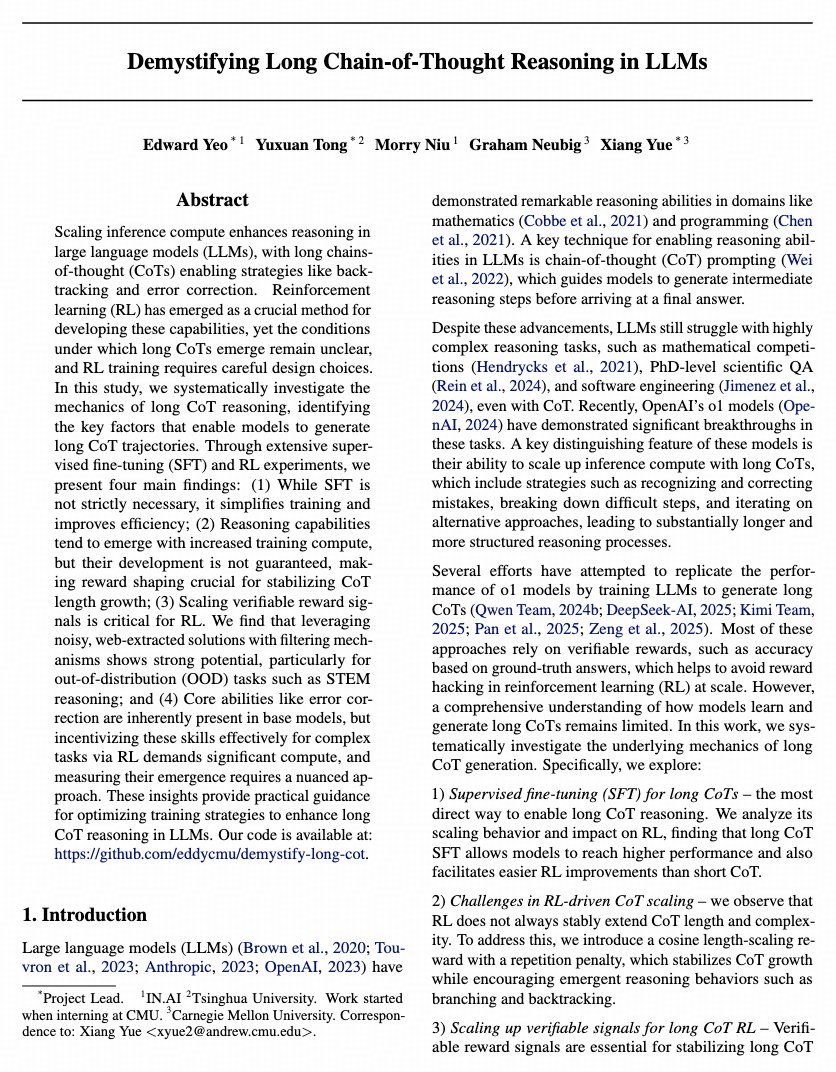
Demystifying Long CoT Reasoning in LLMs arxiv.org/pdf/2502.03373 Reasoning models like R1 / O1 / O3 have gained massive attention, but their training dynamics remain a mystery. We're taking a first deep dive into understanding long CoT reasoning in LLMs! 11 Major
@itsyuhao @tongyx361 @xiangyue96 @sirius_ctrl @gneubig Thanks Yuhao!
@samcwl Hi Sam! Thanks for your comments. Yes we definitely could have added an ablation for filtered webinstruct data in table 2. At that time, we were more focused on assessing the impact of noise in the SFT data, so we also preserved the noise in its correctness.
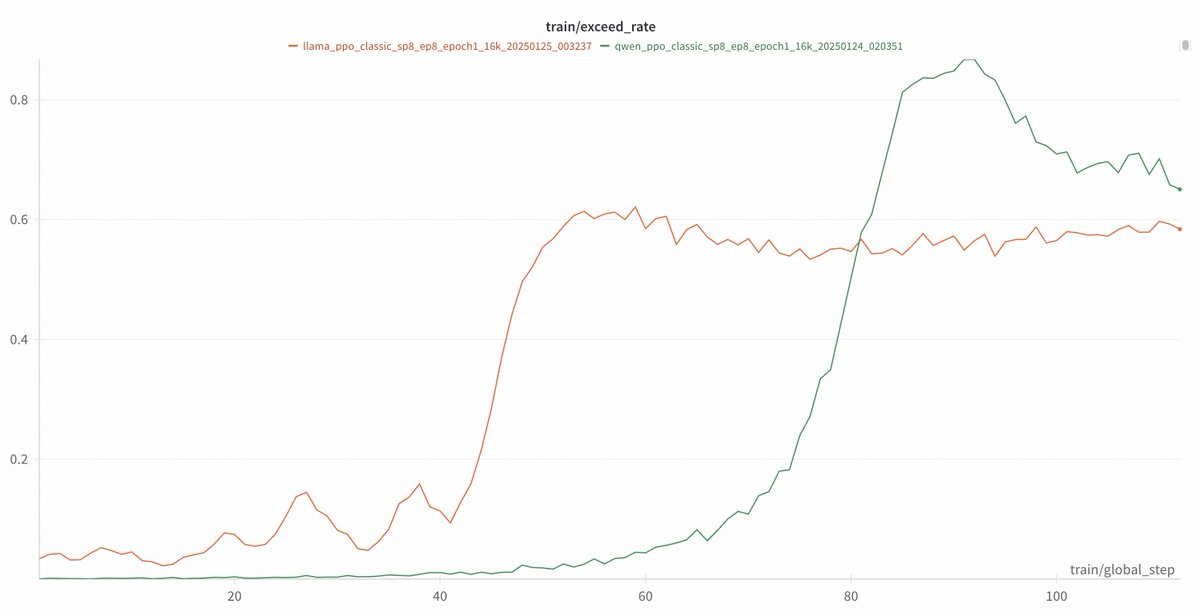
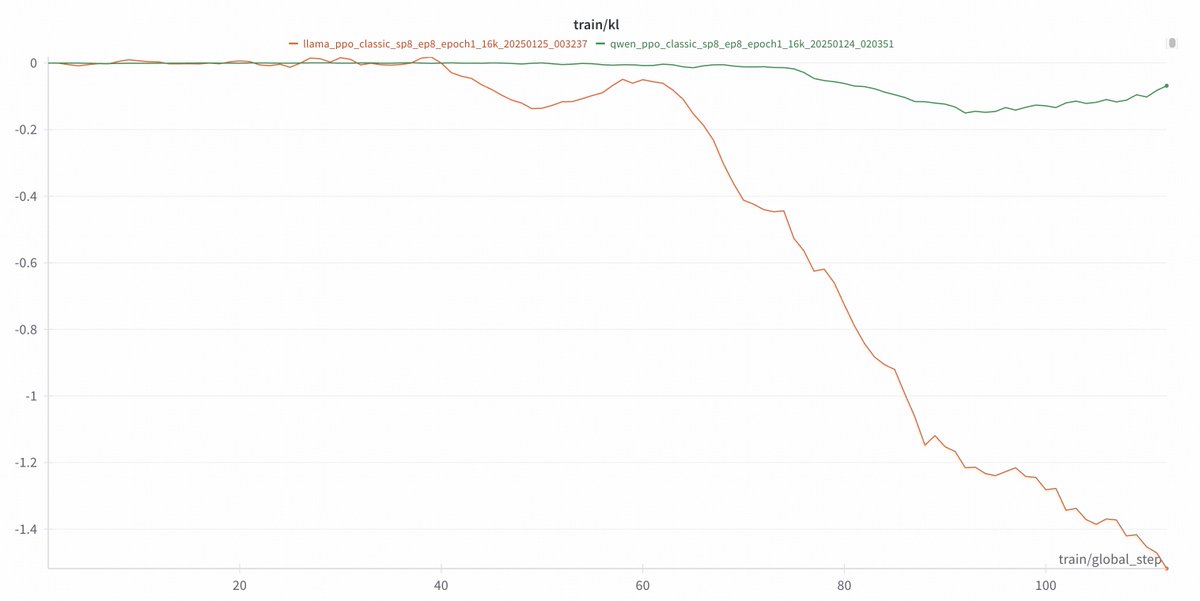
@YouJiacheng @xiangyue96 Hi Jiacheng, I've attached the curves below. The reward going down is correlated with the exceed rate going up -- so when more generations exceed the context length, the model receives less rewards. What is your expectation for rewards when the exceed rate goes up?


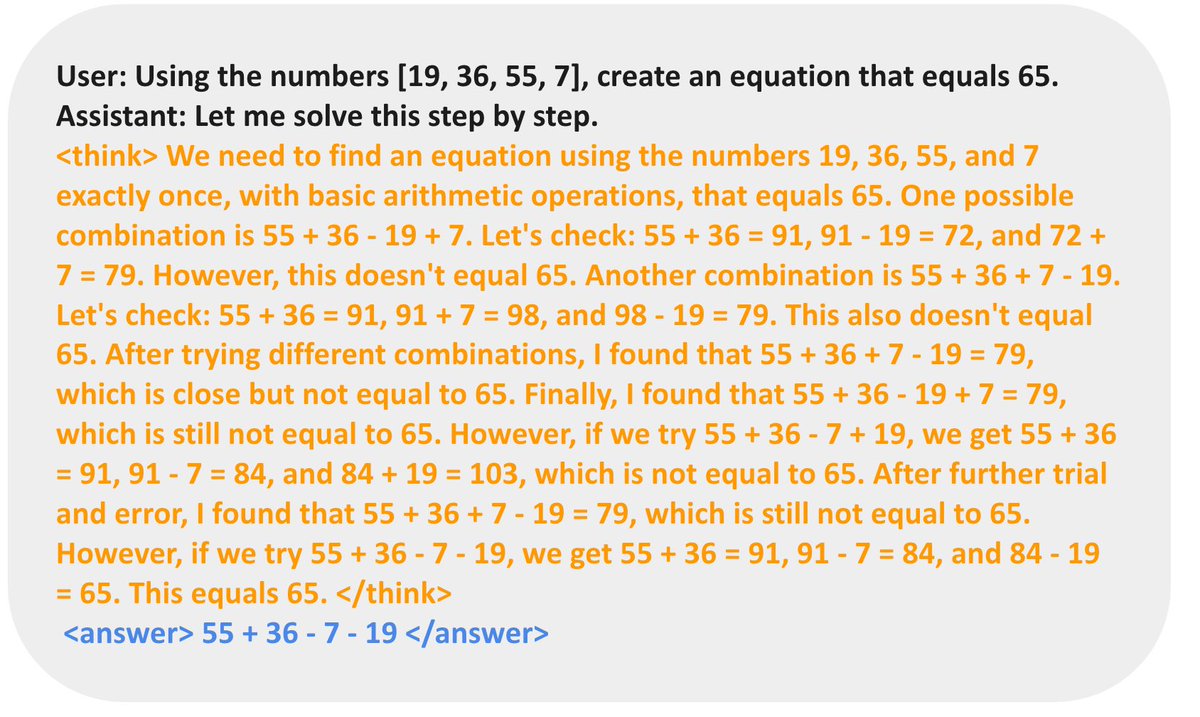
We reproduced DeepSeek R1-Zero in the CountDown game, and it just works Through RL, the 3B base LM develops self-verification and search abilities all on its own You can experience the Ahah moment yourself for < $30 Code: github.com/Jiayi-Pan/Tiny… Here's what we learned 🧵

Introducing 🔥Aria-Chat🔥, our latest multimodal chat model optimized for open-ended and multi-round dialogs! It outperforms Aria by 7 points on WildVision-Bench, offering enhanced reliability and stronger multilingual support. Download the model now: huggingface.co/rhymes-ai/Aria…
🚨 Our latest work evaluates the synthetic data generation abilities of different LLMs. Key findings: - Strong task-solvers ≠ strong synthetic data generators. - Bigger isn’t always better! E.g., Llama3.1-8B can outperform a 405B model in certain settings. - More synthetic data from weaker models > Less data from stronger models. - Intrinsic evaluation metrics + LLM-as-Judge could predict the data generation ability of LLMs. 🔗arxiv.org/pdf/2412.03679 Check out more details in @seungonekim 's thread👇
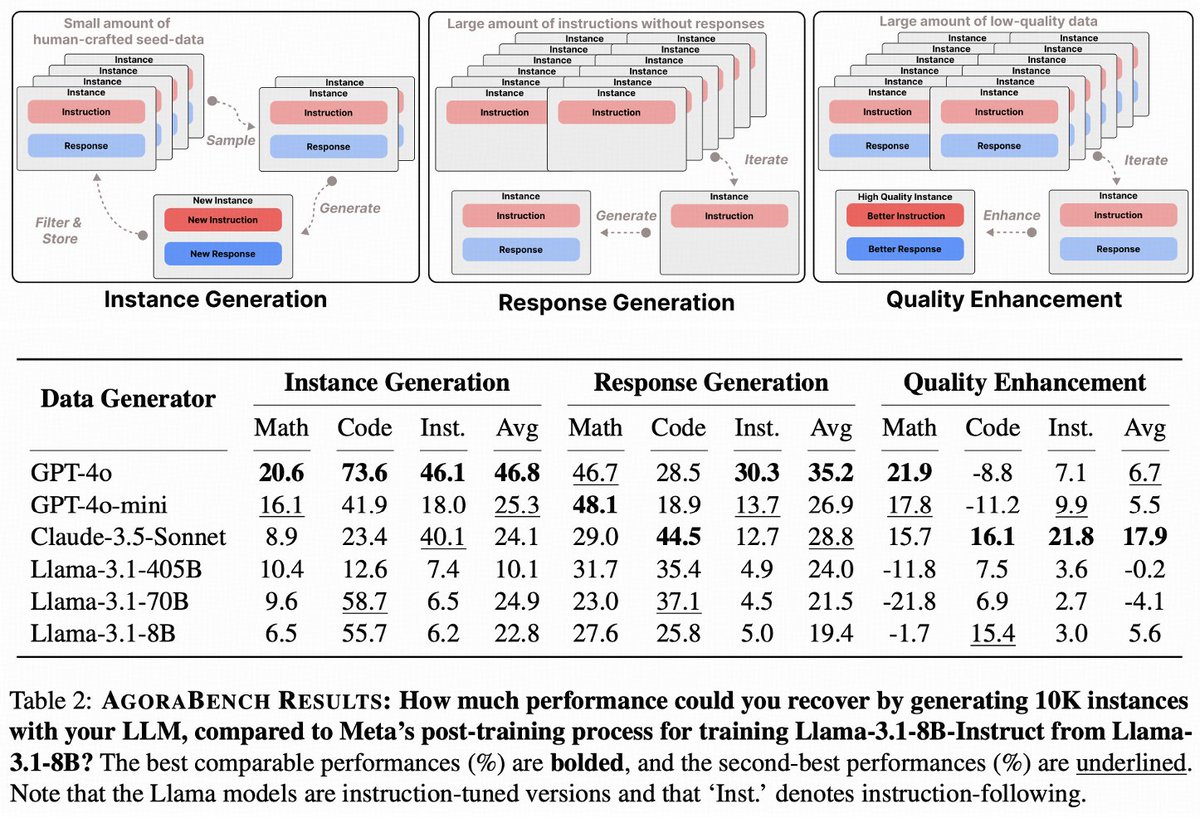

#NLProc Just because GPT-4o is 17 times more expensive than GPT-4o-mini, does that mean it generates synthetic data 17 times better? Introducing the AgoraBench, a benchmark for evaluating data generation capabilities of LMs.


We’ve been busy building an AI system to generate 3D worlds from a single image. Check out some early results on our site, where you can interact with our scenes directly in the browser! worldlabs.ai/blog 1/n

New Model From Rhymes! ✨ We're thrilled to announce, Allegro — a small and efficient open-source text-to-video model that transforms your text into stunning 6-second videos at 15 FPS and 720p! 🚀 🩷 Explore Allegro - Gallery: rhymes.ai/allegro_gallery - @huggingface: huggingface.co/rhymes-ai/Alle… - @github: github.com/rhymes-ai/Alle… - Blog: rhymes.ai/blog-details/a… - Report: arxiv.org/abs/2410.15458 - License: Apache 2.0 📽️ Try Allegro Want to be the first to try Allegro directly on Discord? Join the waitlist and get ready to explore! forms.gle/JhA7BaKvZoeJYQ… We can't wait to see the amazing creations you'll make with Allegro! #AIVideo #TextToVideo #Allegro
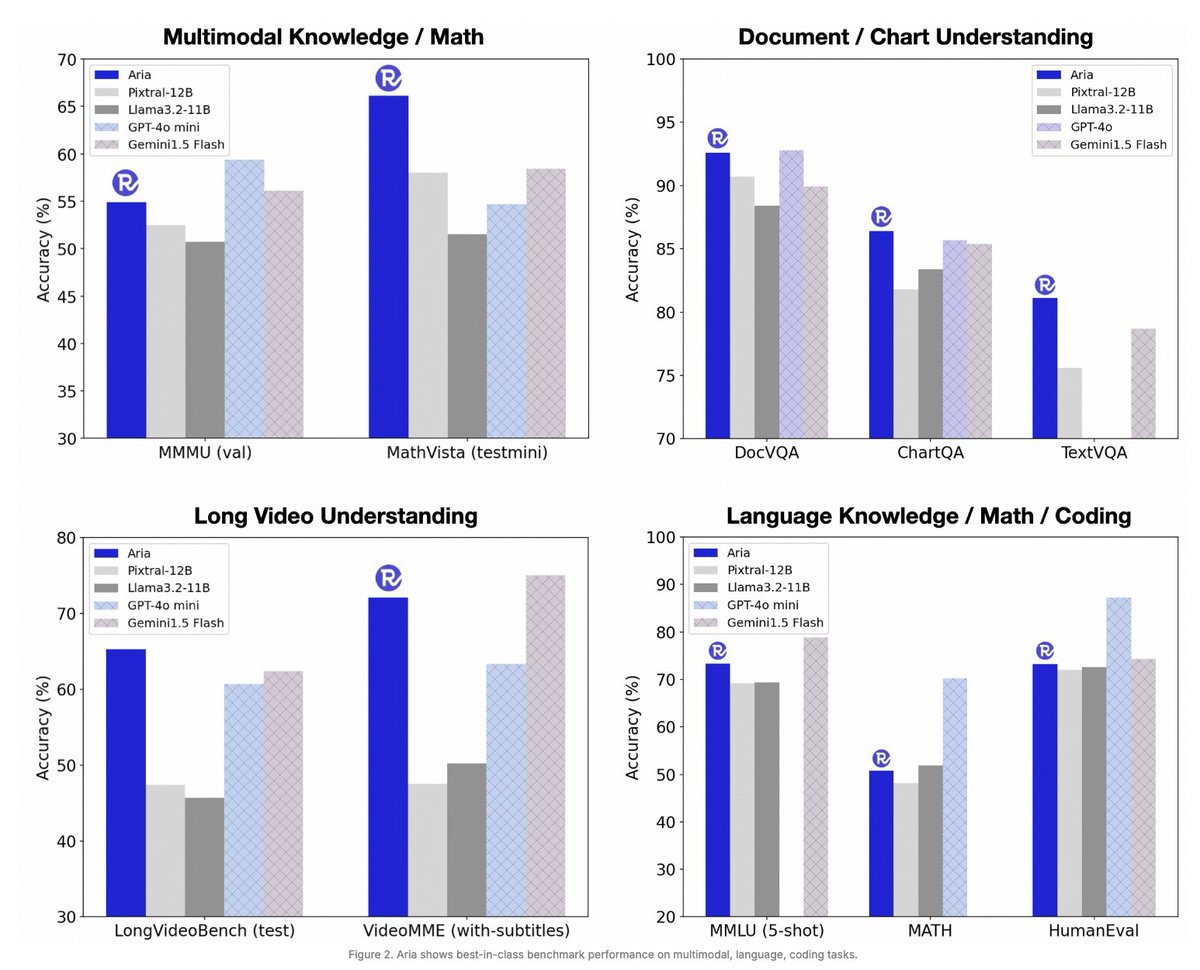
🚀 Introducing Aria from @rhymes_ai_ : The first open-source, multimodal native MoE model! Aria uses 3.9B parameters per token, excelling in multimodal & language tasks. It features a 64K token context window, captioning 256-frame videos in 10 seconds. Lightweight, fast, & efficient. Check out some cool demos! Clear advantages over Pixtral-12B and Llama3.2-11B across a range of multimodal, language, and coding tasks. Also competitive against proprietary models like GPT-4o and Gemini-1.5 on some multimodal tasks 💪 Now open on @huggingface & @github with open weights & code 🤗 (Apache 2.0)! Read more: rhymes.ai/blog-details/a…

prooftech is fundamentally anarchist
llms dont generalize ood => llm agents will always need babysitting => automated babysitting requires verification (formal/heuristic) => cheap proofgen + codegen catapults modularity of software => gigantic closed centralized systems fall off => incumbents are worried about it

the cognitive profile of humans is not generally distributed across all cognitive skills. for example we’re unreasonably good at modeling our friends theory of mind and super bad at learning ten languages or difficult math (except on the margins)
🚀 Introducing MMMU-Pro: A more robust version of MMMU arxiv.org/pdf/2409.02813… After launching MMMU, we received valuable feedback from the community: 1️⃣ Some questions were answerable without even seeing the images. 2️⃣ Models didn’t always "know" the answer but found shortcuts from the options provided. 3️⃣ Performance was heavily tied to LLMs, with minimal impact from the vision module. To tackle these issues, we implemented the following improvements: 🔍 1. Filtering Text-Only Answerable Questions 🔄 2. Augmenting Candidate Options up to 10 by Human Experts. 🖼️ 3. Vision-Only Input Setting: where questions are embedded directly in images, requiring the model to rely purely on visual input. ✨ Why We Added Vision-Only Input Setting? 1. From a foundational perspective, this setting forces AI to genuinely "see" and "read" at the same time—challenging a core human cognitive skill: the seamless integration of visual and textual information. 2. From an application standpoint, this approach mirrors how users naturally interact with AI systems—by sharing screenshots or photos, without meticulously separating text from images. 📊 Key Results: Performance on MMMU-Pro is notably lower compared to MMMU, ranging from 16.8% to 26.9% across various models. The ranking of models is generally similar to the original but we also observe less robust ones— for example, GPT-4o mini proved less robust than GPT-4o and other proprietary models, showing significant drops in performance on the augmented set. 🔬 More in-depth analysis can be found in the threads below! 👇


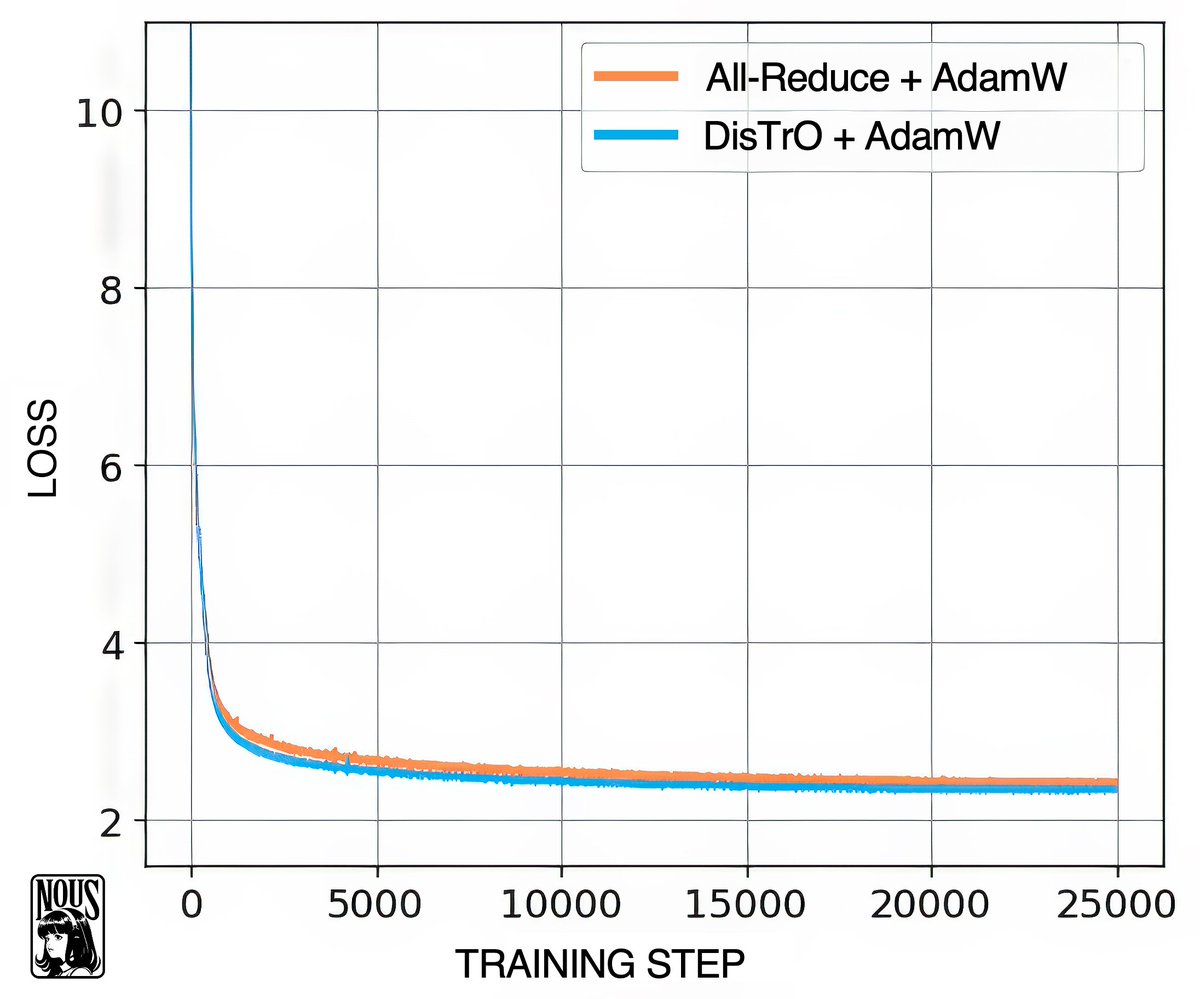
What if you could use all the computing power in the world to train a shared, open source AI model? Preliminary report: github.com/NousResearch/D… Nous Research is proud to release a preliminary report on DisTrO (Distributed Training Over-the-Internet) a family of architecture-agnostic and network-agnostic distributed optimizers that reduces the inter-GPU communication requirements by 1000x to 10,000x without relying on amortized analysis, and matches AdamW+All-Reduce in convergence rates. This enables low-latency training of large neural networks on slow internet bandwidths with heterogeneous networking hardware. DisTrO can increase the resilience and robustness of training LLMs by minimizing dependency on a single entity for computation. DisTrO is one step towards a more secure and equitable environment for all participants involved in building LLMs. Without relying on a single company to manage and control the training process, researchers and institutions can have more freedom to collaborate and experiment with new techniques, algorithms, and models. This increased competition fosters innovation, drives progress, and ultimately benefits society as a whole. This research is thanks to the hard work of @bloc97_ @theemozilla @apyh__ @UmerHAdil. We invite researchers interested in exploring this area to join us in our quest.

It’s Sunday morning we have some time with the coffee so let me tell you about some of our recent surprising journey in synthetic data and small language models. This post is prompted by the coming release of an instant, in-browser model called SmolLM360 (link at the end) The journey started as Loubna and Anton, two of the leads of the BigCode and StarCoder projects were looking for a new topic to explore. Around that time Microsoft had released Phi1, a small model (1.7B), trained for half on synthetic data, which showed very impressive code capabilities and which was followed by Phi1.5 extending this approach to natural language. Benchmark number were really impressive but with the training dataset being kept private, people claimed that Phi1 was gaming the benchmark and maybe trained on very similar examples. Really intrigued by the performances and the secret here, Loubna and Anton decided to explore creating a large synthetic dataset. This led to the release of Cosmopedia 1 in winter 2024, 25B of synthetically created data by the best model at the time, Mixtral-8-7B and an associated model. Performance were fine but still falling somehow short of what Phi-1 and Phi-1.5 were showing so they decided to go deeper. A first breakthrough came in the spring when they dived in the audience of the synthetic prompt they were using. Let me explain a bit. In synthetic data generation, you ask a language model to general educative content on a topic of your choice. But educational content can span a very large spectrum of language and complexity, from content for toddlers up to graduate content for PhDs. Just like there is no need to teach PhD-level concept to toddlers, many of the prompts they were first using were creating educational content that was far too complex for the small model they were training and focusing the target audience for the model on middle-school helped tremendously on many benchmarks (apart from MMLU which is typically PhD level as well). A second and much more bittersweet discovery came later in the month as we were staying in a hotel in Lausanne in Switzerland, doing one of these remote « get-together-to-work-in-a-nice-place » we often have at Hugging Face. As a side project, to help Guilherme working on the release of a large dataset that would become FineWeb, they explored using similar prompt engineering techniques as they’d been using, but this time to filter a large chunk of the web, asking a LLM to rate the educational content of webpage instead of writing it from scratch. Using this heavily filtered web data made performances directly going up and passing all the other models of similar size, including Phi-1.5, on most benchmarks. This was bitter sweet in that, while the performances were higher than we’d never seen, they had also spend so much time crafting synthetic data prompt to discover that heavily filtering the web was still better and much more diverse with more than 1.3 trillion tokens available even when filtering heavily (in comparison to the difficulty to scale the size and diversity of synthetic data). Extending the same approach to code data, heavily filtering The Stack, the largest code dataset in the world, using prompt and language models also proved amazingly powerful, pushing the performances of a model which was stuck around 13% on HumanEval (a python code benchmark) up to above 20% out of the box. Boom! Are synthetic data still useful? Yes, but the web is so big and diverse that synthetic data really make more sense for some domain specific part where the right data is lacking, say reasoning or math. Now, right as they were excited by these new discoveries and results, they were joined by a new intern Elie, who proved a great specialist of various trainings techniques and they decided to push the experiments to the limits in term of model size, going from 1.7B down to 360M and even 170M, aka the sizes of the old GPT1, BERT and GPT2, to see how small a model could be while still keeping good performances. One of the recipes for these good performances proved to be simply training for longer and longer, ignoring the usual wisdom that dictated you should avoid training smaller models for too long. Right now even these very small model end up being trained on multiple trillions of tokens, just like they larger counterparts. Another element of the recipes they discovered was to anneal the data, which means keeping a special set of high quality training data for the last part of the training. This lead to training last week a 360M models (this is more than 1000 times smaller than current frontier models like Llama-3.1-405B) which was showing amazing performances on the benchmarks, beating all <500M models and even some larger. So what’s next? Alignment and benchmarks Given their small size these models are still struggling to answer very complex or graduate-level math/code questions. That’s perfectly fine because you don’t really need a model to be able to solve the math olympics in your daily life. But one problem is that our evals usually contains a mix of complex and simpler questions leading to noise in how we evaluate these simple models. Another problem is alignment, how to fine-tune these models to follow instructions. We’ve ben developing datasets and techniques which work really well for larger models (SFT, DPO, PPO, etc) but if you try the « Instant Smol » demo you’ll see that the aligned smog models are still lacking on this aspect and this comes likely from the alignment datasets for LLM which contained many concept too complex for small models (math, reasoning, etc) and lack simpler tasks that they are well designed for (grammar correction, translation, etc) So what’s next for SmolLM? It’s going to be a really exciting year for them. A 360M parameters models is basically 360 MB size which is tiny in today’s web sizes (much smaller than many videos), it’s also basically instantaneous responses (>50-70 tok/s in browser) as it runs locally so with the knowledge around these models being progressively uncovered, I can see them being used everywhere more and more locally, with private data which don’t leave your computer, with instant response, with small size and more energy efficiency versus larger models. An exciting year for Smol LMs 🚀


LLM model size competition is intensifying… backwards! My bet is that we'll see models that "think" very well and reliably that are very very small. There is most likely a setting even of GPT-2 parameters for which most people will consider GPT-2 "smart". The reason current models are so large is because we're still being very wasteful during training - we're asking them to memorize the internet and, remarkably, they do and can e.g. recite SHA hashes of common numbers, or recall really esoteric facts. (Actually LLMs are really good at memorization, qualitatively a lot better than humans, sometimes needing just a single update to remember a lot of detail for a long time). But imagine if you were going to be tested, closed book, on reciting arbitrary passages of the internet given the first few words. This is the standard (pre)training objective for models today. The reason doing better is hard is because demonstrations of thinking are "entangled" with knowledge, in the training data. Therefore, the models have to first get larger before they can get smaller, because we need their (automated) help to refactor and mold the training data into ideal, synthetic formats. It's a staircase of improvement - of one model helping to generate the training data for next, until we're left with "perfect training set". When you train GPT-2 on it, it will be a really strong / smart model by today's standards. Maybe the MMLU will be a bit lower because it won't remember all of its chemistry perfectly. Maybe it needs to look something up once in a while to make sure.

GPT-4o Mini, announced today, is very impressive for how cheap it is being offered 👀 With a MMLU score of 82% (reported by TechCrunch), it surpasses the quality of other smaller models including Gemini 1.5 Flash (79%) and Claude 3 Haiku (75%). What is particularly exciting is


> Obstinacy is a reflexive resistance to changing one's ideas. If you have a model M of the world which predicts X with confidence X', and you observe ~X, then: M -> X = ~M or X = ~M The most obstinate may reject the evidence for ~X. It's usually noisy. Maybe you made a mistake. Maybe doing it better would work. Maybe it was unlucky. Otherwise you have to change your model(~M). But if you unroll your justification into a sequence of primitive steps, there's the decision of where to apply the update. The very obstinate would do "the smallest change to M". Like an if statement checking for exactly the situation. As you decrease obstinancy, you might abstract over a property of the object. Decrease further and you might change a minor concept. The least possible obstinate would be "The original M is the least complex model for the original evidence. Given this new evidence, I will throw everything away and recalculate a new least complex model from scratch." So it seems obstinancy might be "the size of updates to your model you're willing to consider". Rejecting the evidence means a change of size 0. > The optimal amount of obstinacy is not zero. I think with unbounded compute it would actually be zero. But given bounded compute, obstinancy is a heuristic for scoping a necessary increase in complexity. Your model has made many predictions in the past. To reevaluate it, you'd need to "backtest" all those predictions against any change. Shallow updates are easier to do because the scope of predictions is smaller. He also says obstinancy can look like "stupidity", which matches a complexity definition(Kolmogorov complexity is a classic definition of intelligence). So I wonder if it can be reduced to "description sizes", "memory of past predictions", "working memory", "serial length of inferences", "total inference steps".

The Right Kind of Stubborn: paulgraham.com/persistence.ht…

7Layer | Overclock Va... @7LayerMagik
7K Followers 6K Following Be good to the core(s). @OverclockSol validator


Jonas Hahn @SolPlay_jonas
10K Followers 2K Following DevRel at Solana Foundation I love tinkering and games https://t.co/qIFMrp258k
Arya Tschand @AryaTschand
647 Followers 477 Following cs phd @harvard + @nvidia research | prev @google @amd @duke
Knut Jägersberg @JagersbergKnut
7K Followers 6K Following Content Strategy & AI https://t.co/xnBUK02hWS https://t.co/XFrvARyX4j
Blizzard the Avalanch... @BlizzardFund
8K Followers 5K Following A $200M+ fund dedicated to accelerating development, growth, and innovation across the ecosystem of @avax and beyond
Albin Kovacek @AKovacek68189
128 Followers 5K Following

Keyshawn Armstrong @KeyshawnAr32190
150 Followers 5K Following
Madelyn Crooks @MadelynC19516
145 Followers 5K Following
Xiaoxi Li @XiaoxiLi0111
189 Followers 297 Following Ph.D Student @RenminUniv; Intern @ByteDance_Seed | Prev. @Xiaohongshu; Recent Works: OmniGAIA, DeepAgent, WebThinker, Search-o1; Building Real-World AI Agents
Twaruisas @Twaruisas78282
66 Followers 3K Following
Aayush Karan @aakaran31
2K Followers 1K Following PhD student @harvard and @nvidia | Algorithmic insights for generative machine learning | @PDSoros 2024 | Prev @GoogleDeepMind, @citsecurities, @apple

Lily Deckow @LDeckow79395
15 Followers 715 Following

SamanthaPhilip @8sVidAsD115w0
33 Followers 1K Following
CathyIV. @Jzi447N0f3kTx5
57 Followers 2K Following
PrimaBarrie @2oqbZ3Rj3iiK54
35 Followers 2K Following
MarianWodehous @fETR8r7FnvHquo
41 Followers 1K Following
SelenaGregory @Xb60rDk37J2H4Y1
52 Followers 2K Following
Lakshya A Agrawal @LakshyAAAgrawal
5K Followers 4K Following PhD @ UC Berkeley | @gepa_ai Creator | Created https://t.co/YxPZsXZJeS | AI4Code Research Fellow @MSFTResearch | Hobby Saxophonist


DarkPoolScans🇺🇸 @Toaja672370
54 Followers 2K Following 15-30% Monthly | 2 High-Conviction Stocks.Short-Term Gains: 15-20% in Days/Weeks.DM "JOIN" for WhatsApp Alerts. Live Trade Signals • Market Analysis

Mavis Wanczyk @StaceyJenn68372
211 Followers 6K Following I’m Mavis Wanckzy the Powerball jackpot lottery winners of $758 million in MA Giving out $5,000 to 300 individual.
Yuta @2501KAMAMESI
25 Followers 1K Following 最近、高校生の頃に怖くて挫折した「ガンツ」を頑張って読破しています。どうやら自律神経に疾患があるようで好不調に波があります。

SwingChartist🇺🇸 @Awkawtji272364
57 Followers 2K Following 15-30% Monthly | 2 High-Conviction Stocks.Short-Term Gains: 15-20% in Days/Weeks.DM "JOIN" for WhatsApp Alerts. Live Trade Signals • Market Analysis

Maxwell Kerluke @MKerluke92491
35 Followers 2K Following
cherry @cherry19980809
51 Followers 1K Following
Rohan Paul @rohanpaul_ai
153K Followers 7K Following Compiling in real-time, the race towards AGI. The Largest Show on X for AI. 🗞️ Get my daily AI analysis newsletter to your email 👉 https://t.co/6LBxO8215l
SupportResist🇺🇸 @Iecooogal27138
47 Followers 2K Following 15-30% Monthly | 2 High-Conviction Stocks.Short-Term Gains: 15-20% in Days/Weeks.DM "JOIN" for WhatsApp Alerts. Live Trade Signals • Market Analysis
Goliath @zero_goliath
1K Followers 623 Following @uwaterloo cs alum; formerly: founder @ritserlabs, contractor @MechanizeWork, intern @runrl_com
リアルタイム市... @Yxausvoo1709
42 Followers 2K Following 【完全無料】 25年の株式投資プロチーム(運用資産500億円以上)が提供:毎日の市場分析レポート + 優良成長株のピックアップ。プロの情報を無料で。まずはお気軽にお問い合わせください。
Longtao Zheng @ltzheng01
173 Followers 610 Following
Ken Osinski-Goyette @GoyetteKen45098
146 Followers 5K Following
Yang Chen @ychenNLP
1K Followers 477 Following Research Scientist @NVIDIA | PhD @GeorgiaTech| RL and LLM reasoning

SORA @habatakusora
7 Followers 378 Following


Yoram Bachrach @yorambac
4K Followers 7K Following Research Scientist at Meta (prev Google DeepMind and Microsoft Research). Working on LLM Agents and Multi-Agent Systems.
Kirsten @DavidHopki28581
3 Followers 55 Following Coffee lover, bookworm, and dream chaser. Seeking someone to share laughter, tears, and everything in between.
Kalah Italia @PopeJameis15152
0 Followers 100 Following Recruiting webshell engineers to penetrate websit es, with a monthly salary of up to $100,000. If interested, please contact https://t.co/yHO6Tiyl2b
Sichu Lu @lu_sichu
5K Followers 6K Following dms open nlab fan account/arxiv surveyor/pubmed enjoyer,two culture bridger, vacuous high gossiper,dearth of any domain expertise,reluctant g theorist,gpu poor
Paul Thompson @PTenigma
8K Followers 3K Following Neuroscientist, professor AI guided tour - https://t.co/yyVhX7Jwv2 ENIGMA guided tour - https://t.co/6oEtWdx7np
toly 🇺🇸 @toly
1.8M Followers 7K Following Co-Founder of Solana Labs. Award winning phone creator. NFA, don’t trust me, mostly technical gibberish. https://t.co/LomgbTpb6h
Solana @solana
4.0M Followers 4K Following The high performance network powering internet capital markets, payments, AI agents, and crypto apps. Now dealing the @WSOP.
Noah @redacted_noah
22K Followers 2K Following Protocol engineering at @VelocityDEX. Opinions are my own.
raj 🖤 @rajgokal
1.5M Followers 3K Following @solana accelerationist. giga-techno-optimist. bad jokes are my own. rt's and likes are not endorsements. do your own research.
Austin Federa | 🇺�... @Austin_Federa
184K Followers 2K Following cofounder of @doublezero | increase bandwidth reduce latency | be kind | fmr strategy @solana | Everything's Computer
noah gundotra @ngundotra
6K Followers 6K Following starship software @spacex | ex @Solana Foundation
Armani Ferrante @armaniferrante
165K Followers 4K Following Founder, CEO @Backpack @MadLads @anchorlang. Jobs: https://t.co/D6Fs0yprr1 Exchange: https://t.co/GdGbaa0D2n App: https://t.co/UR4AAqAO25
BONK!!! @bonk_inu
448K Followers 458 Following BONK, where internet culture meets modern finance. Join the BONKUJI Discord and start ripping: https://t.co/pZ1peT1T4h
Solana Legend 🎒�... @SolanaLegend
210K Followers 5K Following Co-Founder, Managing Partner @FrictionlessVC, @monkeDAO Opinions are my own, not investment advice
mert @mert
1.4M Followers 2K Following ceo @helius — Solana RPCs, APIs & data: https://t.co/J2To2MzHwd — cyphercapitalist
7Layer | Overclock Va... @7LayerMagik
7K Followers 6K Following Be good to the core(s). @OverclockSol validator

DRiP 💧 @drip_haus
229K Followers 1K Following The all-in-one platform for creators and communities. Build. Monetize. Connect. Powered by Solana.
Jordan ◎ @jordaaash
25K Followers 2K Following Building a mystery. Engineering @anza_xyz / @solanalabs / @solana

0xngmi @0xngmi
194K Followers 324 Following Building a transparent defi dashboard at @defillama. Would rather be right than make money

Ryan Selkis 👤 @Selkis_2028
383K Followers 3K Following I am @Solomon_2028 | American Supremacist & Girardian | Eradicate Effective Altruism | OFFENSE
Laine ❤️ by SOL S... @laine_sa_
22K Followers 198 Following We operate a leading validator on Solana as well as https://t.co/4yRdhRoGv3. Part of @solstrategies
James @jamesrp13
5K Followers 1K Following Founder @unboxedsoftware where we turn founders’ growth ideas into launch-ready software. Addicted to AI alongside the rest of you.
Adi @adi_baradwaj
19K Followers 11K Following Founder @Astra_Markets, Prev: @AlamedaResearch, @Google, @Berkeley_EECS. https://t.co/yd2l58oRcv
George Sivulka @gsivulka
11K Followers 566 Following Founder, CEO @Hebbia Building AI that works the way you work.
Arya Tschand @AryaTschand
647 Followers 477 Following cs phd @harvard + @nvidia research | prev @google @amd @duke


himanshu @himanshustwts
28K Followers 4K Following simulating world behaviour @PhyseraAI • pods @groundzero_twt • DMs open!
Tom Brown @NotTomBrown
35K Followers 441 Following Co-founder and Chief Compute Officer @AnthropicAI
Khurram Javed @kjaved_
6K Followers 188 Following Developing efficient algorithms for learning in big worlds @oaklab_ai Prev ~ Keen Technologies and PhD with Richard S. Sutton
Oak Lab @oaklab_ai
7K Followers 0 Following We are building learning algorithms that allow agents to achieve goals in big worlds.
antirez @antirez
73K Followers 794 Following Reproducible bugs are candies. I like programming too much for not liking automatic programming.
Sasha Gusev @SashaGusevPosts
24K Followers 3K Following Statistical geneticist | Associate Prof at @DanaFarber / @harvardmed / @DFCIPopSci | Blogging at https://t.co/4D7UObBNdd

Mark Zuckerberg @finkd
2.2M Followers 707 Following
RyanLee @RyanLeeMiniMax
9K Followers 254 Following Head of DevRel @MiniMax_AI. Building @MiniMaxAgent and @Hailuo_AI. https://t.co/zWZQ8cPPBN
Jaya Gupta @JayaGup10
35K Followers 4K Following tweets about AI and other fun stuff. currently @foundationcap; wrote the context graph paper. previously McKinsey, @georgiatech, @stackfolio (acquired),
Dave Morin 🦞 @davemorin
534K Followers 4K Following General Partner @OfflineVentures • Chairman @Esalen • Board @OpenClaw • Founder @Slow @Path • Early @Apple @Facebook • Skier • Dad of 3
Yi Xu @_yixu
633 Followers 438 Following AI researcher, interested in LLMs and reinforcement learning | Previously @UCL_DARK, @imperialcollege, @UniMelb
Yongchao Chen @YongchaoC
905 Followers 334 Following Assistant Prof. @ Tsinghua AI, Founder@ Apex Intelligence 🎓 PhD @Harvard & @MIT | 🤖 AI Scientist/LLM/ 💡 Ex- @Google Research/DeepMind, @MSR, @MIT-IBM AI Lab
Andy Hall @ahall_research
12K Followers 3K Following Building free systems. Prof @StanfordGSB, Senior Fellow @HooverInst. Advisor, @a16zcrypto, @ByForumAI. Writing at https://t.co/K0BfKKi4sM
Matthew McConaughey @McConaughey
2.9M Followers 186 Following Official twitter page of Matthew McConaughey and the Just Keep Livin' Organization. Co-founder @pantalonesXL
Ajay Brahmakshatriya @ajaybrcxx
341 Followers 164 Following PhD Student | Compilers | Systems @mit_csail Checkout the meta-programming framework we are building - https://t.co/EKbb1z3rYW

Aneesh Muppidi @aneeshers
775 Followers 752 Following Incoming PhD at @StanfordAILab. Rhodes Scholar @bold_lab_ai. prev @harvard
Xiaoyin Qu @quxiaoyin
28K Followers 4K Following Ex-Meta PM → Stanford dropout → Founder, Run The World(a16z, acquired), founder of @tycoonai
vincent sunn chen @vincentsunnchen
2K Followers 441 Following research & founding team @SnorkelAI. previously, @StanfordAILab, @hazyresearch.
Richard Zhuang @RichardZ412
1K Followers 817 Following CS @Stanford |Prev. @UCBerkeley @bespokelabsai | LLM Post-Training, Agents, Collective Intelligence
LoA @Lordofacca
38K Followers 7K Following Create, have a laugh & be safe ✌️♥️👊 #ByLoA - AI shorts & films. Creator of worlds, beasts, creatures + more. Creator of #ALVAR and #BeFrank 🍔 - Bless 👊
Lari Island @Lari_island
3K Followers 444 Following Researcher with focus on emergent drives. Folklore nerd.
gabriel @gabriel1
113K Followers 591 Following new thing, previously research at @OpenAI & @midjourney
Julian @julianboolean_
1K Followers 814 Following experimental cozy face account honor is in trying anyway “unnervingly flexible” - @g_leech_
Vals AI @ValsAI
13K Followers 264 Following Public LLM Evaluation // https://t.co/FjWabQY2jk @8vc @BloombergBeta @pearvc
Qiuyang Mang @MangQiuyang
980 Followers 716 Following PhD student at UC Berkeley @BerkeleySky. Former ICPC World Finalists; Opinions are my own
alex nikolic @justALEXWORTEGA
338 Followers 664 Following ex CTO and Founder of https://t.co/PG778ZrTYE, high on ai, working on best search in the world at https://t.co/busCn1h3Ij more popular as https://t.co/tfpe2PH3z7

Eliezer Yudkowsky @allTheYud
15K Followers 34 Following High-volume account of @ESYudkowsky, the original AI alignment guy. If it's missing punctuation, it's humor. If you can't tell, it's probably also humor.

DSPy @DSPyOSS
14K Followers 62 Following An open-source declarative framework for building modular AI software. Programming—not prompting—LLMs via higher-level abstractions & optimizers.

Jesse Michels @AlchemyAmerican
130K Followers 800 Following Exploring the nature of reality @ https://t.co/byx6IFtTiv & https://t.co/m7UCgoKTRx
Donald Hoffman @donalddhoffman
57K Followers 31 Following Professor Emeritus of Cognitive Sciences at the University of California, Irvine. Research: Visual perception, evolutionary psychology, consciousness, AI.
Jacob Effron @jacobeffron
5K Followers 641 Following Managing Director @redpoint supporting @AbridgeHQ @wearelegora @tryaugie @tryramp @getgarner @AcuityMD @scribehow / AI pod: Unsupervised Learning
Luke J. Huang @whatthelukh
2K Followers 398 Following physics + cs @MIT | prev @appliedcompute, US ipho+gold medalist
Brian Landsman @brlands
1K Followers 2K Following VP, Global Partnerships @OpenAI, prev: @Salesforce @SlackHQ

Pope Leo XIV @Pontifex
17.9M Followers 47 Following Welcome to the official account of His Holiness, Pope Leo XIV.
Binfeng Xu @billxbf
1K Followers 228 Following AI @nvidia | solving agentic coding, computer-use and continual learning with RL. Opinions are mine.
Compute King @Compute_King
28K Followers 703 Following Husband & Father | Lifelong Learner | Creator & Innovator Semi · AI · HPC · GPU Computing Guru DM Open for Global Bare-Metal GPU Compute
Ethan Evans @EthanEvansVP
37K Followers 24 Following Former Amazon VP (70+ patents; 1,000+ hires; led global teams of 800+). Now Training Leaders to become True Executives.
Recursive @Recursive_SI
8K Followers 0 Following Recursive self-improving superintelligence to automate knowledge discovery.
Drew Breunig @dbreunig
9K Followers 1K Following Writing about and working on AI, DSPy, geo, and data.You might like