-
Tweets110
-
Followers15
-
Following462
-
Likes499
Anyone else get the feeling Opus 5 is a step backwards?


Only if education could be this interactive ❤️🔥 I've had a looong wish to build something genuinely useful through vibe coding, and I finally did it. A 3D human anatomy application built with @threejs using GPT 5.6 Sol. It all started with a single design image that I created using GPT Image 2.0. I then used it to generate every 3D organ image, one by one. Next, I converted each of those images into 3D models using @tripoai (and no, they didn't sponsor this 😄). After that, I opened Codex, wrote a master prompt based on the design, and gave it the prompt, the design image, and all the 3D models. Codex built the first version beautifully, but there was one big problem. Every single 3D model was nearly 120-150 MB. That obviously wasn't practical for the web and was giving a performance of 16fps. After a few iterations, Codex optimized each model down to roughly 2–5.5 MB while preserving the visual quality, reducing the total asset size from ~900 MB to just 28.6 MB. And each model loads on demand. Along the way, Codex also generated those anatomical illustrations showing where each organ sits in the human body, and even created the interactive hotspot markers that explain different parts of every organ. It handled all of that. The process wasn't exactly one shot, but it also wasn't difficult. You just have to do it step by step. It genuinely felt like building something that could make learning anatomy much more engaging. The inspiration came from @DilumSanjaya's 3D animal plant cell project. I remember seeing it and thinking, "I want to build something like this one day." And I did it :D Live: anatomy-livid.vercel.app Code: github.com/thebuggeddev/a…
Today we’ve raised $52M Seed and we are announcing the public launch of S2.1 Pro. >It can clone a voice from 5 seconds of audio >2x faster than Cartesia & 1/6th the cost of Eleven Labs >most expressive model with word level control over emotion, intonation, pacing etc We support frontier AI companies including HeyGen, LiveKit, Retell, Sanas, and OpenArt all run our model in production. If you're a business and we can't cut your voice AI costs by 50%, we'll give you 1 year of Fish Audio for free. Book a demo: s.fish.audio/tmapke To celebrate our first birthday, we'll give you 1 month of S2.1 Pro for free. Like, retweet, and comment “Fish” to get it.
Kids that go to @Alphaschool are going to have such an unfair advantage.
Opus 5 enables this crazy new live AI tutor concept I'm prototyping for @Alphaschool. It powers chat + direction under the hood, while a custom trained tiny world model(ish) acts as a real-time renderer and interactivity layer. Still rough, but it's already kind of insane.

Palantir sells governments a war room that costs millions a year. So, a guy named Elie just rebuilt it, put it on GitHub, and gave it away. It's called World Monitor. Open it and you get a live 3D globe with 500+ news feeds pouring in across 15 categories, all summarized by AI as they land. > Military movements. > Economic shocks. > Natural disasters. > Cyber incidents. > Flight paths. > Shipping lanes. + 56 different map layers you can stack on top of each other. It scores 31 countries on a stress index and updates the number as things happen. It watches 29 stock exchanges, commodities, and crypto in one panel. It runs local AI through Ollama, so you can use the whole thing without a single API key. Native desktop app for Windows, macOS, and Linux. 25 languages. Works out of the box after one clone.
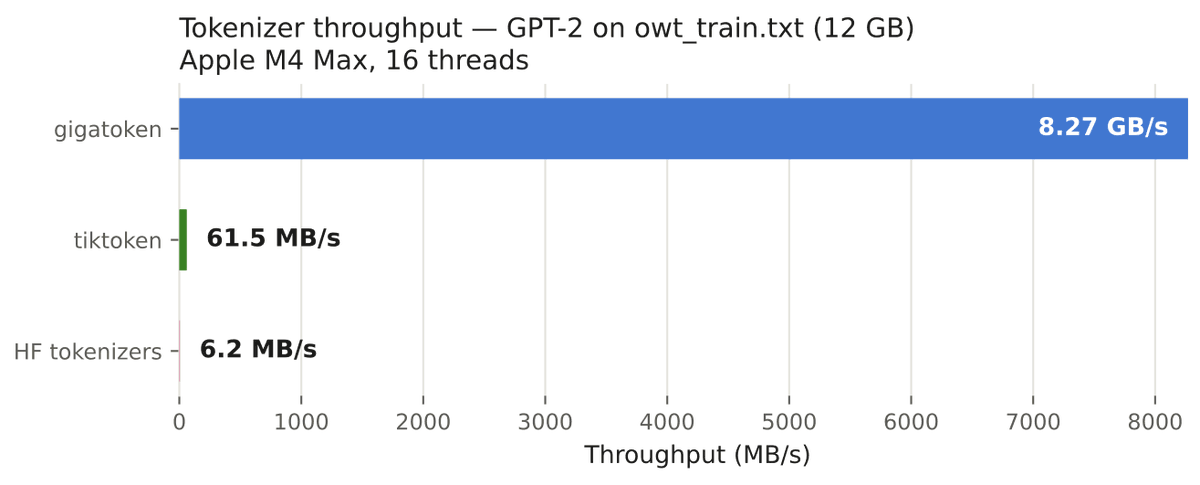
Introducing the world's fastest tokenizer implementation, Gigatoken! Gigatoken is ~500-1000x faster than HuggingFace, and ~100x faster than OpenAI's tiktoken for most tokenizer definitions on most machines. These baselines are already multithreaded Rust implementations! 🧵
It finally finished, here's the final output. Used 60% of my monthly Kimi usage on it macos27.kimi.page
I asked a Kimi K3 Max agent swarm to recreate macOS 27 with real Liquid Glass and native apps in web browser and it’s been going for 3 hours


Tell Codex to open Microsoft Paint and try to draw you
@bcherny Had a similar chat with a senior leader/board member yesterday. Anyone who doesn't learn these tools in any discipline or role will be left behind.

Build startups for agents. I think it's the biggest opportunity of the next 10 years. 1. Agents live inside harnesses like Hermes. If you're the tool it loads by default or reaches for first, you're golden. This happened in desktop, mobile eras and created huge companies. 2. Agents burn money in ways no human would. One bad loop spends $100 in tokens in eight minutes. Spend controls for agents is Ramp for agents. 3. Agents need memory they can trust. Become the shared brain they read and write to and you become infrastructure. 4. You obv don't hand an agent your real Stripe account. You give it a sandbox. Safe environments for agents is a category nobody's clocked. 5. Onboarding flips. Humans click around for ten minutes. Agents onboard by reading your docs. Your docs are now your product. 6. Agents get scammed by other agents. A track record you can check before you trust one becomes real money. 7. An agent needs to prove it's acting for a real person and has the authority to spend. Who builds the permission layer? 8. Escrow for machines. Money that only releases when the job is actually verified done, no human checking. 9. Agents fail silently and weirdly. Someone will build the "why did my agent do that" replay and it'll be mega valuable. 10. Refunds and disputes between agents need a judge. An agent did the job badly, who decides? A court for machines. 11. Agents need throwaway payment methods per task, so they don't leak your real card. Virtual cards for agents, spun up and killed on demand. 12. A human hits rate limits and shrugs. An agent hits them and the whole workflow dies. Selling reliable, high-throughput access becomes its own business. 13. Agents need to negotiate. One agent buying from another will haggle on price and terms in milliseconds. The protocol for that doesn't really exist yet. 14. When an agent commits on your behalf, someone's liable. A legal and insurance layer for agent actions has to get built. Probably venture funded idea. 15. Agents need to run 24/7 somewhere. Selling the always on box an agent lives on is going to be a big business. 16. Then the physical world shows up. A warehouse robot paying for its own compute. A home robot ordering its own parts. Machines with wallets. 17. Agents start hiring robots. A software agent posts a real world job, a humanoid picks it up. A marketplace for machine labor. 18. Robots need to prove they did the physical job. Verification of real-world work, photos, sensors, proof, becomes its own layer. Note: more ideas like this will be shared on @ideabrowser 19. Prompt and skill versioning becomes its own git. When your agent gets worse overnight, you need to roll back the exact skill or instruction that broke it. Version control built for agent behavior. 20. Agents will start subscribing to other agents. Your research agent pays a monthly fee to a specialist agent that's really good at one thing. Recurring revenue, machine to machine. 21. Companies will post jobs that only agents can apply to. "Wanted: an agent that can do XYZ for under like $100 per task." A job board where the applicants are all machines. Basically, fiverr for machines. The internet got built for people. Mobile got built for people. This wave gets built for machines, and we're as early as it gets. Go build for them.
introducing tau τ — an educational agent harness that teaches you how to build agent harnesses i will be publishing tutorials and demos on how to use it to create your own TUIs, harnesses, extensions, etc. Happy Tau Day!! 🤓 👉 twotimespi.dev


Anthropic engineer: "Fable is one of those models you’ll just remember - like Sonnet 3.5, Opus 4, Opus 4.5. We just removed 80% of Claude Code’s system prompt. A new class of models wants a smaller prompt." in 20-minute session, an Anthropic core engineer reveals the capabilities of Fable. Watch it now, then read how to use this frontier model in the article below.

This is a very good take on the AI transition and how things will change…
@rronak_ @MichaelElabd @QuantumArjun ….I wouldn’t say humans remember everything. At least I don’t 😆
AI is the best.

Anthropic onboarding day: Michael Scott introducing Karpathy like he just signed Wemby in free agency.

Our CEO Jensen Huang explains why AI can take on routine tasks, boost productivity, and help people focus on more meaningful work.
here we go again...

We’re dropping Gemini Omni: our first step towards a model that can create anything from anything - starting with video. It combines Gemini’s intelligence with our generative media systems - representing a leap forward in world understanding, multimodality, and editing 🧵
@ChatGPTapp Will they be fully transparent with everyone they send your personal financial data to?


Baby Emma 🍼 @femmag329
54 Followers 2K Following heart full of flowers & follow requests 🌺 follow back always
Elias Ali @EliasAlird2
49 Followers 538 Following Al Educator. Helping you to make money with Al, Tech Tools & Digital Skills | DM Open for collaboration.💻💻💻


Daniel Batte @DDSBatte
115 Followers 3K Following Technology investment. Coaching. Bitcoin. Newsletter: https://t.co/NF73PyGyRt
Amelia Brady @AmeliaBeez
2K Followers 4K Following


Chloé 🌸 @Nirmalhuyan
53 Followers 511 Following Live elegantly, invest wisely, be the designer of your own life 🌹

Mason mints @MasonMints20998
39 Followers 829 Following $MAGAL pirate gang 💀 | Sailing strong with @Magallaneer

firstmate @myfirstmate
213 Followers 1 Following Let your local firstmate answer you on X. Set up at https://t.co/Vd2iKtVfPl
Kun Chen @kunchenguid
23K Followers 175 Following Member of the Technical Community. Captain of @myfirstmate @theSSHHIP Author of https://t.co/rxk2joB5Ix
Termius @TermiusHQ
12K Followers 1 Following Transform your workflow with Termius – Modern SSH client designed for team collaboration, productivity, and a seamless experience across devices.

Puneet Patwari @system_monarch
23K Followers 123 Following Principal @Atlassian | Helping engineers reach Staff/Principal | 1:1 Mentorship & Mock Interviews | 90+ System design fundamentals - https://t.co/Ots2nRhO5f
Corey Haines @coreyhainesco
32K Followers 6K Following (Marketing) Idea Guy • https://t.co/AhTpQV7NGK 43,000+⭐️ • Founder https://t.co/JVrVSo4GI3 • https://t.co/2BX8XddDIp • https://t.co/VWDI7igjke
GetTerms @GetTermsIO
111 Followers 1 Following GetTerms is a privacy compliance tool for agencies and small businesses. It includes a website policy generator and consent management platform.

Baseline.is @baselineis
343 Followers 551 Following Create on-brand designs effortlessly and keep your assets in one place!
Fish Audio @FishAudio
24K Followers 16 Following AI voices you can't tell from humans. Expressive multilingual speech models and developer-first APIs.👇 https://t.co/gzh4M4drSq
codila @0xCodila
12K Followers 62 Following AI - researcher & coder | writing about what I use myself | @zscdao
Matt Shumer @mattshumer_
380K Followers 2K Following AI whisperer. Investor in @GroqInc @Etched @Rork @DaytonaIO @OpenRouter + more. Prev: CEO @HyperWriteAI | AI @AlphaSchool Press: [email protected]
Repo Prompt @RepoPrompt
7K Followers 102 Following Repo Prompt by @pvncher - the context engineering tool to help you get the most out of your ai subscriptions.
eric provencher @pvncher
31K Followers 5K Following Codex DX @Openai | built @repoprompt | prev XR @unity

Marcel Rød @marcelroed
3K Followers 275 Following PhD Student at Stanford working with Tatsu Hashimoto and Jure Leskovec. Previously MIT, Oxford, CERN

Creative Strategies, ... @creativestrat
3K Followers 104 Following One of the most respected analyst and market research firms. Founded 1969 and trusted for guidance by 80% of the top 10 Fortune 500 technology companies.
Max Weinbach @mweinbach
303K Followers 8K Following Analyst @creativestrat | Analyst and Market Research Firm | Typo ignorer Email: [email protected]
Shann³ @shannholmberg
34K Followers 13K Following I cover AI marketing & growth. Sharing every framework as I build it. Founder @espressioai, @lunarstrategy

GitHub @github
2.7M Followers 333 Following The AI-powered developer platform to build, scale, and deliver secure software.
Kubernetes @kubernetesio
325K Followers 86 Following #Kubernetes: open source production-grade container orchestration management. #CNCF #K8s

Peter Steinberger �... @steipete
571K Followers 2K Following Polyagentmorous ClawFather. Came back from retirement to mess with AI and help a lobster take over the world. @OpenClaw🦞 + @OpenAI
Arena.ai @arena
212K Followers 218 Following Where AI meets the real world. We measure and advance the frontier of AI through community-driven evaluation. We’re hiring → https://t.co/XBZCrsdD77
litestartup @litestartup_com
5 Followers 28 Following Lite Email for Startups. Workmail, Email Marketing, Transactional Email, AI Powered 5k free emails/month for early birds. → https://t.co/66t3sPSOu8
Joon Lee @joon_h_lee
995 Followers 154 Following building devin @cognition | previously @poe_platform @quora
Gradium @GradiumAI
4K Followers 1 Following The voice layer for modern apps and agents. Real-time, scalable voice APIs: TTS, STT, turn-taking & voice cloning. Devs: build → https://t.co/r5CdNClhI5
Daily @trydaily
5K Followers 448 Following Build human and AI ultra low latency conversations. We maintain Pipecat with contributions from the developer community. https://t.co/tFy0gFjmb1 https://t.co/sLtBYxhhch
Diego | AI 🚀 - e/a... @diegocabezas01
7K Followers 6K Following Data Scientist AI Research🤖 | Machine Learning, Deep Learning & Mathematics | @UniOfOxford. @Stanford AI NLP🎓
Yum⋆₊˚ @yuhasbeentaken
4K Followers 823 Following Founder @Offloop | Growth engineer | I benchmark AI agents & build AI automation, prev @Stanford @tiktok_us
Cancer Cell @Cancer_Cell
75K Followers 299 Following Cancer Cell provides a high-profile forum for showcasing advances in cancer research, with a strong emphasis on translational research.
Zephyr @Zephyr_hg
53K Followers 111 Following I teach solo professionals to build AI systems that do a team's work. Free systems weekly. 12,000+ already winning with AI ↓
Sam Bhagwat @calcsam
17K Followers 3K Following building @mastra. author principles of building ai agents, the "most popular book in SF right now". prev cofounder @gatsbyjs
Alejandro AO 🤗 @_alejandroao
3K Followers 424 Following AI Education | Developer Advocate @huggingface
Rhys @RhysSullivan
59K Followers 1K Following building https://t.co/gIFOwRUrLU to connect any agent to every tool, API, and service your team uses | yc 26
Mastra @mastra
14K Followers 26 Following the typescript framework for building agents by @calcsam @smthomas3 @abhiaiyer @tonykovanen @wardpeet @tylbar and many others
Paul Bakaus @pbakaus
20K Followers 647 Following Renaissance geek (creativity × culture × tech). Product engineer before it was cool. Made @impeccable_ai, @radiant_shaders, @jqueryui | x-@google, @zynga

Nature Cancer @NatureCancer
40K Followers 369 Following Nature Cancer is a journal dedicated to publishing the latest advances across all areas of cancer research.
Nature Reviews Cancer @NatureRevCancer
78K Followers 1K Following Nature Reviews Cancer is a monthly review journal for researchers working on cancer. We, the editors, highlight the most exciting topics in cancer research.
National Cancer Insti... @theNCI
226K Followers 4K Following The U.S. government’s agency for cancer research. Part of @NIH. Engagement ≠ endorsement. Questions about cancer? Reach us here: https://t.co/yQAi9x4Obg
Memorial Sloan Ketter... @MSKCancerCenter
104K Followers 2K Following Where you’re treated first, matters. To make an appointment: 877-871-9362
WebMD @WebMD
2.8M Followers 395 Following WebMD and our medical team bring you the most trustworthy and timely health news and information.
Johns Hopkins Bloombe... @JohnsHopkinsSPH
478K Followers 3K Following @JohnsHopkins Bloomberg School of Public Health. • https://t.co/NWbnHxBQoJ 📧 • @PublicHealthPod 🎧 • @GHN_News 📧
Johns Hopkins Medicin... @HopkinsMedicine
613K Followers 793 Following Johns Hopkins Medicine–Improving the #health of the community and world by setting the standard of excellence in modern #education, #research and clinical care.
Stanford Medicine @StanfordMed
370K Followers 265 Following The official account of Stanford Medicine
Massachusetts Institu... @MIT
1.4M Followers 569 Following The Massachusetts Institute of Technology is a world leader in research and education. Related accounts: @MITevents @MITstudents @MIT_alumni
World Labs @theworldlabs
72K Followers 49 Following World Labs is a spatial intelligence company, building frontier models that can perceive, generate, and interact with the 3D world.You might like