
NexQuantum Technologies @nexquantum
We build the software required for your business to scale without breaking down. Custom Software | AI | Digital Transformation nexquantum.co Lagos, Nigeria Joined October 2024-
Tweets67
-
Followers11
-
Following4
-
Likes34
Business owners misunderstand websites... a lot. and it's understandable. When you hear business owners talk about websites, they usually make them sound like a milestone. "oh, we've finally launched our website." "oh, our website is almost ready." As though the website itself is the achievement. But we’ve never really looked at it that way. We believe a website is only valuable if it's doing something for the business. Maybe it's helping people discover you. Maybe it's giving potential customers enough confidence to reach out. Maybe it's making it easier for people to buy from you. Maybe it's answering questions your team keeps answering every single day. The website itself is not interesting It's what it helps your business accomplish that is. That's the conversation we'd like to have this week. We'll spend the next few days looking at websites from a business perspective. What they're actually there to do, when a business genuinely needs one, and how to know if it's the right investment for where your business is today. stay tuned - nexquantum.co

Welcome to August. A new month means new ideas to build, new problems to solve, and new opportunities to innovate. At NexQuantum Technologies, we’re committed to building intelligent software, advancing AI adoption, and empowering the next generation of tech talent. Let’s build what’s next. Happy New Month. #HappyNewMonth #August #AI #Technology #Innovation #BuildTheFuture

Technology doesn't build itself. Every product, every platform, and every digital experience begins with people asking questions, solving problems, and working together to turn ideas into reality. Behind every solution we deliver is a team of developers, designers, consultants, and project managers who bring different perspectives to the table. They challenge ideas, refine details, and collaborate until the solution works the way it should. Technology may power businesses, but it's people who build technology. That's why we invest in talented people, encourage collaboration, and create an environment where expertise grows through shared knowledge and real-world problem solving. When you work with NexQuantum Technologies, you're not hiring a company to build software. You're partnering with a team of people committed to building solutions that move your business forward. Bring your next technology decision to us and let out expert team handle it. send us a DM or book a strategy call via our website - nexquantum.co
A sixty-second diagnosis. That's all we need to tell whether your business has outgrown its systems. Growth doesn't always look like more customers or higher revenue. Sometimes it looks like your team spending hours updating spreadsheets instead of serving customers. It looks like information scattered across different files. It looks like simple tasks taking longer than they should because everyone is waiting for the latest version of an Excel sheet. None of these problems appear overnight. They build gradually until they become part of the way the business operates. If any of the signs in this video sound familiar, your business may not have an Excel problem. It may have reached a stage where its systems need to evolve with its growth. Watch the video and let us know how many signs you recognized. and when you're done, send us a DM and let us solve it for you nexquantum.co
Business owners don't need someone to build software for them. They need someone who understands their business well enough to know whether software is even the answer. That's an important distinction. When you're looking for a technology partner, it's easy to judge them by what they can build. you check whether they have a polished portfolio, or whether they have an impressive technical language, and a long list of service offerings. Now, these things can create the impression that you've found the right team. Those things matter, but they shouldn't be the first things you look for. The first thing you should notice is curiosity. Do they ask thoughtful questions about your business? Do they spend time understanding how you operate, where you're trying to go, and what challenges you're trying to solve? Or do they move straight into recommending a website, an app, or a custom platform? The conversations you have at the beginning of a project usually tell you what the rest of the relationship will look like. A good technology partner keeps you involved. They explain their thinking in a way that makes sense. They help you understand the decisions being made instead of expecting you to simply trust the process. As your business grows, they think about whether the solution will grow with it. When the project is delivered, they don't disappear until the next invoice. That's the kind of partnership technology was always supposed to be. At NexQuantum, we've always believed that technology works best when it's built through collaboration. For us, the goal isn't to hand you software. The goal is to help you make better decisions about how technology supports your business. This is why we're the right choice for you. send us a DM NOW or book a strategy call via our website - nexquantum.co
This is a must watch video for every business owner that thinks the solutions to all their problems is to hire more employees. Meanwhile, all they've done is introduce new employees to an already inefficient system. Hiring more staff without understanding the root cause of the inefficiencies just makes you spend extra on salaries with nothing changing. Before you think of hiring more people, eliminate those problems first. We can help you do that at NexQuantum Technologies. Send us a DM or book a discovery call via our website to get started. nexquantum.co
Business owners that bought technology because they believed it was the "right move" regret it today. there's a process to choosing technology for your business, and that process is what we talk about in depth in this article. read it before you buy technology that doesn't yield return. nexquantum.co/insights/choos…
The thing is, as a business owner, you always think you know the best thing for your business. And to be fair, who would know it better than you? You're the one who has spent years building it. You've seen the late nights, the wins, the mistakes, and everything in between. So when something isn't working, it's natural to think it's fine to jump straight to the solution. "We need a website." "We need an app." "Let's automate this process." But let's tell you what we've learned after working with different businesses like yours. Sometimes, the solution you're asking for isn't the solution you actually need. Now, it's not because you don't understand your business. it's because you're too close to it. You're living it every single day. A consultant, however, has the advantage of looking at it from the outside. They ask the questions you no longer think to ask. They notice the bottlenecks you've learned to work around. They separate the symptoms from the actual problem. That's why, at NexQuantum Technologies, our first conversations are rarely about technology. They're about your business. → How it works. → Where it slows down. → What's changed. → What you're trying to achieve. We believe that once we understand the business, the right technology usually reveals itself. Sometimes that's custom software. Sometimes it's automation. Sometimes it's a better website. And sometimes it's none of those. and that's perfectly fine. At NexQuantum, we don't just build what businesses ask for. We help them discover what they actually need. Let us help you discover what your business needs. Send us a DM or book a strategy call via our website - nexquantum.co
Businesses often overestimate how much technology they need. We’ve seen businesses ask for a mobile app when customers are still struggling to find basic information on their website. We’ve seen companies consider building custom software when an existing SaaS platform would solve the problem just as well, for a fraction of the cost and time. And we've seen businesses spend months developing new features, only to discover that the real issue wasn't functionality. It was that people found the product confusing to use. Over time, NexQuantum realized something. Technology decisions become difficult when you start by asking, "What should we build?" A better question is, "Where is the friction in the business?" Is it that customers can't find you? A website may be the priority. Is it that your team spends hours repeating the same manual tasks? Automation or a SaaS platform might be all you need. Are existing tools forcing your business to work around their limitations instead of supporting the way you operate? That's when custom software starts to make sense. Are customers dropping off because the experience is frustrating? Improving the user experience could have a bigger impact than adding another feature. The point is, every technology solution exists to solve a different kind of problem. A website, a mobile app, a SaaS platform, custom software, or a UX redesign aren't competing options. They're different tools for different situations. The mistake isn't choosing one over the other. The mistake is reaching for a tool before you've properly understood the problem. The best technology decisions aren't made by asking, "What's the latest technology?" They're made by understanding the business well enough that the right solution becomes obvious. And that's exactly what we offer at NexQuantum. Your business needs that. Send us a DM or book a strategy call via our website - nexquantum.co to get started
The software that got your business to ₦5 million in revenue may not get you to 50. One of the realities of building a business is that every stage of growth introduces a new set of problems. When you're just starting out, almost anything works. A spreadsheet is enough to track sales. WhatsApp is enough to communicate with customers. Free or affordable SaaS tools help you manage invoices, inventory, accounting, customer relationships, and project management without requiring a significant investment. At that stage, speed matters more than perfection. The goal is simply to keep the business running. But as the business grows, things change. The systems that once made your work easier gradually become the systems slowing you down. Information starts living in different places. Your sales team works on one platform, operations relies on another, finance keeps separate records, and customer support has its own way of tracking conversations. None of these systems are necessarily bad on their own, but they were never designed around the way your business operates. This is usually the point where business owners begin asking whether they should invest in custom software. The answer isn't determined by the size of the company or the amount of revenue it generates. It's determined by the complexity of the business. If your existing tools still support your operations efficiently, there is no reason to replace them. In fact, using a reliable SaaS platform is often the smarter financial decision because it's faster to deploy, easier to maintain, and significantly less expensive than building something from scratch. However, when your team spends more time working around software than working with it, that's a sign your technology is no longer serving your business. Custom software starts making sense when it removes bottlenecks that off-the-shelf tools can't solve. It should simplify your operations, automate repetitive work, and reflect the way your business actually functions not force your business to adapt to the limitations of someone else's product. Choosing between SaaS and custom software isn't really a technology decision. It's a business decision. The question isn't whether custom software is better. The question is whether your business has reached the point where investing in it will create more value than continuing to patch together tools that were never designed to grow with you. The best technology isn't always the one with the most features. It's the one that helps your business move forward. And that's the technology we build at NexQuantum. Send us a DM or book a strategy call via our website nexquantum.co
Most businesses don't have a technology problem. They have a business process problem. Technology doesn't magically fix inefficient operations. It simply amplifies them. That's why, before we recommend software, automation, or AI, we first seek to understand the business behind it. Because the right technology applied to the wrong problem is still the wrong investment. Watch the video to see why this philosophy is at the heart of everything we do at NexQuantum Technologies. And if you want us to take a look at your business? Send us a DM or book a strategy call via our website - nexquantum.co
Not every business needs custom software. And that's okay. One of the biggest misconceptions business owners have is believing that every operational challenge requires a sophisticated software solution. It doesn't. Sometimes, the problem isn't the technology. It's the process. We've seen businesses consider investing in custom software when their biggest challenge was inconsistent workflows. Others thought they needed a mobile app when what they really needed was a professional website that made it easier for customers to find and engage with them. In some cases, introducing a new system too early can create more complexity than value. Your team has to learn new tools, your processes become more complicated, and you've spent money solving the wrong problem. That's why the first question we ask isn't, "What software should we build?" It's, "What problem are we trying to solve?" The answer might be custom software. It might be process optimisation. It might be automation. Or it might be improving the systems you already have. Good technology should adapt to your business. Your business shouldn't have to adapt to technology. The best solution isn't always the most sophisticated one. It's the one that solves the right problem. If you don't want to spend money on technology that doesn't solve anything, Send us a DM or book a strategy class via our website - nexquantum.co

Not every process should be automated. In fact, automating the wrong process can make your business even less efficient. That might sound counterintuitive, especially in a world where automation is often presented as the solution to every operational challenge. But automation doesn't create value simply because it exists. It creates value when it's applied to the right process. Imagine two repetitive tasks. The first takes an employee five minutes each day. The second consumes several hours, delays customer responses, requires multiple handoffs between departments, and is prone to costly human errors. Technically, both can be automated. Strategically, they shouldn't receive the same level of attention. The second process is where automation delivers meaningful business value. That's why the first question we ask isn't, "Can this be automated?" It's, "What impact will automating this have on the business?" → Will it reduce operational costs? → Will it improve the customer experience? → Will it eliminate bottlenecks? → Will it free your team to focus on higher-value work? If the answer is yes, then automation becomes more than a technological improvement. It becomes a business decision. At NexQuantum Technologies, we believe automation should never be measured by the number of processes you've automated. It should be measured by the value those automations create. Because the goal isn't to automate everything. The goal is to automate the right things. If you're looking to automate a business process, Send us a DM or book a strategy call via our website - nexquantum.co Let's help you automate the right way.

As a business owner, you must think every problem needs a technology solution. It doesn't. Yes, sometimes the problem is the tech. Sometimes it's the process. And sometimes, it's simply the way work flows through the business. That's why, at NexQuantum Technologies, we don't begin by asking, "What software should we recommend?" We begin by understanding the business itself. → How does information move from one department to another? → Where do delays occur? → Which tasks consume the most time? → What decisions depend on manual follow-ups? → Where do employees experience the most friction in their day-to-day work? → These questions matter because technology should never exist in isolation. → It should support the way a business creates value. Imagine a company tells us they need a Customer Relationship Management (CRM) system because they're struggling to keep track of customer interactions. A software-first approach would recommend a CRM immediately. Our approach is different. We first ask why customer information is becoming difficult to manage. → Is information scattered across different departments? → Are employees following different processes for recording customer interactions? → Is there no standard way to capture or update customer data? If those underlying issues remain unresolved, introducing a CRM simply gives the business a more sophisticated way to experience the same problems. That's why our recommendations are never based solely on what technology can do. They're based on what the business actually needs. Sometimes that leads to custom software. Sometimes it leads to process redesign. Sometimes it means integrating systems that already exist. And sometimes, after understanding the business, we discover that new technology isn't the answer at all. Our responsibility isn't to recommend the most impressive solution. It's to recommend the one that makes the most commercial sense for the business. Because technology is only valuable when it helps a business operate better, make better decisions, and grow more effectively. That's the thinking behind every recommendation we make at NexQuantum Technologies. And this thinking is what you need for your business's technology decisions. Send us a DM of book a strategy call via our website - nexquantum.co
Before you purchase that tech innovation, Have you taken time to understand the difference between digititalizing, automating or digitally transforming your processes? Because only one of these is actually truly beneficial. And if you don't understand that, you may just make the wrong decision. Check out our blog post and get yourself enlightened for the sake of your business. nexquantum.co/insights/digit…
Let's settle an argument many businesses don't even know they're having. → Digitization. → Automation. → Digital Transformation. People use these three terms as if they mean the same thing. They don't. In fact, confusing them is one of the biggest reasons businesses spend money on technology without becoming significantly more efficient. Let me show you what I mean. Imagine you own a supermarket. At the end of every day, your staff count the remaining products on the shelves and enter the figures into an Excel spreadsheet. Now let's look at what happens at each stage. → Digitization Instead of writing the stock count in a notebook, your staff now enter everything directly into Excel. The paper is gone. The information is digital. But the work hasn't changed. Someone still has to count every item manually. Someone still has to type everything into the spreadsheet. The process is exactly the same. Only the medium has changed. That's digitization. → Automation Now imagine every product has a barcode. As items are sold, your Point-of-Sale system automatically updates your inventory. No one has to reduce stock manually. The numbers update themselves. You've removed repetitive work and saved your team hours every week. But notice something. You're only automating one part of the process. The rest of the business may still rely on phone calls, spreadsheets, and manual approvals. That's automation. → Digital Transformation Now imagine something bigger. The moment stock for a product falls below a certain level... The inventory system automatically notifies the procurement team. A purchase request is generated. Management receives an approval request. The supplier is notified. The finance team can already see the expected cost. And everyone is working from the same information in real time. Nobody is chasing updates. Nobody is asking, "Has anyone ordered this yet?" Technology hasn't just made one task faster. It has changed how the business operates. That's digital transformation. This is why buying software doesn't automatically make a business "digital." Real digital transformation isn't measured by how many tools you use. It's measured by how intelligently your business works because of them. At NexQuantum Technologies, we don't start by recommending software. We start by understanding how your business works today, so we can recommend technology that solves the right problems, not just adds another tool to your stack. Schedule a strategy call via our website nexquantum.co or send us a DM to get started.
Remember when you could run your entire business from your phone? You knew every customer. You approved every payment. You replied to every WhatsApp message yourself. It worked. But then your business grew. Now your day sounds very different. → "Who has the latest spreadsheet?" → "Can someone resend that invoice?" → "Where did we save that file?" → "Who was supposed to approve this?" Notice something. Your team isn't spending more time serving customers. They're spending more time trying to make the business work. Your Operations Manager spends hours compiling reports instead of improving operations. Your Sales team spends valuable time searching for customer information instead of closing deals. Your Finance team manually reconciles records that should already be connected. The problem isn't that your people aren't working hard enough. The problem is that they're spending too much of their day doing work that shouldn't require human effort in the first place. Think about it. Every hour your team spends updating spreadsheets... Searching for files... Following up on approvals... Or entering the same information into multiple systems... Is an hour they could have spent serving customers, solving problems, or growing the business. That's what digital systems are designed to do. Not replace people. Free people from repetitive work so they can focus on work that actually creates value. Because technology was never meant to make people busier. It was meant to make businesses better. That's why, at NexQuantum Technologies, we don't see digital transformation as buying software. We see it as redesigning the way work gets done. Only after we understand how your business operates do we recommend the technology that supports it. Because the goal isn't to build more software. It's to build a business that can grow without becoming harder to manage. If your team spends more time managing work than doing meaningful work... It might be time to rethink the systems behind your business. Let's have that conversation. Book a strategy call via our website - nexquantum.co or send us a DM
Why do people say technology is expensive to adopt? when the real cost is… doing nothing. Business owners often think cost is measured only in naira. It isn't. Cost is every hour your team spends doing work technology could have done in seconds. Cost is every customer lost because your business couldn't respond quickly enough. Cost is every decision delayed because nobody could find the right information. Cost is every salary spent managing inefficiency instead of creating value. You may never receive an invoice for those things. But your business pays for them every single day. And do you know what makes these kind of costs dangerous? It's the fact that you can't see them. It's easy to manage costs you can see. But the ones you can't? They just keep compounding until they become impossible to ignore. And that's exactly why we believe technology should never be seen as an expense. It should be seen as an investment in eliminating those hidden costs before they become bigger business problems. Nexquantum’s goal is to help you build a business where your people can work faster, make better decisions, and spend more time creating value instead of fighting inefficient processes. Before recommending any technology, we first seek to understand what's really slowing your business down. Because the right solution is always the one that solves the right problem. So, if you're beginning to notice hidden costs creeping into your operations, we'd love to help you uncover what's causing them. Book a strategy session through our website - nexquantum.co or send us a DM. Let's identify what's slowing your business down and build a solution that's designed to help it grow.

If your business has experienced any of these 7 signs, you should stop using spreadsheets to manage your activities. → 1. "Who has the latest version?" If every meeting begins with someone searching for the correct spreadsheet, your business has a problem. Business information should live in one place not on five different laptops. → 2. Your team spends more time updating spreadsheets than doing actual work. Hours are lost every week copying, pasting, formatting, and reconciling data. That's time that should be spent serving customers and growing the business. → 3. You can't compare today's performance with six months ago. Historical data keeps getting overwritten or lost. When you can't see where you've been, it's difficult to make better decisions about where you're going. → 4. "We've always used Excel." This might be the most expensive sentence in business. Growth requires better systems, not just familiar ones. → 5. Sharing information feels like a project. Someone updates the spreadsheet. Downloads it. Emails it. Another person edits a different copy. Now nobody knows which version is correct. → 6. Your team spends more time cleaning data than analyzing it. Duplicate records. Broken formatting. Missing values. Before anyone can make a decision, someone has to fix the spreadsheet first. → 7. One mistake changes everything. One broken formula. One accidental edit. One deleted row. Suddenly, your management meeting becomes a hunt for the error instead of a discussion about strategy. Excel has helped build countless businesses. But every tool has a limit. If you're experiencing any of these, it may be time to rethink how your business operates. Send a DM or book a strategy call via our website - nexquantum.co

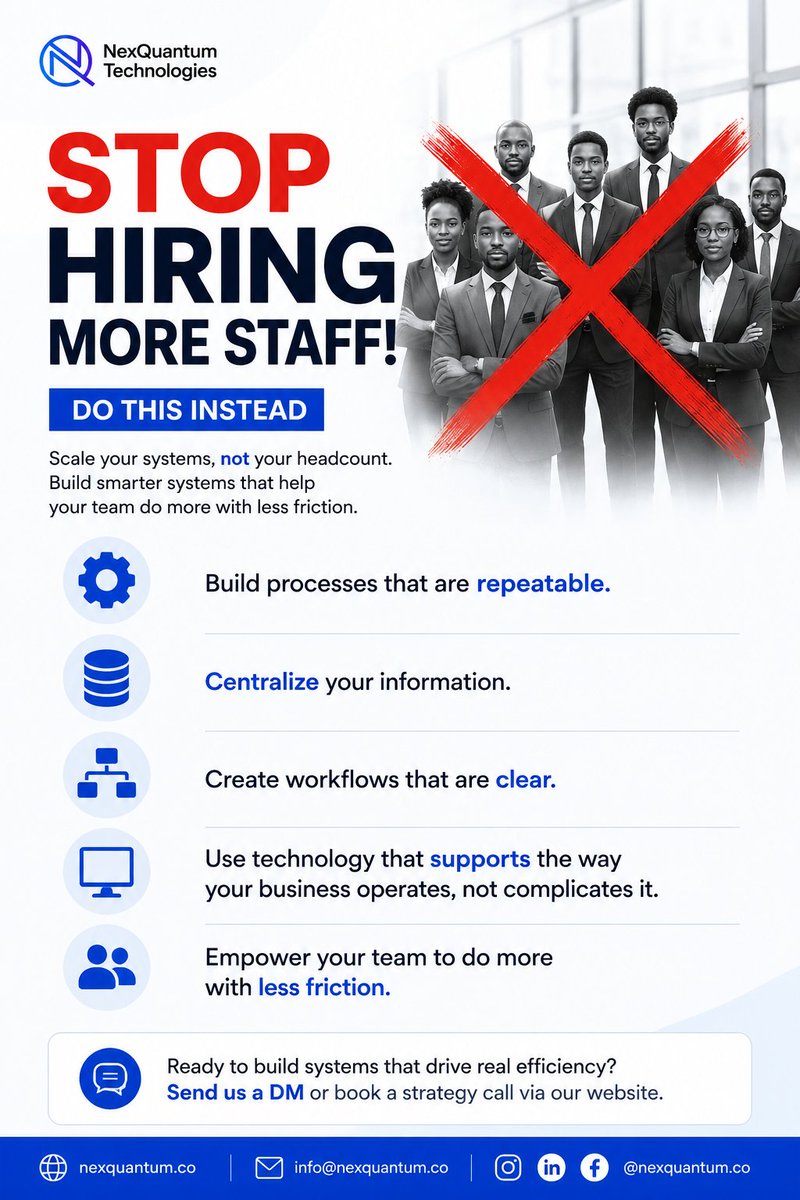
STOP HIRING MORE STAFF! We'll tell you what to do instead. But first, let's dissect the root cause of excessive hiring and why it's often the wrong solution. Every business experiences a season of growth. A season where orders are at an all-time high. Customers are increasing. Workloads are becoming heavier. Business is good. Then, business owners start to notice a change The tasks that used to take minutes now take hours. Approvals become slower. Customer complaints begin to increase. Employees seem overwhelmed. Management looks around and reaches the most obvious conclusion. "We need more people." So they hire. The workload is distributed across more employees and for a while, things improve But then the business grows again and the same problems return. So they hire again. And again. Until they find themselves paying more salaries... ...but operating just as inefficiently. Why? Because they never had a people problem. They had a systems problem. The processes that supported a 10-person business were never designed to support a 100-person business. And no matter how many people you add, broken processes don't magically become efficient. They just become more expensive. That's the mistake many growing businesses make. They scale their workforce... When what they should be scaling are their systems. But what does it actually mean to scale your systems? It means preparing your business to handle more work without needing more effort for every new customer, every new order, or every new employee. It means creating processes that are repeatable. Information that is centralized. Workflows that are clear. Technology that supports the way your business operates instead of complicating it. Because every new employee you hire enters an existing system. If that system is inefficient... The new employee simply inherits the inefficiency. But when your systems are well-designed, every person you hire becomes more productive from day one. That's how sustainable businesses grow. Not by endlessly increasing headcount... But by building systems that allow their people to do more with less friction. At NexQuantum, that's where every conversation starts. We first ask the question "Why is your current system no longer working?" Because we believe, when you fix the system... Your people perform better. Your operations become faster. And growth becomes much easier to sustain. If you’ve already hired plenty staff and the problem has not been solved, NexQuantum Technologies can help you figure out how to improve your systems so the staff you hired can work better and ensure overall organizational efficiency. Send us a DM or book a strategy call via our website @nexquantum.co

Amedu Aiyedun @aiyedun_amedu
8 Followers 239 Following
Mary @carlson100mary
2K Followers 5K Following who needs a plan when you’ve got a sense of adventure?
NexQuantum Academy @NexQuantumAcad
7 Followers 21 Following We train our students to be competent, sought after global tech talent through guided, hands-on training in high-demand digital skills.
DAENIELL - EVERYTHING... @DaenielI
47 Followers 140 Following My job is to understand the psychology behind human buying behavior and to use every technique in my arsenal to make that psychology work for your business.
BestQuality Graphics @BestqualityG
3K Followers 4K Following Brand Designer & UI Designer||Building @TheBest_Hub & @Read_Hub1. Send a DM and let’s work together on your next project
Abbey Ola @AbbeyOla20
48 Followers 54 Following God's general A worshipper A Christian song writer, composer and lead vocalist. A blessing the world will never forget 😎
Norakate @Osinigwe_
150 Followers 264 Following That Anambra girl| Virtual Assistant Transitioning to Email Marketing| Trusting the process

Àbùdíọ̀kẹ́ @midecodeable
524 Followers 525 Following Software Engineer & Founder Building @NexQuantumAcad (practical tech skills + career growth) & @nexquantum (software • web • AI for businesses)
Elixdoc @elixdoc
3 Followers 17 Following Leveraging technology to augment the reach of doctor and provide on demand access, we are making quality healthcare more accessible than ever.
NexQuantum Academy @NexQuantumAcad
7 Followers 21 Following We train our students to be competent, sought after global tech talent through guided, hands-on training in high-demand digital skills.
Gamers-Outlet.net Cd ... @Gamers_Outlet
29K Followers 87 Following https://t.co/Ie5307w7IU is a place that offers digital codes for games, software and much more at the best prices possible, at the click of a button!
Tech Startups @thetechstartups
3K Followers 5 Following https://t.co/6s1JdO6Eh8 is the exclusive platform for technology startups. We feature latest startup news & emerging tech news. Got a tip? [email protected]
Paystack Support @AskPaystack
1K Followers 2 Following Official support for @paystack! Powering African ambition❤️You might like