Hoang Nguyen @nkhplus
Ho Chi Minh, Vietnam Joined December 2007-
Tweets37
-
Followers8
-
Following852
-
Likes14K

"You cannot govern a technology you have only been briefed on." Singapore Minister for Foreign Affairs, Dr. @VivianBala, echoing @karpathy and @yacineMTB on why he runs NanoClaw: "you can outsource memory and computation, but you cannot outsource your understanding" x.com/VivianBala/sta… He also shared his tech stack for running his second brain for Singapore's Foreign Affairs Ministry and parliamentary affairs: - @AnthropicAI Claude Agent SDK - Baileys + WhatsApp - Mnemon (Graph Memory) - @ollama + @nomic_ai - @ggerganov Whisper.cpp + OneCLI With special notes on how he handles security and isolation, and what implications he sees for Singapore Inc.

Built a personal AI agent - why I did that and what it means. go.gov.sg/aiesingapore

Another cool idea behind @superwhisper is that it’s connected to the Gemini Interactions API. Superwhisper stores the original recordings, and Gemini models can interpret not just the transcript, but the audio itself, such as tone or accent. This kind of feedback can be used in separate sessions with a voice agent, so it can focus on highlighted areas or track trends over time. Notes and recordings can also be classified first, so Superwhisper can be used for personal notes, journaling, workout progress tracking, etc.


I'm excited to announce the most ambitious recreation of Bloom's 2Sigma study of the last 40 years. It's funded by @reedhastings and staffed by a team of 20 of the best educators in this country. Our education team's goal is to show the largest academic gains in one year ever recorded, and we'll publish our results even if we fail. Recently, @jwdanner introduced me to @reedhastings. Most people know Reed co-founded Netflix. Fewer know he has been one of the driving forces behind improving education for the last twenty years. When Reed pitched me on recreating Bloom's famous 2-sigma problem, I felt an overwhelming sense of hope for education. Over the last few months we have moved at breakneck speed to assemble an exceptional team. Someone recently described it to me as the "Avengers of education." We are testing one question with the rigor it deserves: can elite one-on-one tutoring reproduce the largest learning gains ever measured in a controlled study? We will work with researchers from Stanford, Brown, Cornell, and other leading institutions, and we intend to be the most transparent research group in the field. That means publishing our methods, our benchmarks, and our results, whatever they show. We will invest up to $100,000 per year per student to give them the best education on the planet. If it works, the data and methods can help educators and technologists recreate these outcomes for every child. We are actively hiring tutors, engineers, and operations people to help us climb this mountain.

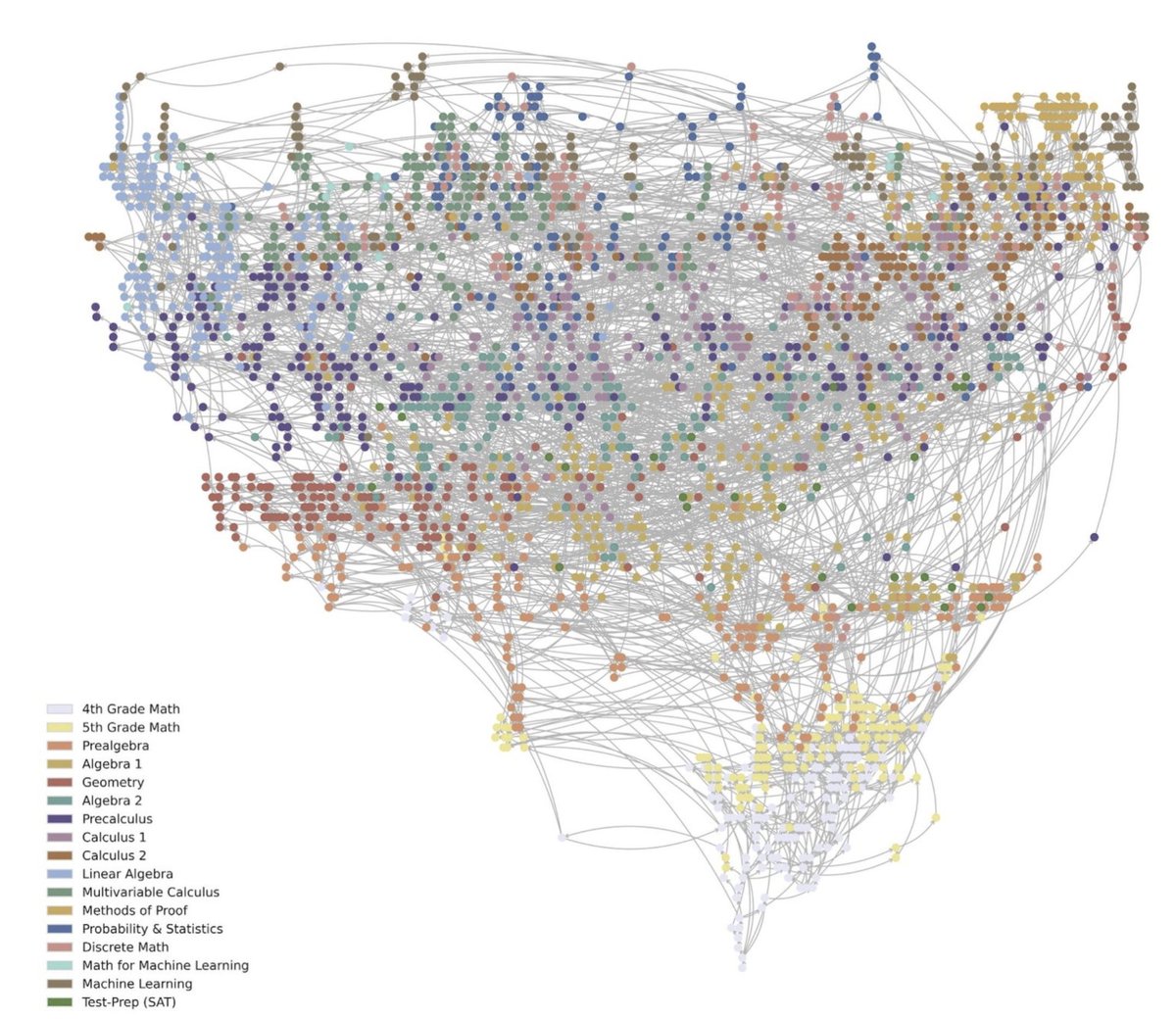
A third grader just scored a 5 on AP Calculus BC. The system that trained him contains no LLM. The core is a knowledge graph one man spent 250 hours encoding by hand, two minutes per edge. The platform is Math Academy. Its "AI" is an expert system that routes each student through nearly 3,000 math topics, from 4th grade arithmetic to the math behind machine learning. Every node, every prerequisite link, every weight was placed manually by a team of mathematicians. The weights alone took Justin Skycak a full month: 1,500 topics at the time, roughly 5 prerequisite links each, 2 minutes to estimate each one. 8 hours a day of pure encoding, done before ChatGPT existed to ease the load. Why go through that? Because the graph unlocks mastery learning, the closest thing education research has to a cheat code. In 1984, Benjamin Bloom showed that students with one-on-one tutoring perform two standard deviations above a regular classroom. The average tutored kid beats 98% of the lecture hall. Nobody could afford a tutor per child, so the finding sat in journals for 40 years. A prerequisite graph with a mastery gate is the workaround. The system always knows the exact next topic a specific kid is ready for, drills it until proven, then moves on. Zero time spent waiting for 29 classmates. That waiting is most of school. A year of classroom math is roughly 150 hours of instruction, and the majority goes to pacing, review, and re-teaching. Strip it out and a motivated kid covers six grade levels in one calendar year. The origin makes it better: this grew out of a math program at Pasadena High School where 8th graders were passing AP Calculus BC, back when the founders were still hand-grading the whole thing. The most effective education AI running today is a graph a few humans built by hand, one edge at a time.

For anyone wondering how a third-grader can complete six years' worth of math in a single year AND score a 5 on the AP Calculus exam. This knowledge graph spans 3,000 math topics, from 4th grade to the university level, providing the perfect basis for mastery learning.

My brother @doerpiyush and I have been cooking something on nights and weekends, and I finally get to share it. It's called Teach Me Something. It turns your AI — Claude, ChatGPT, whatever you use — into your personal tutor. Here's the story of how I used it this weekend. I'm a coffee noob. I got a tiny machine that makes exactly two drinks, and I asked Claude a genuinely dumb question about making a coconut water coffee. You know how this goes — one question turns into two, and soon you're deep in a topic asking the dumb questions you've never asked anyone in your life. But that learning isn't sticky. If the AI gives me an amazing answer, 99% of the time I skim it once and move on to the next question. Nothing sticks. This time my Claude was connected to Teach Me Something. I said: use this as a learning opportunity — make me a masterclass. It built a learner profile, proposed a plan, and generated a six-part tutorial series on coffee and espresso. Customized to me — my machine, my French press, my Blue Tokai beans. Then curiosity fed on curiosity: I'm a history nerd, so I asked for the history of coffee, and got this: "The bean is Ethiopian, the drink is Yemeni, the coffee house Ottoman, then English. Only the espresso is Italian — and it arrived shockingly late." It even quizzes me on what I read, with spaced repetition baked in, so it actually sticks. Once you've read a tutorial made just for you, you can't go back to generic ones. It's open to everyone. Sign up, copy the instructions into your agent, and make your first tutorial in under 10 minutes: teachmesomething.xyz Full walkthrough in the video 📷
Teach Me Something turns your agent into your personal tutor. It's agent-native — an MCP server you connect in two minutes, and then your AI can actually teach you. Ask it to teach you anything and it writes a real tutorial pitched at your level, using your own projects as

Following the amazing reaction to the Marble Curriculum yesterday, we've decided to make it open source 🛰️👇 Everything a child learns in primary school. 1,590 concepts. 3,221 connections across 8 subjects, from Math and Science to Computing and Life Skills. Anchored in the US and UK curriculums, standard by standard (NGSS, Common Core, DfE). What you will find in the repo: every concept as structured JSON with its age band and the evidence a child must show to master it. Every prerequisite link marked hard or soft, with a written rationale. It's a true DAG you can compute learning paths on. Open license, you can build whatever you want with it. Now is a unique time in history to be building in education. Getting AI and kids education right is likely one of the hardest and most important problems to crack over the next decade and we need as many smart and creative minds behind it. We think a common solid basis, accessible to all and that can be built upon, is critical to move fast. That's why we're making this curriculum open source. It's not perfect but we know it's a robust basis, and we believe that sharing it openly is the fastest way to progress in this field. If you're building in education, share this around you and tell us in comments if you find this useful and if you want to contribute. We'll keep working and investing on it @withmarbleapp. Credit goes to @guillaume_boni for building this. I just made it look pretty. Links below 👇


Built a "YouTube realtime copilot" browser extension using OpenAI's realtime 2 API: The agent watches the video alongside you, and can answer any question you have about what was just said via realtime voice chat. The crazy part to me is: It can differentiate the YouTube's audio stream and your voice, so it doesn't confuse the video as commands, and stays silent unless you ask something!

LLM Knowledge Bases Something I'm finding very useful recently: using LLMs to build personal knowledge bases for various topics of research interest. In this way, a large fraction of my recent token throughput is going less into manipulating code, and more into manipulating knowledge (stored as markdown and images). The latest LLMs are quite good at it. So: Data ingest: I index source documents (articles, papers, repos, datasets, images, etc.) into a raw/ directory, then I use an LLM to incrementally "compile" a wiki, which is just a collection of .md files in a directory structure. The wiki includes summaries of all the data in raw/, backlinks, and then it categorizes data into concepts, writes articles for them, and links them all. To convert web articles into .md files I like to use the Obsidian Web Clipper extension, and then I also use a hotkey to download all the related images to local so that my LLM can easily reference them. IDE: I use Obsidian as the IDE "frontend" where I can view the raw data, the the compiled wiki, and the derived visualizations. Important to note that the LLM writes and maintains all of the data of the wiki, I rarely touch it directly. I've played with a few Obsidian plugins to render and view data in other ways (e.g. Marp for slides). Q&A: Where things get interesting is that once your wiki is big enough (e.g. mine on some recent research is ~100 articles and ~400K words), you can ask your LLM agent all kinds of complex questions against the wiki, and it will go off, research the answers, etc. I thought I had to reach for fancy RAG, but the LLM has been pretty good about auto-maintaining index files and brief summaries of all the documents and it reads all the important related data fairly easily at this ~small scale. Output: Instead of getting answers in text/terminal, I like to have it render markdown files for me, or slide shows (Marp format), or matplotlib images, all of which I then view again in Obsidian. You can imagine many other visual output formats depending on the query. Often, I end up "filing" the outputs back into the wiki to enhance it for further queries. So my own explorations and queries always "add up" in the knowledge base. Linting: I've run some LLM "health checks" over the wiki to e.g. find inconsistent data, impute missing data (with web searchers), find interesting connections for new article candidates, etc., to incrementally clean up the wiki and enhance its overall data integrity. The LLMs are quite good at suggesting further questions to ask and look into. Extra tools: I find myself developing additional tools to process the data, e.g. I vibe coded a small and naive search engine over the wiki, which I both use directly (in a web ui), but more often I want to hand it off to an LLM via CLI as a tool for larger queries. Further explorations: As the repo grows, the natural desire is to also think about synthetic data generation + finetuning to have your LLM "know" the data in its weights instead of just context windows. TLDR: raw data from a given number of sources is collected, then compiled by an LLM into a .md wiki, then operated on by various CLIs by the LLM to do Q&A and to incrementally enhance the wiki, and all of it viewable in Obsidian. You rarely ever write or edit the wiki manually, it's the domain of the LLM. I think there is room here for an incredible new product instead of a hacky collection of scripts.

A week ago I noticed our AP History students couldn't match world leaders to what they actually did. So we built a tier list game. Students rank leaders, then argue against a (somewhat sassy) AI to justify their placement. A week later, the knowledge gap is gone.

My 3yo wanted to use the computer like me so I made him his own terminal. He types whatever he wants, it responds with fun messages. No external deps, no ads, just keyboard practice and cause-and-effect thinking. He thinks he's hacking. github.com/meimakes/tiny-…
@thekitze I brought it because it’s a lifetime payment, and I believe you can improve it even further in the future.

Hundreds of questions were asked by my 4-year-old son as we assembled the Reachy Mini robot (2 hours), connected it with Claude Code (5 minutes), integrated real-time VLMs/web search APIs (10 minutes) and brought embodied Al to life at our kitchen table. May the curiosity and creativity of this Generation Alpha, the first Al-native generation, be a wellspring of daily inspiration to us all. Epic foundational work by @huggingface @pollenrobotics @claudeai

I built a Claude skill that turns Claude Code into your personal coding tutor. The core insight: Claude Opus 4.5 is already the best tutor in the world. @AnthropicAI cooked with this model! It has incredible emotional intelligence and deep coding knowledge. What this skill does is just provide a harness—a way for Claude to agentically build the right context about YOU so it can personalize the tutoring experience in exactly the right way. Here's what makes it work: Learner profile from day one. The first time you use it, Claude interviews you. It asks about your programming background, your goal (where do you want this to take you?), and who you are as a person. This gets saved and informs every single tutorial it ever writes for you. From the very first interaction, everything is 100% personalized. Tutorials that use YOUR code. When you ask to learn something, Claude doesn't give you generic examples from some blog post. It finds examples in the actual codebase you're working in. This makes concepts stick in a way abstract examples never do. Quiz mode with spaced repetition. You can run "/quiz-me" and Claude will test you on concepts you've learned. It tracks your understanding score for each tutorial. Then it uses spaced repetition to prioritize the next quiz—concepts you're shaky on come back in 2 days, concepts you've mastered fade to 55+ day intervals. It literally builds retention into the learning process. One central knowledge base across all your projects. Whether you're joining a new company and want to understand their codebase, learning from an open source project, or leveling up on your own vibe-coded project—all your tutorials live in one place (~/coding-tutor-tutorials/). So your personal coding-tutor accompanies you across all your coding adventures. The whole thing is a feedback loop: learn → quiz → retain → learn more → quiz → retain. Your tutorials evolve, your knowledge compounds, and Claude gets better at teaching YOU specifically over time. To install it in Claude Code: • Run /plugin to open the plugin manager • Add marketplace nityeshaga/claude-code-essentials • Enable coding-tutor plugin Here's the Github: github.com/nityeshaga/cla… And here's 20-mins of me walking you through how to use this plugin and how it works 👇🏽 Let me know if you use it to teach yourself something cool!

An MIT study found that 83% of students who used ChatGPT couldn't remember what they wrote. But when students did the hard thinking first, AI didn’t reduce cognitive engagement at all. @DrInesLee turned that finding into three principles for thinking with AI:


ChatGPT for Teachers: openai.com/index/chatgpt-…

To celebrate five years of #AlphaFold, we’re making The Thinking Game available on YouTube. 🧬 Get a candid look at the triumphs, the challenges and the pivotal moments that led to a breakthrough on a 50-year-old grand challenge in biology. Stream for free on @YouTube → goo.gle/4pCVQNY
@daniel_mac8 Could you show me how to use obsidian MCP?


Ben @ play @BenjaminSc7519
145 Followers 625 Following I run a home AI lab: it hunts planets in real telescope data, designs buildable furniture, and ships strange software. All real, nulls included. AMA!
JO. Z @jojodecayz
3K Followers 1K Following Founding member @ComfyUI. Produce Lead of Comfy Agent. I create workflows and visuals too.

Martin_DeVido @d33v33d0
15K Followers 4K Following
Pietro Montaldo @PietroMontaldo
2K Followers 2K Following I build and share AI tools and resources useful for non-techies | Co-founder @ NForceAI | Founder @ NotLinear - AI training
Le Thien Chuong @chuongle
13 Followers 8 Following
Jelly Goni @JELgon
267 Followers 584 Following "If you can't explain it simply, you don't understand it well enough." --Albert Einstein
Seth Kimmel @sethkimmel3
1K Followers 804 Following Founder @sutro_sh - building tools to scale productivity, experimentation, and discovery.
kuro @abue_ammar
2K Followers 285 Following 🔗 Tinycast: https://t.co/sElTnZHhdt 👾 Tinycast GitHub: https://t.co/1QeQuzCAOC 💌 Support Tinycast: https://t.co/9mWnopqbiG
vogel @ryanvogel
19K Followers 789 Following ceo of @rebasetv founding developer @opencode @anomalyco
Diogo Almeida @CompleteSkeptic
148K Followers 97 Following Sane + 🌶️ takes in an insane AI world... AI capabilities researcher: co-created RLHF/ChatGPT @ @openai now trying to right the wrong 🤭 (ceo @typesafeai)
Amelia Wattenberger �... @Wattenberger
36K Followers 5K Following design, AI, web dev, data viz, tools for thought ✨ @shv, previously R&D @GitHubNext, design @AdeptAILabs
joshpuckett @joshpuckett
42K Followers 2K Following designer, investor, advisor · co-founder @iterationdesign @upperstudy · https://t.co/Jn9brli34Y · https://t.co/2sxrSlAsyY

Alex Barashkov @alex_barashkov
31K Followers 466 Following Brand and design for tech companies - https://t.co/UX0nwuKWXz | Creator of https://t.co/tsD7zYVvAu, https://t.co/E4p94b7Nwq.
Naomi Bashkansky @NaomiBashkansky
17K Followers 155 Following Building telepathy at https://t.co/UoSb602PeL. Chess WIM. Former OpenAI alignment researcher.
Daniel Lockyer @DanielLockyer
73K Followers 181 Following • I make sites faster and cloud/LLM bills lower 🚀 • 2:43 marathoner (🔜 2:39) • Performance is my thing
Management Craft @MgmtCraft
41 Followers 26 Following A curated library built to help founders and executives at startups scale from 10 to 100. By @andysparks.
Andy Sparks @andysparks
9K Followers 784 Following Executive coach to CEOs. Building @mgmtcraft. Author. Past co-founder at @Holloway & @Mattermark.
Lee Knowlton @leeknowlton
728 Followers 320 Following living slightly in the future, building what’s missing @every · chief psyop officer at home · prev, cto ultraworking · teacher before tech

ThomPete @Hello_World
6K Followers 134 Following Strategic Tinkerer @ https://t.co/7kkTWHSRpe (NYSE: XYZ) Views are my own. Currently building Buzz https://t.co/74AvLgvc46 Essays at https://t.co/fLYsvO8MZ9

Chris Pedregal @cjpedregal
11K Followers 591 Following Founder of @meetgranola, the AI notepad for people in back-to-back meetings. Previously founded Socratic (acq by Google). Product builder and optimist ✨
Jack Cheng @jackcheng
12K Followers 369 Following Children’s author, pattern linguist, slow technologist, senior editor @every. And newish dad. Building lively worlds, real and imagined.
Calvin Grunewald @CalvinGrunewald
8K Followers 336 Following Founder. Building Machine. Girl Dad. Ex bigtech VP. Building agentic platforms for the future of communication. https://t.co/FIkBWhIvj4
Yiran - edu/acc @yiran__c
1K Followers 456 Following Building @ScribbleDotApp | AI Engineer @AlphaSchool Love the not obvious of the obvious. | 事在人为
Zsolt Kacso @kaolti
5K Followers 688 Following ✨ I design and build cool things. Clients backed by YC, $20M+ raised. Open to work.
Board @boardisfun
5K Followers 47 Following The face-to-face game console where physical pieces make a shared screen come alive.

Iulia Feroli @iuliaferoli
2K Followers 524 Following Physical AI & robotics on YouTube @BackToEngineering · 37K+ subs · Building the on-ramp from software to hardware · she/her 🤖

Nick @nickbaumann_
21K Followers 416 Following codex @openAI | prev @cline | product of @UWMadison 🦡

James Russo @Rames_Jusso
2K Followers 184 Following Working on @HyperFrames_ and building the future of video storytelling @HeyGen | previously at @brexHQ
nate parrott @nateparrott
62K Followers 2K Following design @ @anthropicai, previously @browsercompany libposting until further notice
vanh @VanhDesign
539 Followers 166 Following Builder and Content Creator @DesignCodeio Youtube Tutorials: https://t.co/OAcQzsCzzP

Design Arena @DesignArena
23K Followers 15 Following World's first benchmark for real-world visuals with 6M+ creators and counting. Made by @intelligence_ai

Mentava Reading 🐮 @MentavaInc
8K Followers 261 Following Our software teaches preschoolers to read. Get our best-selling Alphabet Sounds book for free here https://t.co/WjsQP40GwH
Alex Harri @alexharri_
18K Followers 95 Following Building design tools @paper. Read my writing on https://t.co/zS2xTyev3g
Ahmed @ahmedscen
15K Followers 959 Following | Maker of https://t.co/T9BTwmzlRa ❤️ | Grab AI Prompts & Websites
Simon Prince @SimonPrinceAI
11K Followers 322 Following Professor of Computer Science, University of Bath
Ben @ play @BenjaminSc7519
145 Followers 625 Following I run a home AI lab: it hunts planets in real telescope data, designs buildable furniture, and ships strange software. All real, nulls included. AMA!
Piyush Agarwal @doerpiyush
51 Followers 122 Following Ruby on Rails developer | Building Curated Connections - connection engine of communities | Tinkering https://t.co/kTrSFaXNUM


Teaching Lab @TeachingLabHQ
2K Followers 1K Following We believe when teachers thrive, students thrive. Teaching Lab works to close the educational opportunity gap through teacher-led professional learning.
Ste @sterespect
888 Followers 4K Following i design stuff. committed to the bit. designer dad archetype https://t.co/SmqsPze2BJ i own a cafe in Paris https://t.co/mv4LF6R6zD
Shivangi Srivastava @shivangi_sriv
5K Followers 286 Following Building at the frontier of AI + learning | Prev: New Initiatives @swiggy_in | CTO and co founder at Tazzo | Alum IITG
Maxime Rivest 🧙... @MaximeRivest
11K Followers 1K Following Searching for the wise way to interact with AI. Experiments are on GitHub maker of: https://t.co/gwjm7b536l one api for all providers
Catalin Voss @CatalinVoss
2K Followers 544 Following Dad, CTO, & co-founder of @learnwithello. One-on-one teaching for every kid on earth. Ello 2.0 coming soon, come build it with us.
Kaelin Hooper 👾 @KaelinHooper
1K Followers 597 Following Building https://t.co/IqSUKHrn24. Ex-homeschool kid building @roblox games, prev cofounded @joinender. Tweets about education, toys, games.
とみやす|北海... @tomiyasu16
7K Followers 656 Following 農業6年目。北海道で農業法人役員|ブロッコリーやネギ、大豆などを生産🥦|AI×自動化で「農家のめんどくさい」を減らしたい|OpenAI公式グローバル動画出演|農場をフィールドに、現場でのAI実験を発信🌳

Peter Gostev @petergostev
27K Followers 1K Following London 🇬🇧 AI Capability @arena https://t.co/bkfw1nxdmJTrends for United States
You might like