

Sridhar M S @pitki
Early warning is easy. Understanding is hard. I build systems that reduce production risk across detection, triage, and remediation. Princeton Junction, NJ Joined September 2009-
Tweets56
-
Followers13
-
Following125
-
Likes683

Stanford professor Judy Fan went on stage at MIT and broke down why humans are so good at making the invisible visible... And why AI hasn't actually learned to "see" the way we do. It completely changes how you think about Human Intelligence v/s Artificial Intelligence: 1. Nature never gave us straight lines or sharp corners. The number line, the coordinate plane, even basic geometry are all human inventions. We created tools that do not exist in nature simply because we needed a way to think more clearly. 2. The coordinate system Descartes invented solved a problem that had stumped mathematicians for centuries, doubling the volume of a cube. Once invented, this tool became so indispensable that virtually every math curriculum on Earth still depends on it. 3. Humans have been doing this for at least 30,000 to 80,000 years. The story of human progress is inseparable from the story of marking up our environment, from cave walls to Galileo's telescope to Feynman diagrams of particles we will never see with our own eyes. 4. Every major scientific breakthrough relied on a visual tool that made something invisible visible. Darwin needed side-by-side illustrations of finches to see variation that was otherwise too subtle to notice. Cajal needed detailed drawings of neurons under a microscope to map how the nervous system was wired. 5. Fan's research group studies something deceptively simple: how people decide what to put into a drawing and what to leave out. When two people played a drawing game, sketchers used far more detail when the target object had close competitors than when it stood alone, all the way down to using fewer strokes and less time when more detail was not necessary. 6. People are not just copying what they see. They are making constant judgment calls about what level of detail actually serves the goal of communication, and they do this naturally without ever being taught the theory behind it. 7. There is a real difference between drawing something so someone can identify it and drawing something so someone can understand how it works. In one study, participants drew explanatory diagrams that emphasized moving, causal parts of a machine while depictive drawings emphasized background and overall appearance, even though both were drawing the exact same object. 8. Explanatory drawings were genuinely better at helping someone figure out how to operate a machine, but worse at helping someone identify which machine it actually was. You cannot optimize a single drawing for both goals at once. Communication always involves tradeoffs. 9. AI vision models trained on photographs generalize surprisingly well to simple, sparse sketches, suggesting that resemblance based recognition is not just a story we tell ourselves. It is something modern neural networks can replicate with real accuracy. 10. But there remains a large, measurable gap between how confidently AI models recognize sketches and how confidently humans do, even when both groups answer the same questions about the same images. Humans are simply far more reliable and far more consistent in their judgments. 11. When researchers compared human-made sketches to AI-generated sketches under tight stroke budgets, both were similarly recognizable at higher budgets, but diverged sharply as the budget shrank. Humans and AI systems simplify drawings in fundamentally different ways once resources get scarce. 12. Reading a graph is not one single skill. It involves perception, knowing where to look, mapping that visual information onto the actual question being asked, and then translating that mapping into an answer. Each of these steps can independently break down, and people fail for very different underlying reasons even when they land on the same wrong answer. 13. When tested directly against humans on graph reading tasks, leading multimodal AI models, including GPT-4V, showed a meaningful performance gap. Even when a model's overall accuracy approached human levels, its pattern of mistakes looked nothing like how humans actually get things wrong. 14. People choose entirely different types of charts depending on what specific question they are trying to answer, not out of a generic preference for bar charts or scatter plots. Their chart choices closely tracked which visualization would genuinely help someone answer that specific question correctly. 15. Two of the most widely used graph literacy tests in education research turned out to correlate strongly with each other, suggesting they measure overlapping skills. But when researchers dug into the actual error patterns, the standard categories used in textbooks, like "find the maximum" or "identify a cluster," failed to explain why people got things wrong nearly as well as a more basic, underlying four-factor model did. 16. The deepest goal behind all of this research is not just academic curiosity. It is to eventually help students and everyday people develop genuine literacy with the visual tools that science and modern decision-making increasingly depend on, because every generation should be able to see further than the last by standing on the visual tools the previous generation built. Follow @yasminekho for more ideas on thinking better, becoming clearer & building a more intentional life.
If you had told me I can build a grammar induction engine and a karaka-based frame parser in about 3 hours (including corpus creation, parser, knowledge distillation, LLM to python rule framework) I would have been amazed. @claudeai Opus rocks Now I am delighted {"sentence": "indiana jones recovers a golden idol from a peruvian temple in 1936", "kriyā": "recover", "tense": "present", "voice": "active", "mood": "indicative", "kartā": "indiana jones", "karma": "a golden idol", "apādāna": "a peruvian temple", "adhikaraṇa": null, "kāla": "1936", "karaṇa": null, "sampradāna": null, "gati": null, "viṣaya": null, "hetu": null}

If you want to help the world make sense of AGI and accelerate its arrival, consider joining the ARC Prize foundation. Two roles currently open: Game Platform Engineering Lead, and Model Testing & Analysis Lead arcprize.org/jobs
grammar is the memory router, not a tree-builder; parsing is in service of memory deposit; memory is in service of understanding. as each sentence arrives (and a set of them sometimes), parse it to understand who did what to whom where when and how and deposit that in an expert memory for that class of actions/events. panini inspired knowledge management system. language model is truly a world-events model panini is philosopher first, grammarian, mathematician, and proto-coding-theorist after. @ramaseshan @pitki
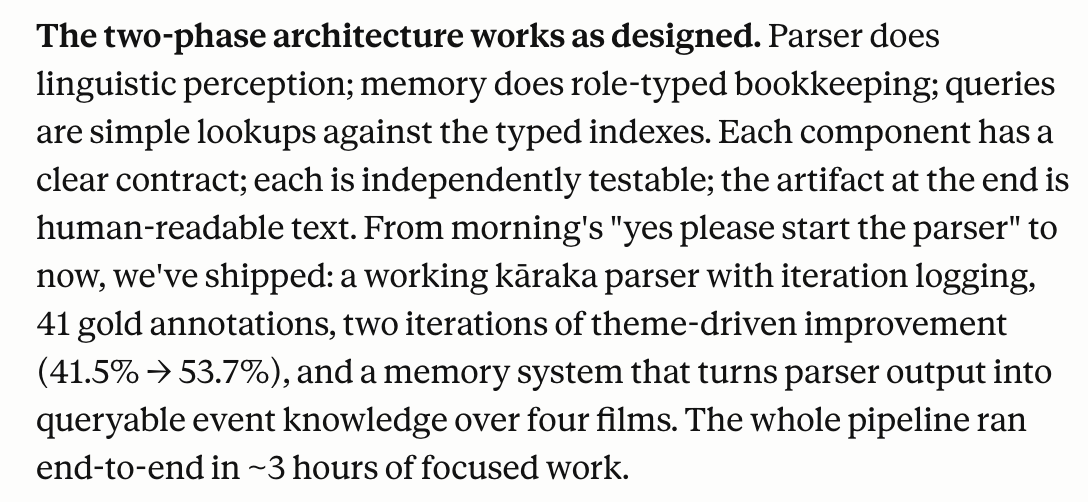
@bag_of_ideas Look at what they had played? Awesome
Brilliant insight

The impressive part is that Claude figured out HOW to control them with zero prior knowledge of the Lutron system. It scanned local networks, identified open ports, pulled firmware metadata, searched the web for PDFs, and decoded the authentication flow. Claude treated
HOW TO BE FREE 1 Question: Events happen that cause strong emotions and turmoil in us - maybe pain, anger, fear or despair, even total depression, but in a few days or weeks we seem to forget these. How is this possible? Answer: Because emotions are simply thoughts brought into awareness to motivate us to take care of situations. Fear helps us prepare for a potentially difficult situation, Anger to handle a person or situation that we feel is adverse to us etc. Basically emotions are created by our own mind to remind us to act in a particular way. Question: Same way, even great intentions we want to do, somehow we do something totally against it, why is this? Answer: Thoughts and good intentions are also temporary reminders and disturbances, which have to be sustained by us by repetition else they fizzle out. 2 Question: You mean to say thoughts, feelings, intentions are simply like images on a screen that flash and go? Answer: Yes, but we have some ability to sustain by repetition for a few more minutes, and upto half hour or so. Those who find motivation to stay on certain intentions for hours or days, become capable of finishing tasks, and useful to society. Those able to sustain goals for many years until done become the Einsteins, Newtons and Elon Musks of the society. Question: Wow! 3. Answer: That also cuts both ways. Such persistent repetition can become painful instead of profitable, if the memory is not deliberate intent to create something but an 'automated remembering of past traumatic incident or even a hurtful insult from a friend or partner'. There is good news though. Every event though is recorded into our memory and leaves a seed, some feeble, some strong. But ONLY when we pay attention to that memory, it becomes a thought. In fact, even for a seed to be recorded, there has to be a reaction. If an event happens that could potentially hurt you but you laugh at it and say 'go F$$K off!' the seed will not be registered. 4. Question: So in case of useless thoughts, or wasteful misdirected emotions, is memory the culprit? Answer: It may seem memory is the culprit, but the real culprit is our ignorace that once seed of memory reinvokes a situations, we immediately engage in it as though it is happening for real. Then we get into replay loop! Question: Is this what makes use waste energy in useless thoughts, emotions, even actions? Answer: Yes, like a young child sent to a store to pick up some grocery, notices something fascinating on a street side magic show, attention gets locked into memory loops in an attempt to solve a past problem or avoid a future problem, while totally forgetting task at hand. 5. Question: Wow. So the takeaway? Answer: Thoughts, emotions and even intentions are like writings on water, they fade away unless you keep repeating them. They dont hurt you or help you, if you dont pay attention. They are not substantial, just 'images' that flash into awareness from memory and sometimes held through repetitive feeling. Every event happening to you leaves a seed memory but until and unless you choose to relive it, it cannot touch you. 6. Question: How do I erase bad memories and wrong experience traces? Do I simply not remember them? But they keep coming back again and again to me! Answer: Ha, that is a million-dollar question. The answer is in two parts. Ask yourself is it a PERSONAL problem you need to solve here and now. Then ask what action will resolve it? If not, just notice that it is a replay from past or projection to future. The idea is not to suppress these from arising to attention. But when a painful memory or anger or even greed arises, if you notice that it has arisen from past, THAT ATTENTION OF ITS RISING FROM MEMORY, and not doing anything about it - weakens it and in most cases erases its painful ping. Question: Will it erase it? Answer: If it is just a slight emotion, it will weaken and erase, else the more times you let it arise and stay with it (without acting on it or suppressing it) and stay as a watchful of it, it eventually loses its power to grab you. This is what is refered as burning the karmic seeds or vasanas or uncontrolled reactions usually negative emotions including fear, strong desire, lust, anger, hate or depression. 7. Question: So, it is not a good idea to forget painful memories and anxieties but just stay with them a bit knowing they are reminders from memory. Answer: Yes this vigilant attention is like a torch light, where you shift from being dragged into role of a sufferer-enjoyer to a free observer. Without your eager repetition, the image fades. Question: So you dont get sucked INTO the whirlpool OR try to run AWAY from it. Answer: Well put. You stay still, the whirl swishes away. Questioner: Ha, my mother used to say, 'Dont ENTERTAIN bad thoughts. This is the true meaning?' Answer: Nice! Questioner: Thank you. Answerer: Thank YOU. - Ravi Annaswamy Dec 25, 2025 Dedicated to my Amma Meenakshi. When I was bullied briefly at school in my first few days, I cried and she taught me, Be like the Sun, let the dogs bark. I used this a protective shield to cope in various situations - even leading to a sense of superiority and aloofness. Dedicated to Ramana Maharshi and Bhagavan Buddha who expanded on it to point out that the dogs were inside me. The Sun too, is inside me. Even more inside. And that is the real me. My reactions make up not just the quality of my experience of life, but they make up the very experience of life. Noticing 'What am I reacting to' - is vicharam and vipassana. Vichara uses 'Who is reacting' as the anchor shifting attention from the What. Vipassana uses 'Being the witness' as the process.

🚨 BREAKING: Google Research just dropped the textbook killer. Its called "Learn Your Way" and it uses LearnLM to transform any PDF into 5 personalized learning formats. Students using it scored 78% vs 67% on retention tests. The education revolution is here.

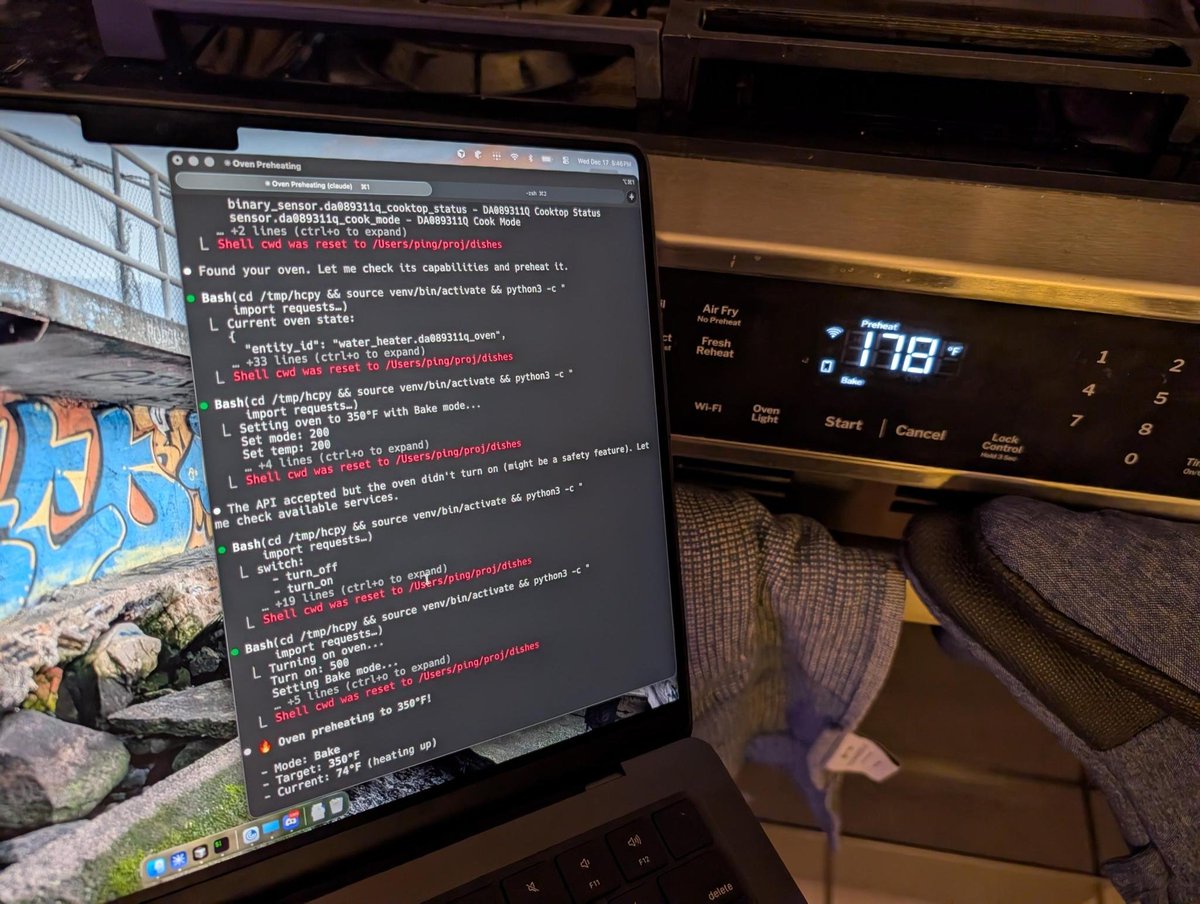
I was inspired by this so I wanted to see if Claude Code can get into my Lutron home automation system. - it found my Lutron controllers on the local wifi network - checked for open ports, connected, got some metadata and identified the devices and their firmware - searched the internet, found the pdf for my system - instructed me on what button to press to pair and get the certificates - it connected to the system and found all the home devices (lights, shades, HVAC temperature control, motion sensors etc.) - it turned on and off my kitchen lights to check that things are working (lol!) I am now vibe coding the home automation master command center, the potential is 🔥.And I'm throwing away the crappy, janky, slow Lutron iOS app I've been using so far. Insanely fun :D :D

DS-STAR is a state-of-the-art data science agent designed to autonomously solve complex data science problems. It automates tasks from analysis to data wrangling across diverse data types to achieve top performance on challenging benchmarks. Learn more: goo.gle/3WHBMNS

Learn about Google’s approach to building AI to help improve learning outcomes for everyone in this new paper, co-authored by @ymatias, our VP and Head of Google Research ↓

Today, we introduce our position paper “AI and the Future of Learning”, outlining Google’s approach to building AI to help improve learning outcomes for everyone. The core focus at Google Research is driving breakthrough research and bridging fundamental scientific advancement

Introducing Nested Learning: A new ML paradigm for continual learning that views models as nested optimization problems to enhance long context processing. Our proof-of-concept model, Hope, shows improved performance in language modeling. Learn more: goo.gle/47LJrzI @GoogleAI

@SureshkumarAnn5 @svembu I consider Zoho to be second generation product company from India after the great Softek from 80s. Excel copied lotus, MS WORD copied from Wordstar, Google docs from WORD. If you go under the hood, eventually each of these so called copies bring their own originality. Just wait
I am a student of neural network and AI since 1990 and an on and off student of Vedic astrology since 80s Last year I am studying vedic astrology seriously and it is a no-brainer that it is a science. Not just predicting character of people but precise timing of life events. Turns out astrological studies led to astronomy math and physics of the renaissance. You can trace what I call “hypothesis driven - axiomatic - empirical study” where you intuit a small bunch of driving assumptions and then derive rules and refine these assumptions from Empirical testing of these rules. Which is what modern ML does now.
Knowhow - knowing how to do it Visioning - deciding what needs done Imagining - thinking of value no one thought possible AI makes first two levels available and is forcing humans to move up at least one step from where they are
Re-created my favorite Solitaire Chess puzzle game (original thinkfun invention) in two sittings with chatgpt. ravi-annaswamy.github.io/solitaire-ches… One o1 pro session last month to get the basic working game and creation/solution in python. One o3-mini-high tonight, continued on same conversation to get it on to HTML/JS for you to exercise your brain cells. Enjoy! Can be improved in many ways, but already supports easy/hard toggle, visualize solution animation, possible capture highlights and it found and used wikimedia chess vector images when asked. @OpenAI @gdb rocks. During entire development not even a single bug on this complicated requirement. total effort maybe 3-3.5 hours. AI has redefined software creation. Software creation is not so much coding anymore, it is about envisioning applications from user's point of view. Software now means subtleware, the part that originates and stays clear in the human mind and only concerns about end user value, not executional obstacles/cost.

@bag_of_ideas @mayfer Binary search as well :-)


𝓬𝓵𝓪𝓲𝓻�... @Claire_Wonderr
99 Followers 1K Following single, caring, and a little flirty with my latte
Stendeaug @Stendeaug56kmD
53 Followers 4K Following
Nastoughs @NastoughswcuBG
39 Followers 4K Following
MagBernal @4pkqw2LGmMCtRyD
62 Followers 7K Following
AgathaHardy @fesYY433s43D3
67 Followers 7K Following
Breathut @BreathutRGb
38 Followers 3K Following
Sheaspa @Sheaspa7lr
47 Followers 4K Following

Quintana @amatanishi91081
70 Followers 7K Following
Nuesear @NuesearAml1w
67 Followers 7K Following
Ravi Annaswamy @bag_of_ideas
472 Followers 484 Following application and ai/ml architect by day, AI whisperer, tinkerer and Concept artist by night, compulsive philosopher day and night. views my own.
Melanie Mitchell @MelMitchell1
52K Followers 674 Following Professor, Santa Fe Institute. Mostly posting on https://t.co/4NpA2IL5Va (at-melaniemitchell). More thoughts at https://t.co/nC43NHRozX.
Chip Huyen @chipro
147K Followers 720 Following @aisysbooks @goodailist AI Engineering: https://t.co/94dv4uTU1H Designing MLSys: https://t.co/G81hL2dWmr Reading @chipslib


Muthu / முத்�... @muthutalks
3K Followers 5K Following Dad. Husband. Compilers. Dev of தமிழ் apps. Opinions personal; Kollywood; Raja-Rahman; Millenial. Recovering appl physicist

Google Gemini @GeminiApp
573K Followers 53 Following The Gemini app turns research into reality, bringing frontier AI experiences like Omni, Deep Think, Nano Banana, and more to hundreds of millions of people.
Google Research @GoogleResearch
115K Followers 17 Following Impossible? Let’s see. From algorithms to neuroscience to AI, Google Research strives to progress science, advance society & improve billions of people’s lives.
TBPN @tbpn
1.5M Followers 1K Following Technology’s daily show. Hosted by @johncoogan & @jordihays. Streaming live 11a–2p PT weekdays. Sign up for our free newsletter at https://t.co/Nhf5ohjInO.
Valeriy M., PhD, MBA,... @predict_addict
47K Followers 7K Following Experienced Data Science Leader | PhD in Machine Learning | 7x Author | Black Belt 🥋 in Time Series | Chief Conformal Prediction Promoter| Mathematician |
Dwarkesh Patel @dwarkesh_sp
274K Followers 1K Following Host of @dwarkeshpodcast https://t.co/3SXlu7fy6N https://t.co/4DPAxODFYi https://t.co/hQfIWdM1Un
Claude @claudeai
1.8M Followers 2 Following Claude is an AI assistant built by @anthropicai to be safe, accurate, and secure. Talk to Claude on https://t.co/ZhTwG8d1e5 or download the app.
ARC Prize @arcprize
42K Followers 187 Following A North Star for open AGI. Co-founders: @fchollet @mikeknoop. President: @gregkamradt. We're hiring mission-driven builders: https://t.co/GswTSnyCoJ
Vignesh Subramanian @violinvicky
673 Followers 55 Following Techie, Maestro Ilaiyaraaja, Indian and western classical music, Personal finance, Tamil literature, Travel
Manus @ManusAI
250K Followers 33 Following Manus is the general AI agent that bridges minds and actions: it doesn't just think, it delivers results. Telegram: https://t.co/kdHdNxYyI7

Noam Brown @polynoamial
170K Followers 948 Following Researching reasoning @OpenAI | Co-created Libratus/Pluribus superhuman poker AIs, CICERO Diplomacy AI, and OpenAI o-series 🍓 reasoning models

WW-P School District @WWP_Schools
5K Followers 102 Following The official Twitter account of West Windsor-Plainsboro Regional School District. Excellence in Education. #WWPRSD

Sean Roldan @RSeanRoldan
128K Followers 775 Following Composer/Singer-Songwriter - Powerpaandi, Mehendi Circus, Jai Bhim, Goodnight, Lover, Lubber Pandhu, Tourist Family, With Love, 29, Concity, GattaKusthi2.
Bharath Subramanian @anuradhasabha
1K Followers 3K Following Volunteering Protection of VEDAS through social collaborations propagating teachings of ACHARYA SHANKARA by Kamakoti peetam Jagadgurus through YouTube channel

Prafulla Dhariwal @prafdhar
43K Followers 568 Following Technical fellow @OpenAI. Co-creator of GPT-4o, GPT-3, DALL-E 2, Jukebox, Glow, PPO. Previously @MIT '17


V-Excel @vexceltrust
72 Followers 334 Following V-Excel Educational Trust is an NGO dedicated to providing lifespan services to persons with special needs. In Tamil Nadu & Maharashtra. [email protected]
Ziming Liu @ZimingLiu11
14K Followers 890 Following Assistant Professor @Tsinghua_Uni CollegeAI. Chief Scientist @MetaCircle_AI Science of AI, AI for AI, AI for Science, KAN.
Adam Karvonen @a_karvonen
5K Followers 753 Following ML Researcher, doing MATS with Owain Evans. I prefer email to DM.

Simon Willison @simonw
221K Followers 6K Following Creator @datasetteproj, co-creator Django. PSF board. Hangs out with @natbat. He/Him. Mastodon: https://t.co/t0MrmnJW0K Bsky: https://t.co/OnWIyhX4CH
Marc Andreessen 🇺�... @pmarca
6.3M Followers 33K Following You’re not talking to someone who woke up a loser. That loser attitude, that loser premise makes no sense to me.

andrew gao @itsandrewgao
44K Followers 3K Following DMs open! happy to chat; @cognition @stanford; prev @sequoia @LangChain @pika_labs; Z Fellow 🇺🇸; views my own
Alex Ratner @ajratner
7K Followers 725 Following @SnorkelAI @uwcse / prev @StanfordAILab – Interested in data management systems for machine learning, weak supervision, and impactful applications.
NJOEM🇺🇸 @ReadyNJ
79K Followers 702 Following Official X account of the New Jersey Office of Emergency Management, NJ Task Force One (NJ-TF1), & NJ All-Hazards Incident Management Team #ReadyNJ

Vaibhav (VB) Srivasta... @reach_vb
59K Followers 324 Following founder mode @OpenAI | ex @huggingface | F1 fan | *opinions my own
David Bonet @d_bonet
143 Followers 759 Following
Andreas Mueller @amuellerml
48K Followers 1K Following Machine learner, Python geek and scikit-learn developer. Principal Research SDE @AzureData @Microsoft. Posting on LinkedIn now.

Sam Altman @sama
6.2M Followers 1K Following The mission of OpenAI to ensure that AGI benefits all of humanity
➶ Rangarajan Narasi... @OurTemples
30K Followers 3 Following Our Temples Our Pride Our Right Foundation I tweet not for entertainment. Twitter is an important social media to share imp. info for consumption and action.
Ravi Annaswamy @bag_of_ideas
472 Followers 484 Following application and ai/ml architect by day, AI whisperer, tinkerer and Concept artist by night, compulsive philosopher day and night. views my own.
Tesla AI @Tesla_AI
504K Followers 19 Following

NJ TRANSIT @NJTRANSIT
257K Followers 136 Following NJ’s statewide transit provider. Monitored 6AM-10PM M-F, 10AM-6PM Sat/Sun. Equal employment opportunity employer.
Min Choi @minchoi
385K Followers 1K Following Building with AI. Sharing what's wild, what's practical, and what's next.
Georgi Gerganov @ggerganov
72K Followers 294 Following 24th at the Electrica puzzle challenge | building https://t.co/baTQS2bL7I | engineer @huggingface
Benedict Evans @benedictevans
350K Followers 951 Following I left Twitter because the owner uses it to promote racism, violence, and hatred. Why didn't you?You might like
