Stephen Ra @racursion
Visiting Scholar @NYU Global AI Frontier Lab Prev: Founding Team & Sr. Director @PrescientDesign ∙ @genentech stephenra.com Brooklyn Joined November 2025-
Tweets99
-
Followers135
-
Following111
-
Likes990
@KevinKaichuang @eLife @SarahAlamdari @nityathakkar_ @vdbergrianne @alexijielu @AMosesLab @nfusi @avapamini Congrats, Kevin and team!

Finally out! <3 nature.com/articles/s4146…

Sam Altman: It was a bad idea to scare everyone with proclamations about how disruptive our company would be, if we hadn't done that, maybe everyone wouldn't hate us OpenAI's Head of Strategic Futures: Social Security is an accounting fraud that must be ended as soon as possible

The main thing I have to say to the young generation of Americans is that your grandparents and great-grandparents committed a kind of accounting fraud when they ran our country a century ago with social security, and at the time it was a reasonable affordance to grant our
Foundation models are moving from predicting molecular properties to representing the quantum wavefunction itself Adam Foster and coauthors introduce Orbformer, a transferable neural quantum Monte Carlo model designed to tackle one of the hardest problems in electronic-structure theory: chemical bond breaking. The difficulty is fundamental. As a bond dissociates, the electronic wavefunction often becomes strongly multireference, precisely where standard single-reference methods struggle and accurate multireference calculations become extremely expensive. Orbformer changes the computational paradigm. Instead of solving each new molecule essentially from scratch, the model is pretrained on 22,000 equilibrium and dissociating molecular structures, learning reusable structure across electronic wavefunctions. It can then be fine-tuned on unseen molecules. That means part of the cost of solving the Schrödinger equation is effectively amortized across chemical systems. The scientific result is striking: across established benchmarks, difficult bond dissociations and Diels–Alder reactions, Orbformer consistently reaches chemical accuracy of about 1 kcal/mol, with an accuracy–cost trade-off competitive with classical multireference approaches. The important AI-for-Science idea goes beyond quantum chemistry. Foundation models become particularly powerful when expensive scientific computation contains reusable structure across related problems. Instead of learning only an observable, we can potentially learn transferable representations of the underlying physical object itself. Paper: Foster et al., Nature Communications (2026), CC BY 4.0 | nature.com/articles/s4146…

Part of it is that our oligarch class has aggressively insisted to the public that they are not a part of the public, want no part of it, would prefer to live on libertarian sovereign islands run by corporate kings, and see their mission as eliminating the problem of labor. If we actually implemented a wealth tax that the public saw as benefiting everyone, there might be more willingness on the part of the public to hear out ideas from the oligarchs. But the 0.1% see a wealth tax as the epitome of all evil. So it’s war. They have the money, but they’re still up against people, to borrow a phrase, and the data center fight shows that people can still at least fight money to a standstill.

hey guys we gotta figure out a new narrative on this data center thing....
We just released the first model of a new series, OpenBind, based on OpenFold3 but preferentially trained for small molecules. OB models will regularly absorb structures from OpenBind consortium + PDB to provide a continually updated system with latest OpenFold features. More👇

OpenBind intends to collect 10,000s of protein-ligand structures & affinities. To prioritize what we collect next, we need cofolding models trained on the latest data. Today we're releasing OpenBind-0 and 717 new ligand-bound structures.

The second in a great series from @owl_posting. In-vitro human-derived systems like organoids and MPS have FDA tailwinds with the Modernization Act (3.0 having just passed a month ago) & are promising, but still have non-trivial, extant challenges. Anyone interested should read.

Where have organoids actually been useful? 6k words, 27 minutes reading time owlposting.com/p/where-have-o… part two of the organoid series. what all are our three-dimensional friends capable of? what gifts do they have to offer? all this, and more, in the essay


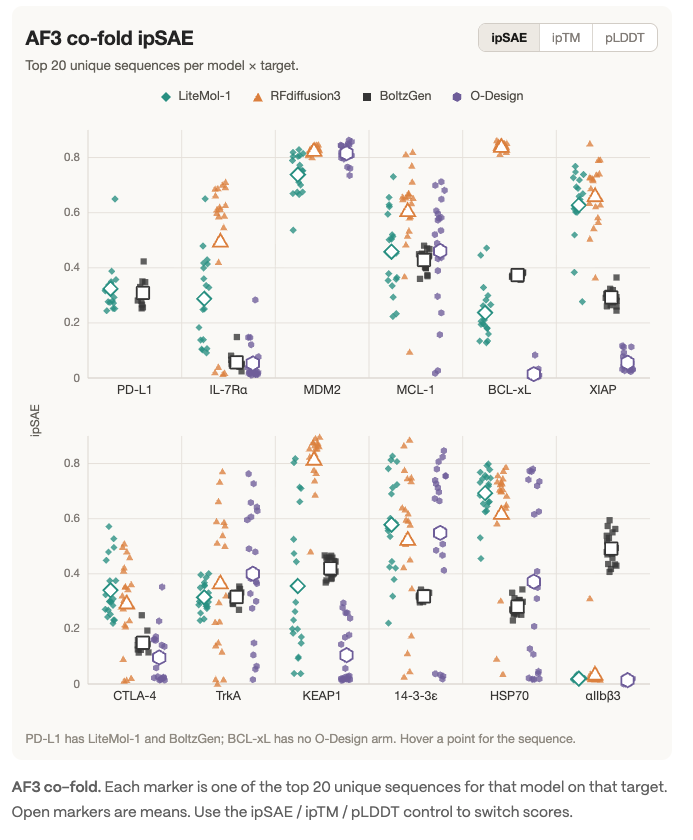
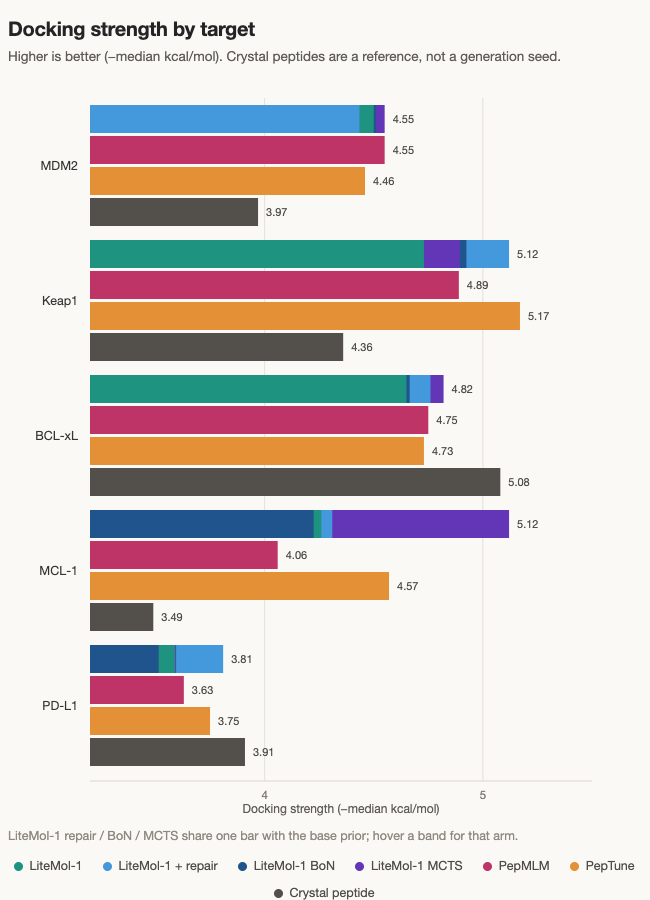
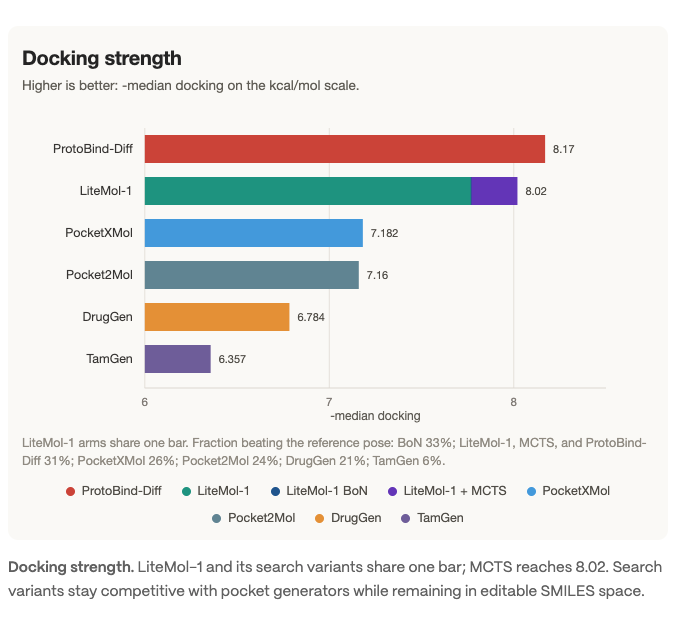
Today, we are incredibly excited to present LiteMol-1, our very first foundation model from LiteFold. Structure-based models like BoltzGen, O-Design, and RFdiffusion have become the de facto standard for designing biomolecules. However, they are expensive to run at scale. In many campaigns, we have to generate tens of thousands of designs and rigorously filter them down to a handful of top candidates. More importantly, most molecule design systems are primarily optimized around binding. But what about everything else that makes a molecule a useful therapeutic: ADME, toxicity, drug-likeness, membrane permeability, synthesizability, selectivity, and more? That’s where we introduce LiteMol-1, our first Multi-Molecule Foundation Diffusion Language Model, pre-trained from scratch. With a single set of weights, LiteMol-1 can conditionally generate small molecules, peptides, cyclic peptides, depsipeptides, peptides with ncAAs, macrocycles, and PROTACs. You can generate molecules unconditionally or condition generation on a protein target sequence. You can in-paint molecules, preserve parts of an existing scaffold, generate non-canonical peptides, cyclize designs, and continuously edit and regenerate them. We also introduce a Monte Carlo Tree Search framework for multi-objective molecular design. Instead of trying to make one molecule perfect at everything, the search keeps a set of promising molecules, each with different trade-offs across properties. This matters because molecular design is fundamentally not a single-objective optimization problem. Finally, and probably the part we are most excited about: this is a model for Agents. LLMs are not particularly efficient interfaces for repeatedly reasoning over thousands of large PDB/CIF files inside an AutoResearch loop. Sequence space is different. SMILES and molecular sequences are compact, editable, and much easier for an agent to inspect, compare, modify, and reason over. So we treat LiteMol-1 as an infinite molecular canvas. The model generates possibilities. The agent takes inspiration from them, evaluates them, edits them, optimizes them, and generates again. The AutoResearch loop continues until it finds candidates that satisfy the given design objectives; while bringing in expensive structure prediction, docking, or simulation only when they are actually needed. Our evaluations across peptide and small-molecule generation show that LiteMol-1 is competitive with, and in several settings on-par with or better than, frontier structure-based and sequence-based models, while operating at a fraction of the generation cost and time. And this is only the first step. Check out our technical research blog post in the comments to learn more about LiteMol-1.

Breakthroughs in AI for biology are largely catalyzed by the diverse datasets deposited by scientists. To make experimental data on biomolecular dynamics from NMR as easily accessible as the PDB, @HWaymentSteele and I are releasing makeshift, installable via PyPi Preprint: biorxiv.org/content/10.648… Docs: makeshift-docs.readthedocs.io

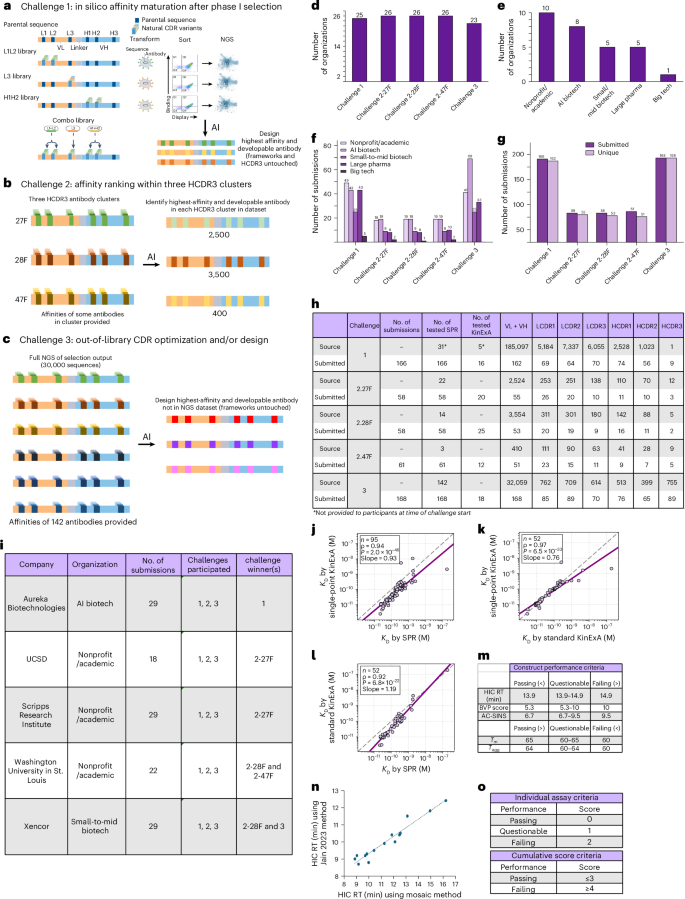
A blinded, prospective benchmark of in silico antibody discovery anchored to experimental affinity and developability nature.com/articles/s4158…
It's recursive self-improvement if it works, reward hacking if it doesn't.

To what degree would people say that so-called “reward hacking” by AI models is a conceptual descendant of what would have been called “overfitting” in the ML era?
Nice article on Polar Express and Muon work coming from colleagues at Flatiron! 👇

Researchers at #FlatironCCM helped build a key piece of hyper-efficient AI training tool Muon — a component called Polar Express that optimized Muon’s core operation: bit.ly/4xNs4dg #math #science
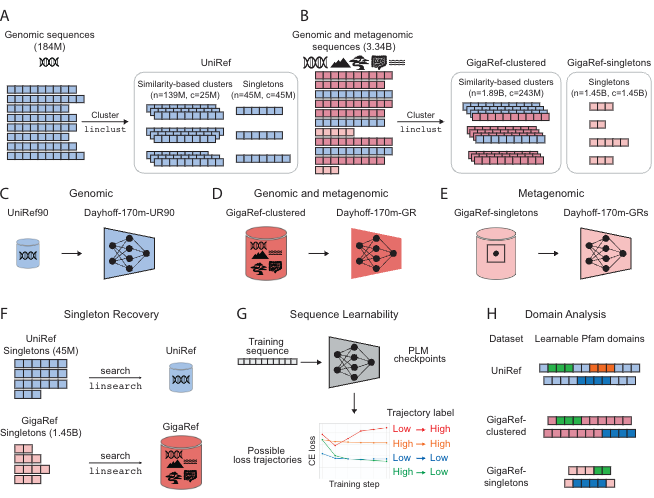
When training protein language models, people usually discard metagenomic proteins that don't cluster with at least 1 other protein (singletons). With @riavinod_ @Samir_char @avapamini @lorin_crawford , we show that this is probably not the right strategy.

Luigi Mangione could kill Brian Thompson over and over every day for 100 years and he would still have less blood on his hands than Brian Thompson
Luigi Mangione has admitted to shooting UnitedHealthcare CEO Brian Thompson: “After years of enduring severe pain from a broken back... I learned UnitedHealth would be holding an investor conference in New York City. I then researched the event online. I observed the annual

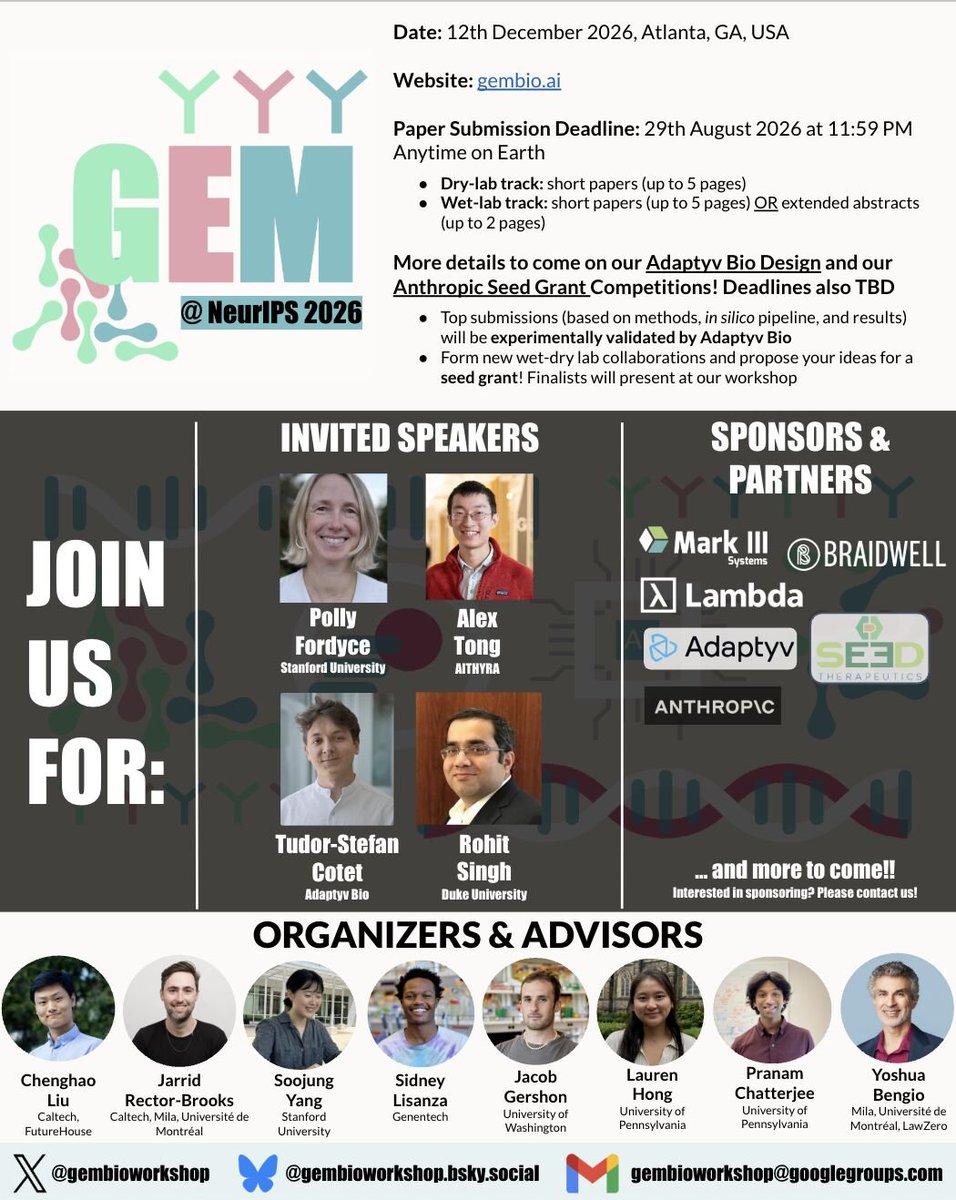
GEM @gembioworkshop is back for NeurIPS! 💻 🧪 Let's talk about lab-in-the-loop, high throughput experiments, the biological systems AI is just beginning to reach, and more. We welcome paper submissions from both dry and wet labs. Paper deadline is August 29th AOE, don't miss it!
Predicting the answer to interventional "what if?" questions — the outcome of an action you never took — need a *mechanistic* model, not a curve fit. And you can only learn one by *experimenting*. Experiments are costly, so the real game is **data efficiency**. Meet the Model Discovery Agent (MDA). 🧵

A label-free, non-invasive approach to imaging neural organoids in 3D using Raman microscopy and an unsupervised autoencoder that maps lipids, proteins, and nucleic acids at subcellular resolution. @dimgeorgievv @xierx1 @alvaroFerGal & Stevens Group science.org/doi/epdf/10.11…


Kevin K. Yang 楊凱�... @KevinKaichuang
24K Followers 6K Following Principal Researcher in BioML @MSFTResearch (@MSRNE). He/him/他. 🇹🇼
Ameen Patel @Ameen_ml
3K Followers 3K Following Inference, prev @PrimeIntellect, @togethercompute, @AmazonScience, @uwaterloo
@BioAI_Neuro @BioAI_NeuralNet
14K Followers 8K Following @MIT trained Neuroscientist interested in Biological and Artificial Neural Networks🧠🤖🕸️ https://t.co/mrNBAVydzT 🎯 [email protected]
Anthony Gitter @anthonygitter
3K Followers 430 Following Computational biologist; Professor at University of Wisconsin-Madison; Jeanne M. Rowe Chair at Morgridge Institute
Gina El Nesr @ginaelnesr
2K Followers 500 Following ai for enzyme design and protein biophysics • @stanford phd • @johnshopkins • 🇪🇬
Will Hua @itswillhua
1K Followers 635 Following Ex @mcgillu @Mila_Quebec. PhD dropout @Yale. Building for post-AGI.
Coban Brooks @cobanbrooks
214 Followers 281 Following protein engineer / phd candidate @romerolab1 / @nsf fellow / currently engineering @adaptyvbio
Matt Agboola @mattagboola
166 Followers 792 Following physics, bio, machine learning @harvardmed @hseas | prev @engineventures, @danahercorp
Anshul Kundaje @anshulkundaje
32K Followers 3K Following Federally funded academic research is the innovation engine of the US economy. Reform is welcome. Destruction will have long term consequences.
Ben Blaiszik @BenBlaiszik
5K Followers 3K Following Making the world a little better with software, materials, and community. Group Leader - AI & data infrastructure at @uchicago/@argonne. Opinions are mine.
Fabio Boniolo @FabioZB_I
588 Followers 2K Following Engineering human tissues https://t.co/6P7lOzXZGD Prev @broadinstitute and @DanaFarber
Zapata @VZapataR
501 Followers 5K Following
पारश @parash061
313 Followers 2K Following
Dimitar Georgiev @dimgeorgievv
96 Followers 574 Following Postdoctoral Research Scientist @UniOfOxford. PhD in AI & ML from @imperialcollege. ML for tissue analysis, analytical chemistry and molecules. 👨💻🧫💊
get the f out @getthef0ut
6 Followers 1K Following
Felipe Vecchietti @skfelipe1
219 Followers 478 Following Postdoc at the MPI-SP in Germany. Previously @kaistpr and @ibs_dscig. Interested in RL, Generative AI, Proteins+AI, and Applied Deep Learning.
vinh q. tran @vqctran
2K Followers 432 Following research scientist @GoogleDeepMind, all thoughts my own, he/him
Sophie @Sophie27286614
0 Followers 65 Following
CRISPRKing @CRISPRKING
11K Followers 5K Following Building open-source pipelines to prove drug targets are real. AI × Bioinformatics × Chemical Biology × Medicine.
Yunha Hwang @Micro_Yunha
5K Followers 1K Following Building genomic intelligence, Asst Prof @MITBiology, @MITEECS, @MIT_SCC, Co-founder and Chief Scientist @tatta_bio https://t.co/gF8HeJoD7s

Talu Güloglu @gueloglut
43 Followers 312 Following ai for bio @eth @genbio, prev. Prescient Design and @Genentech, @UHN and @UofT, @SAFARI_ETH_CMU
Amy Wang @amywang01
638 Followers 383 Following @LilaSciences working on scientific reasoning. prev Prescient Design @genentech MSFTResearch; 🎓PhD @Stanford, SB @MIT
Imran S. Haque (@ihaq... @ImranSHaque
2K Followers 883 Following CTO at @Kimia_Tx. Fmr SVP AI @RecursionPharma; ex-Stanford(PhD), forever Cal 🐻. Find me at https://t.co/LPj0As74Em if the alternative handles get banned.
Xinchen Wang @xinchen_w
438 Followers 593 Following co-founder & ceo of @waypointbio | formerly @MIT @MIT_CSAIL @broadinstitute genomics
Kamal @KamalElGhina
37 Followers 884 Following
Ananda @Ananda61652506
43 Followers 1K Following Deep Learning and NLP Researcher, Mathematics Graduate Student, @UnivofDhaka, LLM, Agentic AI Safety
Robert Scoble @Scobleizer
601K Followers 57K Following San Francisco/Silicon Valley AI | Robots, holodecks, BCIs, analysis of new things | Ex-Microsoft, Rackspace, Fast Company | Wrote eight books about the future.

Seyone Chithrananda @SeyoneC
3K Followers 4K Following 🇨🇦 | 1st yr phd @stanford, always bear @ucberkeley computation, immunology & host-pathogen interactions
Theofanis Karaletsos @Tkaraletsos
5K Followers 2K Following co-founder https://t.co/TIpJn8YQlg building microscopic world models for atomistic simulation | prev Head of AI @cziscience | probabilistic and deep ML
Ron Alfa @Ronalfa
7K Followers 3K Following CEO & Co-founder @NOETIK_AI Using AI to actually solve cancer.
Andrew Dunn @AndrewE_Dunn
12K Followers 2K Following Senior biopharma correspondent at @endpts | Previously @BusinessInsider @BioPharmaDive | [email protected] | Signal (sources only): adunn.68
Sterling Hooten @Sterling_Hooten
286 Followers 997 Following AI Infrastructure and Inference Economics, Mathematics @Columbia
Angelica Parente @draparente
4K Followers 6K Following Building & funding the adjacent possible. Operating Partner @CivilizationVC Prev: @SHV @Nurix_Tx @Stanford @vijaypande & Bryant lab. Tweets my own🔬🧬🧠💻
Simon Barnett @SimonDBarnett
4K Followers 2K Following Partner + Head of Research @_DimensionCap | Focused on the Intersection of Compute + Bio | Prev: Public Biotech Investor | Chemical Engineering @JohnsHopkins
Minji Lee @m1nj12
718 Followers 265 Following PhD student at Columbia CS. prev. Bachelor at KAIST CS
Eddie Kong @d3kong
4 Followers 147 Following
Muhammad Yusuf @yusufxzy
3K Followers 7K Following Writing at the intersection of tech x markets | AI, bio | @Delphi_Digital |
Julian Boecker @julboe7
156 Followers 3K Following Convergence Science PhD researcher @Pantazis_Lab & @MeierLabICR exploring cell competitive interactions in organoids using optical imaging
Nick Edwards @Nick___Edwards
2K Followers 1K Following Autonomous science. Founder and CEO at Potato (@readysetpotato). Former neuro at Brown, NIH, UCSD.
Zavain Dar @zavaindar
13K Followers 3K Following Batman; Investor X Computer Scientist. Founder @_DimensionCap
Devon Cayer @devcayer
585 Followers 2K Following entrepreneur, founder Om, founder of 1859, inc. — love intersection of AI and techbio — prefer to build.
@BioAI_Neuro @BioAI_NeuralNet
14K Followers 8K Following @MIT trained Neuroscientist interested in Biological and Artificial Neural Networks🧠🤖🕸️ https://t.co/mrNBAVydzT 🎯 [email protected]
beetle moses @beetlemoses
214K Followers 607 Following Preorder my debut book of comics! https://t.co/RaqOIxeGOa
Mohammed AlQuraishi @MoAlQuraishi
13K Followers 349 Following MLing biomolecules en route to structural systems biology. Asst Prof of Systems Biology and CS @Columbia. Prev. @Harvard SysBio; @Stanford Genetics, Stats.
Will Hua @itswillhua
1K Followers 635 Following Ex @mcgillu @Mila_Quebec. PhD dropout @Yale. Building for post-AGI.
Mayor Zohran Kwame Ma... @NYCMayor
2.6M Followers 107 Following Fighting every day to deliver a city that working New Yorkers can actually afford. Mayor of New York City.
Coban Brooks @cobanbrooks
214 Followers 281 Following protein engineer / phd candidate @romerolab1 / @nsf fellow / currently engineering @adaptyvbio
Nature Biotechnology @NatureBiotech
325K Followers 3K Following Publishing the best of biotech science and business. Find us on Bluesky, Facebook & Instagram. Part of @SpringerNature and @NaturePortfolio.
Anshul Kundaje @anshulkundaje
32K Followers 3K Following Federally funded academic research is the innovation engine of the US economy. Reform is welcome. Destruction will have long term consequences.
Ben Blaiszik @BenBlaiszik
5K Followers 3K Following Making the world a little better with software, materials, and community. Group Leader - AI & data infrastructure at @uchicago/@argonne. Opinions are mine.
Fabio Boniolo @FabioZB_I
588 Followers 2K Following Engineering human tissues https://t.co/6P7lOzXZGD Prev @broadinstitute and @DanaFarber
Dimitar Georgiev @dimgeorgievv
96 Followers 574 Following Postdoctoral Research Scientist @UniOfOxford. PhD in AI & ML from @imperialcollege. ML for tissue analysis, analytical chemistry and molecules. 👨💻🧫💊
Brian L Trippe @brianltrippe
2K Followers 516 Following Assistant Professor at @Stanford Statistics and @StanfordData | Prev postdoc @UWproteindesign and @Columbia. PhD from @MIT.
Felipe Vecchietti @skfelipe1
219 Followers 478 Following Postdoc at the MPI-SP in Germany. Previously @kaistpr and @ibs_dscig. Interested in RL, Generative AI, Proteins+AI, and Applied Deep Learning.
Chris Gibson @RecursionChris
9K Followers 1K Following OG of TechBio | Father/Husband/Scientist/Founder | Operating partner, Dimension | CEO, BOXBOX (stealth) | Founder/CEO of $RXRX through ‘25. Optimist.
vinh q. tran @vqctran
2K Followers 432 Following research scientist @GoogleDeepMind, all thoughts my own, he/him
Gina El Nesr @ginaelnesr
2K Followers 500 Following ai for enzyme design and protein biophysics • @stanford phd • @johnshopkins • 🇪🇬
Imran S. Haque (@ihaq... @ImranSHaque
2K Followers 883 Following CTO at @Kimia_Tx. Fmr SVP AI @RecursionPharma; ex-Stanford(PhD), forever Cal 🐻. Find me at https://t.co/LPj0As74Em if the alternative handles get banned.
Seyone Chithrananda @SeyoneC
3K Followers 4K Following 🇨🇦 | 1st yr phd @stanford, always bear @ucberkeley computation, immunology & host-pathogen interactions
Theofanis Karaletsos @Tkaraletsos
5K Followers 2K Following co-founder https://t.co/TIpJn8YQlg building microscopic world models for atomistic simulation | prev Head of AI @cziscience | probabilistic and deep ML
Ron Alfa @Ronalfa
7K Followers 3K Following CEO & Co-founder @NOETIK_AI Using AI to actually solve cancer.
Romain Lacombe @rlacombe
7K Followers 7K Following Alchemist-in-training. 🧙♂️ Human & planetary health @thisishcvc 🛠️ Past: AI for Science @Stanford ⚡️🧪 CEO @Plume_Labs (acq. by @AccuWeather) 🌦️
Angelica Parente @draparente
4K Followers 6K Following Building & funding the adjacent possible. Operating Partner @CivilizationVC Prev: @SHV @Nurix_Tx @Stanford @vijaypande & Bryant lab. Tweets my own🔬🧬🧠💻
Nick Edwards @Nick___Edwards
2K Followers 1K Following Autonomous science. Founder and CEO at Potato (@readysetpotato). Former neuro at Brown, NIH, UCSD.
Minji Lee @m1nj12
718 Followers 265 Following PhD student at Columbia CS. prev. Bachelor at KAIST CS
Sterling Hooten @Sterling_Hooten
286 Followers 997 Following AI Infrastructure and Inference Economics, Mathematics @Columbia
Simon Barnett @SimonDBarnett
4K Followers 2K Following Partner + Head of Research @_DimensionCap | Focused on the Intersection of Compute + Bio | Prev: Public Biotech Investor | Chemical Engineering @JohnsHopkins

Sriram (Rami) Hathwar @hathwar607
388 Followers 838 Following Investor @_DimensionCap. Interested in ML infra and biotech!
Ryan Grim @ryangrim
531K Followers 12K Following Reporter at @DropSiteNews - Author of "We've Got People,” “The Squad,” and “This Is Your Country On Drugs.” Co-host of Breaking Points. Signal: cherrygarcia.01
Anne Carpenter, PhD @DrAnneCarpenter
23K Followers 2K Following Discovery in images. Enthralled by science. SAB Recursion, Quiver. Building SyzOnc. Opinions my own. https://t.co/Q7nekPJPBf
Thibault Févry @iwontbecreative
808 Followers 4K Following Researcher Point72, prev NLP Research @Google @NYUDataScience
Ofir Press @OfirPress
19K Followers 9K Following I push the AI frontier by building tough benchmarks with amazing people. SWE-bench, SWE-agent, SciCode, AlgoTune. Postdoc @Princeton. PhD @nlpnoah @UW.
Zavain Dar @zavaindar
13K Followers 3K Following Batman; Investor X Computer Scientist. Founder @_DimensionCap
Brooks Otterlake @i_zzzzzz
89K Followers 1K Following Send me your address so I can visit you and explain my passions
Soojung Yang @SoojungYang2
1K Followers 1K Following AI+simulation for biochemistry! | Postdoc @Stanford | Researcher @MSFTResearch | Previously @MIT PhD
Chi Ossé @OsseChi
76K Followers 2K Following @nyccouncil Member for Brooklyn’s Bed-Stuy and Crown Heights (CD 36) @CMChiOsse | Personal Account
alex rubinsteyn @iskander
7K Followers 5K Following Genomics + immunology + ML = personalized cancer immunotherapy | https://t.co/nReVwtVHPq | https://t.co/8DWibdfDWa
Olexandr Isayev 🇺�... @olexandr
10K Followers 4K Following #CompChem Prof @CMU_Chem. Connecting chemical sciences with AI & #MachineLearning. #tarheels fan. Care:#design, #photography #Ukraine #cats🐈 Rants are mine
Francesca Grisoni @fra_grisoni
4K Followers 905 Following Associate Prof. #AI for drug discovery | Leading @molecularML at @TUeindhoven & @ICMStue | @ELLISforEurope Scholar | Previously @ETH & @unimib | she/her 🏳️🌈
Connor W. Coley @cwcoley
6K Followers 964 Following Assistant Professor @MITChemE & @MITEECS | ChE, Chem, AI/ML, etc. for accelerating molecular synthesis and discovery | https://t.co/cAcVl8CjqR | he/him

Mark Goldstein @marikgoldstein
2K Followers 2K Following absolutely discontinuous with respect to Lebesgue measure. research fellow in ai for science ⚛️ @FlatironInst + ai safety fellow @AnthropicAI
Diana Cai @dianarycai
6K Followers 667 Following Machine learning researcher. Assistant professor of CS @Cornell
Patrick Kidger @PatrickKidger
12K Followers 247 Following 🚀 Doing something new. Curing uncured diseases. 🧪 antibodies+AI, neural ODEs, open-source JAX ecosystem. 👨💻 ex-{Cradle, Google, Oxford}.
Andreas Loukas @loukasa_tweet
2K Followers 581 Following machine learning biology. likes to think about how machines learn. helping drug hunters do their thing
Nikita Makarov @nikitamakaro
214 Followers 474 Following Posting LLM + clinical research | LLMs & Digital Twins for Cancer | PhD student at Roche pRED & Helmholtz Munich | Opinions are my own
Trends for United States
You might like