Nishaanth Reddy @reddmachine
You've used my work. Also Bought · Buy It Again · Rufus · Prime Video @ Amazon → MLE @ Apple. Gen AI realist. Seattle, WA Joined July 2012-
Tweets36
-
Followers83
-
Following89
-
Likes107
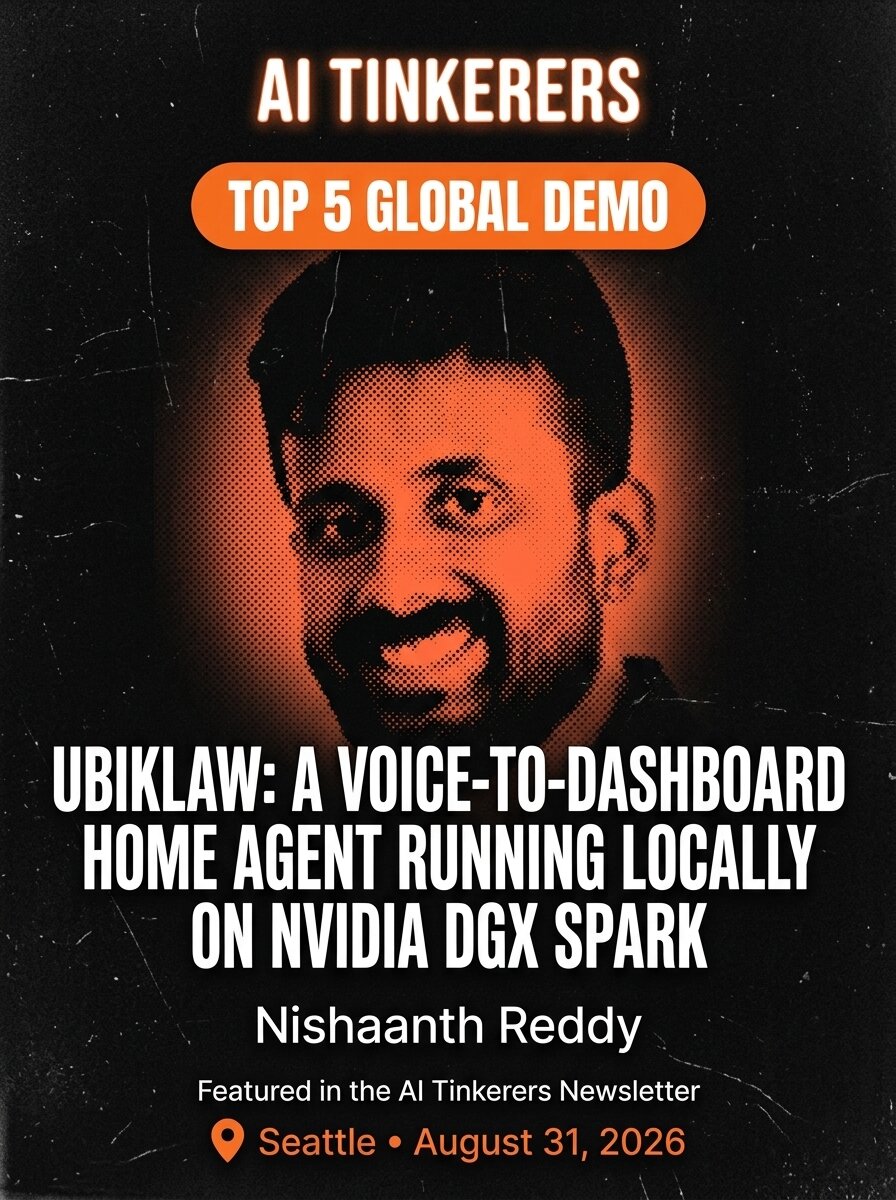
Thrilled that Ubiklaw: Local Voice-to-Dashboard AI got featured in the @AITinkerers Community Spotlights! See it here: post-training.aitinkerers.org/p/top-ai-demos…

Today is a very historical moment for AI video generation You can now generate AI video faster than you can watch it Before it'd take let's say 2-5 minutes to generate 15 seconds of video @fal made a post-trained Minimax H3 variant called Max which is 50x faster than the original but still maintains quality It generates 15 seconds of video in 9 seconds! That means you can now do new things like build a perpetual livestream with it that never ends!
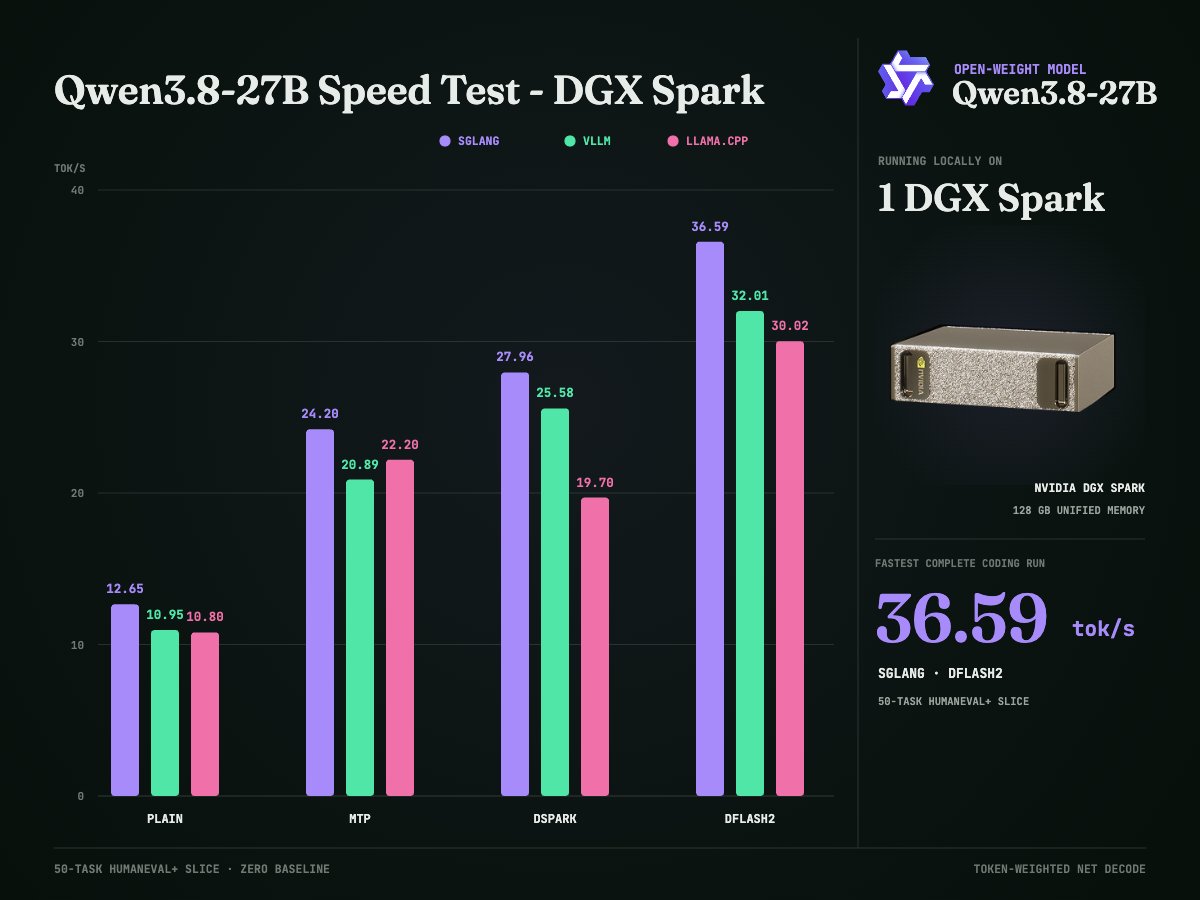
Qwen3.8-27B on one DGX Spark hit 36.59 coding tok/s with SGLang + DFlash2, 2.89× plain decoding. The fastest tool-safe run was vLLM + DFlash2 at 47.41 median tok/s with 18/18 native calls. 12 deployments. Full results and failure notes: morethanamachine.com/posts/qwen3-8-…
@johnennis Exactly this! There has to be an obvious reason these massive AI companies are failing at basic backward compatibility and QA testing.
I really didn't expect Codex to close the gap so quickly. The difference between what Codex was 3 months ago to right now is staggering! I’ve moved most of my day-to-day personal coding from Claude Code to Codex. Claude Code is still excellent, but it seems like for the first time in a long time, it has to play catch up. Kudos @OpenAI and @thsottiaux! It's more that they've stacked a few different wins at the right time. Anecdotally Codex with GPT 5.6 Sol as compared to Claude Code with Fable feels better in the following ways: 1. Speed: Faster with respect to time to first token(TFTT) and tokens per second(tok/s), likely due to using the Cerebras chips. 2. Stamina: More suited effective across longer tasks with auto-compaction. I rarely see any context rot. Also it's very token-efficient without wordy paragraphs. 3. Hiccups: It seems to make sensible implementation choices without pausing at every step. I've rarely had to course correct. 4. Visuals: Diagrams, assets, and image generation feel like part of the same workflow instead of a separate toolchain. Also better integration with more SOTA image generation models. Also Codex+GPT 5.6 Sol made this GIF. PS: I know this is purely anecdotal. When I have time and tokens I can follow up with a more formal comparison.
@Im_IrushiK Exactly this! Opus 5 is such a downgrade. 4.5 to 4.8 were relatively interoperable but 5 is too different and anecdotally worse. I have a hard time believing the benchmarks on this.

We had Kimi K3 recursively self-improve the Cline harness to improve its own performance. 17 hours later, it went from 77.5% to 88.8% on Terminal Bench, and cut run cost from $79 to $49.8.


I was laid off by Amazon AGI today, along with many of my colleagues. My job was deciding which data points matter for pretraining. Turns out I was the one that got filtered out. At 1pm, the reminder for our weekly project sync still went off — for a project that no longer has a team. We could only exchange a smile that needed no words. More seriously: everything I've worked on has been about data, data curation pipeline, data reordering, and data uncertainty. I’m actively looking for new opportunities, including pretraining, trustworthy LLMs, safety, and LLM efficiency — please reach out if you have any openings! To my manager and teammates: thank you for all the help and support you've given me along the way — I learned so much, and I loved the work we did together. It was a great journey, and I know even better ones are ahead for each of you.
Exactly! This is what all these heavily politicized, self-serving AI takes that are emerging against open-source AI completely dismiss. I concede that business dynamics change and that uncertainty is uncomfortable, but if you consider what the history of open-source has been, the benefits are clear for scientific progress and humanity.

In the off chance than anyone cares what I think on this topic: (1) the open-source software movement has been enormously beneficial to socity (2) open-weight (& better, open-data) LLMs will be essential for understanding this technology & for it to be beneficial to society.

Taste used to be a byproduct of the reps. Agents took the reps - so if you're junior, you now have to go get the taste on purpose.
GPT‑5.6 is rolling out in Codex. If your best coding sessions live in Claude Code, that shouldn’t stop you from trying it. Introducing openmemory v2. An open-source CLI to port coding sessions across Codex, Claude Code, and OpenCode. Your context should move with your model. github.com/mem0ai/openmem…

Sol, Terra, and Luna, our GPT‑5.6 family of models, are starting to roll out now in ChatGPT, Codex, and the API.
@addyosmani @aiDotEngineer @swyx @romainhuet @mattyp @lydiahallie @Baconbrix @pbakaus @threepointone @GergelyOrosz Great talk dude. Nice to see someone pushing for putting humans back into the loop.

We took a 30B model and split it in two to write tokens in parallel instead of one at a time. Introducing Nemotron-Labs-TwoTower: a diffusion language model from NVIDIA Research adapted from Nemotron-3-Nano-30B-A3B. Here’s how it works: one half holds the context, the other writes the tokens, with both reusing the pretrained model instead of training a new one from scratch. We found it kept 98.7% of the original model’s quality at 2.42× faster generation.
“Loop engineering” is a hot buzzphrase after mentions of it by Boris Cherny (Claude Code’s creator) and Peter Steinberger (OpenClaw's creator) went viral on social media. Loops are now a key part of how we get AI agents to iterate at length to build software. In this letter, I’d like to share my 3 key loops, shown in the image below, for building 0-to-1 products. These loops guide not just how I build software, but also how I decide what software to build. Agentic coding loop: Given a product specification and optionally a set of evals (that is, a dataset against which to measure performance), we can have an AI agent write code, test its work, and keep iterating until the code is bug-free and meets its specification. This idea of closing the loop took off around the end of last year, and it has been a game changer in enabling coding agents to work longer productively without human intervention. For example, over the weekend, I was building an app for my daughter to practice typing, and my coding agent could easily work for around an hour, using a web browser to check what it had built multiple times before getting back to me, without needing my intervention. The engineering loop executes quickly. Every few minutes, the coding agent might build and test a new version of the software. I hear frequently from developers who are finding new ways to engineer more effective engineering loops. This is an active area of invention! Developer feedback loop: In this loop, a developer examines the current product and steers the coding agent to improve it. Last year, a lot of developers (including me) were acting as the QA (quality assurance) function for our coding agents, manually finding bugs and then asking the agent to fix them. But with coding agents much more able to test their own code, the amount of time we need to spend on this function has decreased significantly. This allows us to make higher-level product decisions, such as what key features to offer, where the UI needs improvement, and so on. The developer-feedback loop operates over time intervals between tens of minutes and hours — that's how frequently a developer might review a product and give feedback. In the case of the typing app, I changed my mind a few times about the visual design, what cat costumes she can unlock as she learns (she loves cats), and the user flow for a grown-up to log in and steer the child's learning experience. When a developer has a clear vision for what to build, it is still a lot of work to translate that vision into a specification for a coding agent to implement. Further, after the developer has seen an implementation, they might update (or perhaps clarify) the spec to steer it toward what they want. If you find that the system repeatedly runs into certain problems, building a set of evals for the agent becomes useful. AI-native teams are increasingly using AI to help shape product direction, for example, automating the gathering and analysis of usage data, summarizing written and verbal customer feedback, or carrying out competitive analysis. However, for pretty much all the products I’m involved in, I see humans as having a significant context advantage over current AI systems — we know a lot more than the AI system about the users and the context the product has to operate in — and thus humans play a critical role. Many people describe this human contribution as “taste,” but I prefer to think of it as humans having a context advantage, since that gives us a clearer path to helping AI systems get better. This also speaks to why this step can’t be automated: So long as the human knows something the AI does not, human-in-the-loop is needed to to inject that knowledge into the system. External feedback loop: This includes a wide range of tactics like asking a few friends for feedback, launching to alpha testers, or putting the code into production with A/B testing. These tactics are usually slow, rarely taking less than hours and sometimes taking days or even weeks. This data informs the developer vision, which in turn continues to drive the detailed product spec, which in turn drives the coding agent. With coding agents speeding up software development, more engineers are starting to play a partial product management role. For many engineers who are growing into this role, the hardest part is shaping the product vision and striking a balance between building (bridging the gap between vision and spec) and getting user feedback to evolve the vision. It is important to do both! I will write more about how to do this in future posts, but for now, I find it encouraging that engineers are playing an expanded role (just as product managers and designers now do more engineering). [Original text: The Batch]


🚨 Forget LIDAR. The Robbyant team just dropped a streaming 3D model that reconstructs scenes live, at ~20 FPS, over long sequences. One single camera. Runs in real time. Open-source. Entirely end-to-end. NO iterative optimization tricks and no post-processing cleanup steps! It outperforms both existing streaming approaches and several offline methods. 100% Free and open-source. Repo, paper and model weights in 🧵↓

This is a new paradigm for interacting with Claude that is significantly more "inline" with all the other human activity org-wide. Once you do all of the under the hood engineering work to make this "just work" (e.g. across tools, integrations, compute environments, memory, security, etc.), Claude basically joins the team in a seamless way - you can talk to it as you would talk to a person and it can help with a very large variety of workloads. Imo this is the 3rd major redesign of LLM UIUX. The first paradigm was that the LLM is a website you go to, the second was that it is an app you download to your computer. This third one is that it is a self-contained, persistent, asynchronous entity with org-wide tools and context, working alongside teams of humans. It really takes a while to wrap your head around it, but it works and it is awesome.

Introducing Claude Tag, a new way for teams to work with Claude. In Slack, Claude joins as a team member with access to the channels and tools you choose. Tag Claude in and delegate tasks to it while you focus on other work.
MCP is fixing tool discovery at the wrong layer. The unit of discovery shouldn't be the tool, should be the agent. Instead of retrieving the right tool from a list of 60+, route to a capability-scoped agent. Stop retrieving the right tool. Start routing to the right agent. nishaanthreddy.com/blog/discover-…
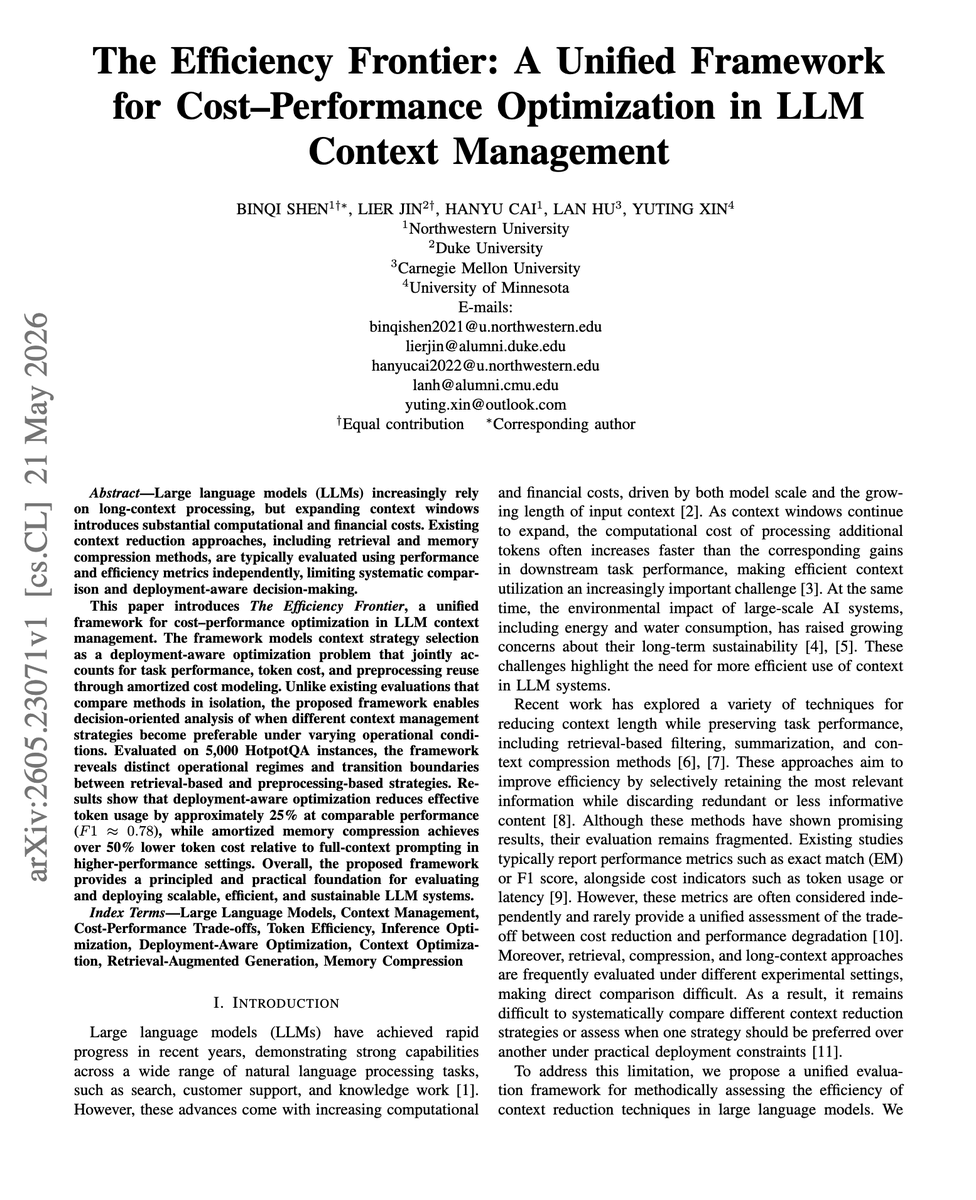
// The Efficiency Frontier // Cool paper on context management. As agents reuse the same documents and histories across many turns, the cheapest context strategy is not fixed. This work describes a principled rule for picking one per deployment instead of defaulting to whatever topped a benchmark in isolation. Retrieval and compression methods are almost always benchmarked on accuracy and cost separately, so you never learn when one actually beats another under real load. The Efficiency Frontier models context strategy selection as a single cost-performance problem, with a log-utility term for diminishing returns from extra context and a reuse parameter N that amortizes preprocessing across repeated queries. Sweep N and the optimal strategy changes, exposing crossover regions where retrieval, compression, or full context each wins. On 5,000 HotpotQA instances, deployment-aware selection cuts effective token usage about 25 percent at the same performance, and amortized memory compression runs over 50 percent cheaper than full-context prompting in higher-performance settings. Paper: arxiv.org/abs/2605.23071 Learn to build effective AI agents in our academy: academy.dair.ai
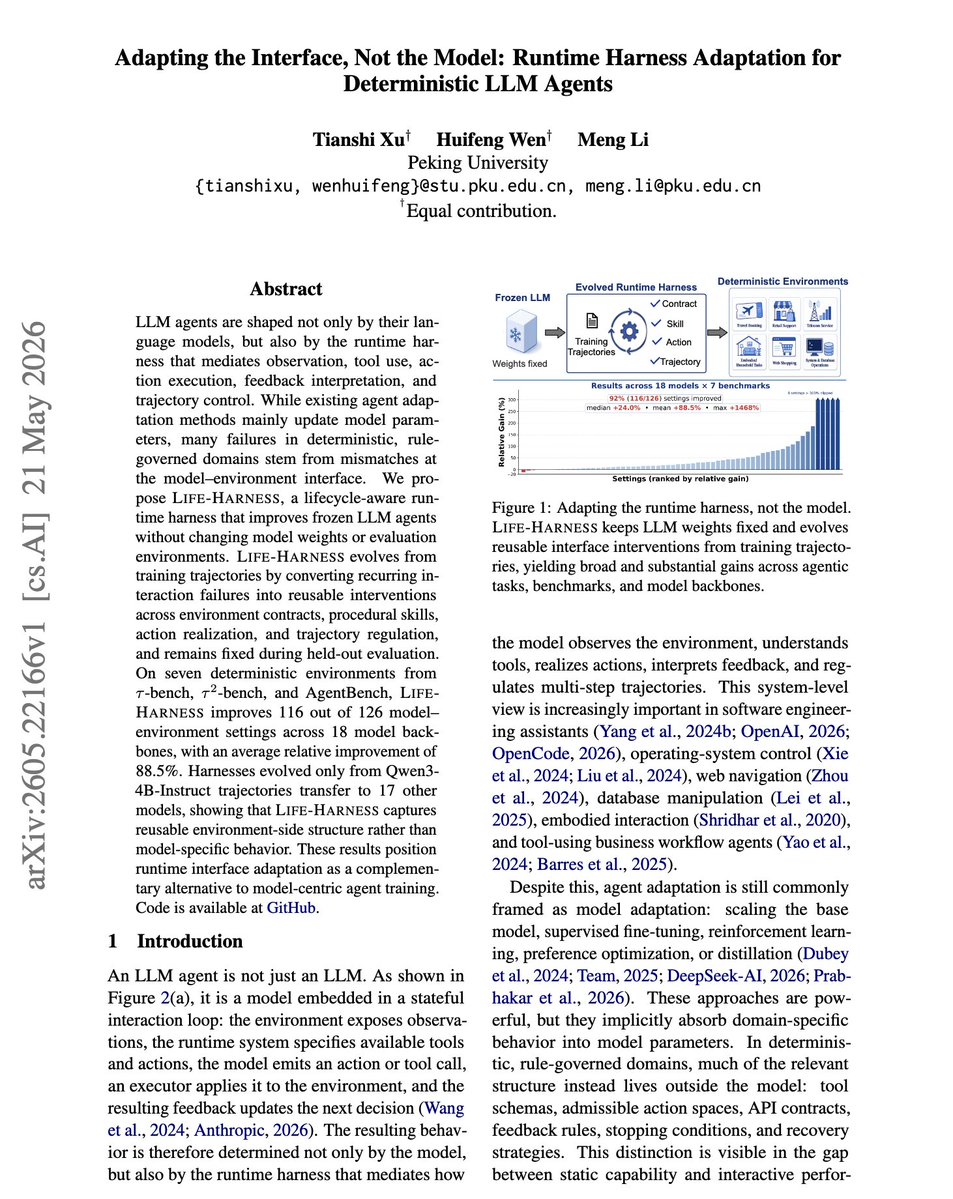
// Adapt the Interface, Not the Model // I am fascinated by the results across my cheap-model-plus-good-harness builds. This new paper also shows good signs of the code-as-agent-harness thesis. The idea is really simple. Do not touch the model. Instead, modify the runtime interface that wraps the frozen LLM. Then convert recurring interaction failures into reusable interventions on the harness side. The paper reports an average relative improvement 88.5% across 7 deterministic environments, 126 model-environment settings, and 18 backbones. A harness learned from one model trajectory generalizes to 17 other backbones. That tells you the harness is capturing environment structure, not model-specific patterns. If you ship agents in production, your harness work is more portable than you might assume. Paper: arxiv.org/abs/2605.22166 Learn to build effective AI agents in our academy: academy.dair.ai

Rohan Suresh @_RohanSuresh_
73 Followers 498 Following
Sindoori Reddy @Sindoori_Reddy
56 Followers 304 Following
TESCREAL @ASMRGPT
910 Followers 1K Following soft-core doom porn. "What's the punishment for taking over the world?"
Aravind Nidadavolu @aravind_ni
0 Followers 27 Following
Dempsey @denpzil
40 Followers 327 Following
Vijay Ramakrishnan @vijaytr1911
32 Followers 168 Following




Awferbu @Awferbu738
30 Followers 972 Following


Tioslursm @Tioslursmg8NQ
42 Followers 4K Following

BonnieBaldwin @qAoj1k8EQ7L8g
74 Followers 7K Following
CherylMay @dvB4m53b29ukwz2
69 Followers 7K Following
JoanneSandy @w2L41xtTv9Cnh2
20 Followers 2K Following

Shessll @Shessll9mP3V
14 Followers 1K Following
dealonai @dealonai
525 Followers 5K Following The All-in-One AI Hub 50+ AI Models | 5000+ Tools | One Platform Code • Images • Video • Content
Sytusee @sytusee43938
70 Followers 4K Following

Madhulekha Arun @MadhulekhaA
27 Followers 49 Following
Sagar Raj Nama @SagarRaj_Nama
67 Followers 272 Following Fitness enthusiast | Travel Freak | Foodies | Exploring the World for Opportunities
Sidharth Shanon @SidharthShanon
89 Followers 362 Following One life, many things to do. Adventurer. Martial artist. Occasionally dabble in everything under the sun.
Naren Elango @ElangoNarenNITK
54 Followers 2K Following Interested in understanding the universe! 🌹🌺 💯 💟 ⚽ Portugal 🇵🇹 🇮🇳 🇿🇦 Proteas 🏏 Studying Mathematics & Algorithms👨🎓 🎬 Addicted to Happy Endings 💓
Daily Gleez @dailygleez
19 Followers 131 Following The aim is to bring fore a range of success stories about individuals and organizations. Articles, that otherwise get buried under tons of ‘Breaking News’.

Neeraj Rajasekar @neerubhai
131 Followers 449 Following Data engineer | Stanford grad | Esri alum | I enjoy discussing maps/ geospatial/ Earth Observation technologies 🗺 and startups in tech.
Balagopal K.V. @balagopalkv
573 Followers 5K Following
Shruti Mandhani @MandhaniShruti
272 Followers 248 Following @EPSRC Research Fellow in Auxetic Materials | 3MT winner 2019 | Science Communicator | Swimmer, Pianist | #WomenInSTEM #SciComm she/her
Arka Rai Choudhuri @Arka_r_c
247 Followers 814 Following
Animesh Mishra @animeshi0n
66 Followers 308 Following Co-founder @crazytraff1c. Former #digitalmarketing guy at @BRIDGEi2i | drummer, gamer, highly opinionated | #HCI #SEO #SEM #SMM #ORM

malavika mani @Dr_mm92
16 Followers 176 Following
The Shoreline @shoreline_nitk
36 Followers 82 Following
Utpal Kant @utpalkanttt
7 Followers 72 Following
Mudit.R.Garbyal @MuditRhenjen
6 Followers 71 Following
vinay prasad @VinayMs92
111 Followers 588 Following
Shravan Shetty @shravanbshetty
6 Followers 122 Following
Piyush Yadav @piyushyadavast2
4 Followers 33 Following
Vinit Yadav @vinityadavasth1
5 Followers 44 Following
rachna @rachnasingh1981
5 Followers 43 Following
Astha @asthasrivastva3
5 Followers 46 Following
Sunny bhatia @Sunnybhatia88
33 Followers 244 Following
Anushka Niroshan @anushka_nirosha
578 Followers 4K Following


Irushi @Im_IrushiK
8K Followers 3K Following Data/AI Engineer & Founder | Unfiltered takes on AI models, tech & startups | DM for Colabs 📨
Dempsey @denpzil
40 Followers 327 Following
Naren Elango @ElangoNarenNITK
54 Followers 2K Following Interested in understanding the universe! 🌹🌺 💯 💟 ⚽ Portugal 🇵🇹 🇮🇳 🇿🇦 Proteas 🏏 Studying Mathematics & Algorithms👨🎓 🎬 Addicted to Happy Endings 💓
Vijay Ramakrishnan @vijaytr1911
32 Followers 168 Following
AI Engineer @aiDotEngineer
64K Followers 68 Following The world's best engineers, leaders, founders, and researchers building with AI. Organizers of the AIE Summit, Code Summit, Europe, Asia, and World's Fair.


merve @mervenoyann
91K Followers 5K Following (mer-veh) open-sourceress at @huggingface 🧙🏻♀️ DM me for any feedback about HF 🤗 https://t.co/MhrMkGTm7p
Dhruv Batra @DhruvBatra_
21K Followers 765 Following Co-founder & Chief Scientist @yutori_ai. Prev: Senior Director leading FAIR Embodied AI @MetaAI and Professor @GeorgiaTech.
Stephen Chin @steveonjava
13K Followers 2K Following Author, speaker, open-source hacker by night. VP of developer relations at @Neo4j by day.

Abarth @TeamAbarth
57K Followers 915 Following An Italian Turin established empowerment company, leader in producing powerful cars. Official Global Channel Privacy: https://t.co/JIMpjT5jtz

Philipp Schmid @_philschmid
119K Followers 1K Following Agents & Gemini API, MTS @GoogleDeepMind | prev: Tech Lead at @huggingface, AWS ML Hero 🤗 Sharing my own views and AI News 🧑🏻💻 https://t.co/7IosdlO6RA

Romain Huet @romainhuet
54K Followers 9K Following Head of Developer Experience @OpenAI, working on Codex and our API. Previously @Stripe. You can just build things!
Katelyn Lesse @katelyn_lesse
7K Followers 86 Following head of platform @anthropicai. previously @stripe @betterment. lfgm.
Angela Jiang @angjiang
35K Followers 79 Following interdisciplinarian. head of product for claude platform @anthropicai
Mike Krieger @mikeyk
467K Followers 271 Following Building at Anthropic Labs @anthropicai. Before: CPO at Anthropic, co-founder & CTO of @instagram and @artifact_news
Clare Liguori @clare_liguori
24K Followers 299 Following Senior Principal Engineer, AWS Agentic AI. Working on @kirodotdev 👻, Strands Agents SDK 🧬, MCP Core Maintainer 🤝
Dan Fu @realDanFu
8K Followers 246 Following VP, Kernels @togethercompute Assistant Professor @ucsd_cse Looking for talented kernel engineers and performance engineers!
Ben Clavié @bclavie
7K Followers 1K Following regressing linearly on a daily basis. wife guy who does retrieval. research @mixedbreadai, prev answerdotai - dms work randomly, responses might be very slow

Harrison Chase @hwchase17
129K Followers 585 Following @LangChain Always hiring: https://t.co/D5Ut3loFO7


Chaofan Shou @shoucccc
71K Followers 3K Following
swyx @swyx
188K Followers 4K Following achieve ambition with intentionality, intensity, integrity & insanity. affiliations: - @smol_ai - @dxtipshq - @cognition - @aidotengineer - @latentspacepod

Taranjeet @taranjeetio
14K Followers 3K Following Founder & CEO @mem0ai - The Memory Layer for AI agents. Open Source: https://t.co/zKOlxAGsbM
Peter Steinberger �... @steipete
584K Followers 2K Following Polyagentmorous ClawFather. Came back from retirement to mess with AI and help a lobster take over the world. @OpenClaw🦞 + @OpenAI
OpenClaw🦞 @openclaw
545K Followers 26 Following Personal AI that actually does things. Your agent, your machine, your rules. Now a 501(c)(3) non-profit foundation — open and independent, forever. 🦞
Anthropic @AnthropicAI
1.6M Followers 2 Following We're an AI safety and research company that builds reliable, interpretable, and steerable AI systems. Talk to our AI assistant @claudeai on https://t.co/FhDI3KQh0n.

PyTorch @PyTorch
510K Followers 91 Following Tensors and neural networks in Python with strong hardware acceleration. PyTorch is an open source project at the Linux Foundation. #PyTorchFoundation

Kartik Sreenivasan @KartikSreeni
1K Followers 582 Following Research scientist at MosaicML/Databricks. PhD from UW-Madison. Interested in LLMs, optimization, and the meaning of life.
Matt Carey @mattzcarey
25K Followers 4K Following agents and mcp @cloudflare, former pro windsurfer 🇲🇹🌊 hype @demodaysai @badagentpod.. occasional angel
Jason Weston @jaseweston
15K Followers 930 Following Senior Director & RS @Meta + Visiting Prof NYU | OG in LLMs | Pretrain+Finetune in 2008+ | 155k+ citations | Current: Self-Improving & Co-Improving AI
Andrew Ng @AndrewYNg
1.9M Followers 1K Following Co-Founder of Coursera; Stanford CS adjunct faculty. Former head of Baidu AI Group/Google Brain. #ai #machinelearning, #deeplearning #MOOCs
Peyman Milanfar @docmilanfar
116K Followers 602 Following Distinguished Scientist at Google. National Academy of Engineering. Computational Imaging ∩ AI. Posts are personal opinions
elvis @omarsar0
317K Followers 999 Following Founder @dair_ai • Prev: Meta AI | PhD • Learn about AI Agents for FREE here: https://t.co/P5SA9u54xO
Prof. Anima Anandkuma... @AnimaAnandkumar
45K Followers 2K Following AI+Science, Bren Professor @caltech, Time100, Fmr Sr Director of #AI research @nvidia Fmr Principal Scientist @awscloud
Arthur Gretton @ArthurGretton
12K Followers 790 Following Professor in Machine Learning, Gatsby Computational Neuroscience Unit Research Scientist, Google DeepMind https://t.co/JJNqmn7jak
Alex Smola @smolix
22K Followers 122 Following LLMs for interaction at https://t.co/uY2XbWTgaT, AutoML at https://t.co/xqkK2q7L02, learn ML with https://t.co/9W8dBWESkW.
Bojan Tunguz @tunguz
305K Followers 8K Following Founder and CEO @tabul_ai. Creator of @trainxgb. ML ex Nvidia. Data Scientist. Physicist. Catholic. Husband. Father. Stanford Alum. Memelord. e/xgb. AMDG.
Sebastian Raschka @rasbt
501K Followers 1K Following ML/AI research engineer. Ex stats professor. Author of "Build a Large Language Model From Scratch" (https://t.co/O8LAAMRzzW) & reasoning (https://t.co/5TueQKx2Fk)
Nan Jiang @nanjiang_cs
12K Followers 76 Following machine learning researcher, with focus on reinforcement learning. assoc prof @ uiuc cs. Course on RL theory (w/ videos): https://t.co/vqVKwY4RJE
Gary Marcus @GaryMarcus
239K Followers 7K Following OG GenAI Skeptic; spoke at US Senate. Warned about hallucinations in 2001. Advocating world models & neurosymbolic AI ever since. Author, Marcus on AI & 6 books
Trends for United States
You might like