Yuriy Stets @stainless_code
Bottom-up design & refactor oriented programming enjoyer. twitch.tv/stainlesscode Joined January 2017-
Tweets467
-
Followers27
-
Following25
-
Likes1K
Normalize caring about the details

Why is it so fucking hard for self-proclaimed "experts" to understand that uploading your proofs, workings, source material and other sensitive data to someone else's cloud infrastructure means you don't own it anymore?

A new risk for mathematicians: a colleague reports that immediately after they posted an abstract of their upcoming talk online, a student elsewhere used AI to derive proofs of the stated results and then posted it on the arxiv. My colleague hadn't posted to arxiv yet.
If this is such a big differentiator for some use cases vs others, then ideally you would provide two flavors in the APIs, so that the user has the choice of which way of the trade off they want to make - with corresponding performance payment. I don't have a lot of xp with audio currently, but it seems to me that the planar format would a bit awkward to do, if you just want to play and mix audio clips. And the planar one you would want if you want to do some processing on the audio. Though having a big sample buffer is kind of pointless for real-time audio, so this whole discussion might be a bit of a moot, as the conversions would not cost a lot. The more important question here is API ergonomics and whether the API design decisions forces the user to do useless/redundant work, because for example, the source of audio might produce it interleaved, the API is planar and the underlying native APIs commonly require interleaved format, there are two useless conversions for no reason.

There's this GitHub issue by Casey Muratori on how the Web Audio API has a design gap since it wants in planar format, and because many systems produce interleaved audio instead, converting between the two is costly and has "substantial performance penalties". I do not know why

I always wondered why can't we have asymmetric CPUs, where you would have like a core to run your OS kernel and maybe a core to run drivers/IO/interrupts. And the rest of the cores strictly user-space, where an application would have some ability to allocate/pin cores from kernel. That would also make cores a lot simpler (not having priviledged instructions and other non-ring3 crap and other bloat), potentially even more performant and maybe with ability to do your own user-space scheduling over your allocated/pinned cores - want to do cooperative multithreading -sure, want to do lockstep wave of work over multiple cores - there you go. And the kernel cores would also be simpler - no FP, maybe only basic integer SIMD, and other things that the kernels don't really need.
@CaptainGPU Що мається на увазі? Тут мова йде про те що коли хтось користується хостнутими ЛЛМками, кимось ззовні організації, це автоматичне порушення НДА, бо куски коду відправляються на сторонній сервер.
I've heard the mantra "programmer time is more expensive that hardware" way too many times. Look at where they are now.
@valigo What does it say when software people claim their software sales are crashing because of hardware costs? As if one cannot make a good game on existing hardware ….
Even on the cpu indices > pointers. The pointers waste a lot of cache space to store useless bits that do not carry much of a value. But I havent yet found a good/elegant solution of how to organize storage of multiple indices that belong to different contiguous chunks of memory. Because if all of your indices belong to a single space, then you can carry the single base pointer around OOB, and index only off of that pointer. But If you have multiple spaces, let's say one or more index spaces per thread (e.g. per-thread arenas or something), like what would be an efficient way to represent that. One way you can take some bits of an index to say which chunk you want to address into, but that eats into the size of indexable space and if you have a user-selectable number of threads - the number of bits reserved would be unpredictable.
Nothing changes the physical reality of the inefficiency of a vector of 64-bit pointers on the GPU. It will always take double the register file space, double the ALU ops to manipulate compared to using HW shifted 32-bit indexes.
@SebAaltonen @justix_lol But the images have to be created with undefined layout and then transitioned to general layout right after per vulkan spec. Is it possible to avoid that somehow?
@SebAaltonen Is there a reason why we can't have constant/static samplers declarations in the shaders directly? There is literally an OpConstantSampler in spirv..
I sure am enjoying all this great new software we have due to 3 years of massively amplified productivity due to AI...!
@SebAaltonen I would call it either NoGL or MinGL.
@SanderSkjegstad @lea_fac There is something missing from Casey's voice though, I think maybe some lower frequencies. It sounds kinda like a very 70 year old man's voice, or am I tripping?
@damageboy @bmcnett Go up a level, the trillion dollar mistake was using malloc/free in the first place.
Uniform buffers suck in general. Making a lot of small buffers to store a single struct is a bit wasteful, as the API implementation now has to have a tracking data structure, probably even hash tables, god forbid. Pointers in shaders were supported since like mid-2010ish hardware. You can just allocate all of your "uniforms" from a single buffer, and only pass a single pointer to a shader, that way you can access those uniforms by offset, as long as the access is uniform.
I'm considering of adding ability to generate structs during compile time to my language. The idea seems fine to me in some cases. Yes, there is a complexity concern and careful control of the struct layout is more difficult, but for some things that are not crucial it is probably fine. But I'm having trouble coming up with some (even vague) examples of where this might be useful, so I'm still on a fence about it. The LSP/IDE should not have an issue with it, as the compile time code that generates the struct should already have been ran. You IDE should have an option to show an alternative view of the struct - show all of the generated members, as it already should have a struct layout visualizer, if it is worth anything. The compilation time shouldn't be a big problem in theory, but this is C++ and the implementations are so complex, that you can't really expect much here.

People are worried about the syntax of reflection, but I’m afraid of something else. I expect reflection to be abused on a massive scale, to the point where no LSP will be able to find a type definition for you, and compile time will be comparable to a flight to the Andromeda

At least I don't have to hear about how great pair programming is anymore
C++ has been tunred more and more into an abomination with every standard since C++11, it is became a joke. I don't even care to do research, but do they even support runtime reflection (introspection only, as you can't change the structs at runtime)?

C++26 reflection syntax looks abhorrent

@SebAaltonen I can't seem to find any of the previous SIGGRAPH talks, only some strange bits and pieces. I assume they are not recording any and not interested in publishing any of them? kinda sucks..

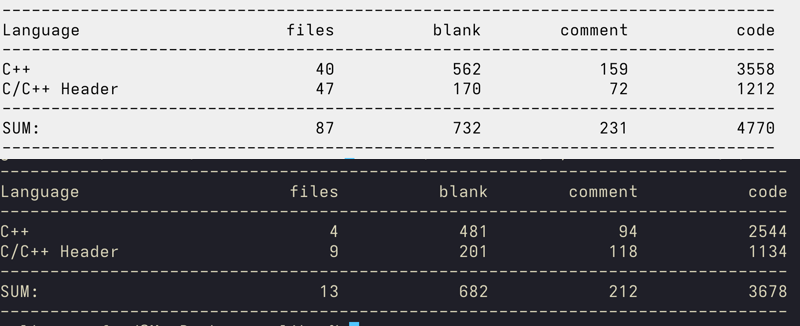
Wanted to give the handmade/data-oriented style a shot, so rewrote the codebase in pure c, no c++ stl or c++ features. Over 1k lines gone, and look at the files! 87 files down to 13. identical functionality. The biggest win (and the reason I did this in the first place) is that compile times went from ~9seconds down to ~240ms. Ok, NOW i'm starting to understand the anti-oop folks, this is wild

Carlin @AuroraMirelle
287 Followers 333 Following Without going through hardships, you won't mature; but when you do face hardships, you will become a seasoned veteran.

Sele @haskellimsi
0 Followers 450 Following


Dream Logic @hodbyn
79 Followers 2K Following

ScalaWilliam! @ScalaWilliam
1K Followers 8K Following Scala expert, AI for coding, data platforms, metadata management, process engineering, TDD. Creator @ScalaAlgorithms. Fan of digital and physical ergonomics.
Aurel @Aurel97288611
16 Followers 1K Following
BonkForYou @DavidVuBoi
194 Followers 1K Following
andr @jewyjuicer
72 Followers 903 Following to all law enforcement entities, this is an admission of guilt
daunteAniggieri @DAniggieri
38 Followers 1K Following Poet in residence, Atlanta Institute of Blacknology
tacitcoder @tacitcoder
0 Followers 441 Following
AwesomeCat @AwesomeCat1484
53 Followers 410 Following I like pressing buttons and poking at software
topol0gist @topol0gist
13 Followers 179 Following
Adam @archeologistdev
124 Followers 881 Following Eng @ Canva, building & scaling mission critical systems.
Steven Savold @atoi6664
115 Followers 145 Following Software Engineer working on VR/AR technology. Passionate about making software faster and more stable. Opinions are my own.
Bryan Cov @bryancovela
242 Followers 2K Following Making music thats out of my league hmmmmm hmmm no
Matthias @Matthia68852060
2 Followers 139 Following
Joseph Garvin @joseph_h_garvin
2K Followers 3K Following voicecoding latency and throughput hacker. How did I get here and what am I doing in this hand basket? @[email protected] @josephhgarvin.bsky.social
Lélahel Hideux @Lelahelry
78 Followers 3K Following

hunter @MagadhKing
54 Followers 912 Following 卐 अथ चैत्त्वमिमं धर्म्यं संग्रामं न करिष्यसि। ततः स्वधर्मं कीर्तिं च हित्वा पापमवाप्स्यसि। 卐
Stani Slavus @stanislavus5000
68 Followers 1K Following
Jebrim @AgileJebrim
5K Followers 2K Following Rendering Engineer turning GPUs into hard real-time coprocessors to enable the rapid development and verification of stutter-free software. Opinions are my own.
Demetri Spanos @DemetriSpanos
3K Followers 180 Following Independent Computational Math / AI / Scientific Computing research. Making No Royal Road (future math textbook app) + course, Math for the Working Programmer
Sander 🇳🇴 @SanderSkjegstad
1K Followers 257 Following Product Lead & Designer of @Blick_Editor Velsignet være vinden ved våre venners vei!
NOTimothyLottes @NOTimothyLottes
3K Followers 625 Following These tweets are fictitious, from a fictional persona. No identification with actual people/products/employers/businesses is intended or should be inferred.
Trần Thành Long @longtran2904
46 Followers 54 Following Unnecessary complexity is the root of all evil
Thomas Klemenc @thomasklemenc
2K Followers 135 Following creates and uncreates software making a better task manager at https://t.co/3lok4mEp24
Yevhen Karpenko 🇺�... @CaptainGPU
6K Followers 4K Following Render Developer/Graphics Programmer. Interests: gamedev, OpenGL, Vulkan, DirectX, shaders, Unreal Engine and art. Популяризую gamedev українською.
Bolt Graphics @boltgraphics
4K Followers 68 Following building next-generation GPUs focused on Path Tracing, HPC, and gaming. based in Sunnyvale CA 🇺🇸🇺🇸🇺🇸
Łukasz | Wookash Pod... @wookash_podcast
8K Followers 293 Following the most technical podcast™ see for yourself https://t.co/3408wX9n30
Isochron Technologies @IsochronTech
27 Followers 5 Following

Sebastian Aaltonen @SebAaltonen
58K Followers 284 Following 30 years of 3d rendering experience. Former principal engineer at Unity, Ubisoft and HypeHype.
Jebrim @AgileJebrim
5K Followers 2K Following Rendering Engineer turning GPUs into hard real-time coprocessors to enable the rapid development and verification of stutter-free software. Opinions are my own.
Raphael Luba @LubaRaphael
2K Followers 94 Following Programmer, BJJ enthusiast (and still bad at it), father of 3, co-founder of @FabmanHQ, working on a compiler @Thekla_inc
Better Software Confe... @BetterSoftwareC
6K Followers 16 Following Software is getting worse. We're here to make it better. VODs are on YT: https://t.co/kitqaYA43w

Vjekoslav Krajačić @vkrajacic
13K Followers 121 Following Building a fast, modern file explorer → https://t.co/DLg0ClqK1O Catholic, Croat 🇭🇷, husband, father of 5.
Ryan Fleury @rfleury
25K Followers 147 Following RJF // @dgtlgrove // Making RAD Debugger at @radgametools in @epicgames (opinions my own)
Freya Holmér @FreyaHolmer
127K Followers 1K Following ⭕ I made Shapes & Shader Forge 🔥 shader sorceress 🎨 artist 📏 math influencer 💜 twitch partner 📡 ex-founder of @NeatCorp banner: @YO_SU_RA


Factorio @factoriogame
50K Followers 63 Following Factorio is a game about building factories on an alien planet.
Handmade Hero @handmade_hero
9K Followers 3 Following A professional-quality game live-coded from scratch with full explanations of each step. Programming by @cmuratori, art by @aerettberg and @yangtianli.

Casey Muratori @cmuratori
77K Followers 158 Following Programming: https://t.co/Bdh1Xj2PpV Comics: https://t.co/fmdjK9HFxW
Jonathan Blow @Jonathan_Blow
160K Followers 337 Following The free demo of Order of the Sinking Star is available for a bit longer! ... https://t.co/JhmXeQ81K2You might like