Tensorlake @tensorlake
Scalable Sandbox and Orchestration Infrastructure for Agents tensorlake.ai San Francisco, CA Joined November 2023-
Tweets347
-
Followers1K
-
Following70
-
Likes265
"The hardest part of running Claude Managed Agents isn't the model. It's everything underneath it." A great build story on running long-lived Claude Managed Agents with Tensorlake Covers suspend/resume, persistent state, checkpointing, branching workflows, and why state matters more than compute for many agent workloads. pub.towardsai.net/building-long-…
Terminal-Bench 2.1 oracle, all 89 tasks: Tensorlake hits a perfect 1.000 — and runs ~1.7× faster than the next provider at the same concurrency. Why oracle = 1.0 is the only honest baseline, and how we got there: tensorlake.ai/blog/accelerat…

Test driving our ios app. This shell is a PTY session that you can reattach and come back anytime when you open your phone and iPad! Beyond running shells, we built some cool features in the app that extends what builders can do on iOS devices. If you want a TestFlight invite please DM me!

Soon you won't have to leave a party to check in on your coding agents! @tensorlake on iOS coming soon! The sandbox shell is powered by libghostty so the editing experience should be really good.


Full write up at pub.towardsai.net/i-built-a-stat…
Most agents die the moment something interrupts them. State gone, start over. A developer tried to break that on Tensorlake.
He built a research agent comparing Pinecone vs Weaviate pricing across 7 pages. Then he hit it with two suspensions and a full machine restart, mid-run. The state survived. It resumed right where it left off. What he measured: create ~800ms, resume ~400ms, suspend ~200ms. That's the whole idea behind a sandbox-native cloud for agents. Pause, resume, no lost work.
We are happy with where the architecture of Tensorlake is right now. It gives us a foundation to go in many directions in the future to help engineers who need compute for many different use cases: 1. CAS and streaming file systems helps with GPUs. 2. Multi-Driver Dataplane architecture helps us run Firecracker/Cloud Hypervisors on bare metal machines, and gVisor based instances in VMs of neo-clouds like Nebius and Coreweave. 3. mTLS-based outbound Dataplane protocol allows us to onboard new BYOC users in under 30 minutes. 4. Multi-Raft based Scheduler scales the control plane to 5 million sandboxes easily, and can burst up to 1–2 million per project. 5. Tunneling infrastructure through proxy and Dataplane enables computer-use use cases such as browser agents. We have a ways to go before we’re at the top of the hill, but the foundation is being laid nicely.
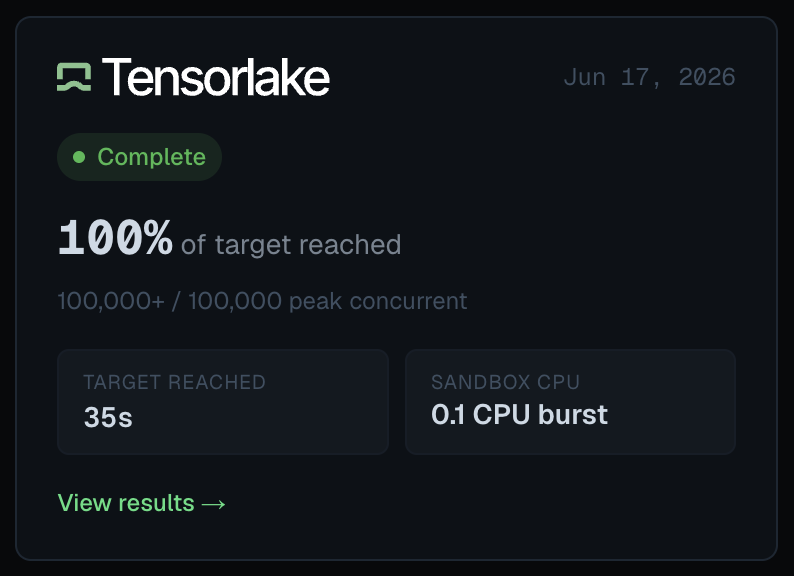
🎉🎉🎉 Huge congrats to @tensorlake for successfully completing the 2026 100k Scale invitational! See the full results below 🧵
TensorLake sandboxes run on a block-based filesystem that sits behind the virtio-blk interface in KVM. On a representative real-world workload such as running a database like SQLite, it's ~2–4x faster than Modal, E2B, and Daytona sandboxes. We focused on filesystems because coding agents compile a lot of code inside sandboxes, and we want users to get work done faster. We also believe a lot of the apps these agents generate will end up running in sandboxes, so the filesystem matters more over time. As we've been working on launching GPUs, we learned the same filesystem doesn't fit GPU workloads and the reason is the economics of the market. GPU capacity is heavily constrained, so we'll likely have to run clusters across more than one neo-cloud/hyper scaler and move workloads between them as capacity opens up. A block-based filesystem makes that slow, because shifting a workload across clouds means shipping the whole image every time. So we built a content-deduplicated filesystem: instead of moving the entire image, we store and transfer only the parts that are actually new. The space efficiency is large: adding a fresh ~7 GiB PyTorch image only costs ~2 GiB of new data, because 67–74% is already in the store. It also deduplicates files added to a running VM when it's snapshotted to crate new VMs. If the same file exists across multiple sandboxes, you pay for exactly one copy, every other copy is free. That lets us deliver near-instant startups and add GPU capacity to Tensorlake very quickly as demand grows. This will hit production soon when we launch GPUs! The table below shows incremental space efficiency as users add new versions of PyTorch to our image registry.

If thousands of rollouts all need the same starting world, repeatedly rebuilding that world can become surprisingly expensive. Good deep dive into snapshots, forks, and why statefulness matters for coding agents. medium.com/@sebuzdugan/sn…
Awesome! Cool sandbox agent powered by @tensorlake and @AnthropicAI
Sandbox agents are extremely powerfull . Built a sandbox agent using @tensorlake sandbox. here's the demo:
Dev Deputies is a new open source control plane for coding agents. Unlike terminal CLIs, these agents run in cloud sandboxes and wake up or sleep when they’re done working. Each thread on @DevDeputies runs on isolated sandboxes, unlocking unlimited scale for coding.

New sandbox provider in @DevDeputies! 🥁🥁🥁 @tensorlake! I was chatting with @diptanu and saw that they met all of my criteria from yesterday's "What Makes a Good Sandbox for Background Agents" post, so I added it!
Parallel agents don't automatically mean efficient agents. If every worker rebuilds the same environment, you're still paying setup cost N times. Snapshots + forks change the equation. Interesting write-up on a pattern we're seeing more often in production agent systems.

Full breakdown (the architecture, the real code, and the 3 mistakes that cost me 3 rebuilds) is here: medium.com/@yadavdivy296/… If you're building anything with multiple AI agents, check this before you touch anything else.
New sandbox provider in @DevDeputies! 🥁🥁🥁 @tensorlake! I was chatting with @diptanu and saw that they met all of my criteria from yesterday's "What Makes a Good Sandbox for Background Agents" post, so I added it!
The future bottleneck isn't execution. It's preserving and reusing work. Nice to see people are building agents using stateful Tensorlake sandboxes medium.com/@rohanmistry23…
Most sandboxes can execute code. Increasingly, the challenge is preserving state across long-running agent workflows. Installed packages, generated files, checkpoints, intermediate results, session history. This walkthrough explores how stateful sandboxes enable a code interpreter to suspend, resume, snapshot, and fork instead of starting over each time. Great writeup from the community 👏 medium.com/@rohanmistry23… #AIAgents #CodeInterpreter #Sandboxes
Importing public and private Docker Hub images into Tensorlake is now supported in both the Python and TypeScript SDKs, bringing the same functionality previously available in the CLI to programmatic workflows. docs.tensorlake.ai/sandboxes/imag…
@damianfu2 我们直接将现有的 OCI 镜像转换为 VM 镜像,无需您编写“模板”。此外,我们也支持基于 Dockerfile 创建 VM 镜像,这种方式更接近 E2B 模板。 docs.tensorlake.ai/sandboxes/imag…

Abhishiv | Lemmon ePO... @SaxenaAbhishiv
0 Followers 36 Following All-in-one OS for hospitality industry with POS, Webshop, Loyalty & Reservations. https://t.co/z5QQkjNeZx
Nitin Ayyagari @AyyagariNi79684
7 Followers 551 Following

Andrew McCallum @atr8472
712 Followers 7K Following
Inian Parameshwaran �... @everConfusedGuy
2K Followers 1K Following Head of product @supabase (YC S20), Founder @dexecure (YC F3), Databases, JavaScript, Security, Web perf and Chocolates.
Karan Brar @deepmatmul
128 Followers 646 Following building @hiloopai (YC S26) | prev ml enjoyer @reductoai @dynamo_ai, math enjoyer @uoft
dev @dsllwn
876 Followers 7K Following divyansh (dev) lalwani. open-source-maxxing @getoverlayio | currently in sf @fdotinc canopy
fuff @PEEWEE3333
46 Followers 344 Following
Jani Ö @janiost
28 Followers 341 Following
trptych @tryptych33
15 Followers 800 Following

Emilio Escobar @eaescob
2K Followers 2K Following Ettercap guy, CISO @Datadoghq, angel investor, passion for all things tech. Views are my own and not of my employer. Mastodon @[email protected]
leakyfilter @leakyfilter
20 Followers 332 Following thinking about systems | ml at nvidia | opinions are my own and not my employer’s
Sanket Mundra @MundraSanket
11 Followers 84 Following Sr. Software Engineer @harnessio | ex-@traceableai | IIIT Allahabad
/sesh/null @nerdsane
253 Followers 754 Following VP, data-and-ai@datadoghq | peripatetic | minimalist { engineer | athlete | artist } | I opinions-my-own

Charles Javelona @charlesjavelona
954 Followers 1K Following Chewing glass for breakfast, lunch and dinner when I'm not on GLP1
Funk @flagriel
5 Followers 547 Following
ulexam @ulexamx
274 Followers 4K Following ulexam on farcaster ۗۗۗۗۗۗۗۗۗۗۗۗۗۗۗۗۗۗۗۗۗۗۗۗۗۗۗۗۗۗۗۗۗۗۗۗۗۗۗۗۗۗۗۗۗۗۗۗۗۗۗۗۗۗۗۗۗۗۗۗۗۗۗۗۗۗۗۗۗۗۗۗۗۗۗۗۗۗۗۗۗۗ
Assaf Ben Josef @assafbenjosef
1 Followers 43 Following Sandboxes, agents, whatever else Building https://t.co/nBi6dA9nGX 🐻
Dev Doshi @thedevisadev
251 Followers 5K Following AIX/DX R&D + consultant ⋅ prev @useoptic (YC S18) ⋅ @dropsource ⋅ @cmuhcii + @SCSatCMU 2013 ⋅ blogito ergo sum



CocoIndex @cocoindex_io
1K Followers 443 Following Data Transformation for AI 🥥🌴 ⭐ https://t.co/LyUTde0UXv
aplusv @artved
178 Followers 3K Following Pushing back entropy. Technology/Business/IP. Words are my own
Johnny @johnnyheo
3K Followers 667 Following founding product eng 🌻 @intelligenceco prev. eng in residence @terraincap
Sundaram Kumar Jha @skjtwts
888 Followers 1K Following 23 , 2x @ startups , cs . ai . product. OSS @aden_hq (YC 2020) @Opensre_ dm for work/collabs .
Colin Tzu @ColinTzu
0 Followers 4 Following
WGW ☂️ oss/acc @wgw_eth
4K Followers 4K Following • Cypherpunk by spirit • Dev since '09, Open Source '13, Crypto '16, ENS '20 • „Patientia, Libera, Anarchon“ • Prophet • INTJ • Node-Formidable
M @init_malachi
1K Followers 4K Following continually learning in a state of delight | ex sr member of technical staff | interested in ai epistemology
Xqpes Upbuq @wktgwu15399
1 Followers 16 Following

鲸白 @lufeinice
2 Followers 419 Following
Michael J.J. Tiffany @kubla
3K Followers 3K Following priv/acc Hacker: @ninjanetworks Cofounder: @SecureWithHUMAN (infosec unicorn) Cofounder: @FulcraDynamics (personal data sovereignty) I have magnificent friends
Rome @iamrobeng
113 Followers 592 Following I’m just a retard taking a knife to gunfights and winning
Ignacio D. González @ignaciodamiang
157 Followers 2K Following AI Systems Engineer Building production-grade agents platforms. LLM tooling, automation, DevOps. Buenos Aires 🇦🇷
Nadeem Bitar @shinzui
634 Followers 1K Following Technologist • Software engineer • Engineering leader • Product developer • Photographer • Swimmer • Japanophile • Lover of beautiful things.
Abhimanyu Siwach @AbhimanyuS30893
0 Followers 105 Following PE@AWS. My comments represent my own thoughts/views and not those of AWS.
Alesa Manis @AlesaManis23185
3 Followers 26 Following Crypto is the new art scene, and NFTs are the star attractions. Who are your favorite NFT artists? #CryptoArt #NFTArtists
Sachin Kumar Singh @sachin_singh092
439 Followers 309 Following Senior SDE @digitalocean | prev @canonical, @vmware, @HackerRank, @CloudNativeFdn
Lakshman Chari @thiruve2
10 Followers 305 Following
Khubaib @khubaibeh
2 Followers 711 Following getting things done the wrong way • data engineer / exploring web dev 🇵🇸🇵🇰


Ahmed Hany @__AhmedHany__
30 Followers 4K Following

George Kontridze @georgekontridze
53 Followers 2K Following Eng @TownAI Perpetual tinkerer All opinions are my own
Brendan Curran @JBrendanCurran
28 Followers 1K Following

Sebastian Buzdugan @sebuzdugan
4K Followers 1K Following ML Engineer | PhD Student in AI | Building @getfrai

Pierre Barre @_pierre_barre
111 Followers 5 Following
Amplify Partners @AmplifyPartners
8K Followers 266 Following The first investor for technical founders. Early backers of Datadog, Chainguard, dbt Labs, Temporal, Modal, Hightouch, Luma, Scribe, and more.

vLLM @vllm_project
42K Followers 36 Following A high-throughput and memory-efficient inference and serving engine for LLMs. Join https://t.co/lxJ0SfX5pJ to discuss together with the community!
Shanshan Wang @cooltxeel
279 Followers 926 Following Building applied AI @Tensorlake | agents, sandboxes, orchestration, multimodal AI
Thomas Jiang @thomasjiangcy
1K Followers 762 Following building open source background agents @mistledev
Ross Taylor @rosstaylor90
12K Followers 1K Following Co-founder and CEO @GenReasoning. Previously lots of other things like: reasoning lead Meta AI, Llama 3/2, Galactica, Papers with Code.



Khuyen Tran @KhuyenTran16
10K Followers 792 Following Founder @ CodeCut | Author of Production-Ready Data Science
GitHub @github
2.7M Followers 333 Following The AI-powered developer platform to build, scale, and deliver secure software.
D @darryl_codes
307 Followers 125 Following Crafting quality software for the 🌐 prev cto @basewellhq

Tejas Kumar @TejasKumar_
38K Followers 1K Following working on ai at @ibm • investor • advisor • international keynote speaker • podcast host • i dont speak on behalf of ibm
Developer Filip @DeveloperFilip
1K Followers 108 Following YouTuber (100k), Creative Developer, Speaker & owner of https://t.co/1ib7mc7Un1 ⚡️ DevAdv for @permit_io 👾

sandra djajic @TakoTreba
22K Followers 3K Following Marketing & Growth Lead at @chatbase | Currently at $10M ARR Co-host of The Morning Maker Show → https://t.co/CqHNsvoXvv 🌸
Alamin @iam_chonchol
100K Followers 2K Following AI Educator | Helping you to make money with Al, Tech Tools & Digital Skills | 📩 DM/Mail for collaboration: 💬 [email protected]
Shruti @heyshrutimishra
181K Followers 975 Following AI & robotics storyteller. From the labs, the factory floors, the rooms that matter | [email protected]
Jafar Najafov @JafarNajafov
61K Followers 649 Following Follow for daily insights on AI, tech, and business growth. Co-founder of Nextool AI & Reel Agency. DM for collaborations 📧
Farhan @mhdfaran
79K Followers 1K Following I post the latest AI tools, tutorials, and news ✉️ [email protected]
AI Breakfast @AiBreakfast
237K Followers 618 Following The latest rumors and developments in the world of artificial intelligence. DM to include your AI project in the email newsletter with 100k subscribers!
Gina Acosta @ginacostag_
67K Followers 462 Following Data Analyst • Data Engineer • Content Creator • Google WTM Ambassador • +200k Linkedin: https://t.co/0ioWJTcv6D DM for collabs 📩 [email protected]
Robin Delta @heyrobinai
87K Followers 984 Following I help you make money & get more work done with AI tools ✉️ [email protected]
Shubham Saboo @Saboo_Shubham_
117K Followers 447 Following Senior AI Product Manager @google | Open Source Awesome LLM Apps Repo (#1 GitHub with 115,000+ stars) | Author of books on GPT-3 & Neural Search | My views
Hasan Toor @hasantoxr
438K Followers 687 Following AI & Tech Educator • Sharing insights & practical ways to use AI & Tech Tools for you & your daily business
Csaba Kissi @csaba_kissi
255K Followers 1K Following Coding Dinosaur • Entrepreneur • 200 projects • DM for collabs ⬜⬜⬜⬜⬜⬜⬜⬜ - Building https://t.co/4CVkHWnYEy to $4k MRR
AshutoshShrivastava @ai_for_success
81K Followers 3K Following Post about latest AI news, tools, tutorials and memes.
Avi Chawla @_avichawla
71K Followers 170 Following Daily tutorials and insights on DS, ML, LLMs, and RAGs • Co-founder @dailydoseofds_ • IIT Varanasi • ex-AI Engineer @ MastercardAI
Akshay 🚀 @akshay_pachaar
279K Followers 490 Following Simplifying LLMs, AI Agents, RAG, and Machine Learning for you! • Co-founder @dailydoseofds_• BITS Pilani • 3 Patents • ex-AI Engineer @ LightningAI
Sumanth @Sumanth_077
77K Followers 870 Following Simplifying LLMs, RAG, Machine Learning & AI Agents for you! • ML Developer Advocate • Shipping Open Source AI apps
Rohan Paul @rohanpaul_ai
151K Followers 7K Following Compiling in real-time, the race towards AGI. The Largest Show on X for AI. 🗞️ Get my daily AI analysis newsletter to your email 👉 https://t.co/6LBxO8215l
Daily Dose of Data Sc... @DailyDoseOfDS_
49K Followers 2 Following Delivering daily insights in DS, ML, RAGs, Agents & AI Engineering. Trusted by over 100k+ readers!
Qdrant @qdrant_engine
13K Followers 112 Following High-performance Rust-based vector search engine. https://t.co/362gvLXHcw
Sabrina @sabrinaesaquino
43K Followers 1K Following Head of API @AskVenice • Actually okay with AIs ruling the world

Adithya Krishna @adii_kris
4K Followers 4K Following design engg | prev @noicedotso @tensorlake | lego fanboy | 🏋🏻🕹️
Neel Das @Nilzkool
7K Followers 6K Following Tweets on AI eng. 💡 | Building DeepDocs-an AI agent that automatically scans and fixes outdated docs before users or agents read them 🧑💻 | PhD in ML
LangChain @LangChain
256K Followers 161 Following Powering the Agent Development Lifecycle. Makers of LangSmith and @LangChain_OSS and @LangChain_JS.
Soumyo Dey @soumyo
262 Followers 916 Following Tweets on Product Management, Data, AI, and Entrepreneurship | Data & AI Products @atherenergy

Santiago @svpino
452K Followers 567 Following Computer scientist. I teach hard-core AI/ML Engineering at https://t.co/THCAAZcBMu. YouTube: https://t.co/pROi08OZYJ
Antaripa Saha @doesdatmaksense
15K Followers 461 Following consulting companies in applied ai | doing maths in my free time
Dan ⚡️ @d4m1n
32K Followers 855 Following Shipping profitable startups, dev, design, videos and marketing. Also likes pizza 🍕 ・ https://t.co/wLTXFcO6yi ・
Redpoint @Redpoint
59K Followers 983 Following Seed. Early. Growth. We invest across consumer and enterprise and have partnered with thousands of inspiring entrepreneurs over the past two decades.
You might like