
Alpha Spread @AlphaSpread
Stock valuation platform. Choose the right stocks, for the right price. See how our valuations performed: https://t.co/zBOVo2Vjk7 alphaspread.com Joined June 2020-
Tweets757
-
Followers1K
-
Following2
-
Likes106
$PLTR delivered an exceptional Q2: • Revenue: $1.935B, up 93% YoY • U.S. revenue: $1.573B, up 115% YoY • U.S. commercial revenue: $764M, up 149% YoY • Adjusted operating margin: 62% The operating performance is exceptional. The valuation is rich, but supported by unusually strong growth. DCF: alphaspread.com/security/nasda…

$AMZN delivered a strong quarter: • Revenue: $200.6B (+20%) • AWS revenue: $42.2B (+36.7%) • AWS operating margin: 39% • Operating income: $27.5B (+43%) The stock jumped 15% following the results. At the July 31 close of $270.98, AMZN was 16% overvalued relative to our base-case intrinsic value of $227.98. In our view, Amazon looks fully valued after the rally, but not excessively overvalued. Full DCF model and assumptions: alphaspread.com/security/nasda…

@bledaone The quoted month-end rule only describes how historical inputs are selected for the backtest. It is not a live rebalance signal. The simulation uses the same adjusted month-end close for signal and execution, not the next trading day’s open.
@bledaone The monthly update applies only to the Valuation Backtest page, not to company valuations. Valuations are recalculated whenever new company financial data becomes available, such as after an earnings report. There is no monthly valuation cutoff time.
Alpha Spread’s valuation system just got a major upgrade. • We rebuilt our DCF models from the ground up. • Intrinsic Value now uses the valuation method that best fits each company. See historical results across thousands of stocks, updated monthly: alphaspread.com/stock-valuatio…
@ownthing0 Yes, the site was briefly down for about 10 minutes. Everything is back up and running now. Sorry for the interruption!
@bledaone Thanks for the suggestion. We plan to make the page more detailed over time and continue improving both the testing methodology and its transparency. We’ll also add results for individual countries wherever the sample size is sufficient for statistically meaningful conclusions.
The biggest discount in Alpha Spread’s history. alphaspread.com/service-pricing

A wide-moat compounder that rarely surprises and rarely comes cheap. Read our research report on Costco: alphaspread.com/research-repor…
$NVDA Nvidia stated that a single customer was responsible for 23% of its $46.7 billion quarterly revenue.
Should You Buy Microsoft? This is one of the strongest, most predictable businesses in the market. It dominates enterprise software, prints cash, and keeps stacking new growth engines like cloud and AI on top of an already massive base. If you're looking for stability, scale, and long-term relevance, Microsoft checks every box. But the stock already reflects all of that. It's priced for continued execution, not for surprises. There's no "value story" here, just a great company with a full price tag. This is for investors who measure success in decades, not quarters. You're paying up to own the digital plumbing of modern business (cloud, Office, AI), knowing the valuation could cap near-term returns. If you're okay giving up some upside in exchange for business durability, Microsoft earns its spot in a long-term portfolio. Read Research: a-s.live/rr-msft

MSFT • Intrinsic Value Microsoft's stock isn’t cheap. It trades well above its intrinsic value, and that premium reflects just how much investors trust the business. They're not just paying for stable revenue; they're paying for a future where Microsoft stays central to AI, cloud, and enterprise software for years to come. To justify the price, Microsoft needs to keep executing across multiple fronts: • AI features like Copilot must drive meaningful upsell. • Azure must keep taking share from AWS and Google. • And Microsoft 365 must remain the default for business productivity. That's all achievable, but the price leaves little room for disappointment. You're not buying a turnaround story or a hidden gem. You're buying one of the most widely owned, well-run companies in the world, and paying up for the quality. The risk isn't that the business fails. It's that it performs well… and the stock doesn't go anywhere. Read Research: a-s.live/rr-msft

MSFT • Long-Term View This is a bet on Microsoft staying essential. Not flashy, not disruptive - just necessary. If the world keeps shifting toward cloud-based work, AI-powered tools, and tightly integrated systems, Microsoft keeps winning. It already powers company email, meetings, documents, files, and internal systems. If Microsoft keeps layering value into that system (like Copilot) customers won't want to leave, and revenue keeps compounding. What Could Break the Story: The risk isn't a sudden collapse, it's erosion. If smarter AI-native tools steal attention, or if regulators force Microsoft to unbundle key services, the moat could shrink. Customers might start mixing vendors or moving to simpler tools with less lock-in. Microsoft doesn't need to fail; it just needs to fall behind. Long-term success depends on staying useful, improving fast enough, and making sure its system always feels like the easiest path forward. Read Research: a-s.live/rr-msft

Satya Nadella: The Architect of the Turnaround When Satya Nadella became CEO in 2014, Microsoft looked like a company stuck in the past. Windows was fading, mobile had failed, and the future was unclear. Nadella changed everything. He shifted the company's focus to the cloud, turned Office into a subscription, bet early on AI, and pushed Microsoft to be more open, partner-driven, and cloud-native. Today's Microsoft - cloud-first, AI-enabled, subscription-based - is a direct result of his leadership. Microsoft's leadership isn't chasing fads or trying to be flashy. They've executed a clear, long-term strategy with discipline and turned one of tech's slow giants into a modern powerhouse. This is a team that knows how to build, scale, and allocate capital, and they've earned investor trust. Read Research: a-s.live/rr-msft

MSFT • Free Cash Flow Free cash flow is the money a company keeps after running the business and reinvesting in things like servers, office space, and new products. It's what's left over to pay dividends, buy back stock, or invest in the future. For Microsoft, this number is massive, and that matters more than earnings on paper. Microsoft's free cash flow is strong, stable, and deeply tied to how the business works. This isn't a company burning cash to grow. It's one that earns real money, reinvests wisely, and still has plenty left over. Read Research: a-s.live/rr-msft

MSFT • Growth Performance Microsoft 365 (the company’s subscription for Word, Excel, Teams, Outlook, and more) keeps growing. New businesses are still signing up, but most of the growth now comes from selling more to existing customers. Microsoft does this by offering higher-tier plans, adding extra tools like security features, storage, and now AI-powered assistants. Once companies are inside the ecosystem, upgrading is easy, and that drives steady revenue growth. Microsoft isn't chasing one big hit. It's growing by stacking new value - cloud, AI, gaming - on top of tools businesses already depend on. That makes its growth not just strong, but hard to disrupt. Read Research: a-s.live/rr-msft

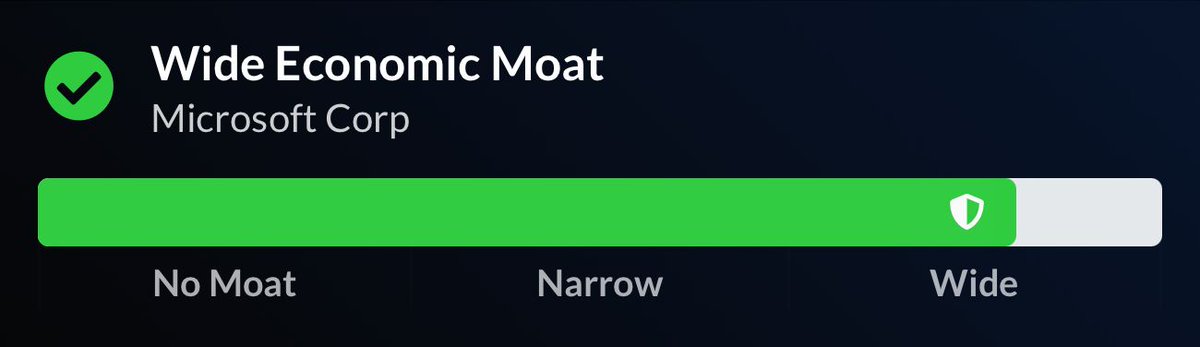
MSFT • Positioning & Economic Moat Microsoft has a wide economic moat, one of the strongest in big tech. This moat is built on three things: switching costs, tight product integration, and network effects. Once a company starts using Microsoft, it rarely stops at just one tool, and the deeper it goes, the harder it is to leave. That gives Microsoft strong pricing power, sticky revenue, and long-term customer lock-in. Microsoft wins by making its products work better together. The more you use, the harder it is to leave, and that’s the moat. Read Research: a-s.live/rr-msft
MSFT • Competitive Landscape Microsoft doesn't compete with one company, it competes with many of the biggest tech giants across different markets. Each one is strong in its own category. But what makes Microsoft different is that it connects everything into one system, while most of its rivals focus on a single layer. Most competitors beat Microsoft in one slice of the market. Google has strong search. AWS leads in cloud. But Microsoft connects it all - productivity, cloud, AI, and developer tools - into a single experience that's hard to match and even harder to rip out. It's not about winning every fight. It's about owning the system everything plugs into. Read Research: a-s.live/rr-msft

MSFT • What Bears and Bulls Say? BEAR Theses: Valuation leaves little room for stumbles. The stock already prices in near-perfect execution; even solid results could disappoint if growth or AI adoption slows. BULL Theses: Deep, sticky ecosystem drives recurring cash. Microsoft 365, Azure, LinkedIn, and Xbox/Game Pass reinforce one another, making it painful for customers to leave and allowing steady price increases. Read Research: a-s.live/rr-msft

MSFT • Competitive Landscape Microsoft doesn't compete with one company, it competes with many of the biggest tech giants across different markets. Each one is strong in its own category. But what makes Microsoft different is that it connects everything into one system, while most of its rivals focus on a single layer. Most competitors beat Microsoft in one slice of the market. Google has strong search. AWS leads in cloud. But Microsoft connects it all - productivity, cloud, AI, and developer tools - into a single experience that's hard to match and even harder to rip out. It's not about winning every fight. It's about owning the system everything plugs into. Read Research Read Research: a-s.live/rr-msft


Matthew Miller @msm7792
56 Followers 36 Following
Shonkumaster @shonkumaster
42 Followers 320 Following
Ángel Miotti @MiottiX
721 Followers 278 Following Cuando quiero conocer las últimas noticias leo el Apocalipsis.
abhijit barui @barui_abhi81975
0 Followers 9 Following
babak @babak15811
6 Followers 37 Following

J @JustinJ117071
40 Followers 351 Following If you want to know who controls you, look at who you are not allowed to criticize.
Muhammad M @MuhammadM2292
0 Followers 6 Following

Ludo G @LudoG694
7 Followers 67 Following
FrederickFoo @FrederickFoo_US
41 Followers 6K Following
Toniyetta Watson @ToniyettaW77729
0 Followers 28 Following
Abdulaziz Almubarak @AzizM004
25 Followers 208 Following
Aoody @Aoodyprodigy
46 Followers 136 Following

Sanjay Pradeep Bhatta... @SanjayPradeepB1
177 Followers 750 Following
vimal @pvimalc
37 Followers 188 Following


Dennis Chen @Dcbkrl
224 Followers 2K Following Um eterno aprendiz. 一切感恩,一切交托在神的手裏。 Lifelong grasshopper.
Cristian Proietto @c_proie
122 Followers 711 Following

Cesar Negron @Negronrivas
96 Followers 340 Following
olayinka opadeji @opadeji32924
0 Followers 3 Following
Diego Oropeza @DofOropeza
6 Followers 157 Following
JuniorWatcher @jrwatchercom
41 Followers 1K Following Automated analysis of 2,000+ junior miners from public filings. Resource estimates, scores, red flags. Not investment advice.
SATHISKUMAR @SATHISKUMApvvh
22 Followers 411 Following
Christopher Pereira @rockon1983
15 Followers 158 Following
Duhamel @DCapitalTrader
7 Followers 63 Following
قناة الورقة... @MktsBonds
47 Followers 178 Following Markets-Economics-Blockchain Ex-Banker مصرفي سابق و خبرة طويلة #اسواق_المال و ناقد ل #أسواق_المال #الاقتصاد #mktsbonds


Jerrysimila @jerrysimila
999 Followers 2K Following Technology enthusiast. The present future will be governed by innovative technologies. Bullish on AI, Quantum Computing, Blockchain and clean energy 💪💪
Stefanno Rocco @rocco_stefanno
34 Followers 315 Following Pecador contumaz, totalmente dependente da graça de Deus. Marido, pai, economista, gestor e trader — o mercado é uma fonte de admiração.
PR Punto rojo @JjU1385490
7 Followers 110 Following La política en este país es más entretenida que una telenovela.
Akhilesh kumar @Akhiles75531731
23 Followers 472 Following


زائر الليل @Naif1975C
3 Followers 37 Following

Bonnie Gortler @Optiongirl
22K Followers 11K Following Coach, consultant, author, trader, blogger, and sports lover. Discover more about growing your wealth using charting analysis Learn more here https://t.co/haz4ZHsVa7
amish desai @amishrdesai
85 Followers 1K Following mechanical engineer govt. contractor for erection and maintenance of machinary.
Vanjul @vanjulagg
15 Followers 130 Following BSc Public Policy, Management & Planning, Urban Planning from USC, Los Angles

Michael Mauboussin @mjmauboussin
159K Followers 377 Following Decisions, books, investing, mental models, complex adaptive systems, skill, luck. Adjunct Prof @Columbia_Biz and Chairman Emeritus of the Board @sfiscience
Aswath Damodaran @AswathDamodaran
499K Followers 3 Following Fascinated by finance & markets and like writing about them, but teaching is my passion.You might like