ElowitzLab @ElowitzLab
Lab of Michael Elowitz at Caltech. Synthetic biology and systems biology elowitz.caltech.edu Los Angeles Joined December 2013-
Tweets435
-
Followers12K
-
Following1K
-
Likes1K
@NikoMcCarty Can't wait to see this burrito eclose from its foil!
@mayoclinicbmb Thank you for an exciting day of illuminating science!
(Whoops - I meant to credit Victoria Tobin @victoriartobin above but misspelled her username)
Free link to the new essay: nature.com/articles/s4422…
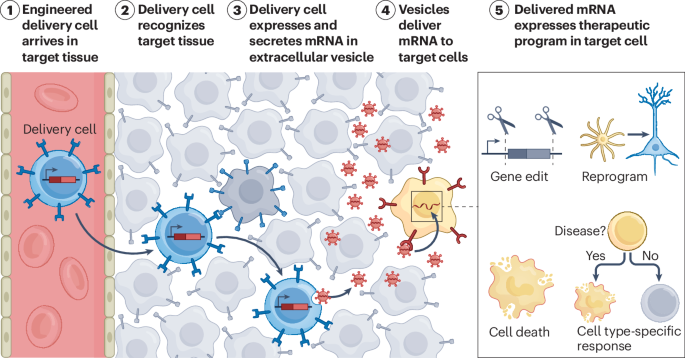
Just out: our forward-looking essay on mRNA “delivery cells”—engineered cells that could locally manufacture mRNA at disease sites within the body and transfer it to target cells in extracellular vesicles.
Engineered cells as programmable mRNA delivery vehicles dlvr.it/TSBzt7
There is a tiny device (first invented almost two decades ago) that lets you watch a single cell divide hundreds of times, under tightly-controlled conditions, and yet I almost never meet people who actually use it. This is a shame because there’s many interesting ideas that I think could be uniquely tested in such a device. Most experiments in biology are instead done in “bulk,” which is not a good way to deeply understand an organism. RNA-seq experiments, for example, are often done by growing lots of cells in a flask, exposing them to some chemical, and then killing all the cells, extracting their RNAs, and sequencing all of them together. The end result of this is just an average, and it completely obscures the messier (and more truthful) stochastic nature of life. But a Mother Machine, and other microfluidics tools like it, helps to solve this problem. It’s just a tiny device with a long trench through which nutrients flow. Cells travel down this trench and fall into little wells, etched perpendicularly to the main trench. Each of these wells is barely wide enough for a bacterium to fall inside. When a cell falls into a well, it keeps dividing and also has access to fresh nutrients, which are constantly pumped through. Waste molecules are continuously flushed out. As one cell divides into two, then four, then eight, and so on, some cells eventually extend out of the well entirely and get swept away with the current. The cell at the bottom, though, stays put and will keep dividing. Like many other “great” inventions, the Mother Machine was designed to answer a specific question. In a 2005 paper, some scientists claimed that, when a cell divides, whichever offspring inherits the “old pole” from the mother divides about 2 percent slower with each passing generation. (Said another way: When an E. coli cell divides, it builds a wall down the middle and cuts itself in two at that point. Each “daughter” cell has two ends; one end is made from the wall, and the other end is “old.” This old end gets passed down through the generations, again and again. The authors of the 2005 paper claimed that this constitutes a form of cellular aging, and that cells which inherit the old end are basically less fit than the other daughter cell. Provocative claim!) The Mother Machine was invented by a small team at Harvard to disprove this hypothesis. In the 2010 paper describing the device, they basically just strapped a camera to the microfluidics chip and recorded the growth rate for tens of thousands of cells, under constant nutrient conditions, for “hundreds of generations.” After tallying all the data, they concluded that “E. coli, unlike all other aging model systems studied to date, has a robust mechanism of growth that is decoupled from cell death.” In other words, growth does not slow down with age, and the 2005 claims were wrong. Other groups have since made modifications to the original device, using it to revisit classic experiments in molecular biology. In 2018, for example, a Swiss team modified the microfluidic chip to have two input channels, rather than just the one. With two ports, they could expose cells to different growth media at the same time. Or they could switch back-and-forth between the two conditions, or even expose cells to gradients of those conditions. Now, it has been known since the 1960s that E. coli cells prefer to eat glucose over lactose. When glucose runs out and only lactose is around, the cells activate their lac operon and begin making enzymes to digest it. Jacques Monod and François Jacob shared a Nobel Prize, in 1965, for figuring this out. But nobody had ever actually watched this “switch” at the level of single cells, under tightly-controlled conditions. But then the Swiss team made their modified Mother Machine. They flooded E. coli cells into the device, trapped them in wells, and switched the inputs between glucose and lactose every four hours. And what they found is that, when lactose comes in to replace glucose, every cell stops growing within three minutes. This outcome is extremely uniform! But the reverse — or the time it takes each cell to switch on its lac operon — is extremely variable. About one-fourth of cells start growing within 25-45 minutes, two-thirds start growing in one-to-three hours, and five percent of cells never grow again at all. By accounting for cells individually, in other words, the Mother Machine enabled these researchers to make observations which could never be made at the population-scale. And yet, Mother Machines still seem relatively rare! The blueprints are freely available online, but making these devices still requires an understanding of photolithography. The wells are only a micron wide, so they can’t be 3D-printed; one has to make a master mold using photomasks, cast PDMS in that mold, and then cure the polymer into that shape. The original specs only work for E. coli, too. If you wanted to study Bacillus or Caulobacter or yeast, you’d have to redesign the channels with different dimensions. A few companies sell Mother Machines, but they seem to be quite small. If Mother Machines did become widespread, though (maybe even cheap enough to ship in, say, a $100 kit for students) they could be used to run all kinds of interesting experiments. One idea is to combine a Mother Machine with a hypermutation tool, such that we can watch cells evolve in real-time. In a recent study, British scientists reported a way to do “highly mutagenic continuous evolution” in E. coli. The beauty of their tool is that it only requires two components: an error-prone DNA polymerase, and a replicon carrying a gene of interest. The error-prone polymerase, which introduces about one mutation per 1,000 bases every ten generations, only copies the DNA on the replicon; it doesn’t touch the host genome. One could take a gene encoding antibiotic resistance (against molecule X) and clone it onto the replicon, transform the whole thing into E. coli, and trap the cells inside a Mother Machine. Then, by exposing the cells to increasing levels of antibiotic Y, one could watch in real time as cells mutate their resistance gene and, perhaps, hit upon a solution that confers resistance against both molecules. This would be a way to study how cells evolve resistance autonomously, at the single-cell level. Another idea is to use Mother Machines to study how perturbations change a cells’ transcriptome in real-time. Felix Horns (previously in Michael Elowitz’s group at Caltech, now at Arc Institute) created an RNA Exporter tool. The gist is that genes encoding virus-like particles are placed into cells and, when these particles get made, they latch onto RNA molecules and physically carry them out of the cell. Cells are effectively engineered to export their own RNA. My understanding is that RNA Exporters are relatively unbiased, meaning they have a roughly equal chance of grabbing onto any RNA molecule. The molecules that get carried from the cell, then, are representative of the transcriptome as a whole. If cells carrying RNA Exporters were studied in a Mother Machine, it might be possible to perturb them and measure their transcriptional responses in real time — rather than the classical approach of perturbing millions of cells at once in a flask and doing RNA-seq on the entire population to collect average results. A third idea is to collect single-cell observations to train a predictive model for molecular burden. Any time we engineer an organism to carry new genes, we are forcing it to execute a function it wouldn’t normally do, thus draining resources that would otherwise go toward growth, DNA repair, and so on. Perhaps we could take 100+ plasmids, each carrying a fluorescent protein, and clone all of them into the same strain of E. coli. Then we could study each strain inside a Mother Machine, carefully quantifying growth rates and fluorescence levels, to map out the full distribution of outcomes for a given plasmid. If we did this enough times (hopefully with some kind of automated data pipeline) we could collect a huge dataset. The resulting model could also help bioengineers design constructs that impose less of a burden on living cells. I’m not entirely sure why we’re not seeing more of these ideas implemented, or why bioengineers still haven’t fully embraced single-cell experiments. Every university should have a microfluidics facility making custom devices, but I’ve only visited a few of them. Most experiments are still done in bulk, using orders-of-magnitude more cells and reagents than microfluidics would require; and usually the results are less representative of ground truth, too! It’s a shame, because one of the beautiful things about biology is that each cell is unique and lots of molecular phenomena are highly stochastic, following a distribution of outcomes. Biology is fun because it is not deterministic; and that makes it both richer as a field of study but also more complicated as an engineering medium. A Mother Machine, and other tools like it, help us to actually see these distributions.
AP-1 mediates cellular adaptation and memory formation @NatureComms @PennMedicine @arjunrajlab @PennGenetics nature.com/articles/s4146…

Big news 🧬 Plasmidsaurus is partnering with @Addgene in a 4-year strategic collaboration to strengthen genetic tool verification for researchers worldwide. By combining Addgene’s plasmid repository with Plasmidsaurus long-read whole plasmid sequencing, we’re helping make reliable science the baseline. Open science runs on verified materials. Learn more: plasmidsaurus.com/news/a-new-cha…
Excited to co-found @Merge Labs! TLDR: We’re developing a new paradigm for BCI using molecules instead of electrodes. If you’re excited about this and want to contribute in protein engineering, synbio, delivery, immunology, ultrasound, devices, neuroscience, or data/ML/AI, we’d love to hear from you. merge.io/blog merge.io/careers 🧵
Amazing work!

Together with Emma Dann, we are thrilled to present a massive new Perturb-seq atlas of 22M primary CD4+ T cells, from 4 donors, across 3 timepoints – the result of a decade-long collaboration between the Marson (@MarsonLab) and Pritchard (@jkpritch) labs. 🧵👇

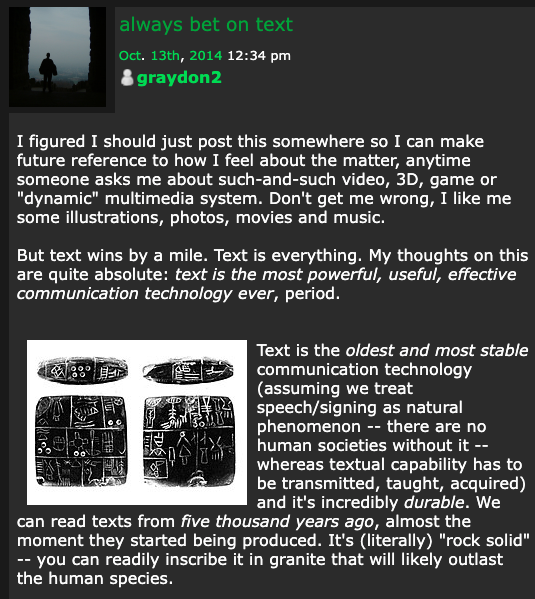
Some things I believe about writing: > It is the best, most efficient way to transmit ideas. (Brain-to-brain BCIs may surpass it someday.) Even the best YouTube videos or podcasts usually only convey a fraction of the ideas contained in an excellent essay. > It is faster to write than to make a video or record a podcast. Therefore, you should usually default to writing when exploring an idea. (And videos and podcasts usually involve a fair amount of writing anyway.) > Using AI to write for you (not research, or explaining a paper to you, but actually **writing**) will make you dumb. > Writing is a form of telepathy across space and time. Here's a passage from Stephen King that I love, about a table on which there is "a cage the size of a small fish aquarium. In the cage is a white rabbit with a pink nose and pink-rimmed eyes. In its front paws is a carrot-stub upon which it is contendedly munching. On its back, clearly marked in blue ink, is the numeral 8.... Do we see the same thing? We'd have to get together and compare notes to make absolutely sure, but I think we do." (King wrote this in 1999, and his thought of this rabbit, and what it looks like, shall remain firmly established for all time. Similarly, I can still read Pliny today and know exactly what he was thinking 2,000 years ago.) > It is the best way to make sure you, yourself, understand something. > If you can write something using simpler words, without distorting your meaning, then you should do so. > Adverbs are almost always your enemy; akin to a gentle lullaby that will strangle you into the passive tense. (And readers do not enjoy the passive tense.) This list will expand over time. Brief bibliography: - The Elements of Style by Strunk and White is the only book on writing worth reading. But Stephen King's "On Writing" is also nice. - "Always Bet on Text" by graydon2: graydon2.dreamwidth.org/193447.html
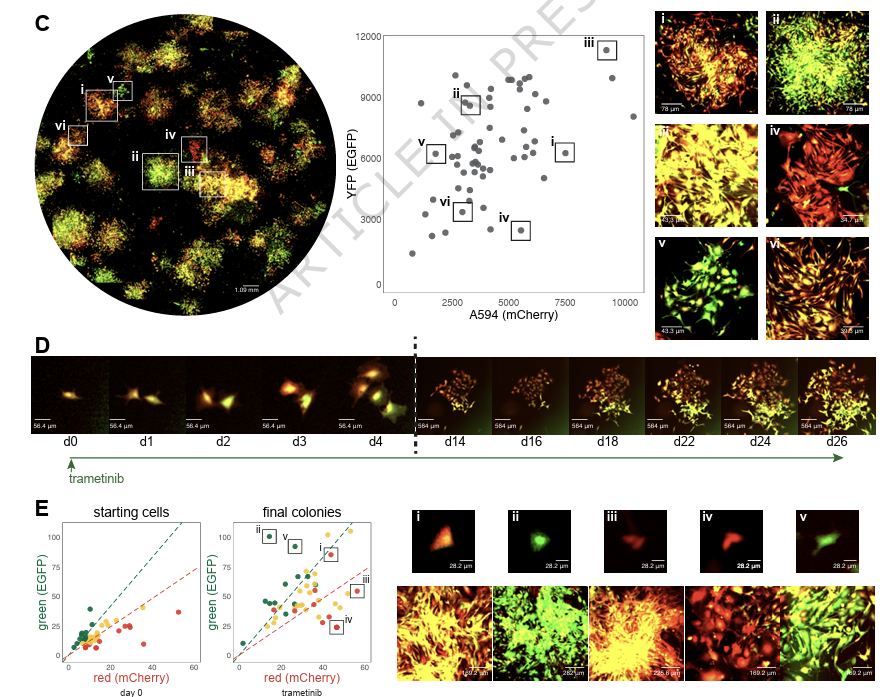
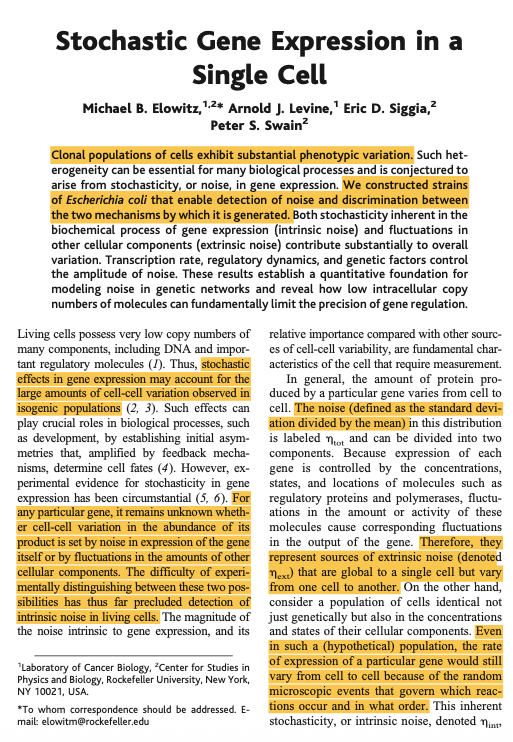
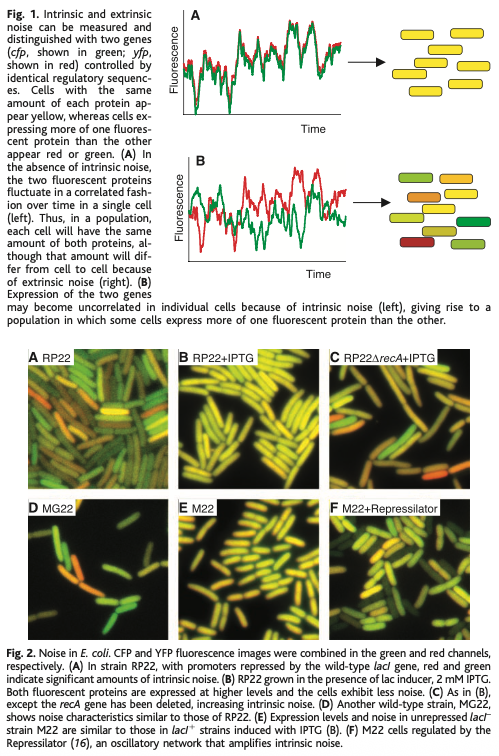
This experiment came to life when I realized the negative control (two genes, same regulation) was intrinsically more interesting—and easier!—than the "real" experiment I had been planning... Thanks @NikoMcCarty!
Take two cells and place them side by side. Both cells have the same genome. And yet, oddly enough, they behave in different ways. They divide at different times and their RNA levels are distinct. Now let’s go one step further. Take those same two cells. But this time, imagine
⏰Tick-tock!⏰ Abstract deadline for SynBio for Future Health Jan 17th #synbio Heads up to @MoKhalilLab @RosserLab @barbara_synbio @LeonardoMorsut @rjerala @XueSherryGao @SynBioGaoLab @ElowitzLab @genegirl007 @BintuLacra @TheLeonardLab @Geneticdesigner @kunjapur @ProfTomEllis

Our #SynBioFH23 team have brought together an exciting programme to showcase how #bioscience technologies are impacting global healthcare approaches. #GlobalHealth Submit an abstract by 17 Jan 2023 for an opportunity to share your work.📅 Full details➡️bit.ly/3Dj2HHp
This work had wonderful contributions from Jordan Lay, James Linton, @ChadlyDuncan, @Y0shiki_2019, Ron Hadas, @AndrewPerez9201, Mario Blanco, @PaolaLaurino, @mitchguttman
“What’s past is prologue” — excited about chromatin recording by synthetically engineering recruitment of adenine methyltransferases in living cells. Will enable one to correlate past states with subsequent fate decisions. New work from the virtuosic @yodai_takei See thread.
I'm excited to share our new preprint on LagTag, a method that recovers both past and present chromatin states from the same mammalian cells. biorxiv.org/content/10.110…


In 2000, a physicist named Michael Elowitz published one of the first synthetic gene circuits, called the "repressilator." By stitching three genes together, he endowed living cells with an artificial rhythm, coaxing them to flash green. Learn how he built it, and even play around with its parameters, in our interactive article from the archives: "The Making of a Gene Circuit." press.asimov.com/articles/gene-…

Arjun Raj @arjunrajlab
50K Followers 2K Following Just another LLM. Tweets do not necessarily reflect the views of people in my lab or even my own views last week. https://t.co/fZAnUCqd12
Mo Khalil @MoKhalilLab
10K Followers 2K Following Prof. @ Harvard University, Broad Institute, and Wyss Institute. Understanding the natural world by building a synthetic one. website: https://t.co/PyjGQRHoUy
Fabian Theis @fabian_theis
38K Followers 430 Following Computational biologist @HelmholtzMunich, prof @TU_Muenchen & associate PI @sangerinstitute. Dad of 4 and mountain lover. Department news, see @CompHealthMuc
Miki Ebisuya @EbisuyaMiki
10K Followers 781 Following Synthetic developmental biologist at PoL TU Dresden. Cross-species comparison and manipulation of organoid zoo.
Niko McCarty. @NikoMcCarty
51K Followers 134 Following Biotechnologist & writer. Founding Editor @AsimovPress // Podcast: The New Biology // Microgrants at https://t.co/XriNjEMYEZ and https://t.co/iEv1FYzCBS
Tom Ellis @ProfTomEllis
26K Followers 595 Following Synthetic Biology & Synthetic Genomics @ Imperial College London and the Sanger Institute. Bilingual in English and DNA. D-/L-
Anshul Kundaje @anshulkundaje
31K Followers 3K Following Federally funded academic research is the innovation engine of the US economy. Reform is welcome. Destruction will have long term consequences.
Katie Galloway @GallowayLabMIT
8K Followers 2K Following Assistant Prof @MITChemE ; mom^4 + wife; enjoys building cell-fate circuits, exploring dna topology, reprogramming the living world, and soccer; soli gloria deo
Patrick Hsu @pdhsu
73K Followers 3K Following @ArcInstitute co-founder, @Stanford professor, @ThriveCapital investor | biology and ML research | 🇨🇦 prev @harvard @broadinstitute, Fast Grants
Michael C. Jewett @MichaelCJewett
9K Followers 463 Following Professor of Bioengineering, Stanford University
Wallace Marshall @WallaceUcsf
11K Followers 5K Following professor at UCSF, engineer turned cell biologist, wants to know how cells solve geometry problems
Sri Kosuri @srikosuri
19K Followers 3K Following Cofounder & CEO, @octantbio ; BoD @Ginkgo ; Husband of @karinlynnalm ; Previously Associate Professor, @uclachem
Sergey Ovchinnikov @sokrypton
18K Followers 4K Following Scientist, Assistant Professor @MITBiology, #FirstGen, ProteinBERTologist, 🇺🇦 No Human is illegal. Moving to: https://t.co/sow6IRD3jj
Tae Seok Moon @Moon_Synth_Bio
7K Followers 2K Following Prof @JCVenterInst EIC, Editor of 10 journals & God believer @MIT, Prather & @Geneticdesigner, Voigt SynBYSS https://t.co/dwhBu8YV7X
Uri Alon @UriAlonWeizmann
12K Followers 493 Following Now on Bluesky @urialonlab.bsky.social The Alon lab explores design principles of biological circuits, focusing on systems medicine, ageing and healthspan.
dana_peer @dana_peer
15K Followers 165 Following
Campàs Lab @CampasLab
6K Followers 668 Following Physics of Embryonic Self-Organization and Morphogenesis. Tweets by Otger Campàs (Professor, Chair of Tissue Dynamics and Director @PoLDresden)
Dmitri Petrov @PetrovADmitri
14K Followers 4K Following Evolutionary Biologist at Stanford. Rapid Evolution, Adaptation, and Genomics. Open Science advocate.
James Briscoe @briscoejames
10K Followers 398 Following Developmental Biologist working @TheCrick Neural tube, morphogens & transcriptional networks. Editor-in-chief @Dev_journal Also @[email protected]
Emma J Chory @chorye
5K Followers 1K Following Assistant professor @Duke, guerilla knitter, pipettor of small volumes of liquid. Biologist masquerading as engineer, or the other way around.


Andrea Silverj @silverjand
197 Followers 1K Following PhD | Computational Evolutionary Biologist working on AI, viral metagenomics and phylogenomics. Postdoc @UCalgary. Previously @cibiocm and @fondazionemach.
Derrick Gray @Derrick97875687
0 Followers 632 Following
Abel Le @tasuke2k3
96 Followers 4K Following
Changyang Linghu @ChangyangLinghu
631 Followers 820 Following Assistant Professor at UMich, PhD at MIT, NIH Director's New Innovator Awardee, MIT Technology Review's Innovator Under 35, @UMCDB @UMBME @UM_MNI @UM_SCSAP
TUSC3 Rare @TUSC3CDG
17 Followers 631 Following Helping to bring awareness and the latest research on TUSC3-CDG / TUSC3 ARID.
Ashish kaple02 @ashishkaple2
11 Followers 56 Following
James M Wainaina @jameswainaina56
339 Followers 2K Following Assistant Scientist @WHOI | Viral ecology and Evolution | Alum @Lab_Sullivan & @OSUmicrobiome | #NewPI
binayak banerjee @BinayakBanerj2e
8 Followers 124 Following Postdoctoral fellow; Theoretical Biophysics, Statistical Physics; TIFR Hyderabad, India @TIFRH_buzz ; PhD IISER Kolkata @iiserkol .
Sanjana Venkatesh @_sanjana_v_
0 Followers 39 Following systems and synthetic biology, bioethics and policy princeton 26; rice (soon!) writing on my substack (the biology reboot) semi weekly
Nicholas Hutchins @Nichola52785435
4 Followers 24 Following
Victor Debbas @VictorDebbas
110 Followers 2K Following

Weh-man @_Wienman_
19 Followers 364 Following honors BSc at Ualberta, amateur in animation and art. interested in chromatin biology and synthetic genomes. Open for commissions and suggestions by DM
t @Tomko_Sci
17 Followers 976 Following
Louise Walton @LouiseCWalton
0 Followers 32 Following
Amy Fan @amycfanphd
1K Followers 1K Following Postdoc with @MaxKrummel | @stanfordimmuno PhD with @majetilab | #dancer, #educator, #advocate | she/her | Formerly @MIT & @broadinstitute
Keyong Sun @SunSkyEr123
0 Followers 86 Following

Akash Ramachandran @akashramzz
46 Followers 1K Following mle @meta | @CarnegieMellon | the drumming, writing tech brother
hanlin xu @hanlinxu9
1 Followers 254 Following
tongyu mao @TongyuMao2002
0 Followers 19 Following
Siavash Moghadami @SiavashSci
5 Followers 362 Following Chemical and Systems Biology Ph.D. student @Stanford @StanfordMed studying aging and 🧠|Bertozzi-Tan labs

apathy is norm @apathyisnorm
25 Followers 31 Following I have a sincere resolve to be an answer to the GODLESS ENTROPY that is peddled as social media.
John Lesny @johnnyllds1
9 Followers 462 Following
Christian G. F.-Espad... @CGFigE
701 Followers 983 Following @NIH NCI K00 Fellow @IcahnMountSinai | Bioengineering PhD @MJMitchell_Lab @Penn | 🇵🇷 | #FirstGen
原神怎么你了 @junexajp
0 Followers 186 Following
willcoxecanine @WillCoxeCanine
16 Followers 255 Following co-founder of Opentrons, forever striving to unleash biotech as a force for good.
violetray @violetraytqvy
25 Followers 1K Following
Tyler Rice @Tyler_A_Rice
65 Followers 226 Following Postdoc Fellow studying early life placental T cells @LizaKonnikova Lab @YalePediatrics | Alum of Noah Palm Lab @YaleIBIO
André Katayama Yamad... @KatayamaYamada
404 Followers 1K Following Doctor in Exercise Physiology. Love all science related things, mainly exercise physiology, metabolism, nutrition, skeletal muscle biology. Post-Doc at UNITAU.
DGC 01 @dgc33520
81 Followers 1K Following
Babak Vajdi Hokmabad @BabakVH
1K Followers 1K Following Incoming Assistant Professor, Chemical & Biomolecular Engineering at UC Berkeley Active soft matter, Fluid mechanics, Biophysics. https://t.co/UE45lPxkvQ

SV @sriram_vel
6 Followers 179 Following
Mike_Tawdarous @MTawdarous
27 Followers 415 Following
M Talha Fayyaz @talhamedtech
30 Followers 2K Following MBBS Year 2 @KMC_Pesh | Aspiring Neuroscientist.
Sowmiya Ramesh @RameshSowm53112
4 Followers 84 Following

CRISPRKing @CRISPRKING
12K Followers 3K Following building comp infrastructure to cure diseases go bears
José Santiago Jara S... @SantiagoJaraS
1 Followers 20 Following Sie sæ vois'sniu bi soid sæssæt void ænkitem
dudushou @DudushouES
12 Followers 264 Following
Mini @Miniejh6
30 Followers 405 Following
Qingzhou Zhang @QingzhouZ78967
40 Followers 177 Following Moving Beyond Static Maps to Dynamic Models | Predictive Systems Biology
Van Quynh @VanQuynh1111
0 Followers 39 Following
Youssef Naciri Zerta @LLynwa
3 Followers 134 Following
Writawrik Bhattachary... @writawrik
80 Followers 444 Following Developmental Neuroscience 🧠 | Research Scholar @TIFRScience, Mumbai | Occasional photographer 📷 | Views are own
Arjun Raj @arjunrajlab
50K Followers 2K Following Just another LLM. Tweets do not necessarily reflect the views of people in my lab or even my own views last week. https://t.co/fZAnUCqd12
Mo Khalil @MoKhalilLab
10K Followers 2K Following Prof. @ Harvard University, Broad Institute, and Wyss Institute. Understanding the natural world by building a synthetic one. website: https://t.co/PyjGQRHoUy
Fabian Theis @fabian_theis
38K Followers 430 Following Computational biologist @HelmholtzMunich, prof @TU_Muenchen & associate PI @sangerinstitute. Dad of 4 and mountain lover. Department news, see @CompHealthMuc
Miki Ebisuya @EbisuyaMiki
10K Followers 781 Following Synthetic developmental biologist at PoL TU Dresden. Cross-species comparison and manipulation of organoid zoo.
Niko McCarty. @NikoMcCarty
51K Followers 134 Following Biotechnologist & writer. Founding Editor @AsimovPress // Podcast: The New Biology // Microgrants at https://t.co/XriNjEMYEZ and https://t.co/iEv1FYzCBS
Tom Ellis @ProfTomEllis
26K Followers 595 Following Synthetic Biology & Synthetic Genomics @ Imperial College London and the Sanger Institute. Bilingual in English and DNA. D-/L-
Katie Galloway @GallowayLabMIT
8K Followers 2K Following Assistant Prof @MITChemE ; mom^4 + wife; enjoys building cell-fate circuits, exploring dna topology, reprogramming the living world, and soccer; soli gloria deo
Patrick Hsu @pdhsu
73K Followers 3K Following @ArcInstitute co-founder, @Stanford professor, @ThriveCapital investor | biology and ML research | 🇨🇦 prev @harvard @broadinstitute, Fast Grants
Michael C. Jewett @MichaelCJewett
9K Followers 463 Following Professor of Bioengineering, Stanford University
Wallace Marshall @WallaceUcsf
11K Followers 5K Following professor at UCSF, engineer turned cell biologist, wants to know how cells solve geometry problems
Sri Kosuri @srikosuri
19K Followers 3K Following Cofounder & CEO, @octantbio ; BoD @Ginkgo ; Husband of @karinlynnalm ; Previously Associate Professor, @uclachem
Jake Wintermute 🧬/... @SynBio1
17K Followers 424 Following Synthetic Biologist - Foundry Theorist - American Wetware - stay humble biodesigners
Uri Alon @UriAlonWeizmann
12K Followers 493 Following Now on Bluesky @urialonlab.bsky.social The Alon lab explores design principles of biological circuits, focusing on systems medicine, ageing and healthspan.
Víctor de Lorenzo @vdlorenzo_CNB
14K Followers 26 Following Not very active in X, if interested please follow me in https://t.co/dmH9Fg5MQq
dana_peer @dana_peer
15K Followers 165 Following
Campàs Lab @CampasLab
6K Followers 668 Following Physics of Embryonic Self-Organization and Morphogenesis. Tweets by Otger Campàs (Professor, Chair of Tissue Dynamics and Director @PoLDresden)
James Briscoe @briscoejames
10K Followers 398 Following Developmental Biologist working @TheCrick Neural tube, morphogens & transcriptional networks. Editor-in-chief @Dev_journal Also @[email protected]
Emma J Chory @chorye
5K Followers 1K Following Assistant professor @Duke, guerilla knitter, pipettor of small volumes of liquid. Biologist masquerading as engineer, or the other way around.
Jay Shendure @JShendure
14K Followers 320 Following Genomics technology developer. Developmental biology adult learner. Professor at @uwgenome @HHMINEWS @BrotmanBaty. He/him.
Alfonso Martinez Aria... @AMartinezArias
9K Followers 903 Following Born and bred in Madrid, brewed in Chicago and Cambridge. Curious about how cells build embryos #NotIntheGenes #InNumbersWeTrust
Minhua Chu @chuminhua432
6K Followers 127 Following ChinaBiotech, Chinese novel drugs, Focus on Chinese biopharma industry
Tony Kulesa @kulesatony
10K Followers 2K Following biotech startups @pillar_vc, ai for science @encode_pillarvc founding team @EdisonSci Prior: @petribio @MIT, @BroadInstitute
Mark Lewis, MD, FASCO @marklewismd
96K Followers 35K Following Director, GI Oncology, @Intermountain. Interests: neuroendocrine tumors, cancer syndromes, empathy (even had a Whipple myself). Tweets my own.
Thomas Gorochowski @chofski
4K Followers 2K Following Synthetic biologist, programmer of cells, and lover of all things visual. Wakes up in the morning to learn some of natures secrets and do a spot of fly fishing.
Yuhan Wang @WangYuhan01
134 Followers 323 Following Spatial omics | Cell types | metabolic regulation Assistant Professor @CornellNutri
Tim Stearns @StearnsLab
16K Followers 1K Following Professor and Dean at The Rockefeller University. Cell biologist. Believer in the power of science education.
Hypothesis Fund @Hypothesisfund
1K Followers 212 Following
MayoClinicBMB @mayoclinicbmb
36 Followers 33 Following “Discovering, pioneering, translating and sharing knowledge of biochemical and molecular mechanisms driving health and disease” MN | FL | AZ
Mayo Clinic @MayoClinic
1.9M Followers 2K Following An integrated clinical practice, education and research institution specializing in treating patients. Account maintained by @MayoClinic.
Brad Gilbert @bgtennisnation
165K Followers 360 Following Brad Gilbert: THE BIG T Podcast, Sports Fan, Tennis Analyst, Tennis Coach, Best-Selling Author, Sports Knowledge. Founding member of the 👊1989.

OpenAI @OpenAI
5.0M Followers 4 Following OpenAI’s mission is to ensure that artificial general intelligence benefits all of humanity. We’re hiring: https://t.co/dJGr6LgzPA
Ben Shenhar @BShenhar
530 Followers 1K Following Physics phd student in the @UriAlonWeizmann lab, working on the physics of aging. ex astro
Dr. Dominic Ng @DrDominicNg
37K Followers 1K Following I’m a neuroscientist sharing ways to build a healthier brain | PhD Candidate | Join 130k+ readers → https://t.co/nYijYg47YM
Emma Raducanu @EmmaRaducanu
602K Followers 4 Following
Sumner L Norman @SumnerLN
4K Followers 940 Following co-founder, Merge Labs co-founder, Forest Neurotech thinking about human + machine intelligence
Merge Labs @merge
8K Followers 5 Following A research lab with the mission of bridging biological and artificial intelligence to maximize human ability, agency, and experience.
César de la Fuente @delafuentelab
8K Followers 331 Following Presidential Associate Professor @Penn - using AI to reimagine antibiotic discovery and peptide design. Previously @MIT, @UBC
Cellular Intelligence @CellularIntelHQ
964 Followers 23 Following We’re building the first universal virtual cell-signaling model to decode the language of cells—so biology is no longer destiny, but design.
Parmita Mishra @parmita
39K Followers 5K Following founder CEO @precigenetic. Scuba diver, engineer, biologist. interested in things that lie deep. // prev. Penn comp bio, research Penn Med (cells n epigenomics)

Brandon Luu, MD @BrandonLuuMD
39K Followers 3K Following Internal Medicine MD Writing about science worth applying to your life 📩 [email protected]
Brian Belardi @brian_belardi
970 Followers 1K Following Assistant Professor @TexasChE @UTAustin | Breaking down biological barriers and building smarter molecules/materials/cells for diagnosing/treating disease ✊
Cate Hall @catehall
29K Followers 275 Following preorder You Can Just Do Things, a guide to personal agency, now: https://t.co/kBuZR0KZhU anon feedback: https://t.co/9RtcgMyTHP | https://t.co/buKUN4hYly
Astera Institute @AsteraInstitute
10K Followers 29 Following We empower visionary, high-leverage science and technology projects with the capacity to create transformative progress for human civilization.
Alex Rives @alexrives
15K Followers 878 Following AI for scientific discovery. Head of Science, Biohub. Founder and scientific director of the ESM project.
EBRC @EngBioRC
5K Followers 413 Following Building the future with biology, responsibly. Community of researchers, industry professionals, policy and practices, and educators.
Molecular Biosystems ... @molbiosystems
2K Followers 4K Following Leading conference on Eukaryotic Gene Regulation & Functional Genomics in Latin America. Volunteer-run. Biennial 🇨🇱 #mbiosys27
IUBMB @iubmb
5K Followers 151 Following The International Union of Biochemistry and Molecular Biology unites scientists in 75 countries/regions via a society, national council, or academy of sciences.
Caltech LCSSP @CaltechLCSSP
641 Followers 1K Following Linde Center for Science, Society, & Policy at Caltech | Research & debate on topics at intersection of science, society, & policy | R.M. Alvarez & F. Eberhardt
Santiago Mille @santimillef
705 Followers 868 Following Bioengineering PhD @Stanford - protein design and mammalian synthetic biology

Fraticelli Lab @FraticelliLab
2K Followers 1K Following Quantitative Stem Cell Dynamics lab @IRBBarcelona led by @AlejoFraticelli stem cells | hematopoiesis | lineages | epigenetic memories Account run by students
lada @ladanuzhna
11K Followers 127 Following working on epigenetic medicines for diseases of aging @ https://t.co/uvAEzU9UDt
Gavin Newsom @GavinNewsom
3.0M Followers 18K Following Husband to @JenSiebelNewsom and father. 40th Governor of California. Host of podcast This is Gavin Newsom.
Nature Reviews Bioeng... @natrevbioeng
5K Followers 178 Following A new online-only journal from @NaturePortfolio publishing high-quality Reviews, Perspectives and Comments across all areas of bioengineering.

Min Dai @artofbiology
1K Followers 942 Following Senior computational scientist in Fishell lab at the Broad Institute and HMS. Ph.D. and B.S. in Bioinformatics. Interests: #SingleCell #MachineLearning #Neuron
Museum of Tolerance @musoftolerance
9K Followers 647 Following The Museum of Tolerance challenges visitors to understand the Holocaust and confront all forms of prejudice and discrimination in our world today.
Pete Buttigieg @PeteButtigieg
3.8M Followers 3K Following Husband, dad, veteran, writer, and proud Midwesterner. 19th US Secretary of Transportation and former Mayor of South Bend.
Luke Koblan @LukeKoblan
708 Followers 314 Following K99/R00 fellow at @WhiteheadInst in @JswLab | Helen Hay Whitney Fellow | Chemical Biology PhD @Harvard in @liugroup
Lukas Moeller @lkmoeller
68 Followers 118 Following BioEng PhD candidate @Caltech | Elowitz lab | prev. @MIT, @broadinstitute, @ETH
Andrew Lu @andreww_lu
294 Followers 995 Following PhD from @Caltech in synthetic biology, Elowitz Lab
AACR President Keith ... @AACRPres
5K Followers 8 Following @AACR President (2026-2027). Director of clinical cancer research, Mass General Cancer Center; professor, Harvard Medical School. Follows/RTs ≠ endorsements.
Daniel Siegwart @DJSiegwart
2K Followers 338 Following Siegwart Research Group | Department of Biochemistry | Simmons Cancer Center | Prof. Daniel J. Siegwart | UT Southwestern Medical Center | Posts are my own.
CaldasLab @CaldasLab
812 Followers 281 Following Functional genomics of breast cancer lab based at the University of Cambridge
Charles Swanton @CharlesSwanton
16K Followers 830 Following Cancer Evolution and Genome Instability, Lung Oncologist Air Pollution and Drug Resistance Fair Weather 🚴

Matt Durrant @mgdurrant
6K Followers 673 Following Life Science Researcher @AnthropicAI. Share feedback on Claude for biology: https://t.co/Rw2bRsK87cYou might like