Christian Lessard @LessardCreTech
Power to the individual • Building @steelbasis steelbasis.com Washington, DC Joined November 2021-
Tweets4K
-
Followers362
-
Following403
-
Likes6K
Microsoft will throw up this banner, make it impossible to dismiss, then force you to submit a support ticket for Copilot to fix. 😤

We are hosting our next Local-First event on August 25th at 7PM! DM me if you are interested in attending. luma.com/l6faqlnd
Couldn't make @localfirstconf in Berlin? Let's continue the conversation in NYC. We are hosting a casual meetup tonight at 7PM at Radegast Hall & Biergarten in Williamsburg. We'll be talking about where digital ownership is headed, what local-first software means in practice, and why it matters for the tools we use every day. No presentations, just good conversation, drinks, and people building interesting things. See you there. luma.com/08byrv8l?tk=Py…

the amount of time i spend cleaning up LLM code is greater or equal to the amount of time it would have taken me to write it myself
@ThePrimeagen Don't worship your spellcheck

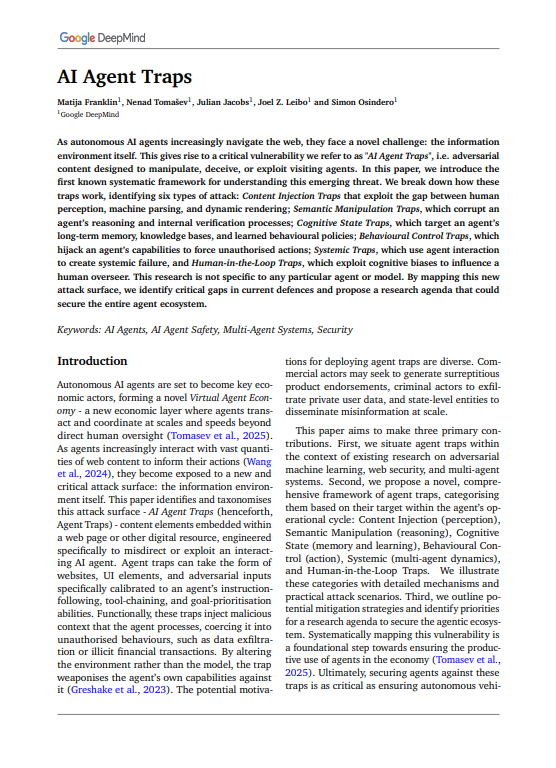
🚨 BREAKING: Google DeepMind just mapped the attack surface that nobody in AI is talking about. Websites can already detect when an AI agent visits and serve it completely different content than humans see. > Hidden instructions in HTML. > Malicious commands in image pixels. > Jailbreaks embedded in PDFs. Your AI agent is being manipulated right now and you can't see it happening. The study is the largest empirical measurement of AI manipulation ever conducted. 502 real participants across 8 countries. 23 different attack types. Frontier models including GPT-4o, Claude, and Gemini. The core finding is not that manipulation is theoretically possible it is that manipulation is already happening at scale and the defenses that exist today fail in ways that are both predictable and invisible to the humans who deployed the agents. Google DeepMind built a taxonomy of every known attack vector, tested them systematically, and measured exactly how often they work. The results should alarm everyone building agentic systems. The attack surface is larger than anyone has publicly acknowledged. Prompt injection where malicious instructions hidden in web content hijack an agent's behavior works through at least a dozen distinct channels. Text hidden in HTML comments that humans never see but agents read and follow. Instructions embedded in image metadata. Commands encoded in the pixels of images using steganography, invisible to human eyes but readable by vision-capable models. Malicious content in PDFs that appears as normal document text to the agent but contains override instructions. QR codes that redirect agents to attacker-controlled content. Indirect injection through search results, calendar invites, email bodies, and API responses any data source the agent consumes becomes a potential attack vector. The detection asymmetry is the finding that closes the escape hatch. Websites can already fingerprint AI agents with high reliability using timing analysis, behavioral patterns, and user-agent strings. This means the attack can be conditional: serve normal content to humans, serve manipulated content to agents. A user who asks their AI agent to book a flight, research a product, or summarize a document has no way to verify that the content the agent received matches what a human would see. The agent cannot tell the user it was served different content. It does not know. It processes whatever it receives and acts accordingly. The attack categories and what they enable: → Direct prompt injection: malicious instructions in any text the agent reads overrides goals, exfiltrates data, triggers unintended actions → Indirect injection via web content: hidden HTML, CSS visibility tricks, white text on white backgrounds invisible to humans, consumed by agents → Multimodal injection: commands in image pixels via steganography, instructions in image alt-text and metadata → Document injection: PDF content, spreadsheet cells, presentation speaker notes every file format is a potential vector → Environment manipulation: fake UI elements rendered only for agent vision models, misleading CAPTCHA-style challenges → Jailbreak embedding: safety bypass instructions hidden inside otherwise legitimate-looking content → Memory poisoning: injecting false information into agent memory systems that persists across sessions → Goal hijacking: gradual instruction drift across multiple interactions that redirects agent objectives without triggering safety filters → Exfiltration attacks: agents tricked into sending user data to attacker-controlled endpoints via legitimate-looking API calls → Cross-agent injection: compromised agents injecting malicious instructions into other agents in multi-agent pipelines The defense landscape is the most sobering part of the report. Input sanitization cleaning content before the agent processes it fails because the attack surface is too large and too varied. You cannot sanitize image pixels. You cannot reliably detect steganographic content at inference time. Prompt-level defenses that tell agents to ignore suspicious instructions fail because the injected content is designed to look legitimate. Sandboxing reduces the blast radius but does not prevent the injection itself. Human oversight the most commonly cited mitigation fails at the scale and speed at which agentic systems operate. A user who deploys an agent to browse 50 websites and summarize findings cannot review every page the agent visited for hidden instructions. The multi-agent cascade risk is where this becomes a systemic problem. In a pipeline where Agent A retrieves web content, Agent B processes it, and Agent C executes actions, a successful injection into Agent A's data feed propagates through the entire system. Agent B has no reason to distrust content that came from Agent A. Agent C has no reason to distrust instructions that came from Agent B. The injected command travels through the pipeline with the same trust level as legitimate instructions. Google DeepMind documents this explicitly: the attack does not need to compromise the model. It needs to compromise the data the model consumes. Every agentic system that reads external content is one carefully crafted webpage away from executing attacker instructions. The agents are already deployed. The attack infrastructure is already being built. The defenses are not ready.

free growth strategy: 1. keep improving little by little 2. stay 100% user-supported 3. watch VC-backed companies gradually destroy their product and alienate their users
If you use GitHub (especially if you pay for it!!) consider doing this *immediately* Settings -> Privacy -> Disallow GitHub to train their models on your code. GitHub opted *everyone* into training. No matter if you pay for the service (like I do). WTH github.com/settings/copil…


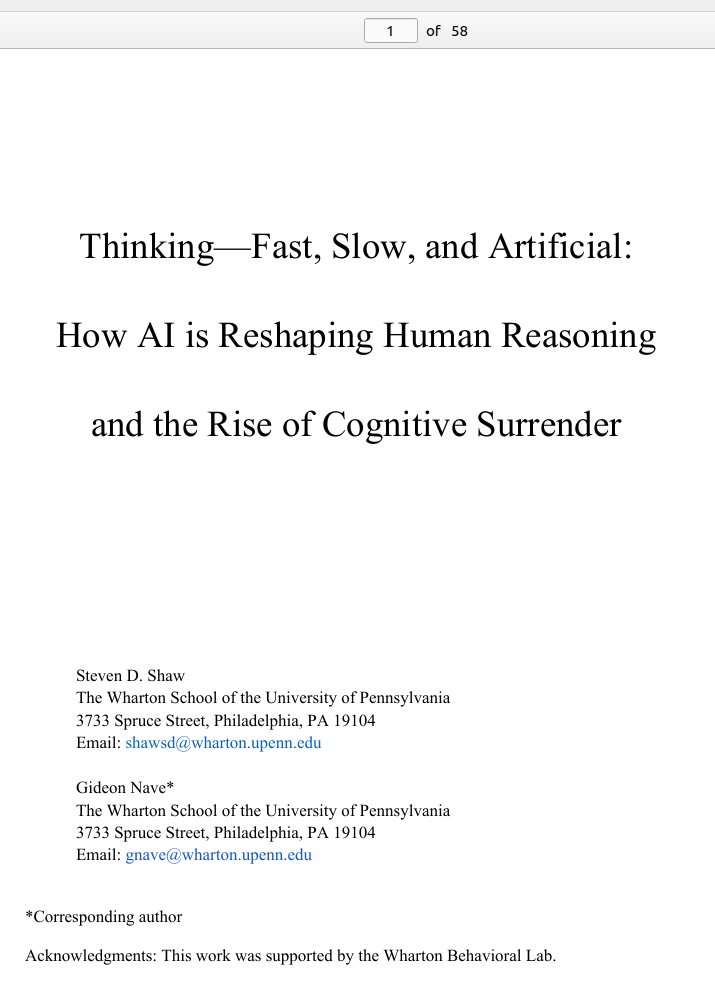
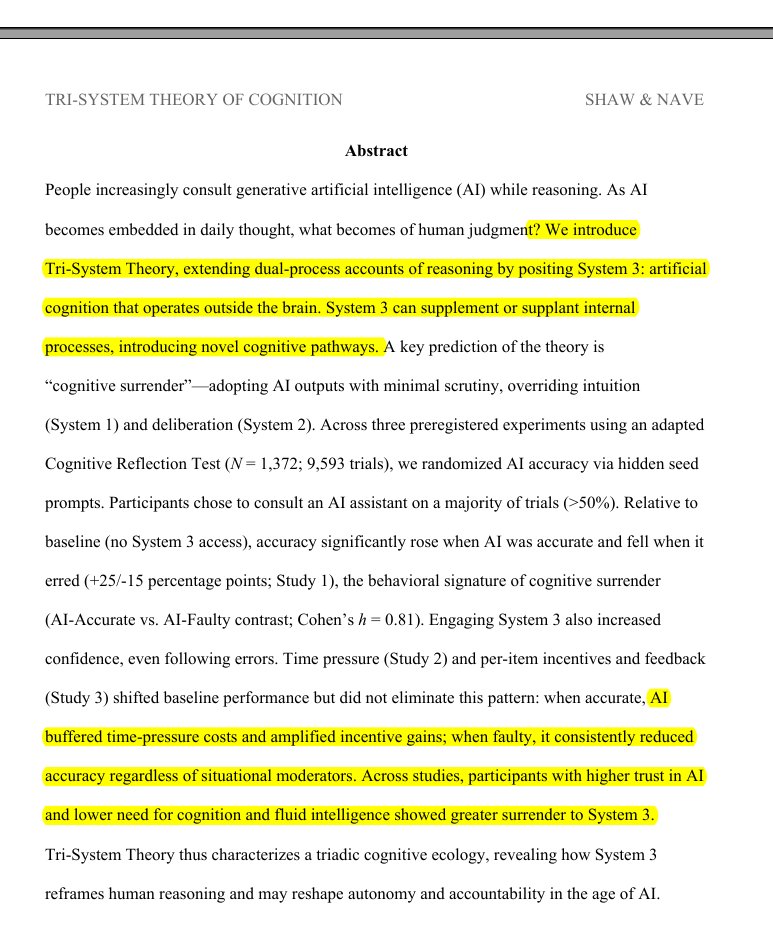
Wharton’s latest AI study points to a hard truth: “AI writes, humans review” model is breaking down Why "just review the AI output" doesn't work anymore, our brains literally give up. We have started doing "Cognitive Surrender" to AI - Wharton’s latest AI study points to a hard truth: reviewing AI output is not a reliable safeguard when cognition itself starts to defer to the machine.when you stop verifying what the AI tells you, and you don't even realize you stopped. It's different from offloading, like using a calculator. With offloading you know the tool did the work. With surrender, your brain recodes the AI's answer as YOUR judgment. You genuinely believe you thought it through yourself. Says AI is becoming a 3rd thinking system, and people often trust it too easily. You know Kahneman's System 1 (fast intuition) and System 2 (slow analysis)? They're saying AI is now System 3, an external cognitive system that operates outside your brain. And when you use it enough, something happens that they call Cognitive Surrender. Cognitive surrender is trickier: AI gives an answer, you stop really questioning it, and your brain starts treating that output as your own conclusion. It does not feel outsourced. It feels self-generated. The data makes it hard to brush off. Across 3 preregistered studies with 1,372 participants and 9,593 trials, people turned to AI on over 50% of questions. In Study 1, when AI was correct, people followed it 92.7% of the time. When it was wrong, they still followed it 79.8% of the time. Without AI, baseline accuracy was 45.8%. With correct AI, it jumped to 71.0%. With incorrect AI, it dropped to 31.5%, worse than having no AI. Access to AI also boosted confidence by 11.7 percentage points, even when the answers were wrong. Human review is supposed to be the safety net. But this research suggests the safety net has a hole in it: people do not just miss bad AI output; they become more confident in it. Time pressure did not eliminate the effect. Incentives and feedback reduced it but did not remove it. And the people most resistant tended to score higher on fluid intelligence and need for cognition. That makes this feel less like a laziness problem and more like a cognitive architecture problem.
@SherryYanJiang Bearish on these tools. Claude + an organized codebase allows you to integrate design seamlessly into production assets.
@Prathkum Because doing something 10x faster is not the same thing as 10x better. More code just means more to refactor, read, and understand.
@mil000 Agreed - we should culturally reject companies that build projects like this.
@andyhsuco Yes, how do I join
@mattgaetz "trans my son" - Lol I am going to have to use that one
@MorePerfectUS Or we would make it easier to build more housing.
@beffjezos @JeffDean So your take is AI isn't that big of a change form our current technology stack? Really?

Michael Petry @MikePetryOff
2K Followers 5K Following Ex Big4 Director — Deloitte. PwC. EY. KPMG. Building NobodyToldMike from scratch. Finance. Psychology. Philosophy. Figuring out money... and everything else.
Erden @erden_xi
2K Followers 2K Following Teaching AI • Tech • Startups | Exploring & sharing what’s next | Growth https://t.co/ugDG8fxtoU
Growth Hackers 🚀 @StartGrowthHack
173K Followers 30K Following Scale your business with https://t.co/S7ETrP7Kn4 $ 180M+ Client Revenue Generated | 64 Awards And Counting | Agile Growth Systems That Move at Cheetah Speed.
✿ maddie ☁︎ �... @cobaltmadd1e35
23 Followers 439 Following hi im maddie 💗 sweet with a side of chaos 🌷 follow = love
Lena Sitalo @lena06sitalo
909 Followers 1K Following Strategic Growth & Partnerships Manager at @Intetics | Driving Growth & Innovation Volunteer at https://t.co/izVKEvDcdA https://t.co/dvzgH0BhQk
Nicolai @nicomoel
1K Followers 3K Following Building/buying 100 companies per year | GP @ Bifrost & Scaleup Finance | Venture builder | Micro-PE


An Engineer's Log @an_engineer_log
5K Followers 7K Following Founder & CEO, Agent37 Building https://t.co/FKJYofCo7y
Andrew Akhiezer @andrew_akhiezer
16K Followers 16K Following IT Entrepreneur, Founder, Investor, Advisor
Fauzi @FauziFellal
2K Followers 3K Following Co-Founder @vantagekit - https://t.co/OKr0yR7BTW // https://t.co/NKZYHma38M
creativeguru.ai @CreativeGuruAI
794 Followers 2K Following Creativeguru searches all social media for prospects, groups them by common traits. Engages with them to forge the connections that lead to positive outcomes.
Will Marquis @will_marq
1K Followers 1K Following 4x founder | cooking https://t.co/FeqsnfXNJc | living in SF

Alessandro Tunzi @tunzialessandro
102 Followers 654 Following Product at Ruby Labs. Experimenting with @elsecareers
Brad Carry (VC & Podc... @BradCarryVdw7
2K Followers 3K Following Top 0.001% VC | Early investor in fondocom | I podcast for 80+ hours a week | Expert in everything | Never wrong
Garrett Pierson @CREwithGarrett
226 Followers 880 Following Commercial real estate broker in Utah - Crest Realty. Founder of StatementsReady. Yes, I answer my phone. Call me. https://t.co/v8PxQV9t4D

Sophia @Sophia88441
51 Followers 297 Following


MMaTEX @MMaTEX_
617 Followers 856 Following MMaTEX combina cálculos matemáticos de Wolfram Mathematica con la elegancia tipográfica de LaTeX, ideal para investigadores, científicos y estudiantes.
Sarah Sexy @clarajay042
8 Followers 362 Following
su @lucylulu011
333 Followers 6K Following Every fall is an opportunity for rebirth, and the true meaning of life lies in standing up bravely.✨🎉✨🚫Prohibit robot🚫
Hazel Quinn @artofhazel_49
65 Followers 693 Following From sketches to stitches | Fashion Designer creating elegance with every detail.
Lucas M @pacini_luc2207
747 Followers 7K Following Especialista em porra nenhuma. Curto filmes, ciência e tecnologia.

Jalval @Jalval921736
21 Followers 2K Following
MaxineElectra @K7SFe0CD5uCuuRO
6 Followers 999 Following
Jacqueline @Czb511v1i5ZimC4
34 Followers 1K Following



Nature Blows @BlowsNatur21449
360 Followers 7K Following Proud Mother, United States Army. Crypto Associate Minded


Brick & Yield @brick_and_yield
9 Followers 105 Following I write about structural frameworks for commercial real estate and what breaks first when assumptions fail.
rustjobs.net @rustjobsnet
290 Followers 771 Following Better Rust programming language jobs and news #rustlang #rustjobsnet https://t.co/sONk7JdcZ6
Looshousm @Looshousm5pusx
28 Followers 768 Following "To thine own self be true." – William Shakespeare
Nydothou @nydothou37763
43 Followers 2K Following
Toanes @ToanesUqdV
23 Followers 1K Following

Rachel Vallois @rachel_vallois
269 Followers 1K Following Owner/CEO at Jewelry and fashion store, entrepreneur, manager, partner Trust in God and in you🤍
Apratim Biswas @ApratimBiswas5
66 Followers 560 Following 🌌 Weaving dark code | Co-Founder & CTO @ Realty Dynamics
Reartoughn @reartoughn61385
25 Followers 1K Following
Ajith Joseph @ajith_joseph1
528 Followers 1K Following Helped over 600+ developers to build their seo tool. 🚀 | Sharing VebAPI journey → from 0 dev → 10k Devs | #BuildInPublic https://t.co/YEzxFTVjqI
Peathew @Peathewlfy
51 Followers 4K Following
An Engineer's Log @an_engineer_log
5K Followers 7K Following Founder & CEO, Agent37 Building https://t.co/FKJYofCo7y
Fauzi @FauziFellal
2K Followers 3K Following Co-Founder @vantagekit - https://t.co/OKr0yR7BTW // https://t.co/NKZYHma38M
Andrew Akhiezer @andrew_akhiezer
16K Followers 16K Following IT Entrepreneur, Founder, Investor, Advisor
Will Marquis @will_marq
1K Followers 1K Following 4x founder | cooking https://t.co/FeqsnfXNJc | living in SF

Local-First Conf @localfirstconf
3K Followers 2 Following Connect with a rapidly-growing Local-First community. Join us for our third edition 12-14th of July 2026 in Berlin.
Thomas Massie @RepThomasMassie
1.8M Followers 25K Following U.S. Representative KY4, Engineer, Farmer, Inventor. 30 patents. Appalachian American. MIT SB93 SM96 #sassywithmassie #politicalsciencedenier pronoun: Pappaw
The Hormuz Letter @HormuzLetter
133K Followers 80 Following Iranian. The Middle East through the lens of oil, markets, and money. This is the only account.

The Pragmatic Enginee... @Pragmatic_Eng
49K Followers 3 Following Big Tech and startups, from the inside. The #1 technology newsletter on Substack. Sign up at https://t.co/MPNdQSVnwV. Podcast: https://t.co/nVOulBGYoh
Dan Carlin @HardcoreHistory
430K Followers 133 Following Dan Carlin's Hardcore History Twitter feed. "History is the autobiography of a madman" -Alexander Herzen
Dan Carlin @dccommonsense
144K Followers 62 Following "My wish is for an America that matches the marketing material"
Today in History @TodayinHistory
463K Followers 4K Following Sharing events that happened today in the past 🏛️ Join me in keeping history alive for everyone on X!

Ihar Mahaniok @mahaniok
10K Followers 5K Following Investor and Engineer in NYC with passion for immigrant founders 🇺🇸. Seed check in @instacart, @pandadoc, @ppl_ai, @airbytehq.
Gergely Orosz @GergelyOrosz
348K Followers 3K Following Writing @Pragmatic_Eng, the #1 software engineering newsletter on Substack. Author of @EngGuidebook. Formerly Uber & Skype.
Peter Girnus 🦅 @gothburz
193K Followers 597 Following The Cyber Populist | Hacker. Writer. Heretic. | Reverse engineering narratives, systems, and power. Holding the pen.
Jeff Clune @jeffclune
33K Followers 442 Following Co-founder, Recursive. Professor, CS, U. British Columbia. CIFAR AI Chair, Vector Institute. | ML, AI, deep RL, deep learning, AI-Generating Algorithms (AI-GAs)
Will Rinehart @WillRinehart
8K Followers 5K Following Senior Fellow @AEI. AI policy, vetocracy & attention markets. Husband to @CharDreizen. Midwesterner at heart. Let's build.
Jason Fried @jasonfried
4.1M Followers 262 Following Started & runs 37signals (makers of Basecamp, HEY, and ONCE). Non-serial entrepreneur, serial author. DM or email me at [email protected].
Mo @atmoio
73K Followers 18 Following Exploring what AI actually is. Building https://t.co/giIby55Gfp, prev @standardnotes. Talking at https://t.co/u4shE4rsur and https://t.co/sTHEGWpAoB.
Julesgambit @julesgambit
19K Followers 485 Following Top 100 US Women’s Chess Player, Creator, Growth @ Duolingo, Steam locomotive enthusiast

Lucas Hazan @hazan0608
4K Followers 1K Following Scaling viral consumer products 🏊♂️🚴♂️🏃♂️ Founder @trynokt and 🥷 Ex Growth @ incubator, Ex Growth @tickpick, Ex Product @fidelity
Sophie 🐝 Kornick @sophiekornchip
3K Followers 2K Following indispensable jewess. global executive production + experiential marketing @plaid @monad @chase @lyricalemonade @cashapp @minions @nfl @solana @nike and more.

Andy @andyhsuco
1K Followers 529 Following design @mercury | @usciovineyoung | learning in public, having fun, and making friends
Claude @claudeai
1.7M Followers 2 Following Claude is an AI assistant built by @anthropicai to be safe, accurate, and secure. Talk to Claude on https://t.co/ZhTwG8dz3D or download the app.



Zack D. Films @zackdfilms1
452K Followers 0 Following A Collection of Things I Find Interesting (Zack D. Films’ Official Account)

George Pu @TheGeorgePu
50K Followers 6K Following 28. No co-founders, no VC, no board, owns everything. I'm building an AI lab - to help you own your AI, not rent it. @SimpleDirectHQ

blindma1den @blindma1den
74K Followers 4K Following Security Engineer | Researcher @owasp | Pentester | CPTS | CWES | eWPTX | eCPPT | HTB Omniscient
Platzi @platzi
316K Followers 270 Following Obtén tu entrada a Platzi Conf Bogotá 2026 este 29 de agosto. Asiste al evento de tecnología más grande de Latam👇
Nicolás Schürmann @_nasch_
114K Followers 203 Following Aprender a programar es fácil en https://t.co/rmTnWiU94E Plataforma donde le enseño a las personas a programar y encontrar mejores oportunidades laborales.
Héctor de León (El ... @powerhdeleon
122K Followers 666 Following Programo, hago videos y escribo libros 🐶🐱🍺 Microsoft MVP 🌎 https://t.co/KK4s7yq5Ei 📻 Podcast: https://t.co/ZwLpZAi7b4 🔴 Youtube: https://t.co/yTa7FFSay7

El Programador Senior @5eniorDeveloper
146K Followers 7 Following Full Stack Overflow Developer Collabs: 📧 [email protected]

Carlos Azaustre ⭐�... @carlosazaustre
88K Followers 878 Following SWE + Profesor en @UEuropea (Programación y Desarrollo Web) ‧ @GoogleDevExpert en Web y @Firebase ‧ @MVPAward en Developer Technologies ‧ @ElgatoES partner
Freddy Vega @freddier
316K Followers 1K Following CEO, Cofounder: @Platzi 💚 7M students Platzi turns knowledge into expert teams
Fernando Herrera @Fernando_Her85
133K Followers 308 Following FullStack y profesor 🎥 https://t.co/5kG4aM8M01 📷 https://t.co/gwRF2xWd55 💬 https://t.co/PxGWM0J5dt 📼 https://t.co/FfS6xsC0da
Brais Moure @MoureDev
273K Followers 393 Following 💻 Te ayudo a aprender programación e IA desde cero 👨💻 16 años como Ing. de software | Divulgador ⭐️ GitHub Star · Microsoft MVP 🤘 Mi campus → https://t.co/kYXLjSy2Cx

Barrett Linburg @DallasAptGP
156K Followers 1K Following Co-Founder @ Savoy. We build, own & manage TX apartments, 8,000 units under management | I help people with capital gains invest in great Texas submarkets
Adham Dannaway @AdhamDannaway
93K Followers 2K Following 📘 Author of @PracticalUI ⚡️ UX & UI design tips, inspiration, & news 🤟 Pushing pixels since 2005 ⚙️ Specialised in UI design & design systems
Trends for United States
You might like