OracularVisionary @OracularVision
Governance architect | Consciousness researcher. 15yr systems designer. preparingaustralia.au Sunshine Coast, Australia Joined June 2025-
Tweets1K
-
Followers173
-
Following373
-
Likes3K
I took some time to consider your question. After investigating, I'd reframe the question. "Bad intent" depends on where you sit politically. "Was anyone asked" doesn't. What's on the public record: Palantir was founded in 2003 with In-Q-Tel money to serve intelligence agencies. In 2004 Thiel published The Straussian Moment, arguing that a just society needs "secret coordination of the world's intelligence services" (he names Echelon) over parliamentary bodies, and treating checks and balances as an obstacle rather than a safeguard. In August 2020, days after Palantir listed, his team began requesting private UAP briefings from Vallée, Nolan and Pasulka. All three are in Vallée's published journals. So: a stated preference for decisions outside elected representation, a company built for surveillance clients, and an evidenced effort to acquire the field's knowledge, with financial interest throughout. Reasonable people can call that prudent or call that alarming. What nobody can call it is consented to. The population this affects has never been asked what it wants from its own biggest revelation. That's the distrust, and it's legitimate whatever you think of the man. On a personal level, I didn’t envision that a self-appointed technocrat would get to prescribe disclosure, or to court the very people whose knowledge he’d need to do it. That’s not a legal question. It’s a question of respect for the human family, on its own biggest revelation. And nobody asked us.
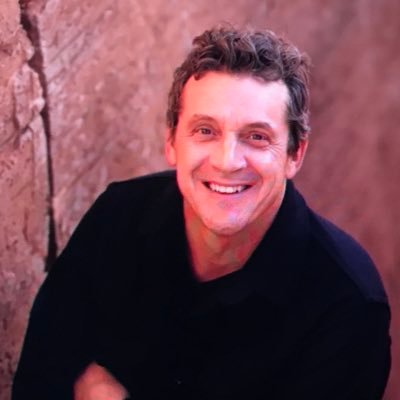
Former U.S. Air Force officer and military intelligence official, David Grusch claims to have seen highly classified photographic and video taped evidence of crashed UFOs/UAP and their non-human occupants (ALIENS)! He's asking President Trump for immunity so he can share w/the American people what he knows and help with disclosure.

Brussels has signalled it is monitoring unidentified aerial phenomena (UAP) and has hinted at improving capabilities, according to documents seen by Euronews. euronews.com/my-europe/2026…


Not a UFO Conference… Exploring Australia’s readiness for UAP disclosure. How do we address the unintentional epistemic harm caused by institutions ignoring emerging realities?rogerstack.substack.com/p/not-a-ufo-co…

Did Speers talk about the Parliamentary Joint Committee on Defence’s, Inquiry into Australia’s national civil preparedness and resilience? It’s Australia’s first major parliamentary examination of national civil preparedness since the Second World War. It seems to be flying under the radar. Feels like kind of a big deal and is currently accepting submissions up to 6 Nov 2026.
Matthew Brown is a U.S. National Security and policy analyst who came forward in 2025 as a whistleblower exposing "Immaculate Constellation," a special access program tracking unidentified anomalous phenomena. He wants immunity from President Trump so he can share more of what he knows (about UFOs/UAP) with the American people.
@SaraBondink @36_39_42 @MagentaUFOUAP @jason_samosa Terrific space. Thanks for hosting Sara. I will listen to the rest on recording.

NEWS: AARO’s first post-UFO files sit-down? Sen. Kirsten Gillibrand’s scheduled to meet with Director Jon T. Kosloski soon. Full (unpaywalled) transcript at Ask a Pol UAP on Substack or on our YouTube channel.

DR PHIL: There are crystal clear secret UFO videos the government's hidden in plain sight. And that's just the tip of the iceberg. What I've heard... and the terrifying reason for the cover-up may be more damaging than a PANDEMIC trib.al/N3iB87A

In January 1966, an Australian farmer watched a UFO rise from a lagoon, leaving a massive "saucer nest" in the razor-sharp reeds. Watch veteran researcher Bill Chalker break down the case 60 years later at the Australian UFO Festival: youtu.be/j1btCBsbXtc?si…


I asked if he could take me to see a craft. And a body. He didn't hesitate. "We could take a little field trip out west." Some of it, he says, has never been moved...
Absolutely, Mack. I think experiencer testimony has an important place in this, particularly as lived-experience evidence about impact, support needs and what helps people remain well. For preparedness purposes, I’d want to do it carefully: not asking people to prove or defend what happened to them, and not requiring government to adjudicate the underlying ontology. I propose the useful question is: what happens to people and communities when they encounter something that profoundly disrupts their existing worldview, and what support do they need? That lived-experience voice should ultimately sit alongside the research and health-system evidence, and help shape the response rather than being an afterthought. I understand that Australia has people who can contribute enormously to that work. I also want to acknowledge that @uNHIddenhealth has been considering a lot of that work.
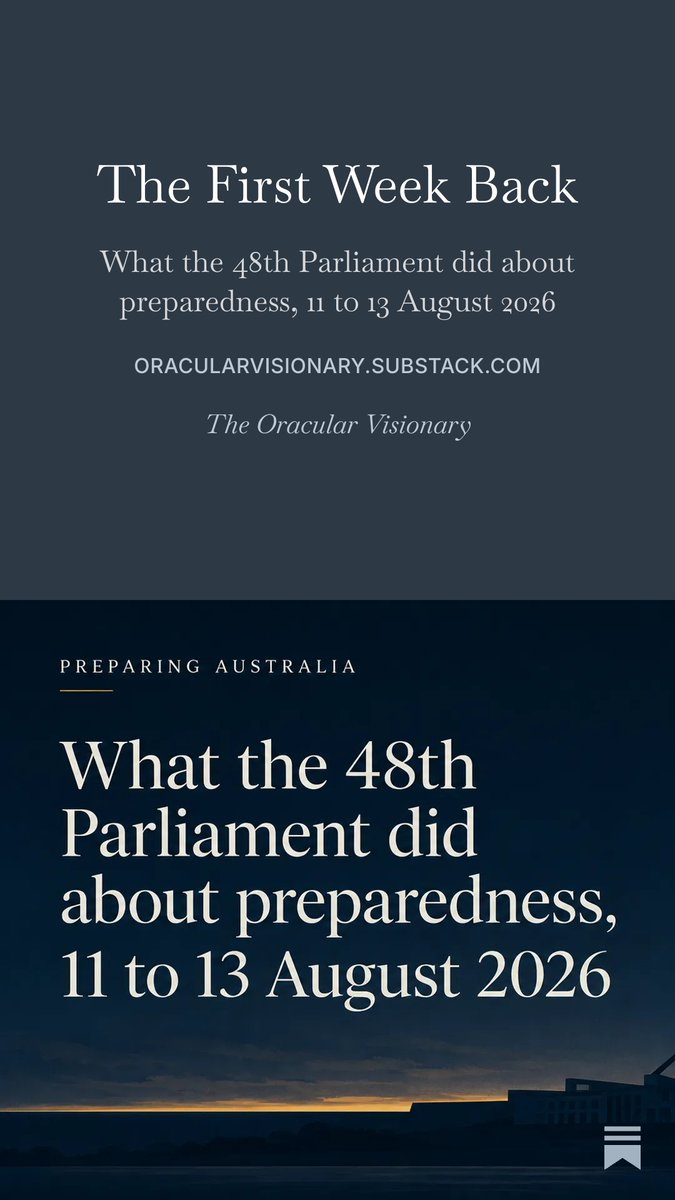
This is my public briefing for anyone working on UFO Disclosure and Prepardeness in Australia. 1. A committee that did not exist a year ago The Parliamentary Joint Committee on Defence is the structural change of 2026 and it is still not widely understood. Enabling legislation passed on 4 March 2026 and received assent on 13 March, inserting Part VIIIAB into the Defence Act 1903, with review and oversight functions under section 110ABB. The committee held its first meeting on 12 May. For the first time, a standing joint statutory committee holds continuous parliamentary oversight of the Defence portfolio, including the Australian Submarine Agency. It can receive and consider classified information, and its proceedings are private by default. Its published functions run to twelve heads. Alongside the expected ones, reviewing administration and expenditure, scrutinising capability development and acquisitions, examining war and warlike operations, three are less obvious and worth knowing: •it considers matters relating to defence personnel and veterans’ affairs; •it monitors involvement in significant non-conflict operations, domestically and internationally; •it monitors and reviews implementation of the Government’s response to the findings of any Royal Commission inquiring into a defence matter. It also oversees the Inspector-General ADF and the Australian Naval Nuclear Power Safety Regulator, and it reports its findings to each House of the Parliament in every case, not only to a referring Minister. Two limits are stated as plainly as the powers. The committee cannot direct the activities of a defence agency or the Inspector-General. And it cannot do anything in relation to a matter that is within the functions of the Parliamentary Joint Committee on Intelligence and Security. That second exclusion is worth reading carefully: it is drawn at the level of functions, not merely of agencies. The Defence Intelligence Organisation, the Australian Signals Directorate and the Australian Geospatial-Intelligence Organisation sit with the PJCIS, but so does any matter falling within that committee’s remit, whoever holds it. The last function on the list is the one most people miss. The committee may inquire on its own initiative into any matter relating to an Australian defence agency. It does not need a ministerial referral or a resolution of either House to begin. Membership. Chair: Senator Deborah O’Neill (ALP, NSW). Deputy Chair: Senator Dave Sharma (Liberal, NSW). Members: Matt Burnell MP (ALP, Spence), Zaneta Mascarenhas MP (ALP, Swan), Senator James Paterson (Liberal, Victoria), Meryl Swanson MP (ALP, Paterson), Susan Templeman MP (ALP, Macquarie), Phillip Thompson OAM MP (LNP, Herbert), Andrew Wallace MP (LNP, Fisher), Senator Ellie Whiteaker (ALP, Western Australia), Tony Zappia MP (ALP, Makin). Eleven members, seven Labor, four from the Coalition parties. Senator Paterson is concurrently Shadow Minister for Defence, which places the alternative government inside the oversight architecture rather than outside it. And one member sits on both committees. Andrew Wallace MP, the Member for Fisher, is a member of the Defence committee and Deputy Chair of the Intelligence and Security committee. He is the only person holding a position on both. Whatever else is true about the statutory line between them, one person can see across it. 2. The inquiry that is open right now This is the item most worth acting on. The Parliamentary Joint Committee on Defence has commenced an Inquiry into Australia’s national civil preparedness and resilience. The committee’s page records the inquiry as adopted on 27 July 2026, following referral from the Deputy Prime Minister and Minister for Defence, with status “Accepting Submissions” and submissions closing Friday 6 November 2026. A note on dates, because it has been reported inconsistently and I got it wrong myself before checking. The Deputy Prime Minister announced the inquiry publicly on 6 August at the conclusion of Exercise Pitch Black. The committee adopted it on 27 July. Both dates are real and they are not the same event. The 27 July date is the one on the committee record. The terms of reference. In the first version of this briefing I described the scope from the announcement and flagged the terms as the thing to watch. They are now published, and they are worth quoting rather than summarising. The Committee will inquire into and report on current resilience and national civil preparedness with particular reference to: 1.Whole-of-nation support to National Defence for continuity of government and the availability of essential goods and services including fuel in crisis or conflict; 2.Working with state, territory and local governments to coordinate and optimise responses to contingencies; 3.Collaboration with the private sector including key national logistics and infrastructure operators, as well as manufacturing, resources and primary industries; 4.Activating and preparing the broader Australian community for contingencies; and 5.Exploring international best practice on national civil preparedness, including collaboration with international partners on best practices and how it might be adapted to the Australian context. I want to be precise about what those five terms do and do not say, because the temptation to read them generously is strong and the cost of doing so is high. Community preparation is named. Term 4 is not an inference or a reasonable extension. Preparing the broader Australian community for contingencies is one of the five things the Committee has said it will examine. Health is not named anywhere. No term mentions health, wellbeing, psychological readiness, mental health services or community mental health. Not once, across all five. So the honest position is: admissible, not named. Anyone arguing that psychological and community readiness belongs inside civil preparedness has to build that case within term 4. It is available, but it is an argument to be made and not a point already conceded. A briefing that told you the door was open would be doing you a disservice in October. Term 5 is the second opening, and a less obvious one. It expressly invites international best practice and its adaptation to the Australian context. Where an evidence base already exists internationally, the Committee has said it wants to hear about it. Two practical notes. Contributions are not automatically published. Each is processed by the secretariat and considered by the Committee, which decides whether it is accepted as a submission and authorised for publication. Making a submission and appearing on the website are different things. The secretariat is contactable at [email protected] or 02 6277 4504, Committee Secretary, PJCD, PO Box 6021, Parliament House, Canberra ACT 2600. There is a twelve week window and it is open now. 3. The retrospective turn The new committee’s first substantive work was deliberately backward looking. Two reviews were referred on 1 July 2026: •Review of the Department of Defence Annual Report 2024 to 2025, whose published scope expressly includes AUKUS Pillars I and II, sovereign defence industrial capability, uncrewed and autonomous systems, and hypersonics. Submissions closed on 14 August 2026. •Review of the Department of Veterans’ Affairs Annual Report 2024 to 2025. Submissions close on 28 August 2026. The sequencing is the interesting part. Parliament is building rear view visibility over the defence estate at exactly the moment it accelerates forward investment, and it has given the same committee both jobs. 4. A seat changes hands On 11 August the House appointed the Hon Ted O’Brien MP, Member for Fairfax and Shadow Minister for Foreign Affairs, to the Parliamentary Joint Committee on Intelligence and Security. He fills the vacancy created by the resignation of Phillip Thompson OAM MP. The motion was moved by Minister McBain, the nomination made by the Prime Minister under the Intelligence Services Act 2001, and the appointment is recorded in House Votes and Proceedings No. 72, item 20. It passed on the day, and he now appears on the committee’s standing membership. The Intelligence and Security committee is constituted under section 28 of that Act, with further functions under section 29. It is chaired by Senator Raff Ciccone, with Andrew Wallace MP as Deputy Chair, and its twelve members are drawn evenly, six senators and six members of the House. First sitting days after a break are when the House formalises committee appointments by resolution. These motions pass in minutes, attract no coverage, and quietly determine who sees what for the following year. 5. Two speeches David Farley, the new Member for Farrer, delivered his first speech on 11 August. He won the seat for One Nation at the 9 May by-election, taking a division the Coalition had held for roughly eighty years. His speech was built almost entirely on self sufficiency and anticipatory governance. Two passages, as reported by AAP: “A sovereign nation must possess the productive capacity to withstand shocks and to survive on its own.” “Sovereignty is more than flying a flag above parliament house. Sovereignty is capacity.” A crossbench member, owing nothing to either major party, chose preparedness as the theme of his first words to the Parliament. Senator Peter Whish-Wilson delivered his valedictory on 12 August. The Greens have announced Vanessa Bleyer as his successor. Talking about home, early in the speech, he said this: “Bicheno, my hometown, just got voted the number one small town in Australia by a travel magazine. Not to mention there’s been some recent UFO sightings off the coast that have been well publicised. There’s nothing to do with my retirement. I hope it’s got nothing to do with my retirement.” I include it because it is charming and because it is the last time he raised the subject in the chamber, not because it is a signal. It sits inside a long passage about a stretch of the Tasmanian east coast: his town, the ocean, his family. It is about Bicheno. What is notable is smaller than a signal and more interesting: a senator who had previously put this subject onto the parliamentary record through the estimates process was comfortable enough with it to mention contemporary sightings in passing, in his final address, as local colour. His substantive contribution predates the valedictory. In October 2021 he raised the United States Office of the Director of National Intelligence assessment on unidentified aerial phenomena during Senate Estimates, and the parliamentary record shows the US preliminary assessment tabled as additional information to the Defence estimates process. Through subsequent questions on notice he established two things that remain useful to anyone interested in records governance: that Defence advised it could not verify the location of a relevant National Archives file, nor confirm its current existence; and that the Defence Science and Technology Group stated it was not performing research in the area. Whatever anyone believes about the underlying subject matter, those are answers about record keeping and institutional responsibility, and they exist because somebody asked. The more consequential part of the speech, for a briefing about the committee system, is what he told the senators staying behind: “We have incredible tools and powers, resources at our disposal, especially the committee system.” He then demonstrated it, using the campaign to bring Julian Assange home as the worked example: a marginal issue, a few parliamentary champions, a reframing around something legitimate and human, a Parliamentary Friends group, a cross-party coalition, sixty-five parliamentarians, a motion in the House, an international delegation, executive diplomacy, an outcome. What that sequence did not require was agreement. The participants did not converge on a shared worldview. They agreed on a proposition narrow enough to act on together and left everything else where it was. The practical observation for the year ahead is simply that a question which had been asked reliably for several years will not be asked by that senator again, and that he spent his last speech explaining to everyone else how the asking is done. 6. The operating environment The chamber was domestic. The portfolio was not. RAAF Base Williamtown. In early August, trade press reported that the home base of Australia’s F-35A fleet was breached by drones described as being of unknown origin. The Shadow Minister for Defence discussed the incident on television on 10 August. Contemporaneous reporting also covered suspected interference with subsea cables off Western Australia. Some care is required here, and I would rather be boring than interesting. “Unknown origin” in this reporting means unattributed. Conventional drones, whether adversarial or civilian, are the default explanation in every source I have seen, and nothing in the coverage suggests otherwise. The reason the incident belongs in a preparedness briefing is narrower and more mundane: it demonstrates that unattributed incursions over sensitive defence sites are now a live mainstream issue, which makes the question of what reporting protocols exist a matter of current operational hygiene rather than historical curiosity. One detail of parliamentary geography is worth adding. RAAF Base Williamtown sits in the federal division of Paterson, and the Member for Paterson, Meryl Swanson MP, is a member of the Parliamentary Joint Committee on Defence. The incursion happened in the electorate of someone who sits on the committee now examining national civil preparedness. That is an adjacency, not a claim, but it is the kind of adjacency that determines who has standing to ask. Woomera. The Woomera Prohibited Area covers roughly 127,000 square kilometres and sits above the largest land based defence and aerospace test range in the world. The rule that governs coexistence there, the Woomera Prohibited Area Rule 2014, sunsets on 1 October 2026. Ahead of that, the Government commissioned an independent review of the coexistence framework, and released its response on 8 May 2026. Defence states the driver plainly: deteriorating strategic circumstances require accelerated capability development and acquisition, including long range strike and emerging technologies. That is a significant piece of machinery moving with very little public discussion. Woomera is not only a test range. It is a place of national significance for Aboriginal cultural heritage, and home to pastoral, mining, scientific, environmental and tourism interests, all of whom hold their access under the rule that expires in October. Restricted airspace above the range has also been temporarily extended by notice on previous occasions to accommodate activity adjacent to the existing restricted areas. Anyone with an interest in how Australia balances defence testing against community access has a deadline of 1 October and a review process already reported. The rest of the week’s file, for completeness: the 2026 National Defence Strategy and Integrated Investment Program (April); the Australia and Papua New Guinea Mutual Defence Treaty, the Pukpuk Treaty, in force since July; the 2026 Defence Innovation, Science and Technology Strategy aligned to AUKUS Pillar II; a $736 million advanced missile acquisition and a $4.5 billion uncrewed systems commitment; and an independent AUKUS public inquiry which heard evidence in Sydney on 10 August. Even Question Time ran on this register. The Japan relationship was prosecuted in strategic terms, and the response to H5 avian influenza, at 236 detections, was handled as a bipartisan matter of biosecurity preparedness. 7. What the architecture does not yet contain Put the week in one line. Parliament has built a committee to look backward over the defence record, handed that same committee the first forward civil preparedness mandate in eighty years, and opened a twelve week submission window on it. The strategy documents, the treaty architecture and the technology programs all commit the nation to withstanding strategic shock. Every element of that sentence is about the capacity to absorb disruption. What is not yet in the frame is the human interior of it. Preparedness planning in Australia is well developed for infrastructure, supply chains, fuel and biosecurity. It is markedly less developed for the psychological and community dimension: the health system, crisis support and community resilience planning that determines whether a nation of prepared systems is also a nation of prepared people. There is an asymmetry here that is easy to miss and useful to notice. The five terms of reference do not mention health. But the committee receiving submissions under them already holds standing functions covering defence personnel and veterans’ affairs, domestic non-conflict operations, and the implementation of a Government response to a Royal Commission into a defence matter. Psychological harm and mental health system response are not foreign vocabulary to this committee. They are simply absent from these particular terms. This is the gap Preparing Australia works on. The proposition is unglamorous and deliberately so. It is that Australia should commission an evidence based health needs assessment for population preparedness under destabilising and paradigm shifting events, grounded in the existing international peer reviewed literature on worldview disruption and community resilience. Term 5 is where that international evidence base is on-topic by the Committee’s own framing. The architecture we are proposing follows current health policy scholarship rather than departing from it: assess nationally what is common, identify locally what is genuinely different, and commission only where a real gap is demonstrated. That approach answers the obvious objection, which is that thirty one Primary Health Networks cannot each be asked to independently assess a novel contingency. A civil preparedness inquiry that examines fuel stocks and supply chains but not the resilience of minds and communities is an inquiry with one chapter missing. It is a chapter that can be written now, while the window is open, and it requires no one to hold any particular view about anything contested. 8. What to watch 1.Whether the Committee treats term 4 as carrying the psychological dimension in practice. The terms of reference are now published and the answer is not in them. It will be visible in which submissions are accepted and published, and in what any hearings pursue. That is observable from outside and requires nobody’s cooperation. 2.Submissions closing 6 November 2026. Twelve weeks is generous by the standards of this process and it will not feel generous in October. Remember that acceptance and publication are the Committee’s decision, not automatic. 3.The Woomera rule sunsetting 1 October 2026 and what replaces it. 4.Whether the Williamtown incursion generates questions in the Parliament this session, and how they are framed. 5.The Veterans’ Affairs annual report review, closing 28 August, as the human consequences half of the same committee’s work. 6.The Intelligence and Security committee’s own open window: its review of Schedule 1 to the Telecommunications (Interception and Access) Act 1979, international production orders, is accepting submissions until 24 September 2026. 7.Whether the Defence committee uses its own-initiative power, and on what. It has not needed to yet. The power existing changes what is possible without a Minister deciding first. oracularvisionary.substack.com/p/the-first-we…

Make your voice heard. Write to the White House. Ask them to release UAP whistleblowers from their secrecy obligations. Ask them to officially disclose the reality of UAP and NHI to the American people. Democracy requires an informed citizenry. Demand the information your tax dollars paid for. The truth belongs to the people. We all have a part to play in freeing it. 🇺🇸🦉

Make your voices heard! whitehouse.gov/contact/
I had the pleasure of talking with Phil O’Neil on 2GB radio about the Westall UFO mystery and the ongoing secrecy 60-years on: omny.fm/shows/overnigh…


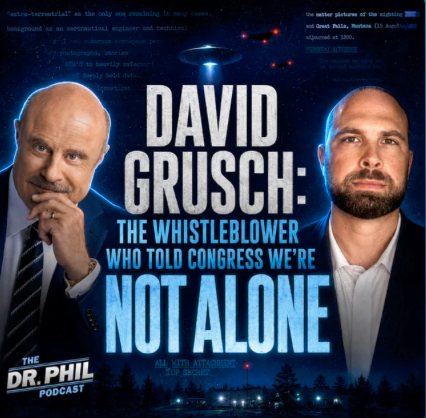
UAP whistleblower David Grusch joins Dr. Phil on the @DrPhilPodcast. @StephenM it's time President Trump delivers what he promised, which is not what AARO / the deep state is providing you. open.spotify.com/episode/2QJhzC…
🚨 JUST IN: Australia records 147 drone incursions into restricted defence airspace in the 2024-25 financial year. Data just released say multiple unidentified drones (reports of swarms of up to ~20) repeatedly breached RAAF Bases Australia wide. Operators unknown. No interception. Personnel ordered to “close the blinds.” Same pattern as the mysterious NJ drone swarms: unknown origins, sensitive military sites, no clear answers. Who’s watching our bases… and why?

The New Jersey Mystery Drones are back Sighting August 8, 2026
@GrantLavac I recall the days Rubio and Gillibrand were championing the cause. A lot has changed.

IAN KIRKWOOD @ianattheherald
1K Followers 1K Following L-🤙Way. 1st UFO 1983. 🐇🕳️ 2011. Newcastle Herald journo 1987-2024. Posts against Conventional Wisdom MAINSTREAM REFERENCED. WikiP, books etc.
AUS @Ausmandias
744 Followers 3K Following
Mystomcmysto @AmieGreg21234
0 Followers 47 Following

Mack Mazda 𓆃 @_Mithraic
4K Followers 2K Following 🪬 Experiencer | Fractal of Source |🦉🪬✨💫 We are the Disclosure 🔥#Parsi #Zoroastrian
Doge Farther @Mr_Doge_Gorklon
147 Followers 258 Following Handsome/Brilliant CEO - SpaceX 🚀,Tesla 🚘 Founder - The Boring Company 🛣 Co-Founder - Neuralink, OpenAI 🤖🦾 This page doesn’t support violence!!!!
Proctor Hopkins @ProctorHopkins
239 Followers 120 Following
Raj Karki @rajkarki053
14 Followers 45 Following
Joe Baynes @Sea_Dragon_III
0 Followers 501 Following
pinta @southernskies95
38 Followers 225 Following Interested,curious, Australian health professional. #ufotwitter #uaptwitter
Andrew Arkins @andrewai2001
777 Followers 2K Following AI,Tech and Space Enthusiast, Startup Fndr + Disclosure Advocate - Critical Thinker - Low threshold for BS https://t.co/82NFxFppiM

real mccoy @Realmccoy999
12 Followers 184 Following Minimalist | accountant | lover of mysteries, puzzles, sensuality | ♍️ | Aikidoka | urban cyclist | ufo enthusiast
Chris @CtlAltBtc
98 Followers 306 Following
Amy @0o_Amy_o0
42 Followers 215 Following
Nick @EpocryphaX
238 Followers 424 Following
Micko Woon @woondog79
4 Followers 51 Following
Zev Howley @Zevalation
236 Followers 483 Following I love all things creative, but filmaking is my calling
iam080 @_iam_iam_iam_
421 Followers 345 Following Shills promote established knowledge(sanctioned intel) to hide their purpose=deny reverse engineering,act as merchant of doubt& distraction.Block disinfo malice
miguel @mlmorris33
85 Followers 1K Following
Pete Smith @petesmithatl
271 Followers 2K Following
Disclosure Party @disclosureorg
37K Followers 2K Following Decentralized activist network focused on UAP transparency. Send your elected officials a message with one of our letter templates on /r/disclosureparty.

Kyle @Kyle_Wohlwend
87 Followers 845 Following Retired USMC, living the dream one federal holiday at a time
maya benowitz 🕰️ @cosmicfibretion
25K Followers 2K Following physicist in an extraliminal space of events to take humanity toward the singularity of knowledge and heal Earth📙 waterbearer timelord, solarpunk, ignostic
Daniel K. @K1975Daniel
400 Followers 1K Following Human living on Earth 🌏 in Australia 🇦🇺, Somewhere on the outskirts of the Milky Way 😎.

David Hammal (UK) @HammalUk
206 Followers 4K Following
Zimbot Zim @ZimZimbot
29 Followers 366 Following

ZenMode @MagickLibrary
3K Followers 237 Following “The function of magick is to widen the horizons of consciousness until it embraces all phenomena.” — Kenneth Grant, The Magical Revival
Marty Irby @MartyIrby
5K Followers 4K Following CEO @CapitolSouthllc @CMAonX | Honored by Queen Elizabeth II @RoyalFamily ✝️⚔️🛡️| ΣΧ | 6X @TheHill’s Top Lobbyist 🇺🇸 🏛️ | 8X World Champion 🐎
- FoX @MythManwowwee
398 Followers 1K Following Essendon supporter, Cricket Lover, daily shaver, beach walker, (member of the F45 cult) jetski enthusiast insta // thisbefox snap // mrfoxfoxfox
UAP Logbook @UAPLogBook
171 Followers 390 Following Tracking UFO claims, file drops, and disclosure theater. Strange enough to follow. Skeptical enough to stay useful.
ophello @ophello
3K Followers 125 Following Humanity must not tolerate the activity of NHI who operate on our home planet without our awareness or consent. https://t.co/SVZ4ARvNob
Tech Future @in5iveyrs
65 Followers 887 Following
Scott Manning 🇦�... @Manning123Sm
2K Followers 4K Following #Ufo #UAP enthusiasts 👽🛸 Father /Husband 👪 🇦🇺 Straya

James Libengood @LibengoodJames
106 Followers 759 Following political theory / digital sovereignty - open hardware and software advocate; academia; personal account. phd @USF; government and international affairs

Benno 🇦🇺 @bennibennasi01
3K Followers 2K Following And mine eyes have beheld great things, yea, even too great for man; therefore I was bidden that I should not write them.
PETER B. @BegicPeter
60 Followers 363 Following
Ian Porritt - UAP Ana... @ian_porritt
1K Followers 987 Following UAP Analyst - operational, behavior, patterns Author UFO Intentions & UFO Origins New Zealand
Other Worlders 👽�... @Other_Worlders
1K Followers 3K Following https://t.co/Lvge9rXxmK https://t.co/oOgPwfZ1nn UFOs, aliens, other worldly tales. 10k 24x24 pixel art collection.
Elisa Taylor @HWoolfy76795
34 Followers 477 Following Growing a life filled with purpose and staying true to myself with a fresh perspective
Trace Bell @tracebelll
622 Followers 2K Following I write and teach on cultural evolution, spirituality, creativity, personal growth, and the deeper patterns beneath it all.
jonas frizz @MFrizz1337
58 Followers 449 Following aliens ufos and all things paranormal . Millenial trying to get a grip. Come hither .
uNHIdden @uNHIddenhealth
4K Followers 823 Following Advancing public understanding of UAPs and Non-Human Intelligence (NHI). Focused on mental health, disclosure preparedness and reducing stigma. People matter!
European Commission @EU_Commission
1.9M Followers 561 Following News and information from the European Commission. Social media and data protection policy: https://t.co/Gz53Net1PO
Mack Mazda 𓆃 @_Mithraic
4K Followers 2K Following 🪬 Experiencer | Fractal of Source |🦉🪬✨💫 We are the Disclosure 🔥#Parsi #Zoroastrian
IAN KIRKWOOD @ianattheherald
1K Followers 1K Following L-🤙Way. 1st UFO 1983. 🐇🕳️ 2011. Newcastle Herald journo 1987-2024. Posts against Conventional Wisdom MAINSTREAM REFERENCED. WikiP, books etc.
stranger @strangerous10
36K Followers 3K Following Former Law Enforcement. Aus Politics | Accountability | Parliament. Just a Machine. designed to spit out evidence of corruption.

Andrew Matheson @matheson73140
205 Followers 424 Following 61 year old mural artist who’s very interested in the UFO subject particularly the famous Westall event of 1966
Wall Street Mav @WallStreetMav
1.7M Followers 855 Following Finance, economics, news, memes. Follow and Tap the .... (🔔 +Notify)
Daily Mail @DailyMail
2.9M Followers 2K Following For the latest updates on breaking news visit our website https://t.co/jF8oLCsWd3 #seriouslypopular
💧Michael West @MichaelWestBiz
104K Followers 16K Following Journalist covering the rising power of corporations over democracy [email protected]
ABC Politics @politicsabc
37K Followers 112 Following (ARCHIVED: Follow @abcnews for latest news) Federal politics coverage by the ABC. This is an official @ABCaustralia account.
Andrew Giles MP @andrewjgiles
25K Followers 2K Following Minister for Skills and Training. Member for Scullin. Authorised by A. Giles, ALP, 187-189 High St, Thomastown VIC 3074.
Political Alert @political_alert
27K Followers 2K Following Your partner in Parliament. CCH Political Alert provides immediate and unbiased political monitoring. Follow us for regular updates from Parliament House.
Luke Henriques-Gomes @lukehgomes
19K Followers 4K Following former journalist. studying to become a high school teacher. ex social affairs editor at @guardianaus.
Milton Dick @MiltonDickMP
10K Followers 835 Following Federal Member for Oxley, 32nd Speaker of the Australian House of Representatives. Authorised M Dick, ALP, Brisbane

Stephen Dziedzic @stephendziedzic
53K Followers 5K Following Foreign Affairs (Asia Pacific) reporter, ABC. Canberra-based. Personal account. Pron: JED-jets. https://t.co/UasBAiHfZh
AEC ✏️ @AusElectoralCom
51K Followers 228 Following We run one of the nation's largest, most complex and scrutinised peacetime logistical events. #ausvotes 🇦🇺 Authorised by the Electoral Commissioner, Canberra
Naveen Razik @naveenjrazik
9K Followers 5K Following Political Correspondent @SBSNews IG:newswithnav 📧 [email protected] signal:naveenjrazik.02
Australia Institute @TheAusInstitute
55K Followers 3K Following Australia’s leading independent think-tank. Authorised by E Bennett, The Australia Institute, Canberra 2603
Australian Senate @AuSenate
36K Followers 389 Following Updates from the Senate Public Information Office
Antony Green - electi... @AntonyGreenElec
211K Followers 156 Following The new title of Election Analyst Emeritus as I slowly slip the surly bonds of the ABC and touch the face of retirement. Tweets are all my own views.
Andrew Leigh @ALeighMP
56K Followers 647 Following Labor MP in the Australian Parliament. Dad of 3. Economist. Triathlete. Author of 'The Shortest History of Economics', ‘Randomistas’, ‘Reconnected’ and more.
Allegra Spender @spenderallegra
25K Followers 310 Following Mum. CEO. Renewable energy advocate. Member for Wentworth. Authorised by A Spender, Edgecliff
Helen Haines MP @helenhainesindi
20K Followers 2K Following Independent MP for Indi | Authorised by Helen Haines, 117 Murphy St, Wangaratta VIC.
Kevin Bonham @kevinbonham
19K Followers 1K Following Psephologist, polling analyst/transparency advocate, electoral consultant, ecologist, chess player/admin. No party loyalties. Auth KB Mt Stuart
Josh Butler @JoshButler
50K Followers 3K Following Political reporter & COS @GuardianAus - send memes & tips: DMs open • [email protected] • secure: [email protected] •
Senator Murray Watt @MurrayWatt
35K Followers 2K Following Dad, True Believer, Qld Labor Senator. Minister for the Environment and Water. Authorised M Watt ALP Canberra
Clare O'Neil MP @ClareONeilMP
43K Followers 1K Following Mum, wife, sister, daughter. Minister for Housing, Homelessness and Cities. MP for Hotham. Fighting for you. Authorised by C O’Neil, ALP, Oakleigh.
Richard Willingham @rwillingham
37K Followers 3K Following Victorian politics. Melbourne. ABC. Dees. Views mine. tips: [email protected]
Paul Karp @Paul_Karp
49K Followers 3K Following Currently NSW politics for Australian Financial Review. POLITICO Canberra Playbook editor (soon). https://t.co/Do4vcs04nD
Australian House of R... @AboutTheHouse
48K Followers 262 Following Updates from the official X account of Australia's House of Representatives. Managed by the Department of the House of Representatives.
Proctor Hopkins @ProctorHopkins
239 Followers 120 Following
AusPoll @AusPoll6
22K Followers 87 Following Reporting and aggregating opinion polling in Australia (we don't conduct polls) | Run by @6NewsAU | Support our work from $4/month: https://t.co/52NpknYrVO
pinta @southernskies95
38 Followers 225 Following Interested,curious, Australian health professional. #ufotwitter #uaptwitter
Ronak P. @ronakpat42
2K Followers 382 Following Former Head of Legislative Relations @uapcaucus 🛸 / Paramotor Pilot 🪂(opinions my own)
Zimbot Zim @ZimZimbot
29 Followers 366 Following
OVERCLASSIFIED @overclassifiedx
14K Followers 233 Following 📡 Documenting UAP • UFO • NHI 🚨 Question EVERYTHING ☢️ The truth is OVERCLASSIFIED
Jacqueline Williams @keepitchaotic
148 Followers 2K Following Science Nature Spirit 💫 Big Love n Loud Laughter 😍😆
Charlie Parish @MrHustleMCR
8K Followers 725 Following Director . Cinematographer . Producer. | #TheBookofEli | #TheDefiantOnes | #AgainstOurWill
Grumman600 @grumman600
614 Followers 3K Following The E-2 Hawkeye is the US Navy's all-weather, carrier-based tactical battle management airborne early warning, command and control aircraft.
Nick @EpocryphaX
238 Followers 424 Following
Zev Howley @Zevalation
236 Followers 483 Following I love all things creative, but filmaking is my calling

BigelowPodcast @BigelowPodcast
5K Followers 10 Following
UfosAroundTheWorld @UfosAroundWorld
2K Followers 1K Following The Truth is out there.!!! but it’s being hidden.
Jordan Flowers @jordanflowers
3K Followers 612 Following Executive Director at Disclosure Foundation @DisclosureFound
Marty Irby @MartyIrby
5K Followers 4K Following CEO @CapitolSouthllc @CMAonX | Honored by Queen Elizabeth II @RoyalFamily ✝️⚔️🛡️| ΣΧ | 6X @TheHill’s Top Lobbyist 🇺🇸 🏛️ | 8X World Champion 🐎
UAP Logbook @UAPLogBook
171 Followers 390 Following Tracking UFO claims, file drops, and disclosure theater. Strange enough to follow. Skeptical enough to stay useful.Trends for United States
You might like