

Philipp Knauer @PhilippKnauer2
Transformation Management @ Siemens Energy | Digital Transformation 🚀 | New Work🐉 | Tennis Player 🎾 | Engineer ⚙️ | Design Thinking 💭 #viewsaremyown Joined March 2020-
Tweets470
-
Followers87
-
Following80
-
Likes1K
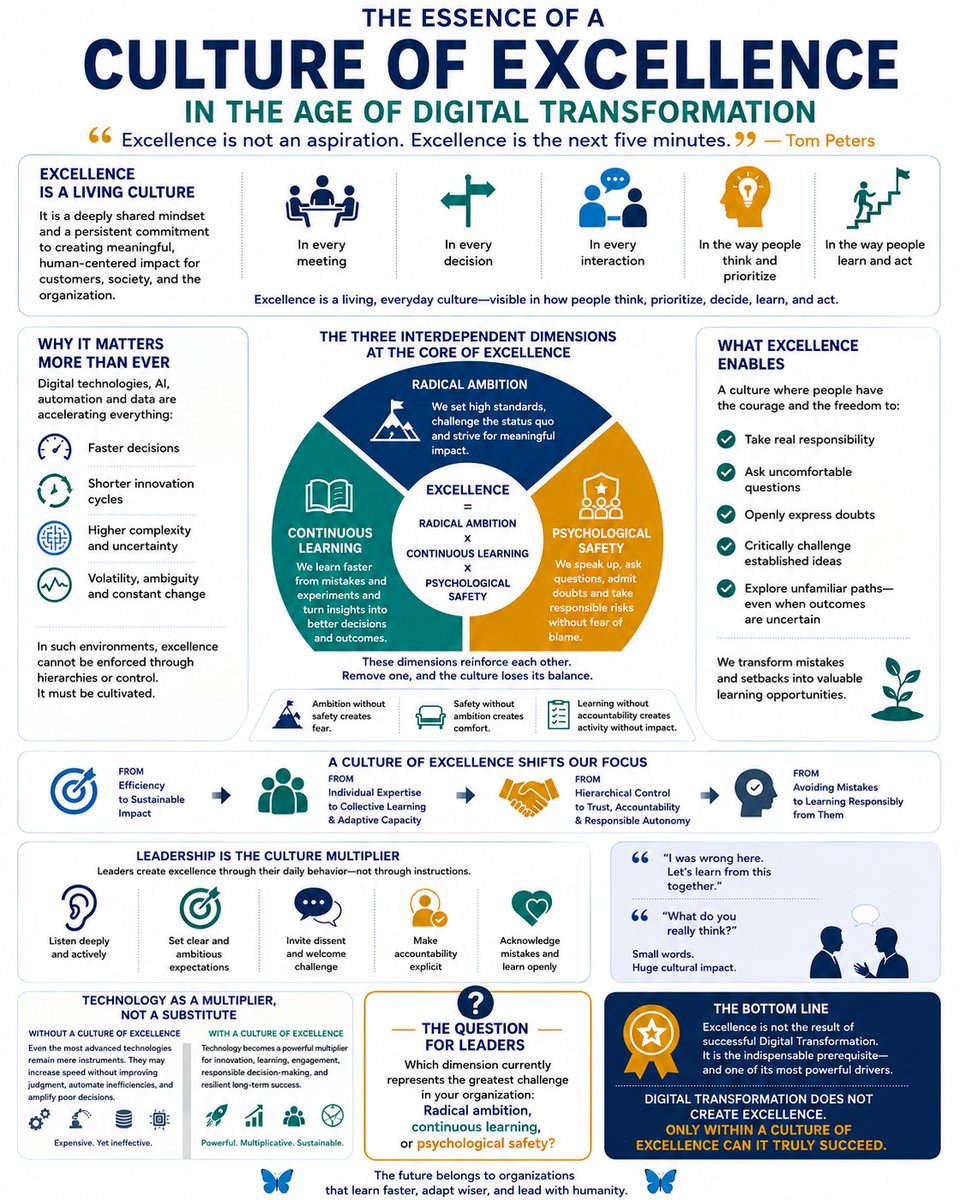
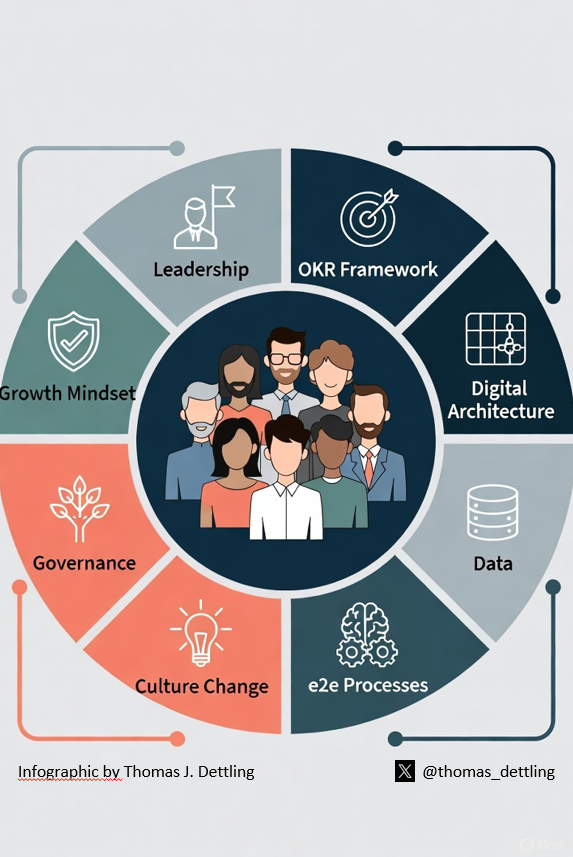
⬛️ #Blog4Managers: The Essence of a Culture of Excellence in the Age of Digital Transformation “Excellence is not an aspiration. Excellence is the next five minutes.” — Tom Peters Excellence Is a Living Culture 🔷 A Culture of Excellence is far more than the pursuit of peak performance, operational efficiency, or the achievement of ambitious OKRs. Its true essence lies in a deeply shared inner mindset: a persistent and passionate commitment to creating meaningful, human-centered impact for customers, society, and the organization itself. Excellence is neither a fixed end state nor a time-bound program that can simply be designed, launched, and implemented. It is a living, evolving culture that becomes visible in everyday behavior - in every meeting, every decision, every interaction, and every moment in which people think, prioritize, question, decide, learn, and act. It is not defined by isolated moments of exceptional performance, but by the consistency with which high standards, responsibility, reflection, and humanity shape the ordinary work of the organization. Three Interdependent Dimensions 🔷 At its core, a Culture of Excellence integrates three deeply interwoven dimensions: Radical Ambition Continuous Learning Psychological Safety These dimensions do not operate independently. They reinforce, balance, and constrain one another. Radical ambition without psychological safety creates pressure, silence, and fear. Psychological safety without ambition risks becoming comfort without progress. Continuous learning without accountability produces activity, but not necessarily meaningful improvement or impact. A true Culture of Excellence invites challenge without provoking fear. It systematically transforms mistakes, setbacks, and failed experiments into valuable learning opportunities instead of hiding, minimizing, or punishing them. At the same time, it does not romanticize failure. It requires disciplined reflection, clear accountability, and the willingness to translate experience into better decisions and more effective action. Courage, Responsibility, and Constructive Dissent 🔷 Such a culture creates an environment in which people have both the courage and the freedom to take genuine responsibility. They can ask uncomfortable questions, openly express doubts, critically challenge established ideas, and explore unfamiliar paths - even when outcomes are uncertain and no proven solution exists. This requires more than permission to speak. It requires confidence that thoughtful dissent will be taken seriously, that disagreement will not be interpreted as disloyalty, and that difficult truths will not be suppressed simply because they disturb established narratives or power structures. Psychological safety, in this sense, is not about avoiding tension. It is about making productive tension possible. It enables teams to confront reality, examine competing perspectives, and make better decisions without reducing debate to personal conflict. In the age of Digital Transformation, a Culture of Excellence is no longer a desirable cultural attribute. It is a strategic necessity. Why Digital Transformation Raises the Stakes 🔷 Artificial intelligence, automation, digital platforms, and data-driven systems are not only increasing technical complexity. They are also accelerating decision-making, compressing development cycles, intensifying competitive pressure, and making uncertainty, volatility, and ambiguity permanent features of organizational life. As technologies become more powerful, organizations must make more consequential decisions at greater speed. They must interpret incomplete information, adapt to changing conditions, and continuously reassess assumptions that may have been valid only months - or even weeks - before. In such highly dynamic environments, excellence can no longer be enforced through rigid hierarchies, detailed master plans, excessive standardization, or traditional control mechanisms. These approaches may create temporary predictability, but they often reduce responsiveness, delay learning, and discourage initiative precisely when organizations need adaptability most. Collective Intelligence Over Centralized Control 🔷 Sustainable excellence increasingly emerges from the intelligent use of collective intelligence: from open, trust-based dialogue across organizational levels and functional boundaries; from deliberate and courageous experimentation; and from the ability to identify, understand, and correct errors faster and more systematically than competitors. No individual leader, function, or expert can fully understand the complexity of a digital and data driven organization. Relevant knowledge is distributed across teams, disciplines, markets, customer interfaces, technologies, and operational systems. This is also why co-creation is essential to integrate distributed knowledge and fragmented perspectives into a shared understanding of complex organizational realities. The strategic challenge is therefore not merely to collect more data or employ more expertise. It is to create the conditions under which distributed knowledge can become shared understanding - and under which shared understanding can lead to timely, responsible action. A Culture of Excellence makes that possible by reducing defensive behavior, strengthening transparency, and enabling people to contribute what they know rather than merely confirm what senior leaders expect to hear. From Efficiency to Sustainable Impact 🔷 A Culture of Excellence fundamentally shifts the organization’s focus. ▪️ It moves the organization from operational efficiency alone toward sustainable and measurable impact for customers, employees, society, and the organization itself. ▪️ It shifts attention from individual expertise toward collective learning and adaptive capacity. ▪️ It replaces excessive hierarchical control with mutual trust, clear accountability, and responsible autonomy. And it moves the organization from the avoidance of mistakes toward the disciplined ability to learn from them. This does not make efficiency, expertise, structure, or performance irrelevant. On the contrary, it places them in a broader and more demanding context. Efficiency becomes valuable when it supports impact. Expertise becomes powerful when it contributes to collective capability. Structure becomes effective when it enables rather than constrains responsible action. Leadership as Cultural Practice 🔷 Leaders play a decisive role in this transformation. They do not create excellence through top-down instructions, detailed specifications, motivational speeches, or carefully designed PowerPoint presentations. They create it primarily through the standards they set, the questions they ask, the behaviors they reward, and the conduct they demonstrate under pressure. This means listening deeply and actively. It means setting clear and ambitious expectations without prescribing every step. It means inviting dissent, making accountability explicit, and responding constructively when people raise risks, doubts, or unpopular perspectives. It also means openly acknowledging their own mistakes. A sincere statement such as: “I was wrong here. Let’s understand what happened and learn from it together.” or a genuine question such as: “What do you really think?” can have a stronger cultural impact than any formal transformation initiative. Such gestures signal that truth matters more than status, learning more than self-protection, and responsibility more than the preservation of authority. People Observe What Leaders Tolerate 🔷 People do not primarily learn culture from corporate values displayed on walls, published in annual reports, or presented at leadership conferences. They learn culture by observing what leaders consistently encourage, tolerate, reward, ignore, and demonstrate - especially in difficult moments. They notice whether bad news is welcomed or suppressed. They notice whether people are rewarded for raising concerns or punished for disrupting consensus. They notice whether leaders protect their own image or take responsibility. And they notice whether high standards are applied consistently or selectively. Culture is therefore not what an organization claims to value. It is what people repeatedly experience. A Culture of Excellence becomes credible only when declared principles and lived behavior are aligned. Technology as a Multiplier, Not a Substitute 🔷 Ultimately, Digital Transformation is far less a purely technological challenge than a profoundly cultural one. Without a strong and living Culture of Excellence, even the most advanced technologies, algorithms, data models, platforms, and tools remain instruments without sustainable impact. They may increase speed without improving judgment, automate inefficient processes, amplify poor decisions, or reinforce existing organizational weaknesses. In such cases, technology can become expensive without becoming transformative. Within a Culture of Excellence, however, technology becomes a powerful multiplier. It strengthens innovation, accelerates learning, improves decision quality, supports responsible experimentation, and enables people to create greater value with greater speed and precision. The difference does not lie in the technology alone. It lies in the culture that determines how intelligently, responsibly, and courageously that technology is used. Excellence as the Prerequisite 🔷 Excellence is therefore not the result of successful Digital Transformation. It is its indispensable prerequisite - and one of its most powerful drivers. Digital Transformation does not create excellence. Only within a Culture of Excellence can Digital Transformation truly succeed. The central question for leaders is therefore not only: Which technologies should we implement? It is also: What kind of culture must we build so that these technologies can generate meaningful and sustainable impact? And within your organization, which dimension currently represents the greatest challenge: Radical ambition, continuous learning, or psychological safety? 🦋 @tom_peters @Khulood_Almani @AkwyZ @TamaraMcCleary @MaryRich78 @rwang0 @timo_vi @drsharwood @DrHolzwarth @HelenBevan @pierrecappelli @JimHarris @jenstirrup @GlenGilmore @subare @Ronald_vanLoon @enilev @Scobleizer @AndrewYNg @YuHelenYu ⭐️#CultureOfExcellence #DigitalTransformation #data #AI #People #Leadership #PsychologicalSafety #Learning #OrganizationalLearning #FutureOfWork #Innovation #Blog4Managers by @thomas_dettling and Infographic created by @thomas_dettling, powered by GPT 5.5
⬛️ #Blog4Managers | Co-Creation in Practice: How True Collaboration Creates Better Outcomes Many transformation initiatives fail not because organizations lack ideas, but because the right perspectives never come together. Companies invest heavily in innovation programs, workshops, and new methodologies, yet the results often fall short of expectations. The reason is rarely the tools themselves. 📢 More often, it is the way people work together. This is where co-creation makes the difference. ▪️ Many organizations introduce co-creation through structured methods such as workshops, sprints, innovation labs, or Design Thinking initiatives. This is both rigorously grounded and practically essential. Yet its true impact does not come from methodology - it comes from mindset. Genuine co-creation means not only collecting perspectives but giving them equal space and value. It requires a willingness to trade control for shared insight and to embrace uncertainty as a productive condition rather than a problem to eliminate. ▪️ In this sense, co-creation is less a tool and more a reflection of organizational maturity. Co-creation doesn’t follow a blueprint. It becomes visible through trust, meaningful dialogue, empathy and openness to insights that emerge through collaboration. From Cooperation to Co-Creation: A Qualitative Shift ▪️ In practice, co-creation is often confused with cooperation. While cooperation is based on the division of labor, co-creation takes collaboration one step further. Value is created through shared thinking rather than by combining individual contributions. ▪️ This shift fundamentally changes both dynamics and accountability. The most effective solutions often emerge when no one can clearly identify where the defining idea originally came from. Outcomes become the product of collective learning and shared discovery rather than individual ownership. ▪️ For leaders, this means moving away from being the primary source of answers and focusing instead on the quality of interactions that enable better thinking. The Architecture of Effective Co-Creation ▪️ For co-creation to produce meaningful results, it requires a carefully designed framework. Successful initiatives begin with a shared understanding of the problem. This step is often underestimated, yet it is one of the most critical. Organizations that rush toward solutions too early typically reduce the quality of the outcomes they can achieve. From there, radical transparency becomes essential. Information, assumptions, uncertainties, and constraints must be openly accessible so that all participants work from a common foundation. Structured interaction replaces random discussion. Divergent phases of idea generation are intentionally balanced with convergent phases focused on prioritization and decision-making. Equally important is clarity around decision-making mechanisms. Co-creation does not necessarily require consensus. It requires transparent and trusted processes for making decisions. ▪️ Finally, co-creation delivers its greatest value through iteration. Short learning cycles allow ideas to be tested, challenged, refined, and continuously improved. A Practical Example: How Co-Creation Gets Started ▪️ A common example illustrates how this framework comes to life. The process begins with an intentionally open question such as: “How can we ... redesign the digital experience for our customers?” The question is deliberately framed so that no single function can answer it alone. A small, diverse team is then assembled, bringing together representatives from business functions, engineering, digital transformation, AI, procurement, sales, tender, projects and individuals who provide critical operational perspectives. The process starts with a structured workshop designed not to generate quick ideas, but to build a shared understanding. Roughly one-third of the available time is dedicated to surfacing perspectives, challenging assumptions, and examining the problem from a systems perspective. Only then does true co-creation begin. ▪️ During an open exploration phase, participants generate ideas without evaluation or judgment. In a subsequent phase, ideas are refined, prioritized, and translated into initial solution concepts. A critical success factor is creating something tangible early in the process - sketches, prototypes, mockups, or scenario-based concepts and journeys. These are then tested through short feedback cycles, allowing the team to learn, adapt, and improve. At the same time, decision-making responsibilities are clearly defined, whether through consent-based approaches or final decisions made by an accountable leader. The result is a structured path that transforms open dialogue into actionable and sustainable solutions. This example highlights an important truth: co-creation does not begin with creativity. It begins with clarity - and becomes effective through structure. Leadership as Enablement: A New Role in the System ▪️ Co-creation fundamentally changes the role of leadership. Control gives way to enablement. Leaders create environments where dialogue can flourish and where people have the space to think, challenge assumptions, and contribute meaningfully. One capability becomes particularly important: tolerance for ambiguity. Leaders who embrace co-creation must be comfortable with uncertainty. They need the ability to resist premature decisions and avoid suppressing complexity simply to create the appearance of clarity. Leadership therefore becomes less visible through decisions and more visible through the quality of questions being asked and the culture being cultivated. ▪️ The leader’s role is increasingly to provide direction without prescribing solutions and to create confidence without eliminating uncertainty. Common Tensions - and How to Use Them Productively In reality, co-creation is rarely frictionless. Functional silos, dominant personalities, competing interests, and hidden power structures can all undermine the process. Yet these tensions are also where much of the value lies. Differences in perspective, conflicting priorities, and challenging conversations are not disruptions to the process - they are often prerequisites for better outcomes. The key is not to avoid tension but to channel it productively. Skilled facilitation, transparent rules, and a shared vision help organizations create constructive friction without allowing it to become destructive conflict. Co-Creation as a Response to Complexity ▪️ The value of co-creation becomes particularly evident in environments characterized by uncertainty and rapid change, such as digital transformation. Complex challenges can no longer be solved from a single perspective. They require the integration of diverse expertise, experiences, and viewpoints. Organizations that learn not merely to coordinate diversity but to transform it into genuine shared value creation gain a significant competitive advantage. As business environments become increasingly interconnected and dynamic, this capability grows even more important. Today’s challenges rarely fit neatly within departmental boundaries. They combine data, technological, economic, organizational, and cultural dimensions, demanding solutions that bring multiple perspectives together. In this context, co-creation becomes more than a collaboration method - it becomes a core organizational capability. Three Questions for Your Next Co-Creation Initiative ▪️ Before launching your next workshop, innovation project, or transformation effort, consider these questions: Do all relevant perspectives truly have a seat at the table? Is there a shared understanding of the problem, or are participants addressing different challenges? Are decision-making processes transparent, understood, and trusted? These questions may seem simple, but in practice they often determine whether collaboration remains coordinated - or becomes genuinely co-creative. Conclusion ▪️ The Courage to Build the Future Together Co-creation is demanding. It requires time, clarity, discipline, and a high degree of reflection from everyone involved. Yet it consistently produces solutions that are more sustainable, more broadly supported, and often more innovative. At its core, co-creation represents a shift in perspective - from individual excellence to collective intelligence. Organizations that embrace this shift do more than improve results. They strengthen their capacity to shape the future proactively. The challenges of tomorrow will rarely be solved by individuals working alone. The defining question is no longer who has the best answer, but how organizations can create the conditions for discovering better answers together. Where diverse perspectives are transformed into genuine shared value creation, innovation emerges - and so does long-term organizational resilience. Reflection for Leaders - Where in your current work environment could you intentionally create a space where people do more than contribute ideas - where they develop solutions together? 📢 Because co-creation starts in the mind long before it becomes a process. ✨ @Khulood_Almani @timo_vi @TamaraMcCleary @AkwyZ @MaryRich78 @rwang0 @drsharwood @DrHolzwarth @HelenBevan @pierrecappelli @JimHarris @jenstirrup @GlenGilmore @subare @JohnLeh @Ronald_vanLoon @enilev @Scobleizer @AndrewYNg @YuHelenYu @amcafee @kaifulee @SusanneMadsen @tceb62 ✨ #CoCreation #Leadership #Collaboration #DigitalTransformation #CollectiveIntelligence #OrganizationalMaturity #People #Skills #FutureOfWork #DataDrivenWork #Blog4Managers by @thomas_dettling and Image created by @thomas_dettling | powered by #GPT5

Recommended bridge day lecture 😎
⬛️ #Blog4Managers | Design Thinking in the Age of AI Why Mindset Matters More Than Method Design Thinking is still misunderstood in many organizations. As a creativity method. As a workshop format. As a colorful break from “real work.” In the age of Artificial Intelligence,

@thomas_dettling @DrHolzwarth I absolutely support this. Design Thinking as a mindset for complex problem solving is crucial for AI adoption. The intelligence in our engineering disciplines must come from our communities and networks. AI helps us scale, but we are responsible for laying the foundations 😎💪
⬛️ #Blog4Managers | Design Thinking in the Age of AI Why Mindset Matters More Than Method Design Thinking is still misunderstood in many organizations. As a creativity method. As a workshop format. As a colorful break from “real work.” In the age of Artificial Intelligence, this misunderstanding is not just unfortunate - it is risky. Because Design Thinking is less a method than a mindset. And that mindset ultimately determines whether AI becomes a true driver of productivity and innovation - or just another technological disappointment. When Machines Become Faster Than We 🔹 Artificial Intelligence is now capable of writing texts, generating designs, developing software, and preparing decisions. What AI cannot do, however, is understand why something actually matters. AI optimizes what has been clearly formulated. It accelerates what is already structured. It scales what has already been thought through. And this is exactly where many organizations face a problem. We apply AI to processes that evolved historically. To problems that were never seriously questioned. To trade-offs that remain implicit. The result is not intelligent value creation, but automated inefficiency. Many AI initiatives therefore fail not because of the technology itself, but because organizations lack clarity about which problem should actually be solved. Design Thinking as a Counterweight to Pure Optimization Logic 🔹 Design Thinking starts from a fundamentally different place than traditional management and engineering logic. Not with the solution. Not with efficiency. But with the question: Do we truly understand the problem - from the perspective of the people who work with it, live with it, or are affected by it? At its core, Design Thinking means deliberately shifting perspectives, making assumptions explicit, structuring complexity without reducing it prematurely, and developing solutions iteratively in real-world contexts. This is not a “soft” discipline. It is hard organizational work under uncertainty. Why This Mindset Becomes Critical in the Age of AI 🔹 AI fundamentally changes how value is created. In the past, what mattered was who mastered the methods, knew the tools, or could calculate faster. Today, what matters is who asks the right questions. Who recognizes which problem should be solved - and which should not. And who can design systems in ways that allow machines to support human work meaningfully. Design Thinking develops exactly these capabilities. Not as creativity training, but as a discipline of intentional design. It creates the ability to pause before optimizing, to question assumptions before scaling, and to make implicit trade-offs explicit. Start by questioning one AI use case before optimizing it. In the age of AI, competitive advantage no longer comes primarily from access to information. It comes from superior problem recognition. Design Thinking and Engineering 🔹 Not a Contradiction. In technically driven organizations, Design Thinking is often perceived as the opposite of engineering. That is a misunderstanding. Engineering stands for precision, reliability, and reproducibility. Design Thinking complements this with user focus, systems understanding, and clarity about purpose and meaning. Together, they create something essential: Engineering that is not only correct, but relevant. And this is exactly where AI unfolds its real value. AI requires clear problem definitions, clean interfaces, and deliberate decisions. Design Thinking provides the foundation for all three. Leadership in the Age of AI 🔹 For leaders, this means a shift in role. Less making detailed decisions, prescribing solutions, and exercising control. More designing conditions, providing orientation instead of answers, and creating learning environments instead of demanding perfection. Design Thinking does not provide leadership recipes. But it fosters a way of thinking that keeps leadership effective under uncertainty. Because AI does not remove the responsibility for good problem-solving. It makes visible how capable organizations truly are at it. 🔹 Design Thinking as a Prerequisite for Meaningful AI Adoption. Artificial Intelligence amplifies what already exists. It makes good systems better - and bad systems visible faster. Design Thinking ensures that organizations work on the right problems, that technology serves people rather than the other way around, and that learning, adaptation, and continuous evolution become part of the system itself. That is precisely why Design Thinking is no longer optional in the age of AI. It is a foundational mindset for modern leadership and organizational development. Artificial Intelligence provides computational power. Design Thinking provides orientation. 🔹 Without clear problem understanding, organizations use AI primarily to automate their own weaknesses. In the age of AI, success will not be determined by the intelligence of systems, but by the mindset of the people designing them. 💫 ✨ @TamaraMcCleary @timo_vi @Khulood_Almani @AkwyZ @MaryRich78 @rwang0 @drsharwood @DrHolzwarth @HelenBevan @phinifa @pierrecappelli @JimHarris @jenstirrup @GlenGilmore @subare @Ronald_vanLoon @enilev @Scobleizer @AndrewYNg @YuHelenYu @gleonhard @quepasachico #DesignThinking #AI #Mindset #Engineering #Data #DigitalTransformation #Capabilities #People #Mindset #Creativity #Collaboration Image by @thomas_dettling | Grok 4.3
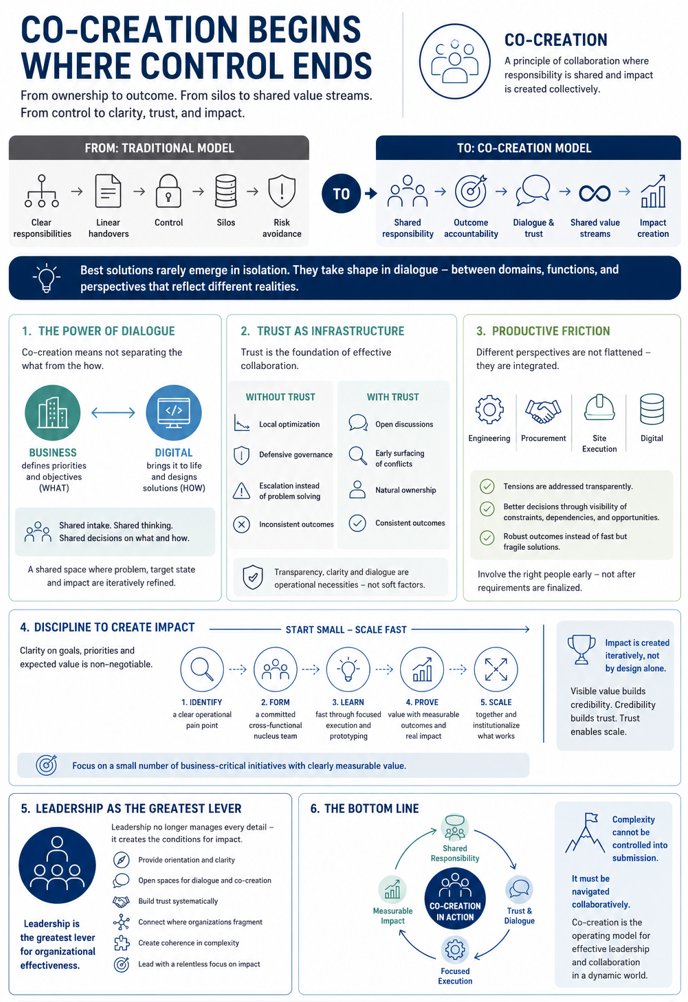
⬛️ #Blog4Managers | Co-Creation begins where control ends Co-creation is not a tool. It is a principle. And it fundamentally changes the logic of collaboration. While traditional organizational models rely on clear responsibilities, linear handovers, and control, co-creation emerges where responsibility is deliberately shared and impact is created collectively. 🔹 It shifts the focus: from ownership to outcome accountability, from silos to shared value streams. In practice, one insight stands out: the best solutions rarely emerge in isolation. They take shape in dialogue – between domains, functions, and perspectives that reflect different realities. Co-creation means not separating the what from the how. Business does not merely define requirements, and digital teams do not rush to deliver solutions. Instead, a shared space of thinking emerges, where the problem, the target state, and the intended impact are iteratively refined. Only within this shared understanding does activity turn into real value creation. 🔹 Yet co-creation does not work without trust. Trust is not a soft dimension – it is the true infrastructure of effective collaboration. Without trust, alignment becomes tactical, decisions become political, and outcomes remain inconsistent. Organizations then optimize not for impact, but for risk avoidance. With trust, however, the dynamics shift: discussions become more open, conflicts surface earlier, and ownership is taken more naturally – especially under conditions of uncertainty. Trust-based collaboration does not mean harmony. On the contrary, it creates the space for productive friction. 🔹 Different perspectives are not flattened, but deliberately integrated. It is precisely within the tension between conflicting demands that quality emerges. Decisions do not become easier, but more robust. Speed is not driven by less alignment, but by better alignment – through clarity, reliability, and a shared understanding of priorities. Co-creation therefore requires a high degree of discipline. Clarity about goals, priorities, and expected value is not a “nice-to-have,” but a prerequisite. Small, focused initiatives are often more effective than large-scale programs, as they enable learning and make complexity manageable. 🔹 Start small – scale fast is not a slogan, but a structural principle: impact is created iteratively, not by design alone. What matters is to generate visible value early, validate hypotheses, and scale solutions together. Leadership fundamentally changes in this context. It no longer primarily defines content, but shapes the conditions under which good content can emerge. Leadership means providing orientation, opening spaces, and systematically building trust. It connects where organizations fragment and creates coherence where complexity increases - not through control, but through clarity, dialogue, and a consistent focus on impact. 📢 Co-creation is not an additional process step. It is the way organizations remain effective in complex and dynamic environments. Wherever solutions can no longer be planned but must be developed, co-creation becomes the central logic of leadership and collaboration. Infographic by @thomas_dettling | GPT 5.5 ✨ @TamaraMcCleary @timo_vi @Khulood_Almani @AkwyZ @MaryRich78 @rwang0 @drsharwood @DrHolzwarth @HelenBevan @phinifa @pierrecappelli @JimHarris @jenstirrup @GlenGilmore @subare @Ronald_vanLoon @enilev @Scobleizer @AndrewYNg @YuHelenYu @quepasachico ✨ #CoCreation #Leadership #Trust #Collaboration #Mindset #DigitalTransformation #HolisticThinking #People #System #ValueCreation #Impact
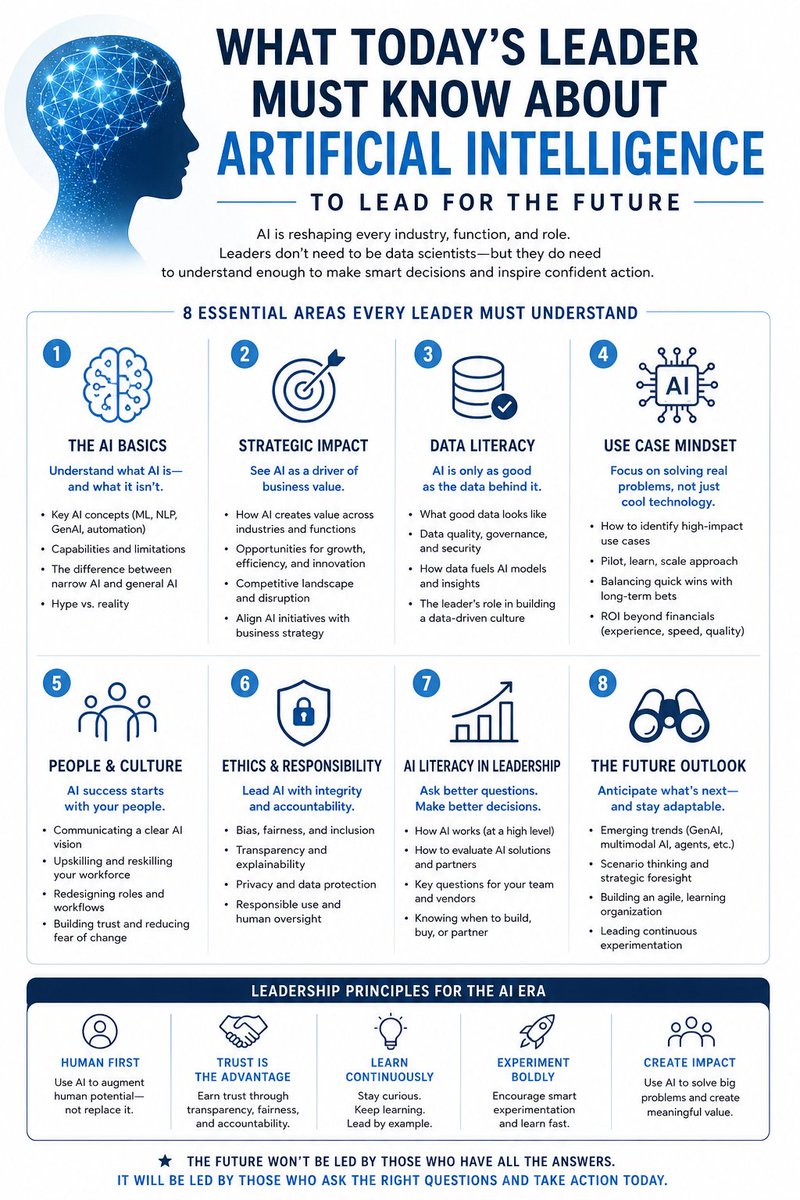
⬛️ #Blog4Managers: What Today’s Manager Must Understand About AI - Beyond the Hype 🔷 Artificial intelligence is no longer a distant vision of the future - it is a concrete management reality. Yet many leadership teams still find themselves navigating between curiosity, pressure to act, and uncertainty. The key point: leaders do not need to become developers or data scientists. But they do need a robust, decision-relevant understanding of AI to lead effectively. 🔷 AI is, first and foremost, a value lever. It impacts cost structures, decision speed, customer experience, and innovation cycles. Anyone who treats AI purely as a technology topic underestimates its strategic significance. The central question is not “What can AI do?” but rather “Where does AI measurably improve how we create value?” 🔷 This requires stronger data literacy at the leadership level. AI systems are only as good as the data they are built on- quality, governance, and context are critical. Managers must be able to challenge assumptions, assess risks, and determine when outputs are reliable and when human judgment remains indispensable. 🔷 Equally important is a disciplined use-case focus. Successful organizations don’t start with tools - they start with real problems. At the same time, it is essential to prioritize the right initiatives to avoid fragmentation, isolated solutions, and siloed thinking. Effective AI initiatives are aligned with clear business objectives, tested iteratively, and scaled deliberately. This requires discipline: enabling quick wins while building long-term capabilities. 📢 At the same time, AI transformation is not just technological - it is fundamentally human. Roles evolve, skill requirements shift, and uncertainty increases. Managers must provide direction, invest in upskilling, and foster a culture where learning and experimentation are the norm. 🔷 Ethics and responsibility are not optional - they are core leadership responsibilities. Issues such as bias, transparency, and accountability must be actively managed. In the age of AI, trust becomes a decisive competitive advantage. 🔷 Finally, Managers need perspective. AI is evolving rapidly - from generative systems to autonomous agents. Static strategies fall short. The ability to adapt, ask better questions, and make sound decisions under uncertainty becomes a defining leadership capability. 📢 The future will not be led by those who claim to have all the answers, but by those who combine clarity with curiosity - and take decisive action. ✨ @TamaraMcCleary @timo_vi @Khulood_Almani @AkwyZ @MaryRich78 @rwang0 @drsharwood @DrHolzwarth @HelenBevan @phinifa @pierrecappelli @JimHarris @jenstirrup @GlenGilmore @subare @Ronald_vanLoon @enilev @Scobleizer @AndrewYNg @YuHelenYu @gleonhard @quepasachico ✨ #ArtificialIntelligence #AI #ChatBots #ML #Skills #FutureOfWork #Automation #DataDrivenWork #People #CultureChange #Manager #Learning #Leadership #Leader Infographic by @thomas_dettling | #ChatGPT
Digital Transformation is not only about Data and Technology, it's about People and Culture. Digital transformation is interpreted, understood, and practiced very differently. Clarifying this with the leadership team and 50 Data/AI-experts was essential. My task - in Partnering with @PhilippKnauer2 - over the past four days was to reassess and reprioritize all tools, developments, and applications managed by the departments, understand the needs of the customers, and define a strategic positioning that can be translated into a clear roadmap, smart plans and OKRs to create outcomes. What a great time. Now I'm on the way home 🚄 #DigitalTransformation #Strategy #Data #Leadership #People #OKRs #Impact @AkwyZ @jenstirrup @jsprondel @Khulood_Almani @MaryRich78 @subare @DrHolzwarth


@thomas_dettling Thank you for guiding us through the challenging days, Thomas. Together we are a strong team raising the sails in the ocean of digital transformation - once again 😎

Elon Musk just identified which jobs go first, and it destroys every assumption about who’s safe. Musk: “AI is going to take over those jobs like lightning. Anything that is digital, which is like just someone at a computer doing something.” Not factory workers. Office workers. The people who spent decades assuming education and desk jobs meant security are actually first. Musk: “Anything that’s physically moving atoms… those jobs will exist for a much longer time.” Output is a file? Vulnerable. Output is physical? Protected. That’s the entire framework. Musk: “AI is really still digital.” AI doesn’t need a body. Doesn’t need an office. Just needs access to the same software you use. Executes faster. Never tires. Costs nothing to scale. But it can’t weld. Can’t wire a building. Can’t fix pipes or work soil. Musk: “Literally welding, electrical work, plumbing. Those jobs will exist for a much longer time.” Trades aren’t the vulnerable jobs. They’re the durable ones. Physical presence, real-world adaptation, manual dexterity provide protection no digital credential offers. Analyst, accountant, paralegal, programmer, anyone producing files and documents, automates first because digital work is exactly what AI does natively. Person moving atoms has natural defense. Physics, unpredictable environments, material resistance create friction AI can’t scale past. Person moving bits has nothing. No friction. No physical barrier. Just software AI already operates better than most humans. The assumption that desk work and degrees represent safety just inverted completely. College graduate producing documents faces faster displacement than the electrician producing installations. Society spent generations telling people trades were beneath them. Pushed everyone toward offices and screens. Turns out the people who didn’t listen built the most automation-resistant careers. Most ironic outcome of the AI revolution. The work society treated as inferior turned out to be the work society couldn’t replace. And the work society valued most turned out to be the easiest to eliminate.
⬛️ Workplace 2026: Recognition as an Engine for Strategy 🔷 2026 is not a “business as usual” year - it is the year when organizations must prove that humans and machines together create more value than either does alone. The latest @Workhuman analysis shows that human–AI collaboration is no longer a trend, but the new normal. AI automates routine tasks, improves information flow, and opens new pathways for leadership and talent development. What matters is how organizations design this collaboration: with clear direction, inclusion, and shared goals. At the same time, something else moves to center stage - capabilities AI cannot replicate: creativity, empathy, judgment, and collaboration. This is exactly where competitive advantage is created. 🔷 Workhuman makes it clear that outdated performance metrics will be obsolete by 2026. Instead of a soup of KPIs, psychological safety, #recognition**, and purpose/values alignment take priority - factors that directly correlate with engagement and performance. Teams that receive regular, meaningful recognition report significantly higher psychological safety and stronger strategic alignment. Put differently: recognition is not a “nice to have,” but a leadership instrument that steers behavior and culture toward strategy. 🔷 The World Economic Forum provides the structural rationale behind this shift. In New Economy Skills (2025), the WEF shows that roughly 40% of core job skills will be disrupted within five years; 170 million new roles will emerge, while 92 million will disappear. In this transition, human-centered skills - from critical thinking to emotional intelligence - gain dramatic importance. They are not only “hard to automate”; they are what enable #innovation, #adaptability, and inclusive #performance systems in the first place. The bridge between these two perspectives is unmistakable ➡️ Workhuman describes how culture and leadership become effective in 2026 (recognition, psychological safety, data-informed culture work, storytelling instead of data overload). ➡️ WEF explains which skills underpin this effectiveness (human skills) and how they can be systematically developed, measured, and certified (assessment frameworks, micro-credentials, AI-powered simulations). 🔷 Human-Centric Skills: From “Soft” to Strategically Hard The WEF study warns that human skills are fragile - they erode in times of crisis and require deliberate practice to recover. At the same time, they are remarkably resistant to automation (e.g., empathy, leadership, curiosity). This creates a dilemma: although these skills determine future readiness, they are often poorly measured, insufficiently recognized, and weakly incentivized. This is where Workhuman a.o. practices come into play. When recognition is tightly linked to values and strategic initiatives, organizations measurably increase clarity, belonging, and performance contribution. Culture becomes a data source - and a lever for steering the organization. Leadership in the Age of AI: From Control to Support & Storytelling 🔷 The data is clear: a large share of team engagement depends directly on managers, and in 2025 “supportiveness” was the most frequently recognized leadership behavior. Leadership in 2026 therefore requires courage, clarity, coaching, and the ability to translate data into meaningful stories - moving away from slide-by-slide PowerPoint decks toward narratives that clarify priorities, prevent burnout, and reinforce cultural signals. Storytelling thus evolves from a “soft skill” into a competitive advantage because it creates orientation and triggers action. From Insight to Execution: 7 Concrete Steps 💫 1⃣ Design human – AI workflows: Redesign tasks (automation for routines, humans for judgment and relationships), clarify accountability, and deliberately integrate “AI teammates.” 2⃣ Measure and manage psychological safety: Use regular pulse checks, recognition rituals, and bias checks in feedback systems. 3⃣ Link recognition to strategy: Thank people not just for effort, but explicitly for values-driven and strategic contributions - turning culture into a strategy engine. 4⃣ Make human skills a curriculum: Creativity, empathy, critical thinking, and collaboration as mandatory development for all leadership levels - not optional. 5⃣ Build assessment and credentials: Behavior-based assessments, digital badges, and AI simulations for difficult conversations and decision-making - visible, portable, and career-relevant. 6⃣ Storytelling instead of data overload: Insights over dashboards - narrative reviews that connect performance, culture, and people signals to guide priorities. 7⃣ Scale leadership impact: Intentionally coach middle management; develop next-generation leaders with clear learning paths, sponsorship, and recognition systems. ➡️ Conclusion Technology builds the infrastructure - human skills create value. Recognition and psychological safety are the fastest cultural levers for performance and retention in 2026. Leadership determines whether AI unlocks productivity or merely adds complexity - through support, clarity, and storytelling. Organizations that connect these three dimensions build systems that learn faster, lead more fairly, and grow more resiliently - actively shaping the markets of tomorrow. ✨ 🔹 Important 🔹 ** Recognition increases engagement and goal commitment. In the context of OKRs, this means: Recognition directs attention toward desired behaviors - specifically those contributions that move Key Results forward. Positive reinforcement increases the consistency of goal pursuit throughout the cycle. Teams feel that progress is noticed - which boosts motivation and ownership. Impact on OKRs: → Teams stay committed to challenging Key Results instead of drifting away when difficulties arise. #Leadership #Empathy #Curiosity #People #Impact #Storytelling #OKRs #Execution #AI #Data #Digitalization #DigitalTransformation #FutureIntelligence #HCD #CultureChange #FutureOfWork #Workplace 🌟 @wef @rwang0 @Khulood_Almani @timo_vi @drsharwood @TamaraMcCleary @AkwyZ @MaryRich78 @DrHolzwarth @HelenBevan @pierrecappelli @JimHarris @mikeflache @jenstirrup @GlenGilmore @subare @Ronald_vanLoon @enilev @Scobleizer @AndrewYNg @YuHelenYu

⬛️ Global Cooperation Barometer 2026 | #WEF26 🔶 The Global Cooperation Barometer is structured along five dimensions of global connection: 🔸 Trade and capital 🔸 Innovation and technology 🔸 Climate and natural capital 🔸 Health and wellness 🔸 Peace and security 🔶 These five pillars were chosen because of their impact on global development and their explicit dependence on cooperative efforts among nations and economies. 🔶 As a guiding element in the analysis, the barometer identified goals that actors are working towards in each of these themes. In doing so, the barometer draws inspiration from the United Nations Sustainable Development Goals (SDGs) and the efforts of other global institutions. ✨ ➡️ Download report: tinyurl.com/ybsykkn2 | @wef & @McKinsey @wef @SDG2030 @SDGS4GOOD @beyond_ideology @Ronald_vanLoon @jsprondel @AkwyZ @timo_vi @TamaraMcCleary @rwang0 @RagusoSergio @mikeflache @HelenBevan @MaryRich78 @pierrecappelli @jenstirrup @GlenGilmore @natascha_zeljko @PhilippKnauer2 @DrHolzwarth @subare @JimHarris @SusanneMadsen @sallyeaves @CynthiaLIVE @enilev @mcgrathmag @HaroldSinnott @Scobleizer @AndrewYNg @YuHelenYu @ipfconline1 @jblefevre60 @SabineVdL @kalydeoo @digital_T_CH @drsharwood @Nicochan33 @AngelaNoonUK @JoanBajorek @Shi4Tech @mitsmr @havardbiz @SwissCognitive @IDEOU 💡 #ClobalCooperation #Economy #Trade #Innovation #Technology #Climate #Health #Peace #People


⬛️ Digital Transformation - How Managers Need to Think About It 🔷 Introduction: Digital transformation is not a tech upgrade; it’s a new framework for value creation: strategy, processes, data flows, and culture are simultaneously and iteratively recalibrated. Reducing it to tools misses the point - and increases the risk of failure. Studies show: fewer than one-third of all transformations achieve their intended outcomes; for digital initiatives, success rates are often even lower [1]. The reason? Not technology, but leadership gaps, siloed thinking, and failure to translate strategy into behavior. Why Managers Fail Outstanding technical specialists become leaders - often without preparation for managing data and AI, leading people and change in the digital age, and solving complex problems in transformations. The result: overwhelm and transactional optimization in silos, even though the task is truly transformational: creating meaning, breaking down boundaries, and opening learning spaces. This is where success or failure is determined. 🔶 Understand Transformation Managers must understand transformation as a continuous learning and management process - not as a time-bound project [2]. Three principles are key: 🔸 Ambidexterity: Run the core business efficiently (exploitation) while simultaneously exploring new digital opportunities (exploration) [3]. 🔸 Data Architecture: Seamless data flows, shared semantics, and transparency as a “single source of truth” - only then can automation, analytics, and AI scale [4]. 🔸 Culture & Structure: Shift from hierarchical-linear to networked, cross-functional organizational forms with clear governance [5]. 🔶 OKRs as the Bridge Between Strategy and Execution Here lies the key: Objectives and Key Results (OKRs) are not an end in themselves but a framework that operationalizes transformation. Why? 🔸 Objectives provide meaning and direction: “What do we want to achieve?” 🔸 Key Results create measurability: “How will we know we’ve succeeded?” OKRs prevent the typical trap of digitalization romanticism (“We’ll become digital”) and force hard prioritization. ➡️ Success factors for OKRs in transformation: Ambition + Realism: Objectives must inspire, but Key Results must be quantifiable (e.g., “Reduce process cycle time by 30%”). 🔸 Transparency: OKRs are public - they break down silos and foster alignment. 🔸 Adaptability: Quarterly reviews to integrate learning loops. 🔸 Data Integration: Key Results based on real-time metrics from the digital platform. ➡️ OKRs and digital transformation share a principle: focus, alignment, measurability. Leading transformation without OKRs risks “busy digital work” without impact. 🔶 The Manager’s Contribution 🔸 Vision & Purpose: Link digitalization to business strategy; technology serves value creation, not itself. 🔸 Lead People: Establish psychological safety, learning culture, and clear communication. 🔸 Live Ambidexterity: Balance resources between optimization and exploration. 🔸 Data Competence & Transparency: Metrics and dashboards as shared reality. 🔸 AI Readiness: Enable teams to use AI responsibly - and rethink work processes. 🔸 The AI era has begun and change is not episodic but permanent. Classic change models fall short; adaptive, data-driven steering with continuous feedback is needed. Leadership shifts from efficiency to resilience and learning capability. Those who keep optimizing transactionally in silos create local improvements - but systemic failure. 🔶 Redesigning Work, Workplace, and Work Culture Transformation demands new work practices: interdisciplinary teams, product/platform logic, agile governance, distributed responsibility, and “human-in-the-loop” AI. Managers are architects of this system: they create contexts where technology delivers impact - and people grow beyond themselves. 🔸 Clarity of Purpose: Every digital initiative must contribute to an OKR. 🔸 Measurable Outcomes, Not Output: Transformation is measured by value levers (cost, revenue, customer experience). 🔸 Transparency & Alignment: OKRs break silos; transformation needs data sharing. 🔸 Learning Loops: OKRs and transformation are iterative - hypothesis → experiment → evidence → scaling. 🔸 Leadership as a Lever: Managers must show attitude: courage, role-modeling, empathy. 🔷 Conclusion: Technology is the enabler. OKRs are the metronome. Leadership, data flow, and ambidexterity are the levers. Transformation succeeds when managers take people, data, and structure as seriously as tools - and have the courage to lead at the system level. This is not easy and romanticism. This is tough, responsible leadership in the age of AI 💡 @rwang0 @Khulood_Almani @mikeflache @HelenBevan @MaryRich78 @pierrecappelli @jenstirrup @GlenGilmore @DG_Collective @pierrecappelli @tinapchopra @PhilippKnauer2 @DrHolzwarth @sijlalhussain @subare @JimHarris @SusanneMadsen @timo_vi @kerstingAIML @sallyeaves @CynthiaLIVE @enilev @mcgrathmag @HaroldSinnott @Scobleizer @AndrewYNg @YuHelenYu @ipfconline1 @jblefevre60 @antgrasso @RagusoSergio @SabineVdL @kalydeoo @Der_BDI @digital_T_CH @drsharwood @Nicochan33 @AngelaNoonUK @JoanBajorek @mitsmr @wef @havardbiz @Gartner_inc @Deloitte @McKinsey @SwissCognitive @AIVentures_aus @IDEOU ✨ #DigitalTransformation #Leadership #People #Data #AI #Empathy #Strategy #OKR #Vision #Success Sources: [1] McKinsey, 2018: Unlocking success in digital transformations. [2] Rakovic et al., 2023: The role of leadership in managing digital transformation. [3] Deloitte, 2018: Ambidextrous leadership and the CEO. [4] IMD, 2023: Navigating the data-driven landscape. [5] Deloitte, 2022: How to lead digital transformation. [6] MIT Sloan, 2025: Why AI Demands a New Breed of Leaders.
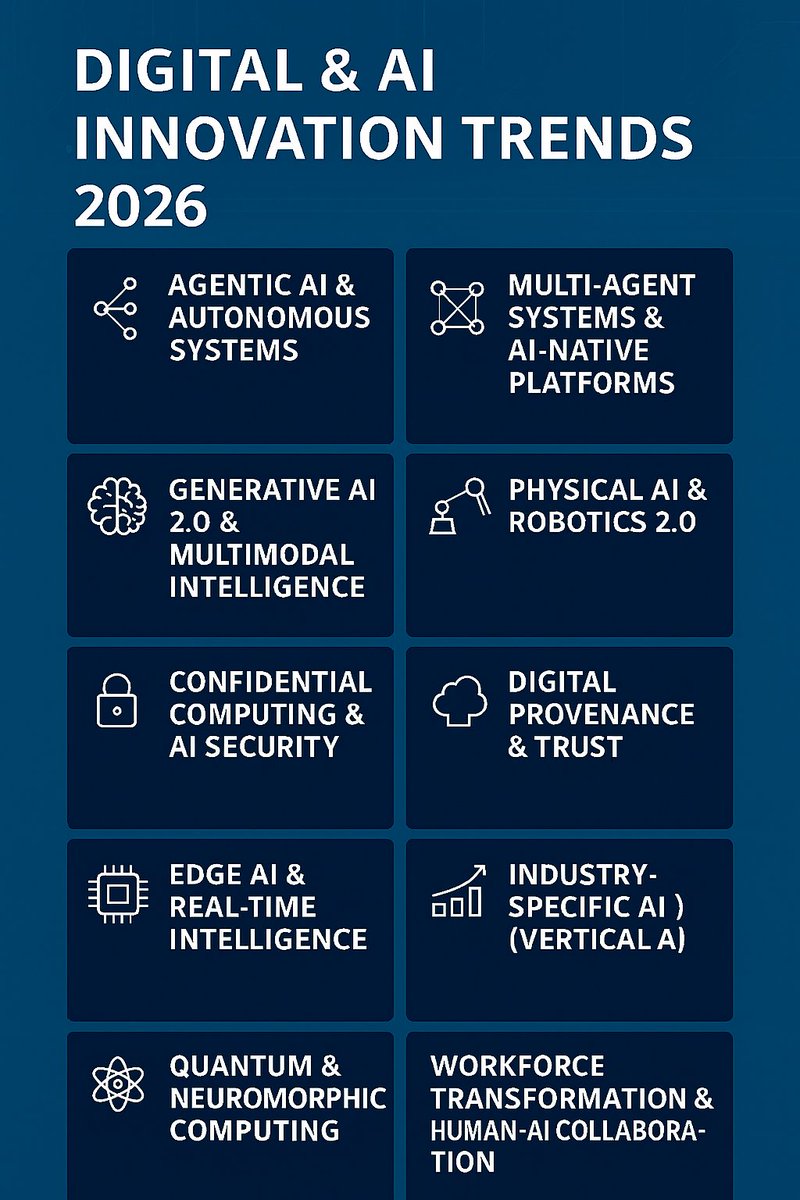
⬛️ Digital & AI Innovation Trends 2026 🤖 ➡️ Here are the key Digital & AI Innovation Trends for 2026, based on the latest insights from Gartner, Deloitte, and other industry sources: 🔹1. Agentic AI & Autonomous Systems What it is: AI agents that can set goals, make decisions, and execute multi-step tasks with minimal human intervention. Impact: Moves beyond automation to adaptive workflows in areas like customer service, supply chain, and finance. Why it matters: Organizations adopting agentic AI will see major efficiency gains and new business models. Governance and ethical frameworks will become critical. usaii.org | deloitte.com 🔹 2. Multi-Agent Systems & AI-Native Platforms Trend: Swarms of specialized AI agents collaborating to achieve complex goals. AI-Native Development: Platforms that use generative AI to accelerate software creation, enabling smaller, agile teams. Prediction: By 2030, 80% of organizations will evolve large dev teams into AI-augmented micro-teams. gartner.com | Top Strategic Technology Trends for 2026 tinyurl.com/5az6b4sw | journeybee.io | 🔹 3. Generative AI 2.0 & Multimodal Intelligence Shift: From text generation to integrated multimodal systems (text, image, audio, video). Applications: Personalized commerce, marketing automation, and creative industries. Challenge: Deepfake risks and need for privacy-focused GenAI. transformik.com 🔹 4. Physical AI & Robotics 2.0 Definition: AI embedded in physical systems—robots, drones, smart equipment. Use Cases: Autonomous manufacturing, logistics, and healthcare devices. Why it matters: Enables self-healing infrastructure and predictive maintenance. zdnet.com 🔹 5. Confidential Computing & AI Security Focus: Protecting sensitive data via hardware-based trusted execution environments. Trend: AI-driven cybersecurity becomes a “battlefield” of defensive vs. offensive AI. Prediction: Preemptive cybersecurity and AI security platforms will dominate enterprise strategies. gartner.com 🔹 6. Digital Provenance & Trust Need: Transparency in data usage and AI decisions. Why: Regulatory pressure (EU AI Act, global compliance) and consumer demand for ethical AI. Impact: Rise of AI governance roles and trust-by-design systems. techdigitalminds.com 🔹 7. Edge AI & Real-Time Intelligence Trend: AI processing moves closer to data sources for speed and privacy. Applications: Predictive maintenance, adaptive production, healthcare monitoring. Benefit: Lower latency and reduced cloud dependency. techdigitalminds.com 🔹 8. Industry-Specific AI (Vertical AI) Examples: Regulatory AI agents for compliance, voice AI in healthcare, computer vision in construction. Funding: Billions flowing into AI-native startups solving niche problems. journeybee.io 🔹 9. Quantum & Neuromorphic Computing Why important: Enables breakthroughs in drug simulation, logistics optimization, and AI model efficiency. Prediction: Quantum-resistant encryption and hybrid computing architectures will become mainstream. startus-insights.com 🔹 10. Workforce Transformation & Human-AI Collaboration Shift: Humans become “editors” of AI outputs, focusing on creativity and oversight. Action: Reskilling programs and new roles like “AI Ops” teams will emerge. usaii.org ➡️ Big Picture: 2026 marks the transition from AI hype to AI execution. AI is no longer a differentiator - it’s a commodity. Success will depend on scaling responsibly, embedding trust, and orchestrating human-AI collaboration across all business functions 💡 @Gartner_inc @Deloitte @usaiinstitute @SwissCognitive @AIVentures_aus @mikeflache @rwang0 @HelenBevan @MaryRich78 @Khulood_Almani @pierrecappelli @jenstirrup @GlenGilmore @DG_Collective @pierrecappelli @tinapchopra @PhilippKnauer2 @DrHolzwarth @sijlalhussain @subare @JimHarris @SusanneMadsen @timo_vi @kerstingAIML @sallyeaves @CynthiaLIVE @enilev @mcgrathmag @HaroldSinnott @Scobleizer @AndrewYNg @YuHelenYu @ipfconline1 @jblefevre60 @karine_grows @RagusoSergio @SabineVdL @kalydeoo @Der_BDI @digital_T_CH @drsharwood @Nicochan33 @AngelaNoonUK @JoanBajorek @mitsmr @wef @havardbiz @IDEOU ✨ #ArtificialIntelligence #AI #People #FutureSkills #Innovation #Trends #RealTimeIntelligence #Human_AI_Collaboration #DigitalTransformation 💫 Infographic by @thomas_dettling | #Copilot
⬛️ In Digital Transformation, 75% of initiatives fail due to cultural barriers - the Growth Mindset provides an evidence-based solution by fostering learning processes and building resilience. It boosts innovation by up to 30% and profitability in 80% of companies, while integrating agile, digital, and AI mindsets. “Your mindset determines your potential for growth and success.” - Dr. Carol Dweck, Stanford University ➡️ More Content? Read my blog on @X : What Managers Need to Know About the Growth Mindset in Digital Transformation. @HelenBevan @TamaraMcCleary @AkwyZ @MaryRich78 @Khulood_Almani @pierrecappelli @jenstirrup @GlenGilmore @mikeflache @DG_Collective @pierrecappelli @tinapchopra @PhilippKnauer2 @DrHolzwarth @sijlalhussain @subare @JimHarris @SusanneMadsen @timo_vi @kerstingAIML @sallyeaves @CynthiaLIVE @pilotspeaker @enilev @mcgrathmag @HaroldSinnott @Scobleizer @antgrasso @AndrewYNg @YuHelenYu @Eli_Krumova @ipfconline1 @jblefevre60 @ahier @karine_grows @SabineVdL @kalydeoo @Der_BDI @digital_T_CH @drsharwood @Nicochan33 @AngelaNoonUK @JoanBajorek @mitsmr @wef @havardbiz @Stanford @IDEOU ✨ #DigitalTransformation #GrowthMindset #Creativity #FixedMindset #Leadership #Innovation #People #Culture #Agility #Digital #Data #AI Image by @thomas_dettling | #GPT5

⬛️ Ambidexterity: The Situational Switch Between Transactional and Transformational Leadership in Transformation Processes In times of increasing volatility, change processes and transformations demand flexible leadership from organizations that simultaneously balances stability and innovation. Ambidexterity - as the ability to link explorative (innovative) and exploitative (efficient) activities - addresses this duality by switching between transactional (structured-reward-oriented) and transformational (inspiring-visionary) principles in a situational manner. 🔶 Transactional elements secure operational control through clear expectations and rewards, while transformational components - idealized influence, inspirational motivation, intellectual stimulation, and individualized consideration - awaken intrinsic motivation and dismantle resistance. In VUCA environments (Volatile, Uncertain, Complex, Ambiguous), this switch is essential, as it creates resilience and boosts the success rate of transformation projects from a typical 30 percent to over 70 percent. Scientifically substantiated, a meta-analytic review by Zacher and Rosing (2015) across multiple studies confirms that 'ambidextrous leadership' enhances innovation performance by up to 25 percent, mediated by higher change readiness and psychological safety. Longitudinal data from a cohort of over 1,000 managers (Kao et al., 2022) show: Situational switching reduces burnout risk by approximately 15 percent, as transactional clarity stabilizes neural reward pathways, while transformational impulses unleash creativity. 🔶 In Kotter's 8-Step Model (2012, updated in Accelerate framework), this manifests phase-wise: Transactional dominates in planning and implementation (tracking milestones, demanding corrections), transformational in mobilization (building visionary narratives, promoting co-creation). A systematic review (Jensen et al., 2022) from 40+ studies spanning 2015–2022 underscores: In volatile contexts, ambidextrous leadership accelerates adaptation speed by 28 percent without efficiency losses, where silos are dismantled and knowledge creation is increased by 20 percent. For individuals, the switch succeeds optimally through hybrid practices: for example, weekly goal achievement check-ins (transactional) supplemented by monthly workshops (transformational), which build trust and boost engagement - Gallup studies (2023) measure +21 percent productivity. 🔶 Organizations benefit from context-based analysis: Prioritize transactional in stable phases, transformational in shifts - upported by 360-degree feedback and coaching programs that train the "switch" (Zacher & Rosing, 2022). This vitalizes structures, reduces turnover, and promotes agility, as evidenced by case studies on digital transformations. Particularly synergistically, ambidextrous leadership integrates with OKRs: Objectives as transformational visions (ambitious, inspiring, growth- and future-oriented) pair with Key Results as transactional metrics (concrete, measurable, reward-bound). 🔶 Phase-wise adjustment optimizes: Explorative OKRs in idea development awaken creativity, exploitative in scaling secure efficiency. Helpful tools, such as hybrid dashboards, can track progress and coach styles - adjust transactionally in case of underachievement (adjust rewards), narratively link transformationally in case of overachievement. McKinsey (2023) reports: Such integration raises buy-in rates to 75 percent, as OKRs not only align goals but dynamize leadership behavior. 🔶 Ambidextrous leadership is thus not an ideal, but an imperative: It transforms processes into sustainable change by empowering people, making organizations flexible, and exceeding business goals. In an era where 70 percent of initiatives fail, it offers the evidence-based path to competitive advantages - through conscious choreography of the switch that unites theory and practice 💫 References: 🔸 Gallup. (2023). State of the Global Workplace Report. Gallup Press. 🔸 Jensen, S. H., et al. (2022). Ambidextrous leadership: A review of theoretical developments and empirical evidence. In Handbook of Research on Leadership (pp. 1–25). Edward Elgar Publishing. 🔸 Kao, K. W., et al. (2022). Ambidextrous leadership and employees' self-reported innovative performance: The role of exploration and exploitation behaviors. The Journal of Creative Behavior, 46(4), 258–272. 🔸 Kotter, J. P. (2012). Accelerate: Building Strategic Agility for a Faster-Moving World. Harvard Business Review Press. 🔸 McKinsey & Company. (2023). How ambidextrous leaders manage through volatile times. McKinsey & Company Insights. 🔸 Zacher, H., & Rosing, K. (2015). Ambidextrous leadership and team innovation. The Leadership Quarterly, 26(3), 391–409. 🔸 Zacher, H., & Rosing, K. (2022). Ambidextrous leadership: A review of theoretical developments and empirical evidence. ResearchGate Publication. @TamaraMcCleary @AkwyZ @MaryRich78 @Khulood_Almani @pierrecappelli @jenstirrup @GlenGilmore @mikeflache @DG_Collective @pierrecappelli @tinapchopra @PhilippKnauer2 @DrHolzwarth @sijlalhussain @subare @JimHarris @SusanneMadsen @timo_vi @kerstingAIML @sallyeaves @CynthiaLIVE @pilotspeaker @enilev @mcgrathmag @HaroldSinnott @Scobleizer @antgrasso @SugShan @AndrewYNg @YuHelenYu @Eli_Krumova @ipfconline1 @jblefevre60 @ahier @karine_grows @RagusoSergio @SabineVdL @kalydeoo @Der_BDI @digital_T_CH @drsharwood @Nicochan33 @AngelaNoonUK @JoanBajorek @mitsmr @wef @havardbiz @IDEOU ✨ #Ambidexterity #Transformation #Leadership #Creativity #Innovation #Performance #Exploration #Exploitation #OKRs #Results #Adaptability #FutureIntelligence #Competitiveness 💡

⬛️ AI Application in Management: A Balanced Perspective 🟢 In times of exponential digitalization, current research underscores the transformative role of artificial intelligence (AI) in management, without supplanting independent thinking or dialogic interaction. A meta-analysis of 63 studies from leading journals shows that AI capabilities can boost leadership performance by up to 25% when used as a complement to human intuition. 🟢 This symbiotic use - AI as a catalyst for reflection, learning, and operational optimizations - holds opportunities for sustainable success, but also ethical risks that must be mitigated through evidence-based governance.Empirical models of human-AI collaboration emphasize that reflective leadership is deepened by AI-supported scenario simulations. A 2025 conceptual study demonstrates how leadership qualities like empathy and strategic foresight are enhanced by predictive algorithms that uncover data patterns, minimizing cognitive biases. 🟢 Managers thus gain depth in decision-making processes without relinquishing their judgment. Nonetheless, meta-reviews warn of bias amplification in training data, necessitating dialogic reviews with teams to ensure fair outcomes. Quantitative analyses indicate: Such hybrid approaches reduce decision errors by 18%, fostering trust only when transparency is maintained. In organizational learning, AI positions itself as a personalized learning companion: Adaptive machine learning tailors content to individual learning curves, as illustrated by a taxonomy of AI applications in leadership. Longitudinal studies confirm a 30% increase in competency development, as AI tracks progress and provides reflective prompts. 🟢 The balance arises from avoiding cognitive dependency: Dialogic leadership integrates AI insights into collective discourses, promoting sustainable knowledge exchange and resilience against technological disruptions. In daily operations, AI optimizes workflows through real-time tracking and resource allocation, as outlined in reviews of responsible leadership. Automated forecasts lower operational costs by 15–20%, allowing managers to focus on relational core tasks. Risks like data privacy breaches are addressed through ethical frameworks derived from corporate AI ethics, demanding fair implementations. A prospective agenda proposes that governance-oriented approaches maximize these opportunities by prioritizing human agency. 🟢 In summary, science substantiates: AI extends leadership reflection and efficiency, as long as dialogic principles and ethical safeguards remain forefront. Managers who use AI as a reflective tool transform potentials into resilient progress- an evidence-based invitation to symbiotic evolution ✨ Relevant Sources Raisch, S., et al. (2025): Review of Artificial Intelligence in Management, Leadership, Decision-Making and Collaboration. ResearchGate Lee, J., et al. (2025): Influence of Leadership on Human–Artificial Intelligence Collaboration. PMC Stahl, B. C., et al. (2025): What can educational leaders learn from corporate AI ethics? SAGE Journals Wang, Y., et al. (2025): Artificial intelligence in educational leadership: a comprehensive taxonomy. SpringerOpen Koedinger, K. R., et al. (2025): The influence of artificial intelligence-driven capabilities on responsible leadership. Cambridge University Press Jarrahi, M. H., et al. (2025): Enhancing top managers' leadership with artificial intelligence. Springer @TamaraMcCleary @AkwyZ @MaryRich78 @Khulood_Almani @pierrecappelli @jenstirrup @GlenGilmore @mikeflache @DG_Collective @pierrecappelli @tinapchopra @PhilippKnauer2 @DrHolzwarth @sijlalhussain @subare @JimHarris @SusanneMadsen @timo_vi @kerstingAIML @sallyeaves @CynthiaLIVE @pilotspeaker @enilev @mcgrathmag @HaroldSinnott @Scobleizer @antgrasso @SugShan @AndrewYNg @YuHelenYu @Eli_Krumova @ipfconline1 @jblefevre60 @ahier @karine_grows @RagusoSergio @labordeolivier @SabineVdL @kalydeoo @Der_BDI @digital_T_CH @drsharwood @Nicochan33 @AngelaNoonUK @JoanBajorek @mitsmr @wef @havardbiz @IDEOU 💫 #AI #DialogicLeadership #People #Ethics #Potentials #Management #Risks #Communication #Creativity #GrowthMindset #FutureOfWork #HowWeWork #Meetings #Dialogue #LeadershipExcellence #FutureIntelligence #Innovation #Competitiveness 💡 Infographic by #AlexBarady | @Pinterest

⬛️ Digital Transformation Trends 🔶 Which industries are driving digital transformation in 2025 and beyond? Industries leading the charge include energy, automotive, manufacturing, telecom, healthcare and government. These sectors are leveraging technologies like 4D Construction, AI agents, Autonomous Digital Twins and cloud native platforms to gain competitive advantages. 🔶 What are the current trends in digital transformation?Current digital transformation trends include Generative AI, Hyperautomation, Composable Business Architecture*, Low-Code/No-Code Development**, Edge Computing, and AI enhanced cybersecurity. These technologies are reshaping how businesses operate, innovate, and engage with customers. 🔶 What is the future of digital transformation? The future of digital transformation lies in AI first enterprises, ethical governance, real time automation, and composable systems. Organizations will move from experimentation to full scale, integrated digital ecosystems that prioritize agility, sustainability, and customer value. 🔶 Why is digital transformation important for businesses today? Digital transformation helps businesses streamline operations, respond faster to market changes, improve customer experience, and drive innovation. It is key to surviving and thriving in today’s tech driven, fast moving economy. 🔶 How does generative AI impact digital transformation? Generative AI enables smarter decision making, autonomous systems, and hyper personalized experiences. It transforms digital transformation by powering AI agents, virtual assistants, and intelligent workflows across industries. 🔶 What technologies are used in digital transformation? Core technologies include cloud computing, AI and machine learning, IoT, robotic process automation, edge computing, and low-code platforms. These tools drive efficiency, innovation, and customer centric strategies. *Composable Business Architecture: A modular approach to designing business structures that builds business processes like "LEGO bricks" - flexible, adaptable, and scalable to enable rapid changes and continuous transformation. **Low-Code/No-Code Development: Low-Code - Visual platforms for rapid app development with minimal manual code (e.g., Drag-and-Drop); No-Code - Completely code-free for non-programmers to easily build applications and accelerate innovation. Sources: 🔸 McKinsey Technology Trends Outlook 2025 mckinsey.com/capabilities/m… 🔸 Deloitte 2025 Digital Media Trends deloitte.com/us/en/insights… 🔸 PwC's 2025 Digital Trends in Operations Survey pwc.com/us/en/services… 🔸 Bain & Company Technology Report 2025 bain.com/insights/topic… 🔸 IBM Top Digital Transformation Trends ibm.com/think/insights… @Khulood_Almani @AkwyZ @TamaraMcCleary @jenstirrup @GlenGilmore @mikeflache @DG_Collective @pierrecappelli @MaryRich78 @tinapchopra @PhilippKnauer2 @DrHolzwarth @sijlalhussain @subare @JimHarris @SusanneMadsen @timo_vi @kerstingAIML @sallyeaves @CynthiaLIVE @pilotspeaker @enilev @mcgrathmag @HaroldSinnott @Scobleizer @antgrasso @SugShan @AndrewYNg @YuHelenYu @Eli_Krumova @ipfconline1 @jblefevre60 @ahier @karine_grows @RagusoSergio @labordeolivier @SabineVdL @kalydeoo @Der_BDI @digital_T_CH @drsharwood @Nicochan33 @AngelaNoonUK @JoanBajorek @mitsmr @wef @havardbiz @ideo 💫 #DigitalTransformation #People #Culture #Creativity #Digitalization #Technology #GenAI #Automation #IndustrialSoftware #Engineering #3DPrinting #Industry50 #AIPlantDesign #4DBIM #CultureChange #Leadership #Innovation #Customer #Competitiveness 💡

⬛️ Important for each Manager: The Fundamentals of Systemic Management - 11 Laws of Systems Thinking 🔸 Today's problems come from yesterday's "solutions." 🔸 The harder you push, the harder the system pushes back. 🔸 Behavior grows better before it grows worse. 🔸 The easy way out usually leads back in. 🔸 The cure can be worse than the disease. 🔸 Faster is slower. 🔸 Cause and effect are not closely related in time and space. 🔸 Small changes can produce big results - but the areas of highest leverage are often the least obvious. 🔸 You can have your cake and eat it too - but not all at once. 🔸 Dividing an elephant in half does not produce two small elephants. 🔸 There is no blame. ✨ @Khulood_Almani @AkwyZ @TamaraMcCleary @jenstirrup @GlenGilmore @mikeflache @DG_Collective @pierrecappelli @MaryRich78 @tinapchopra @PhilippKnauer2 @DrHolzwarth @Female_Shift @sijlalhussain @subare @JimHarris @SusanneMadsen @timo_vi @DG_Collective @kerstingAIML @sallyeaves @CynthiaLIVE @pilotspeaker @enilev @mcgrathmag @HaroldSinnott @Scobleizer @antgrasso @SugShan @AndrewYNg @YuHelenYu @Eli_Krumova @ipfconline1 @jblefevre60 @ahier @karine_grows @RagusoSergio @labordeolivier @SabineVdL @kalydeoo @Der_BDI @digital_T_CH @drsharwood @Nicochan33 @AngelaNoonUK @JoanBajorek @mitsmr @wef @havardbiz @ideo 💫 #BooksForLeaders #SystemThinking #Trust #OrganizationalLearning #Relationship #Thinking #Acting #Collaboration #Mindset #Growth #People #OrganizationalDevelopment #Leadership #Competitiveness 💡 ➡️ Peter Senge is an American management thinker and systems theorist, best known for his 1990 book "The Fifth Discipline" 📚 In it, he describes the principles of the "learning organization," which enables sustainable growth and adaptability through five disciplines - such as systems thinking, personal mastery, and team learning. As a co-founder of the Center for Organizational Learning at the Massachusetts Institute of Technology (MIT), Senge has had a global influence on leadership and organizational development and emphasizes the importance of long-term, systemic thinking in a complex world.
⬛️ Change Management: How to Avoid the Hero Trap In practice, leaders often misunderstand "powerful" as someone who holds a formal hierarchical position, rather than someone with informal influence, empathy and integration intelligence. Build a Powerful Coalition A powerful coalition needs different kinds of people. There are numerous frameworks that describe different functions or roles, but studies have found the following four roles in a change coalition to be helpful. 🔹 Technologists: These people know the problem so well that they can either suggest solutions or know where to find them. They possess informal power through their excellent technical expertise and professional experience. 🔹 Evangelists: These are individuals who know the political landscape and understand how the problem or opportunity fits into that landscape. They can help the entire organization understand why the problem needs to be solved or the opportunity seized. They are experienced change architects and particularly useful in aligning the change with the existing corporate culture. 🔹 Analysts: Analysts know the problem or opportunity—similar to technologists—but their role is to highlight the resistance pain points. They can support leaders in anticipating and harnessing resistance—so that the resistance becomes a resource rather than an obstacle. 🔹 Advocates / Sponsors: These people know the organizational resources and have access to them—they provide formal power to allocate budget and personnel, and to remove barriers to change when needed. They do not need to be involved in the daily operations of the change initiative, but should be kept informed and engaged as needed. In short: Don't be a hero, don't go solo with a solution: Build a coalition of experts and don't just sell a vision of change: Tell the origin story of the problem, leverage what's already there, and actively support its implementation. Don't assume that the culture must change: Ask how the culture supports the change. With this coalition of problem-solving experts, you are ready to develop solutions and drive changes forward ✨ @Khulood_Almani @AkwyZ @TamaraMcCleary @jenstirrup @GlenGilmore @mikeflache @pierrecappelli @MaryRich78 @tinapchopra @PhilippKnauer2 @DrHolzwarth @Female_Shift @sijlalhussain @subare @JimHarris @SusanneMadsen @timo_vi @DG_Collective @kerstingAIML @sallyeaves @CynthiaLIVE @pilotspeaker @enilev @mcgrathmag @HaroldSinnott @Scobleizer @antgrasso @SugShan @AndrewYNg @YuHelenYu @Eli_Krumova @ipfconline1 @jblefevre60 @ahier @karine_grows @RagusoSergio @labordeolivier @SabineVdL @kalydeoo @Der_BDI @digital_T_CH @drsharwood @Nicochan33 @AngelaNoonUK @JoanBajorek @mitsmr @wef @havardbiz @ideo 💫 #Change #Holistic #Perception #e2eProcesses #Empathy #People #Culture #Coalition #FutureOfWork #Innovation #Digitalization #Data #Industry50 #Leadership #FutureIntelligence #Competitiveness 💡


Monique Moutier @moutier_1
0 Followers 55 Following
Jessica Ritter @DrJessicaRitter
12K Followers 5K Following Staatsbürgerin in Uniform | Ärztin | Gleichstellung | Vielfalt | Augenhöhe | Chancengerechtigkeit | Zukunft | Privater Account #WirSindMarine #Ostsee ⚓️
R Harz @RHarz211241
0 Followers 2 Following
Keller, Lena 💐✨�... @w5agd5747618
0 Followers 128 Following
James Slaughter @JamesSlaug93333
36 Followers 210 Following
Jo Walzik @JoWalzik
220 Followers 570 Following @Siemens_Energy Passion for Details, People, Leadership & #EnergyTransition. Drive #DigitalTransformation & #Ambidexterity with #TeamPurple | Views are mine own
Liu Yusi @LiuYusi20210407
50 Followers 485 Following Entrepreneur, financial investor. eMarket pioneer, visual feast artist🥼👗World travel explorer✈️Golf enthusiast⛳🏌️♀️Lions Club member❤️Underwater explorer🧜
Noreen @Noreen19870202
286 Followers 970 Following 🌍 Self-employed entrepreneur | Vice President of London Chinese Charity Chamber of Commerce, likes golf ⛳ red wine 🍷 charity ❤️ reading 📚 travel ✈️ Pilates
Piochi @PiochisFXcBi
121 Followers 4K Following
Theteal @ThetealrZuMC
58 Followers 2K Following
Noonno @Noonno4r97HB
80 Followers 1K Following
Elitsa Krumova @Eli_Krumova
63K Followers 47K Following |Digital🦄| 🏆🔝 Global Thought Leader & B2B #Tech #Influencer | #WomenInTech @Onalytica @WomenTechmakers |#AI #IoT #IIoT #ML #Robotics|#Marketing #SocialMedia|

Scott @Havenlust
341K Followers 211K Following Scott Hefti — Photographer of timeless moments. Nature • Light • Reflection • Connection.
Karine Gromada @karine_grows
210 Followers 1K Following HAII & CogSci Professional | Researcher | Head of Product & AI @DASHDOCK | Speaker
ChritineReneilt @CReneilt24520
6 Followers 430 Following

JO. Jessica Olive @SharonO67684
638 Followers 1K Following
Martin Bethke @Martin_Bethke
6K Followers 1K Following CEO @ https://t.co/vhvefm0PTC | Keynote Speaker & Autor: "Nachhaltiges Wirtschaften als Erfolgsfaktor" | Former CxO @WWF_Deutschland, @NatGeoDE, @Ravensburger | my views
Tanja Moritz @moritzta22
1 Followers 41 Following
I.Snowqueen @IsabelSchlosser
24 Followers 178 Following
Kassem Nasser, CBAP®... @assmnasser
620 Followers 5K Following I read 📖, I tweet 🐦, AI newbie #Certified #Business #Analysis Professional™ (#CBAP), #trainer, #ITIL, #digitaltransformation #solutionarchitect #oracle_ebs
Julia Müller @MuellerJuliaUni
857 Followers 3K Following Professor of Management at @UniOsnabrueck / Research in Human Resource Management, Leadership, Future of Work, Teams, Behavioral Economics / Views are my own.
Kai Hinz @HinzKh
0 Followers 1 Following
Jan Frederick @JanFrederick20
0 Followers 49 Following
Oliver Hartmann @OlivHart
114 Followers 191 Following

ÖCAL AĞAR @ocalagar
382 Followers 4K Following
Suganthan Shanmugalin... @SugShan
15 Followers 40 Following Contributing to the energy transition @ Siemens Energy ⚡️| Passionate football ⚽️ and tennis 🎾 player | Flashpacker 🎒🛫🌍
Evalex Talent Solutio... @EvalexOMT
669 Followers 1K Following Leveraging our heritage through partnership, research, data and technology to realise people potential.

Vanessa Oberst @Vanessa_Oberst
4 Followers 29 Following
Dirk Helmstädt @dirkhelmstaedt
79 Followers 557 Following @Siemens_Energy früher/before/dawniej @PWr_Wroclaw #TractionTransformers #Scrum #Lean #Benchmarking #Mathematics #Telecommunication Tweets DE/EN/PL are my own
Samuel (Sam) Pavin @SamPavin
34K Followers 26K Following Marketing and growth exec | Innovation leader | Growing @resumption_co | Board #FrenchTech Australia | Quondam fui aliquis, nunc umbra.
Jayadeep Divakaran �... @JayadeepDivaka1
1K Followers 5K Following We support our customers on their individual journeys toward decarbonization #SiemensEnergy #teampurple #energytransition #greenenergy #sustainability


Antonio Vieira Santos @AkwyZ
73K Followers 31K Following @Atos Innovation Evangelist. Future Of Work Expert. Helping Customers grow. @axschat @DTLabUCC. Accessibility 🔍 Sustainability, Sociologist🎙
世博体育 DQD体�... @SilkeWSH
3K Followers 1K Following 【开云:https://t.co/JShEKI6YhO】【 鸭脖:https://t.co/oqJUm1QTDX 】 【国际线路:https://t.co/w7642b21EH】【星空:https://t.co/psTYy0VkBe】 【江南:https://t.co/bwVtbBxUaQ】【棋牌:https://t.co/s29efZDkrH】 【彩票:https://t.co/vpT8Iu3oVR】【百家乐:https://t.co/y5pOcG5Np5】 【电子:https://t.co/tEZxKqvtiA】【电竞:https://t.co/nXCXD614kO】 【赌球:https://t.co/W2eXOr45Ws】
Julia Duwe @Julia_Duwe
583 Followers 577 Following Author of "Beidhändige Führung" (Springer Gabler) #Ecosystems #Ambidextrousleadership #Ambidexterity #AI #EcosystemThinking
Stephan Kittel @StephanKittel
3 Followers 24 Following making sure ideas become reality that can be experienced everyday | engineer | #DesignThinking #DataBackbone #MachineLearning | no mud no lotus | views are mine
Moin & Machen | Chang... @change_starters
412 Followers 3K Following Für alle, die die Welt zu einem besseren Ort machen wollen. Wir starten in Hamburg! 🌱💚 #moinundmachen Homepage U/C⚠️ | 👩💻 👉🏻 @SocEntHH (🇩🇪/🇬🇧)
Silke Ploetzner 🍸�... @SPlotzner
1K Followers 854 Following Proud to work @SiemensEnergy communication but tweet as a private person. #sarcasm is a mindset. Views are my own. Love history & to travel
Nils Lindner @nillindesign
664 Followers 3K Following Leiter Central Marketing & Communications @zeiss_di #ZEISS #NewWork #OnlineMarketing #Digitalwork #DadofTwo #Dresden I private Account
Dr. Karolina Najdek @najdek_najdek
390 Followers 3K Following DISRUPTION-CONSULTING-TEACHING *** Micro Business Angel


Polizei Mittelfranken @PolizeiMFR
56K Followers 177 Following Offizieller Account der Polizei Mittelfranken. Impressum und Datenschutzerklärung: https://t.co/ToYyMUVDxj
Der Postillon 📯 @Der_Postillon
1.4M Followers 147 Following Ehrliche Nachrichten - unabhängig, schnell, seit 1845 Home of the 📯. Wir blocken Blauhaken und Faschos.
Stadt Nürnberg @nuernberg_de
101K Followers 712 Following Neues, Schönes & Interessantes aus dem Rathaus Offizieller Account der Stadt Nürnberg Impressum https://t.co/GJZsjkYvgL Datenschutz https://t.co/tv1Mh8BwRx
Karine Gromada @karine_grows
210 Followers 1K Following HAII & CogSci Professional | Researcher | Head of Product & AI @DASHDOCK | Speaker
Synergy @synergy_thegame
6K Followers 56 Following Survival city-building game developed by @LeikirStudio and published by @GoblinzPub #indiegame #gamedev #indiedev #madewithunity Wishlist now on Steam 👇👇👇
rabbit inc. @rabbit_hmi
66K Followers 2 Following rabbit is a consumer AI company making agents accessible on custom hardware — and tapping the unlimited possibility of AI. ⚙️ @rabbithelp_
APuZ @APuZ_bpb
16K Followers 1K Following Hier twittert die Redaktion von Aus Politik und Zeitgeschichte, Zeitschrift der Bundeszentrale für politische Bildung. Auf Bluesky: https://t.co/8VSu0vMPLu
Conceptboard @ConceptboardApp
5K Followers 3K Following Sichere Kollaborationsplattform aus Deutschland für visuelle Zusammenarbeit & Aufgabenmanagement. DSGVO-konform & ISO-zertifiziert.
Tomas Pueyo @tomaspueyo
330K Followers 593 Following Understand deeply how the world works today to navigate the world of tomorrow. Join 120k ppl in my free newsletter:
Prof. Stefan Rahmstor... @rahmstorf
170K Followers 278 Following Professor of Physics of the Oceans & Head of Earth System Analysis at the Potsdam Institute. Public speaker. Dad. I don’t read comments here, I do at Bluesky.
Mehdi Sadaghdar @ElectroBOOMGuy
157K Followers 142 Following Building and fixing and destruction, that's my middle names! https://t.co/TeRNzcmId5
Misha @mishadavinci
140K Followers 344 Following blockchain, AI, & the technologies remaking the future | writing the sovereign human https://t.co/5cVuA6pVgv
Farthest Frontier @Crate_Frontier
5K Followers 2 Following Farthest Frontier, (c) 2026 Crate Entertainment
Tim Temp @TimTemp3
224 Followers 374 Following Redakteur & Analyst @aktionaer | Investor | Erdbewohner | Podcast Host @einfachboerse {No financial advice/ Keine Anlageberatung}
Oliver Hartmann @OlivHart
114 Followers 191 Following
Michael O. Schmutzer @DO_Schmutzer
78 Followers 95 Following CEO & Gründer von Design Offices // Pionier des New Work in Deutschland // Innovator // Design-Narr
Suganthan Shanmugalin... @SugShan
15 Followers 40 Following Contributing to the energy transition @ Siemens Energy ⚡️| Passionate football ⚽️ and tennis 🎾 player | Flashpacker 🎒🛫🌍

KATAPULTU @KatapultUkraine
9K Followers 26 Following Abo holen, damit das alles stabil wird: https://t.co/bvoVju9ffk
Anonymous TV 🇺🇦 @YourAnonTV
527K Followers 409 Following We are #Anonymous, an internet-based international collective from all around the world | Get the latest updates on global conflicts and Anonymous Ops
Anonymous @YourAnonNews
7.5M Followers 962 Following We are Anonymous, we are legion, we do not forgive, we do not forget. Expect us. Here to counter propaganda and un-fuck your mind!

The Kyiv Independent @KyivIndependent
1.9M Followers 38 Following Independent English-language journalism in Ukraine. Become a member: https://t.co/ZnSQWYU6Xx
Prof. Karl Lauterbach @Karl_Lauterbach
1.3M Followers 343 Following SPD Bundestagsabgeordneter, Vorsitzender Ausschuss Forschung, Technologie und Raumfahrt, Bundesgesundheitsminister a.D., der hier selbst und privat tweetet.
Harvard Business mana... @harvard_biz
12K Followers 115 Following Der Harvard Business manager berichtet über Unternehmensführung, Management und Unternehmenskonzepte - Das Wissen der Besten
manager magazin @manager_magazin
110K Followers 1K Following Gegründet 1971 I Wirtschaft aus erster Hand I Wirtschaftsredaktion des Jahres 2025.
WirtschaftsWoche @wiwo
265K Followers 196 Following Weiterdenken. Weiterkommen. • https://t.co/sT6cxnrOWf
Dr. Carina Mieth @Carina_Mieth
418 Followers 2K Following ⚡-Engineer | #Sustainability in Manufacturing 🏭 #DigitalTwins #Simulation #AI 🤖 | plant-based 4 🌡️🌍
Markus Aberle @MarkusAberle_
2K Followers 6K Following Developing sustainable technology and organizations #SpiralDynamics #NVC #WoL #Husband & #Dadof3Girls Sorry, more likes are available @markusaberle.bsky.social
PeterDrucker FanPage @a_Drucker_a_Day
12K Followers 9K Following A revered management thinker, Peter Drucker is the premier Business Consultant mind of our lifetime... (not affiliated w/Mr Drucker)
Inside Energy @OnsiteRepairSE
2K Followers 3K Following Inside Energy explains modern energy systems—grids, turbines, hydrogen, and infrastructure—with clear, independent insights from real-world technology
Carina Reitlinger @c_reitlinger
220 Followers 639 Following Lehrerin & Digitale Transformationsmanagerin: Fokus Brückenbau #growthmindset #bettertogether #learningjourney #WOL #Frauenstärken #IPSN_Nuernberg
Nic @NicDierauf
62 Followers 268 Following
RockYourWork @RockingWork
767 Followers 4K Following @MartinGaedt zeigt 151 Unternehmen in Deutschland, Österreich, Schweiz - alle setzen die 4-TAGE-WOCHE um und teilen Erfahrungen mit der 3-TAGE-FREIZEIT
Constanze Holzwarth @DrHolzwarth
4K Followers 3K Following Führen im #Topmanagement #Leadership Consulting & Coaching #Führung #Transformation #Change #Innovation #Führungskultur #Innovationskultur #Digitalisierung
Thomas Bischoff @boysdontcrei
2K Followers 4K Following Vice Chairman "AI in Industrial Automation" @ZVEIorg | Founder @aicommunityowl | CAIM @ Phoenix Contact
Alexander Sauer @AlexanderKissle
71 Followers 294 Following #creativemind who believes #digitalization can solve our problems when #people are put first. #agile, #empowerment, #newwork https://t.co/66CdGAv9Li
Martin Bethke @Martin_Bethke
6K Followers 1K Following CEO @ https://t.co/vhvefm0PTC | Keynote Speaker & Autor: "Nachhaltiges Wirtschaften als Erfolgsfaktor" | Former CxO @WWF_Deutschland, @NatGeoDE, @Ravensburger | my views
Rebecca Seefeld @RebeccaSeefeld
94 Followers 191 Following comms @Siemens_Energy. tweeting about things i'm interested in: 📰✈️🔬👥📲 views are mine.
workisfaction @workisfaction
478 Followers 30 Following Hier twittert Eric vom workisfaction-Team. Wir sind coaches rund um das Thema New Work und Zufriedenheit in allen Lebenslagen
Timo Christ @DrTimoChrist
29 Followers 43 Following Views are my own. #Leadership #Führung #Innovation #agile #transformation #r4t #mindfulness #futureofwork
Joe Biden @JoeBiden
37.9M Followers 48 Following Husband to @DrBiden, proud father, grandfather, and great grandfather.
Science Magazine @ScienceMagazine
4.7M Followers 457 Following Cutting-edge research, news, commentary, and visuals from the Science family of journals. Follow @NewsfromScience for stories from our News team.
Science News @ScienceNews
5.3M Followers 512 Following Covering the latest news in all fields of science. Publisher @society4science. See also @SN_Explores.
New Scientist @newscientist
4.3M Followers 278 Following The best place to find out what’s new in science – and why it matters.
Tina Schmidke @TinaSchmidke
51 Followers 62 Following working @Siemens | #ConnectingGrids | #PotentialDevelopment | https://t.co/1dg1QmNJ30Trends for United States
You might like
