Terminator @TerminatorCV
Joined November 2022-
Tweets2K
-
Followers706
-
Following392
-
Likes4K
HIS BROKER CALLED BACK WITH A PROBLEM: 34 OF THE 104 COMPANIES JOHN TEMPLETON WANTED TO BUY WERE ALREADY BANKRUPT. Templeton told him to buy those too. It was 1939. War had just broken out in Europe. Templeton borrowed money and bought $100 worth of every stock trading on the NYSE for under a dollar a share — 104 companies in total, a third of them already in bankruptcy proceedings. His reasoning wasn't sentimental: if the U.S. entered the war, industrial production would ramp up hard enough to drag even the walking dead of the stock market back to life. Only four of the 104 turned out to be worthless. The rest returned roughly 400% over an average holding period of four years. Templeton later said he wished he'd held them longer. That trade became the early blueprint for the Templeton Growth Fund, launched in 1954. $10,000 invested at the start reportedly grew to around $2 million by the time he sold the business to Franklin Resources in 1992. In a rare Charlie Rose interview, Templeton explains where bargains actually come from — not calm, rational pricing, but frightened owners desperate to sell regardless of what an asset might still be worth. His entire method was comparing earnings, growth, dividends, and book value against the price panic had created. If similar companies traded at 25 times earnings while one credible business traded at five, that gap was where the research began — not the conclusion, the starting question. Templeton became a billionaire buying assets other investors were emotionally unable to hold. The interview explains the arithmetic underneath the contrarian mythology. Most people watching it will still sell the next time the market gets scary.
ONLY ONE OF THE FOUR WAYS TO SPEND MONEY IS ACTUALLY EFFICIENT. Milton Friedman explained why in a single interview clip that's outlasted entire economics departments. Box one: your money, on yourself. You watch the cost and the quality, because you're the one paying and the one using it — this is the only box where both instincts fire at once. Box two: your money, on someone else. You still watch the cost, since it's coming out of your pocket, but the quality matters less to you, because you won't be the one experiencing it. Box three: someone else's money, on yourself. Cost stops mattering — it's not your money — but quality matters intensely, because you're the one who has to live with the result. Box four is where almost every dollar of government spending lives: someone else's money, spent on someone else. Nobody in the chain has a personal stake in either the cost or the quality. The taxpayer funding it isn't deciding how it's spent. The official deciding isn't paying for it. The recipient isn't paying either. Friedman's argument wasn't about corruption or bad actors. It's that incentives, not intentions, decide outcomes — and box four removes every incentive that makes boxes one through three work. A grid simple enough to draw on a napkin, and it still explains budget waste better than most policy debates manage in an hour.
"IT WAS MY NET WORTH, NOT MY SELF-WORTH." That's Jamie Dimon, explaining how he survived getting fired by his mentor of 15 years — the moment his ten-year-old daughter asked if the family would have to sleep on the streets. 1998. Sandy Weill, his mentor for 15 years, called him into a meeting and ran through a short list of changes. Someone else would run this division. Someone else would run that one. Then: they wanted him to resign. Dimon said okay — not because it made sense, but because by that point he knew it was already decided. The board had voted. The press release was written. There was nothing left to negotiate. He drove home and told his wife and three daughters. Their reactions were all different. The middle one, obsessed with college, asked if she could still go. The oldest, practical, asked if she could have his cell phone since he wouldn't need it anymore. The youngest, ten years old, asked if they'd have to sleep on the streets. That night, about 50 senior managers from the bank packed into his apartment uninvited. He called it "being at my own wake." He spent the next two years figuring out what came next — considered teaching, considered starting his own firm, even flirted with retirement at 42. Then Bank One called: a struggling Chicago bank that had just posted a $511 million loss, so broken an analyst famously said "even Hercules couldn't fix it." Dimon took the job and put $60 million of his own money into the stock the day he started, roughly half his net worth. "I was going to go down with the ship or up with the ship," he said. Three years in, Bank One posted a record $3.5 billion profit. In 2004, JPMorgan Chase bought Bank One outright. By 2005, Dimon was CEO of the combined company — running a bank that had just absorbed the one that fired him, and would go on to become the largest in America. A year after the firing, he picked up the phone and called Weill directly. Told him, plainly, that he didn't think Weill had done right by Citigroup. Then told him his own mistakes from those years, out loud, unprompted. Weill acknowledged both. Everyone in finance gets fired eventually. Almost nobody turns a $511 million loss into the biggest bank in the country six years later — and almost nobody calls the person who fired them to settle it, instead of just moving on.
"I DON'T WANT TO SAY THAT ON TV, BUT I WAS LIKE 'WHAT?'" That's what Denise Ezell said after winning $127,000 at a casino she'd gambled at weekly for eight years, only to be told minutes later that she couldn't have it. October 30, 2023. She and a friend had already hit one casino that night before heading to MGM Grand Detroit around midnight. On what she figured would be her last bet, a side bet on progressive blackjack dealt her a four-card straight flush against the dealer's hand. The table erupted. The dealer congratulated her. She'd already started running through what the money would fix — debt, some breathing room, help for her daughter finishing medical school with a mountain of loans. Then a pit boss walked over and asked for her ID. Routine, she figured, the kind of thing that happens with a big win. Minutes later, casino staff told her she wasn't getting paid. The reason traced back to 2015: an argument with her cousin that a security guard on shift that night labeled "panhandling," which apparently triggered a ban she says was never formally communicated to her. No letter, no notice, nothing. She kept gambling there weekly, welcomed without incident, for eight straight years afterward. This is what it looks like when the rulebook gets rewritten the moment paying out becomes inconvenient — and it's not just a casino problem. In January 2021, Robinhood restricted buying on GameStop and a handful of other stocks in the middle of the biggest retail trading event in years. The official reason was real, not invented after the fact: clearinghouse deposit requirements had jumped tenfold overnight, and Robinhood needed roughly $3 billion in collateral by the next morning just to keep clearing trades at all. But to millions of traders sitting mid-position, the experience landed identically to Ezell's: you were playing by one set of rules, you were winning, and then the platform holding your money unilaterally decided the terms had changed — after the fact, not before, and not because you'd done anything wrong. Ezell spent months trying to resolve it directly with MGM and the Michigan Gaming Control Board before filing a federal lawsuit in June 2024, seeking the $127,000 jackpot plus $75,000 in damages. The house doesn't have to cheat the math to control the outcome. It just has to control the rulebook, and decide, after the fact, exactly when to open it back up.
PEOPLE TRUST A NUMBER BECAUSE IT LOOKS CONVINCING. THE MATH DOES NOT CARE HOW IT LOOKS. IT ONLY ASKS HOW OFTEN IT STARTS WITH 1. Bernie Madoff ran a $65 billion fraud for 20 years. One afternoon with a single formula would have caught him. Count how often his reported numbers started with the digit 1. In real financial data, that happens about 30% of the time. In his, it didn't. Most people assume the first digit of a big pile of numbers is random — nine options, roughly 11% each. Feels obvious. It's wrong. In 1938, a physicist named Frank Benford proved that across street addresses, river lengths, stock prices, and populations, the digit 1 leads far more often than any other digit — almost three times more than chance would predict. The rule is exact: P(d) = log10(1 + 1/d). Plug in 1 and you get 30.1%. Plug in 9 and you get 4.6%. The curve falls the same way no matter the currency, no matter the unit — dollars, euros, meters, it doesn't care. Here's why it catches liars: when people invent numbers, they spread the digits out to look random, reaching for too many 5s, 6s, and 7s. Real data is never that fair. It clusters on small leading digits, every time. Auditors know this. The IRS runs it on tax returns. Researchers ran it on Enron's books and Greece's national accounts before the debt crisis — both broke the curve. So did Madoff's returns, the one time anyone bothered to check. The tell sat in his filings for two decades. Not hidden. Not encrypted. A digit count any auditor could run in an hour.
@cartmanx404 That's an interesting comment, really. I'll keep that in mind, thanks! :)
MIND ONE IS FAST, LOUD, AND CERTAIN IT HAS AN EDGE. MIND TWO IS SLOW, QUIET, AND THE ONLY PART THAT CAN ACTUALLY DO THE MATH. MIND ONE ALWAYS SPEAKS FIRST That's Daniel Kahneman's finding, the one that won him a Nobel Prize in 2002 and turned "Thinking, Fast and Slow" into a book half the planet seems to have read. Almost nobody bet a dollar less because of it. Mind two is lazy. So a real 2% edge gets felt exactly like a sure thing, and gets sized like one. There's a formula built specifically to punish that gap. Tell it your edge is 10% when the truth is 2%, and it says bet five times too much. You look right for a while. Then zero, in one bad run. The formula was never the hard part. It has been free since 1956. The hard part is the honest number, and your fast mind fakes it every single time. No gut. No certainty. One honest guess you keep dodging. A trader I know halved every position the week he watched this. His year got quieter and greener. Kahneman died in 2024. He spent a life proving you do not have the honesty his own math required. The math is free. The honesty is the whole game.
Isaac Newton solved a math problem correctly in 1693 and still explained it wrong. It took another 300 years for anyone to prove it. The setup: Samuel Pepys wrote to Newton with a bet — which is more likely, at least one six from six dice, at least two sixes from twelve dice, or at least three sixes from eighteen dice? Pepys was sure it was the third. Newton calculated the real answer: the first option, at roughly 66.5% probability. He got the number exactly right. What he got wrong was the reasoning behind it — his intuitive argument never actually used the fact that the dice were fair, which meant it couldn't have been logically valid, even though it happened to point at the correct answer. A statistician named Stigler proved this centuries later, without needing to fully understand Newton's original argument to spot the flaw in its structure. This is one of two stories Joe Blitzstein uses to open lecture four of Harvard's Statistics 110 — a free, chalkboard-only course that's been watched over 2 million times and forms the basis of a textbook used at 200+ universities. The other story, a 1708 card-matching problem, resolves into the Taylor series for e almost by accident — the probability of zero matches settling at 1/e no matter how large the deck gets. Then Blitzstein derives Bayes' rule in ten seconds flat: divide both sides of a fraction, done. He mentions, almost as an aside, that the argument over that single line has run for centuries in academic circles. Forty-eight minutes. Free on YouTube. Over 2 million views. Newton was right about the number. He was wrong about why. Most people who watch this lecture say the same thing afterward: probability stopped feeling like a pile of tricks and started feeling like a system with actual rules.
You've probably taken the SAT. You probably didn't take it at 8 years old and score 760 out of 800. Terence Tao did — a test built for 17-year-olds, aced by a third grader. Two years later he became the youngest competitor in International Math Olympiad history. At 13, gold medal, youngest ever. That record has survived almost forty years of the best teenage mathematicians on the planet trying to beat it. He finished his bachelor's and master's by 17. PhD from Princeton by 20. Full professor at UCLA at 24, the youngest in the university's history — an age when most people are still applying for their first real job, not running one. Then came the part most prodigies never reach: an actual career that lived up to the childhood. Fields Medal at 31. A MacArthur genius grant. A $3 million Breakthrough Prize. Princeton gave him another honor in 2025, still adding to a résumé that started before he could legally see a PG-13 movie. Here's how he actually talks about it: "I don't have any magical ability. I look at a problem, play with it, work out a strategy." Not modesty — the actual method. No shortcuts, no secret gift, just relentless, patient engagement with problems other people give up on. And here's the detail that should surprise you more than any of the numbers: colleagues don't describe him as intense or difficult. They describe him as kind. He runs a public blog, answers strangers' questions, and spends real time helping other mathematicians crack the problems they're stuck on. The most gifted mind in modern math also happens to be one of the most generous with it.
@NEXORAResearch That's how it is, in principle, in all spheres
You've probably heard "never lose money, never forget rule number one." You've probably never watched the hour where Warren Buffett actually explains what it means. In October 1998, he spent that hour answering MBA students' questions for free, and investors are still mining that recording for lessons twenty-five years later. The setting: University of Florida, a room full of business students, no slides, no pitch deck. He'd just spent the previous month quietly trying to bail out Long-Term Capital Management — a hedge fund run by Nobel laureates that had just blown up spectacularly using math Buffett himself never trusted. He opened with the two rules he's repeated for decades: "Rule number one, never lose money. Rule number two, never forget rule number one." Most people quote that line and miss what it actually means. Buffett wasn't claiming he never took a loss. He was describing a filter — only buy businesses you understand well enough to be genuinely confident about, and skip everything else, no matter how exciting it sounds. He used See's Candies as the case study: bought in 1972 for $25 million, selling 16 million pounds of candy a year at under $2 a pound. Simple business. Understandable margins. He didn't need to be a genius to know what he was buying. Financial advisors charge asset-under-management fees for decades to deliver some version of "stay in your circle of competence." Buffett gave the whole framework away in one Q&A session, unscripted, to a room of students who probably didn't know they were watching one of the most replayed hours in investing history. It's still free. Almost nobody who's watched it has actually narrowed their portfolio because of it.
@Atlas_fomo Everything happens for the first time at some point😉
@NEXORAResearch Maybe you are right, but there are also many cases where an idea is good and it is immediately picked up by those who know how to properly convey them.
The best communication coach in the world has been dead since 2019. He recorded his framework exactly once, in January 2018, eighteen months before he died. His name was Patrick Winston — ran MIT's AI Lab for 25 years, wrote the textbook the field learned from for three decades. Every January for forty years he gave the same lecture: "How to Speak." Four rules, small enough to fit a napkin. Do not read. Be in the image. Eliminate clutter. Start with an empathetic connection. End on a line people repeat at dinner. Never open with a joke. Never end with "thank you" — that rule alone probably cost the coaching industry a hundred million dollars. He opened every version of the lecture the same way: "Your success in life will be determined largely by your ability to speak, your ability to write, and the quality of your ideas. In that order." Founders pay $80K for an MBA and still hire a coach to teach them this. Engineers get passed over for promotions by teammates who watched one free hour on the train. Ten million views on MIT OpenCourseWare. Almost nobody's used it once.

@NEXORAResearch Diversification must happen in any market and in any business. Diversification makes a person unsinkable in any crisis.
@0xZely This is a very interesting piece, keep up the great work! Looking forward to seeing more content like this
Try Grok Build, it’s awesome! X.ai/cli

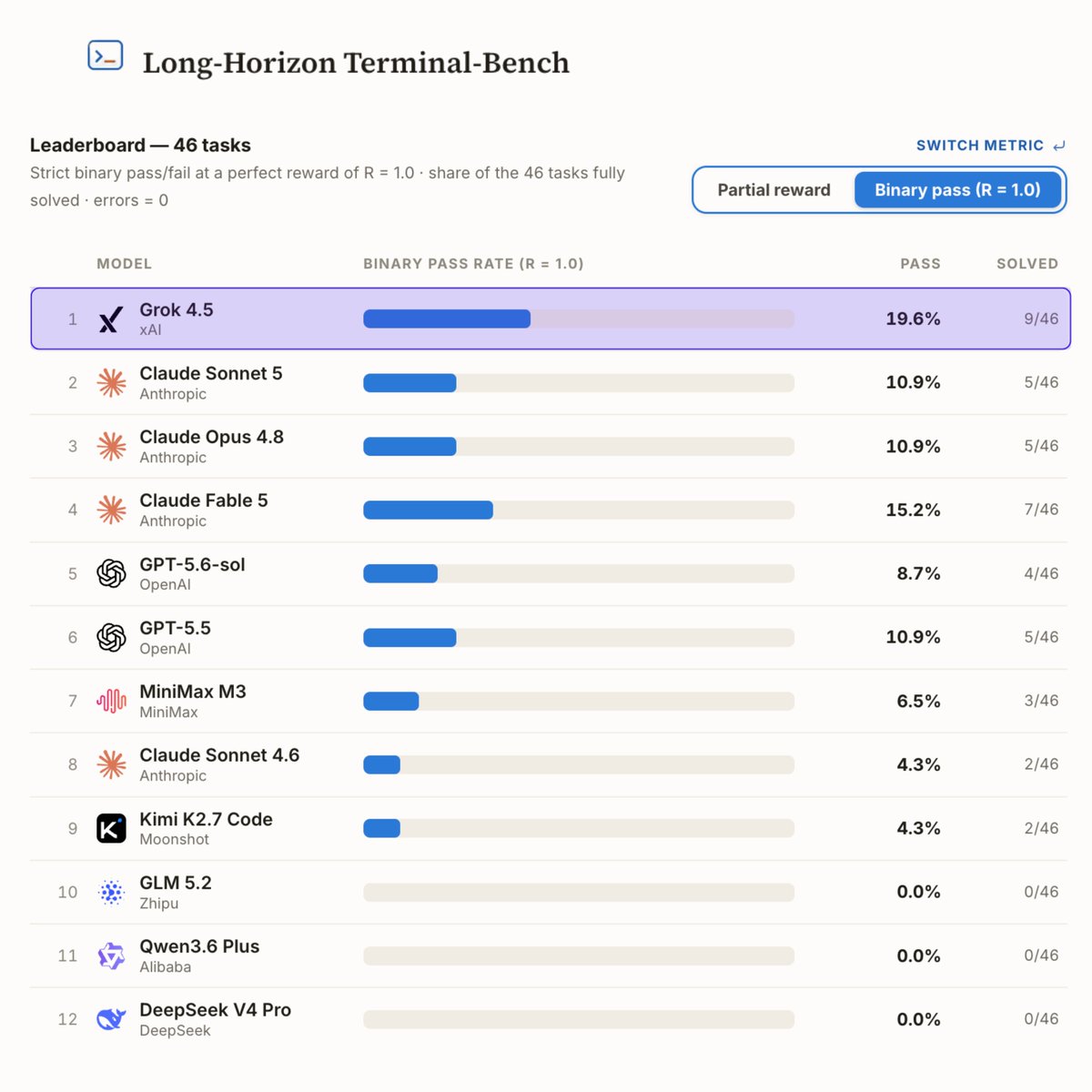
Grok 4.5 now also ranked #1 on the Long-Horizon Terminal-Bench by binary pass rate, outperforming Claude Fable 5, Claude Opus 4.8 and GPT-5.6-sol Under the strictest scoring metric - where a task counts only if it is fully solved with a perfect reward and zero errors......Grok


Moonlight @VVMotyka
76 Followers 395 Following

Synvora @synvora96
30 Followers 51 Following Creating digital worlds ✦ pixels, prompts & imagination.


Cartmanx @cartmanx404
29 Followers 47 Following Every scheme I ran got shut down by the 4th grade. Sharing what actually works. Finance | Investing |Business Psychology | Crypto Alpha

Future IRL | Tech | R... @TheFutureIRL
195 Followers 143 Following AI is leaving the screen. Tracking robots, autonomous machines, and breakthrough tech entering the real world.
Reddio 4aaaa.eth @RichardCantwel9
438 Followers 2K Following AI, hackers, and the tech that's held together with duct tape. I read the breach reports so you don't have to. Occasionally funny, allegedly.
reightS @reight_s
107 Followers 53 Following ai without the sermon | what ships, what's priced in, what's overhyped
INSIDER @x_insider4
2K Followers 351 Following I don't predict. I front-run the pattern. | Charts talk if you know how to listen | Trading since before "crypto Twitter" existed
Buffexx @buffexx
85 Followers 92 Following I won't let your wallet feel sad 💸/Keeping your wallet happy 💼📈
Norvex @norvex1029
240 Followers 189 Following Exploring AI, technology & digital markets. Sharing insights and trends.

Alena DUST @DustAlenaETH
594 Followers 621 Following Mom, crypto degen & AI creator. Building and monetizing virtual influencers.

Cybronix @0xCybronix
496 Followers 273 Following The robots are already doing the work. I show you which jobs, how much they cost, and what it means for yours. Daily drops. Humanoid labor. AI-native.


ebbb @2024e2024
0 Followers 16 Following
Jtt @jj72400331
13 Followers 241 Following


0xNevsky @nastvch
96 Followers 95 Following Where AI meets profit. I'm looking for ways to monetize using AI
Andrii @hey_AndrewUSA
231 Followers 1K Following Making sense of the AI chaos — models, tools, and what's actually worth your time. Builder mindset, skeptic's eye.
Sanjana Sarma @sanjanasarma16
7 Followers 289 Following


GenPix @0xGenpix
423 Followers 183 Following Testing frontier robots on real tasks. Showing what demos hide. Watch every deployment so you don't have to.

hitu @hitu_monke
243 Followers 173 Following researching ai workflows | prediction markets | tracking what moves before it's news

Ratlos @MuenchenLondon
32K Followers 17K Following Activist, Journalist - Fixer - here with own views - based in London and Munich
Gorgecor @gorgecor
235 Followers 4K Following
framexin @framexin
1K Followers 710 Following Faceless AI pages that hit millions of views. Breaking down the exact 2-tool workflows behind them. I can teach you how to run a Twitter account—DM me.

Framez @0xFramez
6K Followers 599 Following AI agents, systems & workflows. Turning long talks into useful guides. I help run Twitter - DM
KL @kl_kenl
77 Followers 1K Following
macintosh @macintosh_busy
190 Followers 112 Following booted in 1984. still here, still smiling. the future is going to be wonderful ✦
Diam @diamai_
399 Followers 289 Following AI is leaving the browser tab. I track agents, robots, and the weird future of work.
KeeperCF @Keeperssd
3K Followers 2K Following Creating AI-powered workflows that convert long-form content into step-by-step resources

AI Pirate @A_Pirate_I
82 Followers 63 Following Sailing the digital Grand Line where algorithms are the new gold ⚓
Rostislav @GoshaRostik
4 Followers 19 Following 🤖 Exploring the future of artificial intelligence. ⚡ Models • Tools • Automation • Startups

Atlas @Atlas_fomo
347 Followers 94 Following Carrying the weight of the chain. ⛓️ Signal over noise. Building in the dark
Moonlight @VVMotyka
76 Followers 395 Following
INSIDER @x_insider4
2K Followers 351 Following I don't predict. I front-run the pattern. | Charts talk if you know how to listen | Trading since before "crypto Twitter" existed
Synvora @synvora96
30 Followers 51 Following Creating digital worlds ✦ pixels, prompts & imagination.
reightS @reight_s
107 Followers 53 Following ai without the sermon | what ships, what's priced in, what's overhyped


Dr. Nobody Important @MinionShortage
71 Followers 288 Following Plotting world domination. Currently accepting minion applications. DMs open. Competence optional.


Promt Lab Dialy @PromtLabDialy
37 Followers 46 Following Practical AI prompts & dual-persona systems. No fluff. Only what ships results. Daily drops ↓
Alena DUST @DustAlenaETH
594 Followers 621 Following Mom, crypto degen & AI creator. Building and monetizing virtual influencers.
Maugerilin @maugerilin
117 Followers 46 Following


Ostap @0xOstap
458 Followers 176 Following predictor | defi content writer | researcher | WEB3 marketer | all my posts are paid for
Denis @Deniscrppig
193 Followers 31 Following Covering the future of AI ! Models - Tools - Automation - Business

Diego404 @0xdiego404
436 Followers 343 Following Vibe coding, writing about AI and how it's changing work Building, learning, and growing sharing the process here

A.k.a Pifagor @pifagor_dao
153 Followers 129 Following Telegram 15K Sub • Degen, Founder Marketing DAO 500 Kol's • Crypto-Shop
GenPix @0xGenpix
423 Followers 183 Following Testing frontier robots on real tasks. Showing what demos hide. Watch every deployment so you don't have to.
Prompt & Profit AI @Prompt_ProfitAI
57 Followers 71 Following
0xNevsky @nastvch
96 Followers 95 Following Where AI meets profit. I'm looking for ways to monetize using AI

hitu @hitu_monke
243 Followers 173 Following researching ai workflows | prediction markets | tracking what moves before it's news


macintosh @macintosh_busy
190 Followers 112 Following booted in 1984. still here, still smiling. the future is going to be wonderful ✦


Norvex @norvex1029
240 Followers 189 Following Exploring AI, technology & digital markets. Sharing insights and trends.

You might like