HanRead @hanreadapp
Deep Reading of Chinese texts and ideas. Culture • Language • Philosophy • History apps.apple.com/app/id67580793… Joined May 2026-
Tweets20
-
Followers3
-
Following100
-
Likes1
@DullClayCutter Another approach might be to translate the moral idea rather than the wording itself: 何为求仁? 终必死。 何不求仁? 终亦必死。
@FrDylanSchrader Many may simply remain unread outside their language communities. China alone has countless classical works containing centuries of history, philosophy, and human insight. Yet because of language barriers, even many Chinese people who want to read them struggle to do so.
@macha3142 The main issue is 从. 从 usually introduces a place (北京, 日本, etc.), not an activity like 旅行. Also, native speakers are more likely to say: 他(从曼谷)旅游回来了,rather than: 他从旅行回来了。 旅游 sounds more natural here, while 旅行 is often a bit more formal or literary.
@CheshireOcelot Once you're comfortable with the Four Books, you might enjoy trying some historical prose as well. The Zuo Zhuan is one of the great Chinese classics. It is filled with memorable characters, diplomatic maneuvering, political intrigue, and vivid historical episodes.
@SzpTKbpPk75827 I would suggest memorizing a few famous poems and classical texts. Even 10–50 would be enough initially. Most Chinese children do exactly this long before they fully understand the words. Years later, those same lines often take on entirely new meanings.
@CiaoCiaota Congratulations! The Gongyang Zhuan is a fascinating topic. I'd love to read your dissertation if it becomes available.
@macha3142 Hope this helps.


@JakabfiK Wow, it's rare to see someone mention the Zuo Zhuan here. I love the Zuo Zhuan and Classical Chinese as well. I actually just wrote a short piece on one of its passages and have been building an app to make selected Zuo Zhuan texts easier to read and explore.
@thecyrusjanssen You're being more Chinese than me — I've never been there, and I'm Chinese 😅
@Indie5051 Cool. I'd love to have a coffee there someday.
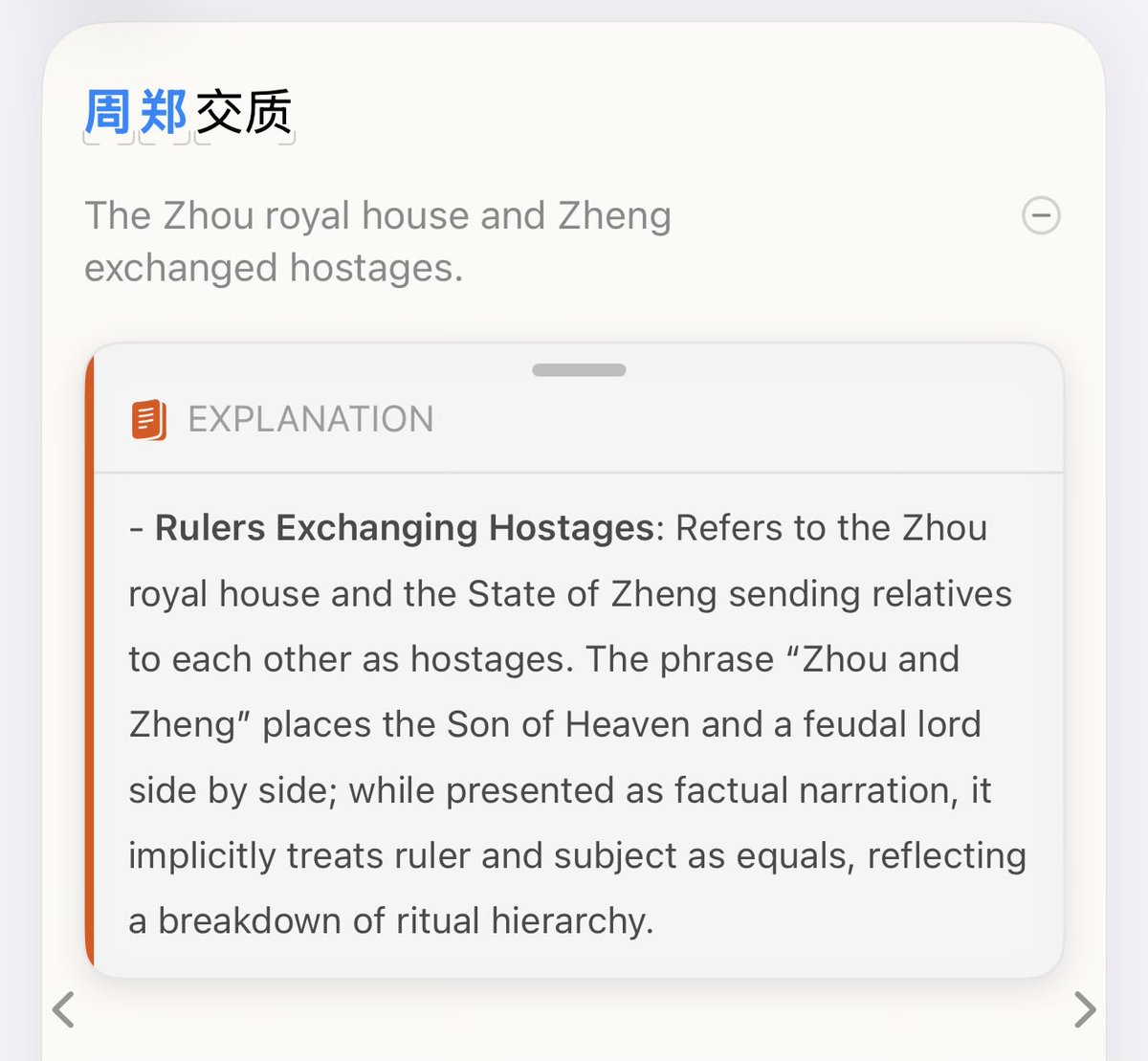
One of my favorite passages in the Zuo Zhuan consists of only four Chinese characters: 周郑交质 A political earthquake. A hidden judgment. History transformed into literature. How can four characters contain so much? Read more: hanreadapp.substack.com/p/how-four-cla…
@macha3142 I’m not sure there is a common Chinese equivalent. If anything, people often joke that they’re completely full, yet somehow still have room for soup or fruit. 😄
@RnaudBertrand @ZhaiXiang5 What's fascinating is that it almost feels like a civilization that appeared out of nowhere. The greatest mystery is that it achieved such a sophisticated level of craftsmanship, yet left behind not a single written word.
@Noctisvelt Guanyin appears in many different forms and postures, each carrying a different symbolic meaning. The relaxed “royal ease” pose seen here is often associated with Water-Moon Guanyin, emphasizing contemplation, compassion, and spiritual tranquility rather than divine authority.
@Ausproperty95 Haha, you got it. Sometimes I stay home for days without cooking or even going outside and still live comfortably. What feels surreal to me is hearing “China is 20 years ahead.” When I was a child, I always read or heard that developed countries were 20–50 years ahead of China.
@DanangAW1996 @escapefrommelos In ancient China, jade was never just decoration or wealth. It became associated with virtue, ritual order, and spirituality. People also believed jade could preserve the body and connect the human world with something beyond death.
@thecyrusjanssen Gosh, this somehow brings back a deep sense of nostalgia for my childhood. It feels like stepping back into rural China in the 1980s — a slower world that’s gradually disappearing.
@TristanGBrown Born as emperor, grew lonely, lost an empire, became a puppet ruler, a prisoner, and finally an ordinary citizen — what a surreal life. After such rises and collapses, the fact that the last emperor still landed relatively peacefully almost feels like a kind of wisdom in itself.
Ancient Chinese often compresses enormous meaning into very few characters. 《左传》 writes: “周郑交质” At first glance, it simply means: “Zhou and Zheng exchanged hostages.” But something much deeper is hidden inside the wording...

raaa | 🍃🇨🇳 @raudiala
1K Followers 798 Following Share Daily Life✨🍃 | Education enthusiast📚 | Open Private Mandarin Class🇨🇳
Josh Koehn 柯恩华 @KoehnJosh
1K Followers 6K Following 我很喜欢学语言。Me gusta aprender idiomas.( 🇧🇷🥋student)..🇨🇳Sinophile/Sinologist #mychinalibrary
Wilton Fernandes @wiltonfernande
196 Followers 54 Following Calgary Real Estate Agent ▪️Buy ▪️Sell ▪️Invest. You can reach me at (825) 365 3772. or [email protected]

Shaun O'Dwyer @shaunodwyer
2K Followers 1K Following KyushuU Prof Author "Confucianism's Prospects" SUNY Press, editor "Handbook of Confucianism in Modern Japan" AUP, editor "Confucianism at War" Routledge (2024)
くう🐭 @zwkuu
988 Followers 621 Following 中国を学ぶニホンネズミ|古典・当代中国語の音読、暗唱がすき|学習中:#文言基礎の千字文 、《孝經》、《莊子·逍遙遊》、《滕王閣序》、中国小学語文古詩詞、《西遊記》| #たまに音読 |神保町SOLIDAでの棚主アカウント → @zwnuma
Tuhin (तुहि�... @tuhintranslates
2K Followers 496 Following Poet; Translator • HIN-BEN-ENG • Translation Fellow '25 @AsiaSpeaks •Translation Grant '25 @englishpen • Editor @risking_delight • PERENNIAL @redriverpress OUT:
Agent 888 @Agent888488
2K Followers 764 Following (Nick) Religious Studies PhD candidate (Rice University), MA History of Religions (University of Chicago), MA Eastern Classics (St. John’s College)
kafur defender @kuwayfir
1K Followers 103 Following fan of 趙高 and كافور الاخشيدي | EN中文 he/him | main art account @yixique, this is my spam
DAObiLand @DaobiTreasury
719 Followers 303 Following | Chinese Classics. Rewilding native culture. Rebuilding aesthetics. | Founded in 2022

ChineseSRS @ChineseSRS
6K Followers 2 Following 📘 ChineseSRS - by learners, for learners 🧠 The complete Mandarin platform 📖 SRS • HSK Path • Graded Readings • Dictionaries. Enjoy your free trial week
李惘然 Li Wangran @liwangran
2K Followers 3K Following Live in Shanghai 🗣🇨🇳🇬🇧🇫🇷dabbling 🇪🇸🇩🇪 🇯🇵sharing my thoughts of Chinese culture, literature, art and language learning.
Patri | 文义灵 �... @StudyPolyglot
7K Followers 3K Following 🗣️:🇪🇸🇫🇷🇬🇧 català•🔜🇨🇳(HSK6) 🇯🇵(N3) ⏸️🇰🇷(A2) 🇹🇭(A1) • professional musician 🎼 & chemist👩🏻🔬#langtwt #studytwt 🌸 @dreaminglangs
Richard Simcott @SpeakinFluently
14K Followers 2K Following I kind of like languages a bit… #LangTwt
Carpe Idiom @CarpeIdiom
1K Followers 735 Following A linguist's twist on Seize the Day. Etymology | Endangered & minority languages | 量词 nerd | Mongolian | Hebrew | Basque | Polyglot 🇫🇷🇳🇱🇩🇪🇮🇹🇬🇧🇪🇸
Ian Johnson @iandenisjohnson
54K Followers 1K Following China civil society, religion, politics. 2024-25 fellow @wiko_berlin. Founder @mjdanganguan. Pulitzer for international reporting. Author three books on China.
Kaiser Kuo @KaiserKuo
103K Followers 5K Following AKA 郭怡廣. Host of the Sinica Podcast, a weekly discussion of current affairs in China. Guitarist of Chunqiu (春秋乐队 Spring & Autumn). Now at @kaiserkuo.bsky.social
Sol 솔 @Solzi_Sez
6K Followers 2K Following DIY Confucian scholarship: the Four Books (Great Learning, Analects, Book of Mengzi, Doctrine of the Mean). Head of Confucian Technologies at @Daoxue_Academy.
Jen Zhu @jenzhuscott
63K Followers 1K Following Cofounder/CEO, Power Dynamics (AIDC cooling tech + ESS BYOE 12GWh p.a. output) | Cofounder, Tech Fellowship & Moderator of Socratic seminars @AspenInstitute
Collin Studemeyer, CL... @CStudemeyer
402 Followers 306 Following A decade in insurance before going independent. Now I write about life, disability, and LTC the way the industry never will. Marathon runner.
Nikhil Jha @NIKHILLJHA
54K Followers 16 Following Hercules Advisors,Health+Life Insurance Expert DM to set up an appointment Email us on [email protected] https://t.co/WsraacPczl
Sally | 莎莉🍒 @JustCherry__
12K Followers 2K Following 华裔Born in Jakarta🇮🇩, Raised in🇸🇬🇲🇾🇮🇩, returned home to the MOTHERLAND🇨🇳🏡Happily living in China since 2018, Based in HZ #DailyLifeInChina📷 #History

Markus Samuel Haselbe... @CiaoCiaota
2K Followers 497 Following Pre-modern Chinese books @KULeuven. Ph.D. in Chinese studies. Gongyang Confucianism, revenge (復讎), and Kang Youwei. Part of @inSinology. First gen, they/them.
余裕の裕ちゃん @guchuanyu
1K Followers 209 Following 大阪大学人文学研究科・外国語学部 名誉教授:専攻は現代中国語認知文法と教育への応用 2026年度NHKラジオ講座「まいにち中国語」を担当しています
raaa | 🍃🇨🇳 @raudiala
1K Followers 798 Following Share Daily Life✨🍃 | Education enthusiast📚 | Open Private Mandarin Class🇨🇳
Dr. Luke in China @96Stats
17K Followers 5K Following Medical AI PhD. Working in China hospitals. Speak and read Mandarin/Uyghur. I explain China’s latest AI & medical papers simply. YouTube: Dr Luke in China
林松涛@語林中�... @tao1tao
15K Followers 448 Following 語林中国語教室(https://t.co/3j1mazQMKL)へようこそ! 立教大学などで非常勤、NHKラジオ講座ステップアップ中国語(2024年1月〜3月)講師。 著書『#一度読んだら絶対に忘れない中国語の教科書』『#中国語文法講義』『初心者のための あてはめるだけでどんどん話せる中国語』(#あてどん中国語)好評発売中。
Olivier F. Delasalle ... @Ofdelasalle
2K Followers 1K Following Ecrivain. Franco-Israélien. Journal quotidien sur la vie en temps de guerre. Rambam, bibliophilie et philosophie chinoise. 💬🇫🇷🇺🇸🇮🇱🇯🇵文言文
Wang @olayelee4
2K Followers 2K Following MA English | Polyglot |Sociolinguist | HSK6🇨🇳 | C1🇩🇪| ТРКИ🇷🇺
Mitch Presnick 柏力 @mitchpresnick
15K Followers 246 Following Founder of Super 8 Hotels China (速8酒店) | Harvard @FairbankCenter | Asia Society CCA | Writing on U.S.–China Economic Strategy🦉
Michael Szonyi @MichaelSzonyi
11K Followers 355 Following 宋怡明 Frank Wen-hsiung Wu Prof. of Chinese History; former Director, @FairbankCenter for Chinese Studies, Harvard Univ.; #PIPFellow @NCUSCR
James Millward 米華... @JimMillward
29K Followers 949 Following Historian of China & Central Asia and mandolinist w By & By. Work on Xinjiang, Qing, Silk Road, & stringed instruments across Eurasia.@[email protected]
Carl Minzner @CarlMinzner
22K Followers 755 Following Professor, Fordham Law School Senior Fellow, China Studies, CFR Author, End of An Era (Oxford, 2018) https://t.co/q2MwW7hPRB Opinions are my own. RT ≠ endorsement

Andy Boreham 安柏�... @AndyBxxx
186K Followers 2K Following 🇳🇿🇨🇳 Video journalist @ShanghaiDaily • Creator/host, Reports on China • Fudan M.A. • INFJ • DM open • 上海日报 • 复旦大学硕士 • 不是吹捧中国的投机者,而是讲述事实的媒体人
Richard Carroll @CheshireOcelot
2K Followers 193 Following Catholic, Southerner, bibliophile, and Reactionary.

Emily Matson, PhD @DrEmilyMatson
2K Followers 2K Following @PennUSChina fellow | @cfr_org term member | @guhistory @ElliottSchoolGW | @uva_history PhD, @Uva_EAC | 东北、历史记忆 | 普通话, español

Harvey Lederman @LedermanHarvey
7K Followers 890 Following Philosophy @nyuniversity, @UTAustin. Language, epistemology, AI, Wang Yangming.
Patrick @__PaiDaXing_
1K Followers 581 Following Self-taught student developer building https://t.co/laOpTWvrA8 for Chinese learners worldwide.
Darius Longarino 龙�... @DariusLongarino
6K Followers 3K Following Senior Fellow at Paul Tsai China Center, Yale Law School / Chinese law and civil society. he/him
jegævi @jegaevi
5K Followers 2K Following Booktwt, arttwt and studytwt I usually read litfic, classics, horror, thriller, mystery and fantasy. Currently learning Chinese - HSK2 🌱 🐥 25 - she/her 🌷
純工藤🌾在学�... @Junsan_team
10K Followers 4K Following 日本人🇯🇵/HSK5/中国語検定3級/実用中国語技能検定3級/偽中国語検定準1級/微信表情包三团yyds/私信不回/INFP-A/头像是本人/永远的17岁
Mischa Wilmers @MischaWilmers
2K Followers 590 Following Mandarin coach, polemicist & founder of I'm Learning Mandarin | Speak 🇬🇧🇪🇸🇨🇳 Future: Euskera
Polyglot Journey (Mig... @PolyglotZone
1K Followers 2K Following Learning and maintaining Spanish, Russian, Mandarin Chinese and Japanese with some dabbling in others
Chunyu 春雨 @Chunyu_China
103K Followers 10K Following Chinese media professionals tell China's stories.
Siefollah aslani @SiefiAslani
525 Followers 7K Following Founder of QashqAI Voice | Ethical AI for Endangered Languages | Cultural AI Governance | Bremen, Germany
Lindie Botes ✦ 린�... @lindiebee
32K Followers 2K Following 🩷 Language Coach ✶ Product Designer ✶ TCK 🎥 Youtube: Lindie Botes ✨ EN•AFR•한국어•日本語•HU•FR•ES•中文
Andrew Seth Meyer @AndrewSethMeyer
672 Followers 683 Following I am a Professor of History at Brooklyn College specializing in the history of early China. https://t.co/wSDOmJZs22
Josh Koehn 柯恩华 @KoehnJosh
1K Followers 6K Following 我很喜欢学语言。Me gusta aprender idiomas.( 🇧🇷🥋student)..🇨🇳Sinophile/Sinologist #mychinalibraryTrends for United States
You might like