rewix @rewixlab
dms are open Joined August 2026-
Tweets19
-
Followers19
-
Following28
-
Likes68
A man had just sold his company for over a billion dollars. Instead of retiring, he flew to Moscow, three times, to buy a nuclear missile. When the Russians wouldn't sell him one, he decided to build his own rockets from scratch. and the whole plan is sitting in a free talk almost nobody has watched His name is Elon Musk. This was 2003, years before Tesla, before he was famous, before he was the richest man on Earth. He stood in front of a small room and calmly laid out how he was going to do the impossible. The people listening had no idea who they were looking at He had done it twice already. His first company, Zip2, sold to Compaq for a little over three hundred million dollars in cash, which he described as "a currency I highly recommend." Then came PayPal The lesson from PayPal is one most founders still get backwards. The feature they sweated over for months, combining all your banking in one place, made people shrug. The feature that took a single day, letting you email money to anyone, made people say wow. So they bet the whole company on the one that took a day. It grew like bacteria in a Petri dish. A million customers by the end of year two, with no sales force, no head of marketing, and zero dollars spent on advertising. eBay bought it for one and a half billion Most people would have stopped there. He didn't take a day off He started asking why humanity had gone nowhere since Apollo, why we could no longer even put a person in orbit while every other technology exploded forward. So he went looking for a cheap rocket. The cheapest ones were Russian, which is how a software guy from Silicon Valley ended up in Moscow negotiating for a decommissioned intercontinental ballistic missile "It's actually pretty interesting going to Moscow to negotiate for a refurbished ICBM" The deal fell through. On the flight home he did the math and decided America could build a rocket far cheaper than anyone was charging. So he did. SpaceX aimed to fly for six million dollars against a competitor charging twenty-five, and built it faster than any launch vehicle in history, including wartime The part nobody mentions is how ordinary his method sounds. A small team of very talented people. Best idea wins, not the loudest person. Obsess over the product, ignore the sales gimmicks. When two paths look equal, pick one and move instead of arguing forever. That was it. That was the whole machine The talk is still free, still online. Almost nobody has watched an unknown man explain, years before he did any of it, exactly how he was going to reach orbit and everyone in the room quietly doubt him
You sit down to do the one thing you promised yourself you would do. Within minutes you want a snack, a cigarette, to clean under the bed, to check your phone, anything but the task. A professor stood in front of a room of students and explained why, and the reason is darker than laziness. and he gave the whole thing away in a free lecture His name is Jordan Peterson, a clinical psychologist who spent decades studying why people cannot do the very thing they say they want to do He starts with something you already know but never say out loud. Your attention is not fully yours. It is steered by forces under the surface you never agreed to. You sit down to read, and a dozen little subsystems that want something else, food, rest, distraction, start popping up one at a time, each trying to grab the wheel You try to push through. The voice only gets louder. This course is stupid. Why am I reading this. What am I even doing with my life. You can build an entire existential crisis in ten minutes, as long as it means not doing the work Then he says the part that lands like a slap "You're a mess. You haven't got control over yourself at all" He is not being cruel. He is being precise. The "you" that made the plan is not the same "you" that shows up to break it Here is the mechanism nobody wants to hear. Every habit you have ever practiced, good or bad, gets wired in and automated until it runs without you. The filler words when you talk. The phone already in your hand. You built that little machine right into your being, and once it is built, wanting to stop is not enough. It is neurological. It runs whether you approve or not At the extreme it looks like OCD or Tourette's, people gripped by impulses they cannot block. You feel the same thing in miniature every time you text someone at 2am that you know you shouldn't, and cannot stop your own thumbs. Autonomous forces, he says, that grip your behavior and make you do things "The less integrated you are, the less you're in control of them, and the more they're in control of you" That line is the whole game. You do not have a discipline problem. You have an integration problem. The parts of you are pulling in different directions, and the loudest one wins The lecture is free. Almost nobody sits with the uncomfortable part: the enemy of the thing you want is not the world out there. It is the other people living inside you
One of the richest men in America said he refused to compete with a group of immigrant motel owners. Not because he couldn't afford to. Because he knew, flat out, that he would lose. and he explained the whole thing for free His name is Charlie Munger. For decades he was Warren Buffett's partner and the vice chairman of Berkshire Hathaway. When he talked about how money is actually made, people recorded it and passed it around like contraband He pointed at the Patels, the Indian families who quietly bought up the motels across America. They live in the motel. They know more about that one building than any outside investor ever will. They pay almost nothing in taxes, and every dime that comes in goes straight back into fixing the place up and buying the next one "You want to compete with the Patels?" he asked. "Not I" The part nobody wants to hear is why. In real estate, the good deal never reaches you. By the time you are a young person looking for an opportunity, the best offerings have already been shown to the big investors the brokers actually deal with. You never even see them. You are bidding on the scraps other people already passed on That is most of the real world. The insider sees the deal first. The specialist knows the street better than you ever will. You show up late, to a game that was decided before you walked in Then he said the thing that changes how you look at the market "Whereas stocks, you're equal with everybody if you're smart" That is the whole point. The stock market is the one arena where a nobody with no connections gets the same price, the same filing, the same information as the giant across the table. No broker hides the good one from you. It is the last level playing field Munger died in 2023, just short of a hundred years old. He gave this lesson away for free his entire life. Almost nobody hears the part where he tells you which game you can actually win
@0x_fokki what an incredible story, that girl is truly amazing
A billionaire studied five hundred years of history and found the same pattern behind the death of every empire. He says the United States is deep inside it right now. and he explained the whole thing on a stage, for free His name is Ray Dalio. He built Bridgewater Associates into the largest hedge fund in the world, then stood in front of a room and gave away the framework he used to see it coming. No course. No pitch. He said he would rather teach you to fish than hand you the fish He became obsessed with one question. Why does the world's money keep changing hands? It used to be the Dutch guilder. Then the British pound. Then the US dollar. Every time, the same arc A country invents a new technology. It uses that to dominate world trade. It builds a military to protect the trade. Its money becomes the currency the whole planet saves in. Then, slowly, it declines and hands the crown to whoever is rising next The Dutch built ships that could sail anywhere on Earth, bolted guns onto them, and ended up running half of all world trade. Their money became the world's money. Then it wasn't The part nobody wants to hear is where he places America. Late in the cycle. The seventh inning. A rising power in the East challenging an aging power in the West, the exact setup he sees in the 1930s. Debt maxed out, interest rates crushed to zero, money printed, and a population splitting into anger on the left and anger on the right He even put a number on that anger. Forty percent of Americans could not cover a four hundred dollar emergency. The richest one tenth of one percent now hold almost as much wealth as the bottom ninety percent combined "If you look at history, what caused countries to succeed and fail was particularly led by technology" That is the engine underneath all of it. The same force that lifts an empire is the one that quietly replaces it He gave the entire map away for free. Almost nobody studies the one part that tells you where we are standing on it
@shiqway92 the new Grok is seriously crazy, i've already checked it out myself
A man turned five dollars into fifty in two months. It wasn't insider information. The whole trade was printed on the front page of the newspaper, in plain English, and almost nobody acted on it. and the man who wrote the method down had already given it away for free His name is Joel Greenblatt. He ran a fund called Gotham Capital that compounded at around 40 percent a year for two decades, one of the greatest runs in the history of Wall Street. Then he walked into a classroom at Columbia and taught the entire thing to a room of students for nothing His specialty was spinoffs. When a big company breaks off a piece of itself, the people holding the stock are often forced to dump the new piece the day they get it, whether the price makes sense or not. Whoever stands on the other side of that forced selling gets rich In 1992 Sears announced it was tearing itself apart, cutting loose Allstate and Dean Witter. It was front page news for months. Greenblatt does spinoffs for a living, and he admits he missed the announcement. Then missed it again. Five separate times Then a famous investor named Michael Price laid out the entire math in Barron's over a holiday weekend, for anyone with a few dollars to read Greenblatt read it. He worked out that he was effectively paying five dollars for a piece of Sears he believed was worth fifty. He bought all he could. Two months later it was at thirty. Eventually it hit fifty The uncomfortable part is that none of it was hidden. It ran in the Wall Street Journal. It ran in Barron's. Every hedge fund on Earth could see it. They skipped it because it looked messy, and messy was exactly where the money was "You don't even have to be smart" That is the actual line he gave the class. He meant it. The edge was never a secret. It was the patience to read the boring pages everyone else flipped past. The method is in a twenty dollar book. Acting on what is already sitting in plain sight is the part almost nobody can do
Casinos drugged his drink, cut the brakes on his car, and held a meeting about breaking his knees. All because one math teacher refused to lose. and the worst part, he had already given his secret away for free. His name is Ed Thorp. In 1961 he walked into Vegas with a $10,000 bankroll and a system, and walked out having doubled it in 20 hours of play. Adjusted for inflation that room was worth closer to a $90,000 win. He wasn't lucky. He had proven, on paper, that blackjack could be beaten. Then he did the thing casinos never forgave. He published it. "Beat the Dealer" hit the New York Times bestseller list and tens of thousands of people showed up to the tables counting cards. On April Fool's Day 1964 the Nevada Resort Association panicked and changed the rules of blackjack overnight. Ordinary players revolted. Business collapsed. They quietly changed them back within weeks. The part nobody talks about surfaced 30 years later, when one man at that meeting finally wrote it up in a Las Vegas paper. One of the proposals on the table for dealing with Thorp was to break his knees. Or worse. Cooler heads decided a dead professor draws more heat than a rule change. He beat blackjack. Then baccarat, until they drugged his drinks and barred him. Then on a downhill road in Arizona his accelerator locked to the floor at 80 miles an hour. A mechanic later said it had been tampered with. They spent years trying to stop him. He never seemed to care about the money at all. "You can have enough. And it is better than not having enough." He survived all of it and walked into finance, where the same edge was sitting in plain sight and nobody was shooting. The book is under twenty dollars. The willingness to publish your edge and let the world try to kill you is the rarer thing.
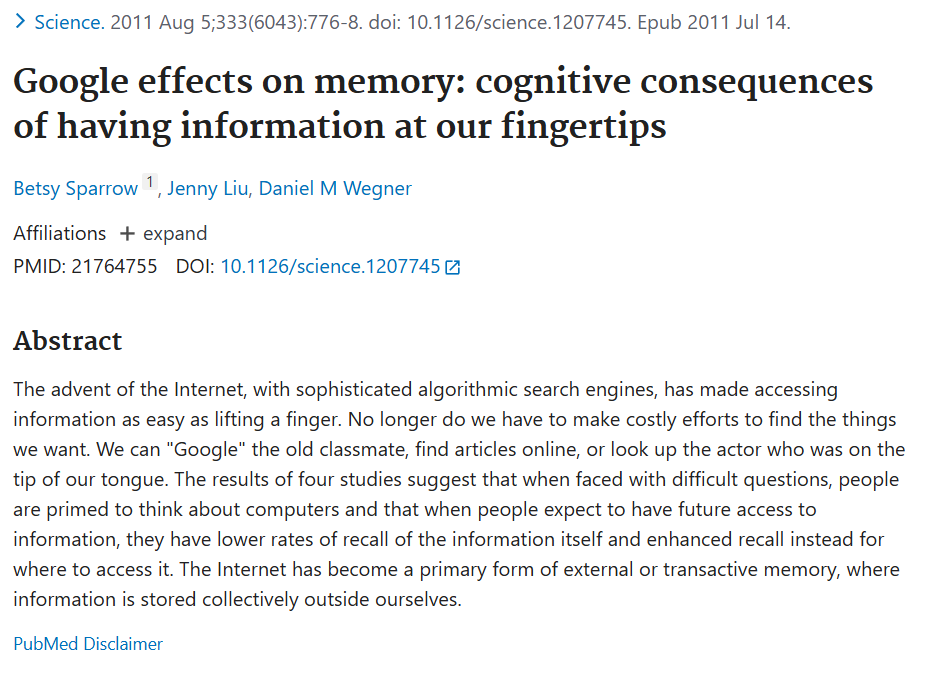
Nicholas Carr described your AI habit in 2010, before AI habits existed. You ask the model before you try to recall anything. It feels efficient. It is quietly training what your memory bothers to hold onto. The mechanism, from Sparrow, Liu and Wegner's 2011 Science study: Hard question -> primes you to think "I'll just look it up" Expect future access -> memory shifts from content to location You stop storing the fact You start storing the address Four experiments, one clean effect, replicated since: knowing you can look something up later measurably lowers how much you retain right now. That part holds. Carr goes further in the book. He cites Gary Small's UCLA scan - 24 people, ages 55 to 76, 12 experienced searchers versus 12 novices - as proof the internet is "rewiring" your brain. The design can't carry that claim. No before/after, no causation, just two already-different groups scanned once. It shows a correlation between experience and activation, not the internet reshaping anyone. Offloading is real. Rewiring, as a causal story, is a metaphor wearing a lab coat. Been running my own version since I started keeping a chat window open 10+ hours a day. One week, forced a 10-second recall attempt before typing any question. Worked, just not how I expected - recall rate stayed around 30%, but that 30% didn't fade for weeks after. A 2011 psychology paper explains more about your AI habit than most 2026 threads on "AI and attention" do. Before the next question to a model: ten seconds of trying first. Not because you'll remember. Because that's the only training your memory still gets. Worth running for a week
@Nezukoa4 it's just like in the movie "The Wolf of Wall Street", unbelievable
@francescoinweb3 i agree. Kalshi is much more interesting than its competitors
@Damir_Akaza that's a really cool idea, i think i would have done the same thing if i'd been a crane operator
MIT wired 54 brains to EEG for four months. The ChatGPT group's connectivity was the weakest, every time Ever shipped a fix with AI, then couldn't explain your own logic five minutes later? That's the effect, measured Design: 54 participants, 3 sessions each. Three conditions: no tools, search engine, GPT-4o. Full EEG. 18 came back for a 4th session where the assignment flipped No tools -> Search engine -> GPT-4o No tools: strongest, most distributed connectivity Search engine: moderate, a clean middle tier GPT-4o: weakest of the three - and it didn't reset Switched back to writing unaided in session 4, alpha/beta connectivity stayed low GPT group also had the lowest sense of ownership over their own essays, and struggled to quote lines they'd written minutes earlier. Small sample, ChatGPT-specific, not yet peer reviewed - the authors say so themselves The ownership drop is the one worth worrying about. Losing your train of thought costs more than losing time Next AI-assisted ticket you close: spend two minutes writing the summary yourself before moving on Makes "AI as your second brain" takes look premature. Read the abstract, decide for yourself


Deniss @learnodd
106 Followers 247 Following ai workflows | prediction markets | spotting moves before they trend
velora @veloraaivs
912 Followers 180 Following Before the future becomes obvious. AI • Startups • Innovation
sasheoka @sasheoka88
6K Followers 845 Following
promptix @promptixAI
654 Followers 242 Following Finding signals before they become trends. AI • Startups • Internet

seeco @seeconvm
960 Followers 226 Following trading data, not emotions crypto × ai × polymarket open for collabs

Oracul @0xOracul
396 Followers 100 Following Following AI before the consensus catches up. Research, experiments, and sharp notes.
kerazcity @0xkerazcity
415 Followers 144 Following AI engineer | Trends expert Sharing interesting things. Open to collaboration

Oleg Bernatskyi @oleh_bernatskyi
104 Followers 135 Following Building @Cryppush | Founder Digital iT Advisor | Crypto, Trading Bots, Web3 & AI | Phuket-based, globally focused | Sharing insights, creating impact
nexora @nexoraAIxt
213 Followers 144 Following Finding the ideas that build tomorrow. AI • Startups • Innovation


KimK1ng | Crypto & AI @KimiDYOR
3K Followers 2K Following 🧠 In crypto since 2020 | 2y blockchain dev 💻 Full-stack Python developer 📈 Here to show how to earn in crypto — without spending a cent
broke boy @0xfuckpoverty
255 Followers 122 Following I find the AI lectures everyone will quote next month. Agents, models, inference & AI startups.

Deniss @learnodd
106 Followers 247 Following ai workflows | prediction markets | spotting moves before they trend
velora @veloraaivs
912 Followers 180 Following Before the future becomes obvious. AI • Startups • Innovation
promptix @promptixAI
654 Followers 242 Following Finding signals before they become trends. AI • Startups • Internet
seeco @seeconvm
960 Followers 226 Following trading data, not emotions crypto × ai × polymarket open for collabs
Oleg Bernatskyi @oleh_bernatskyi
104 Followers 135 Following Building @Cryppush | Founder Digital iT Advisor | Crypto, Trading Bots, Web3 & AI | Phuket-based, globally focused | Sharing insights, creating impact
Oracul @0xOracul
396 Followers 100 Following Following AI before the consensus catches up. Research, experiments, and sharp notes.
nexora @nexoraAIxt
213 Followers 144 Following Finding the ideas that build tomorrow. AI • Startups • Innovation
KimK1ng | Crypto & AI @KimiDYOR
3K Followers 2K Following 🧠 In crypto since 2020 | 2y blockchain dev 💻 Full-stack Python developer 📈 Here to show how to earn in crypto — without spending a cent

wandermist @wandermist
2K Followers 127 Following choose life. choose your future. honest thoughts & vibes
0xNevsky @0xNevsky
207 Followers 146 Following Where AI meets profit. I'm looking for ways to monetize using AI

Rossst.03 @Rossst_03
5K Followers 229 Following Where prediction markets meet AI. I hunt mispriced odds on Polymarket. @zscdao member

broke boy @0xfuckpoverty
255 Followers 122 Following I find the AI lectures everyone will quote next month. Agents, models, inference & AI startups.
James Clear @JamesClear
1.4M Followers 1 Following Author of the #1 NYT bestseller Atomic Habits (https://t.co/aWrO9DWkH5). I write about building good habits. Over 3 million people read my 3-2-1 newsletter.
Bryan Johnson @bryan_johnson
2.0M Followers 668 Following Conquering death will be humanity’s greatest achievement.
David Sinclair @davidasinclair
652K Followers 1K Following Professor researching why we age & how to reverse it. Author & host of Lifespan. Mission: Extend healthy life for all. Views are entirely his own. @joinlifespan
Andrew D. Huberman, P... @hubermanlab
1.9M Followers 2K Following Professor of Neurobiology and Ophthalmology at Stanford Medicine • Host of Huberman Lab • Focused on science and health research and public educationTrends for United States
You might like